Review: Shadow of a Doubt (1943)

Teresa_Wright_and_Joseph_Cotten_in_Shadow_of_a_Doubt_trailerIt is well documented that Shadow of a Doubt was Hitchcock’s personal favorite of his own films. That’s quite a telling statement when you do a quick scroll through some of the titles up for contention. Vertigo, Psycho, Rear Window, North by Northwest, Notorious, even The Birds. And yet the famed “Master of Suspense” chose the often glossed over Shadow of a Doubt.  If we take a slightly closer look it makes a great deal of sense as the film follows through with one of Hitch’s most prominent credos, “There is no terror in the bang, only in the anticipation of it.”

That’s, in fact, a great deal of what Shadow of a Doubt is. It’s the cringe-inducing anticipation for what is bound to happen. The inevitable that is plain as day, except not everyone sees it so clearly. But that’s enough ambiguity.

The story opens in a depressed urban city with Charles Oakley (Joseph Cotten) laid out pensively on his bed. Dollar bills are scattered haphazardly across his floor. Soon he learns two men want to talk with him, and he’s not about to get acquainted so he gives them the slip and heads to the one decent place he can think of. Santa Rosa, California, the peaceful abode of his older sister Emma and her family.

What we learn over time is that Charlie is known at large as the “Merry Widow Murderer,” because he has strangled three such women and taken their valuables. Hitchcock playfully alludes to the fact by opening his film with the “Merry Widow Waltz” and it will pop up throughout the entire story if you’re paying attention.

shadow-of-a-doubt-trainHis train comes barreling towards town with smoke spewing ominously. For now, his oblivious family is just happy to see his face, especially his oldest niece and namesake Charlie (Teresa Wright) who is ecstatic to have something to shake the family out of their funk of normalcy. At this point, there is little to be uneasy about, because Uncle Charlie is not about to do anything rash, but there are a few moments where he gets uneasy. Covering up a paper headline and doing his best to avoid two men taking photos for a national survey. Charlie doesn’t think much of it at first, and it feels just like old times with uncle giving gifts and receiving the royal treatment.
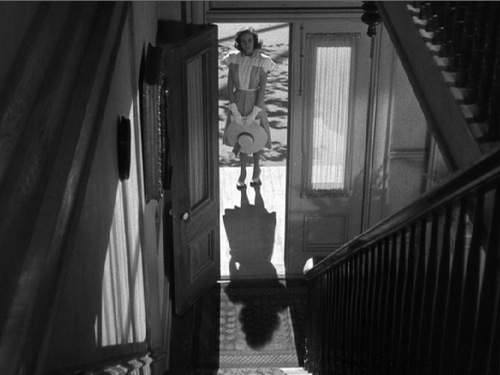
Except the ring he presents to Charlie is plundered jewelry with a mysterious pair of initials engraved on it. Of course, the men interviewing the Newton household are actually trailing Uncle Charlie, and Detective Graham fills Charlie in while also becoming fond of her. But it’s not the kind of news she’s willing to accept. How can she? It’s a late night visit to the local library that finally confirms all her deepest fears. Soon, the telltale signs become more apparent to the audacious girl, and Charlie simultaneously notices the changes in her as well.

This is where the film becomes fidget-inducing because it’s out in the open. Uncle Charlie knows that she knows, and still he remains in their home, in quiet little Santa Rosa, as if nothing has changed. For most of the family, nothing has, but Charlie’s demeanor is completely different. She just wants her uncle gone, away from her family, and then there’s the impending threat that her own life might be in danger. In truth, Uncle Charlie doesn’t want her around, even though it looks like he might get off scotch free.  His mind is already so twisted — so far gone — that he coolly attempts to get rid of Charlie, right under the very noses of their family.

It turns into a psychological mind game between uncle and niece, Charlie vs. Charlie. There’s no detective to save her now because he’s already left town and there’s no other direction to turn. She finally does succeed in getting dear uncle to leave town, and it looks like the living suburban nightmare is coming to a close. Then, in a final instant on the outbound train, Hitchcock’s lets off a BANG! The film’s culmination arrives and is just as quickly passed over. It’s done just like that, but it’s not really what was important. All that nerve-wracking build-up — the meat and potatoes of the drama was what was paramount.

Thus, Hitchcock delivers us a shocking nightmare of a film. It’s not anything like Psycho, existing in a far more mundane world. But Shadow of the Doubt brazenly suggests that murder can reach us even in our homes, even in the places that feel the safest. Hitch exhibits his wicked sense of humor with two characters who love to talk murder in Mr. Newton (Henry Travers) and the next door neighbor Herb (Hume Cronyn). They obsess over crime fiction and discussing ways to get away with murder. Little do they know that the man in their midst is trying to do just that.

Teresa Wright is certainly one of my favorite actresses and her role as Charlie is one of her bests highlighting her cordial charm, while also revealing her adeptness in the role of a tortured heroine. We want her to succeed more than anything, and as an audience, we worry for her well-being the entire film. Meanwhile, Joseph Cotten generally plays laconic types, but still, they usually have more goodness than baseness in their souls. Uncle Charlie is a fine role for him because he’s so sweetly cunning and at the same time sadistically twisted.

Shadow of a Doubt pic 3Unfortunately, the role of Detective Saunders feels rather shallow, but that’s hardly something to get stuck on. If that were the case, we could easily point to Charlie’s parents who seem way too old. But they are perfectly average, ordinary folks, as played by Henry Travers and Patricia Collinge. The script work of the preeminent Thorton Wilder (Our Town) and the on-location shooting in the Everytown of  Santa Rosa lend a universality to this thriller’s impending dread.
Dimitri Tiomkin heightens the film with his usually stirring, pulse-pounding approach to scoring. Hitchcock’s camera, while in black and white, is nevertheless noticeably dynamic. He always emphasizes the necessary focal points, and extreme close-ups and high angles only accentuate the drama. His use of the stairwells in the house is absolutely marvelous, implying both distance and foreboding in numerous shots. For every shot that Cotten looks menacing, there is an equal number highlighting the pure innocence of Wright. It’s the perfect juxtaposition of character, in a film that is really only your typical see-sawing struggle of good versus evil. Except it takes place in our own backyards.

5/5 Stars

4 “Good Girls” of Film Noir

I do not particularly care for the term “Good Girl,” because it feels rather condescending toward the guardian angels of film-noir. In fact, on closer research, I’m not even sure if it’s a widely accepted term. However, they are the ones in stark juxtaposition to the femme fatales, acting as the beacons of light leading their men away from the path of destruction. As such, their roles should certainly not be discounted and here are four such women from four classic film-noir.

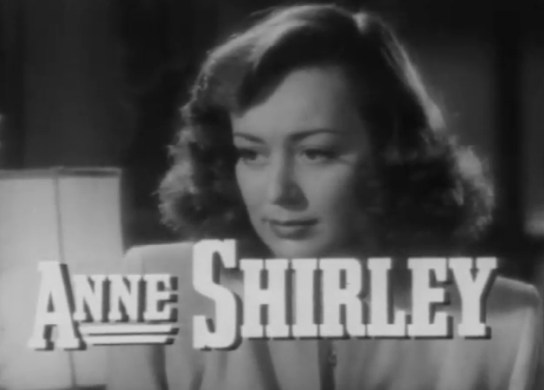
1. Anne Shirley in Murder, My Sweet (1944)

Taking her stage name from the plucky heroine out of E.L Montgomery’s perennial classic, Anne Shirley’s Ann Grayle is the one character of high moral standing in a film clogged with all sorts of undesirables. Even our protagonists Phillip Marlowe (Dick Powell) is cynical as all get out and Grayle’s seductive stepmother (Claire Trevor) cares more about her jewelry than her marriage.

AnneShirleyMurderMySweetTrailerScreenshot1955.jpg

2.Jeanne Crain in Leave Her to Heaven (1945)

Leave Her to Heaven is noteworthy for several reasons. First, it is an obvious example of noir that is atypically shot in color. Furthermore, Gene Tierney gives the most chilling performance of her career as Ellen Harland. However, Tierney’s turn would not be so deathly icy if it were not for Jeanne Crain’s angelic role as her sister Ruth. The polarity of the roles, Ellen’s conniving smile, crossed with her sister’s utter sincerity makes the film work far more evocatively.

JeanneCrainLeaveHerToHeavenTrailerScreenshot1945.jpg

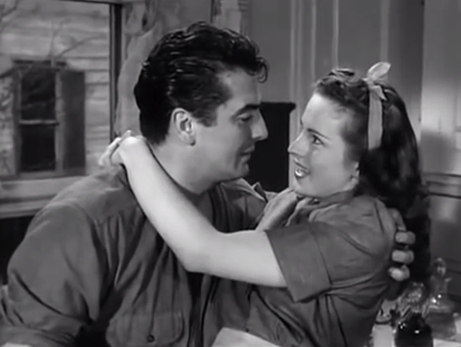
3.Coleen Gray in Kiss of Death (1947)

Of all the “Guardian Angels” the late great Coleen Gray (who passed away last year) was perhaps the sweetest, kindest, most precious example you could ever conjure up. Her role as the faithful Nettie, tugs at our heartstrings. Though she doesn’t have a femme fatale counterpoint, the crazed Tommy Udo (Richard Widmark) more than fits the bill.

kissof1

4.Marsha Hunt in Raw Deal (1948)

Anthony Mann’s Raw Deal is a film that revolves around a man (Dennis O’Keefe) incarcerated in prison with a girl (Claire Trevor) on the outside ready to help him get out any way she can. But it’s the social worker Ann, who we first gravitate towards because she is the righteous one trying earnestly to reform Joe. It is his evolving character, after all, that is at the core of this one.

4a2f4-rawdeal1

Review: Red River (1948)

redriver1Any conversation on quintessential American Westerns certainly has to at least consider Red River. It has genre mainstay John Wayne in one of his most stirring performances, a moody precursor to The Searchers. It boasts the debut of the often criminally under-appreciated method actor Monty Clift. Moreover, it’s cinematic space is filled out by a colorful array of prominent Western stock players. You have the always ornery Walter Brennan, pudgy Noah Beery Jr., Harey Carey Jr., Hank Worden, and numerous others. For a second you can even forget that this isn’t a John Ford film, but instead, the story is placed in the ever-adept hands of Howard Hawks, who knows how to craft compelling stories no matter the genre he’s working in.

In 1851, before Tom Dunson (Wayne) settles on a new plot of land near the Rio Grande and begins to raise his cattle with the brand of the Red River D, he loses the love of his life to an Indian raid, while also picking up an orphaned boy in the aftermath. That young man, Matt Garth (Clift), would become like Dunson’s adopted son and his right-hand man when it comes to running his ranch. The rest of Red River is essentially a road film that chronicles the first cattle drive along the Chisolm Trail. It’s bound to be a gritty, sweaty, and undoubtedly smelly road ahead as Wayne and Clift take the reins on this journey. The intrigue comes with power dynamics because when you put two or more people in a confined space sparks are bound to fly at some point.

redriver2When Dunson begins the massive journey to sell his cattle in Missouri, many wranglers sign on for prospects ahead, but they don’t quite know the degree of hardship that they will face. Soon enough, a stampede leaves one man dead and the company without one of their chuck wagons of provisions. Dunson is a hard taskmaster, who expects his hired hands to finish their job. Morale in the band begins to sink from lack of food and fierce downpours that leave most everyone dejected and distraught.

Then, when Dunson prepares to hang two deserters to make an example out of them, Matt must finally step in. He’s always the subservient one, always backing Dunson with his gun, but for the first time in his life, he crosses the will of his mentor. All the wranglers are quick to continue the journey as they change course for Abilene Kansans and the prospect of the railroad. But Garth leaves a brooding Dunson behind, vowing to kill Matt if it’s the last thing he does. It’s this act of the story which brings to mind the Biblical vendetta of Esau as he pursues his kin for stealing his birthright.

red river 6Garth and his contingent do end up getting to Abilene and are met with open arms by the kindly Mr. Melville, however, perhaps, more importantly, Matt falls in love with a fiery beauty (Joanne Dru) and must leave her behind. Days later Tess Millay also meets Tom Dunson, the man she has heard so much about, and he’s far from being dissuaded from his mission.

Thus, the expected showdown comes with Dunson riding into town with his hired guns, the alarm being sounded, and Garth waiting for him. Dunson draws and Garth will not. It’s a fitting moment, but Howard Hawks develops it in a fabulous way. He fills it with tension and ultimately a hint of humor. The addition of Joanne Dru shifts the power dynamic and she says what everyone else is thinking while angrily packing a pistol.

redriver4Because if Red River was story alone, it would not be the preeminent Western that it is, and I think I made that mistake before. Hawks is a master at using all his actors to perfection in not simply the climactic moments, but also the lulls. With such a substantial ensemble, even the way he positions all his players in the scene holds importance. His scenes are continually interesting from talk of Walter Brennan’s false teeth to complaints about the abysmal quality of the coffee.

My only qualm with the film is the rather shoddy transitions, and so I am interested in getting a look at the theatrical cut with narration from Brennan. John Ford famously quipped that he never knew that Wayne could act until this film, and it’s true that he gives a darkly vengeful performance. But in many ways, Clift proves himself as a worthy co-star. There’s always a tightness, a lilt to his voice, that signals an earnestness and vulnerability. It starts coming out in this film right when he knows that he’s no longer going to follow Dunson. It took two starkly different actors to make the narrative work as well as it did, and Hawks added yet another classic to his catalog. On a side note, the music of Dimitri Tiomkin was noticeable, because the refrains can be heard verbatim in Rio Bravo. If something’s good why change it, right?

4.5/5 Stars

Finding Dory (2016)

Finding_Dory.jpgI heard it from the fish’s mouth that the main question behind this film began to gnaw away at Andrew Stanton relatively soon after the release of his first effort Finding Nemo. The question of, Where are Dory’s parents? Nemo found his father. They got their happy ending. But what about the hapless Dory, always trusting, forever faithful and also hopelessly lost. There’s a story buried there somewhere.

Out of a character who exudes so much joy and positivity, there’s definitely the potential for a lot of heartbreaking moments and this film has those no doubt. After all, Dory (Ellen Degeneres) is a fish who we all know has short-term memory loss and so-called psychological issues often lead to moments of great emotional turmoil, even in fish. This story does have some of those heart-wrenching moments, but it’s also a film of discovery, building off what we already know and love about these characters and reinforcing them in a number of ways.

New and old acquaintances are brought back to the fore namely Crush, Mr. Ray and of course Marlin and Nemo. New castmates including Ed O’Neill, Ty Burell, and Kaitlin Olson entertain us with their own ticks and foibles including faulty echolocation and nearsightedness, reflecting just how much Dory is not alone. Then there are a couple downright oddballs in the dippy sea lion Gerald and a certifiably insane loon Becky, who nevertheless prove their own individual worth.

But it’s the ornery octopus (or septapus) Hank who is the key to much of the plot because it is thanks to his agility and camouflage alone that Dory is able to navigate the Jewel of Morro Bay’s Marine Life Institute with any sort of success. She is, after all, a fish and a fish out of water is far from a good thing.

Still, this film certainly pushes the envelope as far as human-fish interaction. If the fish seemed anthropomorphized before, just wait. Without too many spoilers it gets even more pronounced this time around involving a big rig on the freeway among other shenanigans.  Enough said. It’s a more constrained film, set in and around an aquarium, but the Pixar animators show an adeptness for moving around this world in new dynamic ways with relative ease.

But there’s also a flipside to this. As the voice of God, Sigourney Weaver, so aptly reminds us, “rescue, rehabilitate, release.” That’s the name of the game. Still, it seems like sea life has never been more encroached upon, more endangered or monetized. This negative impact is seen implicitly throughout the film, but it’s never more haunting than the moments when Dory is seen wrapped up in six-pack rings. Being the bright and bushy-tailed tang that she is, no comment is made about it. But in the back of our mind’s we cannot help think about what that image represents. She gets put into captivity for this precise reason, but she wouldn’t have to be removed from her home in the first place if it wasn’t for our own ineptitude as humans.

It’s hard to put a finger on it exactly but there’s also something slightly off about Finding Dory‘s pacing. Perhaps it even has to do with the stakes of this film. It’s not truly driven by some high conflict. Yes, we know Dory needs to find her parents, but there’s something in us that realizes she already has a type of family, Marlin, and Nemo. This idea is explored a little bit while at the same time Dory tries to find her birth parents. But it’s admittedly hard to top a 13-year-old classic and I laud Finding Dory for not trying to do that. Instead, it shows a continued appreciation and care for its characters, in this case, Dory. If Finding Nemo was this rollicking, rip-roaring adventure at sea, then its sequel can best be described as a well-wrought character study. And when that character is such a well-meaning personality as Dory, that’s not a bad thing in the least.

4/5 Stars

The Hunt (2012)

The_Hunt_(2012_film)One lie. That’s all it takes to completely decimate one person’s life. Out of the mouth of babes can oft come gems, but also deadly slander that leads to public scandal and personal destruction. In a small Danish village that’s what happens to Lucas (Mads Mikkelson), a sympathetic kindergarten teacher, who generally cares for his kids, while he tries to maintain a relationship with his teenage son Marcus, who is the casualty of divorce. It’s not easy for Lucas either, but he finds solace in his work and the companionship of his coworker Nadja, who moves in with him. On top of that, he is well-liked in his community which includes his close friend Theo, who has a son and a little girl Klara — dearly fond of Lucas’s dog Fanny.

But in one instant Klara makes the life of her adult friend a living hell. In a moment of confusion, she makes a confession to her teacher. Both surprised and worried, the information sends all sorts of alarms off in Grethe’s head and Lucas is relieved of his position quickly. Next, Klara’s parents are brought in and soon the rest of the community is let in on the troubling news. The following contradictory statements brought forth by Klara are quickly dismissed. After all, she has been thoroughly traumatized by Lucas. He’s arrested but finally released because the testimonies of the children do not add up. Still, he’s now labeled as a sexual predator and ostracized by everyone. His former friends have turned against him, and he is no longer welcome in the local grocery store.

The only place he can turn is his friend Bruun, who does not abandon him, as well as his son Marcus. That does not do any good for faithful Fanny as the witch hunt continues.  The sequence of events has the Christmas holiday as its backdrop, and it seems like peace on earth and goodwill towards men need not apply to Lucas. In one potent moment, the solemn outcast wanders into Church for service, only to be forced to sit in a pew all alone. There gathered around him are all the people who have destroyed his life. All the people who professed to be his friends, and yet quickly turned on him.

His response is uncalled for perhaps, but certainly not unwarranted. Theo is deeply affected and it only takes listening to the listless whisperings of his little girl to know that Lucas is innocent. They make peace on Christmas day and things die down.

Time passes. Lucas is happy. He’s back with Nadja. Marcus is about to get his rite of passage as a hunter. Everyone’s friends again. But still, there’s something not quite right. In the final moments, the motif of a hunt takes on a deeper meaning. The drama has all but subsided and yet it still lingers. Lucas is still being hunted even if it’s only in his dreams.

After the Wedding gave me tremendous respect for Mads Mikkelson as an actor, and The Hunt only solidified that conviction. He is facially so recognizable and expressive. Not exactly a handsome face, but there is a raw beauty to it, and it is wonderful for expressing a broad spectrum of temperaments. It can be an evil mug or a sympathetic face revealing layers of anguish. In many ways, it’s a great enigma, so reserved and yet so emotive. Thomas Vinterberg’s bare-boned film rides on Mikkelson’s shoulders, and he is able to carry the weight brilliantly.

4/5 Stars

The Verdict (1982)

Verdict1Paul Newman is one of those people who bring other people into theaters. They’ll watch him on reruns when they’re surfing through the channels or tell their children and grandchildren about him. That’s just it. He’s a universal actor who transcends the years with his magnetism and charisma. A lot of folks would follow him to the ends of the earth cinematically-speaking, and he plays the bums and ne’er do wells like nobody else.

In some ways, it seems like he should have no place in the film like The Verdict. It’s a slow, brooding drama that churns and grinds methodically through a script courtesy of David Mamet, adapted from Barry Reed’s novel. It’s completely void of humor or charm in many respects. It’s bitter and battered, personified by Frank Galvin, a washed-up lawyer drowning in booze and drifting in a fog of cigarette smoke. His pedigree isn’t so hot either. In the last three years, he’s had four cases and has not won a single one. To make matters worse, he’s an ambulance chaser, the type of prosecutor that every self-respecting citizen would scoff at with contempt.

The film generally lacks polish or pizzazz for that matter, but Paul Newman and director Sidney Lumet are well-established professionals, who know how to develop the courtroom drama in such a way that it remains compelling. All the necessary bits and pieces are there to go along with generally stark and somber visuals.

James Mason is the opposition, a white-haired man with a penchant for winning and doing his homework so that all the holes are stopped up. He’s representing not only two renowned doctors but also the Archdiocese of Boston since they own St. Catherine’s hospital. Galvin’s mentor and colleague is Mickey (Jack Warden), who watches out for him despite his many failings. Being divorced, Frank also tries to find companionship with the aloof beauty Laura (Charlotte Rampling).

Galvin is tempted by a giant settlement, but there’s something inside of himself that says, take the case to trial. Of course, right from the beginning, it’s a train wreck, because he cannot find the witnesses he needs, and Ed Concannon is a real pro with an extensive legal team to do his bidding. On the other side of the room, you only have Frank and Mickey.

They’re able to dig up key witness Kaitlin Costello, although Concannon turns that against them as well. Furthermore, Frank learns something about Laura that doesn’t help. And there we are at the end of the case, a gray-haired lawyer sitting there seemingly defeated. But he does the only thing he can do, in all sincerity plead with the members of the jury to do what is right and just. That is all he can do.

Some might find comparisons to The Verdict in Lumet’s earlier masterpiece 12 Angry Men, including the casting of Jack Warden and Edward Binns. However, I think what makes the director’s courtroom dramas work so well is that they really don’t dwell too much on the actual courtroom. 12 Angry Men is about the discussion going on behind closed doors and The Verdict concerns itself with all that is going on outside in preparation. We see Frank for who he is in the office and out of it. Thus, by the time we actually get into that court of law there’s so much more riding on this verdict.

What’s especially striking about Newman’s performance is that there is almost a complete absence of drama. There is one violent outburst and aside from that, it’s as if he’s utterly fed up with the world. Throwing his hands up in a sense and giving in. Instead, he plays pinball or sits pensively with a drink in hand. That’s why this case is so important because it means something. It signifies an attempt to care again about right and wrong. But the question is, Does anything actually change in the character of Frank Galvin? We leave him sulking in his office, slowly nursing yet another drink as the phone rings out in the silence. What’s the verdict then? Is he a winner or a loser? I’m not sure he even knows the answer to that question.

4/5 Stars

Day for Night (1973)

dayfornightposter10 years prior Jean-Luc Godard made his own film about movie-making entitled Contempt (1963). It too delved into what it looked like to make films, as well as the individuals behind the camera because their relationships undoubtedly affect what is revealed in front of it. His colleague Francois Truffaut came out with his own meta-film about film, but Godard was open with his criticism. In fact, their long friendship suffered because Godard accused his longtime collaborator of selling out and telling a lie.

However, if we look at Day for Night today, that feels a little harsh, because while Truffaut’s film is engrossing and different than his earlier New Wave work, he is, in general, a more accessible director on the whole than Godard. That should certainly not take away from what he gifted to his audience. What he does is color the lines between film and real life. Because, while one mirrors reality, it can never quite replicate it and things get messy when the two begin to get in the way of each other.

Immediately we are thrown into a street scene only to learn minutes later that it’s only a set; these commonplace people only extras filling up a cinematic space. It’s the perfect entry point into the meta nature of the film. Ferrand (Truffaut himself) is the director flooded with all your typical problems, setbacks, and deadlines. He must work around his stars, navigating the drama that comes about with so many personalities all gathered together. Severine is a has-been starlet with troubles remembering her lines. Alexandre is her love interest, a fading star in his own right who is aging gracefully. Alphonse (Jean-Pierre Leaud) is the young heartthrob, who secured a script girl position for his girlfriend, but their playful romance is not without bumps. All the while everyone waits with baited breath for the arrival of transcontinental star Julie Baker (Jacqueline Bisset), who has recently recovered from a nervous breakdown followed by a marriage to a distinguished doctor.

We are privy to series of takes, rushes, and all the decisions that are going on behind the scenes. It is in many ways far fuller and more in-depth than the picture Godard gives, but Truffaut maintains the same respect for his heroes. He goes so far as name dropping: Hitchcock, Hawks, Bresson, Godard himself, Bergman, Rossellini, Lubitsch, Bunuel, Jean Vigo, Jean Cocteau, not to mention an initial dedication to the Gish sisters. Even Citizen Kane and The Godfather, two of cinema’s landmark achievements, are both alluded to in passing.

But adding an exclamation point to everything is the drama of death, romantic affairs, and even a pregnancy, suggesting that life is a lot messier than a moving picture. All the strips of celluloid get tied together in a nice bow. They can be explained away by a plot point. They can be completely discarded on the cutting room floor. Or a double can be hired as an easy fix for any discrepancy. In this, there is a falseness that fails to perfectly align with reality. There is no perfect way to convey the truth, because everything, even a documentary, can never be complete subjective reality. A mirror image is only a reflection of what is real. That is part of what Truffaut is getting at and that is part of the irony of his row with Godard.

You only have to look at its title, because Day for Night points to the inherent artificiality of cinema, but Hollywood films especially.  So, far from telling a lie, Truffaut seems to riddle the film industry with all sort of holes, pointing out the difficulties that come with such a business. Life and film may meet and overlap, but they can never truly reconcile their differences because there is bound to be contention along the way that cannot be perfectly remedied by even the greatest director.

But far from condemning the art form, it’s important to realize Truffaut is pronouncing his undying affection for the medium. He was the one who famously asserted, “I have always preferred the reflection of life to life itself.” This man unquestionably loved movies and it shows.

4.5/5 Stars

Philomena (2013)

Philomena_posterStephen Frears is not the foremost of directors, but he very rarely makes bad films, and Philomena is yet another jewel in his crown. It’s a simple enough story, but those are oftentimes the most rewarding because they tap into something near and dear to most of us. This is indeed another one of those based-on-true-events type tales, and it starts off with Martin (Steve Coogan) a former journalist and political spin doctor. He’s now not doing much of anything aside from contemplating writing a book on stuffy Russian History. He’s also lacking in conviction while being weighed down by cynicism, so it’s not exactly the most uplifting of perspectives.

But then he’s put in contact with the retired nurse and spirited Irish lady Philomena Lee (Judi Dench), on track for a great story. Although he’s not very experienced with human interest stories, he forges ahead with her’s. 50 years before Philomena met a young man and ended up getting pregnant, but the local nuns forced her to work in the convent out of penitence for her “sin.” She could only see her son briefly each day and then one day she lost her Anthony altogether when he was taken away from her, never to be seen again. The events still haunt her years later, but she is finally ready to share her secret.

With Sixsmith by her side, they first visit the convent where it all happened, but very little information is unveiled because while the nuns are polite, they are far from obliging. Martin is able to discover that Anthony was adopted by an America family as was the custom in the 1950s, and he ultimately ended up in the United States. He and Philomena travel across the sea to D.C. to try and get a lead on him.

There Martin makes another discovery. In the U.S. Anthony went by the name Michael Hess and was a prominent aide to both Ronald Reagan and George H.W. Bush. The hardest discovery, however, is that he passed away 8 years prior. Although deeply troubled by this news, Philomena resolves to try and meet anyone she can who knew her boy. They make the rounds without much luck, but there are several revelations that make the whole trip worthwhile.

Everything comes full circle, and it’s in these difficult moments that Philomena shows her true character, and her unwavering ability to forgive in the hardest of circumstances. By now Martin is as invested as she is, and for the life of him, he cannot understand how she could forgive such injustice done to her. But that’s exactly what grace is, an undeserved gift, and she gives in willingly.

For the entire film Martin has been hounded by his editor about angles and getting the juiciest bits for his story, but by the end, it resonates with him too much for him to publish it in some superficial outlet to grab waves of media attention. He respects Philomena too much for that, and yet being the strong and resilient lady that she is, she resolves that people need to and deserve to know all that has happened.

This film was a lot more thoughtful than I would have initially given it credit for because I assumed it would be a weepy tale full of heart, which it was, but it also had great insight into life. Some may see the film as an indictment of hypocrisy that crops up in religion and that is certainly noticeable, but what stands out more to me is the indefatigable spirit of Philomena. She is a woman of great resilience and faith, loving others well even when it is most difficult and really reflecting what it is to be a genuine person of faith. Thus, the dynamic between her and Martin is a wonderful one, because their differences in temperament and worldview do not stop them from forming a far deeper bond of friendship.

4/5 Stars

Girl Shy (1924)

girlshy1Harold Lloyd’s feature Girl Shy is not so much a comic gag reel as a character-driven story. The first type I would equate more with Keaton, the second feels more like the sentiment of Chaplin. Lloyd does both very well and in this case, he plays Harold, a tailor’s apprentice with a stuttering problem — which actually is very pronounced — despite the lack of sound. Of course, his nervous bouts only come along when he has the harrowing experience of interacting with the opposite sex.

Instead of attending a town-wide dance in Little Bend, Harold resolves instead to stay in his basement and type away at the novel he’s writing. It’s called “The Secret of Making Love” and it’s his manifesto for all the boys who don’t quite know how to act around girls. Really, he’s penning it for himself and within its pages, he details how to win over anyone from a vampire to the flapper. To him, it’s going to be the next great thing and we cannot help but admire his ambition — misguided as it may seem.

Aboard the local train he helps a pretty young woman (Jobyna Ralston) stowaway her dog from the conductor, and then he excitedly regales her with his book, when he’s not shaking. The lovely time is broken up when they reach their final destination, but as parting gifts, they trade a box of dog biscuits for a pack of cracker jacks. Perhaps not the most romantic of gestures, but neither one cares. In fact, Mary detours through Little Bend several more times until she finally runs into Mr. Meadows again. They sit by a pond where Harold mistakes a tortoise for a rock and gets in a bit of a sticky situation. However, the gags do not overshadow the human aspect, which is still at the forefront of our tale.

When Harold finally has his date with the publisher everyone laughs at his joke-of-a-book. It dashes all his dreams and he knows he cannot get Mary now. So he puts up a false front, not wanting to string her along, and so, of course, the heartbroken girl goes to the only other person she can. The token rich middle-aged suitor, who is stuffy and boring.

But on the advice of a proofreader, the publishers decide to spin Harold’s book as a humorous read and unbeknownst to him a check comes in the mail. He’s dejected at first because these aren’t the terms he wanted, but then he remembers Mary, and upon seeing news of her marriage, he rushes to stop the impending wedding.

girlshy2At this point Girl Shy loses its heartfelt narrative thread in favor of Lloydian acrobatics, a la Speedy, but don’t get me wrong, it’s still thoroughly enjoyable watching Lloyd frantically try to hitch a ride to the wedding by any means possible. I was half surprised he didn’t try to pull a little girl’s bike away from her because he tried about everything else imaginable. In case you hadn’t guessed, he gets the girl in the end.

Going back to Chaplin, I think he tugs at the part of our hearts that feels sympathy for the poor and unfortunate masses. Lloyd on the other hand channels a different vein, relatable to all those who have ever been rejected or made fun of for being awkward and uncool. He suggests that there is still hope for those people. I relate to the quiet stoicism of Keaton certainly, but the nerdish charm of Lloyd hits home too. I think a lot of us can relate to Girl Shy.

4/5 Star

Carnal Knowledge (1971)

carnalknow1“If you had a choice would you either love a girl or have her love you?”

That is the question posited to commence the daydreamy dialogue rolling over the credits of Mike Nichol’s Carnal Knowledge. The nostalgic refrains of Glenn Miller’s “Moonlight Serenade” bring us in as we begin to listen to the cadence of two voices. We’ve heard those voices before probably numerous times. One has a sneering quality, and it belongs to none other than Jack Nicholson, coming off a few early classics like Easy Rider and Five Easy Pieces. He’s got the trademark snideness in his delivery. It’s all there. The other voice is more soft-spoken and calming. It can be heard on numerous folk records of the ’60s and ’70s — the voice of Art Garfunkel.

These two men play Jonathan and Sandy, two college roommates who spend their entire lives confiding in each other as they try their hands, usually unsuccessfully, with relationships. The age-old debate between looks and brains is only one major point of contention.

There are the awkward opening moments at a college mixer. The college dorm room talks cluttered with girls, girls, and more girls. In fact, they both get tangled up mentally, emotionally, and physically with a girl named Susan (Candice Bergen).

Both leave college going off in two different directions in the realm of romantic relationships. Nicholson’s character is more about the open-minded approach keeping his options open and he thumbs his nose at any ultimatums a woman gives him. He’s his own man and he’s not going to be held down — even going berserk with his longest partner Bobbie (Ann Margret), because of her insistence on wanting more. He’s not about that but ends up cycling through the women. The irony, of course, is that although he seems like a more stable, contented than his best friend, Sandy still winds up in several different marriages just the same.

Really, the film fits somewhere in there with Who’s Afraid of Virginia Woolf and The Graduate if only for the fact that Carnal Knowledge engages with broken human relationships once more. In one sense, there can be a great deal of hurt, pain, and even abuse that come out of them. But also they can be wellsprings of depth and even humor at times. What makes this film, based off of a Jules Feiffer script, is the buddy perspective. It’s the buddy perspective that you could argue that was given a facelift and re-popularized by When Harry Met Sally. And yet you can see it here as well.

There’s candid, frank, sometimes even overtly crass dialogue. And it continues through their entire lives no matter who they are with, what jobs they are in, or how their looks have changed. The conversations continue. The sobering fact is that both haven’t been able to figure things out. It doesn’t seem like they’ve come all that far from their naive college days. Jonathan now seems like a lonely dirty older man compared to a dirty young man. Sandy is enraptured by a young woman who can mystify him with her thoughts. They haven’t really changed a whole lot.

The closing moments of Carnal Knowledge are perturbing not necessarily because of what happens, but because of the realization of what these men have become (or haven’t). We see first-hand that Jonathan has fully succumbed to his own self-narcissism while Sandy tries to convince himself that he’s happy. It’s sad really.

3.5/5 Stars