I’ve never seen anything like it, and I mean that in all truthfulness. The Cabinet of Dr. Caligari has the esteem of being called the original horror film, and that’s not something to be taken lightly. Perhaps I’m more partial to Murnau’s Nosferatu that came out two years later, but this film directed by Robert Wiene is really the epoch of German Expressionism. The German Expressionism Movement, after all, was not simply about painting, or architecture, or theater. It bled into the Weimar film industry as well, drifting as far away from realism as was possible at the time. Some say D.W. Griffith wrote the rules of moving pictures as we know them today, and if that’s so, then it was this film that tried to push the boundaries to the limit.
In an effort to be transparent, I will acknowledge that The Cabinet of Dr. Caligari does not engage me, narratively speaking, like some other silent films. It follows a Dr. Caligari as he presents his spectacular somnambulist Cesare (Conrad Veidt) at a local carnival. But all is not as it seems as a string of murders terrorize the town by night. Also, I was not a big on the score that accompanied this version. It was rather a discordant cacophony and it did not seem to go well with the action, but that is often a problem with silent films if they do not already have a score to go with them.
 Nevertheless, the images alone are striking, and it is still fascinating for the very reasons I mentioned above. It boasts the craziest sets, highly stylized, and made up of every type of angle and shape imaginable. We know resolutely that this is not reality, these are simply facades being put up to engage our eyes. It features a mise-en-scene for the ages, with no attempt to try and be the least bit objective. There’s no effort to aim for realism; none whatsoever, and that level of audacity is impressive. Furthermore, it’s mind-boggling to think that so many people and so many films were influenced by this movement. Especially in Hollywood.
Without it, we would not have 1930s horror films like Frankenstein and Dracula. There would be no Film-Noir or at least not the same moody, atmospheric creature that we know today. In truth, it was many European directors like Fritz Lang, Billy Wilder, Otto Preminger, and even Alfred Hitchcock, who channeled this movement in their own work. It proved to be so important to the medium of film and thus, it’s important to remember these roots. So maybe The Cabinet of Dr. Caligari is not as engaging today, but there is much to be admired and extracted from it still.
4.5/5 Stars




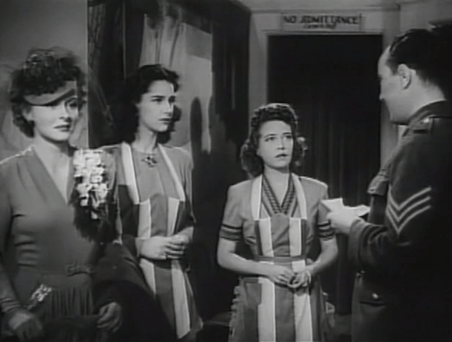
 There are also strategic vignettes sprinkled throughout to boost morale and the camaraderie between allies. A few Brits can be heard taking part in the gaiety and making friends with our protagonists. A table of Hispanic soldiers takes in a floor show. One of our hostesses gets a moving letter from her older brother in the marines who is bent on returning to his family and proving that his training can outlast any “Jap” out there. There’s a last-minute marriage ceremony that we are privy to. Sam Jaffe introduces the audience to a few Russian allies, an Australian soldier has just returned from the front, and several Chinese air cadets get a rousing appreciation. Merle Oberon (the only actress close to being Asian in the film) gives them a stirring sendoff. Finally,