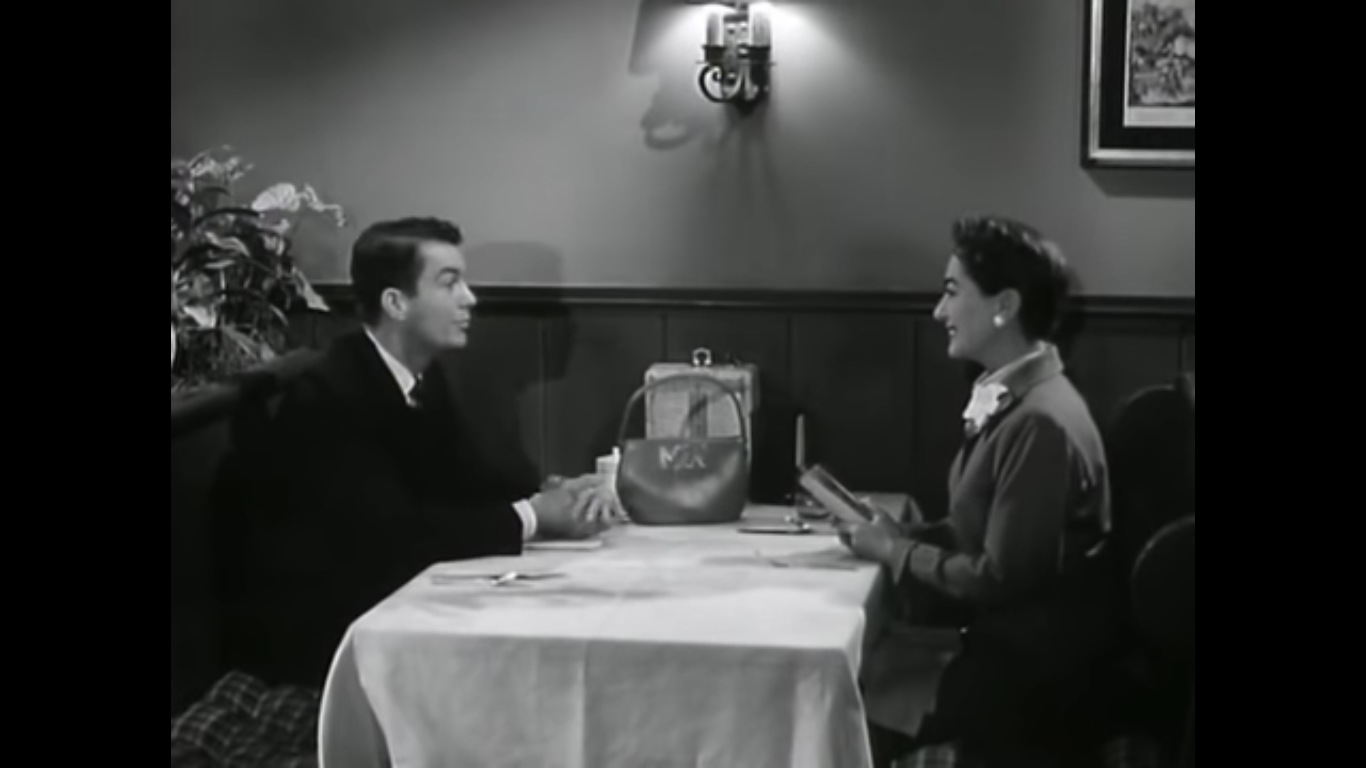
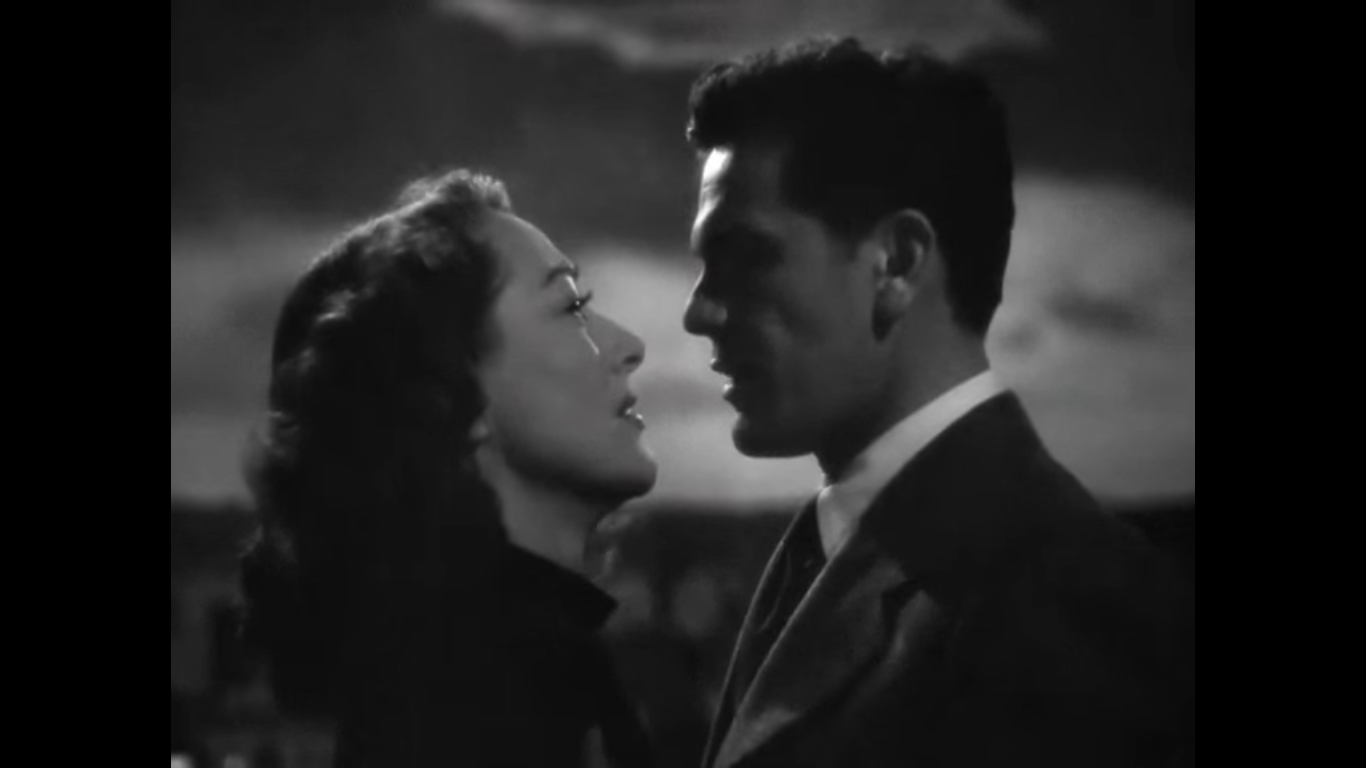
A Woman’s Face (1941)

The movie’s faux Scandinavian backdrop can be traced back to its origins in an early vehicle for Ingrid Bergman back in her native Sweden that was released in 1938. Since I haven’t seen the original, I cannot attest to Bergman, but she doesn’t immediately spring to mind in a role that calls for some amount of moral ambiguity — at least on screen.

Still, A Woman’s Face was a stepping stone part for Joan Crawford, from her effervescent flapper days and pertinacious working gals to something vulnerable and bold for a fresh decade. She sheds all glamour, something used so often as a mask in Hollywood, and willfully puts on a different facade of scars and perceived ugliness. It’s a move her rival Bette Davis readily made as well.

Here Crawford is a creature tormented and self-conscious about her own appearance. She’s crawling with shame. Mildred Pierce always gets the plaudits, and rightfully so, but surely there’s room in the conversation for this picture. Still, let’s not get ahead of ourselves.

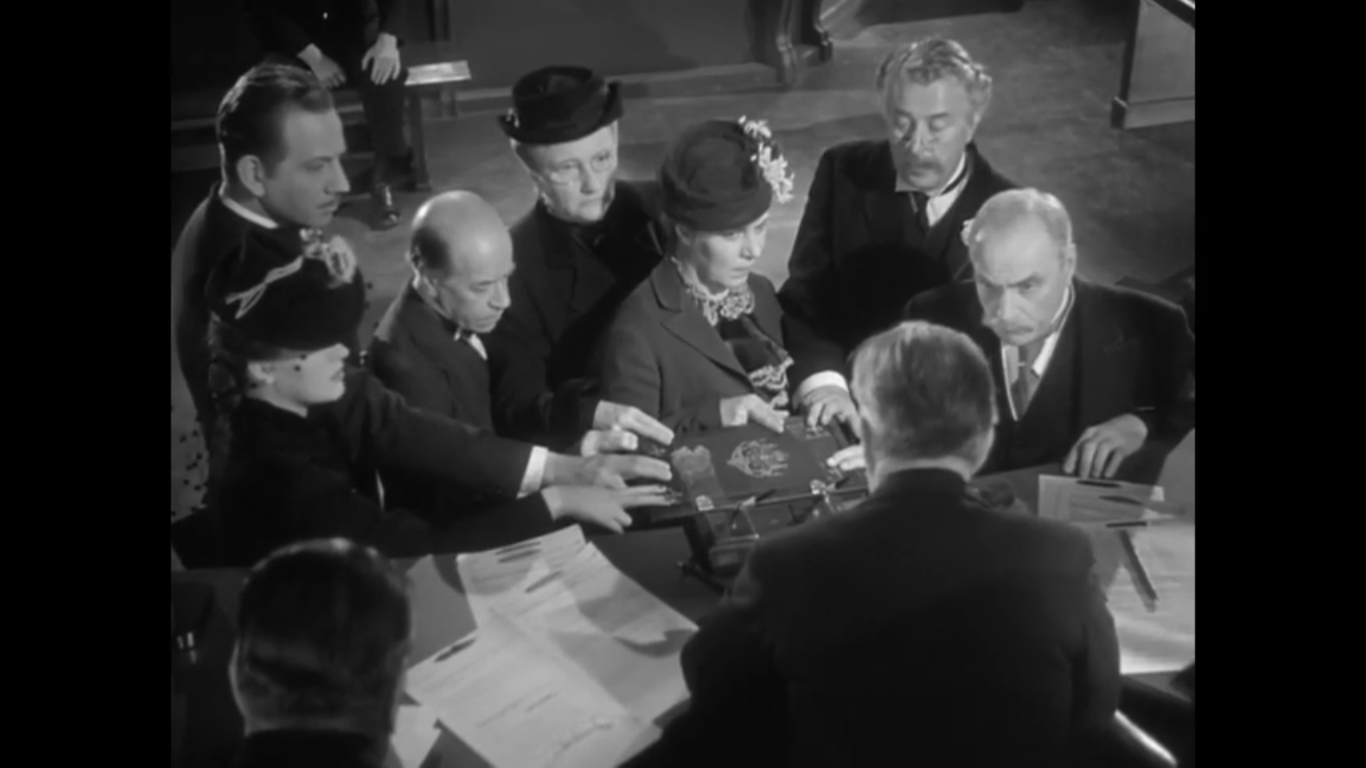
We stand by as a prisoner is marched through the hallways of a court. A menagerie of witnesses has been called to testify in the wake of a murder trial. The very same woman, her face hidden by her hat brim, stands accused, and the film effectively uses each of these disparate individuals to elucidate her story for the sake of the jury (and the audience).

It’s not an unheard-of device, but it’s rather clever, starting on the outer ring with a peculiar sort of character before getting closer and closer to who she is as a person with each subsequent flashback. As such, a sprightly waiter (Donald Meek) and a more guarded manager (Reginald Owen) recount their days serving at a local tavern.

One of the guests, Torstein Barring (Conrad Veidt), is a curious fellow. He’s the life of the party and expects certain privileges. One of those is running up an overflowing tab at the establishment after a merry night of wining and dining. He exhibits a piercing kind of magnetism, sleek and somehow unnerving.

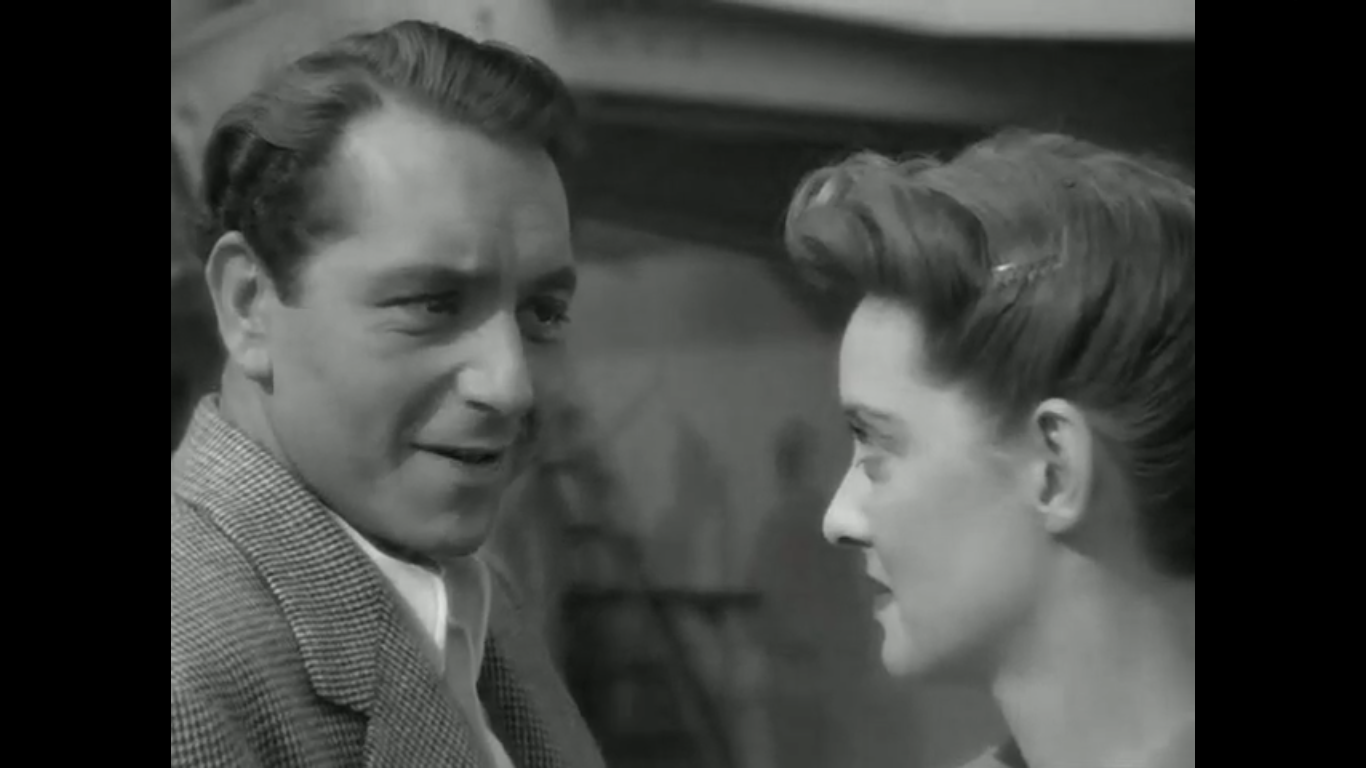
When the lady of the tavern steps out of the shadows and excuses his bill, he’s immediately taken by her. She’s scarred over her face, and yet all he sees are those striking Joan Crawford eyes. There’s something immediate between them, and it comes out in the courtroom that the whole tavern was essentially a set-up for petty blackmail. When people get giddy their tongues loosen, and they are availed of all their faculties.

There’s a level of dubiousness and doublespeak with her underlings providing another layer to the film involving both humor and intrigue. Because they ran a fine and highly lucrative con game complete with all manner of deception. Now they’re looking to save their necks.

The ready victims are the adultress Vera (Osa Massen) — wife of reputed surgeon Gustaf (Melvyn Douglas) — and then her latest beau. The joy of A Woman’s Face is how there are building blocks for melodrama. In literary form, it might come off as convoluted and unclear, but the cinema screen makes it sing.

In one moment Anna (Crawford) is trying to peddle some stolen letters for a weighty sum with a level of vindictiveness. She scoffs at others. In another, she meets Gustaf, who returns home unexpectedly both catching this woman in the act and becoming genuinely interested in her. His wife doesn’t want any of her dirty business getting out so she reluctantly plays along.

Almost everyone has an enigmatic side, some sort of angle or self-serving motive we’re trying to detect. Melvyn Douglas is the one character who is straightforward and easy to read. He offers to transform her face. Not with an ulterior motive, but out of a sense of decency.

There’s a fine level of suspense waiting to see Anna’s face reconstructed. We know what it will be and yet are forced to wait for moments with the camera working to evade a direct shot of her; it adds something, a level of expectation.

It’s yet another soap opera contrivance that works wonders. Because Joan Crawford takes this blemish and turns it into something powerful and ultimately beautiful. With it comes new confidence and new life. Anna and Torstein grow closer and closer and he’s even more drawn to the vision of her rebirthed self. Also, her disposition shifts.

Still, he has almost a Nietzschean charisma, and he coaxes Anna into playing nursemaid to a young relative who’s set to inherit a large fortune. She’s become a governess of the Phyllis Dietrichson persuasion.

Watching Crawford come down the stairs with the precocious little kiddy, I couldn’t help but think of those old glossies of Marion Davies parties except this is a party at a Scandinavian version of Hearst Castle. Images of piano and dancing superimposed over Crawford’s face say everything.

Actually, I misspoke earlier because aside from the young tyke and the kindly Gustaf, the Consul Barring (Albert Bassman) is a jolly old man, who welcomes Anna cordially even as his housekeeper (Marjorie Main) remains distrustful of their latest guest. In truth, they’re both right. They see the two different sides of Anna on display.

There’s an old Hollywood axiom about getting an actor’s good side, and I couldn’t help noticing how A Woman’s Face plays with this practically. Crawford’s right side is kept hidden for much of the first half of the movie and traditional 180-degree filming means it’s all but masked from us.

I noticed the change at the party when she meets the good doctor again. Finally, she’s on the left side of the frame fully unmasked and open to us. It’s true we see her in a different light just as he does too. Perhaps she’s changing — softening even — and he has something to do with this.

Arguably the best scene of the entire movie comes when Crawford’s with her charge in the trolley over the waterfall. It’s the moment akin to Gene Tierney letting the crippled boy drown in the lake in Leave Her to Heaven. There’s the intent. We know what’s happening, and we watch the mechanisms on the face of Crawford. It’s totally wordless and, thus, so effective because the whole sequence is borne on her features. She has a choice to make — caught in a moral conundrum — and it’s a showcase for the total evolution of her character.

In some strange sense, it feels like the dissolution of a femme fatale starting out one way and then slowly changing and eroding until she has a heart of flesh and blood again. She chooses her inclinations to protect over those to destroy. It comes with consequences. Watching a crazed villain disappear into the snowy rapids below is mesmerizing in black and white. Somehow something so deadly looks equally gorgeous.

The ending itself is pat as Anna is exculpated in the courtroom, and yet it somehow works contrary to a whole generation of noirs made in its wake. In other words, I don’t mind the happy resolution because it leaves just enough to the imagination.

4.5/5 Stars

Double Feature: Apartment for Peggy & Take Care of My Little Girl

Recently I was appreciating some films starring Jeanne Crain, an alluring actress who was at the height of her popularity during the ’40s and ’50s. Although she was rarely touted as a preeminent actress, I wanted to highlight two films of hers that more than highlight her appeal.

Both Apartment for Peggy and Please Take Care of My Little Girl are set in the context of college in the post-war years. One has Craine as a newlywed wife tracking down student housing and in the latter film she plays a naive college freshman with sorority aspirations.

Read my thoughts on the two films below:

Apartment for Peggy (1948)

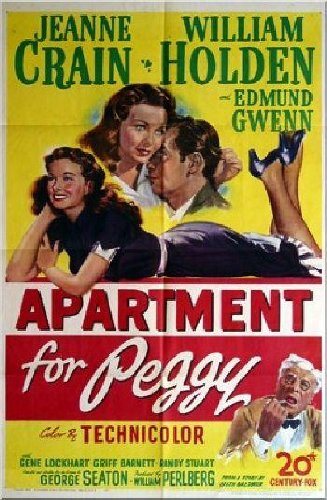
Apartment for Peggy is one of those Classic Hollywood films packed with pleasant surprises. The first of them is Edmund Gwenn. He’s best remembered as Kris Kringle in Miracle on 34th Street. Here he’s directed once more by George Seaton this time playing a listless university professor.

He lives off his pension in his crusty old abode spending his evenings with the same colleagues playing the same music they have for years. However, one evening he quite matter-of-factly announces his aspirations to commit suicide. He’s very rational about it. Still, his doctor won’t give him more than two sleeping pills at a time so he dutifully stores them up for a rainy day.

Then, something else far more momentous happens. He meets a young woman (Jeanne Crain) on a bench. Peggy Taylor motors about 1,000 miles per minute — her mind and conversations leapfrogging all over the place — so her new acquaintance can barely get a word in edgewise. He’s bowled over by her irrepressible zest for life. She’s precisely the person to prickle the professor’s curmudgeonly sensibilities. But she’s also the best equipped to turn Mr. Hypothetical’s life upside down for the better.

Because she tackles just about anything she sets her mind to with this same infectious verve. This is not just the age of the GI Bill (her husband is currently a student), but they are also dealing with a housing crisis. She puts her ear to the ground and manages to scrounge up a space in Pop’s decrepit attic. He’s quite against the imposition and still, Peggy keeps ping-ponging off the walls leaving no room for a rebuttal.

It’s one of many miracles how she spruces up the space and puts it through an astounding transformation. This is just the beginning. With Pop’s begrudging help, she conceives a daytime course for wives and mothers so they can learn about the great philosophers of the modern age (Spinozi included). They want to receive intellectual stimulation on par with their husbands so they can communicate with them.

Pops soon learns his new students are intrinsically driven to learn, and the professor is delighted to serve as their instructor because they seem to intuitively understand his teaching as his most receptive pupils. Their discussions are life-giving. You see already how Peggy single-handedly resurrects the old man so he’s able to see the world with new vim and vigor. Now it’s his turn to return the favor.

William Holden is just about the most innocuous thing about the picture, and that’s not to say he’s bad. Still, this is a picture made by the chemistry of Crain and Gwenn. It acknowledges the generation gap chafing between most any generations with varying perspectives on life with a comic touch. However, any conflict on the part of the elders ultimately engenders mutual affection.

Best of all, it’s a film about ideals and worthwhile pragmatism where the merits of both are made evident. But then again, film is not so much a science as it is a philosophy, an art — concerned with humanities — and the film works in this manner.

It gives off the appearance of a light, inoffensive comedy as we conceive would exist in post-war America. There are many. Certainly, this is true. However, it also sheens with warmth and goodness. Seeing the movie multiple times, the appeal of its brand of geniality just continues to bloom.

3.5/5 Stars

Take Care of My Little Girl (1951)

Sorority movies certainly feel like they’re solely made to meet an audience demand as a convenient cash grab. Take Care of My Little Girl wasn’t the first picture in this genre as I can think of at least a couple predecessors like Sorority House and These Glamour Girls (1939).

However, this movie actually had its origins in the master’s thesis of Peggy Goodin, who eventually turned her research into a novel. She was particularly concerned with how racial and religious discrimination played out in the highly moderated spaces of college sororities. To be clear, 20th Century Fox’s adaptation excises all of this commentary by casting their stable of homogenous Hollywood starlets (Jeanne Crain, Jean Peters, Mitzi Gaynor, Betty Lynn et al.) and a couple of male heartthrobs.

And yet that doesn’t mean the film doesn’t come with any teeth. For its day, it was actually rather controversial if only for its forthright portrayal of the social politics and hazing rituals that have continued to go under scrutiny generations later. The film looks different and yet at its core, it speaks to the very same issues we see today.

Jeanne Crain has such a radiant poise, it’s so easy to like her and not only like her but admire her for how she cares about others. Because she’s a shoo-in as a legacy at Tri-U sorority. Just as importantly, she’s probably the prettiest girl on campus. Not even the resident mean girl Dallas (Peters) can blackball her.

Liz cares deeply for her friends and isn’t totally swayed by the popularity contests even as she strives to make a good impression. She strikes up a rapport with a slightly cynical G.I.-turned-student (Dale Robertson), who helps advise her on classes and thrumbs his nose at the establishment after everything he’s been through. He recognizes something different in her that he likes.

Still, she’s not totally impregnable. Like any young person, she wants to be well-liked helping the class flirt (Jefferey Hunter) with the answers to his French exam. This in turn leads to being pinned. She’s the talk of the sorority house. And yet she’s not easy to categorize.

The picture is surprisingly poignant and perceptive. It’s not some hyperdramatic, superficial portrait of college life even if it’s playing to a specific audience. Also, thanks in part to Crain, there’s a genuine candor to the picture and a visible evolution to this young woman.

It may not be a lot, but it’s something. We do see her change as a human being. Surely college life looks so different now 70 years on from what we’re used to, and yet there are elements that have not changed. We still have fraternities and sororities and social hierarchies. I was aghast to realize even bluebooks have been around for well nigh a century!

This movie doesn’t necessarily suggest these institutions are inherently bad. However, sometimes we believe that tradition is good only because it’s the way things have always been done. But there should be better reasons. There need to be dissenters and people to challenge the status quo. There need to be brave folks who are willing to do what is right compared to what is easy. People who are loyal to their friends rather than simply playing the games for want of status and approval.

Even if the Epstein Brothers’ script forgoes some of the most intriguing aspects of the original story, I appreciate that they explore their topic with something a little bit more involved than superficial exploitation. It actually strives to be about something, however small.

3.5/5 Stars

The Classic Movie Beginner’s Guide: Jeanne Crain

As we do periodically, we wanted to help classic film fans get better acquainted with some of the stars of yore. This week we’d like to focus on the career of Jeanne Crain. Crain (1925-2003) was an actress who came to the attention of audiences in the 1940s and 50s. She was known as a lovely romantic star and a fine ice skater.

At the height of her stardom, she was featured in a couple of high-profile films by Joseph L. Mankiewicz as well as starring alongside the likes of Dana Andrews, Gene Tierney, Cary Grant, and Frank Sinatra.

Here are four films to consider:

State Fair (1945) - IMDb

State Fair (1945)

Many people probably recall the ’60s remake, but Jeanne Crain starred in the original opposite Dana Andrews in the first of four pictures they made together. It remains one of the quintessential movies about Iowa life as exemplified by the country fair. Craine would appear with Andrews later in Duel in The Jungle, Madison Ave., and Hot Rods to Hell.

Apartment for Peggy (1948)

It would be easy to pick other school-related films like Margie (1946) or Please Take Good Care of my Little Girl (1951), but it’s hard not to settle on this delightful post-war comedy. Between the zany, good-natured scatterbrains of Crain and the curmudgeonly charm of Edmund Gwenn, the film is so easy to root for.

A Letter to Three Wives (1949)

Along with Pinkie, it’s probably Crain’s most acclaimed film and it certainly looks better years later. Its main problem is being cast in the shadow of All About Eve. Otherwise, this tale of three wives with three husbands and one case of infidelity remains a gripping exploration of marriage.

People Will Talk (1951)

It’s a movie that’s increasingly impossible to categorize. It deals with topics of suicide and unwanted pregnancy. It was unwittingly made in the maelstrom of McCarthyism, yet with the romantic pairing of Cary Grant and Jeanne Crain, it comes off as a delightfully peculiar comedy full of whimsy.

Worth Watching: Leave Her to Heaven, Margie, The Model and The Mariage Broker, Cheaper by The Dozen, O Henry’s Full House, The Fastest Gun Alive, Man Without a Star, The Joker is Wild,

Vagabond (1985): Agnes Varda’s Empathetic Kane

Vagabond (or Sans toit ni loi, in French) plays as the sum of a fairly dismal life but not an unworthy one. For those familiar with Agnes Varda’s filmography, whether the penchant for seascapes or her concerted empathy for the discarded, it’s easy to see how this picture fits in with the others. In many ways, it blends her sensibilities for narrative fiction and her later documentary work like The Gleaners and I.

However, from a storytelling perspective, Vagabond also plays as her Citizen Kane, except she sets her sight on someone on the complete opposite end of the human spectrum. It’s curious how the paragon of money and power could somehow share fundamental things in common with a proud, young drifter. They feel so isolated and in some sense unknowable because they rarely allow others in.

Citizen Kane is a veritable jungle gym of technical invention and play. There’s never been anything quite like it, but the qualm I always maintained on early viewings is how there’s no connection. Because this is the point. It feels a bit hollow. We never get to truly know Charles Foster Kane because he never really let anyone know him.

The curious thing is how Varda derives so much concern for her subject. If we don’t end up knowing a great deal about her personal biography, it does feel like we at least appreciate her as a ceaselessly proud and increasingly worn-down human being.

I have so little history with Sandrine Bonaire and know only that she made an auspicious appearance in Maurice Pialat’s A Nos Amour (1983). However, watching her is a pleasure; she looks like a more stoic predecessor to Brie Larson.

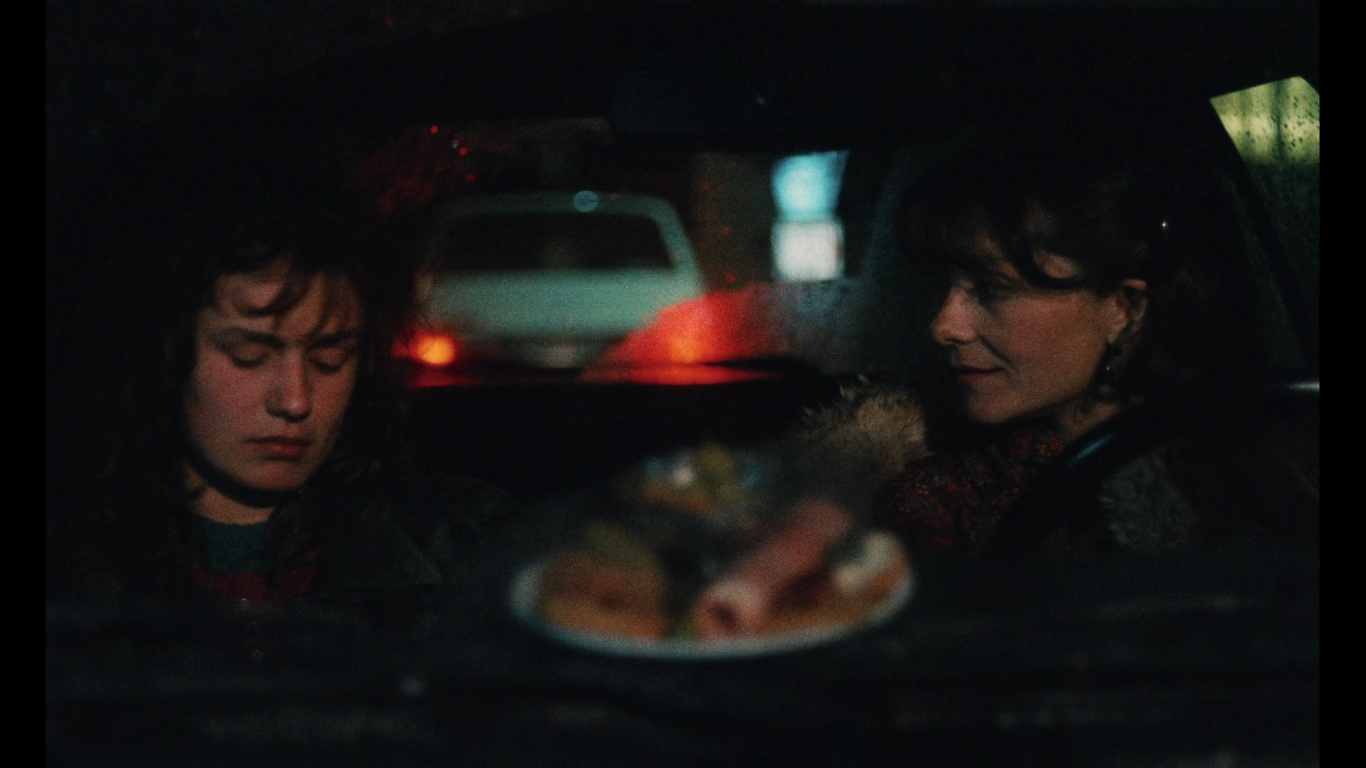
In many ways, Bonaire’s character informs the structure of the film and so it functions well. She is an itinerant young woman, free and apparently happy with her lifestyle. It’s easy to label her as a vagrant and a loafer. She never holds down a consistent job and maintains a brusque belligerence in the face of others. It makes her fiercely independent, and skeptical about the prevailing philosophies of life.

Through it all, we don’t know where she will go; she fosters these short, finite relationships that have a definite beginning and end, and then she moves on to her next destination. There’s no goal or visible endpoint. All we have is the frame of the story to give us some reference to make sense of her life.

It’s composed of scenes featuring these kinds of visual ellipsis as people she interacted with recount their meetings. Each person views her in a different light, and we must come to understand her in this piecemeal fashion only through the perspective of others.

There’s a bohemian family of shepherds who used to be a part of the establishment but now live a rural, much simpler life taking care of livestock. The closest thing she has to a friend and a saint is a beautiful academic (Macha Méril), who has spent her life researching a fungus brought over during WWII that is slowly killing the local trees. She has a conscience and a warm spirit. Far from deterring her, the girl’s standoffish nature of cigarettes and glowering glances only seems to bring out greater adulation. There’s a hint her benefactor feels it too.

A Tunisian farmhand with a welcoming spirit is another person of generosity in her life. They seem to have nothing in common, and yet they bond because they have shared a similar experience of the world as perennial outsiders. He’s the only person she actually shares her birth name with: It’s Mona.

But our protagonist opens herself up only to get hurt. He offers to let her stay in their quarters and help take care of the local vineyards. It’s another brief promise of something beyond a drifter’s life, however small. Still, upon his coworkers’ return, they’re not agreeable to having a woman in their midst. She’s forced to push on again. It’s the life she’s used to, and yet the circumstances make the moment a far more painful point of departure.

There are signs that this is not sustainable no matter how romantic it might seem. Mona befriends an old white-haired lady slowly dying in her grand estate after posing as her maid. Would Mona have been a friend of Charles Foster Kane? This is the closest thing we have to answer, although it too becomes a closed door as the woman’s only kin, a young nephew is anxious to get what’s coming to him.

In a bit of serendipity worthy of Varda’s husband Jacques Demy, there is a kind of interwoven fate to these relationships as some of them begin to fold over on one another and interconnect with Mona in the middle. But this must not be mistaken for Providence.

Her lot becomes increasingly bleak, and there’s obvious intent here. There’s no other place to go. Whether Varda failed to show them before or not, I started to notice the makeshift carpet shoes Mona wears on her feet. She feels all the more pitiful falling in with dubious company and beginning to drink more.

She’s also accosted by some local practical jokers who run about town throwing paint bombs in a mad show of anarchy and artistic expression. There’s no rhyme or reason to it per se, although it leaves her more disillusioned and covered in brown paint that makes her look even more feeble than before. Then, a fire takes her belongings, and she must flee in the wake of an angry confrontation. She’s offered no respite.

At once such a proud and independent individual, she looks so dejected when we finally leave her shivering in her blanket trying to stay warm as a dog barks at her from right outside. It does feel as if the window has closed for her. She had glimpses of other lives and yet they all amounted to nothing. And she is left with nothing.

Freedom is such an exhilarating thing, not being totally beholden to the strictures of the world around us. But it’s equally terrifying being cast out into a life where we have no one to care for us, no one there to love or be loved by. Here again, Vagabond and Kane are so closely related. Whether we die in a luxurious bedroom or a ditch by the roadside, it doesn’t much matter. The outcomes are the same. There’s something ultimately deceptive and debilitating about their respective freedoms. It’s not freedom at all.

4.5/5 Stars

Le Bonheur (1965): Varda’s Sunshine Horror Film

The aesthetic of Agnes Varda’s Le Bonheur is strikingly deliberate. Her title cards are filled with sunflowers. All her characters — members of a lovely little family — wear a rainbow of colors. There’s a verdant gaiety to the forest landscape around them. The score comprised of the buoyant elegance of Mozart does wonders to accentuate this very salient mood. In short, it’s gorgeous. Surely this is happiness personified.

In the middle of the 1960s, that turbulent time of upheaval and the nouvelle vague, it deigns to be domestic and cheerful in a way Godard would never dare and Truffaut could only manage through a boyish point of view.

But it has such a vibrant and daring color palette on par with anything in Contempt (Bardot included), Pierrot Le Fou or Weekend. In fact, this could very well be her answer to a glorious Jacques Demy musical (her husband) and a predecessor to Stolen Kisses and Bed and Board.

The couple’s children are adorable as they toddle around, ride in the back of the family truck or feed sugar cubes to their daddy’s horse — the bicycle he rides home from work every afternoon. Like any young kids, they like to imagine, they’re enthralled by a newborn baby, and they take naps (under the mosquito netting their mother puts out in the forest for them).

By this point, the movie could feel sickening and twee, but there’s an impulse to see the movie out and where it might go. It leaves some questions about a dramatic situation with its title (especially with how fiercely unironic it resolves to be from the outset).

When they return home to their idyllic town, it’s little different. True, the husband, Francois (Jean-Claude Drouot), wants to see a western at the cinema — a prototypical American film. His wife Therese (Claire Drouot) is enchanted by a French film, the first pairing of “[Bridgette] Bardot and [Jeanne] Moreau.” Otherwise, they seem perfectly aligned, going to work and raising their family together.

This all quite effectively lulls us into a false sense of security. Varda knows quite well what she’s doing. As an audience, we want to believe this is what life is like, but we are privy to a movie and so something must change…If there is a source of drama, it’s when the man starts to flirt with a local telephone operator Emilie (Marie-France Boyer). Even this tête-à-tête is light and affable. They feel innocent enough. Hardly prepared to wreck a home.

His wife and his lover aren’t mirror images exactly — they look different — but Varda does very little to distinguish their visible traits (ie. blonde vs. brunette or juxtaposed costuming choices).  They’re both pretty young blondes, affable, draped in bright colors. It feels like a curious coincidence until it builds into something more.

This trifling love affair morphs into exactly the kind of circumstances the exterior does its best to dispel. Surely infidelity does not have license to break into such reverie and tear a family apart. This does not fit with the perfect marital equation or the glorious mise en scene.

So we begin to discover a kind of perturbing even disheartening dissonance about the picture as it continues to break with reality. It builds and begins to ambush us with new contradictions.

Here is a man deliriously happy, both with his wife and then with another woman. He assures his new love, “I have enough joy for both of you. Happiness works by addition.” Then when he cordially breaks it to his wife he says, It’s as if he has 10 arms to love her and he has extra arms (to love someone else).

It doesn’t matter how emphatically or candidly he says those words. They come off poorly. Even as he continues to live in his rapturous dream world without consequence, for the first time the words ring out in the landscape with an inherent hollowness. It’s yet another signal of paradise lost. We have hit upon a point of no return.

Le Bonheur is devastating in a manner that I never would have imagined. Because Varda finally does allow the film’s glorious bliss to crack even if the tone and coloring never waver or fade. The way the young carpenter relives one horrifying moment over and over again in front of the camera feels reminiscent of C.S. Lewis when he wrote about grief and how “The same leg is cut off time after time.”

However, now we have a suspicion of where it might go. The final few minutes of Le Bonheur are not a total surprise; they do feel like a shocking betrayal of our initial assumptions. This is not a criticism; it simply shows how effectively the movie evolves over time while maintaining a certain surface-level palatability. It’s ceaselessly beautiful to look at even as the currents turn.

Whatever its reputation, Le Bonheur feels commensurate with some of the most unnerving psychological horror films and thrillers I’ve seen through the ages. I think of the uneasy denouement of Gone Girl or the unsettling conspiracies in Rosemary’s Baby or Get Out. The curious part is how the perpetrators have no idea what they have done. It’s not a film of premeditated plots, more “happy” accidents, and this in itself is terrifying.

Because we have the same set dressings, the same motifs — almost everything feels the same — but we have an entirely different context. If we’ve settled back into a comforting equilibrium, then something almost imperceptible grates at us. Something has soured with the happiness set before us. It establishes a level of disquietude I won’t forget for some time. Surely something is not right here. I leave it to each viewer to reconcile it for themselves.

4/5 Stars

La Pointe Courte (1955): Agnes Varda and The French New Wave

Agnes Varda became a modern-day cinema celebrity in the 21st century thanks to her immediately recognizable profile and modern incarnations of her work like Vague Visages. Because it’s true she never stopped creating, never ceased exploring this terrestrial sphere.

Watching something like La Pointe Courte (1955), one of her early efforts, one begins to imagine and reconfigure how the movie canon gets forged. Some of it has to do with accessibility (Varda’s Cleo from 5 to 7 seems to gain a resurgence in popularity by the year).

But whereas 400 Blows, Hiroshima Mon Amour, and Breathless became the lodestars for an entire seismic shift in film, Varda is rarely considered in this dialogue. If at all, it’s in tandem with Alain Resnais or her husband Jacques Demy from the Left Bank who were contemporaries of The filmmakers from Cahiers du Cinema. But never is Varda mentioned as a predecessor or the initial pioneer of forthcoming movements and yet she shot a film with little money, passion, and a point of view.

Early on as we glide down the alleyway with the laundry swaying in the breeze I couldn’t help but think how Yasujiro Ozu would have photographed it so differently — stagnant and beautiful — still, Varda makes it feel graceful and alive.

She uses it as a way to get into the house. There’s a man loitering around on the corner, we see boats in the background, and then we’re past the very same laundry through the window into the home of a working-class family.

The stranger by the fig tree has the locals suspicious. They snatch a glance at him, suspecting he’s an inspector come to turn them in. Sure enough, health services show up to pay a house call.

This is a story of the steady degradation of a way of life. These men earn their livelihood through fishing. But with the local bodies of water increasingly polluted, the authorities are quick to come down on them. Young children are tasked with keeping watch and sounding the alarm so the men can rush back to shore and hide their spoils. But the antiquated ways of kids keeping watch don’t stand a chance against newfangled motorboats. Later a man is taken off to prison for such an infraction.

A movie like this looks deceptively simple and yet I’m able to pore over it with such relish. Look at the street, the shape of a tree, some bit of wood, or fishing equipment tossed on the ground. None of this can be fabricated on a green screen. This is a unique and real-world before us that we get to feel and experience in all of its immediate eccentricities.

The way a cat crawls through a hole in a wooden fence. Women crowd in the doorway to acknowledge the death of a child. A man skipping over the train tracks to greet his love. The reunited lovers walking along a stone wall or crouched in the enormous darkened hull of a boat.

Because La Pointe Courte also tells of a Parisian couple (Silvia Monfort and Philippe Noiret), who have returned to the husband’s childhood home. They have different philosophies. For him, it is simple but the lap of contentment. Just living is a pleasure. He can be satisfied here.

His ambitions lie with the intricate, extraordinary things — the kind of everyday visions that prove plentiful in Varda’s gaze, but his woman wants something else. She wants to travel — to see more than the humble alleyways of his small backwater town.

We might liken her to a connoisseur of Hollywood delicacies. Although they are not a pair of Hollywood faces and Varda’s camera finds them immeasurably interesting. She photographs and frames them in all manner of ways: profiles, from up above, side by side, and walking apart. It makes no difference. They are totally worthy of her close consideration.

I find it easy to reminisce about Roberto Rossellini’s Stromboli another film that ties together the worlds of fishing and apathetic romance. There are even touches of  Ingmar Bergman from the boating of Summer with Monika and the visual melding of two human beings in Persona.

It also features water jousting a generation before Cesar et Rosalie. But one must once again acknowledge the imprint of Resnais — he helped edit the picture — and La Pointe Courte predates such seismic works as Hiroshima Mon Amour or Last Year at Marienbad.

This is not an empirical observation but although both their films share momentarily visible sensibilities — how they glide through space — allowing lovers ample opportunity to quibble poetically if not totally inexplicable, Varda seems more invested in the world around them.

These are still real people to her with real problems, not merely the symbols or totems of countries and generations (ie. Nevers and Hiroshima). And so although Resnais’s characters share some intimacies, Varda’s picture is intimate in a different way, allowing for understanding outside the umbrella of romance alone.

She’s intent on humanity — a little boy licking his ice cream cone — in a way Resnais probably wouldn’t devote time to. The moment develops into something bitter and then sweet. He thinks his woman has left him and then she returns with two ice creams (economy size). He gives his cone to a small child. Rather than a mere act of charity or guilt, he’s probably lost any appetite.

The movie is this constant dance between signs of dissolution — these steps back and apart — and then steps forward leading them together again. It’s romance played out in the moments of conversation and indifference rather than any form of malicious Hollywood tirade.

It’s telling Varda ends her movie, not with her couple pontificating as they wade through a local dance party in the streets. For them, it’s practically a joyous occasion. However, she leads us back to a family as they get in their boat to ride off into the distant night. It never loses this level of familiarity in its humble origins. It relishes them even as it signals the inevitable dwindling of a way of life. Whether Varda recognized it or not, her film remains a presage for coming attractions.

4/5 Stars.

Abbott and Costello Films: Naughty Nineties, Time of Their Lives, A&C Meet Frankenstein

The Naughty Nineties (1945)

The next genre Abbott and Costello took on in The Naughty Nineties was the show boat-style musical. Henry Travers fits as a kindly old ship captain who promises family-friendly entertainment headlined by his daughter and a very familiar leading man (Bud Abbott).  Costello crops up in a local band pounding his drum with a parade off the beaten path. Soon enough he’s getting up to all kinds of his usual shenanigans as the lone stagehand for their stage production.

Comedy like this must have a rightful antagonist: Rita Johnson and Alan Curtis lead a trio of shady malcontents. They’re getting brushed out of town, but they set their sites on the naive Captain. His one vice is gambling, and they know how to bend the odds. Soon he has no recourse but to work with them by their rules. They commoditize and taint all he’s worked so hard to build.

Enter Abbott and Costello. They take on a crooked roulette wheel with the hiccups using a wad of chewing gum. Lou makes himself useful in the kitchen whipping up a feather-filled cake though he gets his comeuppance with a cat burger routine that has him cringing over his dinner after every mew.

Although it’s not very organic and feels like the most shoehorned gag in the story (because it was), we do get one of the recorded versions of “Who’s on First?” standing in the halls of comedy as one of the most revered routines of all time. Partially because it only works with the duo. You need the straight man, you need the comic, and then the situation to put them at odds. Few have done it so cleverly as this one.

The rest of the movie isn’t so lofty and that’s okay. Costello’s running around the deck being chased and chasing. It’s puerile entertainment, but not the worst we could have. If nothing else, his ever-present wheezing, warbling sound effects feel reminiscent of Stan Laurel though Costello’s portly frame makes him feel a little more like a man-child. This too became the bedrock of Abbott and Costello’s comedy.

3.5/5 Stars

Time of Their Lives (1946)

Time of Their Lives feels like an obvious departure for the team. We found ourselves planted in a colonial drama with a spritzing of the usual comedy. Box office woes or not, I’m not quite sure I’m amenable to how they retooled the Abbott and Costello formula. This movie begins as a straight period piece. It can be done well with something like The Court Jester, but it does feel like the boys rarely get enough time together. Perhaps this was by design.

Still, like many of the great comedians of their day and age, they seem to work best when they can break away from the rigors of plot and the confinement put on them by a narrative arc even if it’s for the sake of a few throwaway gags. Because this is what their entire reputation is founded on, and it’s these moments in between where they lose the plot and we gain laughter.

Time of Their Lives is certainly in danger of becoming moldy pretty fast if not for a quick change of direction leading into an entirely different movie. The ghost angle is something — Mr. Topper redux if you will — but it feels a bit uneven and not quite in the vein of what we’re used to. What it does morph into is a bit of the Costello and Marjorie Reynolds show, which isn’t an entirely bankrupt proposition. In comparison, Abbott as a straight-laced and tormented psychiatrist doesn’t provide much in the way of genuine laughs. He functions best in conjunction with his able partner.

I’ve already made it painfully apparent, I’m not an admirer of haunted house films with seances and the like, but Abbott and Costello probably give us the funniest version (although I need to rewatch I Love Lucy to make doubly sure). I especially appreciated when Costello the apparition made his presence fully known by rapping his comedy partner over the foot. There’s not a great deal of this kind of interplay in the picture, but it seems telling these are still among the most noteworthy moments.

3.5/5 Stars

Abbott and Costello Meet Frankenstein (1948)

Between the animated credits and their pairing of some historically lucrative stars, Universal does well to promote their assets. Abbott and Costello Meet Frankenstein also shows an understanding of the continued shelf life of IP. If that was true in the 1940s, it’s even more of a buzzword in the modern media landscape.

At its best, we get Abbott and Costello trading off their impressions of some of the most iconic monsters. But more important than that is how our team is back together again. All is right within their world with their patented antagonism restored along with their attempts at menial labor.

Abbott’s bossing Costello around even as he’s somehow managed to nab the pretty girl. It’s really a reversal of the Hope & Crosby dynamic where Bing always seems to get the girls. Here it’s the lovable pudgy nincompoop Costello. Though both his pretty ladies have ulterior motives.

They also have ample opportunity to bump heads with a belligerent businessman. It’s only the beginning of their troubles. McDougal’s House of Horrors is a personal showcase for the traditional gags where Lou crosses paths with Dracula who is very much alive, though he’s never around when Bud comes back to investigate.

Lou can’t catch a break, but of course, that’s the gag. Bela Lugosi’s Dracula, Frankenstein’s Monster, Lon Chaney Jr.’s Wolf Man, he unwittingly has run-ins with them all, and somehow comes out on the other side still intact. This is the ultimate joke that can only work with a foundation of laughs. It’s his absurd invincibility in the face of all of this supernatural threat and menace that seems bent on destroying him time and time again.

It’s also one of the first movies in their catalog with a dramatic turn — Abbott must believe his buddy for once — he knows he’s not just seeing things. It does disrupt the situational irony fundamental to their brand of comedy, but it comes late enough, we’re ready for our resolution, and the movie pays it off in the most melodramatic Hollywood form.

But it is a glorious crescendo of scaredy-cat comedy, and it seems to suggest to forthcoming generations just what can be done if you successfully meld these genres together. Because it doesn’t merely trivialize them. By weaving together the mythology of the Universal monsters from their own standalone entries, this addition effectively built on all their legacies. 

3.5/5 Stars

Abbott and Costello Films: Buck Privates, Hold That Ghost, Who Done It?

Buck Privates (1941)

Service comedies almost feel like a rite of passage for comedy teams, and it’s no different with this early success from Abbott and Costello. Against their hijinks, there’s a blatantly obvious love triangle (Lee Bowman, Jane Frazee, and Alan Curtis) meant to lend some balance to the drama. It feels reminiscent of what studios tried to do by domesticating all the Marx Brothers’ later works with “plot.”

The Andrew Sisters — at the height of their powers — also sing a couple of their best toe-tappers including “Boogie Woogie Bugle Boy” and “Bounce Me Brother, With a Solid Four.” There’s a certain amount of buoyant jingoism about them. This is a staple of their appeal.

Still, it’s strange to think Pearl Harbor had not yet occurred when the film was shot. The country was on the cusp of something but not yet plunged into the abyss of World War. For now, Abbott and Costello can live their charmed comedic life.

This is the picture that transitioned them from the vaudevillian circuit and really made them lucrative movie stars. It’s all about the bits from playing craps to army physicals and a bumbling drill regimen as only Abbott and Costello could pull it off. They do have a mark and easy rival who goes from police officer to hulking company officer (Nat Pendleton), but just as often the comic tension is borne out of their own self-made antagonism.

Costello is always a hapless victim and Abbott always has a way of either berating his ineptitude or egging him on. This was the crux of their not-so-secret formula. Again, like the Marx Brothers, it’s not like they were an overnight success trying to come up with their personas as they went along. They already feel like a well-oiled machine we can thoroughly enjoy without any reservations.

3.5/5 Stars

Hold That Ghost (1941)

Hold That Ghost finds Abbott and Costello perfectly in rhythm. First, they’re bumbling waiters at a fancy restaurant. Then, they’re gas station attendants and in both places, they find themselves unwittingly linked with a local gangster named Moose, who’s tangled up with a blackmailer and the D.A.

All of this is a set-up because the majority of the picture takes place in a haunted house. Even if the studio added these earlier scenes to capitalize on the musical success of Buck Privates, it does feel like the perfect entree.

Our hapless heroes are piled into a jalopy full of a menagerie of mostly second-rate character players and then dropped off in front of a dark and haunted tavern. There’s a ridiculously handsome professor with his head buried in his work, and the pouting blonde just waiting for him to notice. The third member is a jovial radio actress who’s more than game to make Lou’s acquaintance. I was gleeful when the cast took to the floor of the haunted manor for some after-dinner dancing with some raucous choreography courtesy of our portly twinkle toes.

The dark and stormy night elicits all the typical scares especially because Costello is the king of the yellowbellies (and for good reason). Because while his partner chides him for being a lily-liver, gangsters commit murders, detectives show up unannounced out of nowhere only to disappear, and of course, there are the ghosts.

The way Costello sounds off like a little kid taps into his shtick at its best. He’s known for being hoodwinked and demonstrative in some of their most well-known skits (ie. Who’s on First?), but the dynamic works when he’s totally nettled his straight man with his utter idiocy. One can only work with the ire of the other. The same goes for any of the sleights of hand or deception gags they pull.

They work on this spectrum of perceived intelligence. Costello sees things and protests. We know he’s speaking the truth, but to any objective outsider (in this case Abbott), he’s being unreasonable.

Like Stan Laurel, he’s a bit of a charmed character, and the world in all its many lunacies is observable only to him. His hat is swiped from his head, a bedroom turns into a gambling joint, and dead bodies fall on the floor only to disappear into thin air.

The ongoing candle gag only works due to this same principle predicated on timing. Abbott’s out of view and yet standing just off stage so he comes back into frame at the most inopportune (or opportune) time for the visual gag to take. Abbott and Costello pretty much built a career on this, and why not? I find it delightful even after all these years.

4/5 Stars

Who Done It? (1942)

It wouldn’t be an Abbott and Costello picture without them taking some menial job ripe with some humor to show off their usual conflicting ineptitude. They display perfectly out-of-sync, synchronicity if you will. You have to be working together to be so visually discordant.

Costello’s behind a cafe counter cutting a piece of cheese — Linberger cheese — and he’s about to suffocate from the smell. The customer’s grousing for his food and Abbott’s barking after his pal, who has no recourse to bring out a gas mask…

Again this feels like the appetizer whetting our appetite for coming attractions as Costello keeps on getting fleeced by a kid bellhop. But they’re on to better things because our boys are aspiring radio talents moonlighting as soda jerks.

They meet another professorial fellow, who might be their inroad to a career in radio murder mysteries. However, when the network president (Thomas Gomez) gets murdered mid-program, they have a chance to prove just how good they are at solving crimes. Most of the movie takes place in these stationary interiors, inside the radio set, and yet the boys tumble all over the place as per usual.

What sets the movie a cut above some of the other A & C pictures comes with the supporting cast. Who Done It is bolstered by some well-remembered talent of the era falling into their readily available parts.

Patric Knowles and Louise Albritton are well and fine as the prospective young lovers caught in the drama after losing the good colonel. Mary Wickes brings her ever-wry wit to play up her own fledgling romance with Costello.

William Gargan and Bendix can be called upon in a pinch to lampoon their typically hardboiled cops plucked from just about any noir you’ve ever seen. There’s Jerome Cowan in another role. This familiarity helps carry the lulls when our heroes aren’t front and center.

All the rest of the time they’re hard at work filling us with belly laughs. There’s a familiar-sound “watts and volt” bit. Then, with a killer on the loose, Costello gets beset by transcription machines, stage acrobats, and sound effects; it feels like a comedic jungle gym with so many possibilities for his elastic talents. I’ve rarely considered halitosis so funny.

But just about everything is superseded by the finale kicked off by the anxiety-inducing phone gag I knew in another iteration during my childhood. Every person and his brother is able to patch through their calls in an instant — the world over — and yet the operator tells poor Lou his line is busy.

It doesn’t matter if he has thousands of dollars on the line or if there’s still a murderer to be apprehended. Because he constantly reminds us these pictures are about the means, not the ends. This one’s a lively ride hyping up the melodrama and leaning into chaotic bits of slapstick in all the best ways.

4/5 Stars

Classic Movie Beginner’s Guide: Abbott and Costello

We continue our informal odyssey for up-and-coming classic film fans by acknowledging one of Classic Hollywood’s most beloved comic duos. True, they started out on the vaudeville circuit, had their own radio show, and ran a series of television programs, but it was in the movies where Abbott and Costello became huge stars.

Their patented routines between the portly comic (Costello) and his straight-man (Abbott) laid the groundwork for some of the most famous bits of all-time, not least among them “Who’s on First?” If you haven’t heard of the bit, it’s just possible you’ve been living under a cultural rock. But we are here to rectify that. Here are four films to get to know Bud Abbott and Lou Costello.

Buck Privates (1941)

Their first picture together was One Night in The Tropics and there were a boatload of service comedies to follow, but Buck Privates was the one that put them on the map. The Abbott and Costello personas had already been carefully tooled on the burlesque circuit and with musical accompaniment by the Andrew Sisters, the picture was a stirring success.

Who Done It? (1942) - Turner Classic Movies

Who Done It? (1942)

The duo’s comedy was best applied to established genres that they can mess around with. If you’re partial to haunted house films, Hold That Ghost (1942), is a fine place to start, but this subsequent title uses the backdrop of a real-life radio drama murder to give the boys ample space to good off, and they do some of their finest work!

The Naughty Nineties (1945)

It’s inevitable. It’s necessary to include the picture with the most recognized version of their famed “Who’s on First?” skit. If you don’t take anything else away from their period riverboat picture, then this number is a must-see. It’s comedy history being documented for all posterity right in front of our eyes.

Abbott and Costello Meet Frankenstein (1948)

If you’re cynical you could say the studios were running out of ideas of how to advertise the boys at Universal. However, sticking them with such iconic figures as Dracula, Frankenstein’s Monster, and The Wolf Man seems like a fairly inspired choice. The blend of goofy comedy and horror tropes is more than enough to place it among Abbott and Costello’s most popular pictures.

Favorite Films of 2022

It was another strange year at the cinemas, but there was a lot to appreciate.

Here’s a list of some films I enjoyed in 2022 and you might too. I’ll probably be releasing some other capsule reviews at the beginning of the new year. Let me know what you think!

No Bears

Of late I’ve been considering the films that leave an inexorable impact on me. Certainly, they entertain and compel us in some fashion as a viewer, but oftentimes the best, most daring projects utilize the medium of film in some unprecedented way – using its limitations and reflexivities to birth something new and meaningful into the world. I can think of few recent films fitting this category better than No Bears.

German director Werner Herzog always likened the filmmaker to a resourceful vagabond able to pick locks and prepared to spend a night in jail if it means getting the right shot. At least in his estimation, there’s such a thing as good trouble. Director Jafar Panahi takes this to his own extreme as he’s had his own well-documented run-ins with his home country of Iran, which has previously forbidden him from shooting movies. Given Panahi’s mentorship with the revered Abbas Kiarostami, it’s difficult not to draw a line between their work. In something like Close-Up (1990) we are dealing with the almost imperceptible dividing lines between filmed fiction and reality – that which is staged and fanciful and what we might term documentary. 

It does seem like Panahi is somehow dabbling in a fiction willed into reality. But it’s more unnerving than we can imagine even if he’s well aware of the ground he’s treading. His “fictionalized” version of himself struggles to direct a movie remotely across the border in Turkey, while he must remain in the country, dealing with woeful internet connections and kerfuffles with the local populous. We recognize a world around him divvied up and made insufferable by boundaries, borders, rules, and traditions so much so that words and reason seem arbitrary and even religious rites and oaths lack any kind of inerrancy.

He’s currently under arrest by the Iranian government and the dark irony is bracingly apparent. There’s both a bravery and a brazen cavalierness to it all. No Bears contends with both the cultural hypocrisies and the ethics of such a tradition as moviemaking. Sometimes things aren’t meant to be captured and held captive by a camera. Sometimes the camera captures nothing – only the innocuous and the quotidian – still, that doesn’t stop it from being feared. 

Decision to Leave

Decision to Leave is a transfixing tale meditating on the voyeuristic nature of both love and murder. But it’s not just about these themes; it’s about how romance and murder are cut together and potentially become inseparable within this indecipherable realm of the police procedural. It’s certainly not a film without precedent when it comes to the subject matter. It focuses on a detective (Hae il Park) investigating a crime with his primary suspect being the Chinese wife (Tang Wei) of a Korean businessman — a man who recently died in a climbing accident.

It works in the same spirals as Hithcock’s Vertigo as we watch the detective become more infatuated with this enigmatic cipher of a lady. His vocational obligations of interrogation and surveillance fluidly become a personal obsession. It walks this nervy tightrope between bleak romantic drama and dark noir while utilizing exquisite cuts between the past and the present with a precision fluidity bringing to mind something like Antonioni’s Passenger. We are obviously in able hands as our protagonist struggles to stabilize after being sent reeling by the effects of this mesmerizing woman.

Director Park Chan-wook taps into a great many elements that have made fatal noir romances a lasting pillar of crime cinema including entries like Memories of Murder and even Gone Girl. But I became particularly fascinated with how it dealt with this cross-cultural relationship. Somehow Tang Wei perfectly modulates her performance between the innocent heroine and perceived aggressor, and the space is muddied by all the ambiguities that come with interactions totally lost in translation. It weaves together a genuinely tragic romance on an emotional plane full of pathos with a mystery thriller ratcheted up by immense tension.

But there’s also a poeticism to the movie going beyond mere visual aesthetics. These motifs probably deserve further consideration – I’m thinking especially of the juxtaposition of imagery between the mountain and the sea – even as the film itself has much to offer a ready audience. The subsequent ending exhibits the fated doom deeply entrenched in the noir tradition. Otherwise, on a broader scale, Korean cinema continues to offer the world stage numerous dark, surreptitious delights. This entry just happens to be a canny hybrid of all of Park Chan-wook’s earlier predilections ready for consumption.

Aftersun 

You will not find anything spurious or mean-spirited here. In its place is a tableau built out of an intricate array of personal observations. Charlotte Wells has effectively harnessed one of the most powerful attributes of film: its capacity to capture time in a bottle both refracted through our memories and the frames of celluloid space. Many of us are familiar with home movies. Our fathers may have captured them or we gathered our friends together to make some two-bit swashbucklers (even Speilberg’s Fabelmans is deeply indebted to them).

But I was also reminded of this year’s 3 Minutes A Lengthening. Because Wells has dealt with time in a similar manner. In honing in on a moment — this seemingly mundane weekend between a father and his daughter — the director has collapsed a relationship down to its essence in a way most of us can intuitively understand. For many of us, time has probably gotten away with us, and we look back on childhood with warmth if not a glassy-eyed longing. 

Paul Mescal leads the father-daughter tandem with a kind of composure that feels ageless and still constantly unfathomable. He is a man caught between fatherhood and a life he seemingly lost as he navigates his own insecurities through meditation and Tai Chi. What makes it work is how present he seems in the moment. He’s not a perfect father by any means, but he seems like a genuine one – he desires to be available to his daughter. However, the bountiful shared history only works if he has an able foil, and Frankie Corio has a lucid precociousness we see in all the finest child stars – exuding naturalism directors can only dream of.

Because her point of view is so crucial to this piece. Rather like a mundane Fallen Idol (1948), it is through her eyes that we must both mediate between past memories and the present. We appreciate her childlike gaze and also the ruminations of her older avatar. In truth, we are all navigating this in between amidst the past and present, the living and the dead. It might seem drastic but surely this is what movies are for – allowing us to grapple with these very things in the most poetic way possible.  

The Fabelmans 

It’s easy for films about a filmmaker’s own experiences to come off a bit narcissistic, but what better way is there to write what you know? In the case of Steven Spielberg, he feels like a generally beloved figure and so this act of self-reflection feels as much like a gift to the audience as it is a visual autobiography. In other words, I doubt many will begrudge him for taking the opportunity. Many have pointed out that Spielberg’s films always have some semblance of divorce and fractured families at their core.

Upon watching The Fabelmans, my mind drifted to the interview Speilberg did with James Lipton for the Actor’s Studio. Lipton connected how in Close Encounters of a Third Kind, humanity communicates with the aliens by making music on their computers – subconsciously Spielberg seems to be tapping into his childhood: His father the kind, pragmatic computer scientist, his mother the free-spirited artist. An entire oeuvre of movies would not exist without their influence and Michelle Wiliams and Paul Dano bring them to us with tender aplomb.

Late-period Spielberg has given us great period pieces like Lincoln and Bridge of Spies. For me, these lack the immediacy of his earlier works, and yet, again, I hardly begrudge him because there’s still a wide-eyed joy to each new project. He hasn’t lost that fervor and that’s even more evident when tackling his own family, though he’s now a more seamless technician than ever. In recreating many of his real childhood films, we recognize all the seeds of ingenuity, and it’s possible to see the invention plucked out of necessity.

Whether it’s crashing trains or school bullies, movies gave Spielberg a conduit to take control and gain mastery over what he could not fully comprehend. He’s warned, “Art will give you crowns in heaven and laurels on earth, but it can also leave you lonely.” It’s a heady portent even as he watches his parents’ relationship disintegrate in front of his eyes and through celluloid (It felt like a far more heart-wrenching version of Antonioni’s Blow-Up).

Still, for any cinephiles or budding directors, it’s easy to see this man (or boy) as a kindred spirit. It’s like a code – carbon dating his childhood by the movies he watches – and sure enough, we see him enthralled by John Ford’s The Man Who Shot Liberty Valance (1962). What’s more, in an inspired piece of casting, the old master makes a cameo. It depicts another piece of mythology deeply steeped in Spielbergian lore. As they say, the rest was history. Jaws, E.T., Indy, Jurassic Park, Schindler’s List and so many more. What a lineage to celebrate. I feel like I know him better than ever before because he has done something far from self-aggrandizing; he has let us in with a level of profound transparency.

Banshees of Inisherin 

I recall watching a documentary called Godspeed about an American priest who was transplanted to Ireland as his new parish. It was a culture shock because outside of the hustle and bustle of the big city or even comfortable western suburbia, he was forced to live a very different sort of life – one of very close proximity. They always say you can’t pick your family, but in a tiny society like this, you can’t well pick your friends either. That story focused on how such a lifestyle forces you to be known by those around you.

Somehow Martin McDonough deals in some dark inverse of this. What if the person you know most in the world – the one you call your dearest companion and drinking buddy – now wants nothing to do with ya’? What are you supposed to do and how do you react in these circumstances? Banshees of Inisherin is a fable and a character study relying mightily on the written wit of McDonaugh’s bleak quill, and the quibbling, deeply heartfelt performances of Colin Farrell and Brendan Gleeson.

The panoramas of Ireland are right out of a storybook like we expect them, but this is a harsh, acerbic tale, which also happens to be astutely funny. I’ve not always been a ready audience for the Irishman’s work, but somehow I appreciated this far more than I expected. Sometimes being kind is far more potent than leaving a creative legacy – sometimes that is the legacy – and yet McDonough doesn’t stop there. He leaves his feuding rivals to their own devices. And we are left to pick up the pieces (including a ghastly array of severed fingers).

My own first name is Irish Gaelic and with that comes a modicum amount of pride. It feels alive and pulsing with all sorts of history I cannot begin to articulate. Because McDonough and the majority of his cast have Ireland in their blood, somehow it adds profound layers to this story. It’s as if they understand the intimacy and pain of this landscape in almost unknowable ways. Their world is full of rich lineage and a fierce sense of identity which is as much about community as it is about strife and civil discord. It really does feel like a constant battle. 

Guillermo Del Toro’s Pinocchio

It plays like the anti-Disney version of Pinocchio, and it’s more than vindicated in its creative choices. There’s nothing sanitized or streamlined about any of its contours and though I have not seen the Robert Zemeckis version, the source material does seem to fit Del Toro more intuitively. It feels like it can be an earthier more generous version of the tale without saccharine sentiment. The beloved story is placed against the backdrop of 1930s fascism and this measured creative decision evokes something of Jojo Rabbit if not Fellini’s Amarcord, even as Pinocchio is generally a narrative of childish disobedience and ultimate redemption.

Pinocchio is created by Gepetto out of the tragedy of the war and although he’s a beloved creation, he’s a seemingly horrid little boy. To be a fully animated, living, breathing human being is to know the fallibility of the human frame and the depths of death and tragedy. It’s no coincidence Gepetto spends much of the movie toiling away to rebuild the crucifix for the local church. Here is a symbol of the need for absolution even as Pinocchio’s ever-growing nose is a glaring reminder of how often he falters.  

As a child, I abhorred, not the Disney film, but Carlo Collodi’s original children’s book because Pinocchio is such a reprehensible tyke. Del Torro gets that right and his world is fanciful, but not while totally disregarding danger and ugliness. Because this is what the world of fairy tales was made for beyond tangible history and Mussolini. Fantasy sets up parameters for a space outside of our own that nevertheless deals with the most unspeakable and difficult issues that children know to be true so that within this context of safety, they might come to terms with them.

While there’s a talking cricket (Ewan MacGregor), a scowling monkey (Cate Blanchett), half-dead bunnies, and a warty behemoth of a leviathan, what really speaks to us are themes of friendship, fatherhood, and ultimately, sacrifice. As best as I can understand, this is the eucatastrophe Tolkien speaks about where all sad things become untrue. 

Hit The Road

Hit The Road is probably the most genuinely funny movie I’ve seen and part of this is because of the dubious undercurrent. This unease goes unspoken for much of the story, but we recognize it’s there as something that has precipitated this entire journey. I found myself giggling all the way through because each of these characters feels so fully realized with all the quirks and idiosyncrasies we can appreciate even as they feel perfectly calibrated to gripe and annoy one another to no end.

The grousing father with his cast. A chatterbox son who elicits headaches. A mother with maternal instincts constantly worrying about her kids. And an older brother holding onto angst about his future. It’s true these are the markers of a family on a long road trip. But while it’s convenient to provide a comp like Little Miss Sunshine, Panahi is of his own mind and goes off toward a destination of his own design. 

 Rarely do I feel this genuine sense of danger while watching modern films, but whether it’s Tom Cruise’s stellar real-world feats in Top Gun or the societal backdrop of Hit The Road’s Iran, there’s a sense of unease – as if this film in its very conception is a marvelous act of daring expression. Later, the little boy recounts a scene out of the Batman movie where the Scarecrow uses “fear gas.” He’s disregarded by the adults because he doesn’t realize the real weight of his older brother going away.

Again, so much of this is ambiguous and these choices are important. There’s also the decision to shoot another crucial scene from a pronounced distance so our main players feel like mere comic specks on the canvass, but the humor is never far removed from heartbreak. I can’t get the image of the mother driving and singing at the top of her lungs with a forced smile on her face because it’s her only armor against tears. This movie melds both emotions so exquisitely; all that’s left is to marvel at the impact and be totally disarmed. 

Saint Omer

There’s a necessity to Saint Omer’s opening sequences following a literature professor (Kayije Kagame) as she recounts to her class France’s post-war history of shaming female collaborators by shaving their heads for all to see. She makes particular mention of Marguerite Duras’s writing of Hiroshima, Mon Amour – how the author was able to turn these memories of ignominy into a kind of “state of grace.” These moments might feel like a digression, but as the story builds, they become the groundwork for the entire narrative placed before us by director Alice Diop.

Saint Omer has to be one of the most moving courtroom dramas I’ve witnessed in some time. It forgoes using the courtroom premise to build a contentious ever twisting thriller. Movies like this are often won in their grandstanding moments on the stand. Here there’s a completely different approach; this is mostly an understated character piece. 

A French-Sengalese mother and grad student (Guslagie Malanga) is up on the stand for abandoning her 15-month-old baby. Her child eventually washed up on the beach dead. Given the gruesome circumstances, she offers measured, unblinking responses to every line of questioning. Her top almost blends into the wood paneling behind her. We watch as both her shortcomings and her tragedy are laid bare before us and slowly churned through by the pragmatic nature of the courts. The results are imprinted with all sorts of responses, both explicit and implicit, coming from witnesses, judges, jurors, and most stirringly the defendant’s lawyer. “We are all chimera,” she says.

As the proceedings march on, Rama, our literature professor and entry point, grows increasingly affected. She too is Sengalese, also in an interracial relationship, and she identifies deeply with this woman on trial, both for her relational shortcomings and the little indignities she faces. Nina Simone’s “Little Girl Blue” feels like the perfect summation for me in ways that can barely be articulated. This movie is slow, even plodding to my sensibilities, and yet I’m still trying to come to terms with it.

After Yang

Kogonada’s Columbus was a revelatory experience for me because not only did his exquisite work with The Criterion Collection translate to a gorgeous visual aesthetic, he seemed to make the movie I always wanted but had yet to receive. John Cho headlined a picture, and it was a movie about substantive issues. After Yang is a moving follow-up as the director takes a short story and turns it into grounds for how we consider issues of family and grief by way of Yasujiro Ozu.

In his future, Kogonada has created a definition of family in this multicultural world of ours, represented not by rigid uniformity but by vibrant individualism still bonded together by the human qualities of parenthood and care. I know it well and watching After Yang there’s an immediate kinship of a daughter who is grafted into this family like trees brought together by nature. It is natural, and it’s the way we’re often given to explain what adoption looks like. 

Although After Yang is ostensibly about a young girl coping with her feelings after her family’s beloved robot shuts down, again, like Columbus, Kogonada is able to explore so much more. Her father (Colin Farrell) is able to reach back into the android’s memories and recognize his own shortcomings, which also come with startling epiphanies. It might be a mundane conversation they share over tea out of a Werner Herzog documentary or the wide-eyed wonder in which this technosapien (Justin Min) interfaces with the world.

Ironically, media often considers tales where it is the technology pulling us out of our rooted place in our world and society, if not totally undermining it altogether. But perhaps it also has the capacity to bring us closer, whether it’s to our spouses or our children. After Yang is ultimately a hopeful exploration and one worth further consideration. Science fiction such as this requires a resolute belief in the beautiful necessity of human relationships. I want more of it. 

Apollo 10 and ½: A Space Age Childhood

Ever since the early days, Richard Linklater has been intrigued by the capabilities of rotoscoped forms of animation. It certainly gives Apollo 10 and ½ a very distinct visual aesthetic. But what makes the film truly gratifying are the wafts of nostalgia visible throughout its frames. Backed by a Wonder Years-style voiceover from Jack Black, we’re able to fall back into the ’60s of Linklater’s childhood while being inundated with all the pop cultural touchstones and everyday realities that came with life in 1969. NASA and the upcoming moon landing seem to be on everyone’s minds even as siblings and families concern themselves with school or the new records to add to their personal collections (be it The Monkees or Herb Alpert’s Whipped Cream). 

I’m a sucker for these trips down memory lane, and not just because I like to wear rose-colored glasses. It has to do more with mimesis and getting to see a fully embodied representation of a time and era I can never know firsthand because I never lived through its banalities as well as its major cultural events. In fact, the rotoscope images accentuate this aura by giving us footage, TV shows, and even record albums we’ve seen before as secondhand artifacts, and still somehow through this animated mediation, they are rejuvenated before our eyes.

Linklater has always been noted for his interest in the mundane, in conversation, and in the depiction of passages in time. These are some of the joys of Apollo 10 and ½, but it’s also given to the flights of fancy that boyish imagination and space exploration seem to condone. We’ve seen many similar meditations from filmmakers even in 2022 alone. Rarely have they seemed totally self-indulgent. Somehow this is another one that feels real, honest, and intimate. 

EO

There’s no way for EO to be viewed outside the cultural purview of Robert Bresson’s 1966 Au Hasard Balthazar, another tale about a donkey who bears the burdens of life. It occurs to me there are two kinds of people who undertake such a project. You’re either so full of the brash vainglory of youth, you have no fear or deference to your forefathers. The other option is you’re so along in years, you need not worry about what others think. You go ahead and make the movie anyway because Balthazar was a poignant film well worth paying homage to. 

At 82, Czech director Jerzy Skolimowski fits firmly into the latter category, and I’m so thankful we have this film from him. The longer it goes, the more entrancing it becomes with the four-legged EO as our ready conduit of both the anthropological world around him and also the tranquil, sometimes utter bleakness of nature. The comic inflections of social structures, soccer pitches, and what have you, feel adjacent to some of the great comedies of some of his Czech New Wave brethren. I’m thinking of Fireman’s Ball or even Closely Watched Trains, and yet this is a film made decades later.

He does feel like the last of a catalytic generation and while there is some melancholy that comes with this, it’s also a stirring testament to the labyrinthian journeying that comes with filmmaking. Somehow this donkey represents the road traveled quite well, and it’s far from a Balthazar redux. Skolimowski has enough experience and humanity to make EO stand on his own feet in deeply moving ways.