Directed by Jean Luc Godard and starring an international cast including Brigitte Bardot, Michel Piccoli, Jack Palance, and Fritz Lang, this film within a film is Godard’s personal examination of the cinematic world. It opens with the shooting of a scene only to have the camera turn to face on the audience. Then begins a story where a screenwriter married to a beautiful woman is called upon to write a new screenplay for an adaption of the Odyssey. The producer is a vain and loud mouthed American who quickly has his eyes on the producer’s wife. Other members in this production are the real life legendary director Fritz Lang as well as the producer’s personal female assistant. Things begin to turn for the writer after he leaves his wife with the American playboy. She begins to become distant and she finally acknowledges that she no longer loves him. One of the famous extended sequences focuses on the argument they have inside their residence. In the course of the scene their relationship begins to crumble and finally goes beyond repair. This turn of events is very obviously paralleled in the Odyssey by Odysseus and Penelope. In the end the wife leaves with the producer and screenwriter is left in Italy to help finish up the film alone. Little does he know what has happened. Fellini’s 8 ½ may be a greater film about a filmmaker and his art, but I think “Contempt” is important because Godard focuses a great deal on the conflict between the commercial films of Hollywood and the art films of Europe. His film is more about each individual person who together make a film production possible, and he brings it to the screen with one of his best casts.
4.5/5 Stars
Vivre Sa Vie (1962)
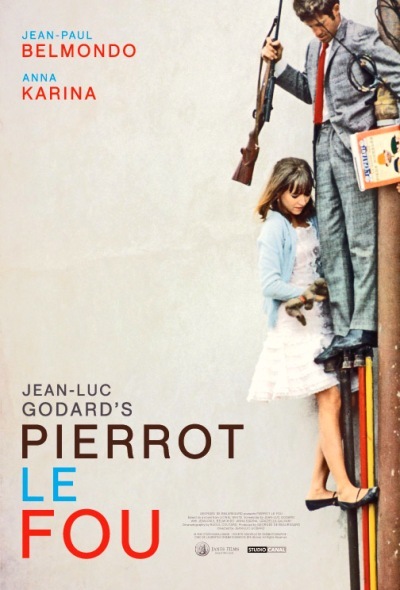
Directed by Jean-Luc Godard and starring Anna Karina, this French film shot like a documentary begins up close and personal in the life of a 22 year old woman named Nana. In 12 separate scenes we slowly are given a view into her life. She goes from leaving her husband, trying to get into the movies, and then finally begins prostituting herself for easy money. All the while this beautiful young lady struggles with men. Here interactions sometimes leave her somber and other times light-hearted. Through it all she tries to live her life the way she sees fit. She might be playing pinball, working in a record shop, viewing a movie, or attempting to pick someone up. She is so alluring in a quiet sort of way and as observers we begin to feel pity for her more than anything. In the end tragedy strikes and all of a sudden it is no longer her life to live. This film had moments where it became talkie however the narrative divided into 12 sequences and the constantly swiveling camera were major attributes. Furthermore, this film appears as if it will be an in depth character study and yet by the time it abruptly ends we hardly know much of anything about Nana besides what is on the outside. In real life Anna Karina would be Godard’s wife for a time and he used her in many of his works.
4.5/5 Stars
Breathless (1960)
The debut of Jean-Luc Godard and starring Jean-Paul Belmondo with Jean Seberg, this film was influential in helping to jump start the French New Wave. The story begins with a small-time thief named Michel stealing a car and then killing a policeman Quickly, he becomes a fugitive in need of money. This brings him in contact with an American journalism student he had met before. They spend time together with Michel professing his love and Patricia still feeling unsure whether or not she truly loves him back. In a final act of reassurance Patricia betrays Michel and he is chased down by the authorities. He is a far cry from the American movie stars and crime films he idolizes. With its jazzy score, bilingual dialogue, jump cuts, and Parisian scenery, this film is chic and cool. It paid homage to Hollywood but it also paved the way for a new era of films starting in the 60s. The film is perhaps not as impressive to today’s audiences but it certainly has a look that you have to appreciate. Godard was ahead of his time because he went against all conventions that had been set up for cinema and he thereby revolutionized the film world.
4.5/5 Stars
The Quiet Man (1952)
Starring John Wayne and Maureen O’Hara with director John Ford, the film follows an ex-American boxer as he returns to his roots in Ireland. Soon he is befriended by the proper yet kindly folk in the quaint town. Also, a beautiful red-haired girl catches his eye one day. Fireworks start between the American and the proud brother, so he will not condone the courtship or marriage of his sister. Finally, Wayne does gain his wife but she is unhappy without her dowry and she believes her husband is a coward since he will not fight for it. Little does she know the past he tried to escape, but once he gets it off his chest, he does fight. Through the exciting event both men grow fond of each other and the town gets a kick out of the entertainment. O’Hara and the rest of the cast including Barry Fitzgerlad are wonderful as the Irish folk, all playing off the Quiet Man.
5/5 Stars
Cool Hand Luke (1967)
In one of his most memorable performances, Paul Newman is Luke Jackson a man put on a chain gang for cutting the heads off parking meters while drunk. Despite the weary and monotonous regiment, Luke will not be cowed and he always keeps his positive demeanor.
Originally the newcomer, Luke quickly earns the respect of everyone including Dragline (George Kennedy), whether he is boxing, eating 50 hard-boiled eggs, or bluffing his way through a card game. Even though he is never quite successful, Luke never stops trying to escape either. His numerous clever attempts lead the Captain (Strother Martin) to utter his famous words about their “failure to communicate.” After multiple escape attempts Luke gets beaten, berated, and tortured.
However, he proves that you can never destroy his spirit no matter how hard yo try and so the ending is inconsequential. So ultimately “Cool Hand Luke” is a winner and a likable one at that.
It is necessary to acknowledge this solid ensemble cast including the likes of Dennis Hopper, Wayne Rogers, Ralph Waite, and of course Joan Van Fleet. Furthermore, there is seemingly no film that better depicts the dirt, grime, heat, and humidity that comes from working in a southern chain gang. The cinematography makes even the audience uncomfortable and a shower seems all but necessary.
Although the focus is often on the indefatigable character of Luke it became evident that this is often a taxing and difficult film to watch especially in the second half. In many ways Luke is the savior of these men in the chain gang and he sacrifices a lot of himself so that they might have some hope. Thus, this film is not just about the highs but the lows as well and Paul Newman plays every moment adeptly with the coolness that Luke Jackson embodies.
5/5 Stars
Leave Her to Heaven (1946) – Film-Noir
Starring Gene Tierney and Cornell Wilde, this film noir is certainly unique. The movie is completely in color, it takes place in quiet locales, and it features a nice family with a new son-in-law. However, Tierney delivers a chilling performance as the jealous and deranged wife who falls for the author Richard Harland (Wilde) and she will not let him go. At first Ellen seems nice enough but all too soon we see the extent she will go to be the only one in Richard’s life. Soon her treatment of others perturbs him and she in turn gets jealous of the attention he gives to her sister. In her final act Ellen commits suicide and tries to pin it on her sister. Even from the grave it seems like she will never give up Richard. However, as we learn from the flashback, this is the first time she did not end up winning. This film is less about action and more about the characters. I must admit Tierney seemed like the greatest villain of all time sitting there callously in the boat and ironically Jeanne Craig became more beautiful the colder Tierney got. Tierney was in a lot of great movies but I think this has to be her best performance because in most of her other movies the audience adores her and here we openly despise her. We cannot wait for her to be left to Heaven so justice can be dealt.
4/5 Stars
How Green Was My Valley (1941)
Starring a cast including Roddy McDowell, Walter Pidgeon, Maureen O’Hara, and Donald Crisp, with director John Ford, the film is told from the eyes of a young boy (McDowell) from a Welsh mining family. Huw has five older brothers, an older sister, and two strong but goodhearted parents. As times get tougher, he sees one brother get married and two others leave for America. Huw faces his own struggles recuperating from an injury and surviving his schooling. Along the way he is aided by the kindly preacher (Pidgeon). However, soon he sees his family torn apart even more when his sister is unhappily married off, a brother is killed, and two others lose their jobs. Then, finally when his sister returns, the town folk start a scandal, and Mr. Morgan becomes trapped in the mine. It does end on a good not and the family stays resilient. This film is full of adversity but more importantly it has warmth and good people. The camera work is excellent and the Welsh singing is memorable.
4.5/5 Stars
Charlie Chaplin’s Little Tramp Who Could: Looking Back after a Century
Before the man with the mustache was Ron Burgundy and even before the Tramp was associated with a dog in a Disney flick, there was another. It has been a century since Charlie Chaplin first developed his Tramp character who is arguably one of the most well-known cultural icons of all time. His persona will forever be identified with that hat, that cane, and of course that mustache.
My musings were inspired by this article:
http://www.latimes.com/entertainment/movies/moviesnow/la-et-mn-charlie-chaplin-tramp-classic-hollywood-20140126,0,4224217.story#axzz2tEoS53ac
The Searchers (1956)
One of John Wayne and John Ford’s best westerns respectively, The Searchers follows an ex-Confederate soldier (Wayne) as he looks for his niece Debbie, who was taken by Indians when they killed her parents. Now Wayne and a young man played by Jefferey Hunter must look for her and bring Debbie home. With an almost obsessive desire, Wayne’s character Ethan Edwards vows to find her. Along the way, the old vet and young man have conflicting personalities that get in the way. Even when they finally find her, she has become more Indian than white, and Edwards seems bent on killing her much to Hunter’s horror. In the end, the gruff but courageous searcher shows his true colors.
A great western, and simply a wonderful film, The Searchers has a lot to offer with great action, Monument Valley scenery, and of course John Wayne. The supporting cast is good as well, including Vera Miles, Natalie Wood, Ward Bond, John Qualen, Hank Worden, and Ken Curtis.
There are some pivotal scenes in this film that I think really get to the core of what it is about, and Ford constructs a multitude of scenes which are simply a joy to observe as they unfold. One turning point has to be when the two Searchers look over a few white girls that the cavalry recovered from the Comanche. One of the girls gives off a childish screech, which causes Ethan to turn around, and Ford’s camera closes in on his scowling face half covered by shadow. Here is a proud man who would not surrender during the end of the Civil War. Here is a man full of prejudice and vengeance. Here is a man who shows glimpses of kindness, and here is a man who knows pain. It is complicated because he heads out after Debbie seemingly in an act of love. But soon it seems that it has become his vendetta, and Ethan has simply become bent on revenge. It takes his final confrontation with Debbie to reveal the true depth of his character.
Undoubtedly this is one of the preeminent American westerns, but I think you could also call it a social commentary on racial prejudice. Furthermore, The Searchers influence ranges from the plight of Luke Skywalker in Star Wars to the music of Buddy Holly (“That’ll be the Day”). I think fittingly enough the film ends with Wayne framed in the doorway, walking off into the distance. After all, he is a searcher, and you cannot expect a man like that to stay put.
5/5 Stars
Shirley Temple Black
With the passing of Shirley Temple Black just yesterday, it made realize that sometimes we do not appreciate people as much until they are gone, which is unfortunate. Now I want to go back and see some of her performances because the only one I have seen in its entirety is probably Heidi. Recently however I did see part of the Bachelor and the Bobby-Soxer and I realized why she was so popular. She was a good little entertainer to be sure, but at her core was this cheerfulness and sweet disposition that resonated with audiences. I hope to discover more of that soon.