Ikiru (1952): Loving and Living

ikiru takashi shimura

“This man bears a cross called cancer. He’s Christ.”

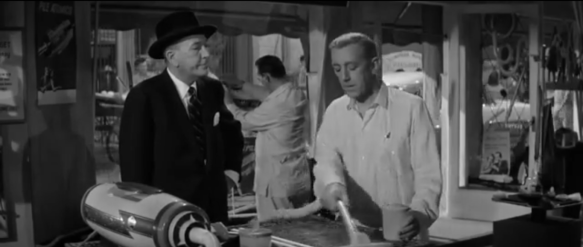
Ikiru is instantly a tale of dramatic irony as we see x-ray footage and an omniscient narrator tells us matter-of-factly the signs of cancer are already obvious. Our protagonist’s work life hits hard as he’s a public affairs section chief — dangerously close to my own title — thoroughly buried in the bureaucracy of Japan.

The great tragedy is how he’s never actually lived. He’s killing time, stamping documents with his inkan (official seal). I know it well because I sat at a desk in Japan watching others doing much the same. There were fewer teetering paper mountaintops around me, but the sentiment holds true. All his will and passion evaporated over the past 20 years. How this happened is made quite clear. We are once again privy to the dizzying circular bureaucracy that I’ve been subjected to in my own lifetime, from college campuses and also living abroad in Japan.

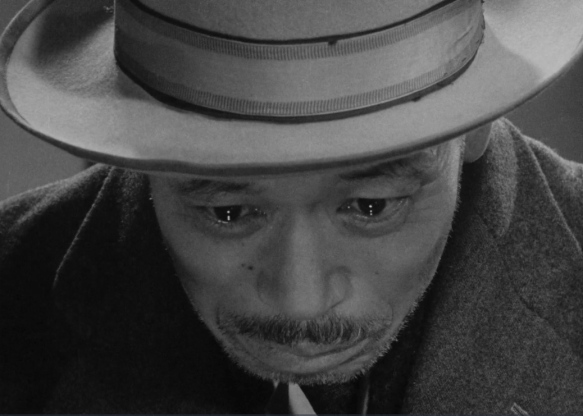
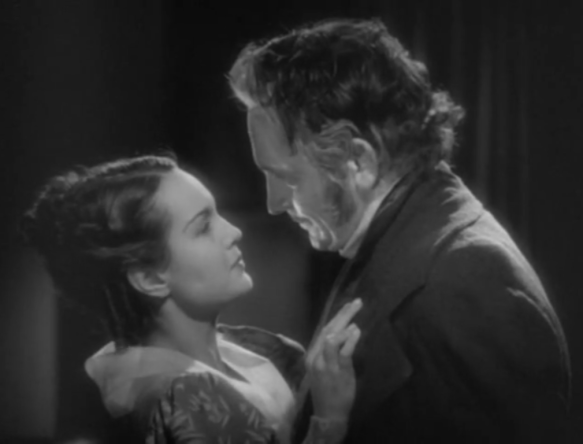
Even as he portrays a man of such a sorry constitution, there’s something instantly endearing about Takashi Shimura. In fact, he has been a friend of mine for quite some time. Aside from Toshiro Mifune and Setsuko Hara, he might be one of Japanese cinema’s most instantly recognizable icons. There’s a glint in his eyes of warmth that so quickly can turn to melancholy. It serves him well in Ikiru as do his distinguished features and graying hair. The dejectedness up his posture, the glumness in his being, verges on camp but it never loses its purpose.

The greatest revelation is the composition of the film itself in the hands of Akira Kurosawa and his editor Koichi Iwashita. I never recalled the editing of the picture, cutting and shifting between time periods. The delight in his son Mitsuo’s athletic prowess only for it to be crushed seconds later on the basepaths. Then, there was the boy’s appendix operation, an event he was not able to stay around for. It paints the relationship with his son, drifting through time, as the world spins around him, and Kurosawa follows the motion to find the heart of his picture.

As Watanabe sinks lower, taking an unprecedented leave from work, leaving all the underlings to surmise the reason, he meets a lowly fiction writer in a bar. The man’s occupation gives him a bit of license to wax philosophical, and he’s more forthcoming, more whimsical than we’re accustomed to coming across, especially in Japanese culture. He tries to empower the dying man to live it up.

After all,  greed is a virtue, especially greed in enjoying life, and so they take to the night scene with reckless abandon blowing Watanabe’s savings in the process. For a night he tries on the life of a profligate and a drunkard with middling results. There are light-up pinball machines, rowdy smoke-filled beer halls, and lively streets overrun by women of the night. They proceed to make their way to every conceivable bar imaginable. As the montage and music roll on and on, I couldn’t help but recall The Best Years of our Lives.

It was a celebration under very different circumstances. A soldier comes back from V-J Day ready to live it up. But much like Watanabe-san, Al (Fredric March) is looking to put off the inevitable for a bit longer. It’s a lot easier to face this heightened reality than the morning after. It’s a diversion tactic.

In one space the two merrymakers totter up the stairs as couples dance cheek to cheek. Their destination seems to be the lively piano bar jumping with tons of western-infused honky-tonk rhythm and blues. But Watanabe-san subsequently brings the mood to a standstill as the house stops to watch him sing a melody born out of the melancholy of the past — reminding us life is brief.

To this point, he feels pitiful almost laughable, laid prostrate by his very drunkenness, and gallivanting around the streets to the sidewalk symphony of honking taxi cabs and the distinct notes of “Bibbity Bobbity Boo.”

The morning after is what we expect. Not only a hangover but real-life sets in and the baggage that comes with it. He realizes his son and daughter-in-law are completely absent. Not only absent; they are indignant about his behavior. Because of course, they don’t understand. He hasn’t told them anything.

Screenshot 2020-04-03 at 65225 PM

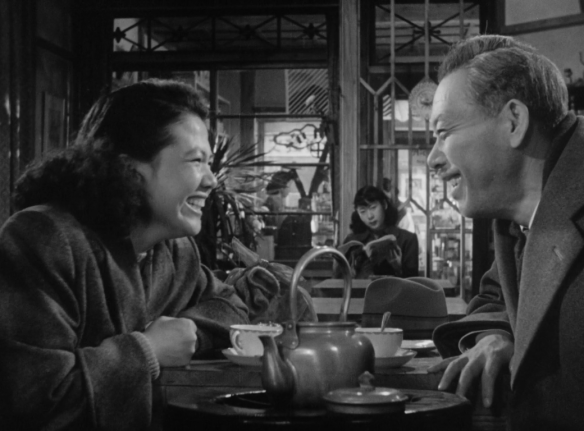
Instead, he gravitates toward the youth of his garrulous young colleague (Miki Odagiri) bursting with untapped spunkiness. The key is how she makes up for his lack of both humor and energy. She somehow uplifts him with her very spirit — teaches him what it means to really live — what it is to have giggle fits. From the outside looking in, without his context, it looks like a sordid romance or some odd preoccupation. It’s more innocent than that.

He recounts how when he was a little kid, he was drowning in a pond; everything was going black as he writhed and thrashed around in the deep void around him. He felt the very same sensation when he found out about his illness — all alone in the world — his son as distant as his mother and father were when he was in the water. Full stop.

Ikiru and the act of living life are split into two distinct segments. Much of it is expounded upon after the inevitable happens and Watanabe-san has passed away. It’s one of the most abrupt deaths in film history. But that was never the point. Death was inevitable. What mattered is how he used the time before. How he lived it out. This tangles with the existential questions of life itself with all its subjectivities.

It sounds callous to say Kurosawa uses the motif, but what unfolds, in narrative terms, is like Rashomon meeting an abridged Citizen Kane. It’s artful and extraordinary taking the recollections of all the observers in his life to try and make sense of this man’s final hours.

The extended scene that follows almost plays out like a parable for me; it makes the dichotomy so apparent even as it expresses so much about these human beings. His fellow bureaucrats shed no tears at his wake. They have no gifts or kind words for him. And yet a host of working-class women, women who only knew him for a very few hours, anoint his burial with tears and burn incense for him.

The rich and well-to-do have no humility, no need, no appreciation because they’ve allowed themselves to be insulated — they believe they’ve brought every good thing on themselves. Revelation falls to those who are less fortunate, who have spent their whole lives impoverished and low. They can appreciate how a simple action by a simple man can be ripe with the kind of profound meaning these men sitting around idly by will never comprehend (much less believe).

It’s admittedly out of left field, but one of the songs I was taken with last year was COIN’s infectious pop record “Cemetery.” Its most gutting line goes, ” Never made time for the family but he is the richest man in the cemetery.” The words terrify me to death, and they inform how I think about Ikiru — its purpose — the meaning of Mr. Watanabe-san’s final act of unswerving resolve.

It’s a warning and a cry, a pronunciation and a prayer for all those who are willing to pay it heed. What is life but to be lived out? There are only a finite amount of hours and days between “In the beginning” and “The end.” There’s no hitch on a hearse. All we can take away from this life is that which is given away. Ikiru must only be understood out of this profound paradox.

Because these men — these acquaintances sit on their duffs partaking of his family’s hospitality — trying as they might, to make sense of the mystery of his transformation. How could this be? What would cause a man to be so radically different even cavalier with both his time and his resources? They quibble about it incessantly as Watanabe-san’s actions make fools of the wise.

It’s really very simple. He says it himself even as he’s half doubled-over with pain, his voice on its last rasping legs, constantly being humiliated. “I can’t afford to hate people. I haven’t got that kind of time.” What if that was our mentality? When I look around me, who is my neighbor? It is anyone and everyone. Not just my friends but the ones who ridicule me — the ones who are hard to live with. What if spent less of my time criticizing and hating and more time loving and living. After all, aren’t they one and the same?

5/5 Stars

The Uninvited (1944) and Stella by Starlight

To place my cards on the table, next to the ouija boards and ghost catchers, I’m not always fond of haunted house movies because how many truly original iterations can you have out of one premise? Granted, there are lots of houses in the world, but how do you make each one stand out among the crowd? If it’s not obvious already I’m already originating from a place of skepticism and apathy. There you have it.

There is some good news. Although The Uninvited won’t exactly make a convert out of me, it is freed up by the fact it was the instigator of many of the archetypes the genre holds onto even to this day. Since this is a movie from the 1940s, the onus is not on the picture to be pop-out scary; instead, it uses its assets of music, mood, and atmosphere to project an inedible impression.

The brother-sister relationship between Ray Milland and Ruth Hussey on the screen is not so common in movies, and you could easily see them playing romantic partners in another movie. The novelty is agreeable enough as they gayly happen upon an old house in Cornwall that they are just thrilled to see since it reminds them of warm childhood memories.

So they walk in of their own accord — their yippy dog scurrying after a squirrel in a fairly spectacular bit of choreography — waltzing around the place just as if they own the place. They have no misgivings until they walk up to an eery room overlooking the cliffside. Just being there makes them heavy and already we have a portent of things to come.

As it turns out, the siblings get an opportunity to buy Windward House and at a real steal too. The owner, a somber commander named Beech (Donald Crisp), is more than happy to get rid of it even as his earnest granddaughter (Gail Russell) can’t bear to see the place leave their possession. You might say she has an attachment, even a compulsion to be there. The old man goes so far as to say the house is filled with malignity against the girl.

Still, brother and sister get their wish, moving in, setting up their housekeeper, and trying to get acclimated. What the sibling dynamic does tease out are other romantic interests. Roderick, for one, is fascinated by the “sleeping beauty magic” about the girl Stella, even as they got off on a bit of a wrong foot.

When they finally do make amends, there’s a conviviality born between them. As a musician and one-time music critic, he plays her quite the tribute: none other than “Stella by Starlight.” It’s an immortal tune, and it also, coincidentally, was composed by Victor Young just for this picture. It becomes a haunting song of lament and romance on par with the entrancing theme from Laura also released the same year. It’s yet another case of music having such a mesmerizing grip on a movie.

If the aura around Laura is one adaptable touchstone, another closely related one is the unnerving ambiance of Rebecca. Daphne du Maurier’s novel, turned into the well-remembered Hitchcock drama, played with this same spectral sense of the otherwordly. The house, Manderley, became a character in its own right, and the deceased first Mrs. De Winter effectively made it into her eternal haunt. As an embodiment of obsessive devotion, Mrs. Danvers played so forebodingly by Judith Anderson, knows few equals.

Much of The Uninvited is about set-up and even the delay tactics bringing us to the point of release. It rarely confronts us only inhabiting the corners and peripheries of the story and milking Charles Lang’s delicious cinematography for every drop of darkness it’s worth. It has a lot to offer.

For instance, there are wailing and moaning noises in the middle of the night. Word of some apparition. Smells of mimosa that flood the air on other occasions. At a later date, their housekeeper raves about a crawling mist upstairs. It’s all very peculiar.

Alan Napier comes into the story as a voice of refined observation — a local physician who partners with them. He effectively brings clarity to the situation by disclosing some of the local history. You see, Stella’s mother died on the edge of the cliffs many years before under tragic circumstances.

If anything, it gives the Fitzgeralds more reason to worry about Stella’s well-being. They somehow decide the best option is to face the spirit head-on with a séance. It’s taken for granted that something exists; this is not a total figment of their overactive imaginations.

And it’s true, something fills up the room. There’s a look in the girl’s eyes of terrible happiness, a possessed euphoria. She’s resolute throughout the entire film; if they destroy that house, they’ll be destroying her. In some unexplainable way, it is a sanctuary for her.

Ultimately, the captain sends her away to a sanitarium run by a local plaster saint, Miss Holloway. Her reputation proceeds her; she’s renowned around town for her charity and stately benevolence. However, up close and personal, it’s only too evident there’s something suspect about her. She obviously still harbors a deep affection for the deceased Mrs. Meredith, championing her memory for future generations. It lends the movie yet another level of subtext.

From thenceforward we deal in ghosts, twists of exposition, and jumps in internal logic that must be parsed through. I’m often not a stickler for plot details, but it felt like The Uninvited ultimately relies on them too much. There are some genuine instances of dread or at the very least intrigue, but I’m more enamored with the Lauras and Rebeccas of the world. Their mystery manages to linger over me.

With The Uninvited my greatest takeaway was “Stella by Starlight” and the starring turn for Gail Russell. She, of course, would remain a bright hopeful in Hollywood for a few more years until alcoholism crippled her career and her personal life. However, within the frames of this movie, she is still brimming with the buoyancy of youth. It’s a pleasure to see her in such a place. If nothing else, I consider this a victory. “Stella by Starlight” might as well be a eulogy to a shooting star that burned out far too quickly.

3.5/5 Stars

Arise, My Love (1940): Milland and Colbert

arise my love milland and colbert

“Arise, my fair love and come away” – Song of Solomon 2:13

The screenplays of Charles Brackett and Billy Wilder are often literal master classes in hooking the audience. They understand intuitively the construction necessary to bring us into a story so we’re invested. Take the opening of Arise, My Love. Yes, there’s some throw-away text about the Spanish Civil War in the summer of 1939. It’s in the aftermath, but then we’re introduced to a telling scene.

One of these soldiers of fortune, American Tom Martin (Ray Milland) sits in confinement as a father (Frank Puglia) from the local monastery pays him a visit. The firing squads right outside his annex make it painfully clear the hour of his own execution is imminent. Those aren’t rubber bullets. The man of faith feels some urgency to ask the prisoner if he even feels penitent — if he needs to clear his chest of anything.

All this sounds rote so far. Anyone could write this scene like so. Then, individuality sets in. Instead of contrition, he bemoans the fact he didn’t get into the action with Chamberlain and Hitler nor has he gotten a chance to take potshots at Nazis. It has the vitriolic gallows wit of Wilder setting up the gag.

Here’s the kicker. The inevitable is whisked right out from under Martin by the most unexpected of Providences. He’s been granted a pardon! It came through the pleading of his wife! It’s an obvious punchline if I know Wilder (and Brackett): he has no wife!

This plucky mystery woman (Claudette Colbert) is a reporter out for a story and boy does she has a way of making a doozy of a spread. They get out of the scenario thanks to her charm, his flying, and a bit of luck.

We are reminded the movie is planted squarely in its moment from the headlines about the Yankees in the World Series and the hunt for Scarlet O’Hara finally being over. Tom was among three American flyboys, who are a group of idealistic interventionists siding with the little guys against the big boys.

Paris, the city of amour, is still free from Nazi influence, and the pilot does his best to channel what’s already in the air. “Gusto” rebuffs him — albeit good-naturedly — because she’s an all-or-nothing gal. She knows if she says “yes” she’ll be head over heels. There’s nothing wrong with that per se. But she’s a career woman.

Now Claudette Colbert doesn’t quite strike me as a typewriter-plunking type like Rosalind Russell or Barbara Stanwyck — one of the boys as it were — but she comes off as deliriously happy. Because it feels like she’s in her element again in this world, whether or not it’s totally manufactured by Hollywood. As her slighted suitor sits in the Cafe Magenta just betting she’ll walk over from her hotel, she looks to climb the journalistic ladder.

She’s dropped with quite the gig: Special Berlin Correspondent. The previous correspondent was kindly asked to leave by the Nazis. Among other infractions, he went to a reception for Herr von Ribbentropp and yelled “Gefilte Fish!”

The agitated editor (Walter Abel) is a long-running trope, but here it works as well as it did anywhere else in that he provides yet another antagonistic force to push against our heroine. Although, given the state of the world, she hardly needs it. He more likely serves as a bit of comic relief.

Because while Tom decides to go off to Warsaw, Poland to fly with his buddies (“I’ve always wanted to drop something on Hamburg after I got ptomaine from that hamburger”), while simultaneously stealing a few more hours with Gusto, Hitler rudely kicks off WWII. They plan to get out of town on the fated S.S. Athenia. No one told them the battle for the Atlantic has already geared up. Though hit hard, they are luckier than most. At the end of the day, Tom and Gusto are still together (and alive)…

Screenshot 2020-03-30 at 81502 PM

If you humor me for only a moment, there is a habit that can get me into trouble. Reading other people’s reviews. I’m as insecure as the next fellow about my writing. I could never do it as well as so-and-so or why didn’t I think of that? That’s all that comparison gets you. Worse yet it can start infecting your own point of view if you consider other voices. Usually, I hold off until after my words are set in cement.

However, in a rare instance, I happened upon a contemporary review of Bosley Crowther, and it gave birth to some thoughts. He ends his piece on Arise, My Love in this manner:

“It is simply a synthetic picture which attempts to give consequence to a pleasant April-in-Paris romance by involving it in the realities of war — but a war which is patently conceived by someone who has been reading headlines in California. Miss Colbert and Mr. Milland are very charming when tête-tête. But, with Europe going up in flames around them, they are, paradoxically, not so hot. Same goes for the film.”

While I understand where Crowther is coming from, I will politely dissent, armed with hindsight as I most conveniently am. I’m often of the mind Hollywood folks are too self-important. How much influence do they really have? And yet even to look back at cinema in 1940 there is a sense there was real social importance in the movies being made — at least the ones that were truly aware of the cultural moment.

I am reminded Hitler was a cinema nut and Goebbels (derided briefly in this film) was deeply engaged in harnessing film for propagandistic purposes. Hitler even had a special prize for capturing Clark Gable. They really could be taken down a few pegs by the medium they too seemed to admire in spite of all their dementedness, and it’s quite a fitting mode of attack.

Think of Chaplin’s lampoon. Think of the various contours of Nazi menace explored in the likes of The Night Train to Munich, Foreign Correspondent, and The Mortal Storm from both inside and out. Hold Back The Dawn shows the implications on the American home front. Even the passing remark from Cary Grant in His Girl Friday to stick Hitler on the funny pages brandishes something momentarily powerful.

If Billy Wilder is not considered to be an integral part of this company, he deserves to be. Because Arise, My Love taps into the same immediacy available only in those uncertain months. He gladly sticks his nose out to be bitten and whether it was from the relative comfort of California, Wilder was not a stranger to personal heartache. He lost loved ones at the hands of the Nazis. It’s a personal context I doubt Crowther could have been aware of. Arise, My Love was promoted as a romance that could only happen in 1940, which is a key to its resonance; it’s effectively encased in the amber of the times.

The final interludes are in a forest, a pasture, as Colbert stands on her soapbox, as it were, in a lasting embrace with her love. It’s not as stunning as Joel McCrea’s delivery of Ben Hecht’s prose in Foreign Correspondent, nor is it Wilder/Brackett’s finest hour. But that’s just it.

For an effort that’s not even that well-remembered in Classic movie circles, Arise, My Love is a charming picture. The word proves apt for much of Mitchell Leisen’s filmography. And yet there is the undeniable wit and sophistication of its writers. Right down to its title. The full passage reads like this:

My beloved speaks and says to me:
“Arise, my love, my beautiful one,
and come away,
11 for behold, the winter is past;
the rain is over and gone.
12 The flowers appear on the earth,
the time of singing has come,
and the voice of the turtledove
is heard in our land.
13 The fig tree ripens its figs,
and the vines are in blossom;
they give forth fragrance.
Arise, my love, my beautiful one,
and come away.

So you see, it’s not only an inflection of passionate love but also naturalistic hope.

3.5/5 Stars

Ruggles of Red Gap (1935): An All-American Gentleman’s Gentleman

Screenshot 2020-04-01 at 82751 PM

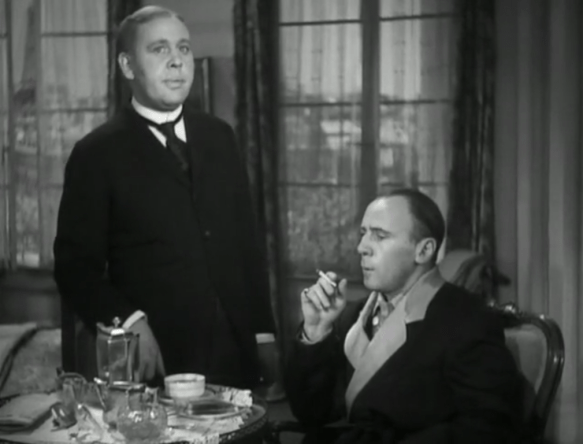
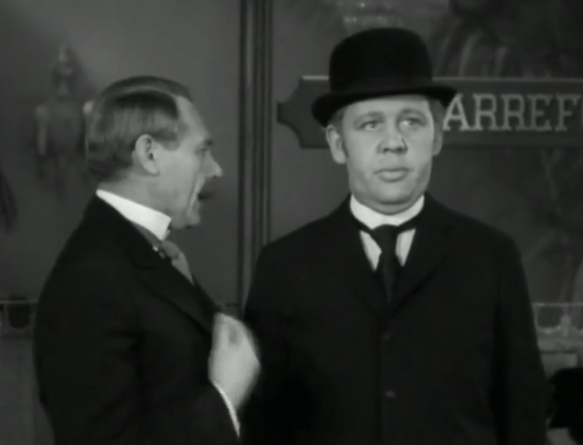
It’s Paris in the spring of 1908. The mumble-mouthed, rather sheepish Roland Young admits to his manservant Ruggles (Charles Laughton) he’s gone and lost him in a poker game. He was terribly good at the art of bluffing. A little too good as it were.

The kicker is the folks he’s handing him off to, vacationers from rural America! Ruggles does a deadpan double-take upon hearing he might be sent to the United States: the land of slavery. His former lord helpfully interjects a fellow named Pocahontas helped put an end to that.

The husband, played by Charlie Ruggles (Coincidentally, sharing his name with one of our characters), is Egbert Floud, a man of the land, totally at odds with hoighty-toighty Parisian high society. He has no qualms about his heritage. In fact, he’s darn proud of it. Handlebar mustache and all.

His wife (Mary Boland) is positively obsessed with social status — tone and Joyeux de vie — and acquiring Ruggles so they might gain a new sophistication. When her husband learns they are about to have a servant, his voice is exasperation personified.

She makes him go off to get some culture, and he proceeds to drag his new manservant along to the nearest gin joint. He’s not a man beholden to any kind of hierarchy. Everyone is a neighbor and a friend. It’s quite unsettling to Ruggles at first, if not a totally novel concept. He’s never had cause to fraternize with Americans before.

Charles Laughton, eyes lolling about in his head, makes it one of the funniest situations I’ve been privy to in some time. To call him robotic is doing him a discredit. He’s so stiff it emphasizes his propriety and his station in life. He’s quietly beside himself performing his duties with these fits and starts. Then, he’s subsequently crawling inside his skin at the cavalier indecency of what he’s being subjected to; he’s too well-mannered to dissent of course.

Except the punchline is how easily he mellows in the company of Egbert and one of his buddies. The alcohol flows, they take to a carousel and wind up crashing Effie’s grand dinner party royally swacked, Ruggles most of all. Mrs. Floud attempting to apologize to the guests with her infantile French. It signals a change and the mistress of the house starts to disdain her help for leading her husband astray — even if it’s decidedly the other way around.

Screenshot 2020-04-01 at 83747 PM

But the great departure happens and with it comes Ruggles fateful arrival in Red Gap, a place he’s no doubt been dreading for some time. For him, it’s a distant incarnation of America and their antediluvian ways.

What a surprise it is that he makes a striking first impression. Everyone seems to take an instant shining to him as Egbert walks him around to introduce him to all his pals, bestowing him the good-natured nickname “Colonel Ruggles.”

He catches the eye of Mrs. Judson (Zasu Pitts) after complimenting her meat sauce. Meanwhile, the editor of the local paper takes an interest in this regal gentleman with military rank, ready to write an entire spread about him on the spot. Almost instantly he’s become a local celebrity.

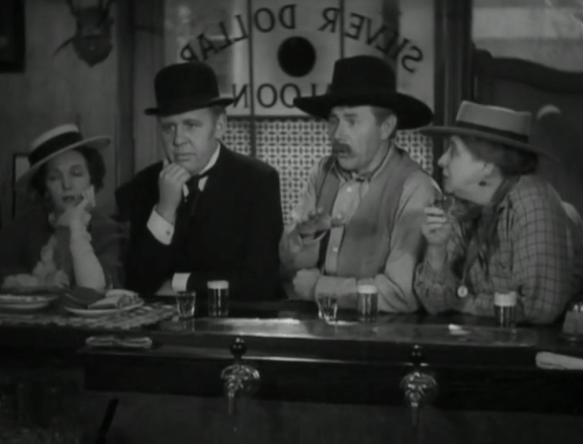
He is quite taken with the life and the normally raw, rough and tumble lifestyle takes a genuine shine to him, at least the good honest folk who still have a love of the land and earthier ways. Ironically it’s the aspiring elites — like Effie Flowd — who are turned off by him, whether through misunderstanding or jealousy. He has breeding they can never hope to have.

The best part of Laughton’s performance is how he’ll slyly “break character” as it were, getting drunk on the town in Paris, stirred on by his jovial company, and then later giving a particularly aggravating man named Belknap-Jackson a kick in the seat of the pants in retaliation (the other man did it to him first). It’s these wildly conceived digressions making the movie for me because Ruggles suddenly breaks out of the convenient archetype we have for him as a gentleman’s gentleman.

I grew up watching (and reading) a lot of Jeeves and Wooster after all, where the comedy is born out of the continually failed plans and romantic miscues of the dopey protagonist. It’s his man Jeeves who must use his acumen to rescue his master from inevitable social suicide.

The beauty of this narrative is how it poses one obvious scenario before devolving into something else. Far from being a story of class clashes, it is a fish-out-of-water tale turned on its head. Ruggles is gradually transformed into a new man, exercising unheard-of freedom over his own life. He becomes a man whose future is entirely in his own hands, and he’s totally taken with the ideology of America.

One day he is unceremoniously fired by his rival just as he was sitting down with an improving book on the 16th president of the United States. At first, you think nothing of it — the book he’s reading. However, most crucially he rectifies his former historical blunder. It was not Pocahontas who had a part in freeing the slaves but Abraham Lincoln.

In the local saloon, he is reminded of who his friends really are and he, in turn, reminds them what their country is really about. What’d Lincoln say at Gettysburg? Everyone’s asking everyone else and nobody knows. Even in 1935, arguably in earshot of someone who could have been there, it’s still a fickle generation far too easily forgetting the past.

It’s easy to feel a bit tentative about themes of Lincoln as a white savior. That he single-handedly fixed the problems of America. That he was a martyr for a cause. But the movie never quite says any of this. I’m putting words into its mouth. What it does suggest is the egregious sin slavery engendered on American soil. Thus, it’s not totally Pollyanna.

Instead, Ruggles stands up and evokes the words of the great emancipator. I need not recite them and could not, but they instill in the people of Red Gap what are nation is called to — exemplifying the principles meant to set this land apart.  It’s a sober reminder that it’s sometimes those on the outside who recognize the great luxuries we are afforded and must give us pause.

Screenshot 2020-04-01 at 92857 PM

The final act keeps on riding these same waves with the grand opening of Ruggle’s new restaurant, offering two major developments. First, there is the return of the Earl of Burnstead — honored guest of the Flowds — who shows up late to announce his marriage to a local girl. Ruggles, having quite enough of the conceited Belknapp-Jackson, boots him soundly out of his establishment with added relish.

However, as a result of his unseemly behavior, Ruggles thinks his reputation and his business are finished for good. And yet he goes out the kitchen’s swinging doors to hear “He’s a Jolly Good Fellow,” not for the Earl but for him! If the Gettysburg address is the first moment of immense pathos, this is the crescendo — the camera turning to the reactions of all the town — these folks who all are part of his adoring crowd. They sing and smile and clap for him.

In my own sentimentality, I couldn’t help but think of George Bailey’s own serenade as all his friends gather around him to lift him up. There’s the same kind of communal exultation and the joy of being beloved by the company around you. It leaves Ruggles almost speechless. So Egbert pushes him through the swinging doors so he can snatch a kiss from his best girl.

I’m not sure I believe in love at first sight, regardless, I was positively charmed by this picture. The cast feels impeccably crafted to fit together, teasing out the comedy and making the story develop into a full-bodied piece of humor and All-American tenderness. It takes caricatures and stereotypes and somehow molds them into the most honorable and lovable ideals.

However, in the context of the times, Leo McCarey’s comedy — his first removed from the very particular influence of The Marx Brothers — feels more like a precursor to Preston Sturgess than a Capra picture. There’s the influence of the pure zaniness of the scenario, with the social elites being brought down a few pegs. Moreover, it feels like there’s a sense, this hope and hankering for America and humanity as a whole to still be something we can believe in.

The farce is of the most good-natured variety. Far from being vitriolic, we laugh with those we were meant to laugh with and laugh at all others who more than deserve it. It might be a simple, idealistic world, but sometimes it’s nice to believe that a gentlemen’s gentleman can make something of himself — like a  well-respected pillar of society in Red Gap, Washington. It works because the gags give way to something more.

For a first-time comedian, Charles Laughton is superb. But he’s hardly a one-man show. That’s the beauty of it. There’s a kind of genial comedic utilitarianism to the proceedings where all can be involved — audience included.

4.5/5 Stars

Les Miserables (1935) and Candlesticks

les miserables 1935 march and laughton

There’s a biblical verse that warns against storing up treasures in heaven where moth and rust destroy and where thieves break in a steal. Jean Valjean keeps two silver candlesticks with him always — they’re probably the nicest things he owns — but their true value signifies something more than worldly wealth.

While it cannot cope with the sheer scale and transcendent grandiloquence of Victor Hugo’s eponymous work, 20th Century Fox makes a valiant go at it using all the resources at its disposal to deliver the 1930s version of a prestige period piece.

Jean Valjean (Fredric March) is before the courts in the year 1800. The judge utters the purposefully grating words “guilty until proven innocent.” After all, the law is explicit. It makes no provisions for a man who stole out of desperation since he couldn’t get work with none to be found. His sister and nephew were starving. It makes no difference. Retribution is swift. 10 years in the galleys for his infraction.

Watching March in such abhorrent conditions is akin to any major movie star being forced to suffer so. Errol Flynn suffered a similar fate in Captain Blood. Charlton Heston and Kirk Douglas being enslaved years later also springs to mind. There’s a fortitude they earn in conjunction with the audience. It makes us commiserate with their lot in life — especially when the world seems so unfair.

Stylistically, the direction is a bit clunky with nothing particularly appealing with how Richard Boleslawski handles the material but given who he’s taking from, perhaps it’s for the best there are not many undue flourishes. Although artistic license is taken with innumerable details, the general essence of the novel (from what little I know) is still present, and, if anything, it has been shaped into a social piece to speak to the times.

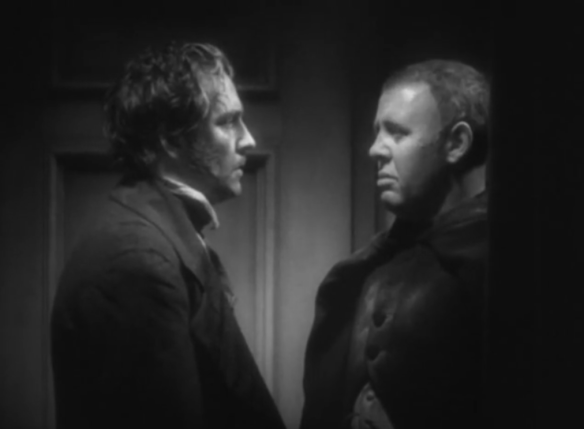
But we have yet to speak of the story’s other crucial figure. Javert (Charles Laughton) is a devoted lawman with a sordid family history hanging over him. He’s trying to do everything in his power to get out from under its legacy.

There’s a recalcitrant timidity to Laughton even as he plays another fellow with power (like Captain Bligh) who is wholly beholden to the law. It becomes more and more apparent how relentless he is in his line of work — to the point of obsession and steep paranoia.

But make no mistake. He is no Captain Bligh. Laughton brings something of a different sort to him going beyond convenient descriptors. He’s merciless in another way with a deceptive even evasive cunning. And again you can’t help but feel sorry for the compulsive way in which he adheres to his duties. There’s something behind his eyes crying out even as his posture is always uncomfortable.  Can we say he’s fragile? Somewhere in there is the little boy making amends for his parent’s failures. He’s part of the same legalistic system that put Jean Valjean into prison.

Here the candlesticks come back into play. The 10 years are up and after an escape attempt, our protagonist gets out of prison hardened and totally skeptical of the rehabilitation the government has in mind for him.

It’s not simply about there being no room; no one wants a scraggly social pariah like him in their establishment. He’s subsequently kicked out of every tavern and evey inn. It gets to the point that he sits in the pelting rain covering himself feebly against the elements. There’s one person he hasn’t tried and on some friendly advice, he seeks asylum with a local bishop (the quietly unperturbed Cedrick Hardwicke).

He soon is introduced to a kind of up-side-down radical generosity (involving the very same candlesticks), which feels so foolish by the world’s standards. And yet it makes people sit up and take note. For one, Valjean, who is a beneficiary, is blessed by charity in ways he’s never experienced in his life.  It changes him, even melts his jaundiced attitudes. Angelic choruses are sung over triumphant imagery as Valjean takes on a firm resolve to change his life.

The movie makes it obvious. He literally becomes a new man — more like the well-groomed, charismatic Fredric March we typically know. He’s robed with a new character and from henceforward March wears the role quite regally going from forlorn criminal to man of the people, held in the highest regard. It’s not an altogether straightforward transformation, and he still manages it with relative ease.

Javert is his obvious foil. The two of them are incongruous. Valjean at his new post as mayor is forever dogged by the inspector’s unyielding ways. Yet again, justice cannot be tempered by mercy. If it’s not already obvious within the dramatic situation, Valjean’s own past must collide with Javert’s hound-like instinct.

les miserables Rochelle Hudson and Fredric March

As a charming background detail informing the film, March gets the opportunity to play across from his real-life spouse of many years Florence Eldridge. However, it is her cinematic daughter who is the other most integral piece. Cosette is a charming girl and an even more effervescent young woman (Rochelle Hudson). She makes her adopted father all the happier and fast becomes his most cherished treasure in the world.

The final sequence in this Les Mis is the first great show of period hubbub with gunfire, swords, horsemen, and smoke all conjoining on the screen. The youth movements have stirred up against the authoritarian forces of the status quo. It’s their fearless leader, Marius (John Beal), who is smitten with Cosette and vice versa. However, it never feels like a purely political story. We never hear the gory details of Napoleon or any of the trials and tribulations besetting Hugo himself for his outgoing stances.

It’s all about giving Valjean a stake in this cultural moment even as he and Javert must have their inevitable faceoff. First and foremost, it must be understood as a broader tale of sacrifice, forgiveness, and redemption. These are big words but then again, there are few books more deserving of such consideration.

It’s no wonder Valjean and Javert are archetypes unto themselves. One of sacrifice, the other of tragedy. The weight of the debt he owes — one he cannot repay — is far too much for Javert to bear. He takes a leap into the realm of Judas Iscariot as the story’s great catastrophe. Is he a villain? Aren’t we all?

The conceit at the center of this adaptation might be simplified, but it gets the theme across. Namely, it takes someone showing us the depths of grace and mercy for us to truly experience what radical love looks like. The law in all its nobility, justice, and truth will crush us under its weight. We cannot stand up against its regulations or else we’ll die trying. It’s best to realize our shortcomings and lend a generous hand to others.

Also, it gives a striking new meaning to candlesticks. They are no longer a blunt instrument with which to murder someone in the parlor. Instead, they are tokens, even tools, of redemption. Though only for some.

4/5 Stars

Mutiny on The Bounty (1935) with Gable, Laughton, and Tone

mutiny on the bounty

More recently I’ve found myself straying away from period pieces and epics and not necessarily because there is something fundamentally off-putting about them. Nor do I think it can solely be blamed on my admittedly short attention span in this increasingly inane and vapid social media-fueled society we live in.

To prove my reasoning, I only need to express a couple of repurposed lines, “To whom much is given, much is required.” It’s not from Spider-Man, no, but it does suggest a movie like Mutiny on the Bounty already has a mountain to climb. It needs to do more to wow me than one of its shorter more economical brethren. Therein lies the issue at hand: greater expectations.

The year is 1787 and the Royal Navy is on a mission to acquire breadfruit trees as sustenance for slaves in the West Indies. This is implied to be a tale about how a mutiny led by a man named Fletcher Christian (Clark Gable) laid the groundwork for modern British sea law still ruling the seas to the present day (that is, 1935).

Thankfully, it never feels quite like we are being taught a moral or a lesson of social significance. It’s nothing more than entertainment, though it’s still one of the great seafaring epics (not starring Errol Flynn).

A handful of hapless men are pulled out of a tavern away from their wives and loved ones and conscripted into a two years voyage with a Captain Bligh (Charles Laughton). Another man of privileged stock takes his post gladly (Franchot Tone).

When his crew is finally aboard and assembled, Bligh sets the precedent of unyielding discipline with a flogging of some poor unfortunate chap. His men look on gravely, no doubt questioning what they’ve gotten themselves into. It’s true the sea is a fierce adversary with gales whipped up and immersive wave-drenched decks swaying madly under their legs. However, if there is a touch of man vs nature in the drama, it’s even more vehemently about bouts of human conflict and insurrection.

Director Frank Lloyd makes liberal use of claustrophobic close-ups played in sharp juxtaposition to the more grandiose naval imagery. It signals the tone of the world even as this grand scale is made tactile through the onscreen relationships. Namely, that of a tyrannical captain and his hapless crew as he ceaselessly dishes out lashes and other sordid punishments indiscriminately even unto the point of death. There must be a breaking point. For now, we wait as they grin and bear their taskmaster.

One of the few sources of jocularity is the ship’s surgeon (Dudley Digges) a blustering old sea dog who dubiously lost his leg — the story of how it happened is the source of many of his largest yarns. Still, he too is in danger of being a casualty. No one is safe on a boat where the most precious cargo is botanical and not human. It’s these plants that are given preferential treatment when rations are concerned.

The crew is half-raving, stir-crazy as they finally weigh anchor on the shores of Tahiti — taken by the country’s beauty, coconut milk, and native girls. Our voyage has reached its midpoint and dipped its toes into what feels like paradise. Is it a coincidence that Bligh seems to all but disappear? Instead,  Tone busies himself picking up as much of the dialect as possible, and then Gable is taken by the pretty woman making eyes at him; they don’t need language to communicate.

mutiny on the bounty Gable and Tone

It’s the interim period of leisure and romance. But this respite must come to an end and with it, we arrive at the beginning of the end. After all, the whole story has been mounting to this precise point as we’ve all but avoided the inevitable.

If I’m to engage with my boyhood proclivities, Mutiny is not much of an actioner or at least not in the sense of a rip-roaring swashbuckler. It’s a war between titans, men of differing ideals, only to be interrupted by the unpredictable ferocity of the sea. So in this way, it’s more of a character piece injected with action. Still, this is not the bottom line.

The conflict is in staying the voyage (and the film) to see whose will is enacted in the end: Bligh’s or Christians with Byam forced to navigate the turbulent waters of ambiguity in-between. One positive of the picture is how none of the three men seem to entirely steal the show; they seem to be on surprisingly equal footing.

Yes, Laughton is an impudent, bull-headed taskmaster but hardly one of the most nefarious villains of all time. This is a tribute to the actor. He sculpts Bligh into a wretched, small-time human being who’s too big for his britches.  A paranoid weasel blinded by his devotion to duty and the sound of his own voice. He doesn’t forget those who revolt and his retribution is swift.

However, he is all but cast aside and forgotten, an insignificant little man, who knows how to make his way amid the rules and regulations of the Navy. It’s a more galling ending than if he had been lost at sea or most preferably eaten by a shark. But Laughton is a credit to the role showcasing his mind-boggling dexterity and range among actors of his day and age.

Gable is ultimately made into a kind of mythical figure out there on the ocean somewhere, but he is not destined to wander aimlessly — he and his rag-tag crew find a place to rest and call home. He wears the fierce, proud masculinity of Fletcher Christian just as you would expect him to (with our without his trademark pencil-thin mustache).

But if they are the two behemoths doing war against one another with the ship and the sea as their arena of battle, it is Tone who actually gets the final word as our initial in to the story. He is the every man, and therefore, the voice of reason for all of us. While I wouldn’t go out on the plank to say The Mutiny on The Bounty is a so-called “great film,” it does a service to its genre as one of MGM’s most prominent period pieces of the decade and a fine showcase for some of their most acclaimed stars.

4/5 Stars

It Happened One Night (1934): Carrots and The Walls of Jericho

it happened one night 1934

When I was growing up we had a VHS of Warner Bros. Bugs Bunny cartoons and like any lad my age, he was an immediate sensation. Casual, mischievous, and yet generally good-natured and out-and-out hilarious. I had no concept of cartoon logic and what made him so memorable as a cartoon character; you didn’t have to tell me. I knew he was because he made me laugh.

Well, it turns out I must attribute some of this childhood entertainment to It Happened One Night because, without the inspiration of its own fanciful whimsy, Bugs Bunny as we know him might never have been born.

But let us rewind for a moment. The movie itself is conceived with one of the great screwball openings as spoiled Ellie Andrews (Claudette Colbert) quarrels with her protective father (Walter Connolly) about being held against her will on his yacht. Not to be outdone, she dives off the side of the boat and swims away ready to join her suitor.

Meanwhile, Clark Gable is Peter Warne, a man of the people — drunkards, vagabonds, and newspapermen — recently fired from his paper and looking for a way to get back in his editor’s good graces.

There’s a sense he would not have gotten this kind of rounded, contoured part at MGM, which was more intent on casting him as their ever-reliable, hard-edged he-man keeping all the hearts of their leading ladies palpating. It has to do with audience supply and demand. It Happened One Night allows him to live a little — to burst out of the mold created for him at his home studio — and the results are a divine departure.

Today the night bus circuit feels like an antiquated or at least a bygone segment of society. Not that Greyhounds don’t exist, but the world’s been proliferated with commercial air travel made available to the economy classes over the past 80 years.

In It Happened One Night, it’s a convenience only to be utilized by those affluent enough to afford such luxury. Hence, the reason Ellie’s father goes searching for her by aeroplane.

What the road trip becomes is a kind of universal equalizer where everyone is on the same playing field, low on money and just getting by. As an audience, for the majority of time, we are resigned to view life from the cheap seats with everyone else. It breeds this kind of communal rapport that only builds over time. Because, of course, two of our co-passengers wind up being Colbert and Gable.

So we have an element of class injected into the action as Ellie is forced off her high-horse. She gets a reality check of how real people live and what life’s like with moderate inconveniences and discomforts. These are sensations she has never experienced. They are foreign to her world. She’s also an easy target getting her suitcase swiped from under her nose.

Being on the lam, it’s not like she can wire dear old dad for more funds. Likewise, lowlifes like the skeezy Roscoe Karns, one-on-the-side Shapely, with an accent on fun, are on the prowl for a pretty dame to annoy. However, it’s Karns portrayal giving the world one of its other foremost cultural icons. That’s right, doc. Bug Bunny!

In the end, Gable dreams up a farfetched gangster plot to keep him quiet sending the spineless sot fleeing for his life. Because this is the role of Peter. He’s a real person; he’s seen the world and knows how to take care of himself. So despite their initial antagonism, Ellie sheds her ignorance and grows to appreciate the man’s watchful eye verging on moments of brusque thoughtfulness.

He sets them up with two separate beds at Dyke’s auto camp when they are forced to take a rainy evening detour. For Ellie, she has the unpleasant sensation of playing his wife, and it adds the tension to the preempted romance.

Gable dominates the evening when he strips down to his bare chest and supposedly helped increase the mortality rates of male undershirts all across the country. You can’t say people didn’t notice, Ellie included. So she joins the Israelites on the other side of “The Walls of Jericho,” the blanket keeping them at a respectable distance.

This scene is a lynchpin moment based on what happens the following morning. Ellie wakes up, and it’s like a switch has gone off. She meets the day disgustingly cheerful as if a screwball dame has replaced her formerly socialite self. We’ve entered the role reversal.

Screenshot 2020-03-27 at 90331 PM

At first, it’s all fun and games as we witness the utter lunacy of their escapades, maintaining the charade for a couple of detectives nosing around for dear old dad. Peter teaches his travel companion about a real piggyback ride — a pastime for the humble and the poor. Low on money, they hitchhike and gnaw on raw carrots by the roadside (like a certain looney tune).

It turns into the Indianapolis speedway as he attempts unsuccessfully to hail a ride. His thumb proves ineffective. Claudette Colbert has a far more viable solution. It’s yet another turn in the story — from helpless waif to resourceful daytripper.

The joy of the movie is how there is a pace to it because we all know intuitively we need to get to New York with Claudette. Capra mimics the continual movement of the film from town to town with his camera set on a crane to follow his couple on their road together. And yet as she begins to soften and warm to her co-companion, some of the urgency is lost but not the delight of the film.

Because we’ve already had time to grow with the characters, appreciate what they’ve drummed up together, and desire to spend the rest of our time with them. Anything else would feel like an early and highly disagreeable end to our time together. What’s marvelous is how Claudette doesn’t want it to end either. The three hours to New York never felt more infinitesimal.

Peter’s exclusive story feels immaterial; he’s certainly not taking any notes to develop copy, and the nightly rituals, The Walls of Jericho et al. feel rote at this point. Where might they go from here? It calls for some kind of emotional response.

Colbert obliges. The love is there. He just needs to respond — to understand there really is something fundamentally different about who she is as a person. Still, fate gets in the way as it always has a habit of doing in rom-coms. There would be no final act otherwise.

The most glorious discovery is not solely our leads but Walter Connolly who is granted a change of heart, one that the final act requires, I might add. Suddenly, we have a new screwball wrinkle: a father who is benevolent and understanding nudging his daughter on to ditch convention and the foregone wedding march for someone she really loves.

Why does this change happen you ask? Much like Colbert’s evolution, I’m not sure we can pinpoint it specifically, nor do we care. The only thing that matters is the inevitable: The Walls of Jericho come tumbling down. Ellie and Peter are finally allowed to know one another in the Biblical sense.

5/5 Stars

Rain (1932): Joan Crawford and Walter Huston

Rain finds its origins in a short story by W. Somerset Maugham, and it was also preceded by a picture starring Gloria Swanson titled Sadie Thompson. She is indeed the central character of this adaptation as well, although the title of this version focuses in on the dreary poeticism.

It’s true that a kind of rainy exoticism defines the entire mood of Lewis Milestone’s movie as this perpetual gloominess sets the tone for the story at stake. A few years before Safe in Hell, we have another picture set on an island. This one is named Pago Pago, and it serves as a weigh station for passengers during a cholera scare.

Among those laid up are Mr. and Mrs. Alfred Davidson (Walter Huston and Beulah Bondi), a pair of religious reformers, who are intent on completing their voyage so they might begin administering to the nonbelievers. They are reformers who’ll gladly break your back to save your soul.

The good, innocuous Doctor MacPhail (Matt Moore) feels like an author’s creation; he’s a character we can identify with as an audience — a stand-in of sorts — who ably fits into the company of respectable folks but remains an impartial observer.

Then, you have a much different ilk, part of the earthier, more salacious crowd, headed up by the island’s local proprietor (Guy Kibbee) and made a lot more enticing by the one and only Sadie Thompson (Joan Crawford). With her checkered dress and made-up eyes, she falls in with the soldier boys on leave, introduced in saucy fashion through a mixture of appendages and hot jazz. In her own estimation, some lively music and a nip of liquor are what rainy days are for.

The movie itself can easily be summed up by a clash of moral prerogatives; it becomes plainly apparent who’s on each side. Kibbee’s character is especially wary of their latest visitors because it’s crusaders like them who readily sully the last remnants of earthly paradise. This is his picture of Eden — freedom to do whatever he sees fit — although it’s quite different than their conception of it. He’s got a gripe with their kind because they represent the age and the newest commandment, “thou shall not enjoy life.”

Throughout the movie, Milestone’s whips and whirls make the film feel all the more alive even as it rages to burst out of the restraint and aestheticism of its more pious players. This obvious motion accentuates what otherwise feels a bit like an island chamber piece.

Because it’s built completely out of the performances. First, it’s Mrs. Davenport (Bondi) denouncing the lady of loose morals dancing on the Lord’s Day — the sabbath — and she wants her husband to put the fear of God into the tramp.

Soon enough, he does just that, confronting Sadie with the fervent belief that it is up to him to save her incorrigible soul. Though he admittedly burns with conviction, it’s his overall demeanor that’s off-putting to the likes of her. She doesn’t take kindly to his Pharisaic demeanor.

Their words, thoughts, and deeds are worlds apart as exemplified in this more understated confrontation. We see them for who they are fundamentally at the core of their beings. He talks of presenting her “a gift.” He’s speaking of eternal things — salvation as Christians think of it — this is her chance to be saved. Meanwhile, she’s thinking about life on this terrestrial rock. Where people get knocked down and beaten up and the like. It’s in this world where she reckons to make out and survive, living her happy-go-lucky kind of life day-to-day.

More than rejecting his religiosity, she rejects his self-righteousness even as his pronouncements come off almost incomprehensible to her. What she does understand is his dismissiveness, his callousness toward her precarious station in life. The doctor, standing by the wayside for most of the picture, finally lets his companion know he thinks the man harsh and tyrannical,  although Davenport affirms his heart bleeds for the poor wayward sinner.

The reformer evokes the Lord’s Prayer as Sadie rails into him with her own indignant tirade only for it to evaporate around her. It comes out of a place of fear and dejection. For all her outward confidence, she really doesn’t know what she’s doing. Shell-shocked piety is a strange garment for her to wear if altogether understandable. But others must judge the outcomes for themselves and the same goes for the denouement.

For all its provocative flaunting in the beginning, Rain relies on an ending of inference, happening between the lines. A lot is at play in the final moments on a subtextual level — be it latent desires or closeted hypocrisies. Instead of a hangman’s noose in a discarded field, it’s a cut throat on the shoreline, but the similarities are undeniable.

It sends shockwaves through the population even as it suggests the conflicted nature of humanity. As far as its impact on Sadie, it leaves her much where she began, though now at least she has a man (William Gargan) to take her by the arm.

Rain was not much of a box office attraction in its day and part of this might have to do with the brazen ending. It’s not a straightforward picture, but like Safe in Hell, between loose morals and redemptive religiosity, the picture jockeys for an uneasy equilibrium. If nothing else, Joan Crawford and Walter Huston make it feel like a seismic battle that’s eye-catching in fits and starts.

3.5/5 Stars

Letty Lynton (1932): A Hidden Classic

Letty Lynton is one of those hidden movies cinephiles look to unearth from the sands of time. In this case, it’s namely because it’s notoriously difficult to view after a court case in 1936 deemed it was too close in plot to the play Unfaithful Woman, which, coincidentally was made into a later movie with Hedy Lamarr.

It’s rather astounding, as we near a century later, the film is still fairly hard to come by though not entirely obsolete. Could it be that this plays mostly into its mystique as a forgotten classic? Partially, yes. But it’s yet another stellar showcase for Joan Crawford’s unparalleled stardom in the 1930s even as it highlights the perils and burden of womanhood.

Letty (Crawford) is a gorgeous socialite who has all the men fawning over her and why not? She’s Joan Crawford draped in luxuriant furs and the immaculate creations of Adrian. However, one of her suitors, Emille (Nils Aster) is particularly persistent. She’s made a habit of leaving him only to return for more passionate romance. This time she’s ready to end it for good.

It’s not healthy for her and so she and her faithful maid prepare to run to another far-off destination by ocean liner never to be seen by Emille again. This is of primary concern. It just happens she is birthed across from Robert Montgomery and you hardly have to tell him twice when he’s caught a pretty girl in his sights. He makes a note of it until the right moment…

Still, two can play the game. They’re both intent on making each other’s acquaintance, and so it is arranged. They spend a jaunty evening cavorting until the wee hours of the morning, being chased around the decks by the crew of sailors washing it down for the night. Their rapport builds fast and easily.

Crawford is a modern girl with her puffed sleeves as decadent as can be. It seems obvious that you need a certain amount of confidence or, dare I say, audacity, to pull off such a look, and Crawford was nothing if not audacious. It helps to cement her legacy in the annals of cinematic fashion.

Christmas comes with streamers and ice sculptures. Despite the gaiety, she has a few bittersweet tears, and he does everything to cheer her up. There they are in her cabin, their feet kicked up on the furniture, and he proposes marriage with a glance as he holds a lit cigarette.

Letty is incredulous, even mesmerized by him. He’s a different sort of man. In a world swimming with men all clawing to get their hands on her, Jerry’s not like that at all. He never tries to kiss her or hold her hand or any of that. He’s not looking to get fresh because his character is genuine.

It wins her over. And then we remember it’s still Christmas, and they are deliriously happy banging on every cabin door as they stroll down the corridor madly in love and rousing the deck with some late-night yuletide cheer. For the first time in her life, she’s going straight and sincere, and Letty’s never felt better.

But it’s inevitable. The boat docks and waiting on the other side stands Emille. It’s wishful thinking to assume he would leave her be. She’s faced with a problem: there are two men in her life. One she doesn’t want to lose and the other she wants desperately to get rid of.

Not taking “no” for an answer, Emille pulls her in his arms and kisses her — trying to seduce her — and she rears back to slap him.”I’ve never had anything in my life I’ve loathed like that,” she says.

In a world hopefully far more aware of the burden of proof thrust upon women, Letty Lynton hardly feels dated. The import of its core drama is here with us today, despite the obvious notes of theatricality. It’s all spelled out through the crazed expression on Crawford’s face, a mix of relish and abject horror at what she’s witnessing.

Because she was prepared to end her life with poison rather than be forced to be blackmailed by her former lover, but she never has the chance to drink her medicine. In a development analogous to future dramas like Blue Gardenia, she becomes both a victim and the accused simultaneously.

Again, she looks to delay the repercussions and kick the can down the line. There’s the obligatory meeting with Jerry’s parents. They are decent, down-to-earth folks who welcome her in, thankful their son has settled on such a fine woman.

Imagine the embarrassment when a police detective shows up to take Letty in for questioning as she is closely implicated in a crime. Her fiancé stays by her side as they go before the judge (Lewis Stone) in the privacy of his office as he deliberates on whether or not to bring the case to court. It doesn’t look good.

In her state of hopeless helplessness, Letty receives some steadfast aid from all sides. The ending is too pat — with looming consequences of perjury — but they insinuate the theme of the movie: happiness is tenable when we surround ourselves with loved ones who will loyally intercede on our behalf. So often relationships are tossed by the waves or racked with tension. What a wonderful thing it is to find the kind of renewed stability Letty installs in her own life.

The movie employs a bit of a cornball ending, but between the amiable chemistry of Montgomery and Crawford, and the redemptive arc, for such a hard-sought picture, Letty Lynton is a worthwhile film to seek out.

3.5/5 Stars

Together Again (1944): Boyer and Dunne

The film’s title couldn’t be more true as Irene Dunne and Charles Boyer pooled their talents for a third go-around, and what a pleasant experience it is. If it wasn’t evidenced by the soaring romance and light comedy of Love Affair and When Tomorrow Comes, they share that thing that is so often conveniently distilled into the word “chemistry.” You can’t bottle it, and it’s rarely a given. Still, on the screen together, something tangible happens.

In this regard, the plot almost feels of secondary importance though Together Again begins with a quirky and, frankly, intriguing premise. One of the most prominent landmarks in the town of Brookhaven, is a giant statue to the late Mayor Crandall.

After his sudden departure from this mortal coil, his wife Anne (Dunne) was quick to shoulder the responsibility. Now she lives in their home with her curmudgeonly father-in-law (Charles Coburn) and a histrionic daughter (Mona Freeman), who is beside herself with hysteria. You see, the head of her beloved father is knocked clean off his body by a stray lightning bolt.

Being the faithful civil servant that she is, the mayor sets aside her day-to-day duties post haste in order to enlist the services of a sculptor. She takes a day trip to the city in order to requisition the new statue, but the artist she calls upon is hardly who she was expecting. Then again, George Corday (Boyer) was hardly expecting to meet such a beautiful mayor. Every mayor he’s ever known was a stodgy old man. They’re both taken aback.

Despite her misgivings, she manages to get talked into going to a quiet little club only to renege their partnership. He’s not the kind of innocuous creative type she had in mind to do justice to their sleepy little town. Obviously, Boyer smolders too much with latent passion and charisma. He unnerves her.

Could the movie be over? She wanders off to the powder room. She looks curiously like the showgirl providing the floorshow. Then, the attendant offers to iron her dress with a wet spot. Minutes later, a raid and someone running off with her garment, means she’s caught in a compromising position when the police waltz in. If we see it coming from a mile away, the beauty of the character is how she walks into it all so innocently.

Anne flees her hotel before Corday can catch her, and she tries to ignore her obscured face on the scandal sheets. It’s all a horrible misunderstanding that she tries to dismiss. When she returns home, a new extravagant hat in tow (she can’t seem to misplace it), she’s practically jumping out of her shoes.

The evolution of Dunne in the picture might be familiar to those who’ve witnessed her about-face in Theodora Goes Wild. There’s this sense of propriety that all a sudden is besieged with all the fits and giggles, quirks, and foibles one comes to expect in a screwy brand of comedy. As her daughter observes, she’s become a little “leapy.”

As mayor, she’s supposed to “keep her shirt on,” but she’s concerned what happened on her little excursion will come out and, of course, it does. This time it’s not Melvyn Douglas but Charles Boyer catching her in her “lie” so to speak. She’s traded out a salacious novel-writing career for a wild night of accidental indiscretion that might rattle her upright standing as mayor of her small town. Her beau even winds up sleeping on the premises much in the same manner of Douglas before him.

It doesn’t offer too much in the realm of invention, but the ongoing rapport of Dunne and Boyer keeps things convivial enough as they get caught up in your typical entanglements. Upon meeting him for the first time, Diana swoons and young love sweeps over her as she tries to dress the part and act more cultured, spending extra time plonking away at the piano. Why she even addresses him in French, when heading off to school, dropping a refined “Bonsoir” bright and early in the morning.

As her daughter tries to impress upon this gentleman her newfound womanhood, Anne unwittingly shows off a bit of her youth, with a becoming new hairstyle and a less fastidious demeanor. As Diana’s main beau, the lanky Gilbert “Good Night” Parker (Jerome Courtland), finds himself more and more scorned; his spirits are lifted by a show of kindness from Mrs. Crandall. He simultaneously alights on his own amorous advances.

There’s nothing particularly inspired in these beats. It’s Dunne and Boyer who continue to make it amicable. Under the circumstances, it’s difficult to consider any two people we would rather see together in the scenario. Coburn for one is tickled pink to finally see his daughter-in-law going in with another eligible man.

The denouement of the movie does provide some mixed signals. Granted, they feel like the status quo dichotomy in 1944. It seems Anne must make a choice between love and duty — her job as mayor or a life away from the stifling town — they are presented as mutually exclusive.

Boyer plays a bit of the cad in the final act when it seems almost laughable that she might have to choose. He draws a comparison between himself and that hat she tried to hide away on the top shelf of her closet. It doesn’t seem quite fair. There’s not much to spoil, but I won’t divulge what happens next.

Instead, my mind drifts once more to Charles Coburn; he was made for these types of supporting roles: crotchety yet secretly good-natured matchmakers. Surely he could deliver on them in his sleep.

Although it’s not quite as stellar as Theodora in the comedy department, Dunne still shows her usual aplomb, and out of personal preference, I fancy Charles Boyer over Melvyn Douglas on most occasions. This one is little different. Forgive my impudence. It’s just so good to have Boyer and Dunne together again.

3.5/5 Stars