Review: Duck Soup (1933)

duck soup 1

Up until this point in time, The Marx Brother’s all-out assault on humanity had still mostly been geared at the likes of stuffy socialites, gangsters, college campuses, authority figures, etc. Albeit entertaining but fairly straightforward worlds where there was not that much to be navigated beyond what we already knew to be true. All that was necessary was to sit back and enjoy the boys at work and cue the rolling in the aisles.

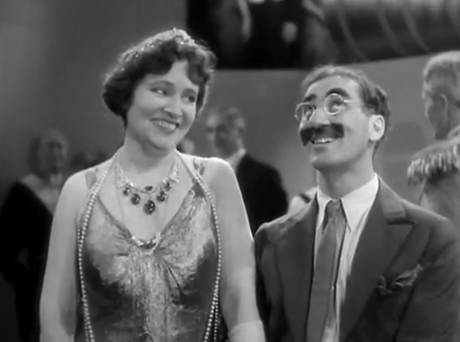
Their audiences by now had been conditioned with a certain type of environment. The framework is still somehow familiar in Duck Soup as well — at least on first glance. There we have Margaret Dumont at the center of it all surrounded by a bunch of stuffy bespectacled chaps with beards. She is calling for the resignation of one of the leaders of the nation of Freedonia.

Her choice to fill the position is none other than that progressive visionary Rufus T. Firefly (Groucho). Why she thinks he is anywhere close to being qualified is slightly beside the point. We just want a chance to see Groucho and he receives the usual majestic fanfare rushing down the fireman’s pull to see what all the hubbub is about.

Meanwhile, Louis Calhern of the adjoining nation of Sylvania is simultaneously conspiring with a cunning mistress to ignite a revolution and take over the country from within while also attempting to woo the prominent Mrs. Teasdale.

Two spies are tracking Firefly right as they speak. In fact, they’re a lot closer than they might think. They’re his brothers. Scratch that. They’re Pinky and Chicolini sent to scrape together some dirt to discredit him with the people. Little does their ringleader know that Groucho, errr, Firefly has been doing a good enough job being disreputable all by himself.

Only when Margaret Dumont has returned back in the fold do you realize how much she improves Groucho’s jokes. Years later the man said himself that the key to the magic was the fact that she never understood any of his barbs — much less why they were funny. However, in this particular outing, Louis Calhern and the demonstrative lemonade vendor Edgar Kennedy do much the same for the other two conniving troublemakers, Chico and Harpo. They’ve never truly had such a good foil as Groucho had in Dumont.

The picture segues into a scene where Groucho sticks his head out the window overlooking a peanut vendor and pretty soon Chico is being offered a spot in Groucho’s cabinet. Sounds about right. Likewise, Harpo gets in on the action and the most surprising discovery is that his body is covered with art in the film’s next truly surreal interlude.

Now with such crucial positions so close to Groucho, who coincidentally would have probably offered positions to a chimpanzee if given the chance, the two infiltrators are called upon to steal Freedonia’s war plans. Again, who cares?

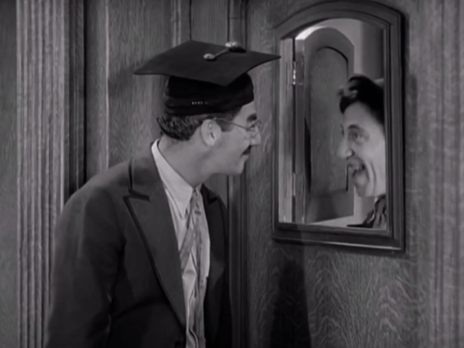
Crucially, their little escapade sets up The Marx Brothers’ next iconic gag with three Groucho’s dressed in nightcaps and pajamas. The mirror scene is the most remembered bit and it’s fun but it’s only a segment of a whole drawn-out sequence that plays on the brothers’ mistaken identities. This in itself could be another commentary if you wanted to make it into one.

Personally, it struck me for the first time that though physically the sequence revolves around Groucho, much of it takes place in Harpo’s world without any dialogue. Furthermore, there are times when we don’t actually know who is Groucho or who is not until we are given cues whether Chico’s trademark accent or Harpo’s hat.

First, the mirror is shattered and then reality when one Groucho steps out and is replaced by another only to be joined by a third. Regardless of what you want to say about this realm of the absurd, it’s a great gag.

duck soup 2.png

Then there’s the final sequence which is the actual escalation of the war between the two belligerent countries but it’s done with the typical tongue-and-cheek manner you might expect from the brothers where war is equated to a minstrel show and Groucho breaks out into a slightly doctored spiritual, “All God’s Children Got Guns.” From thence forward let the surrealist nonsensical nature of war take over.

For me, Groucho sums it up in sending Chicolini off to battle, “While you’re out there risking life and limb through shot and shell, we’ll be in here thinking what a sucker you are.” This was no grand anti-war statement. If anything it was a cynical statement. Of course, that doesn’t take into account Groucho’s constantly changing military garb from Revolutionary War attire, Civil War uniforms, a coonskin cap, etc. It was comedy pure and simple.  

In my mind, it’s no small coincidence that one of the Brothers most reputed films was also directed by Leo McCarey who in some respects still remains criminally underrated. Certainly, he was more a Cary Grant director than a Marx Brothers one but there’s a sense that he could focus their comedy into something utterly electric.

The irony of it all is that The Marx Brothers really hadn’t changed all that much but the way people perceived them and by extension, how they perceived their comedy, had provided this new context that surrounds Duck Soup. So people could start placing all types of assumptions and beliefs onto the film in ways that were most alarming and subversive.

I think the brothers themselves may have even admitted that they unwittingly rather than consciously made this departure. But the implications were great and cultivated the soil for a film that’s legacy would only grow year after year. And it’s true that there really is no superfluous scene. There’s no real chaff as it were even if it is all utterly marvelous absurdity.

However, it made just enough sense for Mussolini to ban the film on grounds of pointed satire. One last time let’s turn to Groucho who would have been overjoyed by such a response but pointed out, “We were four Jews just trying to get a laugh.” That was all. But it was so much. Duck Soup is a pinnacle of comic nonsense.

4.5/5 Stars

Review: Horse Feathers (1932)

horse feathers 1.png

At Paramount Pictures The Marx Brothers released a row of comedies with seemingly arbitrary names evoking fauna like Animal Crackers, Monkey Business, Horse Feathers, and of course Duck Soup.  The phrase  “Horse Feathers” is essentially a variation on “Nonsense” though it sounds rather archaic by today’s standards. That hardly detracts from any of its charms as a film.

There must be a location — a place for the brothers to be unleashed upon the world where they can belittle and bash heads all at the same time. What better place than a university campus that pantheon of learning dating all the way back to the Greeks? It commences with a perfect opening ceremony that’s quintessential Groucho.

He accepts his new post by badmouthing his eminent predecessor, pulling on the facial hair of all his eminent faculty, besmirching the reputation of his eminent institution and singing a typically cheeky ditty, “I’m Against It.”

His son played by none other than his younger brother Zeppo has been spending his idle hours outside of the classroom and off the football field in the company of a College Widow (Thelma Todd). Much like “Horse Feathers,” this might come as another antiquated term or at the very least euphemistic. It usually denotes a woman who lived near college campuses to romance male students. She was commonly known to be easy pickings. But that’s enough context. Watch the film and you’ll probably have all the context you need because Groucho wants to get in on the action too — not to mention the other brothers.

However, there’s more important business at hand. Namely the fact that Huxley hasn’t had a good football team since 1888. Even in 1932 that was still a very long time ago. As Groucho notes they’re neglecting football for education. At the behest of his son, he personally heads down to the Speakeasy to dig up some talent. It isn’t the least bit ethical so obviously, the school’s new head promptly heads straight there.

Before he can enter, however, he needs to provide the password and you guessed it the gatekeeper is the bootlegger Baravelli (Chico). Getting inside is more convoluted than you ever imagined. Of course, the actual joint is then Harpo’s personal playground and overflowing slot machine. His hat runneth over so to speak. The steady stream of gags keeps on flowing.

I was genuinely cracking up whilst Harpo stokes the fire with books in Wagstaff’s office Groucho remarks that Baravelli has the brain of a four-year-old boy, and “I bet he was glad to get rid of it.” Classic Marx Brothers.

Follow that up with an invasion of a lecture hall with Chico and Harpo taking up seats in the front row after their typical fisticuffs while Groucho stands by making snide remarks over the professor’s shoulder. Another perfect scenario capped off by Groucho taking over and getting caught in a spitball war with his two most unruly students.

horse feathers 2.png

Next, it becomes grand central station in the promiscuous college widow’s pad with slabs of ice getting repeatedly chucked out the window and Groucho repeatedly breaking up the action and the fourth wall by talking to the audience. He even invites them to go out to the lobby during  Chico’s piano playing. To be honest, I was never that big of a fan. Each of the brothers pays the dame a visit as does her other beau backing Darwin while Groucho constantly makes a chore of carrying out his umbrella and rubbers before exiting the busy room.

We have the resulting romantic date on the lake with the dame conspiring to steal Huxley’s signals. Groucho’s serenade of “I Love You” is the kicker. In fact, it’s very true that everyone says I love you — including each of the brothers — each in a very different way. Meanwhile, Todd assaults Groucho with baby talk and he all but tosses her out of their dingy (in case you didn’t realize, they had Life Savers candy back in 1932).

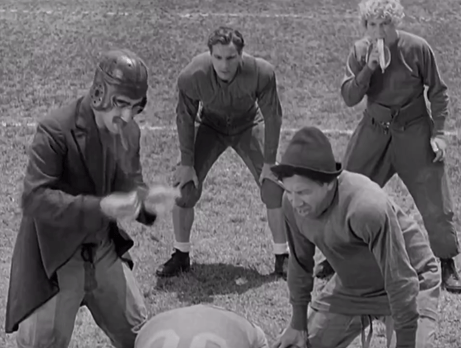
But the finale comes on the football field and there’s no doubt that Chico and Harpo liven things up. The most storied gags are courtesy of Harpo including a football yo-yo and laying down a minefield of banana peels, and of course chariots. They have no respect for the game. What better way to sum it up than marriage Marx Brothers style. They have no respect for that institution either.

Whether or not its second tier to the likes of Duck Soup (1933) or Night at the Opera (1935) is beside the point aside from being purely dismissive. Watching the boys at work here is arguably as wild and deliriously funny as anything they ever put to film. Here is a comedy that wonderfully condenses all that these brothers stood for as far as comic hooliganism was concerned in a gag reel that never has time to run out of steam. A wonderful summation of what college might be like if the Brothers had ever had the good fortune of making it there. Regardless, it’s a joy to the very last hike and the very last frame of chaos.

4/5 Stars

Trouble in Paradise (1932): The Grift of Love

Trouble in Paradise 1.png

Ernst Lubitsch made a name for himself and his “touch” in silents as well as leaving an indelible mark on the 1940s with the likes of Shop Around The Corner (1940), To Be or Not to Be (1942), Heaven Can Wait (1943), and Cluny Brown (1946). But for me, no film better personifies his wit and sensibilities than Trouble in Paradise. It proves to be the most impeccable distillation of his directorial style.

The script is courtesy of Samson Raphaelson who would become a longtime collaborator with the director on future projects. Aided by uncredited edits by Lubitsch, the story is imbued with class in the guise of light comedy.

There’s a certain cadence to the cutting and the music. A constant winking that seems to be going on. And it’s simultaneously the height of refined elegance while being undercut with constant nudges and proddings of comic verve. What is noticeable is the economical sophistication of the filmmaking and a seasoned eye for how to tell a story by the best means possible. It’s not always what you would expect.

Consider the film in its early moments as a case and point. It could have started so many ways and yet Lubitsch chose something different. A trash heap, a shadowy fugitive, then a man knocked out on his floor and an almost incomprehensibly daring shot that moves us to another building entirely where we meet our protagonist. It’s all so very enigmatic and almost wordless aside from the bellowing of the gondolier. The man on the balcony rightfully asserts to the waiter attentively standing in the wings, “Beginnings are never easy.” So right he is.

Nevertheless, the film continues to put on a lovely charade concealing its finest secret until the perfect instant to milk the quarries of its humorous intentions for all they are worth. We are introduced to a tryst featuring two great romantics caught up in the rapturous trills of amour.

They sit down to a divine dinner that plays as an intimate tete-a-tete. But soon the curtain drops and they don’t skip a beat as she ousts him as the famed burglar Gaston Monescu and he comes back perfectly charming to accuse her of being a pickpocket herself. She tickled him when she nicked his spoils but her embrace was so sweet. He couldn’t help being touched.

In even these early interludes it becomes obvious that the talent couldn’t be better with Herbert Marshall and Miriam Hopkins falling into their roles seamlessly with a certain amount of relish. Playing a romantic pair of thieves is a fine proposition after all. The world is their oyster and they’re in love. What could be better?

Meanwhile, Edward Everett Horton has an exchange with the police that I can’t but help compare with I Love Lucy’s famous language transfer. So much is lost amid the words and Horton always was an oblivious sort, God bless him.

However, the character who will prove to be the third in our triangle of cultured passion is Colet (Kay Francis) a glamorous heiress in control of a cosmetic empire. Francis embodies the ravishing role flawlessly even despite her well-documented speech impediment. It’s nearly imperceptible if you’re not looking for it.

Far from detracting from her performance it simply increases our sympathy for her. She may be rich — even out of touch with the world at large — but she’s hardly arrogant. She’s easily taken in and a bit cavalier with her money while two men are vying for her affection.

trouble in paradise 3.png

Edward Everett Horton and Charles Ruggles are both exemplary. I realized perhaps it was something moving deep within me telling me those voices were meant to go together. How right I was. Years later Rocky & Bullwinkle serials would have been a great deal less without them. Just as they make this picture that much better. Horton’s pitch-perfect quizzical look (tonsils, positively tonsils) is wonderfully matched by Ruggles own befuddled mannerisms. Still, I digress.

Of course, we see it already. It is Colet’s vast array of jewels that are of particular interest to a third man: Gaston. Except he’s a clever fellow. Instead of just stealing them at the theater he snatches them so he can give them back to her and in turn gain her confidence with his delicate preening of her ego and artful debonair flattery. He’s skilled and she’s a fairly easy mark.

Soon, he’s hired on as her secretary and it has little to do with his current resume, based on probably one of the films most remembered exchanges that pretty much sums up the tone:

“Madame Colet, if I were your father, which fortunately I am not, and you made any attempt to handle your own business affairs, I would give you a good spanking – in a business way, of course.”

“What would you do if you were my secretary?”

“The same thing.”

“You’re hired.”

His wife AKA his Secretary is getting antsy and a little jealous providing one of the film’s other perfectly inflected quips (If you’re a gentleman, I’ll kill you!). Still, her hubby reassures her all of Colet’s sex appeal is in her safe, 1,000s of francs worth of it. But he’s not as impervious as he would like to believe.

trouble in paradise 2.png

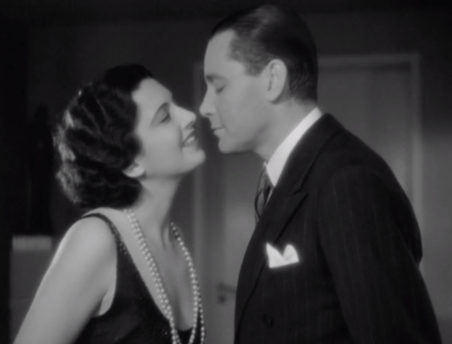
Lubitsch has the finesse to film an entire extended sequence of only a clock with the dialogue playing over it. The romantic interplay is understood without visual cues. We nod in acknowledgment. They’re also almost more romantic when they don’t kiss than when they do, floating inches from each other’s faces, eyes closed in a reverie.  Gliding on air. We begin to suspect whether this is still a put on or if it is, in fact, becoming real. Gaston is good but his wife is getting anxious and she has every right to be.

The family bookkeeper (C. Aubrey Smith) is skeptical of his qualifications and his identity. But the kicker is that Gaston is finally remembered by Monsieur Filiba and only time will tell when his cover is blown.

It’s time to get out of there and yet something keeps him back. He feels compelled to fess up to Colet and yet there’s no calling of the authorities or any of that. She’s far too wealthy to care. It’s what could have been that she will miss and he knows it too. In the end, he still goes out the door and she lets him. No consequences. No real drama.

trouble in paradise 6.png

There’s no need because that’s not what the film hinges on. It’s the love story and not just the love but how it plays out in this theater of refinement which Lubitsch has incubated to perfection. Undubitably there is trouble in paradise, even wistfulness sometimes, but that doesn’t mean things cannot be resolved.

Husband and wife go out much as they came in — not able to keep their hands off each other — or out of each other’s pockets. Try and put a name to it if you must. It’s the “grift of love.” How sweet it is.

4.5/5 Stars

Review: Monkey Business (1931)

monkey business 1931.png

“Love flies out the door when money flies innuendo.” – Groucho Marx

To call on an unforgivable quip worthy of The Marx Brothers, this film is a barrel of laughs. Hardy Har Har. I promise. Never again. I’ll leave it to the professionals. I never was much for comedy anyway…

It’s true these men had approximately 20 years of vaudeville and 5 years on Broadway under their belts even before moving to film. They were a well-oiled, grease-painted machine by now.

Because while some of their puns might be horrendously awful, they come in such a constant barrage of quips and commotion, it’s difficult not to tip your hat in deference. The Marx Brothers are a force to be reckoned with on a great many fronts.

In this particular instance, they are four stowaways who are singing “Sweet Adeline” in the ship’s hull on a transatlantic voyage. It’s the stuff of urban legend whether or not Harpo can actually be heard singing in the film (Later on he gets a little help from Maurice Chevalier on a phonograph).

They spend much of the film’s opening half fleeing the ship’s Captain and all his staff who are looking to put the brigands in irons. But they’re a slippery bunch and they find plenty of time to get into all sorts of mischief as they do best. After all, that’s what they’re there for.

The narrative is blessed by a greater fluidity than its predecessors meaning the Brothers can scramble around and they have an ever-changing array of sets to do their worst. In the same sense, it suggests that they have graduated from mere stage to screen adaptations and are finally getting their feet wet in what the cinema truly has to offer.

It also boasts the swellest live-action Punch and Judy show you’ve ever seen courtesy of Harpo’s pantomime as he outsmarts his pursuers while trading the type of blows you’d expect with such a violent form of entertainment. It’s for the kids.

Groucho and Chico overrun the Captain’s quarters with colossal impudence calling for lunch to be served and finding time to play their typical back and forth over a globe and the history of Columbus sailing the ocean blue in 1492. They were never ones to connect linguistically, though they do agree on one thing amid the stultifying banter. They’d rather be talking about nurses.

Then Chico and Harpo showcase their ineptitude as barbers when cutting a man’s mustache. Their game of too long-too short soon has him looking like Charlie Chaplin and then the cleanest baby face on deck. Likewise, they disrupt perfectly civil chess matches and bowl over innocent bystanders. Harpo even befriends a frog.

Meanwhile, Zeppo the most straight-laced of them all charms a beautiful young woman with greater implications. She’s a perfectly innocent girl but her father is a fairly notorious gangster, Big Joe Helton.

Groucho quite by accident ends up in another gangster’s closet and works on wooing his mistress (Thelma Todd) with his suave dancing and witty one-liners. Groucho’s dancing and guitar playing are on point with that iconic half crouch of his, coattails flying and strings twanging with raucous abandon. Harpo and Chico might be considered the more memorable indulgers in the arts but I almost prefer Groucho. Maybe its a matter of relating to him more.

You expect him to get a belly full of lead but this is the Marx Brother’s Universe so he and Zeppo get hired on as heavies. That brings us to the film’s main conflict if there is any. The Brothers unwittingly find themselves on opposite sides of a gang feud. They never were much for gun-toting, preferring a more primeval form of violence known as slapstick.

A lavish gala is held by Helton only to have his daughter kidnapped by his mortal enemy. The terrace is almost more interesting as Groucho starts meowing like a suggestive kitty picking up the prancing two step where he left off with the same gangster’s moll.

But let us not forget someone was kidnapped. A barn proves to be a fitting setting for the final showdown Marx Brothers-style as Groucho provides color commentary and Chico and Harpo conk their adversaries over the head like they do best. Zeppo’s the only who’s up to any serious fighting.

Monkey Business is probably the first Marx Brother picture to realize their talents with cinematic scope. The wealth is spread wonderfully with each brother alotted the time to shine — showcasing their various shticks — but the medium also provides greater avenues for the sake of a punchline. They would only push the envelope further with Horse Feathers (1932) and Duck Soup (1933).

4/5 Stars

Jewel Robbery (1932)

jewel robbery 1

It’s the old story. A pompous old coot is bragging proudly about his new unstoppable, indestructible system of invisible lights he has put in place to stop even the most skilled burglars. No sooner have the words left his mouth and we already know he’s doomed. Sure enough, not a moment goes by before a clerk rushes in to inform them that the impossible has happened. Someone has absconded with all the jewels. The man proceeds to fall backward in shock.

Next, we meet the “Wavishing Kay Fwancis” as she leaves the suds of her bathtub behind upon hearing the news that there’s been another brazen jewel heist pulled on one of the most foremost jewelers in Vienna. She breathes a sigh of relief when she hears which one. You see she has aspirations for a beautiful diamond from Hollanders. But for now, her pride and joy is still safe.

You can instantly gather what kind of person she is as maids and manicurists dote over her every need. Dressing her and primping her and giving her a makeover as she gossips with her best friend. But despite the decadence showered upon her, she craves something else. Namely, a strapping man who is exciting and who will carry her off to some romantic rendezvous.

Francis navigates these hoops so assuredly in such a way that we believe her in the role. There’s no denying her to be a very elegant lady. But the perfect counterpoint is her naive quality. Maybe it’s even partially based on her slight predilection to pronounce her Rs as Ws (Hence her affectionate nickname). And she acknowledges that even in her own eyes she is both shallow and weak despite holding qualities that might make her a generally decent human being. There’s still time.

When she goes to purchase her coveted diamond like a giddy child in a candy store, she’s in for a very rude awakening. If it wasn’t the 1930s it would feel like a western stick up masterminded by a gentleman criminal who is played by none other than, you guessed it, William Horatio Powell. But he’s a cut above your typical heavy. That’s obvious enough to see. He’s a robber who enjoys a good waltz playing on the phonograph while he’s looting the joint and some trivial chit-chat to make the atmosphere more relaxed.

You get the sense that Powell is relishing every line of dialogue and he’s so congenial with every word of it. It works wonders as he runs verbal rings about his cohorts completely commanding the stage from thence onward. Not to mention passing around his dandy case of cigarettes with something extra special.

jewel robbery 2.png

In fact, being brutally frank, William Dieterle’s film stalls when it lacks Powell and Francis together. While not dismal, the supporting cast doesn’t provide the same electricity or charm as our leading item. Perhaps that’s a good thing because we like them onscreen together. We want them to be onscreen. And we get our wish when he calls upon her at home. It’s all very daring and forward but he wants to use her safe to hide his loot. However, there was also something about the lady too that made him come see her again. Call it fate if you will.

Alas, the police are after him and he must flee. She plays the victim and plays the part well. But secretly she knows her true feelings. We do too and we know that Powell will slip away because in a picture with a tone such as this anything else is inconceivable.

The final stroke of inspiration is in the closing shot where we see something that stands in the face of classical Hollywood convention. Kay Francis looks straight into the camera and puts a finger to her lips boldly breaking that invisible fourth wall. All that has transpired thus far will be our little secret. There the picture ends. With a rendezvous in Nice in the works. If a single image can elevate a picture and leave a lasting impression, Jewel Robbery is a fitting example.

3.5/5 Stars

Review: Animal Crackers (1930)

animal crackers 1.png

Animal Crackers usually makes me think of the soggy little critters floating in Shirley Temple’s soup but the joke’s on me because that tune didn’t come out until 5 years after this film. In fact, legend has it that Harpo purportedly offered Temple’s parents $50,000 to adopt her when they walked by the studio.  That was before she was famous. Imagine what his price might have been afterward. But I digress.

This is the second of The Marx Brothers’ stage adaptations and there’s no hiding its origins. It’s very flat and confined as far as cinematic ambitions go but the same can be hardly be said of the Brothers themselves.

The plot involves a small trifle about a party put on by one Mrs. Rittenhouse (Margaret Dumont) for the intrepid African Explorer Captain Spaulding (Groucho). She is preparing to unveil a priceless masterpiece christened “After the Hunt.” This character set up would be common practice in later films becoming a type of shorthand in itself. Dumont was normally a wealthy socialite humoring Groucho and showering him with accolades. Not to be outdone Groucho would shower her with insults.

But he gets a particularly effusive introduction in Animal Crackers with “Hooray for Captain Spaulding.” Learning something from Cocoanuts the opening musical number integrates Groucho into the song and lets him make an extended charade out of all the pomp and circumstance. It would be followed by comparable numbers in Horse Feathers (1933) and Duck Soup (1933).

Though not as effusive, Chico and Harpo also get a warm welcome playing the parts of Revelli and The Professor respectively. Their gags are rampant, their anarchy as cheeky as ever, and there’s little to no respect for the plotline they find themselves in or the people who fill the spaces around them. That’s simply how they operate.

Groucho begins by picking up a full head of steam and taking off for minutes at a time with a steady stream of verbal soliloquies of lowbrow wit that gives any modern comic a run for their money. Stop me if heard this one. The most iconic involves shooting an elephant in his pajamas and Alabama where the Tuscaloosa…

Not to be outdone Harpo chases after girls incessantly, cheats at Bridge thanks to a sleeve full of Aces, and not only runs off with each version of “After the Hunt” but purloins the silverware for good measure. Meanwhile, Groucho continues to cut down his costars, foremost among them Dumont who would be his verbal punching bag time and time again. But let it be known that no one’s safe. Only Chico seems capable of upending him with his pure stupidity. Then, Harpo just can’t say anything to Groucho. They work great together.

Chico busts the guests’ ears with his idiosyncratic brand of piano playing and Harpo earns his moniker plucking his strings. And to be honest, these are the moments that I have the most difficulty enjoying. Like the musical numbers, sans “Hooray for Captain Spaulding,” these elements feel as if they are set in their era. But when the Brothers get together in a room and the wheels come off in any number of ways, those are the moments where you can’t help but smirk — you can’t help but marvel at the sheer ferocity of their comedy that still feels so alive even today.

So while this picture is much more a stage production than a film, that cannot neutralize the gags which ultimately bodes well for the pictures yet to come, maintaining the chaos but providing room to grow and mature into the transcendent qualities of A Night at the Opera (1935) for instance.

On a side note, my heart always goes out to Zeppo who was reputedly so funny in private life and nevertheless donned his typical straight man role that as expected gets completely overshadowed by his brothers. This is most obviously Groucho’s picture.

However, that’s not to underplay Harpo and Chico with their many talents.  Their constant fits of delinquency are crucial to the comedy. No better example than Harpo pulling at a Flit Gun and proceeding to gas the entire drawing room before committing suicide as it were and dropping next to his sleeping beauty.

3.5/5 Stars


One Way Passage (1932)

one way passage 1.png

There’s a myth that makes the rounds every so often suggesting films of yore were always stagnant affairs. You only have to look at the opening bar sequence directed by Tay Garnett in this picture to confirm such an assertion is an unequivocal falsity. The camera is alive and well in One Way Passage.

William Powell is beloved by classic movies fans the world over but you genuinely wonder if he’s much remembered outside of that faithful populous. The broader public has more wherewithal than often their given credit for and yet there’s no doubt Powell is less heralded than his gangster compatriots at Warner Bros.

Meanwhile, Kay Francis is an all but forgotten flame of the 1930s who is no less glamorous or alluring today. If you run the numbers, she was one of the highest paid and biggest box office attractions well into the mid-1930s. Although soon Bette Davis would take on the mantle. But this context will seem insignificant 80 years on. That’s why it’s such a charming realization this film is a true gem worthy of the talents involved and certainly worthy of being rediscovered today.

All we need is a bar. It becomes one of the crucial settings in the picture. A pair of memorable bartenders played by Mike Donlin and Roscoe Karns give each some added coloring. People are gay and jovial. Two merrymakers accidentally clip each other but it hardly feels like a clumsy meet-cute or it’s exactly that.

Except there’s a star-crossed undertone to it all. No time is spent piddling around. We look into their eyes and meet the gazes of Joan (Kay Francis) and Dan (William Powell). They share the moment and it’s lovely but they bid adieu and head their separate ways to forego ruining the electricity they achieved.

Little do we know we have been introduced to a debonair criminal. A gentleman scoundrel if you can imagine the prototype.  The shorthand is in place and it’s easy enough to decipher so there’s little to no need to mince words or drag out the exposition.  In fact, Jim’s so charming we don’t even realize he’s on the wrong side of the law until a copper sticks a gun in his back.

That’s the key to this picture because at such a short running time it cuts its story down to the essentials, excising the superfluous information and streamlining the events in such a way that is endowed with a playfulness but moreover a grand passion.

Because the inevitable happens and they pass not like ships in the night but aboard an ocean liner named the S.S. Maloa making its way toward Hawaii and ultimately San Francisco.

Far from sputtering, their initial connection only blooms with each passing day together. Of course, she doesn’t know he’s being sent to San Quentin and he has no idea she is terminally ill even near her deathbed. But in this respect, their obliviousness puts them on equal footing.

one way passage 2.png

Joan says she wants to crowd all the intense beautiful happiness into the life she has left. It’s the perfect aspirations for this picture to deliver on because there’s this heightened intensity and that allows it to provide such a potent story in a matter of a few minutes. As things look that’s all they have.

They are going out in a blaze of glory and there’s no more apt description than that. The picture has no time for realism and so it foregoes that for something far more moving in at least in this particular instance. They are imbued with the poetry of star-crossed lovers aboard a sea vessel with an imminent conclusion already in place.

The cop Steve (Warren Hymer) seems like a real brusque stickler and yet he’s baffled by Dan’s charity. He relents since the man saves his life. It’s the only thing that allows this captured petty thief to maintain some kind of pretense of normality with Joan. Steve has enough pity to allow his prisoner the dignity of playing the role he has been cast in.

Of course, Dan also gets some help from the constantly swacked Skippy (Frank McHugh) a con man with a sore spot for cops and the bane of every bartender he comes in contact with.  Then there’s Betty a fellow con woman masquerading as the “Countess Barihaus” (Aline MacMahon in a glowing performance), who has the entire ship cast under her spell including Steve. Not only do they provide the film with an amiable strain of comedy, but they also buy their friend his few hours in paradise with his constant companion. But the dread comes upon us because we realize even as the film’s minutes tick away so rapidly — this euphoria cannot last. It will not.

one way passage 3.png

They share one last tearful kiss and wave goodbye  with one final “Auf wiedersehen.” But the perfection of it is that the illusion they’ve managed to hold onto isn’t even broken in their final moments together. There’s such an undercurrent to the scene — so many things they could bring up or that they could say — and yet they are content in truly cherishing it. The sequence is wafted over with the epitome of bittersweet emotions. And yet they can hold onto the next dream — a reunion on New Year’s Eve.

When it’s all said and done, it’s a wonderful ending that lets us float away on our doubts clinging to the hopeful ending we want to be true. That’s what the great romances do. They do not quash the sentiment beating inside our hearts but they suggest even if it is folly there still is some insurmountable worth in striving for love. Let that connection between our heart and our emotions never be absolved. Because yes, we are rational beings but what does that do for us if we have not love? This picture will probably rip your heart out but it does so tenderly and with the utmost amount of tact. It deserves to be seen by more people.

4/5 Stars

Girls About Town (1931)

girls about town 1.png

I came to this film for Kay Francis and I stayed because of Kay Francis, George Cukor, Joel McCrea, Eugene Pallette, and Lilyan Tashman. All to say, it is a supreme pleasure to watch this cast in action and already Cukor seems capable of handling the material in a way that intuitively understands the comedy while never losing sight of the romantic heart. That balance seems key.

But we also see another Cukor hallmark with two strong female characters who are central to the film’s integrity. Wanda (Francis) and Marie (Tashman) make a living as girls about town. They are bankrolled to get comfortable with out-of-town businessmen. Because a little female company and a lot of bubbly makes any business transaction go down smoothly.

Marie doesn’t mind the vocation but you can see it in Wanda’s eyes. She’s tired of the same haggard men and droll conversation. She wants something of a little more substance. An actual man and a real relationship.

Yet she concedes to do another gig as part of a yacht excursion that’s looking to schmooze a wealthy whale of a man named Benjamin Thomas (Palette). He also is a self-proclaimed king of practical joking. In fact, he doesn’t know when to quit whether it’s glasses of water or deep sea diving for golf balls. Marie gravitates to him for a laugh.

Meanwhile, Wanda has her eyes set on the younger one, Mr. Benjamin’s associate (McCrea) who isn’t much for conversation or any kind of companionship. As hard as she tries there’s nothing doing. But they finally strike up a compromise by playing “pretend.” Their relationship becomes jovial. The only problem is that Wanda is falling for a man who never meant to romance her. Things get a little too real.

But thank goodness, the feelings are mutual and it looks like they will be together for good. A zoo might as well be the tunnel of love as our two euphoric romantics smooch their way through the animals. At this point, the love story is floating on air. Until Jim mentions marriage.

Here Girls About Town earns its keep as a Pre-Code picture due to its subject matter, the flippancy with which it deals with romance, and even fairly radical views on the necessity of the institution of marriage between two people.  None is the focal point per se but they certainly make the picture quite bold even in what it deems to be the status quo when placed up against films that came a mere three or four years later. The inevitable bomb is dropped but it hits like a pin drop. She’s married already. She doesn’t even bat an eye. Divorce is what is called for and there’s no reason her husband would not grant her one. She hasn’t lived with him for a time.

girls about town 2.png

The films secondary narrative involves Benny’s own wife coming back into his life to try and save his reputation only to join forces with the surprisingly reasonable Marie as they scheme to get the old curmudgeon to spend his money and show his affection for his wife.

The final complication just gets better and better and it keeps the picture interesting. At this crucial stage, Wanda’s spineless husband Alex turns an about face and crosses paths with Jim to talk it out.  Now the indignant Jim smells blackmail and lashes out not only at this man but his formerly soon-to-be wife. You can see the heady implications.

But there’s something more to Alex. Perhaps he’s not the villain we assumed him to be. That would have been too easy. So instead of getting the money back from him, Wanda sets her sights on the next best option. An impromptu auction is undertaken as the girls rally to raise $10,000, complete with a heel for a gavel and a wheeling-dealing Marie presiding.

Certainly, it’s not the necessity but the principle of the matter as Wanda wants to pay her man back to show her true character. She was never looking to take advantage of him and she is willing to go to great lengths to renew his trust. It’s made easier by the fact that he’s torn up about what happened. Now she has him where she wants him. Her days as a girl about town are numbered.

Ernest Haller is our cinematographer and there are several setups that are particularly interesting because they trade out our normal frame of reference as the audience by putting us in different places. The first instance comes in the zoo where we find ourselves literally inside different cages with a bear and then some reptiles.

Then, there’s a later sequence where we similarly end up behind the glass of a display case. And of course, we can’t hear the exchange going on outside but the pantomime gets it across just fine. But the creme de la creme is the flurry of close-ups on Palette’s face when he sees all the jewels that he thought he bought for another woman on his wife. Priceless.

3.5/5 Stars

Cocoanuts (1929)

the cocoanuts 3.png

“Did anyone ever tell you that you look like the Prince of Wales?” ~ Kay Francis, Chico, and Groucho.

The Marx Brothers were modern comedians. Out of Groucho Marx alone, there are numerous comics spawned and basking in his incomparable shadow. When certain jokes come out you can all but tip your hat to him. But also Chico and Harpo had their own personas and they worked with each other to simultaneously set up different bits and turn those bits into pandemonium that have overtaken the world with laughter over and over again.

And that’s not over one film or with one studio but over a whole host of projects. For all I know, Harpo Marx went through life mute (I Love Lucy cameos don’t tell me any different) and Chico really did use that accent of his. Even Groucho who was arguably the most visible thanks to You Bet Your Life, What’s My Line, and memorable Dick Cavett interviews, though he lost the greasepaint mustache and eyebrows, still maintained much the same witty image his entire life.

Playing purely the numbers game most comedy teams are duos. Think of most of the great ones. But the Marx Brothers had three and even four when Zeppo was around. They were all family. So when this well-oiled mechanism of chaos is released it really does a number on people. They were known for overwhelming producers in real life with their antics and they do precisely the same thing to each individual audience member who watches them onscreen — at least the ones who don’t mind being railroaded a little. That is their lasting impact.

The fact Cocoanuts was their first film and from the 1920s makes more an impression on my mind. Because talking pictures hadn’t been around for all that long. Sure, some of their gags could have been retroactively transferred to the silent cinema but in many ways, the talkies suited them just fine. After all, they were a vaudeville act and The Cocoanuts was a success on the stage before it was a film. Even during filming, they were already at work on their latest production Animal Crackers (which would again become a film the following year).

Where does that leave us? Looking at The Cocoanuts today, it definitely is stagey because well, it came from a stage play. Furthermore, it’s a rather odd combination having Irving Berlin and The Marx Brothers names attached to the film. Given the main attraction, there’s probably too much singing anyways although the overhead shots soon accredited to Busby Berkeley are quite prominent here.

If we turn our attention to the opening moment, Groucho is on the staircase of the Hotel de Cocoanut giving his restless bellboys some wise words full of crap about money. Meanwhile, a seductive woman (Kay Francis) and her suitor look to steal the priceless necklace of one of the few vacationers (Margaret Dumont) and pin the crime on someone else for their own nefarious purposes. This might not be a criticism you hear often but there’s too much plot and not enough Marx Brothers.

cocoanuts 2.png

Let’s cut right to the best gags. There’s the adjoining room & slamming door gag which provides one of the most pointed moments where the boys are all working seamlessly together to promote chaos on celluloid.

Groucho and Chico have one of their bits over a map and linguistic disconnect that Groucho riddles with his puns and Chico then decimates with his miscomprehension of English vernacular (Most famously Viaduct becomes Why a duck?). Watch it if you don’t understand what that means. In Marx Brothers terms it’s probably poetry in motion.

There’s an auction, termed a big swindle by Groucho but even with Chico’s involvement in the chicanery, for some unknowable reason, they don’t seem to be making any money. Finally, Groucho and Harpo play Tic Tac Toe on a man’s chest and act boorish at a dinner party before running off for the plot’s real finale. Let’s face it. The picture ended right when they left the stage.

The improv and dynamic nature of the Brothers given their vaudeville roots makes me realize just how much their shows would have been blessed by repeated performances and the heat of the moment. Though we can’t have that luxury at least we have this film to remember those hoodlums who elevated the art form of anarchy and wisecracking to new heights.

3.5/5 Stars

Good News (1947)

good news 1.png

The title Good News means next to nothing to me but it does suggest a certain sunny disposition we tend to equate with MGM musicals of the period. That assumption is fairly well-founded. Furthermore, I am well aware of Adolph Green and Betty Comden, that screenplay dream team, an integral part of Arthur Freed’s unit that had so many quality pictures to their name.

Most obvious inclusions include Singin in the Rain (1952), On the Town (1949), and The Band Wagon (1953). And here they are working in the realm of retro nostalgia pieces, their forte, a light comedy scattered with quips and a substantive lineup of tunes. But the important differentiation here is that this was the first one. This is where it all began, in theory at least, making them into a screenwriting mainstay. While the picture has long since been overshadowed by its successors and was never a huge box office success, there’s no doubting the unassuming charms still present in Good News.

Like Singin in the Rain (1952), the year is 1927 but instead of film sets in a Hollywood back lot, we are met with the world of Flappers and Sheiks — the names for boys and girls on college campuses across Middle America. On this particular campus, good ol’ Tait University, the boys are batty about football and girls and the girls are batty about boys — at least on a very basic level. So nothing is all that different.

And yet for anyone born in the latter half of the 20th-century, you can’t help and look at the depictions and think that everything is different.  Whether its styles of clothing, social rituals, colloquialisms, practically everything. Granted this is a musical.

Still, the school’s All-American running back Tommy Marlowe (Peter Lawford) shimmies, shakes, struts, and sings with his buddies about the necessity of being a ladies’ man on campus. Because when they’re not on the field the subject of utmost importance is girls. Obviously. Thus, when a new girl fresh off of finishing school brings her refined manners, stuffy French vocabulary, and flamboyant dress, all the boys heads start turning including Tommy’s.

But as is often the case, not everyone is so infatuated or completely distracted by the opposite sex. For instance, we meet Connie Lane (June Allyson) as she calls for a wrench to remedy a leaky sink and she’s dressed to the nines. She’s a good student and pays her way through school at the local library. Boys are not her main concern though that’s not to say that romance doesn’t tickle her fancy.

So the film is a frolicking and invariably cheesy examination of the mating rituals of college kids. It’s crazy stuff sometimes but be assured we are in for a light and breezy good time — a squeaky-clean version of what college life is if you will.  It’s also short on plot but what is there proves to be a springboard for song and dance. For the most part, that’s promise enough.

A highlight is the familiar velvety fog of crooner Mel Torme as well as the rather dorky but endearing wiles of Joan McCracken who feels much in the same vein to parts Betty Garret would ultimately play. Of course, this is really the Lawford and Allyson show as they must come to know each other, show genuine feelings, get confused about it all, and fall back together again. That’s the way the story has been told since the dawn of time. This one is little different.

A formative number comes off as a musical French lesson as Tommy goes under the tutelage of Ms. Lane to land the new girl in town who is giving him the cold shoulder. Meanwhile, Allyson imparts her knowledge and delivers a warm rendition of the tune, “All The Best Things in Life Are Free.”

“Pass the Peace Pipe” at the local soda fountain — a song that feels doubly archaic coming from the 1920s through the 1940s to the present day — is no less a lively foot-tapping number to be sure. But be relieved that the football scrimmage is not turned into a giant musical number of its own. Football is football and dance is dance. Each gets its own arena and there are plenty of theatrics in both. The cherry on top is a stellar large-scale dance number, “Varsity Drag,” to sum it all up in a rousing fashion much as it began.

3.5/5 Stars