For Me and My Gal (1942)

for me and my gal 1

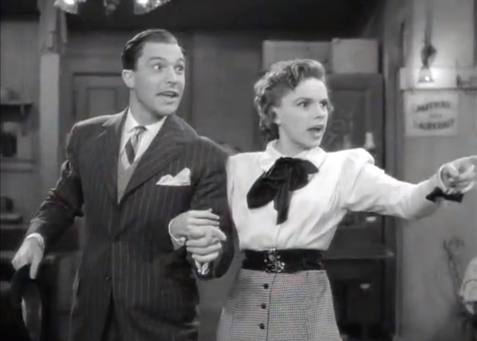
Here is a good old-fashioned American musical that effectively acts as an homage to the vaudevillian circuit that saw many performers realize their talents including numerous future Hollywood icons. At the core is a musical dream team in Judy Garland and Gene Kelly.

Behind the camera is the much revered Busby Berkeley who made musicals into gargantuan extravaganzas thanks to how he managed to capture human forms from above like no one before him. Ironically, here he’s working in a somewhat more conventional and dare I say, informal setting where we get to share the mundane spaces with our stars.

Kelly is Harry Palmer, a man who makes a living clowning around on stage. The arm spinning pirouettes and the athletic moves that defined his style of hoofing are obvious from the outset as are his infectious charm and winning smile. He’s still in the latent stages of his genius but that’s okay. There’s still time.

Judy Garland at this point in her career already had sizable stardom and it was Kelly the Broadway up-and-comer featured in his film debut. But in the ensuing decade, there was no doubt about it whatsoever. They both became quintessential musical stars of a generation along with a select few.

Jo Hayden (Garland) is a song and dance gal who while not having made “The Big Time” yet, still has a noticeable amount of talent. She partners with the good-natured Jimmy Metcalf (George Murphy) who harbors an obvious crush on her. She thinks he’s sweet.

Harry Palmer on the other hand, always seems to be making a fool of himself. A genuine person like her can see right through his come-ons. While her gangly brother (Richard Quine) agrees to finish up his med school, Jo is following her ambitions to get somewhere. She subsequently realizes she does have a bit of chemistry with Palmer on stage after an impromptu performance, if not for the fact that she is already a part of an act.

Jimmy does the noble thing and lets her go as they all have their sights on the Palace Theater in New York City.  You see, it’s the holy grail for vaudeville performers. It means you’ve made it. Palmer is ecstatic when he meets a singer (Martha Eggerth) who already performs there, thinking she might be his in. But he remains true to what he has going with Jo. Still, time and time again they’re playing small towns and their aspirations never seem in reach.

Even when it is right there in front of them and their manager (Keenan Wynn) has seemingly pulled through, Harry is torn up to find that he’s been drafted to head over to France to help the doughboys in putting the Kaiser to rest. He’s no draft dodger but he wants his dream so much and they are so close to being realized. He takes a plan of action that Jo misconstrues as cowardice. She’s ashamed that he would do such a thing especially since her brother is overseas fighting already.

Thankfully that is not the final word. Life sometimes has a curious way of bringing people back together and in the case of this cinematic world, we get a cheering finale courtesy of the MGM dream factory. While For Me and My Gal revels in its star power and the intimate chemistry built between them on the stage and in dressing rooms or in train compartments, we are soon reminded that this film has an ulterior motive. It’s a musical, it’s a romance, but it’s also a product of the American homefront.

Like a Sergeant York (1941) or a Yankee Doodle Dandy (1942) this effort was made with a higher purpose to act as a kindling rallying cry for nationalistic fervor going into WWII. However, just like its contemporaries, the reason we’re still watching it today isn’t necessarily due to those aspirations but the emotional connection elicited from its stars. This is what makes For Me and My Gal truly swell with sentiment. Thankfully Judy Garland and Gene Kelly got together on two more musical efforts to keep it going. Because they help elevate this above the spectrum of a run-of-the-mill propaganda musical with their palpable charisma that transcends any maudlin patches.

4/5 Stars

The Strawberry Blonde (1941)

the strawberry blonde 1.png

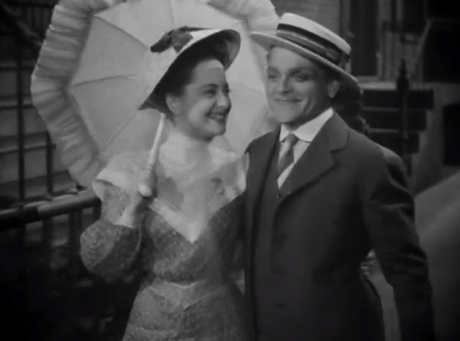
The opening shots of The Strawberry Blonde are not unlike Easter gatherings at my family’s house. Croquet in the backyard…well, that’s about it. But that’s precisely the distinction that’s being made as Raoul Walsh develops a dichotomy between two societies on either side of a brick wall.

On one side the Yale college boys play guitar as their gals all gussied up sing “Meet Me in St. Louis” after a rousing game of croquet. They are eye-catching and the frivolously well-off members of the elite. We think of them and their gayly prim and proper ways when we conjure up archetypal mental pictures of the so-called “Naughty Nineties.”

On the other end, two working men play a good old-fashioned game of horseshoes. They’re a different type of folk. A Greek barber (George Tobias hidden behind an accent and a mustache) and our pugnacious protagonist Biff Grimes. It’s not a typical Cagney picture but it’s still a typical hard-nosed Cagney and that’s the joy of it.

To use his vernacular, he’s a real hairpin. The kind of guy who never takes nothin’ from nobody but has made a habit of getting stepped on his entire life. Whether it’s the girls he’s missed out on or the fights he’s lost or any number of other footfalls. A 5-year stint in prison springs to mind.

Still, he can’t believe he missed out on the flirtatious, bodacious strawberry blonde Virginia Bush (Rita Hayworth), what seems like so many years ago now. But as was his habit, Biff’s friendly rival Hugo Barnstead (Jack Carson) ended up the lucky man.

Following their fateful first encounter, Biff gets continually saddled with Amy Lind (Olivia De Havilland) which obviously would be far from a disappointment with any sensible man. That doesn’t stop Biff from being sore. He needs a house call to get it through his thick skull that he really has a life to be grateful for.

This is the Epstein Brothers’ glorious revamping of a failed Gary Cooper vehicle from 1933, in this case, made to tailor fit James Cagney. The actor returned to his old studio, Warner Bros., looking for a change of pace to get him as far away from gangster fare as possible. Likewise, director Raoul Walsh was looking for a change after the riveting but tragic drama High Sierra (1941).

Given the results, it’s little surprise that the director considered it one of his personal favorites among the many pictures he helmed over the years. The quality cast starts with Cagney but we really have four superb talents at its core rounded out by Olivia De Havilland, a vivacious Rita Hayworth, and that old happy-go-lucky jokester Jack Carson. Alan Hale fills in as Cagney’s derelict father who’s always finding himself getting thrown out of the local saloon by the ear.

By now I all but take James Wong Howe’s photography for granted but as per usual, The Strawberry Blonde looks two-tone drop dead gorgeous as it lights a world with nostalgic hues of turn-of-the-century New York. Whether moonlight, streetlights, or candlelight, it is a film that is totally evocative of a bygone era.

Where men removed their coats to partake in fisticuffs. The same men humored their best girls with Sunday walks in the afternoon while local bands paraded through the park their brassy tunes wafting through the air. The barbershop subculture was in full bloom, quartets and all. Likewise, modernity was coming into its own with nitrous oxide, horseless carriages, electric lights, women’s suffrage, and the art of spaghetti imported from Italy.

In some paradoxical way while being nostalgic it still finds a way to feel surprisingly progressive particularly through the character of Olivia De Havilland with all her so-called improprieties. A nurse who winks, smokes, and whose mother was a bloomer girl and her aunt was an actress. At least on the surface. Maybe she’s not quite like that.

Meanwhile, Biff is always trying to save face his entire life and as a married man, he’s trying to save face with his concerned wife. He lives with discontentedness instead of satisfaction but just as the times keep on changing, Biff does too, realizing how lucky he is.

What makes the film itself a charming change of pace is the fact that it’s not concerned so much with one singular defining moment of drama but an entire life and it elicits a connection with a time and place even as we feel a sense of pity for Biff. It’s not a bleak film, more of a wistful one, and with wistfulness, a lighter more nostalgic tone can still be evoked.

Even to the end when Cagney takes on the masses it’s great sporting fun and he gets in his licks like any of his gangster pictures but he does it with a loving wife and a life to be wholly satiated by.

4/5 Stars

“Don’t be a hypocrite Virginia. Spiritually you winked.” ~ Olivia De Havilland as Amy Lind

Lured (1947)

LuredPoster.jpg

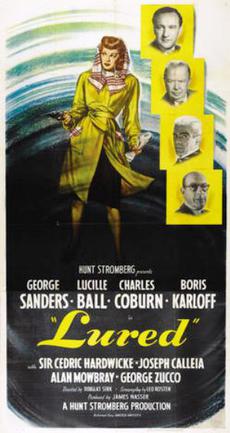
Herein is a slightly off-kilter serial killer, mystery-thriller and early American film in the career of German emigre Douglas Sirk. Of course, the action is actually set in England. It’s a film that builds a paranoid framework like The Lodger (1944), I Wake Up Screaming (1941) or other like-minded films. However, it goes through the normal paces only to lurch forward in the most curious directions.

The parties involved include a Scotland Yard guided by that industrious Brit for a day Charles Coburn. Other people of interest include a street-smart nightclub dancer (Lucille Ball) who saw one of her co-workers go missing after a rendezvous with a mystery man. In fact, a rash of disappearances of young attractive women has overtaken the city.

Thus, upon finding Ms. Carpenter to be a plucky and intelligent young woman the inspector calls upon her services to force their elusive perpetrator out in the open acting as the tantalizing bait. She begins to respond to advertisements in the paper — his calling card — to lure victims into his clutches.

The only problem is figuring out who the man might be because numerous candidates roam the streets and many people circa 1947 placed postings in the paper. It’s common practice. Among people she gets caught up with are a delusional fashion designer who became unstable after years of criticism. The one and only Charles van Druten is played by none other than Boris Karloff in one of the film’s many digressions.

Likewise, Ms. Carpenter answers a call for a position as a maid, though the prospective employer’s intentions prove to be far more insidious involving some dealings in South America and too-good-to-be-true promises of advancement. Once more Scotland Yard puts an end to the criminal activities but is no closer to their murderer.

One of the more prominent people of interest is Robert Fleming (George Sanders) a man of vast influence and a stage producer who finds classical music tepid and most of the upper echelons of the society’s elite even worse. He goes about it all with the playful disdain that can only be attributed to George Sanders at his best.

In fact, his manner is off-putting to Sandra as well but their prickly beginnings cannot completely derail romantic feelings. In those respects, both Ball and Sanders prove to be adequate romantic leads propelled by their wry comedic proclivities. That’s far more rewarding than any romance. The only problem is that he might not be who he claims to be and at any rate, a great deal of circumstantial evidence is piled up against him. A final push for justice must be made.

Lured isn’t an instant classic as the tension while there is never altogether sweltering. But simultaneously the screen is crammed with quality performers and just enough idiosyncratic moments and bits of humor to keep the film from being absolutely conventional. George Zucco is by far the most amusing of the many supporting characters as the crossword puzzle-loving officer H.R. Bartlett who acts as Sandra’s guardian angel while simultaneously coming upon many of his solutions through simple eavesdropping.

This is also a telling film that should make us uncomfortable and it’s not so much that things feel overwhelmingly misogynistic and objectifying of women, it’s the even more sobering fact that things have not changed as much as we would like to believe.

What is the root of most serial killing? Surely we can see familial issues or mental instabilities but oftentimes it’s tied in with a distorted sense of love wrapped up in perverse fantasies hidden from view.

Our killer is obsessed with the poetry of Baudelaire and uses it to realize the fantasies that he never seems able to act out on. The man’s interest is in destroying beauty instead of making love to paraphrase Coburn’s character. When he finally is revealed I’m not sure it’s a surprise but then need we be surprised? Many “normal” men are capable of great evil. They’re simply good at covering it up.

3.5/5 Stars

All I Desire (1953)

all i desire 2.png

Douglas Sirk films almost by design seem to always revolve around the most uncomfortable thematic ideas that you can think of. Whether that is Sirk’s own wry sense of irony or more so the material that was provided him, there’s always something to be gleaned from what he does.

With every story, there must be a hook that reels us in and an event to establish the premise. Has-been actress and glorified showgirl Naomi Murdoch (Barbara Stanwyck) is sitting in the dressing room after one of her middling shows only to receive a letter from her teenage daughter. It catches her off guard because you see, she left home many years ago abandoning her husband and their three children. She had her reasons certainly but she was hardly expecting this.

But in a moment she decides to get dressed up and make her triumphant return to Riverdale, Wisconsin. What draws her there is the letter from Lily (Lori Nelson) entreating her to see her role on the high school stage. She just can’t resist the opportunity and as advertised she thoroughly enjoys her daughter’s performance. It captivates her beyond words.

Naomi unwittingly makes the play a major attraction in the small town not so much for the content of the production but due to her own attendance. They want to see the beautiful scandal maker returning to the scene of the crime after so many years. Among them is the local shop owner Dutch (Lyle Bettger) who once had a thing for Naomi that’s still steadily burning.

It’s true that she throws her former husband (Richard Carlson) for a shock and her disapproving eldest daughter (Marcia Henderson) still resents their mother for leaving them — rightfully so I might add. And yet Naomi didn’t come back to humiliate them. On the contrary, she’s ready to leave on the midnight train and she’s well aware of the need to make a good impression and consider what others will think around town. She hardly cares and yet she does care for the sake of her family. That’s part of the reason she stayed away for so long. People can be ruthless; it’s true.

Still, Lily in her winning way begs her mother to stay for the festivities and conveniently aids in her missing the outbound train. As the housekeeper Lena (Lotte Stein) puts it, Naomi is a woman with “sense enough to enjoy a party when there’s a party.” And everyone loves her for it, not because she’s a sideshow attraction but a truly genial personality.

First, it’s Joyce’s beau Russ Underwood (Richard Long) who asks her for a dance. Another highlight involves the future Yale boy summing up the courage to ask Ms. Naomi to dance and she takes him up on it without hesitation. Above all, it is her impassioned interpretation of Elizabeth Barret Browning that leaves the whole house mesmerized. It’s true that in only her few hours in town she’s already left a new indelible impression on the younger generations.

The entire town, her former husband, even her daughters and son all must grapple with their feelings toward her now. Henry is slowly realizing he is still in love with her and Joyce still harbors a bit of anger toward her mother when they go out riding with Russ.

But the character of Dutch seemingly transforms into an animal for the sake of creating a repeated scandal which looks like little more than fodder for the plotline. However, that’s not the true scandal or at least the true embarrassment. It replays itself in a different way this time. That cannot destroy someone as resilient as Naomi. She fights against it.

Barbara Stanwyck wins me over in every film I see her in each time anew because when words come off her lips they cease to be dialogue torn from a script but actually develop a life of their own as living breathing emotions coming out of her. She gives every performance an authenticity and charisma that’s forever disarming and the same goes for this picture. If any other actor might be flat or uninteresting there’s little else to do but let her command the scene and enjoy it.

There are so many moments we could note where she draws us in. One that spoke to me is during a tearful goodbye to her son (Billy Gray) who is hurt by what she did and she, in turn, tells him in all sincerity that people do bad things and they hurt people that they never meant to. Continuing to hate only leads to more hurt.

A darker Sirkian ending as he was set to make would have been more realistic but no matter. How can we hate All I Desire? Barbara Stanwyck and Douglas Sirk do wonders with it and they would do it again a few years later with There’s Always Tomorrow (1956).

3.5/5 Stars

Magnificent Obsession (1954)

Magnificent_obsession.jpeg

This is the type of film that when the inevitable happens and a character mentions the title phrase a swell of angels voices begin to murmur and in one sense Magnificent Obsession is a sentimental even spiritual endeavor wrapped up in a soapy melodramatic morality tale.

But the key is that if you know anything about Douglas Sirk, you easily get a sense that this is not the director getting on his soapbox unabashedly. He is using the very material he is given and finding some of the ironies within it.

The story unfurls rather like a modern age parable. There were two men. One man died — a good man — so that another might live and that other man is Bob Merrick (Rock Hudson) a conceited, frivolous playboy only out for a good time.

The unseen, deceased Dr. Phillips left behind a recently wedded wife Helen (Jane Wyman) who was madly in love with him and a grown daughter Joyce (Barbara Rush) who was equally delighted with her new mother.

All of that was torn away from them by the selfish jerk of a man who unwittingly left Dr. Phillips without a resuscitator because the foolhardy Merrick got in a boating accident.

The film begins the long winding road of a soap opera as Merrick begins to change. First, he wants to buy Mrs. Phillip’s sympathy which he will never acquire that way. But he feels like wherever he goes he is somehow haunted by the sacrificial love and anonymous charity which seemed to dictate Dr. Phillips life. He can’t seem to get away from it. It makes him feel awful.

Of all places, he gleans wisdom from one of Phillip’s closest friends a sagacious artist (Otto Kruger) who imparts him with knowledge on how to pursue a life of true purpose. He’s warned by Randolph in one moment, “This is dangerous stuff, one man who used it went to the cross, died at the age of 33” but Merrick begins to go through a radical transformation — to take on this so-called magnificent obsession. Hudson gets the situation which allows him to exhibit his changing attitudes toward his fellow human beings and ultimately his own change in heart.

Anyways the plot spins and jumps in the most inconceivable and unlikely ways that have no other purpose but to set up the dramatic moments that fail to take heed of how absurd everything seems. It’s laid on slightly thick even for me with a few eye-rolling moments no less. Absolute poppycock if I might be so bold.

Still, there’s no doubting the potential impact of this emotional manipulation. You might suspect a crescendo courtesy of the Little Tramp except in lieu of Chaplin we have Rock Hudson in his first leading role. There’s no comparison but he and Wyman do prove to be a compelling romantic team.

I had never quite thought of it like this but sometimes it’s truly a joy to watch some visionary directors work cinematic magic in spite of the material they’ve been given. Currently, if you make a movie it’s usually on your own volition. Either you wrote it or you signed on knowing full well what you are getting involved with (at least in most cases).

But in Classic Hollywood you have so many more examples of great or at least interesting directors saddled with mediocre material. But the truly great ones took that material and made something fascinating out of it whether it was through mise-en-scene, shot selection, or simple choice of tone.

After seeing the works of Douglas Sirk it’s easy to wager that he was such a filmmaker. Originally from Germany and only transplanted to Hollywood in the 1940s, very late compared to many of his contemporaries, he was a very intellectual man and it bleeds into how he approaches his films.

Sometimes to grasp what he is getting at is an exercise in near extrasensory perception. Because he works in irony but very often it gives the pretense of mere melodrama if taken at face value. And that’s what he did, taking that standard so-called women’s picture of the 1950s and giving it a further dimension that allows it depth even today.

So is Magnificent Obsession a masterpiece? Not necessarily. But should that even matter and what does that subjective label mean anyway? Might we just be happy that there are directors like Douglas Sirk who made enduringly riveting films that we can go back to again and again? The idyllic shots of Lake Tahoe would easily make nostalgic souls yearn for the images found in this film alone.

3.5/5 Stars

The Prisoner of Zenda (1937)

prisoner of zenda 1.png

It’s the curse of a childhood watching too many reruns of Get Smart but I can’t seem to get Don Adam’s impersonation of Ronald Colman out of my head while watching The Prisoner of Zenda. There are worse curses to be stricken with though I suppose.

This classic adaptation of Anthony Hope’s eponymous novel also relies on a storytelling device that I have long abhorred, again, probably because I watched too many sitcoms with the incessant trope of one actor playing two unique individuals who always seem to have the gall of showing up in the same frame together so they can interact.

Yet here I generally don’t mind the convention so much because it feels less like a gimmick and more of a way to get at a far more interesting dilemma about identity. Because Ronald Colman is given the dual roles. One as the incumbent king, Rudolf V, who first finds himself incapacitated the night before his coronation thanks to some foul play and then ultimately kidnapped by one of his enemies.

But Colman is also, rather conveniently so, an Englishman named Rudolf Rassendyll who initially meets the King due to his striking likeness and ultimately resolves to play the role at the behest of the King’s faithful aides (C. Aubrey Smith and David Niven) so that the kingdom is not usurped by the vengeful Duke Michael (Raymond Massey).

Duke Michael on his own is hardly an interesting specimen as villains go but he does have a woman who is madly in love with him (Mary Astor) and another man in his stead who is even more unscrupulous than himself in Rupert of Hentzau (Douglas Fairbanks Jr.).

No doubt the King’s plotting brother and Rupert are flabbergasted to see the King make an appearance at the coronation without a hitch — their plans spoiled — and the King reunited with his Queen, Princess Flavia (Madeleine Carroll), a woman who finds herself rather unexpectedly falling in love with this man who seems so vastly different from the person she used to know.

It sets up one of the greatly humorous balls in recent memory with a stop-and-go waltz, followed by passionate romantic confessions, and harrowing interludes where Rudolf brazenly confronts his opposition with his usual gentlemanly charm. Though he doesn’t trust them too much in order to keep his life to live another day.

Thus, it’s drawn up as a film of factions led at one end with Ronald Colman and his cohorts the wizened Colonel Zapp (Smith) and young Captain Fritz (Niven). Then you have the stone-faced Massey with his counteroffensive joined by Fairbanks Jr. as a character of arrogance and playful impertinence who subsequently livens up many a scene. Madeleine Carroll makes a mesmerizingly beautiful entrance on coronation day to complete this vast accumulation of talent which included directors John Cromwell as well as George Cukor and W.S. Van Dyke filling in a handful of scenes for which Cromwell struggled to get the desired results.

First and foremost, I admire Colman deeply as a romantic lead and a most virtuous protagonist but he is secondarily an action hero, at least not in the way that Flynn and Fairbanks Sr. or even Tyrone Power will always be thought of in such terms.

So Prisoner of Zenda is a fine film and there’s a great bounty of entertainment that can be plucked from its pages but it’s not quite the swashbuckler you might be led to believe. Even the enduring finale punctuated by the climactic duel is a fine showing complete with shadowy castle interiors courtesy of James Wong Howe paired with snappy repartee and clashing steel but it’s not quite as thrilling as Flynn and Rathbone. There’s certainly no crime in that.

That long trod connection between love, duty, and honor is drummed up once more but it can be seen as a timely commentary on one residential royal who abdicated his throne in deference to love. I’ll give you a hint, he was British and he went off to marry a commoner named Wallis Simpson. You would think Hollywood would go for a love conquers all sentiment but apparently not if David O Selznick is working the strings.

As someone who is coming at films from so many directions in so many different orders and approaches, sometimes it’s fascinating to step back and see why I’ve finally arrived at a film at a particular juncture in time.

Madeleine Carroll began as a mere blip on my radar after I saw 39 Steps (1935) but after numerous years of never seeing another one of her pictures I found myself back to Hitchcock’s Secret Agent (1936) and still further I sought out My Favorite Blonde (1942) and The Prisoner of Zenda — two of her most lauded films after she made the move to Hollywood.

More remarkable than her gilded place as one of the first successful British actors in Hollywood, was the fact that she willingly dropped her entire career for something far more profound. Because she was a British subject and after her sister died during the Blitz, she resolved to return to her home and serve tirelessly in the Red Cross as her contribution to the war effort.

She didn’t have to do that but she was so compelled that she gave up the limelight, the recognition, and the undoubted wealth to sink into the background and do her part. Certainly, that has nothing to do with this wonderful film. Then again, maybe it does. Because this is a film about doing your duty and living by a certain code of honor that no one holds you to but yourself. Some might call it a human conscience. Rudolf had an inclination to do what was good as did Carroll.

In truth, her part to play is rather small though still memorable. But what are films if not artifacts that wield so much power outside of themselves? They point all of us to people and places, times and universal themes that we might never get to any other way. I watch movies for something that goes beyond mere entertainment and I did an abysmal job trying to explain it but maybe I don’t have to. Maybe you understand it. Because what we do outside of the movies to impact our fellow man is far more important than any performance on celluloid.

4/5 Stars

If I Were King (1938)

if i were king 1.png

There’s a moment in the film that can’t help but draw us back to Genesis where Joseph (of technicolor dream coat fame) has risen in the ranks of Egypt and finds himself with the lives of his brothers in the palm of his hands. He’s able to toy with them while also blessing them immensely. It’s easy to see the hand of Providence at work. Nothing so meaningful happens in If I Were King but there is, nevertheless, a similar moment.

Ronald Colman plays the charming, most agreeable of vagabonds and that’s hardly a complaint. We might call into question the validity of his portrayal of such a mythic figure as Francois Villon but we can never doubt his pure charisma.

Francois Villon as witnessed in this film, directed by Frank Lloyd (Mutiny on the Bounty) is a glorified scoundrel who might be a far cry from the man who actually bore the name Francois Villon but, once more, do we care? Hardly.

Preston Sturges’ quill is in playfully fine form mixing eloquent verse with a lightness of being that’s able to upend typical medieval drama with its warring nations, kings, and battles. All of the aforementioned are present but they’re made rather more enjoyable. The tongue in cheek nature of it all enlivens any dips into needless melodrama.

Instead of stringing this man up for his obstination, insubordination, and theft the giggling king (Basil Rathbone) proceeds to make the same man commander of his armies for not only killing the most loathed traitor in the king’s ranks but also boasting he could do a far better job running the kingdom. The origins of a new medieval gameshow are afoot: King for a week.

Basil Rathbone shines in a particularly enjoyable performance for its various quirks including a cackling delivery that feels completely at odds with the persona he cultivated with the majority of his villainous roles. In other words, it’s a real corker.

Meanwhile, in his newfound place of power, the remade Grand Constable finds he has considerable influence. First, to free his friends from the caverns of the dungeon and being by the king’s side to advise him in his moment of crisis. You see, his generals don’t want to fight the militant Burgundians who are about to lay siege to his kingdom.

Villon receives a stroke of genius from the lovely lady in waiting (an exquisite Frances Dee clothed in royal opulence), unload all the kingdom’s food supplies to the poor so the feckless military leaders will get off their duffs and be stirred to action with their larders all but depleted. It’s a drastic and terribly outrageous solution but it does produce some results.

The earlier raucous swordfight within a tavern against the king’s constable is only surpassed and subsequently quashed by the sheer magnitude of the final conflict between the Burgundian marauders and the city’s protectorate — a sequence that was declared to use some 900 extras. It’s certainly no hoax watching the mad chaos of clattering steel.

It was some time into watching this medieval period piece that I realized if Hollywood were to remake such a film as this or one of a similar nature it seems like there would be an unspoken impetus to somber it up and make it into high drama.

All but gone are the days when period dramas could be fun with a touch of whimsy to go with the usual action, adventure, and romance. Errol Flynn and Ronald Colman, those charming heroes of old, are a forgotten breed of leading men and the last time I remember a film channeling this same enjoyment in such things was The Princess Bride now over 30 years ago.

In truth, I suppose the space for medieval heroes and swashbucklers has been edged out by newer and bigger blockbuster beasts. Namely, sci-fi and superhero mammoths that have taken over the main stage. And I have nothing particularly against said tent poles mind you, but I do long for more pictures like this one. Period pieces that don’t have to be so serious. They can have fun too (even if historical accuracy goes a bit to the wayside). That’s a pardonable offense when there’s no pretense for accuracy.

Because If I Were King is blessed by its rich and constantly comedic overtones. That is no doubt the gift of Preston Sturges. This picture can wear the strains poetry and still keep the mood a sprightly one. Films like this are something special.

4/5 Stars

So Proudly We Hail! (1943)

so proudly we hail 1.png

There were three reasons to watch this film. Their names are Claudette Colbert, Paulette Goddard, and Veronica Lake. Yes, this picture directed by Mark Sandrich was fairly groundbreaking in its day for telling a story about nurses during WWII but there might be mixed feelings across the board about how the story unfolds.

While I still try and organize my own perceptions, a moment can be allotted to take stock of our stars. Claudette Colbert strays quite far away from her comedic sweet spot in a dramatic role as Lt. “Davy” Davison that she nevertheless conducts with a compelling fortitude.

The studio also all but got rid of the iconic peekaboo bangs of Lake and exchanged any of her many noir gals opposite Alan Ladd for a vengeful nurse, Olivia D’Arcy, traumatized by Pearl Harbor and the dirty Japs who ruined her life forever. She’s practically a different person.

Although Paulette Goddard hardly ever appears in a sweater, the boys are still enthralled by her like always but even she is given a major reality check about the hardships of war. And that’s part of what this film was meant to reflect — that it wasn’t just the brave soldiers who were putting their lives on the line — but there were legions of women too sacrificing and giving their all.

Paramount also did a very commendable thing in trying to de-glamorize their biggest stars in deference to delivering this stirring patriotic drama as a eulogy to all of those at Bataan and other South Pacific battlegrounds. But while the intentions are admirable, there’s this underlying feeling that Hollywood still creeps into the story far too often, which makes sense, since this is a Hollywood picture.

It all begins with an extended flashback as the film follows the nurses through their deployment. First, there are the tearful send-offs leaving families for the first time or gals leaving their best guys. In the case of Joan (Goddard) she gets away from two of them and by the time she’s onboard, it looks like she’s already landed a new one (Sonny Tufts).

In the wake of the hysteria following Pearl Harbor, the nurses are for the most part caught in a fog of war without any knowledge of what is going on and the Japs have all but jammed their communications. They continue floating around listlessly just waiting for some definitive plan of action.

When it comes and they are brought in as reinforcements to the Bataan peninsula. Here finally it seems we get our first look at the front lines. What reality really looked like. The mayhem that overtakes any war zone. It’s pure insanity. By the film’s midpoint, they are being pushed back and the evacuation becomes a life or death ordeal. We finally begin to see the casualties.

What follows is a single moment that comes like a kick in the gut and it’s a segment in the picture that we cannot criticize for being hammy or over-sentimental, delivering a visceral shock that’s a painful reminder of how abhorrent and horrible war truly is. Lake is allowed to let her hair down for a final instant as she leaves the picture in searing fashion. It burns but there is another inkling that suggests that this might really be emotional manipulation.

My main qualm is that the picture feels fake in a theatrical sense. If it’s true that film puts a mirror to reality, it also seems equally true that we often only care to see what we want to in that reflection. We document that and then do a little touch up afterward. James Agee harshly likened So Proudly We Hail to war through the lens of a housewife’s magazine romance.

My own feelings are perhaps more nuanced. It’s propaganda to be taken with a grain of salt. In one sense it couldn’t be more realistic as a document because it comes out of that time and place as a timely film while the war was still raging abroad. But the narrative is still so wrapped up in romance and melodrama built out of said love stories or personal torment. And yet it indubitably has its affecting moments that are difficult to brush off.

What I really appreciated was that its intentions were honorable. To give a spotlight to women and it also depicted a number of Asian allies in a positive light whether they be Chinese (Hugh Ho Chang) or Filipino children dreaming that Superman will come to save the day.

All this is to say in convoluted terms that So Proudly Hail cannot be condemned as an awful picture outright. It does some things well and others with a level of mediocrity but what do my words matter now nearly 75 years after the film came out?

Hopefully, contemporary audiences were uplifted by its intentions. I’m inclined to recommend another picture taking place during the same time. They Were Expendable (1945) directed by John Ford and starring the trio of Robert Montgomery, John Wayne, and Donna Reed is another title worth considering.

3.5/5 Stars

“I’m a Chinese madame, not an Indian.” Hugh Ho Chang as Ling Chee

Midnight (1939)

midnight 1939.png

“You’re in a fine mess! You got to get a divorce from a man you’re not even married to!”

It was only a recent revelation that Claudette Colbert at times feels far too sophisticated to be playing beautiful hitchhikers or penniless taxi passengers as she does in It Happened One Night (1934) and this film, Midnight. Though it’s easy enough to explain away.

The screwball comedy has always thrived on incongruities as much as it did on the class divides between the rich and the poor. Where the extravagance is almost laughable in its boorish decadence and the little men still have lives seemingly worth living because they are free from societal pressures. After all, making just enough money to scrape by is nothing short of paradise.

In this way, Claudette Colbert was the perfect person to tiptoe this line because she could be cosmopolitan and was glamorous with all those other snooty folks. But she’s also a comedienne like the normal folks, seeing the humor and working it for the laughs just as much as she’s willing to do things that seem normal. A walking enigma she might be but she also makes Midnight a sublime comic fairy tale as our uproarious modern-day Cinderella.

One of her cohorts and romantic partners is Don Ameche, the Parisian cab driver Tibor Czerny who begrudgingly opens up his livelihood on wheels for her as a random act of kindness. As we mentioned before the smartly dressed Eve Peabody has no penny to her name or a franc for that matter.

But what she does have is audacity and it buys her a ticket into a lavish gathering as one Madame Czerny put on by some rich somebody or other. It doesn’t much matter since it’s all only a pretense anyway. Billy Wilder and Charles Brackett’s script unwittingly created the original party crasher plot.

Eve finds herself at a snobby patronage of the arts where the impassioned man at the piano plays either Chopin’s 12th Prelude or his 11th Etude. Again, it doesn’t much matter but it’s hilarious all the same.

What happens subsequently subverts expectations nicely. Instead of getting tossed out of the proceedings she winds up the fourth in a bridge game of rebels warring against tepid entertainment.

There’s the debonair Jacques Picot (Francis Lederer), Marcel (Rex O’Malley) the man who nearly gave Eve a fright by fetching her, and Helene Flammarion (Marry Astor) a married socialite who is more than a little buddy-buddy with the dashing Monsieur Picot.

The charade becomes increasingly awkward the longer it keeps going and going and going. Every Cinderella has her midnight. The real joke comes when the fanciful game finally ends only to be replaced with a new reality as a true to life Baroness. She has no idea how it happened and that’s where our last important party comes in — her fairy godmother so to speak.

Mr. Georges Flammard (John Barrymore) witnessed Eve putting on a nervous floorshow and was intrigued. Now he watches her masquerade continue and he sees how they can help each other out. It has nothing to do with a desire to fool around. On the contrary, in an attempt to undermine his wife’s philandering he wants to bankroll Eve’s little white lie a while longer until she can win Jacques over and pull him away from Mrs. Flammard. It works quite well too.

Meanwhile, the entire cabbie population of France looks for the mysterious girl at Tibor’s behest. It proves to be equivalent to any missing persons agency in town and it comes with made to order traffic jams to boot.

Midnight turns into a magnificent floorshow as all parties collide in an immaculate perfectly timed collision. Eve and Mr. Flammard’s joint ruse looks like it might soon be ousted by Marcel and Mrs. Flammard who are intent on finding the truth about this curious baroness. But the whole fantasy is saved by a dazzling entrance by one well-tailored gentleman, Baron Czerny.

Now a new round of sparring back and forth begins. It’s full of glorious escapades, riotous telephone conversations with fictitious daughters, and Eve and Tibor trying to one-up each other with tall tale after tall tale. One thing Eve has going for her is Mr. Flammard still in her corner working his magic and John Barrymore puts on a fine showing in the film’s latter moments — his devilish eyes still gleaming as bright as ever.

Monty Wooley is introduced into the plotline in the ultimate piece of pitch-perfect casting as an opinionated but easily swayed judge. Thanks be to Classic Hollywood where pompous Americans can preside over a Parisian divorce court. But what matters is the right people get together. So screwball and fairy tales can still coexist. Wilder would prove it once more with Balls of Fire.

John Barrymore has always struck me as the tortured talent of the silver screen. One could contend that he was the most prominent member of the Barrymore dynasty except whereas his siblings Lionel and Ethel aged gracefully he burned out. Midnight came a little too soon for him.

It’s been a longheld fact that Billy Wilder and his writing partner Charles Bracket gifted two quality scripts that were ultimately directed by Mitchell Leisen. The integrity of the work was compromised to the point that Billy Wilder vowed to become a director himself so no one could mess with his material and when the material being messed with was Midnight and Hold Back the Dawn (1941) it begs the question how would the same magnificent films have ended up in Wilder’s hands?

Nevertheless, the actors are a fine gathering of talent while the script does wonders with the typical Wilder-Brackett combination that squeezes innumerable wit out of its wonky plotline. Billy Wilder must always get the last word in and his scripts always do. This one is no exception.

4/5 Stars

Counselor at Law (1933)

counselor at law 1.png

The law offices of Simon and Tedesco are at the core of this film but it’s really George Simon who’s of particular interest to us. Based off a play by Elmer Rice, Counselor at Law is a self-contained office drama of great energetic verve. It’s handled assuredly by a young Hollywood director on the rise named William Wyler — a man who continued to make quality films throughout the 30s and by the 40s and 50s became lauded among Hollywood’s finest filmmakers. Here you can already see him reining in the chaos to hone in on a lucid story that’s witty and at times admittedly tragic.

We’re quickly introduced to an office positively buzzing with activity which sets the scene nicely. There are frequent coming and goings from office to office, mail deliveries, telephone lines crisscrossing this way and that with a reception area full of people.

It soon becomes apparent that there’s a head-spinning regiment of phone calls, appointments, and anything else you can imagine going on in this busy beehive on any given day. It makes a day at work seem like the most rewarding social experiment that you could possibly conduct in that revered tradition of people watching. Because as an audience that’s what we get the privilege to do as Rice’s adapted script constructs the beats of the story as a delightful web of interactions.

John Barrymore gives a frenetic performance as the whirling dervish of a lawyer Mr. Simon. And it feels like a stroke of genius that we never see him enter a court of law but only observe the various people and types he must work with to get his job done. It makes for an engrossing human drama that puts us in touch with a myriad of narratives all at once.

Instead, we get to know so much about his makeup and personal character. He receives multiple visits from his kindly mother who he playfully ribs or from his wife who he lavishes with affection constantly while she remains notably aloof. But that’s simply his way. He’s a mile a minute generally magnanimous soul who does his job well. Many folks in the town are indebted to him and though he’s successful, you get the sense he hasn’t forgotten about the little fellow on his way to the top.

This sentiment lays the groundwork for the film as a piece of commentary. It gets its source from a boy from the old neighborhood who got brought in by the cops for spewing communist sentiments on a street corner. Now his poor mother is asking a favor of Mr. Simon. He obliges only to get ridiculed and belittled by the proud young man.

As such Counselor at Law has a bit of a socio-economic angle as well suggesting the longheld stratosphere that was imposed the day that the first Europeans came off the Mayflower. Any following party has a harder time making it and yet some of the more assiduous ones do. It’s staying there that can be difficult.

But the attacks come from the bottom too. From the fiery youths who look at a self-made man such as Simon as someone who has sold out on his kind; he’s a dirty traitor. There’s no way to win. The American way seems a tough road to traverse and still come out a winner.

One such passing interaction with a past client, in particular, changes his entire day for the worse and a crucial fact that went unbeknownst to him could spell curtains to his career. In a matter of minutes, disbarment seems to be looming over him. He can’t take it.

But the film also has another layer. Love stories are playing out and there are two levels to it. Obviously, there is Simon and his wife who he adores and her “other man.” Then, there’s Rexy (Bebe Daniels), Mr. Simon’s faithful secretary constantly brushing off the frequent advances of a bookish but persistent Mr. Weinberg. But there’s also an unrequited love that’s unspoken and seems the most devastating of them all.

Ultimately, we are privy to the blessing and the curse of the workaholic. By the end of the film, Simon’s true love is still his work even if there’s a hint at something more. Whether or not he can maintain his lifestyle is left to the imagination and perhaps it is better that way. We leave him on the upswing but with questions still to ask. It suggests that the American Dream isn’t always quite what it seems. It can be equal parts joy and tragedy. The question is whether or not it is worth the risk.

4.5/5 Stars