100 Men and a Girl (1937)

one girl and 100 men.png

It’s fascinating how history works. Deanna Durbin and Judy Garland came up at the same time. In their day, stars were groomed from an early age and MGM had both the starlets under contract. But instead of holding onto both talents it turned out that Garland remained and Durbin signed a new agreement with Universal.

The conventional wisdom was that you only needed one young singing girl at a studio. That niche was filled. Of course, that proved to be far from the truth as Durbin became a smash hit in her own right rivaling Garland.

100 Men and a Girl is only one film in a long list of successful outings she had in the 1930s starting with Three Smart Girls (1936). Most of these pictures were directed by Henry Koster and proved very popular with audiences.

This particular one surrounds Durbin with players including Adolph Menjou and has some My Man Godfrey (1936) castmates carried over from the previous year. There’s the inclusion of flabbergasted Billy Gilbert as the easily duped funnyman and other crucial character actors like Mischa Auer and Frank Jenks taking up posts as a flutist and a stymied cabbie respectively.

But front and center and most agreeable of everyone is this pleasant girl who unwittingly finds herself in high society and taken under the wing of a bubbly socialite (Alice Brady), who finds this girl’s demeanor charming perhaps for the very fact that she’s so sweet and well, a frantic force of nature. It’s delightfully refreshing and different from the snooty company the lady is used to having in her presence.

But Patsy Cardell can also sing quite stupendously and that’s to her credit. I’m hardly musically inclined but Durbin even at this age hardly seems a show tunes singer, sweetly navigating the utmost of classical compositions with a voice that feels beyond her years. My personal tastes are simpler but there’s no discounting her vocal abilities.

Still, the film is born out of an admittedly absurd idea and the light bulb flashes in a rapid burst of inspiration. Patsy’s father (Menjou) is out of work and so are 100 of his fellow musicians. What should she do? Starting a symphony orchestra is what she should do! It’s as clear as day and she motors forward determined to make her idea turn into something tangible with the promise of backing from Mrs. Frost (Brady).

The wind is in her sails and she’s not about to allow logistics or the scorn of others uproot her vision. Her goal is to get her daddy on Mr. John R. Frost’s radio show. It’s just what her father needs to get back to work. Presto! This is a film plot that might as well have gotten resolved with a puff of smoke. Just like that. Instead, she is crushed by the curmudgeon husband (Eugene Pallette), his wife now off in Europe out of sight. So Patsy has no recourse to go to the top and famed conductor Leopold Stokowski (playing himself).

The rest of the story relies on a number of convenient happenstances. False hopes and crushed dreams become real hopes and true dreams. Although it’s a pure pipe dream of a film, sometimes that’s just what we need whether we’re still wrangling with the Great Depression or in the here and now 80 years onward. Because films like this that are ethereal, fluffy, and light still give us something.

Durbin holds her own with cheerfulness and a certain amount of sass that doesn’t compromise her basic principles. She was instantly likable in her day and still much the same today.

Henry Koster will never get any respect for the kind of pictures that he made but that’s okay because he made films that were crafted with a genuine heart. That speaks to people in ways that other types of films can’t seem to manage. True, this picture can hardly claim the title of an artistic masterpiece for critics to fawn over and dissect to death with their immaculate vocabulary and academic analyses. That too is okay. Here is a film that’s wacky, fun, and it’s okay with being just that.

Deanna Durbin was credited with saving her studio from the pits of bankruptcy during the depression years with her voice and her spirit and a certain candor that made her a beloved girl-next-door icon for a generation. She was crystallized in that image and never quite broke out like she probably would have liked.

She also never saw the same acclaim from modern generations like a Judy Garland since she didn’t have a film like The Wizard of Oz (1939) for folks to rally around but in her time she was quite the attraction. All told, finding her again today is still a lovely revelation. She remains enjoyable to watch even for nostalgia’s sake. Sometimes that’s enough.

3.5/5 Stars

Fear Strikes Out (1957)

fear strikes out 1.png

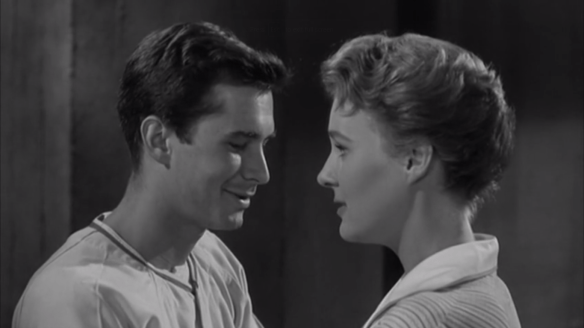
I can’t think of another actor more apt to play this version of Jimmy Piersall’s story than Anthony Perkins. History reflects a more multifaceted even complicated individual.  By other accounts Piersall could be a real cut-up; here the story is very singular-minded in how it portrays its protagonist. It’s played for the drama which it no doubt was but you get to wondering if Piersall had written the script it might have turned out to be more of a comedy.

Robert Mulligan’s film suggests there are arguably the two most important people in Piersall’s life. The first is his father (Karl Malden) who from an early age instills his boy with the onus of making it to the big leagues. That’s the goal and his father watches proudly as his boy becomes a high school star while never letting his son rest on his laurels or let down his guard. He must be constantly vigilant, continually thinking ahead, all in an effort to land a contract with the Red Sox.

He starts out in the minor leagues and there he meets a pretty nurse, the relatively unknown Norma Moore playing the ingenue and his first wife Mary. She makes him deliriously happy and vice versa as they begin to build a life together.

But the conflict at the core of the biopic is Piersall’s own bouts with undiagnosed nervous breakdowns which would be now categorized as bipolar disorder. Put in the context of the era where mental disorders were more often than not left stigmatized and misunderstood, this is actually a fairly fearless film for taking on such source material. But, of course, much of the credit must begin with Piersall himself for being willing to acknowledge it all, to begin with.

Particularly foundational to this film is Jimmy’s ongoing relationship with his father. The scenario happens so often it seems like a cinematic trope but sadly it’s also very close to the truth. It occurs between a parent and their child when they get so vicariously invested and demanding and controlling of their child’s life that they heap so much pressure on them that it becomes nearly an unbearable weight to succeed. Compounded by the fact that these parents are usually trying to realize their own failed talent and never seem to find it within themselves to give their children a pat on the back or a word of encouragement.

You get the sense it was a vicious cycle. Their father never did it for them and so they wind up having a hard time showing any amount of their affection to their kids. It’s something, in this case, that must be earned on the ballfield or in Brian Wilson’s case earned with how many hit records he churned out and composed. Maybe it’s why a parent a la LaVar Ball seems to cherish the spotlight, commanding the media’s attention even more than his boy. Whatever the outcome is, it never seems enough.

It’s purely a testament to Karl Malden’s quality as an actor that he makes Piersall’s father into a nuanced man who is not a holy terror. In fact, even when he doesn’t say it outright we know full well he is proud of his son and he even loves him. He’s not a bad man by any means. That doesn’t make measuring up to his standards any less daunting or his behavior any less damaging.

Though tender and tortured in the everyday moments, Perkins performance on the ballfield feels artificial but you can hardly blame him for lacking the posture or the swagger of a ballplayer where hitting and fielding come as second nature. He looks too much like he’s playing at it — he’s too wooden — not like he’s actually played it his entire life.

Almost uncannily it seems that I find myself at certain movies only after the subjects are gone. Piersall was still a young man in the midst of a baseball career when his story and the subsequent film was made. He passed away in 2017 at the age of 87.

Whether this story is completely true or sensationalized, there’s still an essence of something meaningful here. That we should not be ashamed of our fears and we cannot live life in pursuit of what will earn us the affection of others. It will only succeed in running us into the ground.

That’s why the moment at the end of the film is so fitting, showing Piersall playing a lazy game of catch with his dad. There’s no agenda. No pressure. You simply get the joy of throwing that ball rhythmically again and again perfectly in sync with the person across from you. I’ve done it many a time with my own father and I permanently retired from the game after being little league champions in middle school. Still, I love baseball for those very simple pleasures that it offers.

3.5/5 Stars

The Stratton Story (1949)

stratton story 1.png

If you’ve never heard of the baseball player Monty Stratton, you’re not alone. In my days of wanting to be a ballplayer myself, I knew quite a bit about baseball Hall of Famers going back to the genesis of the game. But Stratton was not a Hall of Famer like Honus Wagner or Ty Cobb, George Sisler or Rogers Hornsby or even the members of the Bronx Bombers including Lou Gehrig and Joe Dimaggio. Though famed Yankee Bill Dickey does makes a cameo in this one.

Stratton was not in the same category as these men and there is a reason for that. Tragedy struck his life. Interestingly enough, Hollywood looked to make a movie out of it calling on the talents of Jimmy Stewart as well as director Sam Wood. It’s Wood’s association with the picture which causes me to surmise it was meant to be another Pride of the Yankees (1942) with Wood taking up duties again and one All-American in Gary Cooper being traded out for another in Jimmy Stewart.

No disrespect to Monty Stratton or anything that he went through but at face value, his story is hardly that of Lou Gehrig. Still, maybe that’s the point and we can learn something from that. Generalizing and putting all baseball biopics together is in error and in this case, it feels callous. This is a film that makes Monty Stratton’s story into his own and it’s at times winsome in its simplicity and still equally moving.

Watching this picture anchored by James Stewart in another everyman role is as charming as ever. Equally enjoyable is Frank Morgan or even the budding romance with June Allyson coming to fruition within its frames. His brusque mother (Agnes Moorehead) who only knows the tough life of a farm woman even has her affectionate side; you simply need to get to know her. Also, having an old pro like Jimmy Dyke playing the big league manager is yet another touch of authenticity that might be easily overlooked in the modern day.

Through and through, this is Stewart and Allyson’s film as we watch Monty make a name for himself going from being an indefatigable farm boy with a cannon to the minors in Omaha, and finally to the big leagues where dreams are made. Equally important to his career trajectory is the parallel story of how a potentially disastrous first date turned into a lifelong romance with his girl Ethel.

She sees him through a great deal both the highs like the birth of their son to the lows, a fatal event that will change Stratton’s life forever. It’s in this portion where we could criticize the film for stalling but it does rightfully so as Stewart must make a decision whether or not he’s going to fight back to regain his life.

Eventually, he does, going further than any naysayer might give him credit for. Then again, you get the sense that Monty Stratton was the kind of ballplayer that most folks found it in their heart to cheer for. Part of that appeal is Stewart’s typical geniality certainly but the man he was portraying had to be fairly special too.

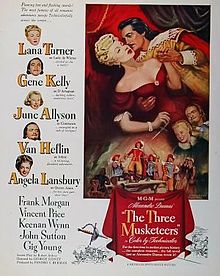
The spectator in the movie theater might remark Gable and Turner are better kissers on screen but I’d truthfully rather watch Stewart and Allyson. They’re more my type of people.  In fact, I’m pretty sure I would have liked Monty Stratton too. He seemed like a humble fellow who lived his life with everyday dignity. They don’t always make them like that now. The same could be said for this movie.

The film closes with the prototypical “The End” credit but that really was not quite right. Because Monty Stratton was still pitching and had a long life ahead of him just waiting to be lived. That’s the power of this story. It recognizes a man who did not let circumstance deter him from continuing to live a full life.

Stratton died on September 29th, 1982 and within that time he made a second comeback to baseball, moved back to Texas to start a farm team, and was deeply invested in his community until his final days both in promoting Little League and attending his local church.

3.5/5 Stars

Lady Bird (2017)

Lady_Bird_poster.jpeg

Greta Gerwig has a deep connection with Sacramento that I failed to appreciate when I first saw her in Frances Ha (2012). In that film, she’s making a life for herself in New York but stops off in Paris and returns home to the west coast. Now with Gerwig directing in lieu of Noah Baumbach, we have the inverse and the affection on display is indisputable.

A young woman resides in Sacramento with dreams of the culture of the east coast, namely New York. It’s the old story. We rarely appreciate where we come from or who we have in our lives until we have to leave and say goodbye. There’s no place like home.

Although I lived in California most of my life, it’s a big place and I do not know Sacramento intimately and yet I can deeply admire someone who does and takes care in portraying it on screen. It’s hardly a touch-up job but Lady Bird exudes an agreeable rose-colored nostalgia.

We are reminded that this is the post 9/11 generation which barely had cell phones and was still listening to “Crash Into Me” and Justin Timberlake. I remember bits and pieces of that time and I certainly recall the aftermath which will never be wiped from my memory. However, I increasingly realize fewer of my generation remember this era and so for me it’s a type of period piece that I can appreciate first hand.

There’s something about the story that evokes Anne of Green Gables for me. It is a mother-daughter movie. Our heroine Christine (Saoirse Ronan) has a gripping personality and like her predecessor desires a name change, in this case, Lady Bird. It leads to heated conflict with her mother and yet there’s a father too who has an affable spirit to play peacekeeper. We grow to appreciate them all.

The opening conversation between Lady Bird and her mother (Laurie Metcalf) is so very honest in capturing how as human beings we are so quick to cycle through emotions – bonding, loving, then arguing and instantly annoyed. I heard talk in an interview Gerwig gave about her writing process. It wasn’t so much about hitting all the right beats at first. She wrote so many pages and lived with the characters and let them take her where they would. In this regard, there’s a three-dimensional even lived in quality to each individual that cannot be fabricated. Far from being types, they overlap and interact in ways that feel refreshing and authentic.

The parents actually have an integral place in the lives of their children. They are not relegated to being killjoys or caricatures. There’s hard and fast truth to both Metcalf and Tracy Letts as they exquisitely inhabit their roles. There’s none of that leaving out a parent conveniently to make it easier to write for. Lady Bird pays respect to all of its characters much as it does its setting.

The best friend is another well-trod trope and you wonder if there’s any way to create something that has not already been done. Lady Bird and Julie’s (Beanie Feldstein) relationship sums it up precisely. As they quarrel, get involved in theater, and dance and daydream about all the things you’re supposed to. Eating unconsecrated communion wafers, feet in the air, backs on the floor chatting. It’s endearing and what we all craved in high school, whether we had that person or not.

Then, of course, there has to be the love interest. And yet again Lady Bird does something far more realistic. There’s not just one boy but two. The theatrical one, Danny (Lucas Hedges), from a big Irish family and then the hipster nonconformist one, Kyle (Timothy Chalamet), who can be found playing bass, smoking, and reading Howard Zinn’s A People’s History of the United States at a cafe. And even by the end, we never know which one was better for her. That’s not the point.

They were all part of her discovering more of herself. You even have the cool girl who everyone tries to suck up to. She’s entitled and has a hunk boyfriend and her parents don’t care what she does but even she has some humanity and a moral code. She’s not the devil’s incarnate. None of these characters are. As one who has dabbled in writing coming-of-age fiction with varying degrees of success, I recognize the ability of someone who is able to balance the economy of the genre with something that feels so resonant. It captures that expanse of time that is high school colorfully and with a degree of variedness. There is little chaff.

Like some of its immersive and empathetic brethren — The 400 Blows (1959), American Graffiti (1973), and Boyhood (2014) spring to mind — Lady Bird is not simply a coming-of-age story from the female perspective but an eloquent articulation of the human experience.

It’s also a film of benevolent spirituality. It’s set at a Catholic high school with some of the hallmarks we might recognize — uniforms, mass, communion. But it never feels like a mere punchline and those in positions of authority are generally warm and understanding.

The bright-eyed sister (a venerable Lois Smith) shares her love of Aquinas, Augustine, and Kierkegaard. Later she’s the victim of Lady Bird’s practical joke to try to gain a new friend. She plasters a sign on the sister’s car reading “Just Married to Jesus.” At a later date, it gets brought up matter-of-factly, the sister smiling at the joke but noting it’s been at least 40 years.

She is the perfect embodiment of a spiritual leader, leading by example and a heavy dose of compassion. She nudges her students but there’s also enough sense to realize ultimately they will have to figure it out. I did have a momentary flash of how perfect it would have been to cast Dolores Hart in the role but that’s hardly a complaint mind you. I also felt compelled to quote Kierkegaard’s journalings right about now and so I will. He penned the following:

“Of what use would it be to me to be able to formulate the meaning of Christianity, to be able to explain many specific points–if it had no deeper meaning for me and for my life… I certainly do not deny that I still accept the imperative of knowledge and that through it men may be influenced, but then it must come alive in me, and this is what I now recognize as the most important of all.”

I’m not sure if I have anything to add to his words but they just feel applicable to all of us. And Christine gets somewhere in her personal journey. In one moment, she’s finally made the move to New York and like all good insecure college students, she’s having a drunken conversation with a dude about God. He asserts that he doesn’t believe that there is one. Then she mumbles to herself how people don’t think there’s a God and yet they so readily take on the arbitrary names their parents choose for them.

Eventually, she wanders by a church on a Sunday morning after a short stint in the hospital (nothing too serious) and stays to enjoy the choir. But in a moment of realization, she walks out and calls up her mom to reconcile because she recognizes how important that relationship is to her life. She’s willing to acknowledge her affection for her mom which is a step toward greater understanding and love.

Lady Bird paints in warmth and laughter, anger and tears, that all have deep abiding roots in the love of family and friends. That’s how a film about a red-haired teenager in Sacramento could manage to be for all of us. I want to see it again already as I know my esteem for it will only rise.

4/5 Stars

Only Yesterday (1991)

only yesterday 1.png

Only Yesterday’s opening images resonate with me because of their sheer familiarity. The reflections of urban life in a skyscraper. Office buildings with desks, computers, copy machines. All those necessities of the modern working world.  This is the personification of the status quo that many of us are used to, not simply in a place like Tokyo in the 1980s, but all over the world even right now. Many of us know that life intimately. It’s the first of innumerable moments where Only Yesterday will provide instances of immediate recognition.

From what I gather, Only Yesterday redefined what anime was capable of and really what was considered appropriate subject matter for the medium. This is not only a children’s film though it looks back at adolescence. It’s equally a film for adults and a female audience with its narrative fluidly cycling between childhood memories and current recollections; the point of view belongs to a single independent working woman named Taeko.

These are the two distinct time frames that Isao Takahata’s film works within. In 1966 Taeko was just a girl. And it’s true that all those remembrances of childhood only exist as wisps of their former clarity. Visually the flashbacks are composed of minimalist watercolor backgrounds that manage to capture the transient nature and washed out qualities of our memories. Often recalled fondly but never captured with the same vibrancy that we had in the moment.

And the mystery of the mind is that it can so quickly recall a moment based on a time, a place, a person, a thing, or for no particular reason at all. It could be a vacation floating in the baths of Atami. The novelty and the ultimate letdown of a pineapple not yet ripe. But there are cultural recollections too like the Beatles exploding at Budokan or your older sisters sporting miniskirts as members of the emerging pop culture generation.

Meanwhile, school life is full of your typical scenarios including landmark decisions about hall monitors chasing offenders through the hallways. Young romance is awkward and innocent, blooming around a baseball diamond.

After a single injudicious conversation, talk of periods blows up all across school with the subject becoming the boys’ new favorite point of humor. Taeko also shows off her talents as “Village Child A” in the school play, finding ways to extend her performance and make something out of nothing. She simultaneously looks to commit death by fractions. I must say that I relate. I never did like fractions.

Further still, there are sisterly tiffs over enamel hand bags and altercations with fathers who are normally calm and distant but in a single moment lash out in anger. They are the type of incidences that remain emblazoned on your mind. Meanwhile, mothers scold and chide their children.

only yesterday 2.png

But the true fascination in these events come in the very fact that once more they are tied to the present and lay the foundation for who Taeko is. The same can be said for each and every one of us. However, in 1982 she is now a young working professional. Still, unmarried and quite content with that aspect of her existence even as she bonds with her distant cousin Toshio.

Her aspirations are to spend more time in the countryside — a  countryside blessed with tranquility and gorgeous panoramas — situated in sharp contrast to her life in Tokyo. Because it is in the said countryside where she begins to find a life that somehow feels far more fulfilling. The work and the living are simple but the people are kind and it somehow feels more purposeful. It’s also a prime environment to gather yourself and reflect on life.

Only Yesterday exhibits truly breathtaking imagery that captures both the minutiae and the exquisite scenery of Japan with this fascinating mode of realism. It is only improved upon by the fact that it is a drawn world capable of gravity-defying feats that nevertheless personify authentic emotions. And yet it fits the film on the whole because this is a story that seems to find a rooted contentment in what we would term the mundane. As this is a film that evokes memory, it’s fitting that such a thing would be so.

One of the great mysteries of the world even today is that it’s these very things that are most meaningful to us as human beings. Sure, we remember the big life events but oftentimes equally important are the other times. Because what is life if not a series of small incremental events connected together through experience, jubilation, sadness, wistfulness, pain, and contentment? Each of us carves out a road for ourselves that cuts through the past to the present to a future that we have yet to discover.

The original Japanese title translated is “memories come tumbling down” and somehow that resonates with me far more, being the nostalgic person that I am. It’s true. Certain memories will always be attached to a distinct time and place. Some good, some bad, but all a single element in this patchwork of life. Here is a film that deftly navigates the past and the present through various fragments, assembling the shards into a story that derives satisfaction in all its diversions. Taeko is able to get nearer to the life that she longs for. In that respect, Only Yesterday is in one sense an enchanting film but also a sincerely fulfilling exploration of humanity.

4.5/5 Stars


From Up on Poppy Hill (2011)

Kokurikozaka_kara_film_poster.jpgThe song “Sukiyaki” sung by Kyu Sakamoto proved such a charming enigma for me. Here was a record that was so quintessentially Japanese, a melodious ballad, that was nevertheless branded in the West with a more novel title and became a smash hit. However, here within the framework of this anime, the song feels perfectly at home once more as “Ue o Muite Arukō” an impeccable benchmark of an era in Japan’s history. It’s true that the full extent of the musical score is noticeably more western than we might be used to with anime yet the cornerstone of the soundtrack is Sakamoto’s iconic tune.

What we are given by director Goro Miyazaki and a script by his father Hayao Miyazaki is a small-scale nostalgia piece that still manages to have broader implications for all of Japan. More crucial yet is how it aims to hone in on a story that is part family melodrama, part love story, and even a high school feel-good tale.

We are planted in Yokohama (south of Tokyo), circa 1963, with the nation setting its sights on the 1964 Olympics famously documented in films such as Kon Ichikawa’s official documentary and Walk Don’t Run (1966). Here Up From Poppy Hill gives a more up close and personal approach that allows us to empathize with a very different type of narrative.

Because even with the pull for modernity feeling so prevalent, there is this sense that Japan, as not only a nation but a culture, must not forget the past. Yes, the war years were rife with so many tragedies but therein still lie traditions and the ways of old that must not be forgotten.

The greatest emblem within the confines of the film is the so-called “Latin Quarter” on the high school campus — a dingy rickety old building that serves as headquarters for many of the school’s circles including philosophy, chemistry, archaeology, and of course, the school newspaper.

Umi is a young student who must help run her family’s boarding house by preparing meals daily after school and the like. But after a fateful encounter, she is drawn to become a member of the academy’s journalism circle transcribing news.

One of the figures who leaves an impression on her is Shun, a stalwart member of the journalism circle, who is part of a band of students intent on fixing up their headquarters. But more so than that these audacious students must plead with the local chairman to reverse his plans to demolish the old relic. For them the reasons are twofold. First off, it’s their home and secondly, it’s part of their history.

Poppy Hill also takes great care to consider Umi and Shun’s parents. Her mother is a professor and her father was a sailor who died during the Korean War. Shun’s past is something that’s even more murky, clouded by facts that he’s never quite been able to reconcile. Their coming together at school proves a near act of fate since their personal histories are tied closer than they could have ever known. Again, the past and the present prove equally important to their identity.

The main draw for me is the throes of nostalgia that wrap up the picture. Pictorials that capture the innate beauty of living in Japan generations before with the harbor and the fresh sea air off in the distance. While simultaneously you have the degradation left over from the war and the increasing pollutants which come with what is termed “progress.” It’s true that in all things there can be derived both a positive and a negative. The same could be said of the love/hate relationship with the U.S. and the constant give and take between progress and remembering the past. These issues prove universally applicable.

But this is never a story to dwell on the bad, far more content with forging an innocent and genial path. That’s one of its finest attributes and you can see Hayao Miyazaki’s own warmth coming up through the seams. There is little animosity here as it’s replaced by laughter and more pleasant aspirations. While son might never reach the heights of his father as a storyteller, Up From Poppy Hill is nevertheless a quaint tale that brims with benevolence.

3.5/5 Stars

National Velvet (1944)

national velvet 1

“Everyone should have a chance at a breathtaking piece of folly, once in his life.” ~ Anne Revere as Mrs. Brown

There’s been many a boxing and a ball sport movie and so it seems only fair that there be room for at least one more Technicolor horse drama, especially one with the breathtaking and gloriously unbridled energy of National Velvet.

It showcases the lofty aspirations riding on the back of a horse and carrying the effervescent hopes of a young girl. I’m certain we could use more movies like this — ones done with this amount of candor and geared toward a broad audience — namely the entire family.

True, Clarence Brown is a director mostly lost to time and perhaps understandably so. This isn’t so much of a technical marvel as it is a story that wraps up its audience with some amount of vigor.

Nor was it a film shot abroad in some exotic location. But that is hardly a criticism, mind you. This was Hollywood’s rendition of the British Isles created in Pebble Beach, California much in the same category of other such period classics like How Green Was My Valley (1941) and Lassie Come Home (1943) — the most obvious point of connection being the always admirable Donald Crisp.

Featured front and center is Elizabeth Taylor in the days when she hadn’t yet been propelled to iconic sex symbol status and still remained the sweet precocious little girl who made the screen sparkle with her adorableness.

Here she is as Velvet Brown. Other girls, namely her big sister (Angela Lansbury) are boy struck but Velvet can best be described as horse struck. She dreams about them in her sleep, thinks about them in her waking hours, and must stop the moment she sees one of her favorite thoroughbreds in the fields on the road home to her town of Sewells.

From the first time she sees “The Pie” in all his majesty, she’s absolutely enchanted by him. It was a love story meant to be. Stirred up by her mother’s own past forays in sport, Velvet begins to entertain thoughts of entering her beloved horse in the Grand Nationals which she believes he is capable of winning with the right training and a rider who knows him.

With the guidance of Mi (Mickey Rooney), a young nomad hired on by the family, they get the horse trained up for competition. But of course, the only one who truly can ride “The Pie” and believes he cannot put a foot wrong is Velvet herself.

Perhaps it’s not as epic as a Ben Hur chariot race or a pod race but there’s still somehow such investment in Velvet and her horse and we feel the same urgency that’s coursing through Mi as he’s watching the race. It’s an infectious moment that catches us up in its swelling emotions to the very last leg.

Far more important than the outcome of the race, however, is how Velvet remains true what she deems to be right. She never lets her pure love of horses — or this particular horse — be muddied by any amount of press or potential fame that might come out of the partnership. Because she’s not seeking any of that. Her intentions are very sincere. She’s doing it all for the sheer joy of getting to gallop across country with her best friend. That’s reward enough for her.

It’s true that Velvet’s parents prove to constantly upend our typical expectations and there’s a pleasure in finding out more about their true character bit by bit. They are folks of hardy stock who are plain but not without their unostentatious charm that comes from being bred in a world of hard work and no doubt Christian charity.

Anne Revere gives one of the most enjoyable performances of her career, start to finish, imbued with an impeccably dry wit that also comes with being a mother who loves her family dearly and aspires for them to have hopes and dreams to carry them through life. You get a sense that she desires they might be decent people who never weary of doing the right thing. There’s a sublime nuance to her turn that would be lacking from the film’s frames otherwise. She is the moral heartbeat and the counterbalance to every other character.

Fiction also mirrored reality in that Elizabeth Taylor truly became the tenderhearted horse whisperer as one of the few people who could actually handle and ride her horse. There’s no sense of parlor tricks and if it’s possible to say this, there’s almost a visible chemistry between her and her steed. They seem meant to be together. Fittingly, on her 13th birthday after the filming was done she was bequeathed her four-legged friend and they remained together for his entire lifetime.

The only rather odd performance or casting choice might seem to be Mickey Rooney who was still a major star in 1944 but sometimes his role doesn’t feel the most authentic. It feels like he’s playing at his part. Meanwhile, Taylor continually bowls us over with every drop of cheerfulness she has in her being.

Maybe I am unfairly prejudiced against Mickey Rooney but he always seemed more like a personality than a true actor. Here as Mi he more or less looks like a tragic story waiting to happen but now thanks to a girl and a horse, he’s getting his shot at redemption. Thankfully for us, this is not wholly his story but more so the story of the horse and its girl.

It’s a wonderfully forward-thinking message for its day that a young girl with ambition can succeed in a man’s world even on the racetrack. Fantasy or not this is a story that uplifts with sheer climactic euphoria.

To all the future teachers, doctors, lawyers, explorers, scientists, and jockeys, this film gives its message loud and clear. Dare to dream. You can’t worry about what others might say. Just go out and pursue whatever it is with all the passion you can muster. No matter the outcome, there will be little to regret.

4/5 Stars

Four Daughters (1938)

four daighters 1.png

The entire packaging of this Warner Bros. film includes director Michael Curtiz, screenwriter Julius Epstein, composer Max Steiner, and Claude Rains all who (not unsurprisingly) would have their hand in that revered classic Casablanca (1942).

Here the Lane Sisters are joined in their quartet by Gale Page with Claude Rains playing the musical patriarch of his family who has trained his daughters up to be an orchestra right in his living room. He’s a belligerent but good-willed father with all his show of bluster merely a facade to hide a heart of pure gold. The role slightly subverts many of Rains’ typically even-keeled gentlemen.

Most of these opening sequences draw up just how quaint and delightful they all are together and what a perfect little life they share as the men begin to show up in their lives to call on them. Isn’t love grand? That’s what we might be prompted to surmise is the film’s main theme.

Four Daughters teeters perilously on the edge of being insufferably schmaltzy to its core and yet it seems that the arrival of John Garfield and the insertion of his character into this idyllic world of giggling girls and small-town romance is just enough to save this story and make into something worth remembering.

Mickey Boyd (Garfield) walks into their home as an acerbic outsider who thrums his nose at the picture-perfect American family in their quintessential American home but he also has a gift for the piano and as musicians themselves, that’s an instant point of connection. Furthermore, he’s come into town as a favor to his old colleague Felix Deitz (Jeffrey Lynn) who happens to be a close family friend and maybe one of the nicest guys you’ve ever met, either onscreen or off.

Still, Mickey is a tough one to crack but that doesn’t keep the maternal Aunt Etta (May Robson) or vivacious young Ann (Priscilla Lane) from trying their best to figure him out. In fact, Mickey becomes a bit of a pet project for Ann as she looks to slowly transform him into an honest to goodness genial human being. She does a fairly good job at it too as he is brought into the fold of the family for every subsequent round of holiday festivities.

The second act proves to be the most potent and whether or not the turn of events are truly probable does not detract from how affecting these sequences turn out to be. And ironically, at the center of it all are Mickey and Ann. The man who has always been the outsider looking in and the youngest sister full of playful precociousness. He is the one who helps her see things as they actually are and she, in turn, continually spruces up his life and to use an inane phrase, she “turns his frown upside down.”

But I think that’s the key to the final act of Four Daughters. It’s dramatic but it loses that almost sickening layer of sugarcoating and shocks everyone within the frame of the film back to the reality of the world with one tragic event or two events depending on what you deem the tragedy to be. This doesn’t simply feel like a mere play for our emotions — though it might be partially this — but it’s really a bit of a representation of what life actually throws our way.

That’s why Mickey is by far the most important character in this picture and he’s so necessary for it to be anything more than typical Hollywood fare because in some sense John Garfield makes that man into a real person. He’s not necessarily a bad fellow. In fact, we kind of like him because he seems a bit sardonic, frank, and he’s not going out trying to be something that he’s not.

True, the Hollywood happy ending is tacked on as we come to expect but perhaps in the closing moments, as the sisters look through the drawing room window and Ann is back to her gate-swinging ways with her beau as before, we can gain some satisfaction in the moment. Not simply because all is right in this little universe but the family went through trials and now are better for it — more attuned to the world. They are no longer simply four daughters or soon to be four wives. They are four women.

The film was dressed up in Technicolor in Young at Heart (1954) with Doris Day and Frank Sinatra and Sinatra elevated that film much as Garfield does here. His tune “All the Way” while having no bearing on the plot is nevertheless a memorable number. I have nothing against Mr. Lemp’s taste in music nor his disdain for the contemporary bilge of his day but I rather like the crooners myself.

3.5/5 Stars


Shack Out on 101 (1955)

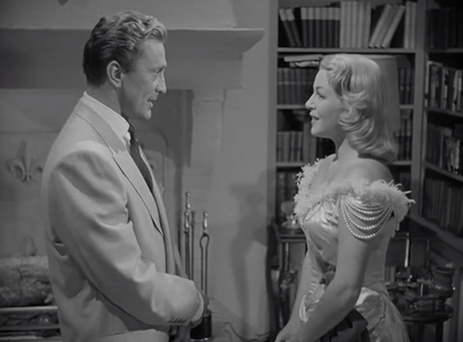
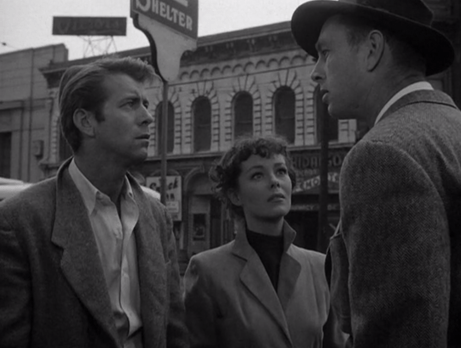
Shack_Out_on_101_film_posterLike a Cry Danger (1951) or a Private Hell 36 (1954), this low budget film noir flick is such a joy to watch because it wears what it is right on its sleeve, clear out in the open. What we get is an utterly absurd paranoia thriller that also happens to be a heaping plate of B-noir fun.

It’s a dirty, grimy picture about a dirty, grimy place. The cook behind the counter’s named Slob (Lee Marvin) and he has a dirty mind and disheveled look to match. He’s constantly at odds with the owner of the roadside shack (Keenan Wynn) and they make countless verbal barbs at each other time and again. You get the feeling that they relish jawing and putting the other man down.

Meanwhile, though the joint might not be one of the most frequented attractions there is some traffic from PCH and it brings in a few regular visitors.

The day-to-day “Hash Slinger” and longtime waitress Kotty (Terry Moore) is in the middle of a rapturous romance with a local professor Sam Bastion (Frank Lovejoy), and she’s beyond ecstatic to be going with someone who is a real man — intelligent and gentlemanly. Though recently he’s been especially occupied with work.

The traveling salesman Eddie (Whitt Bissell) with a nervous streak nevertheless remains a tried and true friend. He and George (Wynn) both made it through D-Day together and since then he always makes a habit of coming by the old place when he has a free moment. Kotty and the Professor take kindly to him too. He’s just that kind of amiable fellow.

Shack Out on 101 shines most obviously amid its small talk because there’s an invention to the dialogue that’s delightfully slovenly and colloquial. It’s full of the types of dialects, jabs, and put-downs that fill our everyday conversations in a way that feels thoroughly authentic and brings each character alive as they sit at the counter.

There might be two men standing in the front of the diner on a slow day lifting weights and talking about how muscles are for amateurs. Pecs are what real men call them.  Then they proceed to show off and compare their physical attributes. No reservations whatsoever.

Later on, they try out the latest fashions in spearfishing attire as they dream about the mythical “Pancho” who they’ll soon spear in the tropical waters off the coast of Mexico. Little do they know how close that is to the truth. Except there’s no need to go to Mexico. The catch is right at home.

When the film actually gets preoccupied with its plotting, it starts to go cockeyed and crazy. Admittedly, fallout from the Cold War must have been on everyone’s minds because, like Aldrich’s Kiss Me Deadly (1955), this picture too tries to play the nuclear angle. It’s hardly effective though I suppose it needed a broader, more concrete story to add a certain amount of intrigue and this one is complete with spies and government secrets.

Still, in the end, it comes out pretty thin. What we truly relish as the audience are not the attempts at drama but the way the film manages to make its apparent lulls invariably interesting and even how it manages to have asides at all given its infinitesimal running time. Sure, it won’t win any awards and the joint is a real dive but that’s all part of its cruddy charm. For a B-picture, this cast is quite the array of talent.

3.5/5 Stars

Silk Stockings (1957)

silk stockings 1.png

In full disclosure, though I admire Ernst Lubitsch’s directorial eye and Billy Wilder’s trenchant wit, the Ninotchka (1939) premise alone never intrigued me. But as with all the great pictures, it’s not necessarily the main conceit but the execution of the story with its own unique digressions which matters most.

That’s why having screen goddess Greta Garbo paired with the two men mentioned above is of note. They ultimately created something delightful together. And as we draw the line all the way to Silk Stockings almost two decades later, the names attached are equally important.

We can probably start with Fred Astaire who was in a period in his career that constantly seemed to fluctuate between retirement and flurries of inspired activity. In this particular case, he would follow Silk Stockings out into the theaters with a second success in Funny Face (1957) pairing him with Audrey Hepburn for the first and only time.

Though he had his initial misgivings about the material and his director, Rouben Marmoulian proved to have quite the success with Silk Stockings, which would subsequently be his last effort in a generally underrated career. He took the successful stage play and transferred it to the screen, this collaboration even featured several more tunes from Cole Porter’s repertoire while writers such as Leonard Gershe (who had already penned Funny Face) and industry veteran Harry Kurnitz worked on the script.

Then, Cyd Charisse had the seemingly insurmountable task of inheriting the role owned by a larger-than-life star if there ever was one — Garbo herself. And yet maybe it’s a reflection of my own predilections in performers but I rather like Charisse in the part not because of the acting per se but for the moments where she’s able to shed the role and become the sentient ever dynamic being she is as a dancer.

The ball starts rolling when an American film producer, Steve Canfield (Astaire) tries to coax a brilliant Russian composer named Boroff (Wim Sonneveld) to compose the score for his next film. Simultaneously three of his countrymen have been enlisted as emissaries on Parisian soil to bring him back home before he gets polluted by capitalist dogma any further. The oafish louts are eclectic talents as diverse as Peter Lorre, Jules Munshin, and Joseph Buloff.

Of course, if you know anything of Ninochtka (1939) or retrospectively, Wilder’s similar One, Two, Three (1961) you’ll know that they too get seduced by the decadence of capitalism to humorous ends. It seems there is only one person who will not fail in her mission, that is Ninotchka (Cyd Charisse), an austere devotee of the party whose only interest is observing French trivialities on a purely academic basis while making sure her comrades remain diligent in their duties. She’s a tough case to crack. It’s bound to take time and yet at some point, Canfield gets to her with a little help from “The City of Lights.”

Janis Paige enters and wows the reporters and everyone else with a tornado of flirtatious vivacity captured in the number “Glorious Technicolor Stereophonic Sound.” Like It’s Always Fair Weather (1954) before it, the musical number manages a few jabs at the direction the industry was heading with the advent and subsequent cultural boom of television. And yet in his shrewdness, Astaire lobbied for the picture to be shot a very specific way and sure enough, it got made in Cinemascope and Eastmancolor with Stereophonic Sound.

silk stockings 2.png

After shedding her dour exterior, Cyd Charisse gets arguably her finest starring spot in any film, playing opposite Astaire again following The Band Wagon (1953) and despite the constraints of her character, she fairly rapidly transforms into the free-flowing, immaculately graceful spirit we know her to be.

Fittingly, Charisse earns the film’s most emblematic scene where she exquisitely dons her first pair of silk stockings along with an entire wardrobe as she goes through her ideological transformation which subsequently transforms her very movements with carefree ease. She brings it to life moment by moment so effortlessly. In “Fated to Be Mates,”  Astaire and Charisse are featured together at their most lively as the leading man leads his partner in twirling carries and their dance devolves into a show verging on parkour and gymnastics.

Along with the amorous “All of You” to instigate his relationship with his repeatedly aloof leading lady, Astaire gets another contemporary showcase that simultaneously alludes to his rich legacy in the industry. “Ritz Roll and Rock” perfectly encapsulates this performer-extraordinaire who came out of a certain era and yet never seems outmoded even in the latest music craze.

He went out on top and continued to perform at that same level to the very end. Not every leading man can say that. Of course, the exclamation point at the end is the smashing of his top hat for all posterity. As we’ve all probably noted over the years, it’s a bit of a moniker for him and fittingly when he’s gone, it’s retired too. No one else deserves to wear the crown of the king.

3.5/5 Stars

NOTE: My entry in The FRED & GINGER BLOGATHON !