
Review: Notorious (1946)

notorious 1.png

I never put much stock in a Hitchcock title out of force of habit or lack thereof because he never seemed to. But thinking on Notorious I came to the rather unextraordinary epiphany that it refers to lovely Ingrid Bergman as much as any Nazi, at least from a certain perspective.

In the film, she plays the daughter of a Nazi war criminal who was put on trial and found guilty. She, however, is not implicated in his deeds. Instead, busying herself with having a good time, drinking, dancing, laughing — all the superficial pursuits that can distract her from a post-atomic world. You might even say her reputation precedes her and that provides the framework for how others see Ms. Huberman. Namely, one government agent named Devlin, put on her case and writing her off early on as a certain kind of woman.

There’s that initial shot at one of her parties where all the guests are dancing and drinking and everything’s jovial and there Cary Grant sits on the edge of the frame just his profile identifiable to us. And the beauty of the scene is that Ingrid Bergman starts talking to him but instead of showing us his face Hitchcock elects to wait until everyone is gone and they’re sitting together in the next scene. But already there’s this implicit sense that there’s something unusual about this man even without putting words to it.

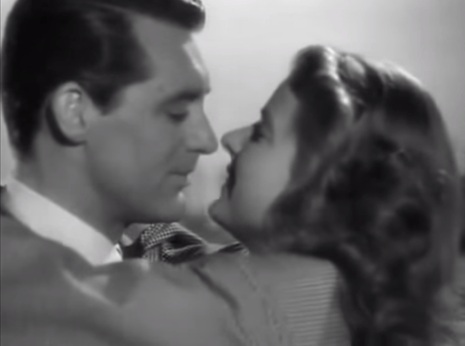
In the subsequent scene, we get our first view of Cary Grant and Ingrid Bergman together and how wonderful they look. But Bergman’s character makes an off-handed remark about love songs, about how they’re a bunch of “hooey.” Of course, that pertains to this film and where it will decide to go in the realms of romance, but in my own mind, I see it also functioning as a reaction to Casablanca’s “As Time Goes By” — a film where lovers fell in love partially because of a song.

It’s easy to put the title of a spiritual sequel on Notorious for numerous reasons. Once again we have Bergman and Rains in crucial roles and then trading out Bogey for another legend in his own right, Cary Grant. The paranoia of Casablanca is replaced with the sunnier disposition of Rio de Janeiro which nevertheless is underlined by a certain looming Cold War menace. In this case, instead of the letters of transit, we are provided a Hitchcock MacGuffin, including a bottle of wine, some uranium, and an iconic UNICA key.

But if nothing else these minor remarks can put the debate to rest conclusively. Notorious is a spectacular film in its own right and it enters some similar yet still uncharted territory in accordance with the waters Casablanca chose to ford a few years prior. Meanwhile, Grant has glimpses of his previous self from other films but soon enough he falls into the role of cool and calculated federal agent Devlin in what feels like a true departure.

There’s that supremely unnerving shot as we take on the perspective of a disoriented Ingrid Bergman as Grant walks into the room and hangs over her in a strangely alarming way. Everything is setting up the dynamic at this point.

Still, others will remember the extended make-out session that made history by upholding the Hays Code ” three-second rule” while simultaneously perfectly encapsulating nearly an entire romance in a matter of four or five minutes. There was little else to be said because it was all seen in that one sequence and Hitchcock could proceed with his conceit.

Because, ultimately, Hitchcock’s picture is built around this idea: The American government has a little job to be done and Alicia and Devlin are caught in the middle. Thus, it becomes that time-worn idea of love versus duty. In one sense, Devlin’s caught in a terrible position and yet in the other he treats Alicia so badly — and it’s not simply that this is Alicia but this is beautiful, sweet Ingrid Bergman that he is pushing away. Still, in pushing her away, it’s leading her toward the objective.

He’s simply not willing to dictate anything because that means being vulnerable. Very simply he’s not willing to open up.  Cary Grant has never felt so icy, so aloof, and so unfeeling. Then, on top of this, Sebastian (Rains) looks a far more agreeable fellow cast in such a light. He genuinely loves this woman even if she is a spy. It makes for a conflicted viewing experience.

Though there is a juncture in the film where Devlin is beginning to shift his way of thinking. But as if on cue (undoubtedly) one line of dialogue out of Alicia’s mouth during a racetrack exchange (“You can add Sebastian to my list of playmates”) poisons his whole frame of mind again. His prior opinions of Alicia are confirmed and he sours to her — never giving her the benefit of the doubt from that point forward — and ultimately torturing her so that there is no other choice.

Just like that, she goes through with it. Instigating her relationship with Alexander Sebastian (Claude Rains) and succeeding so thoroughly that she’s married to him soon enough. For the U.S. government this is a smashing success but for Alicia and Devlin it’s nothing of the sort.

The descending stairwell crane shot is textbook Hitchcock and so often cited but it’s for that very reason. He so directly points us toward the cues of the scene and he does it with his usual technical elegance.

He gives us a party but it’s a party underlined with so much tension because there are stakes that go beyond the nominal appearances. There’s the fact that Devlin’s one of the party guests but also Alicia has that all important key that proves to be their chance to figure out what Sebastian is hiding. But it also makes them far more suspicious.

Beset with paranoia as much as illness she’s suffocated by the presence of her husband and mother-in-law. It looks like Devlin will never come to her. But he does. We’ve seen this before. Cary Grant comes to her bed as she lies there disoriented and looks up into the eyes of this man looking to be her savior instead of opting to use her. At least on one account, the tension has been resolved.

But in the same breath never has there been so much sympathy as for Claud Rains in the closing moment indicative of how Hitch has even given his purported villain a chance to be sympathized with and Rain’s typically compelling performance does precisely that. So even in this final moment, Hitchcock is playing with us giving us that Hollywood ending that we desire and at the same time undermining it in a wonderful way that’s both suspenseful and artistically arresting.

Notorious just might be the Master’s purest expression of his art lacking the micromanagement of Selznick in Rebecca (1940), the technical experiments of Rear Window (1954), the psycho-sexual layers of Vertigo (1958), the man-on-the-run motif of North by Northwest (1959), or even the low budget and marketing frenzy of Psycho (1960), while still garnering the highest production values in its day.  The results speak for themselves, positioning Notorious as one of the definitive romantic thrillers by any standard.

5/5 Stars

Review: Spellbound (1945)

spellbound 1.png

The Fault… is Not in Our Stars, But in Ourselves… — William Shakespeare

It’s so easy to adore Ingrid Bergman and it’s no different in Spellbound. Yes, she starts off as an austere psychiatrist purely interested and invested in scientific thought and practices in psychoanalysis. However, by the film’s conclusion, she evokes the passionate vitality that made her so beloved in pictures such as Casablanca (1942) and Notorious (1946).

The eminent Gregory Peck was still in the dawn of his career and while not your typical Hitchcockian hero, he is Gregory Peck a handsome actor with tremendous presence and a quiet dignity that made him an acting favorite for years to come, shortly to gain the reputation of an undisputed superstar. Put two such icons together and it’s honestly very difficult not to be won over, especially in a Hitchcock picture.

In fact, I’m predisposed to empathize with both of them from the very beginning and to thoroughly enjoy this picture even if it’s hardly the best of Hitchcock or the respective stars. But the story about the female psychiatrist Constance who falls in love with her colleague and subsequent patient one Dr. Edwards does have its share of enjoyments without question, aside from the names above the title.

As with any solid Hitchcock movie, there’s psychological duress and the man is implicated in a murder that he must run away from even if it’s proved he is innocent. So Spellbound is no question a romance and a bit of a mystery wrapped up neatly in a psychological thriller.

Michael Checkov the famed Russian stage performer (and nephew of Anton Chekhov) plays Dr. Brulov, Constance’s old mentor — a charming sort of gentleman who is impertinent but oh so sweet to his friends  — exhibiting the most jovial of personalities.

Even today, there still is a certain logic to psychodynamic therapy as there is to cognitive behavioral therapy that seems believable depending on how it is utilized and who is practicing it. Thus, though there are jumps Spellbound makes that are a little bit preposterous or a little too easy to resolve — like the perfect correlation between dreams and reality — there’s still kernels of truth in this film and it must be lauded for tackling the ideas of Freud in ways that were fairly groundbreaking for their day.

It also boasts the famed dream sequences inspired and partially orchestrated by the acclaimed surrealist artist Salvador Dali. His imprint is undeniable on the images that Peck recounts, reminiscent of the Persistence of Time and other similar works. Even Hitchcock would continue to address these topics with an arguably more Hitchcockian dream sequence in Vertigo and some similar analysis at the end of Psycho to assess Norman Bates.

Of course, Hitchcock films are at their best when the plot is working in spite of dialogue. Though the script is composed by Ben Hecht who has a long list of wonderful accomplishments, there’s also the influence of the overbearing hand of David O. Selznick on the picture meaning it relies perhaps too much on verbal explanation instead of Hitchcock’s own timeless setpieces or visual approach to cinema. Still, he does manage a few perspective shots that are particularly interesting providing us the frame of reference of several of his characters in key moments.

There’s also the benefit of Miklos Rozsa’s particularly elegant score which nevertheless is less a Hitchcock score as Bernard Hermann would famously compose later. In some respects, it suffocates the drama though it does include the cutting edge use of the Theremin, this marking one of its earliest appearances in a film score.

But ultimately, Spellbound does have a delightful false ending, as things slowly spiral down into despair only to find their new conclusion as all the puzzle pieces of Peck’s character begin to fit together. His exoneration is followed by the ousting of the real perpetrator, another quintessential Hitchcock villain.

The summation seems to be that though humanity might be wrought with shortcomings, many of them buried so deep inside, love does have an uncommon power to heal old wounds. The fault might be in ourselves but that need not be the resolution of the story.

3.5/5 Stars

Review: Rope (1948)

rope 1.png

Rope’s title sequence is composed of your prototypically serene establishing shot. But really, you could not have a more unique and in some sense unnerving picture. It was Alfred Hitchcock’s first foray into Technicolor and it’s quite the looker as are the beautifully constructed backdrops that spice up the mise-en-scene for this glorified stage play.  He also busied himself with camera set-ups in an effort to shoot the picture as near to a single take as was possible with the technology of the time. He actually “cheated” a bit by splicing segments of film together at intentional breaks to give the effect of continuous motion. Still, it’s an impressive endeavor all the same.

But the experiment is twofold both behind and in front of the camera. It’s all a reworking of the murderers Leopold and Loeb, two affluent students who succumbed to Nietzsche’s superman complex. The project was an early script by playwright Arthur Laurents penned from an adaptation by Hume Cronyn, a Hitchcock regular in several earlier pictures (Shadow of a Doubt and Lifeboat).

In this case, Brandon (John Dall) and Phillip (Farley Granger) are looking for the perfect victim in the perfect murder. Where murder is a crime for most men but a privilege for a few — like themselves.  It all begins with a shockingly graphic opening for the 40s that rips away any shred of upper-middle-class sensibilities put upon us by that establishing shot. It’s all a ruse.

The assertive, far more charismatic Brandon also happens to be the main architect pulling along the flighty Phillip into his little experiment.

The act of throwing a small get-together against this exhilarating backdrop proves tenuous because of the insidiously dark deed that Hitchcock has made his audience privy to. Otherwise, this would be a run-of-the-mill picture of cocktails and hor ‘d oeuvres. But underline it with a murder and it’s a completely different proposition altogether.

Their exhibition comes as little surprise from two men who are snobbish, entitled jerks. Their lives are so dull that they stoop to murder to see if they can be brilliant enough and brazen enough to pull it off, going so far as inviting their most astute mentor played by none other than James Stewart.

Though I enjoy him as much as the next fellow, Stewart does feel oddly out of place in this film and within this role of Rupert. He seems to know it too. Nevertheless, Hitchcock would find far superior uses for him in due time.

There are also a couple knowing winks to the sinisterly attractive James Mason (a future Hitchcock collaborator) who is conjured up to do battle against the dreamboats Erroll Flynn and Cary Grant by a few admiring partygoers. Of course, no one seems to take into account that they have Jimmy Stewart right in their stead.

We begin to feel for Janet and Kenneth two schoolmates who have been used in the game. She is soon to be engaged to the formerly eligible David. Kenneth was the beau she was with before he broke it off. Now their lives are manipulated just like the late boy’s father who is also invited to the gathering.

Rupert proves that he knows something’s afoot not that it’s all that difficult to see Granger’s character slowly coming apart at the seams. Alcohol hardly helps his unstable demeanor. It becomes a showdown with his two pupils but he could have never expected this. It’s on this level that Rope is thoroughly troubling. It’s in this way that we begin to understand why Nietzsche might have been troubled by his own conclusions. There is little hope in this conception of the world.

Simply put, the film is dour to its core. It has no heart and in that sense, Jimmy Stewart does not feel at home within its heartless frames. The charade falls short for these very reasons. Though it’s technically ambitious, it doesn’t quite manage that perfect Hitchcock balancing act of crime mixed with wit. There’s no way it can with such a worldview.

Still, Rope shows, if anything, that Hitchcock is never complacent, always looking for the next great challenge. That is one of the many reasons that we still hold him in high regard as one of the foremost directors of any age. Because even a callous film such as Rope is worth seeing.

3.5/5 Stars

Avengers: Infinity War (2018)

Avengers_Infinity_War_poster.jpgEntering into the latest Avengers blockbuster I felt like I was missing something thanks to a cold open that places us in an unfamiliar environment. It’s a feeling that has come upon me on multiple occasions previously.

Not only because as a mild enthusiast I’ve missed a stray entry here and there but I also easily forget interconnected events and after a certain point, why bother? We have come to accept there will always be another Marvel movie.

Yes, this is the culmination of 10 years that began inauspiciously with Iron Man in 2008 only to balloon into a skyrocketing phenomenon that will not disappear any time in the near future. Superheroes like Iron Man, Captain America, Thor, Hulk, and so many others have reemerged as integral parts of the public consciousness. And many fans have been waiting with bated breath for this day and they will wait again and again for future movies like it. That’s an established fact. Regardless, they can breathe a sigh of relief and thoroughly enjoy themselves with this realization of all their dreams up on the big screen. It will hardly disappoint.

To describe the plot of Infinity War is almost arbitrary as SPOILERS in this day and age are guarded against like the plague but here is a nibble anyway. Thanos (Josh Brolin), a being who has long been alluded to, is finally on the scene. The opening sequence is a microcosm of what he hopes to do on a cosmic scale, leveling half of the remnant left over from Asgard.

As a supervillain, he has a vision for the world that’s not too unbelievable. He seems to have been acquainted with Thomas Malthus’ work (even unwittingly so) while holding a contorted view of what empathy is. What others term mass genocide he deems an indiscriminate mission of mercy — killing half the universe’s population will mean resources are more widely available for everyone else left alive. He proves to be one of the most interesting characters within the narrative for the very fact we have barely met him before.

Infinity Stones also become of utmost importance again as Thanos must add them to his collection so he can rise to the stature of a demigod and dictate the outcome of all life with the snap of his finger. That’s some kind of power! The stones themselves are exquisitely color coordinated. One is safeguarded by Dr. Steven Strange (Benedict Cumbertach), another is implanted in Vision (Paul Bettany) and fiercely protected by his girlfriend the Scarlet Witch (Elizabeth Olsen). The Soul Gem brings Thanos back in contact with his two stepdaughters Gamora (Zoe Saldana) and Nebula (Karen Gillan) with grave consequences.

Everyone else who makes an appearance (and at times a lightning-quick cameo) relies on a viewer’s running tabulation of everything up until this point in the MCU. And though you’ll probably enjoy seeing these characters that you have some familiarity with — and you even laugh throughout — there is a sense they are only vague contours. There are too many of them for the resonance to run deep and personal. It really only works if audiences have bought into the machine and already have some background with these heroes in place. The scarier thought is if viewers do not. Infinity War would be void of any meaning. All flashes of imagery, destruction, and hyper-frenetic editing. Any other actual amount of personality would be absent.

Some people live and others die but to confess I didn’t much care whether any of these characters perished is one of the most unfortunate realities of the movie. It’s not that I know they are coming back necessarily or anything of the sort. I admit to being fickle. I can’t remember why I should care about these characters. Because for some so much time has passed since I had any connection with them. To watch them become collateral damage has little resonance with me. I’m numb to it.

I won’t make allusion to archetypal literature like Hamlet or film references like Star Wars or Harry Potter because in some ways that would denigrate that material. Am I being a bit harsh? Perhaps I am. In fact, it was Hary Potter and The Deathly Hallows (2010) we have to thank for this current reality followed close behind by The Hunger Games and The Hobbit. Stories like these coincidentally begun the practice now popular in the industry.

It was no longer about simply having sequels but milking a movie for all it was worth — breaking them up into pieces — making films that were meant to be a part of a greater whole.  It’s not a film so much as a commodity. Differing from the earlier examples like The Godfather movies or even The original Star Wars trilogy — those were pictures that very much could stand on their own merit. Not that they were not enriched and more fully realized with their later installments but we could consider them alone.

Infinity War comes out of this philosophy where a film was never meant to be taken by itself. Everyone knows it. The producers, the directors, the actors, and the audience.  By now as a collective assemblage of viewers, it seems like we’ve been cowed into submission.

I for one watched the movie and never quite relished it — there was nothing all that new or novel — and yet I was never bored per se. However, even my newest favorite superhero Black Panther felt like he was now fit into the Marvel mold. Nothing surprised. Nothing ignited a deep-seated exhilaration inside me. A Stan Lee cameo comes and goes.

Though the picture does promise action and verbal sparring which it delivers handily. In fact, if you consider the screenplay by writing duo Christopher Markus and Stephen McFeely, they do an admirable job with both the monumental juggling act and crosscutting of multiple storylines. The same can be said for the other dynamic duo directing, brothers Joe and Anthony Russo who must perform the same type of orchestration that would have buried a single director in his grave.

Still, there is an uncanny feeling the picture is made up of two kinds of scenes. You have action sequences packaged nicely with all the trimmings and CGI to your heart’s content. Then you have in contrast many stagnant sequences with all these big names standing around in a single location talking it out usually over some point of conflict, sprinkled with a few jokes or exposition that feels all too familiar. The well-timed comic relief disguises how run-of-the-mill everything is.

That’s what’s Marvel has in many ways perfected. In this regard, there’s nothing lacking and if it’s what you signed on for now 10 years ago (without even realizing it) it takes little hesitation to say you will be satiated at least until the next Marel movie and the next installment of Infinity War in a year’s time.

However, I couldn’t help but leave the experience feeling slightly lackluster about the affair. Because in many ways Infinity War is the culmination of a generation of films and really the emblem of where Hollywood continues to head. Sure, we have yet to get the second half of our story but if this is any indication of what we have to look forward to in the future, it does look like a fairly blasé fate at that. Though the jokes and the pyrotechnics are present in full force, there is little magic — that certain amount of intangibility lifting entertainment above the mediocre and allowing it to capture our imaginations. My only question is — as someone unread in Marvel comic literature — what could the Deus ex Machina possibly be?

3.5/5 Stars


Saboteur (1942)

saboteur 1942.png

“It’s my duty as an American citizen to believe a man innocent until he is proven guilty.” 

I stand corrected. Maybe Foreign Correspondent (1940) is not Alfred Hitchcock’s most patriotic movie. Maybe it’s Saboteur, made two years later. Or maybe they are both made by the fact that they are more than mere propaganda and that’s what makes them still worthwhile today. This is, above all, another thriller by the same man who continually tinkered with the genre in the subsequent years.

The narrative starts with wartime industry which has hit its boon since there are Nazis and Japanese to fight. Defense Plants have become a crucial part of the war and also part of everyday life for the average American. Robert Cummings is the epitome of one, a fresh-faced lad who all of the sudden finds himself wanted for the murder of his best friend which happened after a ruthless act of sabotage. In this respect, Saboteur is a more elegant version of Hitchcock’s predecessor Sabotage (1936).

There’s a wonderful sequence where our protagonist has hitched a ride with a gabby truck driver who consequently looks a bit like James Cagney. Every subsequent thread of conversation and even the passing billboard, all points back to everything that’s gone down so far. The man’s trying to run away but he can’t. Fugitives never have been able to as far back as Jonah. They always have to face the music.

Barry Kane follows the one wild lead he has involving a man played by Norman Lloyd (a future Hitchcock partner in Alfred Hitchcock Presents) and it lands him at a stately ranch that feels like quintessential Americana — it’s a luscious slice of West Coast leisure. But it’s another delicious instance where Hitchcock allows villains to live lives not unlike our own with families, babies toddling around, and swimming pools. Except these people also happen to be involved with conspiracies threatening national security in the wake of WWII.

After, a harrowing escape from the police with a swan dive off a bridge, Kane continues his journey. Saboteur quickly becomes another entry in Hitchcock’s innocent man-on-the-run canon and while not the tip of the spear, it’s thoroughly entertaining for the very fact that it remains on the move as it jumps from place to place. In fact, there are obvious shades of 39 Steps (1935) and North by Northwest (1959) in place as it goes literally from coast (California) to coast (New York).

And in each location, we meet a row of interesting side characters whether a trucker or the sagely blind man and a band of eclectic circus vagabonds. But the most important is the stalwart Patricia Martin (Priscilla Lane), initially looking to turn in this traitorous criminal with his hands cuffed together until she realizes that’s not who he is.

The director and his writers use the whole film to tell tiny parables about America where the circus can function like our democracy or a decision to not turn in a man can merely be an exercise in basic human rights. In these moments the film evokes the kind of patriotic messages that feel unconvincing when viewed now. Even Cummings brief stint on the soapbox facing off against his sophisticated foe is an obvious call-to-action.

But for 1942 it makes complete sense and that hardly takes away from the thriller that Hitchcock still manages to spin because though war might be afoot and Film serves different purposes on the Homefront, it can still function as entertainment. Hitchcock was one of the greats in that capacity. A murderer is set loose in a movie theater during a crime picture and the action leads us most iconically atop the standard bearer of American freedom and equality, Lady Liberty herself. Once again, it’s the perfect Hitchcock ending even if that’s more in going with the style of the entire picture thus far rather than pure execution.

3.5/5 Stars


Tokyo Sonata (2008)

Tokyo Sonata 1.png

I can’t even begin to comprehend what it’s like to get laid off in Tokyo. In any city, any place, any circumstance it’s one of the feelings which would instigate the formation of a lump in your throat. But Tokyo is swarming with so many people and so much competition; it seems like you would be practically swallowed up. I’m surprised there are any available jobs at all.

That’s what makes it especially demeaning for Ryuhei Sasaki (Teruyuki Kagawa) to go to the unemployment office. He’s long held an administrative job in a prestigious company but when he is suddenly let go, Mr. Sasaki finds that he is overqualified for any amount of work offered him at the agency. Surely, beggars can’t be choosers but no matter how many times you’ve had that phrase shoved down your throat, it doesn’t make such a reality any easier. A janitor is a far cry from a cushy desk job.

By an act of serendipitous chance, he happens upon an old school chum who has been stricken by the same fate and yet being three months in he’s seasoned at the lifestyle of keeping up appearances even as he attends the food line with the homeless. He still dresses in his suit, carries his briefcase, and feigns taking business calls. It’s an unnerving dichotomy that Ryuhei soon readily adopts as well.

But behind every man, there is usually an entire family and Tokyo Sonata is very much a dissection of the Japanese familial unit after a stressor is applied. All parties are affected. But we see the cracks even before the news breaks.

Kenji, the youngest child is caught in class with an erotic manga which he vehemently denies owning. But as an act of retaliation, he calls out his teacher in front of the class for reading similar material on the train. He purportedly saw him and the man has no defense. They meet later in a quieter exchange and his teacher simply states, “Let’s stop poking each other’s wounds and ignore them.”

It’s a morose response to deep issues of loneliness and isolation and while this particular instance pertains to love and sexual intimacy we can take this very same outlook and apply it to many of the film’s dynamics. If we keep things hidden and disregard them things might still work out.

On a whim, Kenji wants to play the piano and yet it’s for a very understandable reason. It’s because of a girl. He has a crush. Well, actually it turns out to be the woman teacher and she’s twice his age and recently divorced but that doesn’t stop him from using his month’s lunch allowance to pay for lessons without his parent’s knowledge. Again, the family operates in secret deceptions. Little white lies and overall detachment.

The eldest son, Takashi, by some peculiar circumstance, is signing up for the American military as a non-citizen for deployment in The Middle East. Of course, he too has moved forward with the plan without consulting his parents. He ambushes his mother with the news quite suddenly because he needs her written approval. He knows that she is the easier touch and doesn’t even bother telling his father at first because he knows full well the response that will come.

Their home life as represented by the dinner table feels like such a sterile environment and that’s in a scenario where none of the chinks are showing. No one says anything in fact. I feel sorry for the woman of the house. As both wife and mother, Megumi (Kyōko Koizumi ) is dutiful and maternal. She’s not necessarily aloof but the world around her feels so unloving and unfeeling. It’s hard to make a contented life for yourself when the entire atmosphere is dictated by the man of the house based on cultural precedence alone.

When the deep-rooted concept of saving face goes so far it means lying to your family I think there’s a problem. Because the lie can’t be kept forever. And even when the people close to you (or not close to you)  don’t let on, eventually they know. It’s devastating to watch since it lacks any of the normal benchmarks we use to measure devastation. It reveals just how matter-of-fact something like this can be. The response is a non-response.

I know full-well that these types of circumstances play out; I’m not sure if I buy every last bit of execution in Tokyo Sonata. It feels a little too contrived. And yet even in the things that feel too perfectly planned there’s no doubt some truth. How everyone in their own way is trying to pull something off behind everyone else’s back. There is distrust in every corner of the house. If even things that aren’t altogether bad are hidden, what about the ones that are catastrophic like losing your job or little dirty secrets like reading racy manga? Multiply that across an entire society and you can readily predict the unnerving implications.

It is a picture where everyone wants to wake up and find out that it is all a bad dream and it very well could be. This is Tokyo Sonata’s true departure from any pretense of the real world and in these moments while the film loses some integrity as a true-to-life drama it undoubtedly gains some inscrutability from visions of hallucinatory nightmares. At these crossroads, we see the clearest articulation of Kiyoshi Kurosawa’s background in J-Horror.

But in the end, the darker mood gives way to the most subdued of crescendos born out of an unassuming performance of “Claire de Lune.” It’s one of the few moments of palpable warmth in the film and it embodies the incomparable magnetism that music has. I can’t think of a better way to salvage Tokyo Sonata. It’s a purposeful statement of not feeling the need to say anything directly. Impeccable for a culture such as this. Maybe it serves to only exacerbate the problem. But change is incremental. It will not happen overnight. This just might be a baby step toward a more personable future.

3.5/5 Stars

Side Street (1950)


SideStreetposterThough director Anthony Mann later made a name for himself with a string of Westerns pairing him with James Stewart, it’s just as easy to enjoy him for some of the diverting crime pictures he helped craft. Everything from Raw Deal (1948) to T-Men (1947), He Walked by Night (1948), and of course this little number.

Another simple pleasure gleaned from Side Street is the second teaming of the two young starlets Farley Granger and Cathy O’Donnell who made such an impression together in Nicholas Ray’s sensitive drama They Drive By Night (1948)

We begin this particular picture with a flyover of New York City and the “Voice of God” narration comes off as another installment of The Naked City (1947) because it too takes to the streets, shot on location in the city of a thousand stories with thousands more waiting to happen.

There’s something engrossing in this style of storytelling which takes interest in several seemingly unextraordinary, unconnected individuals and then over the course of less than an hour and a half slowly ties together all the threads of their lives into one cohesive narrative.

There are some calling cards of crime pictures including sleazy extortion, a body fished out of the East River, and the police who are working the beats of the case and trying to keep the frenzy of journalists at bay. Paul Kelly and Charles McGraw head up the police procedural angle.

But the man we come to know the best is unassuming postman Joe Norson (Granger), who becomes extra jumpy after unwittingly stealing thousands of dollars when he thought he only swiped a few bucks to buy his wife a mink coat. He’s just a poor, small, unimportant little man in the scheme of things. An “Average Joe” if you pardon the expression. He’s not supposed to be embroiled in such a story. It’s a bigger can of worms than he could ever imagine and there are consequences.

Other people of interest are wealthy businessmen, crooked lawyers, cabbies, bar owners, bank tellers,  journalists, cops on the verge of retirement, nightclub singers, and at least a few ex-cons, all the usual standard bearers.

Joe’s wife is in the latest stages of her pregnancy and shortly her baby is on the way but her husband has made up a fanciful story about a new out-of-town job that’s loaded him with cash. Of course, she has no idea what’s going on and nor does he. He asks a near stranger, the man who runs the local bar to hold the cash for him. He says it’s a nightgown for his wife.

But Joe’s not a criminal. His guilty conscience is too much for him so he goes back to the office to plead with them to let him return the money. Of course, they have as much right to it as he does. What follows is a cat and mouse chase across the city. First, some thugs tail Joe looking for the $30,000. Then, Joe and ex-convict George Garsell look for the bar owner who has all but disappeared and conveniently the money’s gone too.

As the police are also involved, they want both men, believing they are complicit in different murders that have been committed. Joe has just enough time with his wife to explain his predicament. Still, he got himself into this mess and he holds the belief that he is the only one who can make it right.

What follows is a culmination of all the events thus far as all the character arcs begin to bump up against each other. Namely, Joe, a local nightclub singer (Jean Hagen), and the last man that Joe wanted to see, Garsell himself.

Side Street closes out with a lively car chase near The Third Avenue El that predates many of the revered classics from Bullitt (1968) to The French Connection (1971) years later. The full weight of the title’s meaning, subsequently makes itself increasingly clear as squads of police cars look to close in on the criminal’s getaway taxi. Of course, what makes it compelling is the fact that Joe is right in the thick of it all to the very last avenue…with a loaded gun pointed at his head. Thankfully there are no speed bumps in this one.

3.5/5 Stars


Review: Foreign Correspondent (1940)

foreign correspondent 1.png

If Alfred Hitchcock had any contribution to the war effort then Foreign Correspondent would no doubt be it. Nazi Minister of Propaganda Joseph Goebbels was purported to have admired its qualities as a work of propaganda and that’s high praise coming from someone who was quite familiar with influencing people. If nothing else it proves that moving pictures can be deeply impactful on mass audiences and that still holds true much the same today.

It’s also subsequently reductive to call our leading man Joel McCrea the poor man’s Gary Cooper which may have come into being because the other star turned down the role. Something that he subsequently regretted. However, there’s something inside of me that thinks that McCrea almost works better because he has a sardonic edge. Cooper was quiet and strong, a true blue American but McCrea is ready to hit the pavements with a voice that’s incisive.

In this picture that’s his trade. He’s used to crime beats and as such he’s given the task as a scoop getter, a foreign correspondent, in the European theater for the folks at home. What he comes upon is more than he could ever imagine with international treaties, assassinations, kidnapping, drugging, and far-ranging conspiracy. All because of a peace conference looking to alleviate the belligerent rumblings in Europe. In this case, Johnny Jones (McCrea) aka Huntley Haverstock acquaints himself with an international peacekeeper named Van Meer only to have the man disappear, reappear, and wind up in places that one would never expect. It’s all very peculiar.

One of his other acquaintances is the lovely and bright young woman played by Laraine Day (known to baseball fans as the future Mrs. Leo Durocher), who has joined her father (Herbert Marshall) at a summit of the International Peace Party.

Within this basic storyline laced with some snappy lines provided by a whole slew of script contributors (including regulars Charles Bennett and Joan Harrison), Hitchcock strings together some lovely visuals including crowds of top hats, crowds of umbrellas, and a lively chase as Haverstock sprints through traffic to try and apprehend a gunman. Unsuccessfully I might add.

The world is highlighted by some equally inventive locales that are simultaneously indigenous to their environment in typical Hitchcock fashion like the windmills in Holland. With its churning mechanisms and creaky stairwells fit with cavernous hallways, you can tell Hitchcock finds great delight in using the stage to build the stakes of his story.

Because it’s all a massive cover-up and that conveniently sets the stage for our romantic comedy which is being overlaid by this international thriller of stellar intrigue. As our intrepid correspondent acknowledges, he’s “thrown a monkey wrench into some international dirty business whatever it is.” That’s about all we need to know and it does suffice.

My only misgiving is how easily Laraine Day’s character gives way and loses her disapproving edge to fall madly in love with Joel McCrea. Still, the film doesn’t end there. There’s a lot more that must happen. A lot more crises to be averted.

Though it’s hard to know the precise timeline now, there’s an innate sense that Foreign Correspondent is really on the cutting edge of the current events and it benefits from that very quality that still lends a certain amount of credence to this nevertheless wildly absurd plot.

Because though it’s undeniably a work of fiction as noted by the opening disclaimer, there’s still the touches of truth that were all too obvious to the general public. Namely, Hitler and a World War threatening to explode — bombs already raining down on Great Britain as undeniable proof.

The most remembered setpiece comes last and it’s a beautiful touch of ingenuity, Hitchcock simulating the crash landing of an airplane like few others of his era would ever dare to attempt and it comes off with torrents of energy that leave a stirring impression.

But that is almost matched by the passionate rallying cry that Joel McCrea sends up over the radio waves to his fellow Americans, urging them to keep their lights burning because they’re the only source of hope in a world getting increasingly darker. This final monologue was essentially an afterthought penned by Ben Hecht but it’s heft no doubt impressed Goebbels. This one’s an international thriller with a patriotic tinge. Fitting, as Hitchcock in many ways would be as much an American as he was an Englishman.

Foreign Correspondent is sutured together along those same lines. Because just as Joel McCrea and George Sanders’ characters work together to get to the bottom of things, the imminent war necessitated a partnership between the American and British nations. It was a long time coming but the lights kept burning and remained indefatigable to the very end.

4/5 Stars

Review: Rebecca (1940)

rebecca 1.png

“Last night I dreamt I went to Manderley again…” ~ Joanne Fontaine in Rebecca 

In normal circumstances, voice-over introductions rarely resonate but for some reason, the ethereal tones of Joan Fontaine opening Rebecca leave a lasting impact and that’s after well nigh 80 years.

This was Alfred Hitchcock’s first film in Hollywood and it truly is a stunning debut but if you take a step back and see who was working behind the scenes, it soon because fairly plain that this was as much of a David O. Selznick film as it was a Hitchcock one, if not more so. Because Selznick had Hitch under contract and he was following up the grandeur of Gone with the Wind (1939) with another costume drama positioned to be a smash hit.

Though Rebecca was slightly less ornate and preoccupied with its more gothic sensibilities, Daphne du Maurier’s novel was nevertheless ripe for a Selznick treatment with a sturdily constructed story and quality production values all across. And of course, you have the acting talent which while not necessarily head and shoulders above all of Hitch’s previous works was nevertheless top of the line.

First, of course, is Laurence Olivier providing a great deal of import to the part of one of our protagonists, George Fortescue Maximilian De Winter, the tortured man of breeding whose life is stricken with past tragedies. But equally crucial is Joan Fontaine’s role as the unnamed woman who subsequently becomes the second Mrs. De Winter after a whirlwind courtship in Monte Carlo. She began as the meek lady in waiting for a boorish socialite Mrs. Edythe Van Hopper only to fall in love with the older man.

Fontaine inhabits the role with a breathless wide-eyed timidity that’s immediately attractive and makes her the object of our sympathies. She always gives off the appearance of a frazzled little deer in the headlights like she doesn’t quite know what to say or what to do in the presence of others whom she deems more important than herself.

It’s that very quality that drew me to Fontaine from the outset the first time I saw Rebecca and no doubt a similar quality that draws Maxim de Winter to her character. There’s an undeniable innocence there full of an angelic beauty that exerts itself each time she interacts with others, eyes wide with mouth agape. That in itself is an immaculate illusion given Fontaine’s own life full of estrangement. Here she is faultless and demure.

And that comes into focus even more clearly because Maxim can often be an unfeeling man, swarmed with past demons though he might be. Put them together and he’s certainly the dominant figure. The same goes for their arrival at his stately home Manderley. The current Mrs. De Winters is totally overwhelmed by this grand estate and the staff that frequent its halls.

The shining example is the apparition of a housekeeper Ms. Danvers (Judith Anderson) and it’s a career-defining role for a character actress who always could be imperious and a little unscrupulous. But she was never as harrowing as the fiercely loyal woman who starts playing mind games with her new employer.

You also have the incomparable George Sanders playing his English gentleman with biting wit and a touch of blackmail. He becomes pivotal to the story for the very sake that he speaks up on the deceased Rebecca’s behalf as much as Mrs. Danvers does. They adored this woman that Maxim loathed so deeply by the end of their relationship. And it’s in this chafing that the ultimate conflict is uncovered — the type of conflict that threatens to rip Maxim away from his new love and splatter his reputation in the courtroom drama that ensues.

Much like Laura (1944) in her eponymous film, Rebecca lingers over the entire narrative and haunts its frames from start to finish. Yet in the latter work of Otto Preminger, the lady actually makes an appearance on screen incarnated by the entrancing Gene Tierney.

Here Rebecca is a specter who never tries to show herself. There is no physical semblance of her, only signs and references of her being — most memorably the scripted letter “R.” Because, truthfully, she doesn’t need to show her face. She almost wields more power without being seen. It’s that rather unnerving feeling of impending dread that’s hanging over the audience as much as it does Mrs. De Winter.

In the end, Hitchcock didn’t exactly get the murder that he would have liked but in any case, it does not fully take away from the impact of Rebecca. Instead of being a film of overt actions it starts to work on our psyches as a sterling psychological exercise matched by its deliciously dark atmosphere. The mental distress is heightened by the eerie interiors marked by layers of shadow and the shrouded impressionistic seaside that envelops the De Winter compound. Fittingly, Manderley is razed to the ground once and for all.

Ironically enough, though the production is very much on the Hollywood scale, it’s probably the most “British” film that Hitchcock ever made in America based on not only the subject matter but the majority of the acting talent because on top of Olivier and Sanders you have such esteemed character actors as C. Aubrey Smith, Nigel Bruce, Melville Cooper, and Leo G. Carroll (a Hitchcock favorite).

Still, he was blessed with the best talent he had at his disposal since the infancy of his career, in part because of his move across the Atlantic. Joan Harrison who would become one of the most prominent and only female producers in Hollywood turned in work on the script along with Robert E. Sherwood with the score being composed by Hollywood icon Franz Waxman. Even if the players at work are not necessarily evocative of the many trademarks we usually attribute to the director, that hardly makes Rebecca any less of a delight.

Furthermore, there is something inherently honest about the lead portrayals throughout the film. Not necessarily because they’re realistic but they are full of fear and hatred and emotion and you see it in the words and on the faces of the characters. This is hardly a playful film. It’s not trying to subvert drama with humor or dry tonal reversals. But it’s candid in its despair as much as in its joy.

For all their intrigues and complexities in technical feats, storytelling, and psychology, sincerity is not always something you look for in a Hitchcock picture. Here it works. Casting this devasting love story up against the backdrop of gothic horror makes it all the more affecting. The marriage of the talents of David O Selznick and Alfred Hitchcock turns out to be a surprisingly bountiful proposition. Even if it wasn’t made to last.

5/5 Stars

Love With The Proper Stranger (1963)

Love_With_The_Proper_Stranger.jpegAt first glance, this doesn’t seem like the type of picture suited for Steve McQueen and Natalie Wood. He was “The King of Cool.” She was a major player from childhood in numerous classics. Neither was what most people considered a serious actor. They were movie stars. They had charisma and general appeal to the viewing public.

What we have here is a stark slice-of-life scenario. Even put in the context of her Italian family unit Wood feels slightly out of place. It’s the kind of portrayal that worked for Ernest Borgnine in Marty (1955) and other such pictures. The same if not more can be said of Steve McQueen with his parents. He’s hardly an Italian. But the chemistry is there and that’s almost more important.

Any criticisms or preconceptions aside there must be credit paid to our stars. All power to them for wanting to be in this picture and casting aside what might have been more glamorous material for something that might stretch their acting chops. Because in the mid-50s and onward we were beginning to see a more honest strain of drama in Hollywood films. I would hesitate to call this film complete realism but there’s a candid quality that’s unquestionable.

Love With The Proper Stranger manages to put a narrative to the kind of hushed up realities that needed to be brought to the light. It’s part daring, part matter-of-fact in its actual execution. Because in merely acknowledging its subject matter, even in a minor fashion, it starts a conversation that can lead to some sort of human understanding.

You see, the film opens in a bustling union hall where a freelance musician named Rocky (Steve McQueen) gets paged by someone. He comes face-to-face with a girl. He can’t remember her name but the face is familiar. There’s a smile of recognition. The reason she came to see him catches him off guard though. She wants to ask him to find her a doctor. Because you see, they had a one night stand (the title proves a poetic euphemism) and she’s pregnant. The rest you can put together for yourself. His reaction is not what she wanted.

And so that’s how they reconnect. At first, strained and then looking to gather enough funds to pay the doctor to get it done. They’re genial enough and understanding after the initial encounter. That’s part of what’s striking. Love With The Proper Stranger chooses to traverse a generally understated road in lieu of melodramatics.

Sure, she’s a sales clerk at Macy’s and her family is devoutly Catholic with her older brothers often nagging her to get married. And he’s broke and shacked up with a nightclub dancer (Edie Adams) who runs a doggy kennel in her apartment. Still, that’s all just white noise or at least only shading to what’s really of interest.

One of the most indicative moments occurs when they’re staked out in some god-forsaken rundown warehouse and they open up about romance as they wait for their appointment. Their assertions are meant to make us understand them better but what we are provided is a level-headed dialogue that wears cynicism openly while honestly trying to figure out if love, kisses, and marriage, all those things that the movies and music seem to romanticize are even worth it after all.

During the very same conversation, Wood’s character confesses, “All I felt was scared and disgusted with myself.” Nothing more. Waiting for the bells and the banjos to sound doesn’t work. And when they go to the shady meetup and get funneled to a backroom it’s not any prettier. In fact, it’s probably worse. And it’s these moments that grieve me and pain my spirit. That anyone would have to deal with such an unfeeling environment. It’s not about condoning their behavior or not but being truthful to the way things actually are.

Meanwhile, the film’s latter half is decidedly lighter as if our main characters have settled into the new reality at hand. I suppose that’s the way real life is. It keeps on moving no matter the circumstances. Whatever decisions you have chosen and whomever you pick to live your life with.

Angie rebuffs his gallant proposal of marriage, finds her own apartment, and doesn’t complain about the road ahead. She didn’t need him to fall on his sword or take his medicine. Whatever apt metaphor you choose. That’s not her idea of a sound union. Instead, she tries to content herself with a well-meaning cook named Anthony (Tom Bosley) while Rocky piddles around discontentedly. The directness of the story allows us to dig in; it’s the comic tones of the unwinding romance that guide us to the end. Our leads see it through splendidly with a charming grace that’s collected and still sincere.

Although he will never earn much repute because his offerings are generally low-key, I will continue to do my best in cultivating an appreciation for Robert Mulligan as a director, as well as Alan Pakula. Not that they were quite as socially conscious as a Stanley Kramer or as intent on pushing boundaries like an Otto Preminger but To Kill Mockingbird (1962) and this picture are both statements of quality in themselves.

In fact, it’s rather bewildering that despite the names above the title, an immersive setting in New York’s Little Italy, and a genuine storyline, Love With The Proper Stranger is easily glossed over. Maybe it goes back to our stars. It’s not as monumental as The Great Escape (1963) or The Great Race (1965). And it’s not lauded to the degree of West Side Story (1961) or Bullitt (1966). That’s okay. It has no bearing on whether you enjoy it or not.

Not to undercut everything that I’ve already said but I’ve waited long enough. The final question I was left with is whether or not Natalie Wood was still friends with Santa Claus working at Macy’s. But then again, maybe in the world she finds herself in, Santa can’t fix all her problems. I suppose that’s okay too.

4/5 Stars