Murder! (1930)

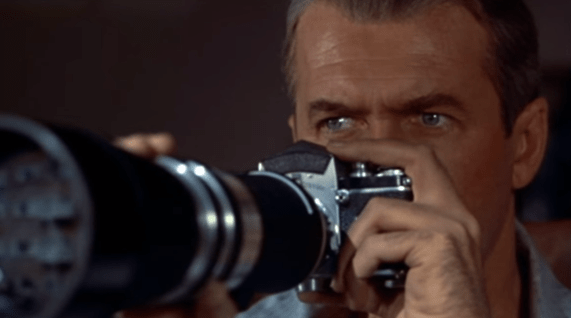
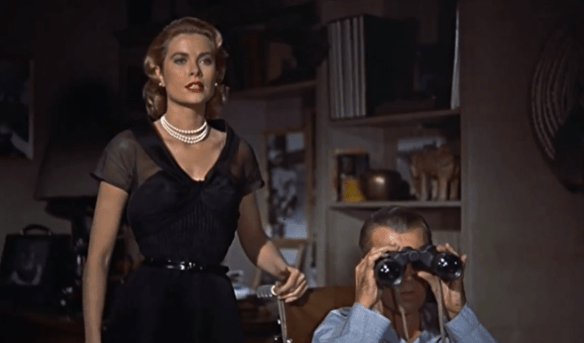
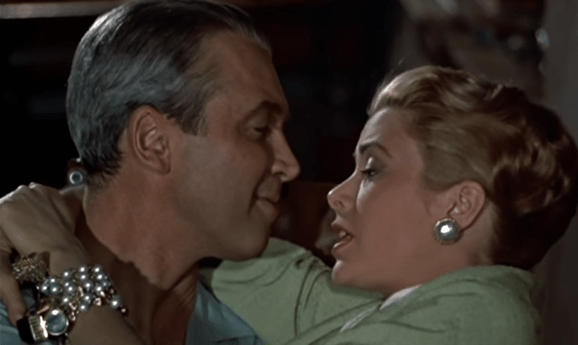
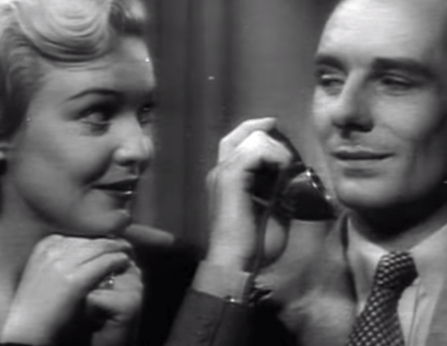
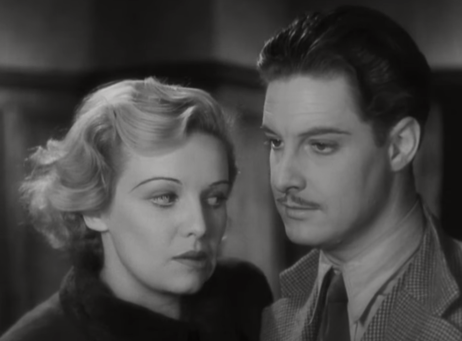
Murder_hitch.jpgAlfred Hitchcock captures the pure bedlam that overtakes a neighborhood when their peaceful dreams are rudely disrupted by an awful din. As is customary everyone is in a foul mood, peers out their windows, bickers with everyone else, and moves into action.

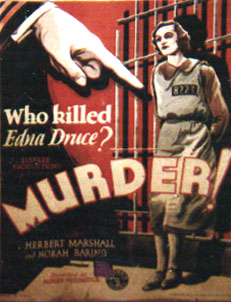
Then in a split second, everything’s beastly still. The reason: The dead body lying on the floor discovered by the policeman making his rounds. The blunt instrument is at the feet of a disoriented young actress who looks to be the obvious culprit. But there has to be more to this story than what meets the eye. This cannot be as simple as we are led to believe. It’s a stellar environment to introduce a murder. Acting as one of Hitch’s few whodunits, Murder! involves itself with the rest of a stage acting troupe full of players.

Still, in the ensuing court hearing, the aspiring starlet, Diana finds her life on the line in the hands of a jury. Their deliberations feel a bit like 12 Angry Men (1957) as Sir John (Herbert Marshall) is hustled and hurried into coming to a guilty verdict by groupthink as the one remaining holdout.

In these sequences, there’s a sense that Hitchcock has a bit of frustration with the state of affairs with the legal system or if nothing else a great interest in its functions much like Fritz Lang did in pictures like M (1931), Fury (1936), and You Only Live Once (1937). But it’s truly a Hitchcock touch to have the pronouncement of death given as the camera continues to focus on a worker cleaning up the juror’s room. But it’s key that the story does not end here, rather like The Phantom Lady (over a decade later) there’s more to the story and only one man is interested in figuring it out. Because of his sheer fortitude, it’s understandable that he becomes our hero.

Sir John finds himself in a bit of a moral dilemma (as denoted with an early example of character voiceover) because he feels partially responsible for the problems assailing young Diana and he resolves to do something about it. Unfortunately, the film’s latter half slogs on a bit as Sir John calls upon the services of Ted Markum and his wife — two witnesses in the opening scene — to help close in on the real killer. The individual they suspect to be the culprit. However, the real trouble is not simply pinning the murder on this perpetrator but also figuring out how they did it.

A woman’s life hangs in the balance as the gallows sit menacingly in her future. Still, Hitchcock uses some cruel poetic justice to tie his story’s loose ends up. A trapeze act gets a lot more morbid than ever before and again Hitchcock returns to human tumult which livens up his picture moderately and makes Murder! truly worthy of its name. In such instances, there are obvious signs of the master at work. Otherwise, this is hardly Hitchcock’s most diverting offering in the genre.

3/5 Stars

Coco (2017)

Coco_(2017_film)_poster.jpgIt only serves to show where my mind goes when I watch a movie. I couldn’t help but think of Harry Chapin’s elegiac and stirringly heart-wrenching tune “Mr. Tanner” as I was ambushed with some of the most revelatory notes of Coco. The most meaningful line out of that song relates how music made our eponymous hero “whole.” I feel the same guttural satisfaction blooming out of this picture.

Coco proves to be a film about many things. This is a film about music melded with family. The wholeness that comes out of music when you do it for sheer love and passion. Because you couldn’t live without picking up a guitar or throwing back your head to sing. Serenading family or penning a love song is just an extension of who you are. If you know anyone like that you can thoroughly appreciate what we have here.

In the best ways, it’s also about when families and our passions and the traditions that we’re taught to live by and that are passed down to us seem to collide — wholly impervious to any type of reconciliation on first glance — yet still somehow capable of fitting together.

Our hero Miguel (voiced by Anthony Gonzalez) is a precocious boy who lives with his family in Mexico as part of a shoe-making matriarchy where they have long been taught to despise music because their no-good great-great-grandfather left his family behind to pursue his dreams as a musician. The conflict is created right there.

Visually it’s another inventive landscape for Pixar to play with under the helmsmanship of Lee Unkrich because though the setting and storyline are planted in the present world of Miguel’s family, it’s infused with rich undertones of Mexican tradition. Not least among those is “Dia De Los Muertos” or “The Day of The Dead.”

Except instead of taking that as a mere tradition or a cultural practice the film translates that into a fully animated reality as Miguel experiences the “afterlife.” There the spirits of his ancestors exist in skeletal form making a yearly pilgrimage to commune with their still-living relatives. Family is still of the utmost importance to their lives and the most tragic reality is to have no one left to champion your legacy.

The hero’s journey laid out before Miguel is direct and compelling so we know what he is up against. He must receive the blessing of one of his blood ancestors before sunrise or else spend his days forever in the land of the dead. Even now he’s slowly losing more of his definition a la Back to the Future (1985). The stakes are obvious and his inner conflict stressed by the very fact that his relatives will only provide their blessing if he gives up his true love: music.

There’s so much else that could be lauded in the film for how it dares to explore its setting much in the way Inside Out (2015) did. It boasts some clever reversals akin to those found in something like Toy Story 3 (2010) and plays on the themes of hero worship in a similar fashion to UP (2009) with Miguel being charmed by mythical singer Ernesto de la Cruz (Benjamin Bratt). It’s also a bit of a Ratatouille (2007) tale of someone pressing against the currents around them to realize their individual gifts. But far from being to the detriment of the film, every one of these similarities is a genuine compliment. Could there be too many themes even? I’m not sure.

However, the idea I was most taken with deserves a bit more explanation. I’ve purposefully refrained from talking about Coco until now. If you were like me you probably assumed that our hero was named Coco or something like that, without giving it much forethought. However, we soon find out that she’s the fairly senile great-grandmother of our main character.

Because a major aspect of this film has to do with this idea that can best be described as transgenerational memory — where we pass down our recollections of the people that came before us to the younger generations. It’s no small coincidence that the lynchpin track is called “Remember Me.” Because in digging into his family’s personal narrative Miguel develops a deeper bond with his great-grandmother. It’s striking how even as we grow forgetful our long-term memory, the entrenched recollections of childhood or even muscle memory, often stay with us. That’s precisely how it is with Coco and Miguel aids in keeping her memories alive.

In these moments I could not help but reminisce about one of my favorite musicians Glen Campbell who passed away just this past year. He was a high profile casualty of Alzheimer’s and yet during his last tour though he could hardly remember the words anymore to his most famous songs, his fingers were just as nimble on the guitar frets as they were as a young man. Amazing. One of his final tunes was the brutally honest admission “I’m Not Gonna Miss You.”

And I mention it in passing only to suggest that if the idea is that you will only be remembered if other human beings remember you then that’s a terrifying world to be subjected to. As a writer that means that I will fade away unless someone actually unearths some of the mindless drivel I penned and shares it. If I’m single it means I better find someone quick and start a family so my children can not only pass on my gene pool but keep my name.

Even the pervasive theme that two people’s love for each other will live on forever, though a nice sentiment, still rings slightly hollow. Not to be a nitpicker but eternity is a long time. Even a blazing meteor burns out at some point. So if you’re like me maybe Coco will get you to think long and hard about your mortality. I’m not sure the answers are that easy to come by but they’re necessary to consider nonetheless.

In the context of this life at present, Coco fittingly rewrites the negative admonition to never play music with a more positive call to never forget family. Taking the restrictive and making it ripe with promise. That’s something most of us can probably get behind and share with our kids and grandkids as the years go by because we won’t be on this earth forever. The question remains, what do we do if we aren’t so lucky?

4/5 Stars


Black Panther (2018)

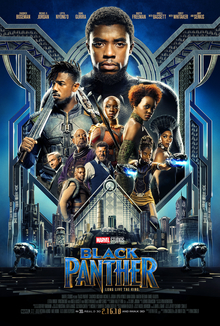
Black_Panther_film_poster.jpgFor some Black Panther might be a stellar actioner, consequently, brought to us by a visionary director, Ryan Coogler. It’s top-tier as far as Marvel movies come; there’s little doubt. For others, I completely understand if Black Panther rocks their entire paradigm because there’s so much of note here. The box office seems to confirm that just as much as the dialogue that has been created in its wake.

What’s so revolutionary about this addition to the cinematic landscape is that this is not simply a superhero movie created by a predominantly black cast and crew but that their very heritage is so crucial to the roots of the story. The identity and complex history of Africans and African-Americans is wrapped up in the very sinews of the narrative. A whole diverse patchwork of ancestry and generations of culture is meticulously infused into the African nation of Wakanda.

Many may have forgotten that in an earlier Marvel installment the king of the 3rd world nation of Wakanda was killed in an act of terrorism. His son T’Challa proved to be next in line to the throne as long as no challengers arose from any of the five tribes that encompass the country. In such a case the two warriors take part in a ritual combat.

Far from just having intricate primordial traditions, the nation has also long-harbored an immense secret. Under the pretense of an archaic nation, they have built a technologically advanced empire around the versatile metal vibranium. In order to keep its properties protected, they have foregone sharing it with the world at large. Already you begin to see one of the primary themes running through the film. With great power comes great responsibility. How you choose to wield it is of vital importance especially when the world around you is hurting.

I have long been a fan of Ryan Coogler and Michael B. Jordan and the partnership continues to impress. Coogler somehow managed to take a Marvel franchise film (which we’ve had too many of) and turned it into a radically personal picture. It works on both levels — arguably catering to all audiences.

His female characters are imbued with tenacity and still a capacity for great good. Lupita Nyong’go is a perfect example as the lifelong sweetheart of the ascending king T’Challa because she has left her homeland to help the oppressed in less fortunate lands. She jokes that she would make a phenomenal queen one day because she’s stubborn but it’s the truth.

Meanwhile, the king’s mother (Angela Basset) is stately; caring deeply for her children while his sister (Letitia Wright) is feisty and blessed with the ingenuity of an inventor. She’s the Wakandan Q if you will. And there’s Okoye (Danai Gurira) the fearless leader of the all-female royal guard. Far more than an assassin, she is guided by a sense of honor and loyalty that splits her right down the middle.

Many people will be happily surprised by a soundtrack that synthesizes original music by Kendrick Lamar with a score by Ludwig Goranson (Community) infused with distinctly African instrumentation. It makes for a satisfying marriage in music. But no less impressive are the intricate costumes and set designs which develop this appealing aesthetic of the old with the new. Coogler’s team seems to have a very keen awareness of both which is refreshing.

When Black Panther falters at all the problem is simply due to repetition. After 17 other entries, we can hardly blame a film like this for doing something that’s seemingly derivative even momentarily. It’s inevitable. Because if you’ve seen one fight scene between two agile, armored superhumans you’ve seen them all to some extent.

And yet this picture does so much more within that framework that’s moving because there’s a certain ambition and an innate understanding of what movies are capable of. They can help us cull through crises while still maintaining the exhilarating guise of a superhero action flick. It’s true that at times it feels like we are watching a Bond film only rejuvenated with more diverse characterization.

Like the best films in that franchise or any other really, the villains are noticeably tempered in a very particular way that is stimulating. Yes, multiple bad guys, and when I say that I mean that each has unique shading giving us different looks. Andy Serkis is the chortling international arms dealer who seems small scale and yet he’s made dangerous. There’s a distinct edge to him.

Even more important is Erik Warmonger (Michael B. Jordan) because he acts as T’Challa’s character foil. As we find out, they have a lot more in common than they would have been led to believe except Warmonger has more sinister intentions. The joy of Jordan’s performance is that the character is high-functioning, charismatic, and actually poses a threat as we see on multiple occasions. But no matter how twisted or misguided he might seem there’s still some level on which we can understand his lifelong resentment. Also, let me just say it now. From his clothes to his swagger, he just looks cool…and supremely confident.

Meanwhile, fellow tribesmen such as M’Baku (Winston Duke) and W’Kabi (Daniel Kaluuya) do not necessarily have sworn allegiances staked out and so that gives them some agency to shift the tectonics of the story this way or that. Again, they have a certain amount of power that gives them an undeniable presence.

Like The Winter Soldier or Civil War (arguably my favorite Marvel entries thus far), the villains are compelling because they invariably feel planted in the real world or better yet they’re made up of friends and family. There’s nothing more disconcerting than people who aren’t villains at all and yet they still go in opposition of you.

Thus, Ryan Coogler has succeeded in constructing a layered story that might be one of the few Marvel films I would gladly pay a second viewing to. It hinges on so many issues with consequences for our contemporary landscape. Again, with great power comes great responsibility.

It deals with the afterlife as represented by the ancestral hunting grounds where first T`Challa and then Erik commune with their fathers to receive insight. For the former, it means reconciling with his father’s own failures during his lifetime so he might not make the same mistake. For the latter, it means connecting with his own father about their joint Wakandan heritage which Erik never knew first-hand living in America.

Black Panther calls into question themes of isolationism as much as it does a complicated history of colonialism. Look no further than the African artifacts exhibit in the History Museum and you can plainly see that we are still grappling with the same issues planted in the same past. Far from dismissing it, we would do well to continue to entertain a dialogue. The roles that museums, archivists, and archaeologists play in all of this are important too. Suddenly, even for a brief instant, I’m starting to second-guess Indy’s obdurate assertion that artifacts belong in a museum. Where do we draw the lines on such an issue while not unwittingly promoting colonialist traditions? I don’t quite know.

The final words of Warmonger linger in my mind as well:

T`Challa: “We can still heal you…”

Warmonger: “Why, so you can lock me up? Nah. Just bury me in the ocean with my ancestors who jumped from ships, ’cause they knew death was better than bondage.”

His words sting, as they should because so much truth dwells right there. I have always struggled to reconcile those very things because for being a nation made of immigrants the African-Americans are nearly the only ones who did not come to The Promise Land of their own volition. The handprints of such a reality can still be spotted in our world today.

There are deep roots that are set in place. In the History Museum corridors, you see documentation of a muddied past of colonialism. Then, in Oakland (Coogler’s hometown) along with basketball and Public Enemy you see obvious signs of social decay and problematic issues of drugs and gun violence.

The fact this is actually put out there is nearly a relief and a necessity. However, and this is a big however, there seems to be an underlying hopefulness that we can somehow live together. Marcus Garvey once proposed blacks recolonize their native country and that in itself brings up other issues of cultural identity.

Erik Warmonger is right at the center of that with African descent and yet longheld ties to American society. What do we label him? I’m not sure we can. I’m not sure we need to. That’s for the individual. Regardless, it’s a work in progress. Messy no doubt but hope is still present.

Like Fruitvale Station (2013) before it, being rich in black culture by no means suggests that the film is completely exclusive in the same regard. Far from simply being a token white person, Martin Freeman is allowed to be a hero just like his counterparts, and anyways maybe for once, it’s okay for the Caucasian characters to take a momentary back seat if only to allow other voices to speak.

What we are left with as King T’Chala addresses the United Nations is not the sense that one people group is better than another or the new should overthrow those who have long been in power but that we should find those points of intersection — the things that unify us.

“Now, more than ever, the illusions of division threaten our very existence. We all know the truth: more connects us than separates us. But in times of crisis the wise build bridges, while the foolish build barriers. We must find a way to look after one another, as if we were one single tribe.”

It’s a fitting summation because this is a film that draws up different tribes, turns people against each other nearly in an instant, while constantly rearranging factions and who holds the keys to the kingdom. If it’s resolved in the end it’s only a fragile peace at best and if we are to maintain that we need far more than vibranium. We need a heavy dose of human understanding and empathy.

We can acknowledge our past failures as a society but must never allow them to shackle us for good. Mistakes are meant to be learned from. It’s when we’re not willing to learn and to change, that dire straits look inevitable. I hope for our sake that the film’s call-to-action might still stand true.

But the film itself is also an imperative to take deep abiding pride in your heritage and who you are as a human being — unique just as you are. Thus, it seems utterly misguided to desire a future world where we do not see color. Instead, we might yearn for a day when everyone can look at the rich strains of human diversity and proclaim “It is very good.” Where we can survey that same world and see that every color, creed, and tongue is finally one tribe instead of many.

4/5 Stars
Fruitvale Station (2013)

Fruitvale_Station_poster.jpgRyan Coogler is from Oakland, California. He was attending USC Film School in 2009 when Oscar Grant III was shot near the BART station. From those experiences were born his first project. He envisioned Michael B. Jordan in the lead role. Thankfully his vision and the casting came to fruition.

I appreciate smalltime gems like Fruitvale and Short Term 12 (which both came to by attention at the same time). Maybe they are very intentionally crafted into these intensified dramas with heightened bits of reality but there’s also something meaningful in how they are able to tell smaller scale stories in an economical way. That in itself is an art just like making a cohesive blockbuster is an art.

The allure of the picture comes in putting us in the moment. Coogler works in capturing the final hours of Oscar Grant’s life which would seem mundane and unextraordinary if it weren’t for how they were capped off. It’s a film that breeds a certain amount of empathy because the camera is always over the shoulder, at the hip, or in the most intimate spaces putting a lens on what is happening.

But when the picture turns tragic there’s this undeniable sense of immersive drama while still crafting a story that connects to all of us. It feels as if all facets of Oscar’s character are put up to the light.

Because if you put up the magnifying glass to each of us you soon realize that we don’t always act the same way around everyone. When you see Oscar in his different interactions each person brings out something else in him. And he is very much a people pleaser.

What the story offers up are these perfectly manufactured moments (some better than others) to capture the contours of a single individual. None is fake per se — a facade if you will — but oftentimes various interactions bring out a certain side of someone. The lady attempting to have a fish fry and struggling miserably appreciates Oscar’s genial nature to call up his grandma and get her help. There’s the entrepreneur who has created his own web design business who thanks Oscar for finding a bathroom for his pregnant wife. Even the dude who comes to Oscar to pick up his smokes.

They are hardly central characters but each interaction serves the purpose of the story. However, this is not solely a film for the African-American community though it was an important story to tell.

Coogler in the way he purposefully draws up the narrative seems to be suggesting that it is for all of us. It’s not about color as cut and dry as black or white. It’s not even about good versus evil. It’s about issues of race and violence and injustice still clearly visible in our world. But not in a way that makes one party out to be the hero and completely demonizes another.

We connect with Oscar no doubt but we see his flaws as much as his humanity. He’s gone through a long stint in prison. His temper smolders dangerously as much as his spirit is generous to his friends. He rather immaturely covers up his troubles at work. But he’s 22 years old. In fact, maybe its just that. His flaws are his humanity.

And with the law enforcement we see the brutality but what is just as prevalent is fear and confusion. In the heat of that moment I’m not sure what I would do. All I can do at this point is give the benefit of the doubt and mourn the loss of a human being taken from this earth far too quickly in the worst circumstances possible.

Its true the fateful moments — seen in real cell phone footage at the beginning and reenacted later on — are full of chaotic tumult that we can’t quite understand. What’s even more haunting is the fact that Coogler got permission to shoot in the very locations where Grant was fatally injured. In that specific sense, the film couldn’t be more authentic.

One of the sequences that resonated was the communal prayer in the hospital corridors. It’s true you can read someone’s character in the times of pandemonium but also immediately following. It’s in the turbulence where Octavia Spencer takes charge in the best way she knows how and probably in the most effective way. Because there’s a helplessness in the air. This is one way to keep things together.

It’s one of the films most unifying moments for me because amid the torrent of understandable anger and apprehension it establishes a singular instance of calm in the wake of such emotion.

The film ends much as it begins with footage of the real because that’s what this is in a sense. Reconstructed, undoubtedly stylized and put back together with inevitable human biases as it may be, I appreciate its efforts. The intentions seem candid and the results speak in such a way that though calling out this brutality is more concerned with making Oscar into a version of a human being not just another thug or a victim to be pitied in order to rally a cause.

Didactic films get tiresome but Fruitvale Station rarely feels like that. Its platform undoubtedly is a social one and yet the director quite adeptly makes sure his narrative resonates on an individual less austere level.

Of course, to form a truly robust, well-informed opinion of the events more accounts would be necessary but as a film there is definite quality in this production. I still hold that Ryan Coogler and Michael B. Jordan have one of the best collaborations going on in movies right now. Here’s to hoping they don’t let up anytime soon. I’m eager for more stories from them. I think many other people are thirsty for them too.

4/5 Stars

The Fortune Cookie (1966)

The_Fortune_Cookie_(1966)_poster.jpg“You can fool all of the people some of the time, you can even fool some of the people all the time, but you can’t fool all the people all the time.” ~ Inscription in the Fortune Cookie

For some inexplicable reason, I expected The Fortune Cookie to be in color. Maybe in some subliminal way, I assumed it would be like a dry run for the zany Odd Couple (1968), pairing the two stars who would make the most delightful comedic coupling in years. But once you get into the nitty-gritty and The Fortune Cookie is less of an intangible idea floating up in the sky, it’s very obvious that this is more akin to The Apartment (1960) and the obvious reason is Billy Wilder.

Once more he lets Jack Lemmon do his sympathetic role, that guy that we all know who is a bit of a loser but not a bad sort of fellow. From such a characterization Lemmon’s scintillating skill at both physical comedy and verbal jokes come off like they always seem to. You can’t help but smile. But Wilder places that same man — that sorry individual — a simple cameraman named Harry Hinkle, into a very cynical world indeed. It’s Wilder’s version of America.

While he unequivocally loves the country that welcomed him when he was an immigrant, that by no means suggests that Wilder is unwilling to satirize its very flaws. In fact, he relishes doing just that. Sometimes it feels like that was what Billy Wilder was put on this earth to do. Make people laugh and do it with a biting style that forces us to look a little closer at the incongruities around us.

You can easily make the case that the main attraction here are two noteworthy dynamic duos (although it’s slightly dependent on how you want to draw them up). First Billy Wilder paired with his writing partner I.A.L. Diamond yet again after their string of successes with Some Like it Hot (1959), The Apartment (1960), and One, Two, Three (1961) among others.

But perhaps just as importantly we have the genesis of the longstanding comedic collaboration between Lemmon and Walter Matthau. It just works. It’s easy to see why they continued starring together because when they’re in the same room wonderfully hilarious things come into being.

Otherwise, the film takes a wacky premise involving a Cleveland Brown’s punt returner leveling a CBS cameraman and draws them out as far as they can possibly go. It’s actually rather impressive that this single spark of an idea gave way to a fairly substantial picture. Because all kidding aside, and without consideration of its title, the film is not unsurprisingly cut out of Billy Wilder’s cynical worldview as already acknowledged.

Yet again he finds his perspective of America derived from some combination of screwball comedy and a more downbeat, melancholy tone. True, he made some delightfully dark films-noir but this same malaise somehow worked fairly well in his comedies too.

Here it’s perfectly enhanced by world-class shyster Whiplash Willie (Walter Matthau) the conniving ambulance chaser who takes great interest in his brother-in-law’s purported injuries on the football field — even if they wind up being next to nothing. The insurance company doesn’t know that and that’s the key.

The periphery is complicated by a private investigator (Cliff Osmond) staked out across the way who has their room bugged and under surveillance. Harry’s mother is constantly bawling. The wife (Judi West) that he once loved and who ran off with another man is tantalizingly close to returning to him. Meanwhile, the soft-hearted football superstar who bulldozed him, Boom Boom Jackson (Ron Rich), looks for any way to make his little buddy’s life more comfortable and it’s taken a major toll on his success on the field.

It’s these very relationships that have Harry seesawing back and forth as his wily brother-in-law coaxes him to keep working the angle so they can nab their $200,000 in recompense. Watching Lemmon pirouette in his electric wheelchair, stiff-necked in a brace is priceless. Concurrently, Matthau seems to be limbering up for all his greatest roles from The Odd Couple to the Bad News Bears (1976) showing off his own impeccable adroitness with curmudgeon comedy — delivering dialogue in such a tone with such a way about him that’s at the same time devious and terribly hilarious. He even answers the phone like nobody’s business.

Lemmon owns the final scenes, however, as he must try and reconcile this lie he has been made to live — this charade he has been playing for the sake of $200,000. Perhaps even more troubling than Harry’s lie and less funny is what happens to Boom Boom. Because he’s such a kind soul even dangerously subservient in how he follows cinematic precedence. But we can make the case that this is part of what Wilder is poking at.

The one moment his protagonist shows any integrity, the one moment he stands up, literally, is in the face of a supposed bigot. Even if it says little, there’s no denying that it says something. Sometimes we don’t need comedies to win the big battles. A film called The Fortune Cookie is not going to garner a lot of respect (nor should it necessarily) but it can at least get us to stop and think. Maybe the utter absurdity in some ways isn’t all that far away from our own existence. That’s part of its charm. Crack it open if you’re so inclined.

3.5/5 Stars

Blackmail (1929)

Blackmail_1929_Poster.jpgIn one sense Blackmail proves to be a landmark in simple film history terms but it’s also a surprisingly frank picture that Hitchcock injects with his flourishing technical skills. It’s of the utmost importance to cinema itself because it literally stands at the crossroads of silent and talking pictures and holds the distinction of being one of Britain’s first talkies.

So close did it ride the lines, in fact, that two versions were released. It was initially supposed to be a full-fledged silent until it was requested that Hitchcock update the production to follow the tides of the times.

Far from being hampered by the transition, Hitch takes everything in stride and delivers a story that is pure cinema. It means simply that the film functions as a visual narrative. Still partially silent, yet using dialogue, and utilizing all the tools at his disposal to develop the greatest impact to reach his audience.

The story is simple really, about a young woman named Alice (Anny Ondra, future wife of German boxing icon Max Schmeling) who’s having a bit of a rough time with her boyfriend who’s on the police force. Still, she’s trying to make it work but another man has taken her fancy. He’s an artist and he uses the excuse of showing her his work as a pretense to get her up in his room. We all have an inclination of what might happen next. She’s taken advantage of and Alice has no recourse but to defend herself.

A conniving low-level conman is looking for an easy bit of blackmail and the policeman goes to great lengths to protect his girl but she herself is struggling with her guilt with what happened. Her nerves cannot take the constant strain because she was never meant for such circumstances. She’s hardly a bad person. In fact, she has no reason to feel remorse because, in the film’s candid portrayal of the artist’s less than honorable intentions, it’s easy to sympathize with Alice.

What makes the picture extraordinarily refreshing is that Hitch never relies too heavily on dialogue although it was the newest technology. He seems to already have an intuitive sense of how it can be used in cadence with the moving image. He can still make a film that for sequences is much like a silent picture and far from detracting from the story he is developing it further. It only serves to bring out more of the story whether it be the atmosphere or certain amounts of character development.

The local gossip chattering on and on about the murder and how she would never use a knife no matter the provocation but we are also privy to the young woman’s reaction shots as the word “knife” reverberates through her consciousness. Even in that moment, the dialogue underlines her inherent guilt and the further moral dilemma she has been put in.

Hitchcock’s already resorting to using memorable locales, in this case, The British Museum to make his chase sequences pop with character. You might say this is even an obvious precursor to Vertigo (1958) with a chase sequence that takes off across the rooftops of the museum.

But the ending comes with a bit of fateful luck that’s simultaneously darkly comic in quintessential Hitchcock fashion. It’s the perfect punctuation on a film that spun on an unfortunate split second altercation and it just as easily fell back on track with another such moment of good fortune. It’s the director’s way of teasing his audience in a sense and he’s very good at it — mingling murder with wit.

3.5/5 Stars

The Lodger: A Tale of the London Fog (1927)

The_Lodger_1927_Poster.jpgWhat’s striking about Alfred Hitchcock is the sheer breadth of his work and how his career managed to take him in so many directions as he continued to evolve and experiment with his craft from silent pictures, to talkies, then Hollywood, and all the way into the modern blockbuster age. And yet the very expansiveness of his oeuvre begs the question, where to begin with it all? Certainly, his lineup of masterpieces in the 1950s are a must.

But of his early silent pictures, The Lodger is the film that Hitchcock himself noted was really the beginning of his filmography as we know it and within its frames, there are some telling signs of an artist coming to grips with his craft.

His subject matter here is a bit of a Jack the Ripper-type tale set in London. A rash of murders has overtaken the town as coincidentally a new tenant with suspicious tendencies moves into the room of a local family. Their daughter does her best to make him feel welcome but her macho boyfriend, a member of the local police force, is skeptical of the competition. Especially since circumstance seems to point to the lodger’s guilt. So in this central conflict, we have a bit of the innocent man motif that Hitch would scrutinize and continue to tweak again and again.

Hitchcock already shows an immense aptitude for visual experimentation, utilizing his mise en scene in fascinating ways.  He makes great use of staircases whether he only shows a man’s hand as it slides along the banister or he sets up crucial moments along the expanses of the stairwell, characters slowly descending toward us being representative of innumerable tension.

We also unwittingly have one of Hitch’s first documented cameos and his assistant director on the picture is none other than his soon-to-be wife and lifelong collaborator, Alma Reville. That connection alone makes this production crucial to Hitchcock’s future career.

It’s easy to make the assertion that Hitchcock remained in the most basic sense a silent filmmaker his entire career and if we can count F.W. Murnau as one of his major influences from his time in Germany, you have that same sense of visuals over dialogue or even title cards. Some of his greatest scenes are in fact nearly silent. The crop dusting chase in North by Northwest (1959) or Norman Bates discarding the evidence in Psycho (1960) both spring to mind.

Though the parameters set up by the studio and expectations of his audience meant his leading man could not be found to be guilty, Hitch still manages to make the scenario as interesting as he possibly could — even if the degree of moral ambiguity wasn’t quite to his liking.

Consequently, in many ways, The Lodger also manages to be one of Hitchcock’s most tenderly romantic films. Because while his pictures have romance and passion they are more often than not subverted by the macabre, sensuality, or that notable dry wit. But here, the love story seems generally sincere.

Because there are tinges of true heartbreak here and the circumstances that bring the two lovers together are imbued with emotional consequence. Even the intricacies of a flashback and genuine interactions between two people who exude a certain chemistry make up for any overly theatrical moments courtesy of the tenderhearted heartthrob Ivor Novello.

But as he generally had a knack for doing Hitchcock also knows how to squeeze the most out of his ending sequences with the most satisfying spectacle. In this case, although the police have exonerated their suspect, the mob is after him and he flees them only to get caught on the iron works of a fence, his handcuffs leaving him dangling, vulnerable to the onslaught of humanity. He hangs there pitifully, at their mercy, a near Christ-like figure.

Perhaps the outcome was not quite what he wanted but the burgeoning master still manages a true Hitchcockian ending worthy of remembrance alongside some of his more championed pictures.

3.5/5 Stars


A Matter of Life and Death (1946)


Matter_Life_Death_Hunter_Niven

Matter of Life and Death is planted in its era. It carries the vague notions of a war film, it’s certainly a romance, and it revels in the throes of fantasy. But on the whole Michael Powell and Emeric Pressburger’s film functions outside the typical confines that are put on film as a medium. The scope it dares to take on is far more expansive.

The plot is made in the first few minutes when a pilot looks to eject amid the fog engulfing his failing bomber. It’s in that single moment where he picks up the signal of a radio dispatcher down below and their lives are never the same. Believable or not they fall instantly in love — in that moment of heightened emotion — they find a connection. She, never to see his face and he, never to make it out alive.

The Conductor (Marius Goring) from the other side is already looking to pick him up. Except something goes terribly wrong, or terribly right for the pilot, depending on your perspective. In other words, he doesn’t die. He escapes death. It causes a bit of a stir and Conductor 71 must try and rectify the situation.

But of course, Peter David Carter (David Niven) quite by chance is reunited with the woman from the other side of the wire, the American named June (Kim Hunter) and they are allowed a happy life together. Except with his reservation with the afterlife still up for contention, Peter finds himself being visited by the Conductor who coaxes him to accept his death. Instead, Peter calls for an appeal and his case is set to be brought before the highest authorities to decide once and for all if he must accept his death as ordained or have it postponed so that he might continue to cement his love for June.

It evolves into a wonderfully fantastical courtroom drama, wrapped up in romance, with a bit of time travel, purgatory, special effects, and color all mixed together in a tirelessly imaginative arc.  It’s true that the ambitions of the conceptual narrative are really unlike any other cinematic creature as it cycles so lithely through time and space. Freezing images, moving characters about this way and that, and cutting back and forth between worlds most easily differentiated by their color schemes.

Still, in some way, I was gripped more with the furious emotion of The Red Shoes (1948) and yet with its phenomenal conception and immaculate staging, A Matter of Life and Death manages to be an extraordinary picture by most accounts. If its waves of romance did not seize me instantly, its sheer inventiveness was nevertheless breathtaking.  And if the concept enthralls me even more than the narrative does then so be it. It shares a world akin to Seventh Heaven (1927) or Wings of Desire (1988) and that alone is worthy of praise — carving out a place in the pantheon of transcendent films — featured on the conveyor belt that makes its way through the years.

Fantasy films were made to be like this, arguably functioning in a realm that only films could facilitate and Powell and Pressburger examined near unfathomable realms. Not only with scripting but the selection of shots, and developing fascinating spectacles out of the Other World from the stairway to heaven to the infinite courtroom where Peter’s case is debated. Jack Cardiff’s photography takes on the monumental task of balancing two worlds with equal import — the world we know and the complete other realm that has yet to be revealed to us who are still among the living. It leaves us feeling enamored with both. Not simply because of beauty but sheer size and scale.

The storyline comes down to the final moments where Peter and June are asked to make the kind of choices we have been expecting. Right about now we can hear the words ringing in our ears, there’s no greater love than to lay down one’s life for the ones you love. Their actions say as much. But as we might just come to find, give and it will be given back to you more abundantly than you could ever imagine. Sacrifice all that you have and you will find yourself gaining so much more.

It brings to mind a dialogue that emerged from the courtroom when the prosecutor (Raymond Massey) notes that “nothing is more important than the law. The whole universe was built on it.” But his learned opposition (Roger Livesey) ascertains that “this is a court of justice not of law.” The implications being that the law is good and must still be fulfilled but justice is the key here, where right is done by all men and love reigns supreme.

There are a plethora of interesting topics that arise from The Archers’ film but one of the foremost is the sentiment of not only the post-war but of an entire millennium. It’s a belief that could arise from many marginalized points of views suggesting that there is a great deal of prejudice and ill-will that could be exacted against the English (and certainly Americans too), anyone who has been a major world power.

The jurors put up against the defendant all have grievances they could hold against the English people, but then again, we are not our fathers’ fathers and we cannot necessarily turn back the clock on their past sins. But what this film does suggest more powerfully still, relevant in a post-war era or any age really, is the idea that people can reach out across the sea and really across the world to be united by something. We’ll give it a name to it and call it love in its many forms — more specifically as the Greeks might call them, storge, philia, eros, and greatest of all agape.

4.5/5 Stars

Note: My entry in the Time Travel Blogathon


Angel and the Badman (1947)

Angel_badman.jpg

With John Wayne partnered with his longtime collaborator James Edward Grant (Hondo, McClintock!) it’s easy to see Angel and the Badman as an early vehicle for his conservative ideals but far from being heavy-handed, it goes down as a solid B-picture with a surprisingly unique perspective on the West.

In this instance, the western is used to construct a fairly simple parable that plays out over the frontier using figures that we know well from every cowboy picture we’ve ever seen.  The outlaws and the homesteaders, the sheriffs and the doctors, they’re all present.

But underlying their every interaction is a certain purpose. It’s not simply to entertain — though the film is adequate in that department and has it’s share of gunfights and showdowns. It foregoes most of the normal set pieces to carry out its main objective as a moral tale. Still, these established figures help draw up the themes by the very way they see the world.

Quirt Evans (John Wayne) has and always will be an outlaw as preordained by society until the fateful day when he finds sanctuary in the home of a Quaker family after incurring a wound. They take care of him and nurse him back to health but above all, they give him the benefit of the doubt — that he is not too far gone and he still has more than a fair chance to redeem his life if he so chooses.

The local apothecary functions as the main counterpoint to our angelic first family. He is very rational-minded, devoted to scientific thought and his cynicism leads him to begrudgingly patch up the outlaw all the while grumbling under his breath. It’s telling though that he holds this overtly religious family in high regard. But nevertheless, the parameters have been set. We must sit back and find out where John Wayne falls within the frames of this corral.

It’s true that he’s saddled with a past full of womanizing, guns, greed, and every other sin known to man. In fact, the local sheriff is bent on hanging a rope around his neck but the old veteran (Harry Carey) is a sly fellow ready to bide his time and let Quirk slip up somehow.

The main point of contention is a payload of gold that a band of glowering thugs is intent on getting a handle on. Quirt is all that stands between them and the prize but even in his injured state he still packs a gun — the bullets inside and his stellar marksmanship being the key deciding factors.

Playing against this very storyline is a parallel thread that bears equal importance if not more. Penelope Worth (Gail Russell) is the daughter of this Quaker family and she is tasked with taking care of this formidable outlaw. In any other scenario, they would be oil and water. Their lives and personalities should never mix and yet in this romance, they ultimately do. True, his lawless lifestyle chafes against the worldview of these religious Quakers who promote an existence of good will and pacifism. Still, people can change.

John Wayne notably disliked High Noon (1952) and his most famous denouncement of the picture can be seen in Rio Bravo (1959), viewed by many as a cinematic answer to its predecessor. However, in this earlier film, you see in Wayne’s character a man who also falls for a Quaker much like Will Kane (Cooper) does in High Noon. But here he comes from the wrong side of the law. Still, she redeems his very nature and far from throwing off the perceived shackles of her beliefs or simply tolerating them to stick to what he knows best (namely gunplay and showdowns) he does the fairly brazen thing and wholeheartedly embraces her way of life. Because he loves her.

It begs the question, which outcome is more believable: The sheriff who went against his wife’s pleas so he could uphold his personal convictions or the outlaw who gave up his old way of life even in the face of death because he was transformed by the love and lifestyle of his woman? Rather than drawing up which one is better exactly, it might suffice to say that Angel and the Badman, while lesser known, is still a diverting western with its own moral dilemma because westerns are and always have been horse operas.

3.5/5 Stars

Thor Ragnarok (2017)

Thor_Ragnarok_posterMy heart lept in my chest when I heard that Taika Watiti (What We Do in The Shadows) was going to be helming the latest Thor movie. Because it’s hardly a well-kept secret that Thor has essentially been the weakest of all the Marvel threads (Hulk’s individual film excluded).

So once more Marvel has done an impeccable job of keeping lukewarm bandwagoners such as myself mildly interested. Benedict Cumberbatch as Doctor Strange. Brie Larson in the upcoming Captain Marvel movie — another personal favorite. Then, we have Ryan Coogler directing Black Panther with one of the most glorious casts in recent memory. They make their product so alluring despite my general lack of interest in the perennial juggernaut.

But back to Thor Ragnarok which goes far beyond the quip-filled, light-hearted humor that Marvel has often boasted, to great success, I might add. Even with its darker moments and strains of drama, there’s little doubting that Watiti’s brand of near insouciant humor is alive and well. Exhibit A is the very fact that we are reintroduced to Thor (Chris Hemsworth) as he swings precariously from a rocky prison encased in chains about to be executed by a fiery conflagration of a villain.

In case you haven’t realized it already what we are about to be served up is a comedy about an apocalypse. Oxymoronic as it may sound, the film all but pulls it off. Still, more explanation is in order.

Thor returns to Asgard only to begin quibbling with his black sheep of a brother Loki (Tom Hiddleston) just like old times. They call on their father (Anthony Hopkins) whose imminent death is less an ending and more a god-like dispersal. There are other asides involving Dr. Strange (Cumberbatch) and yes, we even found out a little bit more about the Hulk and what Bruce Banner (Mark Ruffalo) has been doing the last couple years.

Being the weasel that he is, Loki’s always betraying his brother and Thor winds up getting captured by a former Valkyrie (Tessa Thompson) who has taken on the life of a slave trader, bringing in fighters for the Contest of Champions. Thor is destined to be the newest attraction on center stage.

Watiti most obviously makes his general tone felt in the film through his own character Korg, a giant rock monster who is more like the Michelin Man than The Thing. Watiti’s understated voice coming through so clearly as he matter-of-factly talks about the not uncertain death that awaits nearly everyone. But he’s also handy for a few rock, paper, scissor jokes as well.

Jeff Goldblum is probably the film’s other finest creation for his own brand of oddly perturbing flippancy with gladiatorial violence and hedonistic relish of death matches. But in the same breath, The Grandmaster also happens to be probably the funniest addition to the cast for those very same reasons.

In fact, it’s these themes touched on briefly that are most crucial to drawing conclusions about Ragnarok. It’s deeply entrenched in issues of death and mortality, violence and warfare. By no small coincidence, the main villain brought to the fore is Hela (Cate Blanchett) who helped Odin build his kingdom and has come back to rule it as her own. It’s not a particularly inspired creation but what did we expect? It is what it is.

Meanwhile, Led Zeppelin’s “Immigrant Song” is the film’s favorite hard-hitting tune to conjure up for perfect trailer sound bytes to crosscut with the action at hand. Whether it serves any other purpose aside from just being a bit of retro-cool is probably beside the point.

There’s a line that seems apt for such a film that I couldn’t help recalling. It goes like something like this, “We laugh at death because we know that death will have the last laugh at us.” It’s one thing to make light of death as a coping mechanism and as an outlet to grapple with something we don’t completely understand, quite another to completely dismiss it. Because the far easier road is to try and evade dealing with it altogether.

The usual CGI extravaganzas and spectacle aside, there is something still to relish in this movie. What I’m trying to say is that Thor Ragnarok is a deathly funny superhero film. In spite of the usual tiresome amount of pyrotechnics, random cameos, and overzealous action sequences, there is an ephemeral and still a delightful enjoyment to be found in this picture. It no doubt bears the imprint of Watiti while still wearing some of the tiresome Marvel tropes.

The one theme it does suggest most overtly is that “Asgard” was built on past indiscretions, bloodshed, and violence. But moreover, the mythical nation is not simply a place. It’s the people that make it up. And in the wake of an apocalypse, it’s some amount of solace. That and Jeff Goldblum giving the commoners a pat on the back. It’s always good to undercut solemnity with another punchline following the credits.

3.5/5 Stars