Ride in the Whirlwind (1966)

Ride_in_the_Whirlwind_(movie_poster)Anyone who takes the time to search out this movie whether the reason is a young Jack Nicholson who wrote, helped finance, and starred in this western or because it’s directed by cult favorite Monte Hellman,  they probably already know it was shot consecutively with The Shooting. Whereas the first western has an unnerving existential tilt as the plot takes us through an endless journey across the oppressive desert plains, you could make the claim that Ride in the Whirlwind is a more conventional western.

However, it’s still highly intriguing for its main premise and the dilemmas that evolve as a result. But that’s enough with the big picture. Here are a few more details to fill in between the lines. The action begins with a holdup, a true western staple. True, a pair of men get injured but it’s about what you expect from such a skirmish. In the end, the stage rides off generally unimpeded and the bandits retreat to their lair up in the nearby mountains to wait it out for a while. Maybe they know a posse is on their trail and maybe not.

Either way, they’re mighty careful when a trio of riders make their way through the main pass. Of course, they don’t know that these are only a few cowhands making their way to Texas and they’re looking for a place to bed down for the night.

Both sides have a general sense of the other but rather than make waves they do the mutually beneficial thing and everything goes about their business nice and easy. There’s no need for guns and no ones looking for any trouble.

But the next morning a posse that means business rolls in and they’re not about to wait and ask questions. They set up posts to pin down their adversary and they hardly discriminate between who was a bandit and who is innocent. That’s not the way their righteous form of justice works.

Rather like the early Hollywood Classic The Ox-Bow Incident, they are searching for the men to lynch and it hardly seems to make any difference if the men are innocent or not. They shall be avenged. However, an interesting observation is that in once sense this does not seem like mob rule. The posse is calculated and cool in executing their objective although that’s no comfort to those who are actually innocent.

In the ensuing standoff, one of the ranch hands, caught in the crossfire gets it and the two bandits who come out with their lives get about what we expect. The second half of the film follows the two men who were able to escape and they just want to find a pair of horses so they can ride away from the whole business.

Their quest on foot leads them to a nearby homestead and this latter half of the story brings to mind earlier pictures such as Shane or Hondo where families are seen trying to make a life for themselves out on the plains.

Wes (Nicholson) and Vern (Cameron Mitchell) are desperate to get away yes, and they sneak into the families home but what makes them so different is the very fact that they are not real criminals. They are only doing this out of necessity. They treat the womenfolk respectfully including the ranchers taciturn daughter Abigail (Millie Perkins) but they’re also bent on taking for themselves a pair of horses.

First off, Evan ain’t so keen on having his home invaded or his family held hostage and he’s especially not obliging that they’re going to run off with some of his stock because they’re his after all.

This is in itself another brooding film like The Shooting but for different reasons. It’s filled with genuine tension because the irony of the situation is that we know these men are innocent and yet in order to survive in some ways they must take on the mantle of criminals just to live another day. There’s no space for a rational third way. There’s no grace or any type of understanding and so they’re forced to play by the rules already set up by the posse that’s pursuing them. That’s the moral conundrum at the core of this tale.

Ride in the Whirlwind has the dismal type of ending we expect with a bit of a silver lining but it’s that very shred of hope that makes it an affecting western. It feels right at home with the sentiments of the 1960s where the world is not as innocent as it used to be and the world often does not function by the most equitable standards. Some would say that’s why the western fell out of favor because in the classical sense, it no longer reflected the perceived world at large like it once did.

3.5/5 Stars

The Shooting (1966)

ShootingHellmanCrime films, westerns, and horror. It’s easy to see why these genres make arguably the best B-pictures, all things considered. It lies in their ability to deliver thrills with minimal capital and a bit of inspiration. Film Noir is by far my favorite but a film such as The Shooting makes me love shoestring westerns too. Except that’s just an initial gut reaction. What happens over the course of this film truly plays with our preconceptions. Its ambitions being rather curious.
The players are set fairly early on.  The cult favorite Warren Oates is cast as the laconic Gashade who however indifferent he might seem has some shred of decency in him as signified by his friendship with Coley (Will Hutchins) a needy and rather dimwitted miner.

His genial personality makes the addition of our third player all the more important. She’s a woman (Millie Perkins) who comes upon them unannounced and generally unwanted by Gashade. But she also comes with a proposition and money to boot.

Our protagonist is lukewarm to the whole undertaking but for some inexplicable reason agrees to become her guide in tracking someone. He wins a spot for Coley in their caravan as well and it’s easy to see Coley is very much taken with the lady to make up for his buddies complete lack of interest.

The acerbically biting Millie Perkins rivals Jane Fonda and Raquel Welch in the pantheon of cinematic Western women as she verbally spars with her fellow travelers. While the ever-leering Jack Nicholson, here in a very early role as a hired gun robed in black, adds another layer of tension to this extremely peculiar western exercise.

Monte Hellman follows a script penned by Carole Eastman that leads us through the blistering deserts of Utah on a very certain quest that nevertheless becomes increasingly vague and ambiguous as the film progresses. The very fact that The Shooting takes one of the archetypes of a man with a burning vendetta (for example The Searchers or The Bravados) and subverts it so completely denotes how unique this film manages to become.

It’s all orchestrated with a certain idiosyncratic paranoia both musically and otherwise. The opening moments prove just how effectively a score can impart a level of anxiety into a film without anything of much consequence actually occurring. It complements the slow burn that follows for the next hour — slow, brooding, perplexing, all those things — as we wander along with them like the Israelites in Exodus. But there’s an underlying goal to it all, the resolution that we expect to bring everything that has happened thus far to fruition. There will be a cathartic showdown where all is revealed if not made right.

Hitchcock’s long since overused quip that I will nevertheless mechanize one more time goes something like this and seems apt for this film. There is no terror in the bang only in the anticipation of it. That’s the key here. The “bang” as it were, comes but it comes in such a way that we were never quite expecting. The sequential narrative points that we are used to traversing are never quite passed in the succession that we are used to.

There’s a penchant for throwing out names that feel vaguely relevant such as Beckett or Kafka but not being literary enough I will forego such pieces of analyses to simply state in many ways The Shooting feels perfectly at home in the 60s. It’s a real trip and not simply on horseback. More in a precursor to Easy Rider sense. I believe the coined term is an Acid Western.

Paired with another Hellman-Nicholson collaboration backed by Roger Corman and filmed consecutively, The Shooting is made for a double bill with Ride in the Whirlwind. This number, in particular, proves just how mind-bending a western can be. There are no small films only small budgets and with enough vision, not even that can inhibit a truly inventive endeavor like this.

3.5/5 Stars

Woman on the Run (1950)

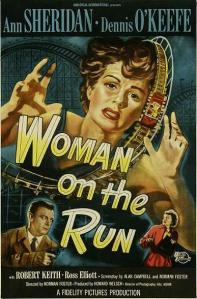
Woman_on_the_RunB-films have little time to waste and this one jumps right into the action. In a matter of moments, a man is shot, another man has killed him and a third witness gets away into the night. Although Frank Johnson (Ross Elliot) is rounded up by the police to be a witness he gives them the slip for an undisclosed reason and they must spend every waking hour trying to track him down.

What’s important to this particular story is that he left behind his wife Eleanor (Ann Sheridan) to be questioned by the police and they are hurting for a break. They need answers so they slam her with all sorts of inquiries.

She’s not all that cooperative though and the reasons are rather hard to discern. Is it belligerence, fear, or sheer apathy to the entire ordeal? Because you see, Ms. Johnson for some time had been drifting apart from her husband an accomplished painter who nevertheless put little stock in his own skill.

And that’s where the film’s two themes begin to intertwine.  The police surmise that the runaway man is fleeing a killer, but for his wife the implications are twofold. In her eyes, he’s just as likely running away from a marriage he couldn’t cope with. That is her dilemma which she masks both pointedly and inadvertently with various diversions to keep the police reeling.  After all, she’s not particularly keen on helping them or sticking around for that matter.

Whereas in earlier roles Ann Sheridan was always slightly overshadowed by other performers, most notable of those being the always electrifying James Cagney, here she gives perhaps her finest performance and she’s at the center of it all. That’s not to say she isn’t surrounded by a stellar supporting gallery.

Dennis O’Keefe, remembered as a gritty leading man in pictures such as T-Men and Raw Deal, showcases a new playful side as a journalist trying to nab a scoop on the runaway witness and at the same time making eyes at the man’s bride. But he manages to give the part some life that goes far beyond a one-dimensional characterization. There’s more to him as we soon find out.

The other important player turns out to be Inspector Ferris (Robert Keith) who as the long arm of the law is looking to find his man before his adversary does. But he’s not about to take flack from anyone and if ever there was a cop who was no-nonsense he fits the bill. His croaking voice always interrogating his subjects in a continuous effort to get his job done. Too bad he wasn’t quite counting on Ann Sheridan.

A relentless climax aboard a roller coaster at a local amusement park precedes Hitchcock’s Strangers on the Train when it comes to making carnival games such a deadly ordeal. And there are hints along the way ratcheting up the tension whether it’s a familiar cigarette lighter, a striking coincidence, or a passing remark that initially goes unnoticed.

The script strikes a strange path at times given to clunky expositional dialogue that feels as trite as can be and then in the very next sequence there’s a bit of patter or a dry quip that makes things all the more interesting. Also, a pair of small supporting roles for Victor Sen Yung and Reiko Sato add another layer of authenticity to the characterization only surpassed by the on location shooting that catches the essence of mid-century San Francisco.

In the end, Woman on the Run turns out to be one of those wonderful treasures that has rather unfairly gotten buried in the dusty attic of film noir. But far from being an antique, it plays fairly well today with an underlying tension running through Sheridan’s performance as she not only reflects on her own dwindling marriage but stresses to discover her husband’s whereabouts in fear of his very well-being.

It’s surprisingly entertaining and you get the sense that if Norman Forster (a fairly prolific actor, director, and screenwriter) were someone other than Norman Forster, this picture might have been scrutinized more closely. As it is, it’s just waiting for more people to dredge it up. How did I get here? If you’re a sucker for film noir and Ann Sheridan there’s no better place to go than Woman on the Run.

3.5/5 Stars

My Man Godfrey (1936)

my man godfrey 1.png

There’s a key moment in My Man Godrey where the ditzy Irene Bullock (Carole Lombard) giddily announces to her mother, “Godfrey loves me. He put me in the shower!” Her mother’s response could best be described as one of indignance but it’s a barrel of laughs for the audience. Because this film is full of off-the-wall remarks which taken out of context are so peculiar you don’t even want to attempt to understand.

That’s the beauty of this screwball comedy from the often underrated Gregory La Cava, best known for this picture and the following year’s Stage Door. Otherwise, the script is courtesy of Morrie Ryskind a veteran of some of the Marx Brothers’ comedies.

It opens as a biting satire of the affluent masses occupied by inane decadence and a multitude of frivolous diversions from scavenger hunts to parading livestock around in front of their friends. The screenwriter’s efforts were well worth it no doubt but the cast indubitably breaths incredible gales of life into the material with each battling for laugh after laugh.

The following interludes repeatedly exhibit perhaps the wackiest, most melodramatic family of comedy from most any decade. It comes from having too much time on their hands, too much money, and not enough sense. They’re a real screwy bunch. We meet the two Bullock daughters (Lombard and Gail Patrick) as they try and outdo each other in the middle of the previously mentioned scavenger hunt, searching out “a forgotten man.” They have no concern for who he is and how he lives. Only that he might win them the game.

Still, the said man plays along and somehow finds himself hired on by young Irene as the family’s latest butler to not only spite her older sister but also so that she might have a protege and maybe due to an inkling of a girlish crush. It makes little sense, only to say her mother’s protege is a musician named Carlo (Mischa Auer) who is good for very little except offering up the pretense of culture and eating them out of the house.

But Godfrey proves to be just about the best butler that the Bullock’s ever could muster, navigating their morning routines of hangovers and playing straight-man to the incessant chaos that constantly swarms around him. On their part, they are so self-absorbed and oblivious, they never seem to question how perfectly he has transformed into a butler. Surely, he cannot actually have been “a forgotten man” from off a trash heap? But no, they don’t concern themselves with such things. It goes unnoticed.

It seems like each member of the family has their special calling card.  They are a bunch of bubbleheads and Carole Lombard is the queen of them all, though mother (Alice Brady) is equally effervescent and a tad asinine. That’s  a part of her charm. She also flatters very easily.

Meanwhile, the other daughter Cornelia (Patrick) is more acidic, purring like a feline ready to pounce and make her sister pay for whatever trivial affront she’s perpetrated. Because, truthfully, they’re just a whole clan of boorish rich people who have no idea what’s happening to the world on the outside — if that point has not already been asserted enough. They’ve probably never heard of The Great Depression much less felt its true effects.

Mr. Bullock (Eugene Pallette) probably has it the worst as the long-suffering father — the nearest thing to a sane individual in the entire family. Still, you can’t live in a house of such madness and not have a few unhinged moments of your own. He’s constantly finding himself piping up amid the bedlam his gravelly voice trying to secure even a moments peace. He rarely succeeds.

Again, Godfrey is the calming force that brings a modicum amount of stability to such a place. He along with the veteran maid Molly (Jean Dixon) navigate the choppy waters of melodrama every day as Irene becomes increasingly infatuated, her emotional outbursts becoming more frequent, and Cornelia looking for any way to possibly make his life miserable to get him fired. Still, he goes about his duties.

And that’s part of the joke at the core of this film. The “forgotten man,” this tramp coming up against their own upper-class sensibilities and coming out looking like the true human being with brains and class and culture. Except it’s really a joke within a joke because maybe Godfrey is more than we first perceived him to be. In fact, he’s a lot more.

Pair such a raucous cast with some top tier comic patter that sizzles with wit and you’ve just happened upon the most wonderful mess imaginable. There might be other screwball comedies I enjoy more, but few are as hairbrained as My Man Godfrey and that is a grand word of praise for this brand of comedy. If it’s not stark raving bonkers it can hardly claim the name screwball honestly. No such problem exists here.

William Powell is a natural in this role showcasing that typical dry wit of his that effortlessly pokes fun at these people but also seems to appreciate them for all their shortcomings even finding time to truly respect them in the sincerest of ways. As per usual, Carole Lombard is so over the top to the nth degree with her sniveling zaniness spilling over into every scene.

In the past, I mistook her performances as a sheer annoyance but now I see how perfect she is for such a part. There’s an overwhelming commitment to the craziness that pays heavy dividends and by the film’s end, she’s overrun everyone with her energy — even Godfrey. He has no rebuttal.

For a time she was the greatest screwball actress though over the subsequent years the likes of Katharine Hepburn, Jean Arthur, Rosalind Russell, and Barbara Stanwyck gave her a run for her money. Still, there’s something undeniable about being the first and, in many ways, she was that woman.

If there were any residual ill feelings between Powell and Lombard now three years out from their divorce, there’s no visible animosity and together they succeed in forging My Man Godfrey into a classic screwball through and through.

4.5/5 Stars


The Thin Man (1934)

The_Thin_Man_Publicity_Photo

“What were you doing on the night of October fifth, nineteen-hundred-and-two?” ~ William Powell as Nick Charles

“I was just a gleam in my father’s eye.” ~ Myrna Loy as Nora Charles

With The Thin Man, Dashiell Hammet successfully crafted several archetypes that go beyond the basic pulpy film noir standards that he also helped to define. Nick and Nora Charles were a cinematic power couple even before the word was in vogue and as their real life counterparts, William Powell and Myrna Loy were quite the pair in their own right being matched in a mind-boggling 14 films together.

The Thin Man became one of the most beloved pairings, helmed by W.S. Van Dyke and spawning a wildly popular series of sequels that continued throughout the 30s and 40s. At the very least it suggested that it was not so much the story lines but more so the characters that resonated with the general public.

It’s true that casting William Powell as Nick Charles was one of the hand in glove situations. He had a certain dashing even debonair quality with his pencil mustache perfectly thrown askew by the scenarios he gets himself into. Above all, he has a witticism or lithe quip handy for any given situation. He’s a real riot at dinner parties. One of those men who has a perpetual smirk on his face.

But Myrna Loy is just as impeccably cast as his fun-loving wife who is as game as he is to have a rip-roaring good time. She’s constantly keeping up with his droll wit while continually chiding him good-naturedly to get back into the amateur detective game.

For the time, with no children to speak of, their beloved wire terrier Asta (the famed Skippy who was also featured in other such classics as The Awful Truth and Bringing up Baby) rounds out their happy clan.

It really is a strategic depiction of marriage and family circa 1934. The Great Depression still had a fresh imprint on the nation and yet in Nick and Nora you see no indication of any such malaise.  Their days are spent drinking martinis and gallivanting around town while their nights are filled with fancy dinner parties and the occasional crime caper.

These forms have been so often parodied to this day but at the time it seems obvious that The Thin Man whether subconsciously or not was an escapist fantasy that indulged the desires of those less fortunate. Because if nothing else, they could at least spend some fun taking a load off and joining the Charles for an enjoyable evening. Everyone laughs. Cops and citizens have close knit connections. Excessive drinking is only a delightful diversion. The only ones who were in need were the slothful and the greedy.

Although The Thin Man employs admittedly incomprehensible plotting at times it’s hardly a knock. So many characters get thrown in and chatted about it becomes difficult to keep them all straight much less figure out what their bearing on the plot is. And it is the oddest cross section of individuals to be sure.

Much like The Third Man, this precursor, The Thin Man acts as a nifty MacGuffin in a pinch, driving the plot forward with his spectral presence. The fact he’s hardly on screen does not detract from his overall importance in this film. Meanwhile, his invested daughter (Maureen O’Sullivan), wife, mistress, and various other involved parties all get tossed around as culprits and accomplices including Porter Hall and Cesar Romero.

While not noir in the typical sense James Wong Howe’s photography does give the film certain dark sensibilities at times to contrast with the plethora of more comic moments in drawing rooms and the like. It also shares in the tradition of Agatha Christie and other such detective fiction narratives with bits of amateur sleuthing and all the subjects rounded up for a dinner party so the culprit might be revealed.

But what The Thin Man truly explored was the capabilities of crime when paired with comedy. In some sense here is a film where you have certain screwball aspects but I hesitate to call this film a true screwball just as I hesitate to call this a gangster picture though there are cops and thugs.

It’s that immaculate blending of comedy and crime that makes The Thin Man go down like a perfectly mixed martini. It was the charisma of Powell and Loy that allowed the series to exist well beyond the parameters of a one hit wonder.

4.5/5 Stars

Destry Rides Again (1939)

Destry-Rides-Again-1939Destry Rides Again is integral to the tradition of comedy westerns–a storied lineage that includes the likes of Way Out West, Blazing Saddles, and Support Your Local Sheriff. It takes a bit of the long maintained western lore and gives it a screwy comic twist courtesy of classic Hollywood.

The rambunctious town carries the fitting name of Bottleneck which runs rampant with guns, beer, floozies, and more beer. The town’s mayor has a permanent seat in the local saloon playing solitary games of checkers while turning a blind eye to many clandestine activities. Meanwhile, the bar’s proprietor and local hot shot (Brian Donlevy) keeps grips on numerous shady dealings including dirty poker and murder, if you want to get technical. Though he does put on a good time with a floor show courtesy of his best girl Frenchy (Marlene Dietrich) who has the whole town swooning with her knockout looks. That’s the way the world works in Bottleneck and it’s a fairly crooked operation.

After the latest sheriff is laid waste the banjo-playing drunk is christened the town’s next lawman. It certainly is a fine joke but he does something somewhat admirable. He resolves to lay off the sauce and sober up. Calling in the grown son of one of his buddies from the old days to be his deputy.

Now he’s no longer a drunk. Just a blustering old fool who no one takes seriously for one moment. Still, when Destry comes into town he believes he will have the hulking spitting image of the boy’s father, a man who will instill fear in every local troublemaker. After all, that’s how things have worked in Bottleneck as far back as anyone can remember.

But instead of a leering heavy, he finds himself face to face with gangly Tom Destry Jr. who makes a memorable first impression on the town holding a woman’s parasol and a cage of parakeets as he helps a young lady off of the stage. However, in those opening moments he does a seemingly dangerous thing, instead of exerting his dominance he seems oddly comfortable in his skin. The townsfolk think he’s a pushover and he strings them along rather well. After all, he doesn’t carry any guns. He spends a great deal of time whittling and there’s a good-natured affability to his demeanor in nearly all circumstances. Added to that he has the oddest quirk of supplying an ever-ready stream of anecdotes for any given situation.

It’s such displays that earn the glee of the local thugs and hoodlums and the ire of not only his sheriff but the folks who feel he’s aiding their enemies. And yet in certain moments, he surprises them, proving to be an incredibly humble marksman (a precursor to Atticus Finch), breaking up a vicious catfight between two women with a pail of water, and getting buddy-buddy with the town’s rebels only to turn on them.

He seeks to bring law and order to the town on his terms looking to pin a murder on Kent in order to put him away for good. Of course, he’s not about to take it lying down and the town blows up into a scatterbrained finale that equals any of the zaniness in any of its aforementioned brethren of western comedy. As the menfolk fight it out with guns, Frenchy with a new resolve gathers all the womenfolk in an assault on the opposition using all blunt instruments imaginable from rolling pins to gardening tools. It’s sheer madness.

That’s not to say that Destry does not have its share of tragedy and that might be its greatest fault. Sometimes it doesn’t quite know where to fall between the lines of comedy and drama. Still, with the two legendary icons as luminary as James Stewart and Marlene Dietrich, it’s hard for this one not to be a winner though they seem so diametrically opposed to each other.

However, Cooper and Dietrich worked surprisingly well in Morocco and so Stewart and Dietrich work in a pinch here.  There’s also an abundant stock company including future stars like Brian Donlevy and Jack Carson not to mention small time funnymen like Billy Gilbert, the long-suffering bartender, and Mischa Auer, the man who unwittingly loses his pants in a poker game. Moral of the story is, don’t gamble. In fact, I wouldn’t be surprised if Destry would come in with a story right about now.

4/5 Stars


Review: Mr. Smith Goes to Washington (1939)

James_Stewart_in_Mr._Smith_Goes_to_Washington_trailer_cropThe opening credits roll and recognition comes with each name that pops on the screen. Jean Arthur, James Stewart, Claude Rains, Edward Arnold, Guy Kibbee, Thomas Mitchell, Eugene Palette, Beulah Bondi, H.B. Warner, Harry Carey, Porter Hall, Charles Lane, William Demarest, Jack Carson, and of course, Frank Capra himself.

We are met with the ubiquitous visage of Charles Lane calling in a big scoop on the telephone. A senator has died suddenly. The likes of Porter Hall and H.B. Warner fill the Senate Chamber presided over by a wryly comic VP, Harry Carey. Corruption is personified by the flabby pair of Edward Arnold and Eugene Palette while Claude Rains embodies the tortured political journeyman. The eminent members of the press include not only Lane but the often swacked Thomas Mitchell and a particularly cheeky Jack Carson.

To some people, these are just names much like any other but to others of us, linked together and placed in one film, these figures elicit immense significance and simultaneously help to make Mr. Smith Goes to Washington one of the most satisfying creations of Hollywood’s Golden Age from arguably “The Greatest Year in Cinematic History.”  The acting from the biggest to the smallest role is a sheer joy to observe as is Capra’s candid approach to the material.

As someone with a deep affection for film’s continued impact, it gives me great pleasure that stories such as Mr. Smith exist on the silver screen if only for the simple fact that they continually renew my belief in humanity, whatever that means. Because it’s an admittedly broad, sweeping statement to make but then again that’s what Frank Capra was always phenomenally skilled at doing. He could take feelings, emotions, beliefs, and ideals synthesizing them into the perfect cultural concoctions commonly known as moving pictures.

But his pictures always maintained an unfaltering optimism notably in the face of all sorts of trials and tribulations. He never disregarded the corruption dwelling in his stories–it was always there–in this case personified by the stifling political machine of Jim Taylor gorging itself off the lives of the weak and stupid.

The key is that his narratives always rise above the graft and corruption. They latch onto the common everyday decency, looking out for the other guy, and in some small way uphold the great commandment to love thy neighbor.

Politics have never been my forte. Like many others, I’m easily disillusioned by “politics” as this becomes a dirty word full of arrogance, partisanship, and scandal among other issues. It seems like the founding principles that laid the groundwork for this entire democracy often get buried under pomp & circumstance or even worse personal ambitions.

Although this film was shot over 75 years ago everyone who’s been around the block lives as if that’s the case then too and so they’re not all that different from today at least where it matters. Cynicism is a hard thing to crack when it runs through the fabric of society from the politicians, to the newspapers, all the way down to the general public. It’s not hard to understand why. Still, the genuine qualities of a man like Jefferson Smith can act as a bit of an antidote. He as a character himself might be a bit of an ideal, yes, but I’d like to have enough faith to believe that people with a little bit of Jefferson Smith might still live today.

Common, everyday people who nevertheless are capable of extraordinary things like standing up for what’s right when they know that no one else will or when they know all that waits for them at the end of the tunnel is disgrace. But the promise of what is beyond the tunnel is enough. That is true integrity to be able to do that and those are the causes worth cheering for when David must fight Goliath and still he somehow manages to overcome. That’s the chord Mr. Smith strikes with me. thanks in part to Capra’s vision but also Stewart’s impassioned embodiment of those same ideals.  He has a knack for compelling performances to be sure.

Time and time again James Stewart pulls me in. His career is one of the most iconic in any decade, any era no questions asked. There are so many extraordinary films within that context perhaps many that are technically or artistically superior to Mr. Smith by some  estimations, but he was never more candid or disarming than those final moments in the senate chambers as he fights for his life — clinging to the ideals that he’s been such a stalwart proponent for even as his naivete has been mercilessly stripped away from him.

In the opening moments, his eyes carried that glow of honest to goodness optimism, his posture gangly and unsure represented all that is genuine in man. Now watching those same ideals and heroes come back to perniciously attack him, he presides with almost reckless abandon. Is he out of his mind? At times, it seems so, but as he wearies, his hair becomes more disheveled, and his vocal chords have only a few rasps left he still fights the good fight. There’s an earnest zeal to him that’s positively palpable.

As our stand-in, Saunders (Jean Arthur) first writes him off as a first class phony or at the very least a political stooge ready to do another man’s bidding but she does not know Jefferson Smith though she does grow to love him. And Arthur’s performance truly is a masterful one because without her Smith would hardly be the same figure. She brings out his naivete by sheer juxtaposition but she also puts the fight back into him because he brought a change over her that in turn rallies him to keep on pushing. They’ve got a bit of a mutually symbiotic relationship going on in the best way possible. You might call it love.

Capra repeatedly underlines Smith’s honesty and genuine nature not only through numerous rather simplistic montages of Capitol Hill and the surrounding national monuments but in the very way his character carries himself around others. He never assumes a position of superiority. He’s always humble. He sees the inherent need to raise up young people well so that they might progress to become the leaders of tomorrow with a great deal to offer our world. He fumbles with his hat in the presence of pretty girls and holds his idols in the highest esteem. It’s all there on Stewart’s face and in his actions. We too comprehend the solemnity and the gravity that he senses in the office of the Senate.

While this was not Jimmy Stewart’s debut and it was only at the beginning of a shining career as has already been noted, it was in these moments that the cinematic world fell in love with him. He can’t be licked and for good reason. He was never one to give up on lost causes just like his father before him.

I guess this is just another lost cause, Mr. Paine. All you people don’t know about lost causes. Mr. Paine does. He said once they were the only causes worth fighting for, and he fought for them once, for the only reason any man ever fights for them: Because of one plain simple rule: Love thy neighbor. ~ James Stewart as Jefferson Smith

5/5 Stars

Review: Mr. Deeds Goes to Town (1936)

Gary_Cooper_in_Mr._Deeds_Goes_to_Town_trailer“He could never fit in with our distorted viewpoint, because he’s honest, and sincere, and good. If that man’s crazy, Your Honor, the rest of us belong in straitjackets!” ~ Jean Arthur as Babe Bennett

Mr. Deeds Goes to Town is a true treasure of idealism and Americana. People, especially now, may have many quibbles with the films of Frank Capra because he was the undisputed champion of feel good cinema that revelled in happy endings, stalwart honesty, and the little guy being permitted a fighting chance.

It’s no wonder that he made such good use of the likes of Gary Cooper and James Stewart because they embodied common, everyday American decency like few other actors could ever claim. Admittedly it’s easy to belittle his pictures as saccharine and sentimental to the nth degree but beyond that Capra always seemed to have an inherent sense of what America stood for or at least what he believed it could and still can stand for.

Every man deserves a certain amount of respect. You might call them inalienable rights like life, liberty, and the pursuit of happiness. And any force that tries to impede that is in simple terms an affront to all humanity. Because though we might all think we’re different, we share a lot more similarities than we often want to concede. It’s easy for us to forget that and that’s what happens here.

Longfellow Deeds (Cooper) becomes the overnight talk of the town because his rich uncle dies in a horrible car crash and bequeaths his wealth to his unsuspecting nephew. It’s the kind of good fortune that others drool over but in Deeds’ hands, he takes it in stride. He comes off as a real Yokum from the one horse town of Mandrake Falls but if anything Deeds is incredibly smart. He realizes he can have contentment out of the limelight and with very little. He enjoys quiet days oftentimes filling idle hours with his prized tuba and poetry that he writes for postcards.

But his new status as a millionaire forces him into the life that he doesn’t much want. Mansions and butlers, folks looking for handouts, ravenous newspapermen (and women) and conniving lawyers. Front and center is Mr. Cedar (Douglass Dumbrille). It’s these very individuals who see Deeds as a ridiculous outsider to be belittled and taken advantage of.

The brilliance of Capra’s movie is that he makes his hero, while simple and practical, still very astute. He may have his many quirks but there’s a surprising amount of business acumen and common sense flowing through his veins that consequently sends everyone else for a loop. He spies phonies from a mile of away and he looks to reform the local opera while finding ways to spend his newfound fortune sagaciously.

The only thing he’s not watching out for is a pretty girl, journalist Louise “Babe” Bennett (Jean Arthur) is ready to nab him, capturing his heart and simultaneously giving the whole city a front row seat to his exploits about town from quarrels with a snooty circle of poets to an evening jaunt ending on a fire engine. She’s a pro at spinning the tale into one of a first class boob, christening him the “Cinderella Man” that the whole world laughs at. They eat it up and they want to see him fall–this idiotic nobody suddenly being scrutinized by society for his good fortune. It’s all rather unfair but oftentimes that’s the way the world turns. It’s a cruel and sometimes curious place.

Because while Deeds grows fed up with this whole lifestyle, ready to leave it all behind him, Babe finds herself truly falling for her project since he models something she rarely sees in a man — real honest to goodness integrity that guides his every action. There’s never a false pretense or a veiled intention. What you see is what you get. Ironically enough, in this land of fakes, she’s the only “real” person he thinks he’s met. And she knows what’s been going on, going so far as to tell her editor that she’s quitting. There’s no way she can keep up the charade only injuring the character of the one she loves more and more.

But of course, everything dives into the depths of despair when Deeds is sent to trial calling into question his sanity after he resolves to use $18,000,000 to portion off acres of land to destitute farmers to work for him. It’s utter lunacy, isn’t it? The workers line up around the block leading into his home as he offers them a chance at a real life without starving children and food lines every day. This is what Cedar, Cedar, Cedar, and Blumenfeld are bringing him to court for or is it the fact that they want a portion of his fortune? Yes, that just might be it.

Anyways, far worse than that fate is the fact that he thinks his girl has betrayed him and she has in a sense, but she’s also devoted to him by now. She watches helplessly as her man gets railroaded. She began as the one to crucify him in the tabloids and now she prepares to watch him get crucified in the courtroom. In these moments, he does take on a Christ-like post watching all the proceedings without a word. He never makes any effort to defend himself after accusation after accusation is thrown his direction.

But the bottom line is that he does not have to let himself be destroyed. Being the martyr, in this case, is not his job and Capra lifts him out of the pit and resurrects him. The fact that Louise fights for him and numerous others including his cynical right-hand man Cornelius Cobb (Lionel Stander) and the local newspaper editor (George Bancroft), not to mention a legion of grateful farmers. So Mr. Deeds ends with a tumultuous courtroom finale befitting one of Capra’s finest pictures. It brims with goodness and bubbles over with humor that constantly underlines this feel good classic.

Though Gary Cooper represents Capra’s love of the every man with common decency and common sense, Jean Arthur remains equally crucial to the worlds that he creates. It has to do with her quality as an actor that allows her to play the snappy, witty, world-wearied types. Because she represents all the many people with that very same cynical streak and yet the very fact that her heart can be melted and her whole mindset can be changed suggests that there might be hope for all of us. That hope burgeons up from Mr. Deeds and leaves us with a warm feeling indeed.

4.5/5 Stars

Star Wars: The Last Jedi (2017)

Star_Wars_The_Last_Jedi.jpg“Let the past die.”  – Adam Driver as Kylo Ren

I left the theater feeling completely taciturn. It’s an onerous task to begin articulating all the jumbled fragments circulating through my mind but I will try my very best.  Certainly, there is a great deal to be enjoyed and to be relished about Episode VIII and you would be served well to go into The Last Jedi not searching out its faults but reveling in the successes that are there. Let it be known that there are many and Rian Johnson is a fine maker of movies as he guides us through the Resistance’s latest evasion of The First Order still up to their old business of quashing anyone who dares defy them.

True, I did not necessarily find it a narrative of revelatory reveals or epic showdowns in the vein of what I initially envisioned. However, I can see the picture separating itself from all of its predecessors — subverting the norm and drawing away from all that we knew before. That gels with much of what was said in the wake of The Force Awakens. It could not simply be another Empire Strikes Back if the new franchise was to flourish. In that regard, there’s no doubt Johnson’s film is an undisputed success building on the character arcs instigated in J.J. Abrams’ effort.

Yet my feelings are somehow conflicted.  Kylo Ren’s (Adam Driver) call to action to Rey (Daisy Ridley) midway through was never more pointed. “Let the past die. Kill it if you have to.” And that’s much of what has been done here. Not simply in a single film or to the Jedi order or the legacy of a character but in some respects to an entire franchise.

I am realizing that though I cherish Star Wars as my own, the many aspirations and fantasies of my childhood, it is a communal narrative. It might seem odd to get so thoroughly introspective but I can’t help it. Star Wars is almost inbred into my DNA.

Watching this film might topple the white knights. For one, the Jedi order as we know it. They lose much of their mythical stature that they always evoked. We already lost Han Solo and it’s little surprise that Luke and Leia (with Carrie Fisher’s passing) will most likely not be returning either. The old guard has been all but removed from their posts (with the exception of R2, C3PO, and Chewbacca though Anthony Daniels is the only other returning core cast member).

But it’s no surprise that I often savor the past — the way things used to be. That’s part of what made The Force Awakens such an enjoyable ride. There was an innate sense that this was something new, yes, but it was also squarely centered on the glories of the original trilogy. If I said it once I said it a thousand times, it was like returning to the company of old friends.

Now the old is gone and don’t get me wrong the new additions were greatly appreciated. Once more Rey (Ridley), Fin (John Boyega), and Poe (Oscar Issac) are indubitably winning personalities and fine action heroes. It’s easy to become immersed in their individual journeys along with the newcomers such as Rose (Kelly Marie Tran). However, that doesn’t take away my wistfulness at the conclusion of The Last Jedi.

It wasn’t even the kind of bittersweet conclusion we saw in earlier installments either but a plaintive ending without a giant climax. Harrison Ford received a venerable though tragic send off. His contemporaries not so much. There is still hope and events have been prolonged for Episode IX but not in some monumental cliffhanger fashion.

Whenever I take in a new film I am also constantly filtering it through the reference points that I already know. Obviously, Star Wars has such a vast lineage that must be sorted through but this latest film also can be read through various other archetypes. It strikes me that Luke Skywalker, the Star Wars hero I always aspired to emulate, was like Welles’ Harry Lime in The Third Man — waiting in the wings until he finally stepped out of the shadows.

Though I enjoyed that moment and the pure rush of adrenaline when he came back to the fore, expectations do not always correlate with reality.  Although we get to see Luke Skywalker and there are some enjoyable moments, the best of them come as all too brief reunions with his faithful astromech pal and his sister followed by a showdown with his main adversary — The nephew who turned to the Dark Side — again it was this wistful sense of an anticlimax.

We see in Luke what Obi-Wan (Alec Guinness) once was at least in a visual sense. A hermit who has removed himself from society. Cloaked, bearded, and detached. But whereas Old Ben was a wise, eccentric, and even a fatherly wizard, Luke has become a world-wearied, surly misanthrope. A far cry from the man we dreamed about.

The reverberations of the past echo down in other ways too from the inciting distress signal from his sister that started him off on this cinematic adventure all those many years before and then a visitation from a furry friend.

Likewise, the final showdown is somehow more reminiscent to the archetypal lightsaber battle of A New Hope than all the fanciful epic showdowns we imagined of Jedi Master Luke Skywalker tackling every conceivable villain with his green lightsaber. The old man’s words even mirror the final lines of his late mentor (Strike me down in anger and I’ll always be with you. Just like your father).

Even briefly with lightsaber in hand facing down the greatest forces in the universe as we always thought possible in our mind’s eye, there’s a momentary catharsis. Though the full satisfaction of the moment is stripped from us. Luke is not quite how we remembered him, nay, maybe not even the same man Mark Hamill embodied all those years ago.

It does bring to mind the mythological line out of John Ford’s The Man Who Shot Liberty Valance. “When the legend becomes fact, print the legend.” And it’s still true of Luke Skywalker for those in the galaxy far, far away and right there he can remain a hero.

The film’s most intriguing dynamic reveals itself in the perceived connection between arguably our two most crucial characters in Rey and Kylo Ren also known as Ben Solo. But that core struggle between the two of them — literally the dissonance between the Light and Dark sides of the Force — is rudely disrupted. It’s such an ambiguous dividing line between good and evil and though it still remains, the character of Supreme Leader Snoke, equally implicated in this web comes off as little more than a ploy. All the potential grand conspiracies around it are gone in a puff of improbable smoke.

Intertwined with this is Rey’s familial identity which has been of paramount importance to everyone ever since these new pictures were conceived. It’s not so much that I minded what the revelation was (minor as it was) but it was more the fact that this bit of seemingly crucial exposition was so quickly cast aside as well. It felt once more a bit like a bait and switch — as if the Star Wars saga was somehow rewriting its own mythos in counterintuitive ways.

Maybe for once, Star Wars has become a bit more pragmatic; it has sought out realism and the things of this world more than a galaxy far, far away. Here I will admittedly contradict myself but I am not sure how to deal with this development because Star Wars was always a fantasy, always a science fiction fairy tale built out of imagination and dreams. Now it seems to be inching more and more toward the real world. Not because there are any fewer lightsaber battles or blaster fights or fewer alien species and star systems to explore, but the makeup of the new generation of characters is somehow different.

It is a pipe dream to believe that Star Wars could always be the same because it was not created in a vacuum, it is no longer George Lucas’s, and it has so many other parties invested in it. I for one must come to accept that. The film ends on a rather odd beat with young children getting rapt up in tales of the Last Jedi and looking off into space empowered by the hope brought by the Resistance before the credits roll. Though it felt very un-Star Wars it’s somewhat fitting given this new direction.

Hopefully, younger fans eat up this latest installment and conceive adventures and worlds of their own like I once did, feeding on the visions of the screen as fuel for countless Lego lightsaber battles and made up assaults on the enemy forces with their ragtag band of Rebel Scum. These new films don’t mean so much to me but maybe they can mean something to the current generation. Maybe that’s what they’re meant to do.

Will I see The Last Jedi again? I wouldn’t be at all surprised but unlike The Force Awakens, this isn’t so much an extension of the original trilogy. This is a breaking of the chain. This is something starkly different and it’s taken the galaxy into uncharacteristic territory.

I resolutely admire Rian Johnson for his choices because it seems like he’s made a Star Wars film that is hardly cookie cutter in nature and the fact that it will not please everyone is a marvel (no pun intended) given the usual reality that blockbusters are supposed to be easy on the eyes while hardly divisive. Though flawed, it’s a relatively bold movie in running time, in how it utilizes its characters, and ultimately how it chooses to depart from its longheld traditions. But the boy inside of me still yearns for the Luke Skywalker of my youth as naive as that might sound. I suppose I’ve never been much of a realist.

4/5 Stars

Bachelor Mother (1939)

bachelor mother 1.png

Of course, Bachelor Mother is a blatant oxymoron and it’s a perfect summation of that vestige of a genre the screwball comedy — a genre that’s about marriage and divorce and the gray areas in between conveniently skirting past issues such as adultery or people “living in sin” as it were. The norm was not a genre of divorce but of remarriage.

As such this Ginger Rogers vehicle has her playing a woman who doesn’t actually have a child out of wedlock but it’s assumed as much and that’s where the roots of the comedy get their traction. Because therein dwells so many societal taboos that are subsequently turned into marvelous fodder for misunderstanding though no actual moral statutes have been broken. It’s that line of dramatic irony that the rom-com, in general, has always needed in order to survive.

Just think how perfectly it all happens. In one moment Polly Parish (Ginger Rogers) finds herself laid off from her department store gig just in time for Christmas and between the unemployment agency and home she happens upon a lady leaving a cute little bundle of joy on the doorstep of the local orphanage. She says it’s not hers. She found it somewhere and now she’s leaving.

But Ginger Rogers being our concerned heroine can’t just let the baby sit there so she takes a course of action, delivering the child inside and enlightening the staff about the situation. Of course, they all believe she’s simply shirking her maternal responsibility and running out on her child and they pass the news along to David Merlin (David Niven), one of her former employers.

By now, Polly is already long gone. She’s agreed to take part in a dance competition at the local hall the Pink Slipper. There’s $50 in it for her and her partner Freddie (Frank Albertson of It’s a Wonderful Life prominence) if they can win. Waiting, babe in arms and valet in tow, Mr. Merlin tries to rectify the situation and get Polly to take back her child.

If the film was born on the steps of the orphanage, then it is solidified right here as a full-fledged screwball comedy of motherhood and misconstrued circumstance. Polly finds herself called into Mr. Merlin’s office and is offered her old post as long as she takes her child back. Still, they don’t listen to her renunciation so she has no course but to become a mother, after all, babies are cute. They can’t be that much work…

The fact that this is a screwball and not so much a domestic comedy is made clear by the fact the baby is more of a plot element than an actual character and Rogers and Niven find time to fall in love even with the added strain of motherhood.

What seems to do it is a lovely night together on New Year’s Eve which is highlighted by an extended gag where Niven introduces Rogers as his date from Sweden who conveniently does not speak a lick of English. It’s punctuated by the definitive punchline of the film. Simultaneously, Rogers struts her stuff all night long (though we miss Fred Astaire) in a reverie of pure joy.

But that’s not all that’s capped off amid the pandemonium of the festivities. Love Affair is far from just the movie up on the nearby theater billboard. It’s also something coming to fruition between our two stars. However, if this was the end it could hardly claim the name screwball. That’s when the baby comes in. J.B. Merlin (Coburn) finds his son with this single mother and draws conclusions of his own and…he’s very happy to be a grandfather and not so happy with the spineless conduct of his son.

What follows is a mad dash by our two leads to try and conjure up other stand-ins for a game of Who’s the Father? Three eligible contenders are brought in to play the charade. We already know Merlin, then there’s the dancing fiend and disgraced floorwalker Freddie, and the landlady’s bespectacled son.

In the end, everything is squared away nicely and the corkscrew comes full circle. Though Charles Coburn plays a very small part it proves to be a crucial one. Meanwhile, I adore Ginger Rogers and once more following Stage Door and Vivacious Lady, she proves in yet another film her genuine skills as an actress of immeasurable smarts and humor. Sometimes I’m admittedly unfair to David Niven — he’s never been the most compelling actor — but he’s fine in this picture.

This film also shares much the same world as the Devil and Miss Jones (including Charles Coburn) and the toy store environment provides the perfect arena for a terrifically comical shoplifting sequence full of excitement. It’s this movie to a tee. Positively quacking.

3.5/5 Stars