The Big Country (1958)

230bc-big_country833Directed by William Wyler and starring Gregory Peck, Jean Simmons, Charlton Heston, and Carroll Baker, this pacifist western revolves around a feud between two ranching families. A gentleman sea captain comes out west to be with his fiancée on her father’s ranch. After his arrival, he encounters a jealous farmhand (Heston), the beautiful schoolteacher friend of his fiancée, and of course the Hannasseys, who are sworn enemies of the Terills. In a sense he is a fish out of water because he never feels a need to try and prove his bravery to others. The schoolmarm is caught between the two families since she owns the vital watering hole “Big Muddy.” Mckay buys the land as a wedding present but when the wedding ties are cut now he is the one in the middle of it all. In order to stop the imminent bloodshed, he bravely rides into the Hannassey’s territory in order to get both sides to reason. Whether it be the score, the cinematography, or the dialogue, you will certainly come to realize that this is a Big Country.
 
4/5 Stars

Spartacus (1960)

91a01-spartacus_sheetaIn this epic film starring Kirk Douglas and directed by Stanley Kubrick, a slave turned gladiator leads a revolt against the Roman empire. Spartacus leads his fellow plebeians in a sacking and burning of the countryside while slowly gaining followers. Along the way he is reunited with his love (Jean Simmons). However, soon all hope of triumph or escape is gone and Spartacus must face the Roman legions in one final battle. Utterly overwhelmed by the other forces, his followers are slaughtered and taken prisoner. With all hope gone he must kill his friend (Tony Curtis) and then face death himself by crucifixion. But all is not lost because his wife and child do get away allowing his legacy to remain. Overall this film is good but it does have flaws, one of them being the casting of Tony Curtis with his New York accent. Laurence Olivier, Charles Laughton, and Peter Ustinov all have important roles in this film as well.

5/5 Stars

The Leopard (1963)

Directed by Luchino Visconti and starring a stellar cast including Burt Lancaster, Alain Delon, and Claudia Cardinale, this Italian film revolves around a Prince and Patriarch during a period of social change in Italy in the 1860s. 

His Excellency the Prince of Salina (Lancaster) is a highly respected noble, who lives with his family on a large estate in Sicily. In his own life, the Prince is annoyed with his marriage and perturbed about the company his nephew Tancredi (Delon) is keeping. However, a revolution led by a man named Garibaldi means great change for the nation and finally following the lead of his nephew, who joins the rebel redshirts, the Prince sides with the new way and supports the plebiscites that are set up. His nephew falls for the beautiful daughter (Cardinale) of an aristocrat, and despite the fact that his own daughter has an eye on Tancredi, Don Fabrizo fully supports the marriage knowing it is good for the family. Because of his title and the respect he has garnered, the Prince is offered a position as a senator in the new government. But he courteously turns it down feeling he is too old and too attached to the old ways. Tancredi and Angelica are to be engaged and they are presented together at an extravagant ball. Over the course of the evening, Don Fabrizo has time to talk, dance with the young beauty Angelica, and reflect on his own life. As the lavish evening begins to dwindle the Leopard walks off to clear his head. 

In some respects, I saw this as an Italian equivalent to Gone with the Wind, and I could see some precursors to The Godfather here because the Italians portrayed are very religious and chivalrous people who can also be ruthless. However, I think it is fair to say that The Leopard is its own film entirely, and it should be taken as such. Tancredi and Angelica are no Rhett and Scarlett and the Prince is not the Godfather. They are their own unique characters. In my personal opinion, I would recommend the Italian version because that is the way the director meant it to be seen and Lancaster’s normal voice seems out of place in the film. Some may say that this detracts from his performance, but I think his presence and acting ability show through even if he is dubbed.

4.5/5 Stars

There Will Be Blood (2007)

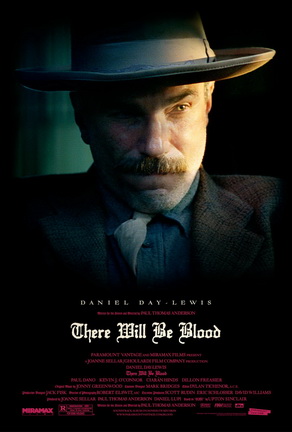
fe325-there_will_be_blood_posterStarring Daniel Day-Lewis in a brilliant performance, the film opens at the turn of the century where a Daniel Plainview finds oil and starts a small drilling company. After a worker dies, Plainview takes the abandoned baby as his son H.W. He uses the boy to endear himself to others and his successes grow. Time passes and Daniel is approached by a boy who knows the location of oil. Daniel goes there and buys up all the land he can, becoming a wealthy man in the process. However, not everything is wonderful. He begins a long conflict with a local preacher (Paul Dana) and his son becomes ill after an explosion. Later a man comes to Plainview claiming to be his brother and Daniel also abandons his son. The years pass and he is more greedy and tyrannical and on top of that he is also a drunkard. He cruelly mocks his son before cutting all ties with him. Finally, he commits one last violent act. What stands out is that Plainview has no redeeming qualities and this man proclaiming to be a minister is also an undesirable. This film had moments reminiscent of Giant, The Treasure of Sierra Madre, and even Citizen Kane. However, despite the commanding performance of Lewis, it is not quite the same caliber in my mind.

4.5/5 Stars

Lawrence of Arabia (1962)


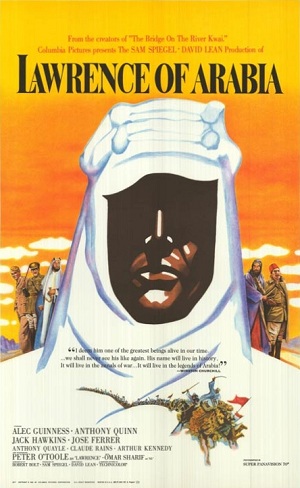
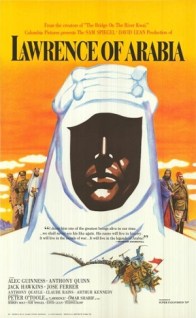
A film of truly epic proportions, in length, scenery, and brilliance, Lawrence of Arabia is essential cinema. Peter O’Toole delivers a stellar performance as T.E. Lawrence, a British soldier during World War I. The movie begins with his death from a motorcycle crash, which gives an early glimpse of the character.

Then, a flashback goes to his time in Arabia where his task was to unite the Arab tribes, and lead them in rebellion against the enemy so the British might win. Against the better judgment of his commanding officer, a Mr. Dryden of the Arab Bureau suggests Lawrence be sent to assess the possibility of an Arab revolt against the Turks. Lawrence heads with his guide to pay a visit to Prince Faisal. However, his guide is shot by another man and Lawrence resolves to make the journey alone. Their paths cross again in the camp of Faisal. There Lawrence interests the Prince because his ideas are far different from his commanding officer.

Showcasing his audaciousness Lawrence suggests a bold attack on Acaba which would allow the British to bring in supplies. He leads a group of men across the brutal desert knowing that this will be less expected. Sheriff Ali (Omar Sharif) doubts it will work and disapproves that Lawrence takes two young outcasts as his servants. It is later during the journey that Lawrence truly wins over the other men, including Ali, because he is relentless, even going back for a lost straggler. With some luck, Lawrence is able to gain the help of Auda Abu Tayi, but it is not without tension. Ultimately, his forces are able to take out the Turks, and Lawrence heads back to Cairo to relay his progress. However, on the way back he must struggle with the loss of a servant and the guilt of executing a man.

Lawrence is sent back to Arabia and there he leads his forces in guerrilla operations against the Turkish railroads. His exploits are documented by an American newsman, and by this point, he has become a mythical hero among his followers. However, after going to scout a town the seemingly invincible Lawrence is ultimately flogged and tortured, leaving him a broken shell of a man. He insists on leaving Arabia but his new commander, General Allenby orders him back for one final push towards Damascus.

This final mission sees a change in Lawrence, who has hired killers and missionaries to help him in his siege. Against the better judgment of Sherif Ali, Lawrence leads a massacre of Turks as they move onward. He takes Damascus, but his fragmented counsel of Arabs are unable to unite, and the city is given back to the English. Major Lawrence is promoted once more to Colonel, and then gets shipped home because his services are no longer necessary.

This is one of those films you want to see on the big screen because the scenery and cinematography is just that impressive by itself. David Lean had a skill at making epics, and this is perhaps his masterpiece. The desert is often stark and desolate, and yet striking in the same instance. The expanse of space that is viewed in a single shot is often mind-blowing. A human being on the horizon is hardly a speck, and the ever-present camels are hardly any more substantial. To complement these grand images is an equally magnificent score by Maurice Jarre, complete with overture and all. The cast must be mentioned too with such supporting stars as Omar Sharif, Anthony Quinn, Alec Guinness, Claude Rains, Jack Hawkins, and Anthony Quayle.

Then, of course, there is the man who played Lawrence. As portrayed so wonderfully by Peter O’Toole, Lawrence is an intelligent and, at times, arrogant man, who can be odd, distant, audacious, and also unscrupulous. That being said, he was an extraordinary man who was a mover and a leader of men. A very unique, at times controversial, and long unheralded man, who contributed to the war effort in a far different way.  In many ways, he was an adopted brother to the Arabs, and their country was also his. He was “Lawrence of Arabia.”

5/5 Stars

Titanic (1997)

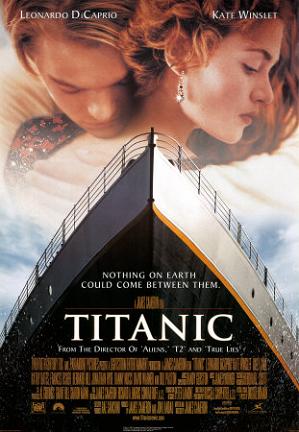
c8571-titanic_posterStarring Leonardo DiCapprio with Kate Winslet and director James Cameron, the film opens with an exploration of the submerged Titanic. An interesting discovery puts the explorers in contact with an elderly woman who was there in April 1912. Rose recounts her arrival as a newly engaged 1st class passenger. She felt trapped in her life until she accidentally met Jack, a 3rd class drifter who won his ticket in a poker game. After he saves her life, their forbidden relationship continues as they spend more time together. Jack, who is an artist, even does a charcoal drawing of Rose. However, all too soon the unsinkable ship hits an iceberg and chaos ensues in the following hours. Heroically, once again Jack keeps Rose alive although he himself perishes in the cold. Back in the present Rose now keeps him alive with her memories. This epic romance is fairly good with a semi-autobiographical story, special effects, and a decent score.

4.5/5 Stars

Bridge on the River Kwai (1957)

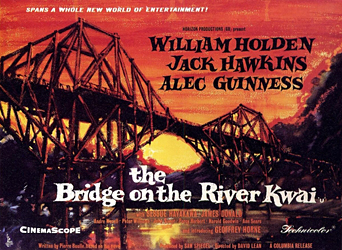
f1d1f-the_bridge_on_the_river_kwai_posterStarring Alec Guinness and William Holden with director David Lean, this is a World War II film that follows the exploits of British POWs and also Allies on a secret mission. Guinness is the proud and principled British Colonel who leads his men in a memorable entrance. With stubbornness he wages a war of wits against the Japanese camp overseer. He inspires his men and eventually reaches his goal of personally leading them in the completion of the bridge. At the same time an American soldier (Holden) attempts escape and somehow winds up alive and safe. However, all too soon he is sent right back with specialized commandos to destroy the bridge. In a chaotic and tragic finale, the British colonel puts a wrench in the plans and the implications are costly even though the objective is achieved. This is a magnificent and enjoyable film with good cinematography, interesting characters, a two-sided story, and of course whistling!

5/5 Stars

Gladiator (2000)

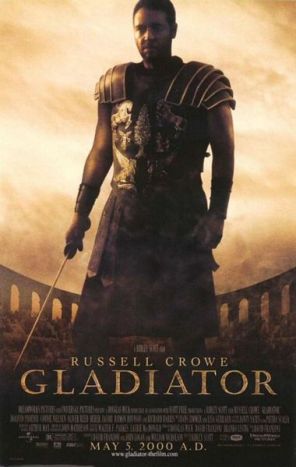
9db87-gladiator_ver1Starring Russell Crowe, Joaquin Phoenix, and Connie Nielsen, with director Ridley Scott, this film is set during the waning days of the Roman Emperor Marcus Aurelias. General Maximus is a great and loyal warrior who the old man wants as his successor. However, his jealous son will not have it, killing his father and then ordering the execution of Maximus. He escapes but is mad a slave and then a gladiator. Through this he gains the respect of the masses and is able to defy Commodus. Over time, Maximus is part of a plot to remove Commodus. Once again the enraged emperor wishes to quash the legend of Maximus forever. He does not win in the end and Maximus has aided Rome. This action-epic had a lot of exciting scenes and a good hero. The score was good too but sometimes it seems as if the cinematography could have been better. This film is reminiscent of the classic epic Spartacus and it was a pretty good in it’s own right.

4/5 Stars