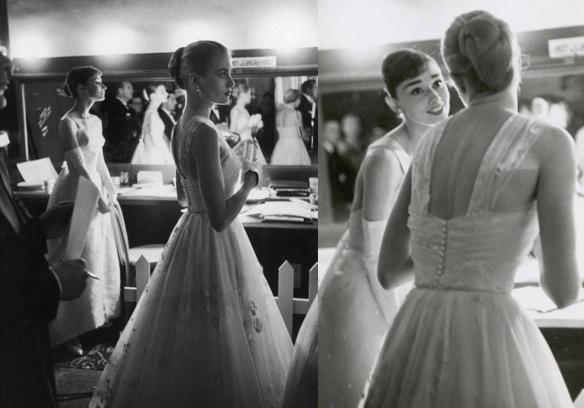
Grace Kelly & Audrey Hepburn

hepburn and kelly

Source: TIME

The caption from TIME Magazine read as follows: Audrey Hepburn and Grace Kelly Backstage, 1956. The two most elegant stars of their era are photographed backstage at the RKO Pantages Theatre, as they wait to present: Hepburn gave Best Picture to Marty, and Kelly awarded the Best Actor statue to Ernest Borgnine for the same film.

I’m not sure if they ever met again or had any further interaction but this image always fascinated me because I would say unequivocally Audrey Hepburn and Grace Kelly are my two favorite actresses of all time, from any era, any decade, bar none.

That third spot undoubtedly changes often between the likes of Catherine Deneuve, Teresa Wright, Natalie Portman, Gene Tierney, Joan Fontaine, Paulette Goddard, Brie Larson or any number of other talented stars but the bottom line is my deep admiration for Princess Grace and Ms. Hepburn has remained unwavering.

I think it’s been a little over 10 years ago since I saw Roman Holiday for the first time and I was initially struck by Audrey Hepburn even though I knew very little about classic movies. Living under a rock as I did, I probably didn’t even know her name. But I didn’t need that to be affected by the film. I think it only took a couple more films to realize I had a slight crush on her.

What followed soon thereafter was a viewing of Rear Window, followed by High Noon, To Catch a Thief, and then, of course, the inevitable happened and I had a crush on Grace Kelly too. Rear Window is still my go to film when people ask me my personal favorite. There are so many wonderful aspects to enjoy and one of those is Kelly’s performance as Lisa Fremont.

Though in some ways Grace Kelly and Audrey Hepburn couldn’t be more different, there are a couple luminous qualities that undoubtedly tie them together. First, they both performed in some wonderful films as already mentioned and they are both renowned as style icons and women of immense beauty.

They shared some of the same leading men including William Holden, Gary Cooper, and perhaps most notably Cary Grant. They both were taken from us far too soon but their lives even after Hollywood were marked by their efforts as global goodwill ambassadors.

All of these things are certainly true but beyond that, there’s something about the way they carried themselves that’s so iconic. It’s the kind of thing you can hardly teach and seems even harder to categorize. It’s grace, it’s humility, it’s good humor and it’s a spellbinding presence. It’s both onscreen and off it. I could watch their movies over and over again and part of that is because they are such special individuals who were imbued with innumerable traits like the aforementioned that are so easy to admire.

Though the tabloids devoured their every move, they seemed less inclined to care about the spotlight. Though they both won Oscars on the biggest stage, they still maintained a civility that would put other stars to shame.

I think it’s only fair to end with some viewing recommendations. Some possible Double Features might be High Noon and Love in the Afternoon, Sabrina and The Country Girl, or even The Bridges at Toko-Ri and Paris When it Sizzles. But there’s a particular pairing that’s perhaps the most obvious.

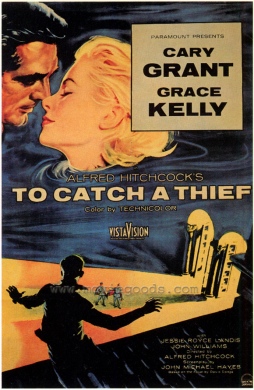
For your viewing pleasure check out the Double Feature of To Catch a Thief (1955) and Charade (1963).

To Catch a Thief is, of course, Alfred Hitchcock’s famed romantic thriller starring Grace Kelly and Cary Grant about a reformed cat burglar living on the Riviera. It has that textbook Hitchcockian blend of mystery, romance, and wit with Kelly as the quintessential Hitchcock blonde.

Meanwhile, a few years down the road, Stanley Donen developed his own homage to “The Master of Suspense” long dubbed in many circles as “the best Hitchcock picture Hitchcock never made.” It too is a lithe thriller juggling its romantic interludes and snappy repartee with a genuinely tense spy plot throughout France.

I will end with one moment in the film that seems especially pertinent to this discussion. Crucial to some of the film’s storyline is a stamp collector who provides invaluable information to our hero Regina (Audrey Hepburn). In a brief passing moment, he nonchalantly mentions a batch of stamps including, “12 Princess Grace Commemorative stamps.” This is, of course, in reference to her marriage of Prince Rainer of Monaco in 1956 which became an international sensation. It’s a reassuring note.

So though we might have wished that they shared more moments together or even that they could have shared the silver screen together, this throwaway line in Charade reminded me, even briefly, how iconic these two ladies were. And though it’s really only in spirit, this slight nod allows them to share the screen as much as it simultaneously acknowledges their rightful place in our popular culture.

Many people will remember them as royalty for years to come. Audrey Hepburn of course famously coming to public attention as Princess Ann in Roman Holiday and Grace Kelly leaving her Hollywood career behind at the height of stardom to become Princess Grace of Monaco.

This is my entry in the Grace Kelly Blogathon hosted by The Wonderful World of Cinema!

Review: High Noon (1952)

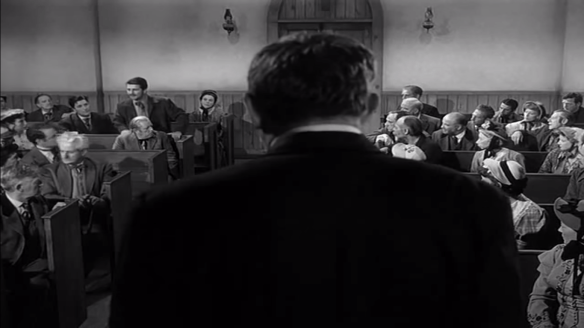
highnoon1Drums softly beating. A voice mournfully bellowing,”Do not forsake me, oh, my darlin‘.” It can only mean one thing, the beginning of High Noon, a western that has grown near and dear to my heart in the recent years. And yet how can a western of under 90 minutes mesmerize and cause goose bumps to form time after time? That opening ballad sung so wonderfully and folksy by Tex Ritter is one great reason. It’s a mournful dirge of a song which nevertheless draws us into this film, and personally, I cannot help but belt out a few lines now and then (I’m unashamed to say I know the whole song). After all, it’s this song that reflects the story of our main character Marshall Will Kane (Gary Cooper) and reiterations of the tune can be heard throughout for the following hour as we all wait for the noon train.

The song makes it clear that Ben Miller is coming after Kane for sending him to prison. He’s got revenge on the mind and three of his buddies, including his brother, are waiting for his arrival, along with everybody else in town. Meanwhile, the Marshall is about to hang up his badge as it were, because he’s gotten hitched to a pretty young quaker (the estimable Grace Kelly), and they look to settle down with a store in some sleepy town. He’s well-deserving of it after all he’s done and the town stands behind him.

But the news of Miller’s return is no way to start the honeymoon. Still, the couple sets off, but Kane turns around realizing he cannot run (I do not know what fate awaits me. I only know I must be brave. For I must face a man who hates me, Or lie a coward, a craven coward; Or lie a coward in my grave).

highnoon4

This is the backdrop that he’s trying to scrounge up a posse with. Others getting out of town, some telling him he should get out of town too, and a general commotion about what they should do about the whole mess. There are numerous cross-sections and enclaves all with different motives and most importantly excuses. They all turn down a chance to help Kane for one reason or another (even his closest friends). It seems so easy to pass judgment, but then again what would we do in such a situation? In fact, it brings to mind the Hollywood Blacklist which this story was supposed to be an allegory for. This is not just some fictionalized parable, it was mirroring real life to some extent.

What really resonates about this film is the resolve of one man, because when it comes down to it, Kane did not need to stay, he did not need to do what he did, but he stood by his guns, literally, when no one else would stand with him. It’s easy to conform, easy to go with the crowd. It takes real courage to walk out on your own — although the Marshall did have a little help. So whether or not John Wayne thought this film was wholly “Un-American” or not, I think I would have to disagree with him on this one. Maybe what Kane has is reluctant courage, and I could see how the Duke would be disgusted by such a “spineless” individual. But for me, he’s all the more relatable played so aptly by Gary Cooper.

highnoon7It continues to amaze me that a film of this length can have so many wonderful characters who leave an indelible mark on the story. Certainly, you have the hero and the villains, but then we have character actors such as Thomas Mitchell, Harry Morgan, and Lon Chaney Jr. playing some of Kane’s buddies. There’s the gang at the bar and the hotel clerk, who are no friends of the Marshall. There’s his former flame Helen Ramirez (Katy Jurado) and his hot-headed deputy (Beau Bridges). The rest are filled out by men, woman, children, town drunks, and churchgoers. Zinnemann does a wonderful thing aside from just using the clock as a plot device and tension builder. He also calls back all these many characters as the noon train comes in with smoke billowing black. The audience and all these people know what that shrill whistle means. Things are going down, and Kane is going to face it all alone.highnoon2The isolation is so wonderfully conveyed by an aerial shot where the camera moves up to show the stoic Marshall standing in the middle of a ghost town. No people around and no one showing their faces. Then of course, when it’s all over, the floodgates open and all the folks rush into the center of town. Fittingly,  Kane drops his tin star in the dirt in disgust as the refrains of Tex Ritter’s ballad continue.

Put High Noon up against other films and it could be criticized as nothing more than a western, but perhaps that’s why I like it. I cannot help but gravitate towards it. In some ways, it reminds me of growing up and it allows me to forget about any sort of deeper meaning for an instant so I can be fully enraptured with this story, this song, and these characters. It’s a worthy incarnation of the mythic west, that also leaves a little space for some humanity.

People gotta talk themselves into law and order before they do anything about it. Maybe because down deep they don’t care. They just don’t care.” – Martin Howe (Lon Chaney Jr.)

5/5 Stars

Fourteen Hours (1951)

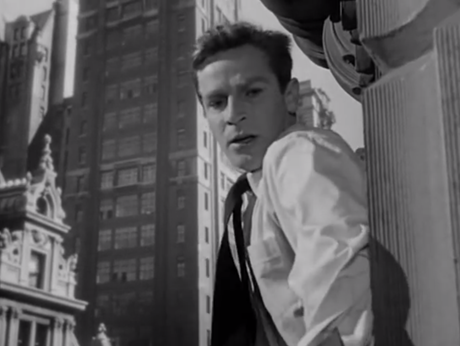
fourteenhours1Fourteen Hours is a taut little thriller, based on real circumstances that occurred in New York in 1938. The film opens with a young man standing on the ledge of a tall hotel in New York City. An unsuspecting waiter happens upon him and a traffic cop (Paul Douglas) spies him from the street below. All of a sudden, a mundane day gets a little more exciting for all the wrong reasons.

Henry Hathaway’s film has the kind of self-contained drama of a modern film like Phone Booth (2002) and a media frenzy that is in some ways similar to Billy Wilder’s Ace in the Hole (1951). Really when you break it down it’s essentially about two men. Robert Cosick (Richard Baseheart) is the despondent and disturbed man tottering on the edge of destruction. He needs a friend. He needs guidance. The rapport built between him and Charlie Dunnigan (Douglas) is what keeps him where he is.

Outside of this main dynamic, we have a lot of smaller events all happening at once. The gruff deputy chief Moskar (Howard Da Silva) tries to work on the inside of the hotel to get the man indoors. A psychiatrist with a hypnotic stair (Martin Gabel) tries to divvy out advice to Dunnigan and others. Meanwhile, Robert’s histrionic mother (Agnes Moorehead) and his plain-speaking father both make appearances, but to no avail. They even finally track down his girl Virginia (Barbara Bel Geddes) in the hopes that she can get him down. All the while the journalists scrounge around for a good story that they can feed to their papers because this is news!

fourteenhours3Down in the streets below young people (Debra Paget and Jefferey Hunter) look up wishing they could do something. The cynical cabbies decide to make a wager on when the man will jump since they aren’t getting any more business for the time being. Even Grace Kelly makes an appearance (her debut), as a young wife who is about to go through with her divorce. But the man on the ledge flusters her and she and her husband have a happy ending.

Hour after hour drags on as Dunnigan continues to work on Robert to get him to come in. He loses his temper once, converses about fishing for floppers, and talks fondly about his wife. By far Paul Douglas is the standout because he has such a genial quality that makes his newfound friend, and the audience, trust him. He’s a good egg as they say, and at the end of the day, he gets to walk off with his wife and son after a good day’s work.

I think it’s true that the film was remade as Man on the Ledge, but I doubt that I would ever want to see it after this film. Don’t get me wrong, it crawls a little bit in the middle, but the combination of this human drama and the plethora of characters lent itself to a generally interesting tale. Also, it’s never static visually. Hathaway gives us a lot to look at. I will admit that several of the storylines were flimsy and unnecessary, but it was still fun to see Grace Kelly for at least a few moments.

3.5/5 Stars

Review: Rear Window (1954)

Hitchcock_stills_0006_rear-windowWho in their right mind would make a film that takes place in a courtyard? Rear Window has always been fascinating from a technical standpoint, and Alfred Hitchcock is certainly not “The Master of Suspense” for nothing. He uses the confined space of a single Greenwich Village courtyard with an incapacitated individual to truly build the tension to immeasurable heights. The events within the film are often highly bemusing as Hitchcock has a wicked sense of humor, whether Jefferies is trying desperately to scratch that itch or the conversation turns morbid as he tries to eat breakfast.

The script has so many great little moments of back in forth repartee; some supplied by the always dynamic Thelma Ritter who plays the nurse with a lot of advice and opinions about rear window ethics: “We’ve become a race of peeping toms. What people ought to do is get outside their own house and look in for a change. Yes, sir. How’s that for a bit of home-spun philosophy.

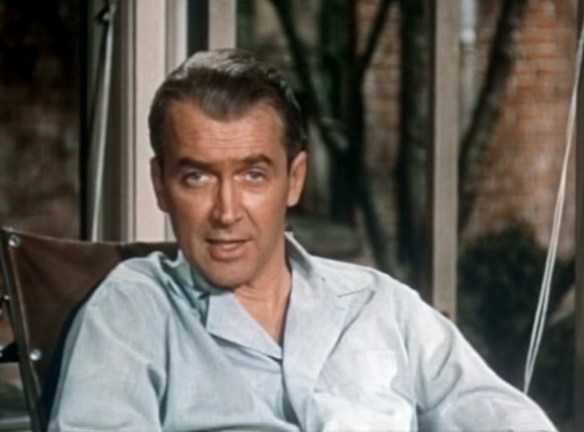
James Stewart is always a pleasure, but this time around he is perhaps at his most constrained as famed photographer L.B. Jefferies, who is laid up in his apartment for weeks on end with a leg in a cast. He got the injury thanks in part to his last big photo shoot where he ran in front of an oncoming race car. With nothing better to do, he spends his idle moments people watching and getting to know his neighbors. That’s one way to put it at least. As an actor, Stewart is stuck and relegated to conveying his whole performance through his gaze and the dialogue he speaks to those few who come in and out to see him. Most of what he’s doing is simply looking across the way and yet it works.

His neighbors are as follows:

There’s Ms. Torso who is an aspiring dancer and always the target of many men. There’s Ms. Lonelyheart who never can find the love she so desires. A washed-up composer spends the entire film trying to figure out his newest project (even getting a visit from Hitchcock himself). There are the newlyweds who hardly ever leave their bedroom because they’re doing something… Then, comes the older couple on the second floor with a cute little dog and the sculptor who lives below.

Most interesting of all is the couple directly across the way from Jefferies’ because that’s where a long-suffering husband and his wife live. All seems normal, to begin with, however, Jefferies begins to have his suspicions thanks to circumstantial evidence and no sign of Mrs. Thorwald. His first thoughts immediately shoot to murder, but it seems highly unlikely. Day and night he continues to watch seeming to get more evidence, only to have his theories crushed, and then gain new hope through more evidence.

James_Stewart_in_Rear_Window_trailerThe interesting part is that as an audience we are fully involved in this story. We see much of the picture from Jefferies’ apartment, because there is no place to go, and so we stay inside the confines of the complex. In this way, Hitchcock creates a lot of Rear Window‘s  plot out of actions occurring and then the reactions that follow. We are constantly being fed a scene and then immediately being shown the gaze of Jefferies. It effectively pulls us into this position of a peeping tom too. Danger keeps on creeping closer and closer as he discovers more and more. The narrative continues to progress methodically from day to night to the next day and the next evening.
In the climactic moments, he finally faces the man who he always looked in at from the outside and yet by the end the roles are reversed with Jefferies space being fully invaded, and yet he can do little to flee, because of his cast. Hitchcock cuts it in such a choppy and chaotic way which breaks with the smooth continuity of the rest of the film, but it works so wonderfully in stark juxtaposition.

This is one of the main appeals of Rear Window because it has this Hitchcockian story of murder, mystery, and suspense. However, I am constantly eager to revisit this story, since there are so many other intricacies that are of interest.

Although the film uses a score by Franz Waxman, the majority of the sounds heard are diegetic and they either are street noises or music wafting around the courtyard from one of the apartments.  Also, there is only one small outlet to the outside world. At times, it becomes fun to survey what is going on whether it is kids playing on the street corner or cars passing back and forth. It builds this sense of realism suggesting that this world that has been created is larger than this one set full of apartment buildings.

Another important element is themes of romance and love. Jefferies comes into the film with issues in his own love life. His girl is the elegant and refined Lisa Fremont (Grace Kelly), who seems perfect, too perfect in his estimation. In his mind, they just don’t seem compatible enough, and he cannot see marrying her. It’s something they have to work through because she truly loves him.

Really every character essentially has a different outlook on love and different struggles, because romance is never an easy thing. Like the lyricist’s song, it is so often fragmented, but in their case, Jefferies and Lisa seem to figure things out just as the song finally gets finished. The moment where you can see it in Jefferies’ face that he is both impressed and worried for Lisa’s safety seems to be the time when things change. He realizes his love for her since she is very dear. He quits his thinking and his analyzing of their relationship, as gut-wrenching emotions take over when she is caught. In a sense, he listens to Stella’s earlier advice: “Look, Mr. Jefferies, I’m not an educated woman, but I can tell you one thing. When a man and a woman see each other and like each other they ought to come together – wham! Like a couple of taxis on Broadway, not sit around analyzing each other like two specimens in a bottle.”

Wendell Corey, in his supporting role as Jefferies’ friend and the police detective, is a man who can be a skeptic and still prove his loyalty as a friend. They can be at odds and still poke fun at each other with mutual affection. It feels real. Raymond Burr as the villainous Lars Thorwald works well too because he is certainly an angry, unfriendly grouch, but he does not seem altogether evil. It shows how easy it is for the lines to be blurred.

rear-window-first-shot-of-gkAbove all, Grace Kelly shines opposite Jimmy Stewart. There’s no one quite like her, so elegant, eloquent, with a touch of playfulness and adventure. She is willing to fight for her man and even go out on a limb for him (ie. breaking into Thorwalds’ apartment). One of the film’s most extraordinary images, out of many, has to be when a shadow covers the face of Stewart as he rests. Then there is a close-up of Kelly, her face slowly descending towards him. It’s hard to forget and for the rest of the film, she attempts to not let him forget her.

It’s not often easy for me to make statements like this, but Rear Window has to be close to my favorite film of all time. Yes, I said it. It never gets old for me, and I pick out new things every time. It’s more than just a mystery thriller. Hitchcock made it a technical marvel that is also steeped in themes of love and ethical questions. The players are the best of the best from James Stewart, to Grace Kelly, to Thelma Ritter, all down the line. It’s at times deliberate, but never boring, completely immersing the viewer into this drama as a firsthand witness. It’s the type of cinema we just don’t get every day because it has everything and it cuts to the core — to the most visceral level. That is the sign of cinematic greatness.

5/5 Stars

To Catch a Thief (1955)

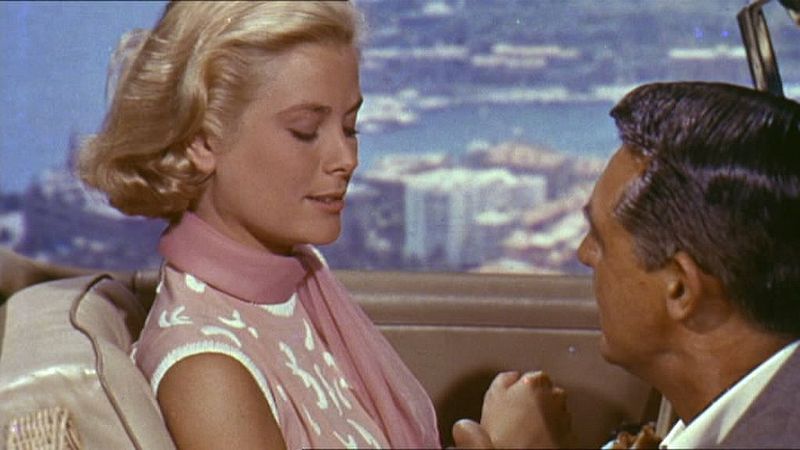
800px-To_Catch_a_Thief3Robert Wagner certainly knows It takes a thief, to catch a thief. The same goes for Cary Grant in this film which has him playing reformed cat burglar John Robie who is suspected for a series of thefts that have struck the French Riviera.

However, he knows he is not the culprit so he must clear his own name by catching the cat himself. The police want to nab him, his old French resistance buddies suspect him, and a beautiful young American woman (Grace Kelly) traveling with her mother is sure he is the cat. With a little help, mixed with some passionate romance, he is able bring some closure and get the girl.

That is all fine and dandy if you wanted a typical romance thriller. However, no one does it as well as Hitch. He somehow wonderfully balances the little bits of humor with his darker moments of suspense.  Jessie Royce Landis helps bring that comedy whether she is putting her cigarette out in some eggs or holding her book upside down as she commits a little white lie.

Hitchcock certainly had better films, but this one is so fun and it has the same glamorous Hollywood look as Hitchcock’s Man Who Knew Too Much (1956) with location shooting and vibrant colors.

Cary Grant and Grace Kelly make quite the pair, perfectly matched with the French Riviera in all its glory. I am convinced that Grace Kelly is and always will be one of my favorite actresses, period. Any era, any genre. Her name sums up her persona, because much like Audrey Hepburn, she has an extraordinary grace in how she carries herself. She can also be quite mischievous as well in her role as Francie. She is sure to set off fireworks.

4/5 Stars

To Catch a Thief (1955) – Alfred Hitchcock

1b4d6-to_catch_a_thiefStarring Cary Grant and Grace Kelly and directed by Alfred Hitchcock, this film follows the life of a former cat burglar who is accused of thievery in France. An outbreak of thefts seem to point to John Robie and he seeks refuge with some old friends. He plans to clear his name by catching the real thief. He learns that a vacationing mother and daughter have the most expensive jewels and he strikes up a relationship. The daughter realizes what he is and goes on to tempt him to steal her valuables. When they actually go missing she suspects him. Trying to figure out what is going on Robie struggles with a possible burglar who falls to his death and he attends a ball with Francie who has pronounced her love for him. After a clever switch Robie waits for the real perpetrator only to be surprised. As a thriller and romance this is a fun film. The cinematography is excellent and Kelly’s wardrobe done by Edith Head is memorable. Cary Grant and Grace Kelly are certainly a memorable screen couple.

4/5 Stars

Dial M for Murder (1954) – Alfred Hitchcock

Directed by Alfred Hitchcock and starring Ray Milland, Grace Kelly, and Robert Cummings, this film tells the story of a married woman who has fallen for another man. However, her suspicious husband finds out and decides to have her murdered. Through a series of events he finds his murderer and sets everything up for the following evening. His plan goes awry and his wife lives so he must rush to cover up all his involvement. In the ensuing days Kelly’s character is accused of murder even though she was simply defending herself. She finds herself facing death and yet the clever police detective figures everything out. He realizes her innocence and traps Milland in his own plan. With the typical Hitchcock style and solid acting, this movie is full of many suspenseful moments and it became an early example of film making for 3D.

4/5 Stars

Rear Window (1954) – Alfred Hitchcock

02805-rearwindowposterStarring James Stewart, Grace Kelly, and Raymond Burr with director Alfred Hitchcock, this is a superb film that takes place in a very limited space. L.B. Jefferies (Stewart) is a professional photographer who is incapacitated in his flat with a broken leg. All he has to pass the time is watching the people across the courtyard. Although he very rarely interacts with them, he slowly begins to know them just by spectating. Pretty soon he realizes something is amiss when the annoying wife across the way is no where to be seen and her husband (Burr) is acting strangely. With help of his ravishingly beautiful girlfriend (Kelly), Jeffries tries to uncover the truth. Everything escalates when Lisa breaks into the man’s apartment and it finally peaks in a climatic confrontation. In the end all is well and Jeffries realizes his true love. This is one of my favorite films because of its unique setting and it is possibly Hitchcock’s best. He takes an environment that is so confined and then makes a very entertaining and suspenseful film with it.

5/5 Stars

High Noon (1952)

14bd7-high_noon_posterThis may not be the greatest film of all time, but it is certainly one of the greatest westerns gifted to us so generously by Fred Zinnemann. It tells a very simple story, yet it is, in fact, so powerful simply, because of the hero it depicts. In its time it also served as a condemning allegory of the finger pointing going on in Hollywood.

*May Contain Spoilers

The film tells the story of Marshall Will Kane, who is willing to face his foes even when no one else will help him. Gary Cooper plays the newlywed lawman, who must flee town or face the killer coming on the noon train. He resolves to do just that, despite the pleas of his loving wife (Grace Kelly). The sheriff scrambles against the clock to get help. However, no one is brave enough to face the enemy with him. Even with the odds against him, he faces them in a showdown. Cooper is outgunned, but not outmatched — heroically prevailing.

This film is so powerful, because it is full of human emotions, and it feels so real since the events unfold almost in real time. The somber ballad, sung by Tex Ritter, also helps to create the mood right from the opening credits. In fact, I must admit that multiple times I have found myself humming or crooning the words, but then again I suppose it makes sense since the song is woven into the very fabric of the film.

The score by Dimitri Tiomkin utilizes the tune throughout to complement the images of the town. In that respect, “Do Not Forsake Me, Oh My Darlin'” is not just a song, but an important piece of this story. It is easy to forget the supporting players since Cooper often steals the show. Nevertheless, there’s Lloyd Bridges, Grace Kelly, Katy Jurado, Thomas Mitchell, Lon Chaney Jr.,  Harry Morgan, and even a young Lee  Van Cleef. Many have pasts with Kane that we cannot expect to fully know. All we can understand is the here and now that causes a person to weigh their options, and either follow or go against their conscience. Kane and then his bride both did what they thought was right even when others would not follow suit.

It struck me how simple the story is, and yet on the other side, it is a complex allegory that critiques humanity. Will Kane is a man, who helped make the town what it is, but when trouble comes and the odds are bad no one is willing to help him. Besides the obvious positives like a good story and a heroic protagonist, this film stands out because it feels so human. Here we are as an audience watching the events unfold almost minute for minute. Then we see the various town folk and their fear of getting involved, and to make matters worse a lot of them are Kane’s very good friends. It makes us question what we would have done in their position. Because some of them were obviously good people, who were scared to be involved. Of course, during this time McCarthyism was prevalent and it is suggested that this film alluded to that. However, whatever you think it is still unquestionable that High Noon is a powerful film, a love story, and at its simplest a classic western.

5/5 Stars