Jour de Fete (1949)

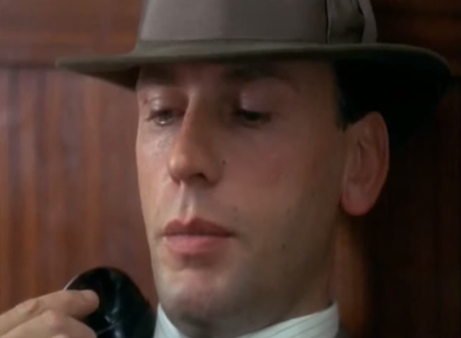
220px-Jour_de_fete-posterJacques Tati’s film seems like the perfect mode of expression in the post-war world. It’s boosted by lively, accordion-laden carnival music, with wry commentary from the old lady, and a bicycling postman, the mustachioed Francois (Tati himself). Use of sound becomes so integral to the comedy and the comedy is so important to the story because there isn’t much of a story. It’s populated by every type of livestock imaginable and you’re not quick to forget it because they’re constantly being heard and causing havoc, whether it’s a billy goat or a brood of chickens.  It’s a little different feel, but Tati makes me think of Britain’s own quaint Postman Pat. He’s a little more humble than the U.S. Postal Service and his customers are a simpler sort of folk. Although he becomes obsessed with the American-style of mail delivery complete with helicopters and motorbikes. This leads to a frantic race to deliver the mail with the speed of Americans. But the French countryside was not meant to function like urban America. This is Tati’s critique of not simply American culture, but more so it’s reliance on technology. But he takes off any of the edge by delivering it through his charming, bumbling brand of humor.

Amid this meager plot, Francois finds time to help put up a flagpole and enjoy the local carnival that enters the small town. Not to mention being accosted by a very industrious fly. Fittingly, Tati seems to pull off the Buster Keaton sliding stop, giving the illusion of being out of control, when in reality he was a wonderful physical comedian. Much lengthier than his predecessor, but still memorable in his own right. His bike riding antics feel reminiscent of Keaton in Sherlock Jr.

Jour de Fete is not quite as enchanting as Tati’s later works, but part of that might be due to the absence of the Mr. Hulot persona. It’s his saga that we want to be a part of, and he’s the man we want to get to know. Right now the director is still exploring the world that would become more pronounced in his later films. However, Francois does not have quite the aura that Hulot could build. Truth be told, I was slightly thrown off by the colorization. I probably would have appreciated the straight black and white of M. Hulot’s Holiday or the vibrant color of Mon Oncle. But that is not to say that Jour de Fete is not at least a mildly fun romp.

3.5/5 Stars

Man With a Movie Camera (1929)

Man_with_a_movie_cameraWatching a film like Man with a Movie Camera makes me disappointed that there are not more films like it, because what it does, along with the most historically significant films of our times, is transport us to a different time and place we can never fully know or comprehend. Dziga Vertov does that with Soviet Russia circa the 1920s, and it’s pretty amazing. It doesn’t have some grandiose agenda but acknowledges flat out that it is simply an experiment. What it does so well is stripping film down to its most basic components. Consecutive moving images. The images that end up within and outside the frame.

There’s an inherent difficulty placing Man with a Movie Camera up against other films because it functions so differently. It has such vast importance on an experimental and inventiveness spectrum. It’s not a narrative that will grab hold of your interest and it’s not even made in the typical documentary form that we are used to. However, if you quiet yourself for a few moments, it really does have a fascinating quality. If we just sit back and watch, we can marvel at the little things as if we were just sitting on a bench and perhaps watching the world going by.

We see the streets of Russia in cities like Kiev and Moscow. The birds, the people, and even the movie theaters, all comprising day to day life. It actually feels rather like the German silent People on Sunday (1930), and it is crazy to think how mundane this communist society feels. Then, there are other moments that are quite invigorating or at least they get the blood pumping. Cars, trains, machinery, water, in constant fluid motion and it’s a spectacularly relentless rush.  Vertov even does some photography of athletes and sports which feels very much like a precursor to Leni Riefenstahl’s work in Olympia (1938).

There are other times where Vertov is literally playing with the medium. Playing with the film images, still images, and seemingly anything else he can think of. But he warned us beforehand so it’s quite alright. There’s double exposure, aerial shots, split screen, slow-motion, stop-motion, and probably so many other techniques and tricks that we easily take for granted.

Also, we hardly think about the pace of these images, because they feel so normal. But that in itself should cause us to stop and back up for a moment. Man With the Movie Camera has an average shot length that was unheard of at the time. Instead of over 10 seconds, it was going about 2 seconds. That’s about what you get with your average blockbuster now, but when Vertov did it, people thought it was abrasive for its sheer speed. It was different than anything they had ever been subjected to before and yet it would appear that over 80 years later we are most certainly indebted to this cinematic experiment. It’s one for the ages because even if you’re not fully captivated, it’s hard to downplay how influential this work was. It revolutionized and totally rearranged how people perceived film.

4.5/5 Stars

The Conformist (1970)

conformist3 I had never seen anything from Bernardo Bertolucci, but a few of his other films that came to mind were Last Tango in Paris and 1900. I was expecting some mix of The Godfather and Le Samourai set in Italy during the 1930s. In all honesty, those were the meager reference point I was going into this film with. In some respects, it felt like my first time with The Leopard or The Battle of Algiers, because I thoroughly enjoyed the films, but the history and backstory really eluded me. Not knowing the ins and outs, what was fictitious or what was reality, I was forced to strip it down. So even if I could not track with everything, I could appreciate it as a piece of cinema trying to paint a picture of a certain time and place.

That’s what Bernardo Bertolucci and his cinematographer Vittorio Storaro do so well, and it turns The Conformist into a visual delight. It can stand on that merit alone, depicting gray facades that are only an outer shell for beautifully stylish interiors, flooded with light and infused with colors and textures. The drawing rooms are luxurious and Paris and Rome become the perfect backdrop for a world that vacillates between the bleak and the decadent. It’s the clean modernization of this fascist society intermingled with the ways of old. Storaro on his part, even makes leaves compelling and a man walking down the street becomes fascinating with dutch angles and contorted perspectives. That’s just the visual side of this film.

conformist1The Conformist, at its core, is a character study of one man, Marcello Clerici (Jean-Louis Trintignant), who is trying to find normalcy in a 1930s Italian world that is dictated by fascism. He’s a member of the secret police, who is assigned to knock off a political dissident seeking asylum in France. The target turns out to be one of his former professors so that in itself begins a personal conflict. There is a constant clashing of the state and duty with family and kinship. But within this main objective which drives the entire story and eventually takes Marcello from Rome to Paris, there is also a lot of personal baggage to be parsed through.

Although Marcello is pursuing the professor with his comrade Manganiello, a barrage of flashbacks cast some light on the rest of his life. It develops the framework for this man, what he does, and why he does it. His mother lives in their crumbling family mansion contenting herself with the companionship of her Japanese chauffeur “Tree.” Marcello’s father is locked away in an asylum. That is his family of origin and even going back to his childhood, he was traumatized and sexually abused. Now, in the present, he tries to conduct a normal lifestyle with his fiancee Giulia (Stefania Sandrelli), but when he goes to confession on her prompting, we realize how hardened he has become. His family does not seem all that important to him and religion is little more than a social structure.

conformist5And when he finally travels to Paris with Giulia, to meet with his old professor and complete his objective, that task gets complicated when he sees Anna (Dominique Sanda). Whether they know each other from before or not is ambiguous, but what’s not ambiguous are his advances towards her. It’s another weird, twisted dynamic because she knows that he is a fascist, and Marcello knows he will soon enough have to kill her husband. His wife and Quadri’s wife get along quite well. There is no animosity there, just like there seems to be no visible animosity between Marcello and his former teacher.

Murder should not enter this equation just as adultery doesn’t seem logical. Marcello even has his doubts, but again relationships, love, and family all take a back seat to the cause, just as he takes a back seat and lets everything run their course. But he cannot maintain his perfect veneer forever. There has to be a breaking point somewhere and so there is. With the fall of Mussolini, no one wants a conformist and Marcello is stuck in this gray area.

In The Godfather, since they are in America, at least they have some corrupted notion of family and religious faith. They accept capitalism although they work outside of it at times. But in The Conformist, although Marcello likes the idea of family, he really does not desire it. He falls for another woman in lieu of his wife, and yet that woman is of little concern to him when it comes to the agenda of the state. He looks for normalcy and maybe he gets it in a sense, but underneath it lies so much pain, dirt, and corruption. Just look at Marcello. He’s a repressed, misogynistic, faithless, fascist conformist. We expect him to be like Le Samourai, and he can’t even pull a trigger with confidence. He’s a pitiful, messed-up man who has been riddled with fascism. It didn’t kill him, but it might as well have.

4.5/5 Stars

Sunflower (1970)


sunflower

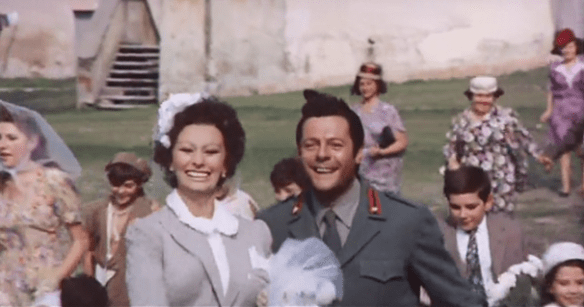
Vittorio De Sica is at the forefront of Europe’s most accessible filmmakers of the 20th century and that’s because the stories he crafts are heartfelt, moving, and also enter comical territory with ease. Sunflower pairs him once again with two of Italy’s Titans Sophia Loren and Marcello Mastroianni, and as you would expect the film starts off full of passion, playfulness, and a little pasta. It’s the dawn of WWII and the frisky pair is in love, deciding to get a quick marriage so they might get a 12 day leave before Antonio has to ship out.

In a sense, this is a kind of war film, because Anto gets sent off to the Russian Front and we get a glimpse of the harsh realities there. We are treated to some newsreel style war footage all the while veiled with a billowing red flag. Sunflower is not a film about the politics of the war per se, but rather the effect that war has on people and their relationships.  It can heighten passion, tear people apart, and change lives for good.

When the news comes home that the war is over, there is a flood of relief and then everyone including Giovanna (Sophia Loren) frantically begins the search for their kith and kin. Worried mothers and wives bring their long-cherished photos into train stations clinging to the hope that just one person passing by will be able to give them some fragment of hope. That’s what Giovanni gets and it’s not much, but a jaded soldier who suffered alongside Anto tells her the last time they were together, he was freezing to death in the snow. Her first reaction is to berate him, but he’s too tired to care by now. So she prepares for the journey to Russia to find the whereabouts of her long-lost love. She will not take no for an answer, but what she finds is more painful than even she could expect. It’s a different type of scar, a different type of hurt that no one could foresee.

sunflower1In some respects, Sunflower feels like a precursor to Life is Beautiful (1997), because both films are full of hopefulness, but they both exist as heart-wrenching stories. They deliver the same moving swells of emotion, but for different reasons. Sunflower ends up feeling a little like Umbrellas of Cherbourg in its tragedy. But the title seems to suggest, maybe, just maybe, like the old adage says, out of the ashes beauty can still rise. All the pain and suffering are only the fertilizer for flowers to spring up from the desolated earth. A memorial of what has happened, but also a harbinger for the future.

This is truly an international film because although it’s in Italian, it was partially shot in Russia (a first for the USSR) and features Russian performer Lyudmila Savelyeva in a prominent role. But the lovely score comes courtesy of America’s own Henry Mancini, rounding out this film perfectly. It’s another pleasant surprise from Vittorio De Sica.

4/5 Stars

The Blue Angel (1930)

blueangel1The Blue Angel is the name of a nightclub and it turns out to be a very fateful nightclub indeed. It just takes us a while to figure out why. Although Josef Von Sternberg’s film is known, rightly so, for making a star out of Marlene Dietrich — in the first of their 6 collaborations — this early German sound film is nevertheless about the decline and fall of Emil Janning’s character. Immanuel Rath begins as a professor at the local college, and although his pupils are unruly, he commands the utmost respect. He sees it as his prerogative, and he is quick to bring order and discipline to these young lads. But boys will be boys and they become corrupted by the beautiful cabaret singer Lola-Lola (Marlene Dietrich). One evening the professor drops into the seedy joint to look out for some of his troublemakers and talk with the proprietor. Of course, he unwittingly ends up meeting the gorgeous girl backstage and returns the following evening with a seemingly very flimsy excuse.

Ironically, his boys are not the only one who take a liking to her. The once restrained and reserved man of learning begins to change. He becomes a man obsessed and infatuated beyond the point of logic. But what does he care? He enjoys being in Lola’s company and the idea of a marriage proposal makes complete sense in the reverie that he is swimming in. So they do get married. The professor leaves all the common sense behind and goes on the road traveling with his wife and their promoter.

blueangel2But by this point, he is a sorry figure, so pitiful and bedraggled in every way. He reluctantly parades himself in front of audiences as a clown just to make some money for him and his wife. It is, of course, inevitable that he return back to his old stomping ground, and it does eventually happen. He reluctantly goes onstage and it is difficult to watch this final chapter. Lola is no longer his. He’s completely ruined. Completely destroyed. Oh how far the man has fallen, as he winds up keeled over on top of his former desk in the gymnasium.

I think I enjoyed Emil Janning’s in The Last Laugh more and yet to its credit The Blue Angel does not cop out in the end. It has a tragic trajectory that in some ways feels like a precursor to such noir as Scarlet Street and Nightmare Alley. It’s understandable how Dietrich became a star because stars have the capability of drawing your attention. Janning’s gives a wonderful performance certainly, but the allure of Dietrich is too much to discount. She steals the show just like she steals the Professor’s heart. We’re just “Falling in Love Again and we Can’t Help It.”

4/5 Stars

Metropolis (1927)

MetropolisposterFritz Lang’s archetypal sci-fi epic is steeped in politics, religion, and humanity, but above all, it is a true cinematic experience. It is visually arresting, and it still causes us to marvel with set-pieces that remain extraordinary. How did Fritz Lang piece together such a gargantuan accomplishment? Maybe even equally extraordinary, how was I able to see almost a complete cut of this film, which was at different times thought to be lost, incomplete, and ruined?

Metropolis really feels like one of the earliest blockbusters, although I would have to further substantiate that. Still, it’s basic story is generally captivating following a young man named Freder from the upper echelon of society with a father who runs things. This young man is really in the perfect position to succeed, the way society is set up. He even goes to the preeminent school where all the boys are dressed in white. Little does he know in the lower depths the beleaguered, grungy, weary masses in black are slowly killing themselves with work. The machine that drives this society is never satisfied, always desiring to be fed more and more and more.

When the boy finally sees the reality of the infrastructure his paradise is built upon, he cries out in horror. This is not the way things are supposed to be. He eventually switches places with one of these workers and attends a meeting deep in the catacombs (an allusion to the early Christians), where the pure goddess Maria lifts the spirits of her fellow man. But of course, the evil inventor Rotwang is enlisted by Freder’s father Joh Frederson. Their own relationship is marred by conflict over a woman they both loved. Freder’s dead mother. And so the scientist looks to resurrect his long lost love, and he needs Maria to develop his plan. He kidnaps her and from her likeness creates a double, who goes out to wreak havoc on all of Metropolis. The apocalyptic words of the Book of Revelation ring true as the whore of Babylon deceives the masses and leads them to destruction.

But Freder is the Mediator, he is the Savior of his people, and he is necessary to bring peace and tranquility to a world that has descended into such brokenness. So Metropolis is certainly a film full of symbolic touches, religious connotations, and political commentary, but all of this is developed by Fritz Lang through an archetypal hero’s narrative.

Hollywood has become an industry seemingly so obsessed with story, screenplays, plots. Certainly, a film like Metropolis is at least adequate in that area alone, but what really sets a film such as this apart is its cinematic scope. The sheer vast expanses it fills. The scope it creates through its plethora of extras and encompassing sets is hard to downplay. How to describe scenes where water is literally breaking down walls and covering masses of fleeing children? Or smokestacks spewing out refuse while trains, planes, and automobiles pass by in every direction. People scattering this way and that, following the false Maria in a chaotic frenzy. It reminds us what the motion picture, the moving picture, is all about. The images that are brought before us lead to a suspension of disbelief because more importantly they are incredibly affecting. At the atypical 20 frames per second, they are images full of tension, full of energy, and full of life.

Metropolis-new-tower-of-babelIn a sense, with Metropolis, we can easily see a precursor to Chaplin’s Modern Times a decade later. There is a general apprehension of the machine and the impact of a true industrial revolution. There is a fear that there are more positives than negatives. That machines will take over and man will become outdated. Perhaps someday our creation will destroy us. By today’s standards, such notions seem archaic, but are they? We still live in a society ever more obsessed with advancement, technology, and all the things that come with that. However outdated some of Metropolis might feel, and there are numerous such moments, at its core is the final resolution that between the body and the mind there must be a heart to regulate. We are not simply animals with bodies or rational machines with minds, but the beauty of humanity is that we have a heart, pulsing with life and vitality. That is something to be grateful for and never lose sight of.

5/5 Stars

Nosferatu (1922)

nosferatu1The hand of F.W. Murnau is less noticeable in this early classic of his, but Nosferatu still works seamlessly as a piece of drama and horror. In fact, it by now has become somewhat of a horror classic and the archetype when it comes to vampire movies, taking a lot of inspiration from Bram Stoker’s Dracula. I think one of the things that makes Nosferatu so gripping is the fact that it mixes the plausible with the supernatural making for this weirdly rewarding ride. Is it scary? No, not in the modern sense of the word.

But it’s a story steeped in Myth. There is mention of the Black Death, supernatural creatures, and a being that “suckles himself on the hellish elixir of their blood.” What wonderful imagery that develops a genuine awe in this devilish being. And yet in the same instance, we’re getting scientific explanations of venus fly traps and tentacled polyps acting as symbols certainly but also tying us back to the real world. These forces of nature are real, backed by science, and make a vampire just a little more conceivable.

Running through Nosferatu is a love story, and much like Sunrise, although Nosferatu is a “symphony of horror,” there is also a bit of a love song underlying the vampire tale. It lends this story some heart, because these characters, like our protagonist Hutter, actually have something to live for.

Nosferatu most certainly is a symphony, and along with the expressionistic images, it uses title cards as well as excerpts from ship logs, books, and letters to tell the story. One such inter-title card from Count Orlock reads: Your wife has a lovely neck. Hutter has little idea what he means (or pretends not to), but we know, making it a rather funny but unnerving comment. There’s something about knowing what is undoubtedly going to happen and being powerless to stop it. For instance, when someone acknowledges they have two mosquitoes bites quite close together that spells trouble to the audience, but we can only watch and wait.

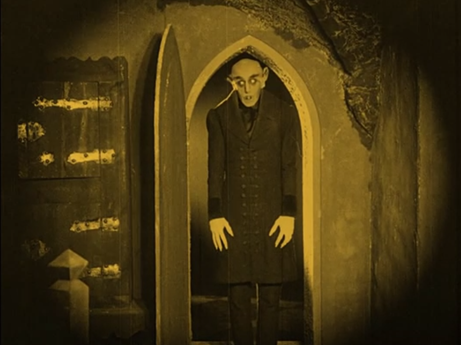
nosferatu2Because when Hutter first goes to offer Count Orlock a house we know it is bad news, to begin with, but it takes a long time for anything to actually happen. Orlock moves into the abandoned mansion across from Hutter and his wife, and that’s when the danger strikes close to home. There’s a madman in the hospital diverting attention, and Hutter winds up incapacitated so he is incapable of coming to the aid of his love. She is left vulnerable and the vampire has already proven what havoc he can wreak with the crew on a ship. Aside from Max Schreck’s frightening facade complete with pointy ears, bulging eyes, and menacing fingers, the vampire literally appears and disappears into thin air. There is a haunting aura built around him because he is something supernatural, something that we cannot understand except through myth. I found myself getting tense waiting for something that I was not sure about. That was the exciting part. It’s not a blood and guts, monsters jumping out of closets, kind of horror. It’s not ridden with cliches either because it was the one creating its own mystique.

It’s hard to believe how much popular culture has been derivative from Stoker’s Dracula, much like Doyle’s Sherlock Holmes, or Shelley’s Frankenstein. However, amidst all the vast works of Dracula and vampires, Nosferatu stands out. It represents the visual aesthetic of German Expression wonderfully, and it casts a long shadow. It’s hard not to, at the very least, admire its artistry and be taken aback by its legacy. In the realm of silent films, Nosferatu is a must, pure and simple. It doesn’t rely on bloodcurdling shrieks and screams, but the images begin to invade our consciousness. One seems fleeting and the other sticks with us.

4.5/5 Stars

Commissar (1967)

commissar1

Even with the so-called Khrushchev Thaw, it’s pretty amazing that Commissar even got made and perhaps even more astounding that it made it to the viewer all these years later. Some of that might be because it originated from Russian Civil War literature and anything else we can attribute to luck.

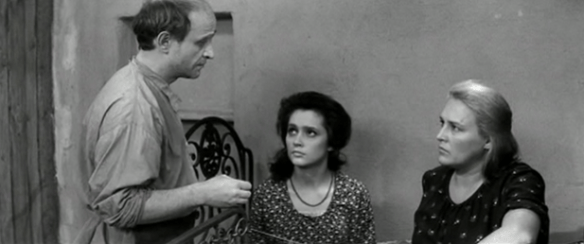
It is, as it titles suggests, about a commissar: an official of the Communist party, but this one seems special. First of all, she’s a woman which in itself is an interesting piece of commentary, but perhaps more so is the transformation she goes through.

From the outset, she is what we conjure up in our minds. Brutal, tough as nails, masculinized and mechanized by the collectivist agenda of the party. She’s the perfect comrade cog in the communist machine. Except then she receives the startling news that she is pregnant, and she must seek refuge in the home of a nearby Jewish clan. They are forced to quarter her, serving the greater good. She’s aloof to the whole idea and their diminutive patriarch puts up a fuss.

You see, he already has five children, a wife, and a mother to look after. He can’t afford to have this unwanted extra baggage, and she’s no friend of theirs. In this sense, the film feels reminiscent of Melville’s Silence de la mer. However, Commissar evolves into its own creature, just as all parties involved change over time. Yefim and his wife make their guest comfortable the best they know how and following the pregnancy they take good care of her.

Seeing her with a newborn is an altogether strange and foreign image, and with the cult of motherhood, the commissar’s whole demeanor shifts. She looks on at this family with contented eyes and stares back at her former life with some reluctance. It seems impossible to traverse the same paths she once did.

Perhaps most frightening are the images that are interwoven into the plot. They are disorienting, paranoia-filled, listless dreams that swoop in during pregnancy and restless hours of sleep. In the present, there are the children playing their militant games, terrorizing their sister, a sad reflection of the things going on outside of their own homes. There are constant contributions and pogroms always hanging over God’s people.

Whether it’s a hopeful fairy tales or a truth which you are willing to die for, the film paints a fairly bleak picture of what it means to live life. Our commissar is wholly disillusioned and the shadows of the Holocaust hang over the narrative because they lurk in the near future, not the past.

Director Aleksandr Askoldov’s favors a  fluid camera that nevertheless feels unrefined more times than not in its blunt and most certainly chaotic movements throughout the frame. It’s as if it’s not confident keeping still  — needing to prove its mobility in all circumstances. Still, the film boasts a lasting power that feels counter-cultural. This is not the film we expect coming out of the USSR circa 1967. These characters feel conflicted, their story feels sobering at best. It also offers up a strangely haunting dance sequence like no other, but then again this is far from an ordinary film. The director would soon be fired, expelled from the party, and exiled. The KGB would lock his film away and throw away the key for 20 years. He undoubtedly struck a cord — then and now.

3.5/5 Stars

Ordet (1955)

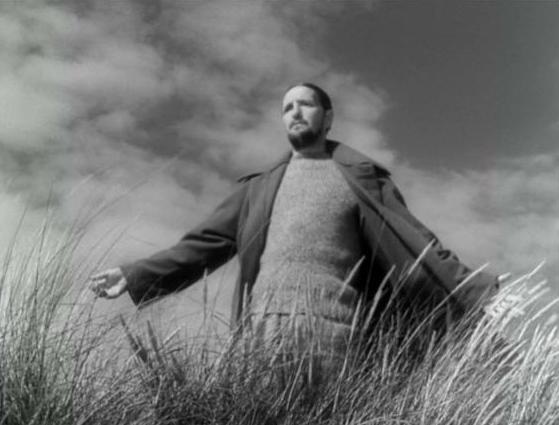
Ordet1955screenshotCarol Theodor Dreyer’s Ordet is a deeply thought-provoking, spiritual foray into the realms of faith and love. However, it is as much about doubt as it is faith, as much about discord as it is about love. It shows a spectrum that, while irrevocably Danish with its actors and setting (a bit reminiscent of Bergman), still has a universality that correlates to the contemporary world we live in. This later work by Dreyer is deliberate in pace, simple in its misce-en-scene, but the life is breathed into it by the characterizations and a beautifully subtle approach to depicting them.

The story is based off a play by Lutheran Pastor Kaj Munk, which was first performed in 1932. The majority of the tale takes place on a rural farm belonging to aged and bearded widower Morten Borgen. Aside from being a farmer, he is a prominent member of his community and a devout Christian. Now he contents himself smoking his pipe as he has three grown sons and a couple grandchildren.

His first son is happily married to a wonderful woman and mother of two, but he himself is struggling with belief in a God, and he acknowledges lacking faith in such things. His wife continues to encourage him, but he knows that such news will deeply trouble his father.

Johannes, the middle son, began believing he himself was the incarnation of Jesus Christ after deluging himself with the works of the famed Christian existentialist Soren Kierkegaard. So now he goes around spouting off scripture and calling out those around him for their lack of faith. What makes it so mesmerizing is the dazed sincerity behind each word. He truly believes what he is saying.

Finally Borgen’s third boy, Anders, is deeply taken with a girl named Anne from the nearby town, but of course her father Peter is from a different sect, and so everyone knows that neither father would willingly agree to a marriage.

These are the problems that plague the Borgen family, so they are undoubtedly commonplace in any spiritual community. Dreyer depicts it all in very mundane terms but not as unimportant, not without a deft hand and sensitive touch.

There is one scene in particular that comes to mind. The young girl Inger, a namesake for her mother, comes up behind her uncle Johannes and with all sincerity, in her eyes and voice, she begins to ask him to raise her mother from the dead. They talk about it for a time and while they talk pensively the camera slowly makes a spiral around them. Now if this was Tarantino (in Django for instance), he would need to bring attention to his camera and the scene loses all of its impact, because he’s a director who is often about as subdued as a toothache. But with Dreyer there is a sensitivity to his movement that’s gracefully smooth, accentuated by his long takes, with a simple backdrop, and pinpoint lighting.

Between the bickering over Ander’s betrothal and the sudden decline in the condition of the pregnant Inger,  there is a lot of soul searching to be done and problems to be parsed through. In a sense, it looks like any life full of conflict, pain, and unforeseeable suffering. It’s all there and it hurts the Borgen family and turns neighbor against neighbor. This film has so many different worldviews and philosophy colliding at once. There are those who are devout in their faith, but their faiths differ. There are those who doubt it all or want cold hard facts. Some have blind faith and others are off-putting with their message. Then there those who seem content in their spiritual lives even though they are not perfect people. So essentially we have almost every iteration or cross-section of society, at least to some degree. It makes for an interesting battleground, but within that, it’s interesting how these characters start to find common ground and build rapport instead of breeding bitterness.

Furthermore, the final moments of the film are so surprising in their sincerity as they are for what actually happens. It’s in a sense wholly unbelievable, but we don’t disbelieve it — in fact, we want it — because we have followed this film thus far. What happened felt so close to home and so the ending, although somewhat unusual, feels right. It’s a strikingly beautiful conclusion to a film that speaks to our doubts, questions about faith, and ultimately our capacity to love and be loved.

This is the sort of film that would probably never see the light of day in Hollywood. It’s either you make God’s Not Dead or something that has no spirituality in it whatsoever. Ordet goes far beyond the depth of such films and it is better for it. I will not say I agree with everything that each character says, but that’s the point, because they all come from different perspectives. The best we can do is come and try to understand what others think so we can move forward from there. But spiritual conversations matter.

4.5/5 Stars

Viridiana (1961)

220px-Viridiana_coverLuis Bunuel like another cinematic auteur, Ingmar Bergman, seems to often fill his films with religious imagery and themes, but whereas Bergman appears to have genuine questions about his own spirituality, Bunuel is all but content to subvert all such depictions for his own purposes. He has a wicked sense of humor with the opening crescendos of Handel’s “Messiah” playing over the credits only to come back later when his film is at its most tumultuous.

The story opens, of all places, in a convent with a pretty young novice (Silvia Pinal) preparing to take her vows. But she is ordered by her superior to visit her long-estranged uncle. She is reluctant but goes anyways to his mansion in the country as a courtesy.

There she meets the lonely old man (Fernando Rey), isolated in his great home with only a few servants surrounding him. In young, vibrant Viridiana he finds joy and dare we say, love because in her face he sees the likeness of his now long deceased wife. She embodies the objects of all his passions and desires that he forgot so long ago when he was widowed. However, Viridiana is aloof and will show no affection towards him, ready to stay only as long as she has to. But he wants her to stay, needs her to be by his side forever, obsessing about her, and using all means necessary to keep her in his midst. It’s disconcerting how far he takes things, even lying to his niece that he took advantage of her in her slumber. Now if she leaves the house, she can never be the same woman she entered as, even if what Don Jaime is false. In the end, she does pack her bags in a tizzy and her hopeless uncle takes his life.

Now the life of a nun seems impossible, her life all of a sudden becoming tainted by these events. So she resigns to do the next best thing by taking her Uncle’s home and opening up its doors to the less fortunate — the beggars and the sickly. It’s a nice sentiment, but it doesn’t turn out especially well. She also becomes connected once more with her Uncle’s illegitimate son (Francisco Rabal), who has a more cynical view of the world. He sees her piety with an air of contempt.

In the chaotic interludes that follow, the house is torn to shreds by all the benefactors of Virdiana’s charity. While she is away, they make for themselves a rich feast, “A Last Supper,” pulling out all the stops like table clothes, fine china, and wine. What ensues is utter debauchery that Bunuel plays for laughs all the while Handel reverberates over the din.When Viridiana returns and sees the degeneracy around her she slowly dissolves into a shell of who she used to be. She’s been broken and much to her cousin’s delight, she’s lost her ardor, now jaded by all that is around her.

It’s a depressing conclusion suggesting that charity is all in vain because there is a degree depravity that courses through all people. In some sense, I find a Bunuel film more uncomfortable and disconcerting than most any, because he displays the most surreal, idiosyncratic, and even perverse things as comical. He lacks reverence and reveals the darker side of humanity all with a smile on his face. His style of filmmaking is abrasive because it rubs up against social mores and has fun with the baseness of mankind. If we note that before going forward, it still seems possible to learn from him and be a tad mystified by his work.

4/5 Stars