La Visita (1963): Commedia all’italiana and The Human Heart

the visitor 1.png

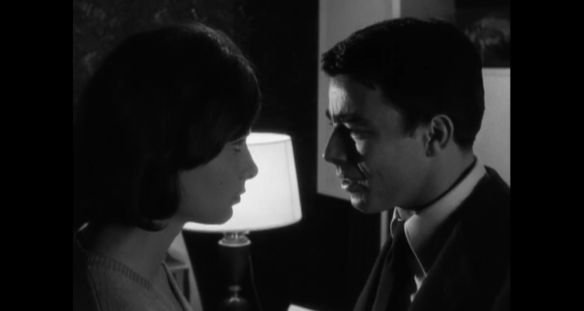
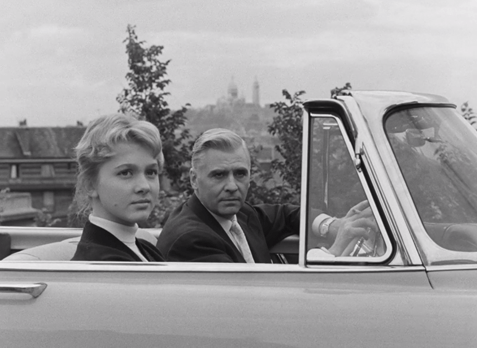
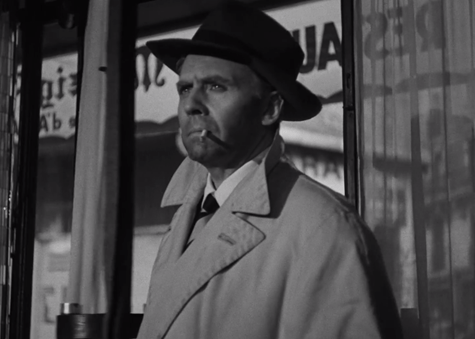
The premise of The Visitor is born in a rapid succession of images and shots. It’s a meet-cute correspondence so-to-speak as an attractive young woman venturing into her 30s looks to find an eligible man to invite into her home on some kind of ill-defined get-to-know-you basis.

It would not be possible without an advert in a newspaper fishing for a husband who meets certain basic qualifications. It’s not quite a blind date, but it might as well be. It somehow feels akin to the hook-up, internet, online dating culture we are awash in during the 21st century. At least, this is the 1960s alternative.

But lest one gets the wrong impression, it also feels a bit like 84 Charing Cross Road, except there is no pretense of books. They’re two lonely people looking to get together with someone for the sake of companionship. If they’ve read the Good Book, they know it’s not good for man (or woman) to be alone.

The pretty single woman, Pina, waits for the train from Rome bringing her mystery man. Sandra Milo though still her beautiful self all but transforms into a different woman than most are normally accustomed from her in anything from the director’s earlier Adua or Fellini’s 8 1/2.

If you’ve seen anything from Divorce Italian Style to Two Women, you might not be totally surprised (or scandalized) by the misogyny, but somehow it never feels right because it reflects the lustful intent in the collective hearts of men. It’s not the actions that are most troubling; it is what they suggest about society-at-large. When the colloquial name for someone is “Miss Booty,” you realize the seat of the issue.

Because as Pina brings this bookish-looking fellow named Adolfo (Francois Perier) back to her humble abode, the cringe-worthy gaze of the camera — his gaze — continues to dictate the picture. What we have before us is obviously in the mode of so-called “Commedia all’italianaor “comedy the Italian way.”

It’s the Italian spin on the sex comedy, which in Hollywood would look a bit more like Pillow Talk or at the very least Buona Sera Mrs. Campbell. And yet unlike Hollywood, there seems to be little narrative drive. The picture is contented to amble along, which can be both its greatest blessing and a defining curse.

At its best, it casts a sardonic eye at the fragilities and flaws running deep within Italian culture and certainly all its romantic dalliances. But there is a fine line between reveling in the passionate desires and simultaneously trivializing this pervasive trend in society.  There’s an effort to try and smooth it over with humor.

The quirks are present in full force. A parrot sounding unmistakably like Donald Duck and a turtle named Consuelo. Local weirdos abound including an oafish peasant ready to throw jealous temper tantrums and get any sort of rise out of the visiting Roman that he can.

Throughout their courtship, recollections coming stream back whether it’s work — the purportedly well-off bookkeeper is actually hated by his boss. They’ve also maintained relationships in a laundromat and with an itinerant truck driver, respectively, never quite finding time to talk about their former lovers. Perhaps it just slips their minds…

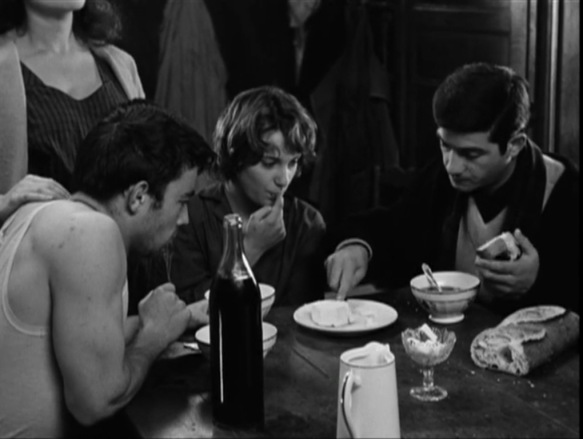
Dinner provides another telling arena. As the man gets more comfortable with himself, we begin to see a bit more of who he is, especially piggish, gobbling away at her dinner and relishing in all the gluttony before him to satiate his appetite. Likewise, there’s the youthful siren (Angela Minervini) tugging at him, reminiscent of Marcello’s desires for Stefania Sandrelli in Divorce Italian Style.

the visitor 3.png

Except there’s no lacquered pretense of suavity or manners —  not really. The pudgy face, bespectacled lout is precisely that and his interactions with the flaunting girl prove painful to watch. This relationship with Chiaretta comes to a head at a gathering outdoors where all the teens and adults mingle over dance. The wheels fall off the cart. Pina is hurt and feels betrayed by her now uninhibited man. It doesn’t come out immediately. Still, it’s there.

Eventually, she lashes out at him, for his arrogance, his treatment of animals, and of people, including herself. She has a point, and don’t get me wrong; he’s completely deserving of her wrath. But if he gets berated, I might be deserving of a few choice words along with most everyone else. He woefully admits that this is what happens to one living alone. We cannot condone his behavior. It’s a sorry excuse and yet…the harrowing thing is how mundane he is in his substandard treatment of others.

Can we conveniently write them off as lonely, insignificant people trying to get by in the world? I’m not sure. Will we enter the insidious gray area of writing off his behavior or condoning it? It’s possible. I didn’t enjoy being subjected to the utter pitifulness of it all and I’m not sure if I’m ready to admit seeing some of their qualities reflected right back at me. We are not immune to the loneliness they feel. We see all their defects.  Can we acknowledge our own?

This final question remains: Will they find their happiness or live a life weighed down by this sense of miserable drudgery? Redemption begins with not simply a change of actions but a change in heart. It always strikes me Italian-style comedy rarely seems possible without some manifestation of human tragedy. There’s no more human way to grapple with our own boorishness, our own misapprehensions, and our own inadequacies.

3/5 Stars
Adua and Her Friends (1960): Starring Simone Signoret

adua and her friends 3.png

It’s movies like Adua and Her Friends from director Antonio Pietrangeli that remind me of the elemental joys of watching movies you’ve never heard of before. It’s a humbling experience to acknowledge how much of cinema there still is to explore and how names like his sometimes arbitrarily get past over.

Because the only reason I ever made my way to the picture was on the merits of the cast alone and taking stock of the names, it is quite the epic ensemble. Simone Signoret anchors with her typically self-assured beauty. Sandra Milo is frisky and if not for her brunette locks, certainly a dumb blonde archetype. Then, Emanuelle Riva, stretching her own range, is angsty and cross with the world that women such as they are subjected to. The three actors are a trio of standouts along with one very special guest to be mentioned later.

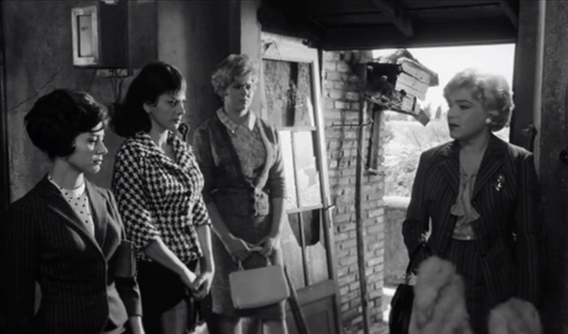
Our opening image is a telling one with peppy jazz playing against the brick buildings and cobblestone streets. These exterior shots give us some sense of the adjacent world: the caverns of a local brothel. We learn they have been shut down by the Merlin Law (1958) and must find some new way to subsist.

With no real prospects, four of the women set out to make their own future. They buy up a run-down property partially secluded from town, to turn it into a restaurant, strictly on the level. This is no Risky Business. I could see them remaking this film generations later only for it to lose all of its flavor and charm in translation.

Because they hit every single roadblock imaginable along the way. The nightmares of going into business with starkly different personalities chafing against one another. Managing to get off the ground with the exorbitant amount of startup costs thanks to a deal with the devil. Having your soft open for a handful of customers only to run out of ingredients and any amount of things to feed them. You name it and they have the issue.

But the impediments don’t feel obvious nor the humor madcap and over the top. It finds a happy medium in a perceptive often nuanced equilibrium fluctuating between hardship and laughter. The jazz and sunny countryside neutralize any hint of a dramatic outbreak and though the picture is a tad long, it does allow a certain width and breath to cycle through all sorts of scenes.

Thus, the buildup of the restaurant from a fledgling even flimsy enterprise into a bustling, highly lucrative undertaking, is all the more believable. We see it happening and get to relish the process. This is the movie at its most delightful. It’s not as purely comedic, but even for the briefest of moments, you cannot help but recall Playtime’s own bungled restaurant opening. The difference for these women is their very livelihoods are more obviously at stake.

It plays best as scenarios and momentary interactions. The Father from the local convent drops in, trading conversation and well wishes for the secondhand scraps to serve as slop for his pig. The first customers start trickling in, enticed by the “restaurant” sign over the arch, which leads to an all but empty pavilion lined with tables.

adua and her friends 4.png

Each woman has a man in their life, whether physically present or generally absent. Milly hooks the nicest beau of the bunch, smitten with both her and her cooking. Marilina courts the most demons and tries to steady her tumultuous personal life by bringing her young son to live with them. His upbringing causes some squabbles, which ultimately culminate in his baptism.

It’s a poignant moment reflecting the women entering a realm of religious piety. It’s not so much that they have been radically changed, but the way they are perceived and how they make their living gives them a new lease on life. The goodness and inherent decency in them are given a chance to shine through. One is quickly reminded they are not defined by the men who drift in and out around them. The cornerstone of the entire film is their female camaraderie — the affection they hold onto — even when they bicker amongst themselves.

All the villains in the picture are of the opposite sex, and it makes sense given the cultural framework and their past profession. They’ve been relegated to a specific caste of society and in their efforts to break free, they meet the hegemonic forces that be. The most blatantly obvious antagonist is the peremptory Doctor Ercoli (Claudio Gora), who bankrolls them and requests 1 million lire a month for his recompense. When he actually inspects their premises, it reflects just how pitiless he is and how powerless they remain. It still feels like they are owned.

The rest of the louts are more like abject scoundrels and losers. Lolita’s purported beau has all but run off with their money and when he does show his ugly face again, he has the gall to try and pump her for more, spinning tall tales of going on the road again where he’s a big name.

adua and her friends 1.png

Their love is not lasting nor their promises secure. Of course, Marcello is charismatic as a car salesman; he always seems to be in all his pictures. There is something pathetically despondent about him at times, but it only serves to mask his swings in infidelity.

Signoret’s moment of ultimate realization is a bitter turning point. She recognizes who he really is and leaves him to his own devices. In the moment, she’s deeply hurt and yet she has an unassailable resiliency to take every beating with poise. Not that she’s unemotional, but she will not be totally trampled by the world around her even as she is wounded.

They reach their lowest point, completely destitute and scandalized, despite everything they did striving to make an honest living for themselves. Instead, they get their pictures plastered all across the pages of the red hot Il Tempo.

Their final act of rebelling is a cathartic one as they go out on their own terms. However, there’s more. Even at its most abysmally low, Signoret soaked head to toe in the rain, jeered by the ladies on the streets, she still maintains her composure.

She’s fallen far but like another French icon, Jeanne Moreau, she captures the screen and even if she’s been toppled, there’s no way to totally crush her. If nothing else, she commands our undivided attention and makes Adua and her Friends worthy of its title. They are a force to be reckoned with no matter what the tabloids might read.

4/5 Stars

Les Cousins (1959): Chabrol Takes on Paris

Screenshot 2019-12-16 at 90447 PM.png

“A girl and an exam aren’t the end of the world.”

Most anyone can probably tell you Les Cousins is a fine companion piece to follow-up Le Beau Serge, and it’s true. It features much the same cast — specifically Jean-Claude Brialy and Gerard Blane, in a kind of role reversal. However, instead of pervasive talk about Brialy’s health, this picture is occupied with their familial connection. Otherwise, the action has been transported from the rural to the jazzy street corners of Paris.

Regardless, it doesn’t play like your typical or atypical Nouvelle Vague film, but that’s not to say it’s conventional. Instead, there’s a crispness to it and a composure to the filmmaking.  Truffaut arguably didn’t get there until The Soft Skin, and I don’t know if Godard ever aspired to that. What connects them truly is Cahiers du Cinema and the shared affinity for a new form to upend the preferred traditions of their contemporary French cinema.

Paul is a flamboyant prodigal who, with his goatee, might have been a beatnik if France was lucky to have the craze. They certainly have soiree and cafe culture, and he might as be their elder statesman because he’s not one to fritter his time away on anything so insignificant as studying.

The other primary player, Charles, is a square milquetoast with commendable tact, both proper and reticent, eyes often flooded with shy embarrassment. Whereas Brialy gets to fill up every scene and fly all over the place with hyperbole and a clever line to enter and exit every conversation he throws himself into, Blain easily acquiesces to the story. Somehow the dynamic seems to favor Le Beau Serge and yet there is some mode of fascination to see the roles reversed in a new environment.

Because it’s true Paul’s flat is quite the bachelor pad, laden with a cluttering of artwork and frequented by the gregarious creep Clovis, a sly reprobate who likes a good party, a pretty face, and stirring up trouble. We get a mild suggestion of what might be afoot when a girl from last winter is mentioned to be on the way up. It’s very serious — very cryptic — but when Paul slips her the wad of money, and she slips out again rarely to be seen, it says more than enough.

But it’s quickly lost among the new stimuli and if we are to share the place of Charles, naivete clouds his perceptions. Taking to the streets in the real world as it were, Les Cousins momentarily taps into the New Wave’s invigorating on-location energy. Certainly, the jump cuts of Breathless happened on the streets of Paris, and here we have two fellows taking to the streets and sightseeing with a flurry of abandon.

Next on the agenda, Paul takes his cousin to the local hangout, what is jokingly referred to as “the bowels of hell.” Whatever it is, the tavern is a lively place frequented by people who all seem to know Paul on a friendly basis. The one who sticks out to Charles is Florence; he grows impetuous, immediately taken with the girl.

Between classes, he wanders into a bookstore where the proprietor bemoans the modern generation’s reading habits. They’ve given up Balzac and Dostoevsky for detective fiction and racier fare. Reading is relaxation and nothing more. He effectively acts as a barometer for Paul and his ilk.

That same evening, they hold quite the gathering effectively, playing as the complete antithesis to the humble dance thrown together in Le Beau Serge. This is livelier, full of bubbles, and glamour. Eventually, it devolves into a raucous affair driven by alcohol and the frisky amorousness in the air — a superficial portrait of the debauchery of the idle bourgeoisie. Fellini’s La Dolce Vita is not too far off albeit with an influx of Parisian youthfulness.

The scenes of two lovers on the street are a gorgeous fixture within the picture, looking sleek and stylish in the patchwork of shadows and moonbeams. Again, it’s an obvious compliment, although it seems to set it apart from some of its Nouvelle Vague brethren.

Screenshot 2019-12-16 at 84938 PM

It’s the beginning of something we can’t quite judge right off. She’s somehow taken with the idea of trying to love him; this at least is genuine enough. Whether it’s his utter devotion — the lovestruck sincerity of his words — or some idealized vision of her own mind, we can’t be sure.

Her friends think it’s a lark and a laugh attempting to serve her with their idea of a reality check. After all, she’s a girl who’s slept around. Why try and play at something inauthentic to who she already is? She and Charles are not from the same walk of life nor the same standards — moral or otherwise. It’s the same old story and as an impressionable girl of 20, she seems to believe them easily enough.

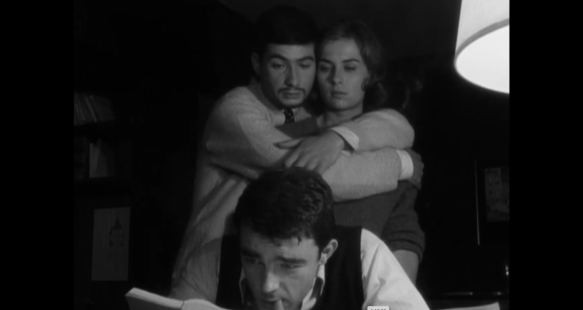
Soon the two young men are warring for the affections of the same girl. Their arrangement is verging on a menage a trois, though they remain admittedly good-natured on the surface. One suspects heartbreak lies dormant. In the follow-up gathering, there’s something more tenuous in the air as Wagner’s “Valkyrie” begins to pick up.

Paul sombers up in a curious change in mood as the movie somehow switches gears. Even as the merriment commences outside, Charles castigates Florence for getting in the way of his studies. He spends the entire evening in the adjoining room feverishly attempting to work in preparation for his impending exam.  Based on my own proclivities, it’s easy to empathize with him and in this roundabout way, it has a pulse on much of the college experience.

However, the most curious of the melodramatic crescendos ramps up out of nothing. This darkly cynical undercurrent begins to exert itself rather insidiously, but it enters in too late to really gel with everything Chabrol has crafted thus far. It feels like an incongruity in its final act — the progression is illogical and at the same time too cleanly resolved. Florence all but dissolves from the story like a phantom as Paul listens to the empty chambers of his gun click, utterly dumbfounded. I’ve let something slip here, but I will leave you to consider the results.

Les Cousins plays as a weaker, less whizz-bang rendition of Jules et Jim, nor can it quite justify its ending. But at this earlier juncture, it feels as if Chabrol already has a better grasp of traditional filmmaking compared to his compatriots, while injecting the picture with mood and artistic flourishes that feel far from conventional. He’s tapping into some still-to-be-exploited reservoirs and even if it doesn’t quite land the finish, Les Cousins offers up something with prolonged interludes of intrigue. This would be a springboard for a prolific career ahead.

4/5 Stars

Le Beau Serge (1959): The New Wave Goes Provincial

Screenshot 2019-12-12 at 81146 PM.png

Claude Chabrol was looking to shoot his first film in Paris but for budgetary reasons, he decided to set his first picture in the village of Sardent where his mother grew up. Le Beau Serge could not occur in any other place.

True, the opening shots are universal. Francois (Jean-Claude Brialy) riding the bus into town, there to be met by his relations, or actually someone who turns out to be a childhood friend, the amicable baker Michel (Michel Creuze). He’s seems made for a sleepy, humble town such as this — content with the life he has around him.

That this might be the beginning of the New Wave in the rural countryside is a curious conclusion. Because it’s true Chabrol was one of the boys at Cahiers du Cinema, soon followed up the more well-remembered works of Truffaut and Godard.

However, it’s also a timeless tale you might see out of any year if you were to pick it out of a hat. Because coming from a small town or returning to a place you haven’t seen in some time are touchstones many of us resonate with. I’ve never dug very much into Claude Chabrol’s filmography aside from a couple stray diversions like Les Biches, but it’s some comfort starting at the beginning.

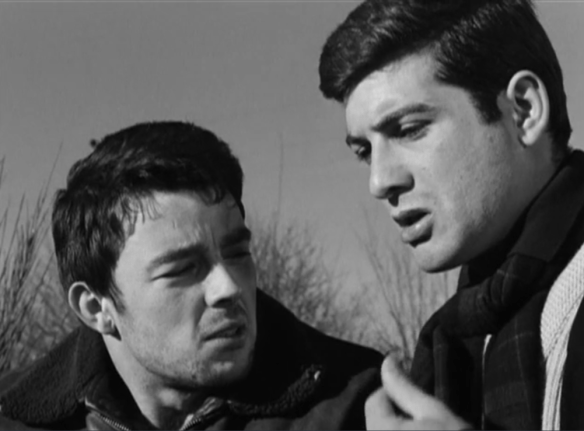
The title gives us some minor inclination. Even as Francois and then Michel are introduced initially, we know Serge (Gerard Blain) is a person of great interest, and it’s true he represents something elemental to the story. He is plagued by demons Michel will never know. When we first get a glimpse of him, he’s quite royally soused, and it catches Francois off guard. He knows him from a different time and is worried about his boyhood chum.

What becomes evident are the themes of duality due to the character foils Chabrol posits. The one point of criticism is how the picture gets carried away with the mood music as if in his youth the director’s not brave enough to be still; he still needs some pulse going through the story. Although perhaps we must temper this because although cinematically you can witness some of the same verve of Truffaut — the type of energy that would come to define the Nouvelle Vague — this movie is generally quite reserved.

Still, it does have these latent vigours of youth on its side ready to be tapped into. There are brief moments where Blain gives off the angst and bellicose of James Dean even as Brialy plays his prim and proper counterpart, Francois, who has returned to his childhood town to reclaim his health. He’s sickly and the country air is meant to do him good. In fact, it seems like every 10 or 20 minutes someone is inquiring yet again about his well-being.

But he’s also the last person Serge wants to see in his ignominy. He’s married out of guilt, a drunk, and an utter nobody. Instead of Jim Stark’s desks, he takes a slug at granite walls, driven by this same reckless, at times feeble, animal magnetism.

Screenshot 2019-12-14 at 93527 PM

It’s curious to note Chabrol takes on religion more in the bent of Eric Rohmer even as Francois makes a visitation of the local priest (Claude Cerval) and begins an ongoing dialogue on the state of the local community.

They are themes replayed in the likes of Winter Light and Calvary where the man of the cloth bemoans the fact the adolescent generation, who are still around, no longer believe in anything — even themselves, as Francois interjects. It’s yet another lens to put on not only Serge but possibly Francois and then Marie (Bernadette Lafont).

She’s the town’s harlot, slinking around with a new boyfriend on any given Sunday and reconnecting with Francois on his return. But she too is humanized by the peripheral presence of her alcoholic old man Gomaoud.

Meanwhile, Serge totters through the cemetery spouting off garbled exposition except, this isn’t what immediately stands out; there’s something engaging about the whole scenario. Chabrol does well throughout the entire film to utilize the real, honest contours of the entire town in a seamless manner, and it’s in a moment like this where it really comes to bear. The same cemetery plays into a confrontation between Francois and Glomoud when he accosts the old man for his behavior.

The personal comes to a head at the local dance hall — the most humble of spaces plucked out of a simpler age. Francois and Serge end up fighting over a girl at a party with Serge expressing the violence we always knew him capable of. It almost feels like he has left his friend for dead, whether or not that’s entirely the case.

This might have been the end, with Francois leaving on the same bus dejected, going back to the city, never to see his pal again. Yet he refuses to leave for some inexplicable reason. Soon their world is ensconced in a layer of snow, making for a gorgeous final act. It’s nature’s way of suggesting — and Chabrol’s too — maybe our sins can be wiped away or at the very least forgotten.

Francois is paid a visit by the local priest entreating him to leave for the sake of his health. But he’s resolved to stay — to be an example — and hopefully help his old friend find his way somehow. It’s the idealism shining through again, believing he can help, that he can be an answer and a savior in some sense.

Once more we must attribute these feelings to the bull-headedness and the pride of youth. It can be both a blessing and a curse. It’s what makes Serge resent his friend, and it’s why his friend thinks Serge still needs him. His act of charitability involves extending a hand of support to Serge’s stoic and increasingly pregnant wife Yvonne (Michele Mertiz). Francois can’t be Serge’s ultimate savior and maybe a newborn child cannot right his life, but in a human sense, it’s still a sign of hope just like new-fallen snow.

By the time Le Beau Serge is over, it’s elementary enough to realize why it’s been overshadowed by the freneticism of Breathless or even the exuberance of 400 Blows and Jules et Jim. In its own way, it’s a fine entry onto the cinematic stage for Chabrol. While it offers youth, it also supplies a deep, even surprising, thoughtfulness.

4/5 Stars

The Tale of Princess Kaguya (2013): Takahata’s Swan Song

The_Tale_of_the_Princess_Kaguya_(poster).jpgDuring the period of time I lived in Japan, I became acquainted with the works of Isao Takahata, and by that I mean I watched both Grave of The Fireflies (1988) and Only Yesterday (1991). This was all that was required because these two films on their own left a profound impact on me.

While Hayao Miyazaki is, rightfully so, the benevolent poster boy of Ghibli Studios, you might say Takahata was, in his own way, a visionary and the hidden engine behind the company. He was rarely as prolific as his counterpart, but the films he left behind are thoughtful masterpieces — even more pensive in nature — while arguably boasting headier themes. In fact, you might say the partnership between the two directors exerted an influence on Miyakazi’s films specifically.

While living in Tokyo, the news Miyazaki would come out retirement had the world in a tizzy of excitement. About a year later his colleague would pass away, and I’m not sure as many folks were aware, but those who’ve admired his films took note and quietly pondered the glorious oeuvre he left behind.

Today I can finally say Tale of Princess Kagura is more than worthy of joining the company of his best films, sharing his usual affinities while bursting forth with an altogether new leaf — a lifetime in the making. Whether it’s serendipity or not, it seems like an impeccable summation of the director’s work, still so vibrant and serenely mesmerizing at this, the tail end of his career.

In full transparency, as someone who knew next to nothing about The Tale of The Bamboo Cutter (this film’s ancient inspiration), it’s easy to come at the material a bit wary. But soon enough, this guardedness begins to fade away. Because like any of the great tales — Aesop’s Fables, The Brothers Grimm, The Odyssey, even Biblical parables — this story is equally built out of the archetypes of humanity. In some way, it speaks to universal themes we can imbibe on some deeper human level.

The initial jumping-off point is unfamiliar and yet it bears some resemblance to what we might know somewhere deep down in our being. Because on one auspicious day, the Woodcutter happens to cut down a bamboo shoot and when it breaks open, with radiant light, a tiny creature is birthed into the world; he christens her a princess sent from the heavens.

So he and his wife act accordingly, taking this small yet significant creature as their own to raise up so that she might one day earn a status far beyond their humble origins. It begins as a story about how Providence can smile down upon the most unremarkable of souls.

The Woodcutter is a doddering man even hilariously so, devoted as he is to his new daughter. Whereas his wife is more tranquil and a comforting maternal figure. As their new daughter is taken in, she rapidly grows by the moment, earning the name “Bamboo Shoot” from the local pack of children, although her father is adamant she’s a princess, and he resolves to do everything in his power to make this vision a reality.

It’s in these earliest interludes, set in the meadows and forests of God’s green earth, where we realize what a hallowed place nature will hold in this story as the words of a ubiquitous tune about “birds, bugs, beasts, trees, etc.” keeps on being repeated — a song that feels as old as time.

While The Tale of Princess Kagura is about so much and it’s lengthy, especially for a hand-drawn piece of animation, there’s something very primordial about it — again, going back to the base tenets of our very existence and our collective consciousness.

The child joins the company of a strapping woodsman named Sutemaru who is admired by all the youth, despite his own common origins. Our heroine shares their mutual affection for him.

Meanwhile, her father continually invests in the life he’s vowed to give her — sending her to the city, setting her up under the tutelage of an eminent woman of etiquette, and promoting her to all the surrounding nobles. Kagura is bestowed with the blessed new name, and her renown grows.

However, this is the juncture where her old life — one of humble means, communing with nature, and Sutemaru — ceases to exist as it formerly did. She must try and acclimate to a new life at first glorious, then constricting, and ultimately devastating.

She’s pursued by five prominent suitors, all vowing to bring her glorious treasures to consummate their love. Instead of taking their proposals subserviently, she boldly asks for them to prove not only their resolve but their true affections. There’s something utterly modern about this young woman navigating her way in a world dominated by men. Where she willfully challenges convention as dictated by traditional patriarchy with the ultimate symbol being the emperor, a man accustomed to getting whatever he so desires.

The story readily evokes numerous elements of Japanese culture, and they inform the folklore, whether unfurling scroll paintings, virtuoso koto-playing, and the antiquated customs of nobility. But Takahata’s film works on an even more basic level.

Beyond all else, at it’s very best, The Tale of Princess Kagura is blessed with breathtaking visuals, making full use of the format. Mystifying developments are brought to the screen with a matter-of-fact immediacy we come to accept. It’s the kind of film where you must let it happen to you. If you relinquish your doubts and come to accept everything generously, you stand to be rewarded. Only then are you allowed to revel in its intricacies, simplicities, and the marvels it puts forth in any number of ways.

The palette breaks with so much of what we’ve come to expect from animation, both the western status quo with the proliferation of computer-driven images and also Japan’s own distinct stylings. It’s the epitome of sartorial splendor and in an era where animation — both western and eastern — is easily earmarked and pigeon-holed,  it’s very rare to view something so singular. In fact, it’s an unassuming revelation in terms of harnessing the art form in an altogether definitive manner.

It’s bold in its willingness to be spare, recalling the impressionistic recollections featured in Only Yesterday. And yet the style readily evolves, waxing and waning amid the seasons, the changing plot points, and subsequent emotions that overtake our heroine.

The watercolor-like sensibilities and bursts of colors demand a fearlessness when it comes to using white space and minimalism. Because what it really does is continuously impress upon us a particular mood, a feeling, or sensation.

I am reminded of one scene that totally overtook me as the Princess zoomed off into the night as a blur of charcoal and color, the score hitting staccato notes to capture the pace in which she darts off into the night — grieved and agonized by the current world she’s being subjected too.

Then there’s the other moment amid the cherry blossoms that feels like swirling, whirling euphoria under the falling pink petals. For an instant, we get lost up in the moment with our heroine. And because this is a Takahata movie, there has to be an element of this mystical realism where the film’s world and the medium of animation afford this fusing of the every day with the supernatural. Sure enough, it comes with the same magical flourishes we would come to expect from Ghibli. We watch our protagonists soar through the air with a visceral abandon personifying their overflowing joy.

Later, we are caught up in the awe of an ethereal decension bringing the gods down to us on a cloud from the luminous moon above. This is what we come to expect from Ghibli — this swelling exhilaration — although each moment feels fresh as if seen with new eyes.

However, and this is no slight on Miyazaki whatsoever, it feels like Takahata has a greater stake in depicting both the somberness and the elation. He reminds us sometimes it takes one to bring out the other. But in the end, as he suggests time and time again in his story, it’s all part of this cycle. It’s the tale of nature and life — the birds, the bugs, and all the creatures. That includes us.

The film subtly evokes Buddhist, perhaps even some Shinto traditions — this inbred environmentalism — and the relationship between humanity and nature. Though we might see the same themes echoed in many slightly different forms. There is the Christian mandate to “Be fruitful and increase in number; fill the earth and subdue it. Rule over the fish in the sea and the birds in the sky and over every living creature that moves on the ground.”

There were later generations of Romanticists kicking against the goads of the Industrial Revolution, looking to salvage nature from the soot-filled pyres of modernity. Then the Transcendentalists who called for finding meaning in the solitude of nature while also finding a spiritual presence in all things. Even now there is the ever-current fight in the war against climate change, in spite of a sea of skeptics.

Thus, if we do this admittedly cursory run-through of history, it reminds us this is not really a matter of Eastern vs. Western thought at all. Surely, there are differences, but our struggles, questions, and hopes are not totally dissimilar. They are wrapped up right there in our elemental narratives. Isao Takahata gifted us with one final revelation executed with his usual care and thoughtfulness. It’s a delight to proclaim it good. It’s even better to say it’s not just for Anime aficionados. I want to believe it’s for everyone who will give it a chance.

4.5/5 Stars

When a Women Ascends The Stairs (1960): A Prescient Portrait of Japan

When_a_Woman_Ascends_the_Stairs

A version of this review was first published in Film Inquiry

If director Mikio Naruse’s Floating Clouds is a film about making peace with the war years, then When a Woman Who Ascends The Stairs is a far more forward-thinking endeavor. In fact, I would say it’s a near-prescient portrait of where Japan has ventured now over 60 years onward.

One lady comments you can still see the old Tokyo but it’s obvious — even the classy scoring and the generally sleek compositions suggest as much — modern society is upon us in full force.

It’s the 1960s built on the bedrock of a post-war economy. In a highly fashionable area like Ginza — renowned even today for its shopping and glamour — the western influence is undeniable. Most of the film doesn’t take place on the main streets, however, but in the back alcoves in the lines of bars hidden away. Even here the American influence is felt with many of the bar names deriving from English.

What’s presented is a different type of life, even as it presents its own fashionable conception of the world.  Mama-san (Hideko Takamine), as she is known by all, is one of the women living in this world. She is a kind of hostess. If it’s a euphemism or not, I can’t entirely say.

Still, her entire existence can be summed up by one early shot. The daunting stairs winding up in front of her toward her work. In a practical sense, they lead up to the bar she frequents every evening dutifully, but Naruse’s shot comes to represent something far more.

I’m not sure if we could call it the stairs toward the glass ceiling exactly, but it is true she enters a new world when she steps into work every day. She must fortify herself. She has an untenable veneer built up over the years.

It braces her to be the perfect hostess to all, balancing her customers’ entreaties and come-ons with the utmost ease and floating from each conversation with impeccable tact. Meanwhile, behind the scenes, she works with her longtime manager and bill collector (Tatsuya Nakadai) trying to eke by paying off the creditors they must rent from.

It’s never a sustainable life. Trying to keep customers happy while getting by on only the smallest of margins. Even a regular, named Minaboe, has started frequenting another place. His absence hurts her business. Thankfully, there is other clientele to work on and so she does her best to keep them happy while never quite acquiescing to their wishes. For 5 years in this tawdry business, she’s kept strong in this regard.

Because this is a film all about sex really, though we never see it outright. And if it is about sex, then it’s only as a commodity, a tool, a bargaining chip to be used. Despite being a story about women giving companionship to men on their business trips and away from their wives, for the longest time, no notion of actual love is developed. This should not catch us by surprise.

It is business first. Mama-san is expected to supply small talk and the girls that work under her flirt with the patrons over drinks. But as Keiko later admits, when she returns to her humbler roots, it’s all a created fabrication. They wear kimonos, buy perfume, and pay for taxis and apartments they can barely afford, way above their paygrade just so they can maintain the fantasy for their obliging audience. Meanwhile, there’s another side, a lot more disheartening and downright heartbreaking.

It’s the undercurrent of Tokyo if you wander into the red district or happen to step outside the confines of the beautifully cultivated exterior. It’s not a lie — all the things in front — but there is so much more to contend with. Love hotels, geishas, and hordes of hostesses to go with them. What do they beget? Among many things suicide, loneliness, and helplessness.

If there is any other film I found myself cycling back to it was actually Imitation of Life, directed by the master of luscious American melodrama Douglas Sirk. It also was about a strong single woman trying to make her way in a world all but dominated by men. If it was true in America, it was even more so in an albeit modernized Japan.

Hideko Takamine faces much of the same struggles as Lana Turner in the movie from a year prior when it comes to her own dreams — in this case, gathering enough funds to open her own bar. The only way to get ahead seems to be settling and giving in to the constant implicit or explicit demands of men. Because they hold the power. Society has certain set expectations. So they must play the game or live a life like hamsters on a wheel, in a constantly spinning wheel of survival.

Turner’s life is equally complicated by her relationship or lack thereof with her daughter (Sandra Dee). But in a manner indicative of Japanese culture, Reiko must deal with a nagging mother and a timid brother who are constantly dependent on her for money. It’s the tug and war between familial duty and what she aspires to.

It starts being a film about love once Mama-san finally relents and opens herself up to be hurt. She’s finally human and loves, and the scenes that evolve out of this development are the film’s most devastating. What makes them even more impactful is how they just keep building off one another, scene after scene. There is no relief in this barrage of pain, rejection, and heartbreak that our heroine is taxed with.

There was a certain continuity created between Hideko Takamine and Masayuki Mori thanks to their work together in Floating Clouds and yet the relationships go still further. She’s proposed to and berated and lied to and loved. And yet at the end of the day, she must put a cap on her emotions and saunter up those same solitary steps and put on the genteel facade expected of her. The final action, the smile on the face, and then the token salutation, a last touch of irony.

Even with its touches of humor, in an expression or a line of dialogue, it’s nowhere close to the campy, technicolor crescendo Sirk cooked up for Imitation of Life. But as Sirk was capable of dissecting American life, I would wager Naruse is equally perceptive and adept when it comes to Japan.

Satire and sarcasm infused in drama do not function in the same manner in Japan. In its place, Naruse commits irrevocably to his story and consequently provides another moving examination of his culture. It has a lot to say about a Japan that still seems to exist to this very day in ever-evolving forms.  Loneliness, suicide, and patriarchal ways are not just specters out of the past; they are alive and well to this day.

My last thought is only this. Setsuko Hara was the first Japanese actress I truly recognized across a body of the work; she was a luminary personality, and Hideko Takamine might be right below her, proving herself to be incomparable in her own right.

The performance she gives her yet again is so potent with the range and verisimilitude to all but carry the picture. She’s spellbinding, beautiful, and simultaneously breaks our hearts with the depth of her vulnerability. I won’t be forgetting it any time soon. Because in one go she effectively represents an entire subset of human beings and imbues them with unmistakable pathos.

4.5/5 Stars

Departures (2008): Agents for The Dead

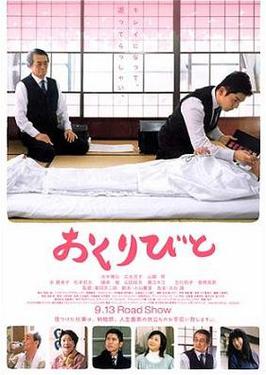
Okuribito_(2008)One could choose any number of labels to attempt categorizing Departures. It’s a film indebted to the rapturous compositions of the past. It shares elements akin to any police procedural ever made or for that matter, the veterinary antics from a British gem like All Creatures Great and Small.

They are admittedly disparate reference points, but they seem fitting given Departures subject matter. No, not a travel agency as our main character Daigo Kobayashi (Masahiro Motoki) supposes.

The job title of NK Agent, picked out of the local ad section, relates to something entirely different. They take care of the dear departed — that is — they work with dead bodies.  There’s the aloof veteran trained in all facets of the trade and the young newcomer aching to prove himself.

Each case brings with it, its own unique complications. It’s not a common art nor one that is held in much regard. But as the film explores over time, it plays a crucial role in a society that must grapple with death and bid adieu to loved ones like everyone else.

In his former life, Kobayashi had a position of repute. The Greeks might have liked him. He didn’t denigrate himself with toil and sweat as much as the common man. He was an artist; a cellist to be exact, and he brings joy to the masses and swelling pride to his devoted wife Mika (Ryōko Hirosue). The only problem is no one is showing up to their concerts and so the orchestra is unceremoniously dissolved.

In keeping with spousal protocol, Mika stays supportive and suggests they move to his old family home in the country where they might live for free as he figures his affairs out. But as one who is even only minorly familiar with Japanese culture, there is an inkling something else dwells hidden from view — just waiting to reveal itself.

Daigo answers a job description on a whim and finds himself greeted by the quizzical secretary (Kimiko Yo) and a boss (Tsutomu Yamazaki) who has an unorthodox manner of doing business, especially in such a highly methodical, procedure-heavy culture like Japan.

Needless to say, the new hopeful sits down for about two seconds and comes home with the job and his first bonus. It’s a hilarious initial interaction setting their relationship in stark relief. We like his workplace for how very unique it is. Because these people feel like they might easily be punchlines and nothing more, and yet we grow to appreciate them even as Kobayashi remains our protagonist.

This is what Departures is able to manage. It’s drama but never squeamish about utilizing comedy. Take, for instance, the moment he’s called on to play a cadaver in his senpai’s sponsor spot or when he throws up in the presence of a particularly grizzly undertaking. In the aftermath, some schoolgirls comment on the rancid smell on the bus leading him to take an expedient trip to the local bathhouse to clean up.

But in contrast, Departures is full of all kinds of emotion and soft strings of pathos, whether hyper-realized or not. In between the lines are complications and relationships wrought with both warmth and the tension of lives shaped by regret. The best moments are unspoken, reflected by totems or actions. The handling of a weathered stone, the heart-rending notes of a cello, and certainly the ceremonial burying of bodies.

Even the moment where Daigo must fess up and tell his wife what he’s really been up to, it tears her apart; she’s so very ashamed that he would take part in something so defiling. It bores into the heart of this narrative.

Because to its very essence, the movie not only puts words to a very archaic Japanese art no one wants to acknowledge, it also supplies a space in which to grapple with death and how we grieve — how we let our loved ones go into the great beyond.

Since the dawn of man, it has been a prevalent theme throughout the ballads and religious convictions of mankind, whatever the background. Even a basic deist like Ben Franklin noted that the only things we may count on are “death and taxes.”

Egyptians were embalmed for a future afterlife with relics now found in the British Museum for us all to fawn over. Norse heroes dreamed of Vahala, a place to glory over their valorous feats with their countrymen.

Christians believe in not simply an afterlife but a new heaven and new earth where this current world, with all its flaws, will pass away. On a cursory level, varying strains of Buddhism and Hinduism often delve into issues of rebirth in further pursuit of nirvana or enlightenment.

For Japan, in particular, death is so closely tied to family. Rather like Latin culture, there is this extension of the family unit reaching out into the great unknown where saying goodbye and keeping constant communications with dead ancestors is a part of culture, albeit a dying art.

Taking stock of these themes, it makes sense many have decried the film for its sentimentalities. Yes, there are touches of the saccharine, but what resonated with me most was something else. When it counted most, Departures managed to be a delicate drama in a manner suited to Japanese society where quiet strength is prized and benign tranquility highly sought.

And if you guess the plot points — not an altogether difficult task — it means very little to me. Because for many meaningful movies, these narrative elements are only employed to hang your hat on. What really matters are the characters, the emotions they exude, and whether or not they can reach out to the audience and induce a reaction.

Departures was such a film for me. One of the miracles of life is finding some semblance of humor in the darkest, saddest parts. Death is undoubtedly one of these. However, it begins with coming to peace with the future. Knowing that we were made for something more than this world of ours. We are not destined to be creatures of death, but creatures of life. Of course, that’s only one man’s opinion. We all deal with departures differently.

4/5 Stars

Whisper of The Heart (1995): Take Me Home Concrete Road

Whisper_of_the_Heart_(Movie_Poster).jpgWhisper of The Heart is wholeheartedly a Japanese anime and yet learning John Denver’s “Country Roads” holds a relatively substantial place in the plotline might catch some off guard. After all, as the metropolitan imagery establishes our setting, we hear a version of the song playing against the bevy of passersby, cars, and convenience stores.
Director Yoshifumi Kondō boasts animation both simple and clean yet ever so attractive for those very same reasons. It positively glows with nostalgic yellow hues and employs anime’s preoccupations with the most intricate details — moths drawn to a light being just one prime example.

When I lived in Japan, I became fascinated by foreign music and how it gained a foothold in the country. You only have to look to jazz, The Ventures, The Carpenters, or Mariah Carey to see how deep their imprint is on the collective culture. The same goes for John Denver who made tours of Japan on several occasions.

But whereas musicians often become icons, sometimes Japan cultivates an environment where nuggets of culture can take on a life of their own. This theme serves as a perfect breeding ground for Ghibli’s classic coming of age story.

Shizuku is, at her heart, a spunky and feisty heroine with the kinds of hope and aspirations that often seem buried in a very restrained culture like Japan. In her middle school existence, an unknown person named Amasawa becomes an almost mythic figure in her life as they have checked out all the books she’s so voraciously eaten up in her nascent but ambitious literary odyssey.

They look to be a kindred spirit. It takes a fortuitous meeting with a commuting cat on the JR line to sustain her adventure. The disaffected animal leads her to a Secret Garden of sorts. This one is not found in nature but in the home of a delightful old man.

Because Whisper of The Heart is full of the blushing love of adolescence in its many tangles found throughout the student body. It’s no different in Japan, at least on the emotional level, or for that matter, the utter denseness of the male sex.

But it’s also a very particular world where dwarves and fairies can coexist with the mundane elements of everyday life. Shizuku comes to realize this when she reaches the end of her adventure — the peculiar second-hand shop cluttered with clocks, violins, and shiny doodads of all shapes and sizes. It’s run by a genteel proprietor who also happens to relate to her not so fictitious phantom: Amasawa.

This looks to be the working of Hayao Miyazaki behind the scenes because no matter how mundane we might perceive the world to be, he’s always allowing for bits of magic to seep in and liven up our existences. Implicitly, he always seems to be suggesting we need the richness of our imagination girded around us to make the most out of life.

He also employs the most amicable cultural appropriation, turning Denver’s down-home “Country Roads” into a lively, bright-eyed violin jam session in a Tokyo back parlor. It’s the strangest incarnation of the song I could have ever imagined and yet somehow it manages to be apropos. I only need to remember pop instrumentals of “Daydream Believer” during my former days frequenting 7-Eleven’s in Tokyo. It fits the aesthetic.

But back to Shizuku. Her newfound companion dreams of being a Violin maker and going off to apprentice in Italy. Not to be outdone, she wants to write stories. She’s charged with empowerment and then the subsequent doubts ambushing anyone who’s ever endeavored for such a thing. I am reminded of the artistic encouragement churned up by C.S. Lewis and J.R.R. Tolkien that blessed the world over with two of the most formidable fantasy worlds: Middle Earth and Narnia.

Because we need people who will gladly court our ideas, gives us encouragement, and supply even the brief inkling that our passing daydreams are not complete balderdash. If they provide enjoyment or engage with beauty or goodness for just one person, perhaps even this makes them entirely worthwhile.

The sagely old man charges Shizuku that craftsmanship of any kind is never perfect. But we must begin. We need to start somewhere. To pilfer the film’s own metaphor, we are all unburnished stones waiting to be polished to the point of perfection. There’s the necessity of time and effort to make it work. The diamond must be pulverized. The brass burnished. The grain sent through the thresher. 

Again, Miyazaki’s imprint is all over the picture because he is always and forever the spinner of benevolent fairy tales paired with creative inspiration. His avid imagination never ceases to mesmerize. Surely there are lots of magical beings, soaring through the air, lands full of castles and kings, and yet the seat of it all is found in the revelation these very things can exist in our everyday reality. They need not be distant. Far off lands can come to meet us, be it through books or writing, music, or people with memories that extend far beyond what we see and know.

It’s easy for me to laud Whisper of The Heart for being timeless. Yes, we see word processors, a dearth of cell phones, more antiquated train services, and yet so much of the interactions, the yearnings, and the derivations are universal.

I must turn my attention only to the sound of cicadas, the warning bell near the train tracks, or the clink of a mailbox at the front door. They are so basic, so unextraordinary, and yet they sound so familiar. To my ears, they remain almost comforting. Because this movie is comfort food, whether you fancy udon or steak and potatoes.

Full of warmth. Love. Longing. Passion. Miyazaki and Ghibli have captivated the world over with such sensations. Yoshifumi Kondō more than proved himself capable of eliciting this same type of wonder. It’s only a shame he was not able to give us more films. But there only needs to be one solitary act of creation to leave an impression. Whisper of The Heart is an unassuming monument to his career.

4/5 Stars

Quai Des Orfevres (1947): Directed by Henry-Georges Clouzot

Quai Des Orfevres 1.png

Unearthing Quai Des Orfevres is a glorious discovery of post-war French cinema. Because Henry-Georges Clouzot is always a man I heedlessly clump together with Jacques Becker when it comes to French film history. Not because of an immediate connection but, on the contrary, it’s the very thinnest of labels.

They both have a handful of superior films to their names and yet never seem to reach the full-fledged prominence of some of their countrymen as far as their bodies of work are concerned. If we want to oversimplify the situation we have Jean Renoir on one side and then the youthful revolution of the Nouvelle Vague with the dawning of the 60s thereafter.

And yet, to acknowledge Clouzot was considered by Alfred Hitchcock himself as a true rival for the title of “The Master of Suspense” seems a heady admission. On the laurels of Wages of Fear and Les Diaboliques alone, there is some merit in the conversation. Most agree Psycho was a reaction to the latter film (since Hitch could not get the rights).

One area Clouzot can claim primacy over Hitch is the fact he personally wrote most, if not all, of the screenplays he directed. Quai Des Orfevres benefits as much from his writing as anything, yet another robust entry to his filmography. Though it came to fruition only after a substantial ban from the French film ministry.

That is a story worth dissecting on its own because his previous picture, made in occupied France, was all but bankrolled by the Third Reich. You can imagine that this didn’t sit well with people. It’s a fitting anecdote for the very reason that the war no doubt affected his characters as much as it affected him.

The France featured here is not quite the post-war Vienna of The Third Man, but it’s merely a hop, skip, and a jump away. For that matter, it evokes a bit of Carol Reed’s world from Odd Man Out too.

In this case, Clouzot’s focused on a group of performers at some shoddy theater house. It’s hardly glamorous entertainment, but for all those involved, at least it’s a meager living. If nothing else, they look after their own.

Right in the thick of it is vivacious stage talent Jenny Lamour  (Suzy Delair) and her balding husband, Maurice Martineau (Bernard Blier), who can constantly be found accompanying her on the piano. Between her shameless flaunting and flirting and his burning jealousy, it proves to be a highly volatile cocktail.

The conflicts, in this case, are not political or instigated by human avarice. They are of a more personal nature, between a husband and wife in turmoil. We do not know their history, but if the scenes around them are any sign, they are coming off hardship, with the war being indicative of their entire life together.

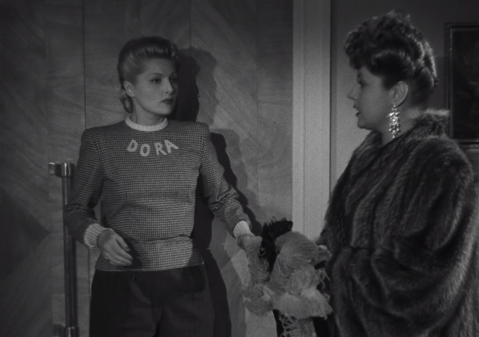
A local photographer, named Dora (the glamourous Simone Renant), who has some business with Jenny, is also paid a visit by a hunched, beady-eyed creep who happens to have quite the portfolio of financial holdings; it’s the only reason any girls give him the time of day. In this instance, he brings a pretty young thing to pose for him.

In some twisted way, it’s mutually beneficial. They want his influence and he wants pretty girls to dominate. One bystander notes, if Brignon (stage actor Charles Dullin in his final performance) were poor, he would have been in prison long ago.

Despite the generally disquieting nature of these themes, it’s even more sobering to admit, somehow it still remains timely as a portrait of men in power using their capital to lord it over the opposite sex. There is social repugnance, but they label him a “dirty old man” and leave it at that.

What’s more, Jenny Lamour is going to see him; it’s good for her career. Maurice despises the smutty scuzzball and with his anger justified for once, he goes to confront him at his hotel room; the staff and manager catch the tail-end of his outburst.

This only matters in reference to the film’s crucial inciting incident. Brignon is murdered one evening. It’s not unfamiliar or unexpected. Still, keeping the details murky for those unfamiliar with the story is in the best interest of all. But, needless to say, law enforcement gets involved when the body is found — his apartment in disarray.

This, of course, cuts out a large swath of the story. Because it is not a mystery. This is a character study. The man who winds up drawing out the performances and reactions from everyone else happens to be the curious Inspector Antoine (Louis Jourvet). It’s true colorful detectives are a mainstay of the police procedural with Columbo, courtesy of Peter Falk or even Alistair Sim’s Inspector Cockril, from Green for Danger, springing to mind.

In fact, in the preliminary stages, the inspector can be found poking around the musical hall, not unlike a Columbo — unassuming and out of place — and trying to decipher what he has to work with.

Later, in his office, he helpfully summarizes a deposition for Mr. Martineau to save the man time (He’s the most obvious suspect if it’s not apparent already). Bringing in the rest of his person’s of interest takes up the remaining daylight. It’s only a matter of time before a resolution is met. The Inspector’s generally insouciant when it comes to the daily grind, though he’s deceptively astute when it counts most.

Quai Des Orfevres 2.png

To reiterate, the story is not necessarily about the tautness of the plotting. There are too many questions. Not enough answers to loose ends. How does Jenny remain so even-keeled while her husband is the one sweating it? The alibi Maurice makes up is so flimsy. His case lines up so serendipitously with a bank robber who stole his car the same night. Why does Dora involve herself? But all these details are almost beside the point.

We know the perpetrator almost before the case has started — we think — and at any rate, it’s before the inspector comes on the scene. To evoke Columbo again, this is not so much a mystery as much as it is a “How’s he gonna catch them.” But in this version, it’s not an elementary case of fun and games.

Rather, a statement is being made on the state of law and order. Where the police search after a murderer of a despicable man because it is there job. Because these are the working-class folks. Criminals, in one sense of the word, yes, but also victims in another.

The characters and their dynamics become the seat of all the intrigue. The decisions they make. The logic they use. What they choose to disclose and hide from one another. Jenny, Maurice, Dora, they all are involved, but it’s more complicated than surface-level perceptions might suggest.

Even Inspector Antoine, the film’s most splendid creation, as realized by Jouvet, is given the benefit of a personal history outside the context of the film. His beloved son, from his time abroad in the French colonies, is the love of his life. The case almost seems like an unwanted distraction from what he’d really like to be doing. It’s this insightful brand of humanity found within most of the characters transforming Quai Des Orfevres into a truly singular take on the conventional crime thriller. The final shots sum up these ideas in succinct terms.

4/5 Stars

Bob Le Flambeur (1956): Melville’s Noir Heist

bob le flambeur.png

“Montmartre is both heaven and…hell.” 

While Melville would continue to cultivate his own unique canvass and pulp sensibilities, Bob Le Flambeur, as a slightly earlier work, shows its deep abiding debt to the American noir cycle. Because it was at this juncture in time where analogous crime pictures like Asphalt Jungle, Kansas City Confidential, and The Killing were still being churned out in the States.

Bob The Gambler must fit into this same conversation with how it instantly calls on voiceover and submerges itself in the throes of darkness as its constant palette of choice. Melville’s yet to have a Jean-Paul Belmondo or Alain Delon to hang his hat on, as it were (the latter actor was turned down for an early role). Still, he does have Bob (Roger Duchesne), more than meeting the prerequisites of a noirish hero.

He’s silver-haired with piercing eyes. His dress is nice, impressive, but not altogether flashy. Someone says of him, “Both young and old and already a legend.” Even as the voiceover draws us into the world — and the landscape in itself becomes not only a metaphor but a character — we meet a dame too, all before getting to the focus of our story.

Exteriors at times feel harsh and dilapidated. Trash collects in the gutters of the streets, and no one’s doing the city any favors, dumping their refuse wherever they please. At times, interiors, like a gambling joint or a kitchen, are so spare they play as a unique aesthetic all their own. Bob’s home is full of paintings and paisley wallpaper designs. The eye strays to the tiling, which along with the wallpaper, aid in creating this satisfying geometry of checkerboards, shapes, and patterns filling out the film.

Bob is forever the focal point guiding the movie’s progressions. In one scene he’s ready to shell out money to those in need, but he has his own code — he’s no fan of pimps — and since the cops are looking to run one in, he’ll willingly leave Marc to the police dogs.

For someone with such enterprises and acquaintances, Bob still manages an oddly amicable relationship with the police chief. He’s gone straight for 20 years, after a famed bank job he was forced to pay penance for. He’s done his time and reformed. His noble side has come out on more than one occasion.

But this is Bob The Gambler and so a bit of card play, roulette, and chance should be a part of it. Certainly, Bob more than lives up his name, always winning big on the horses only to lose it the same evening on something else. The capricious nature of it all somehow entices him.

When he hears from a buddy that the local gambling house is full up on cash, he makes a near-instantaneous decision. He’s going to rob it. It seems such a drastic way to end 20 years living under the law, and there’s no real inclination of why he decides this. It’s somewhere in between the lines there, and Melville has left us to figure it out. All we know is he is resolved to do it.

Simultaneously, he moves on with the planning measures. All the paces. The inside man. The financier. Layouts, schematics, gathering the crew together. Each is a single step in this methodical process. Bob proves himself to be no slouch when it comes to the details.  An abandoned junkyard becomes his chessboard to lay out all the pieces in real-time, helping all his crew visualize their parts.

However, despite such intricate planning, it only takes one chink in the armor to ruin it. She’s a young woman — only a girl really — and Bob feels somehow responsible for her. He doesn’t want to see her get harmed and, subsequently, hardened by a life walking the streets.

bob le flambeur 2.png

He treats her well, gives her money, even lodging in his apartment, and he expects no favors in return. After all, it is his young colleague Paulo who is madly in love with her. It’s this that causes him to run off his mouth. He wants to impress her and keep her for his own. Little does he know there are others. She’s not tied down by any stretch of the imagination, and her feminine wiles find her moving up the totem pole, from cigarette girl to hostess to a floor show main attraction.

Meanwhile, the squirrely croupier who has vowed to be their ticket on the inside has a prying wife who catches wind of the scheme. At first, it appears she might be one of the moralistic types, but it becomes apparent she’s even more of an opportunist than him. She wants more of the cut and so if we can go out on a slight limb, she is our second femme fatale.

The police commissioner receives his tip and readies his men, that is if the information is in fact true. Bob seems all but oblivious to these details. True enough, he learns the girl let the word slip, and he gives her a going over. And yet, according to plan, he gets into his tux and heads to the casino. There are only two options: either it works or it doesn’t.

There’s not a gunshot until well into an hour of the picture. When it comes is not important; simply knowing it does is something. No question there’s a weight to the action because when you’re waiting for a gun to go off, instead of having them blasting every few minutes, the impact is more apparent. It punctuates the action.

Fully cognizant of the tension wrapped up in the heist, Melville cuts between faces waiting in cars or sitting in bedrooms — all a part of this plot in some way, shape, or form — and Bob still keeps on gambling at the roulette wheel.  Gambling becomes not just a distraction for us but for Bob as well. Surely, he cannot have forgotten? Is it possible? I’m not sure. One could hazard a guess; it becomes his undoing, but hardly in the way that you might initially expect.

The tragedy in the final moments of Bob Le Flambeur is a different strain verging on the height of comic irony. It might easily elicit a chuckle from a few for the sheer chance of it all. It’s a textbook example of how a heist can go utterly wrong and somehow come out right in another way. When I say textbook example, it might actually be the only one just like this, and this is the film’s final trick. It’s indelible in its own right.

Melville came into the gangster genre with deep reservoirs of understanding and his own applied sense of understated style. Just as he stole and borrowed from others, he would, in turn, become the influence for the generations to come — not least among them the Godards and Truffauts of the world. For the time being, he lived with minor acclaim, but the film community would learn his name soon enough. Although, even that, he borrowed from another man.

4/5 Stars