Canyon Passage (1946): Ole Buttermilk Skies

canyon passage 1.png

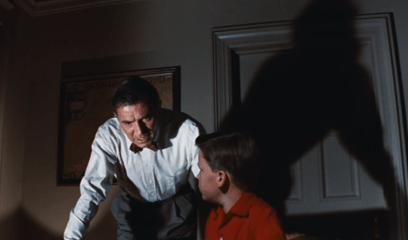
Portland, Oregon 1856 could lead us to many places but in these circumstances, it guides us to an enterprising mercantile store owner named Logan Stuart (Dana Andrews). Though he’s the main driving force behind the story, there’s little doubt this is a tale of pioneering far grander than a single individual.

As such, Canyon Passage is the epitome of a hidden gem, lined with talents who generally does not garner enough credit today for their many fine attributes. First of all, is Jacques Tourneur the French director who made a name for himself in a career laced with genre pictures and this one is no different, boasting a spectacular visual vibrancy.

The opening is exemplary, showcasing his skills as a master world-shaper, taking a western town that we only spend minutes in and through torrential rain pouring down, streets of mud, and various interiors, he’s already created a space that feels tangible to our eyes.

He continues this yeoman work throughout the story, which is a credit to its hardy terrain. We have sumptuous outdoor panoramas with rolling plains and expansive skies above. Then, there’s the verdant underbrush of the forests captured, the lush greenery, and even the interiors of cabins and shops have a rustic beauty about them that feels real.

Our trifecta of leads all proved substantial stars at one point or another beginning with Dana Andrews, then Susan Hayward, and Brian Donlevy, yet for whatever reason, it seems their names (much like their director) get lost behind a host of far more visible faces.

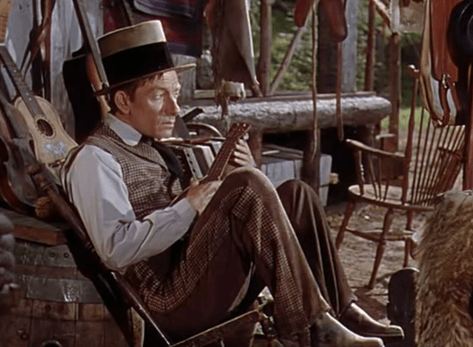
Nevertheless, they earn their due and in all other regards, Walter Wanger’s production is knee deep with equally memorable supporting players like many of the greatest westerns of the age. Hoagy Carmichael meanders about doing this and that with his mandolin and donkey, singing an occasional song, such as the instantly unforgettable “Ole Buttermilk Sky,” which captures a bit of the folksy milieu wafting over the picture.

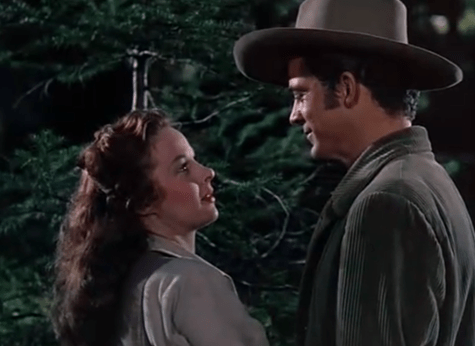
Canyon Passage is also ripe with love triangles beginning with Logan and the future wife of his best friend, Lucy Overmire (Hayward) who he has been tasked with bringing home. They share a mutual affection but Logan respects his buddy George Camrose (Donlevy) too much to steal his girl; they’ve been through far too much together for that.

Instead, he sets his eyes on the pretty young woman (Patricia Roc) who was taken in by a genial frontier family headed by Andy Devine and his wife. They would gladly welcome anyone into their fold and it’s no different with Logan as he looks to make strides with Ms. Caroline.

canyon passage 3.png

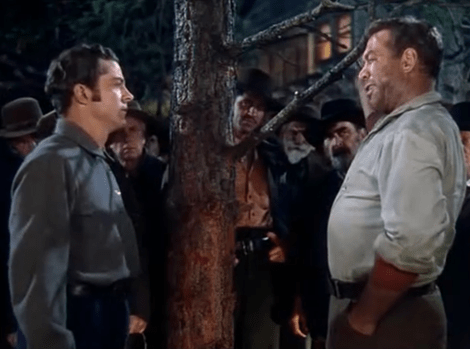
However, if this was all Canyon Passage was about, it would lack a sizable conflict. But Logan must simultaneously deal with the local instigator of trouble Honey Bragg (Ward Bond as a burly villain) who has previously had more than a few run-ins with Logan and he’s not looking to make nice.

In fact, the whole town congregates in The Golden Nugget saloon after Bragg challenges his adversary to a showdown to have it out once and for all. The full brutality of such a society sets in with the men crowding around ravenously for a good show of pugilism to get their blood stirred up. A hint of lawlessness has been injected into the air.

But George also has demons of his own, namely, a gambling habit, which he can’t break, owing money all across Oregon to the point his friend bales him out only if he promises to quit. Still, the urge for wealth and constant comparisons with Logan’s continual success, make him continually discontent. He goes straight back to the cisterns that prove to be his undoing.

Like some of the best westerns by the likes of Ford or Hawks, this one feels, at times, like it’s about nothing much in particular and yet the paradox is it’s about so much that’s meaningful, speaking to the humanity at large. There is a local house-raising for a young couple just starting out and they marvel at all the folks who come to help them out. Because, for all the charitable neighbors, this is an investment in their own livelihood.

We see crystal clearly. What is going on, in front of our eyes, is the fleshing out and the building up of an entire community. Then, we receive a showcase for men of principle going against a world that seems so violent, brutal, and utterly untamed. Instead of cowering in fear or remaining apathetic, they look to confront it in some way.

However, beyond this, we have another broad conflict that’s age-old. The chafing between those who began with the land — The Native American tribes — and then the white man expanding westward with a belief they deserve a chance at a new life. In the eyes of those who started there, these newcomers are desecrating their home. In the eyes, of the pioneers, they are making it into more of a home.

When human beings wind up in close proximity, with varying viewpoints, beliefs, and practices, there’s bound to be repercussions and there are. Watching Canyon Passage you realize these very things were affecting real people, men and woman, families and the children within them. It feels like a truly eye-opening scenario.

Bloodshed ensues and against such beautiful exteriors, it only makes the scarring of the land and the bodies all the more inescapable. There’s something inside of us saying this is not the way it was meant to be.

canyon passage 2.png

What makes Canyon Passage quite powerful, frankly, is there’s no single point of contention or an individual goal in mind. It’s this all-encompassing drama with grand themes — grandiose in both scope and scenery — that concern a whole host of people trying to make lives in the western territories. You can begin to understand most everyone’s point of view. Amid the destruction and unrest, it’s easy to recognize the problems at hand. Surely, the West was meant to be more than this. Fights and warring, razing and killing.

But the frontier has always been an arena for hardship. Death by any number of ways. It’s the resiliency people lived with that meant something. In Canyon Passage, there are the same kind of folks who don’t go skulking around in their troubles but instead rise up to make the best of the next day to come. One might wager a bet it’s one of the bygone markers of the American spirit. Hopefully, we haven’t lost it all yet. We could probably still use some of that just as we could still use ambition and love, friendship, and fellowship with an underlying empathy for our fellow man.

Only when “The End” flashed upon the screen did I realize, in my former days of channel surfing in vacation hotel rooms, I once caught the tail-end of Canyon Passage. There again was an indelible image I distinctly remember, Hoagy Carmichael ambling along on his donkey, through the forest, knocking back a tune. It made me distinctly mirthful like an old friend just recently discovered again. If this film isn’t considered a classic by now then it should definitely be in the running.

4/5 Stars

5 Favorite Films of the 1950s: The B Sides

Just a day ago a whole slew of individuals shared their 5 Favorite Films of the 1950s for National Classic Movie Day. Thank you again to The Film & TV Cafe for spearheading that quality endeavor!

In retrospect, I realized all my choices were really “A Pictures,” which were difficult and yet at the same time fairly easy to choose. They were all no-brainer picks because I love them a great deal. Many others also chose the likes of Singin’ in The Rain, Roman Holiday, and Rear Window (for good reason, I might add).

However, the decisions that left me the most intrigued were, of course, the dark horses and the underappreciated gems. Certainly, you have to start somewhere when it comes to embarking on the classic movie journey, but half of the fun is unearthing treasures along the way. For instance, I was left charmed by the following picks, all wonderful films in their own right, that I would have never thought to choose:

People Will Talk, The Narrow Margin, The Earrings of Madame De…, It’s Always Fair WeatherThe Burmese Harp, and Night of the Demon, just to name a handful.

All of this to say, I was inspired by these folks to take on “Round 2” for my own edification. I’m going to leave my highly subjective list of “A Sides” behind for what I’ll term the “B Sides.” The only rule I’m going to place on myself is that this fresh set of picks must be what I deem to be “underrated movies.” Again, it’s a very subjective term, I know.

Regardless, here they are with only minor deliberation!

stars in my crown.png

Stars in My Crown (1950)

Jacques Tourneur is an unsung auteur and if all he had on his resume were Cat People (1942) and Out of The Past (1947), his would be quite the legacy. However, throughout the ’50s, he helmed a bevy of fabulous westerns and adventure pictures. I almost chose Wichita (1955), also starring Joel McCrea. In the end, this moving portrait of a frontier minister won out because it cultivates such a fine picture of how one is supposed to live in the midst of a bustling community of disparate individuals. This involves conflict, tension, tragedy, and ultimately, a great deal of human kindness.

the breaking point 1

The Breaking Point (1950)

Howard Hawks’s To Have and Have Not with Bogey and Bacall is probably more well-known but this version has merits of its own. Namely, a typically tenacious and compelling John Garfield playing a returning G.I. and family man trying to make a living in an unfeeling world. His wife portrayed by Phyllis Thaxter deserves a nod as well for her thoroughly honest effort. The movie gets bonus points for shooting in and around my old summer stomping grounds on Balboa Island.

bigger than life.png

Bigger Than Life (1956)

It does feel a bit like Nicholas Ray was the king of the 1950s. Rebel Without a Cause is the landmark thanks, in part, to James Dean. However, his best picture, on any given day, could be Johnny Guitar with Joan Crawford, On Dangerous Ground with Robert Ryan, or The Lusty Men with Robert Mitchum. Today I choose Bigger Than Life because James Mason gives, arguably, the performance of his career as a man turned maniacal by the effects of his new miracle drug, cortisone. It employs the same gorgeous Technicolor tones and Cinemascope Ray would become renowned for while also developing a truly terrifying portrait of 1950s suburbia.

ashesanddiamonds1

Ashes and Diamonds (1958)

I skipped James Dean’s most famous film, but never fear because in his place is a film featuring an actor who channeled the American icon’s angsty cool. In Andrzej Wajda’s Polish drama, set at the end of WWII, Zbigniew Cybulski embodies much of the same electric energy. His defining performance is central to a gripping tale about a country absolutely decimated by war, between German occupation and the ensuing columns of Russian soldiers arriving on their doorstep.

good morning.png

Good Morning (1959)

This might be my personal favorite of the Yasujiro Ozu’s films for its pure levity. The images are meticulously staged as per usual with glorious coloring. Every frame could easily be a painting. However, against this backdrop is a domestic story about two brothers who hope to wage a pouting war against their parents who won’t cave and buy them a TV like they want. The conceit is simple but the results are absolutely delightful.

Well, that just about wraps up my 5 supplemental picks…

Except I would be remiss if I didn’t share at least a handful of other outliers. Let me know what you think of the films I chose!

Honorable Mentions (in no particular order)

Wichita (1955)

wichita 1955.png

The more and more I get to know Jacques Tourneur the more it seems that he was content in making films on his terms no matter the budget or restrictions. His ambitions were not to win awards or garner acclaim yet he was a master craftsman painting in shadows, intrigue, and vibrant strokes.

Known in his early days for his lucrative partnership with producer Val Lewton on low budget horror movies that still stand the test of time as inspired works, the high watermark of his career is indubitably the noir masterpiece Out of the Past (1947). By the 1950s he had settled into making westerns, swashbucklers, crime pictures, and pretty much anything else handed him.

The striking realization is that he never really moved up the Hollywood totem pole which makes me suspect it was partially by choice. He was content with a certain stratosphere of production and when you watch a picture like Wichita you can understand why.

It takes many of the mythical staples of The West and insets them within the contemporary Hollywood framework that generated a lore of its own.The lineage that gave us a plethora of television classics like Gunsmoke, Bonanza, Rawhide, The Rifleman, Cheyenne, Bat Masterson, Wanted Dead or Alive, The Big Valley, Wagon Train, Sugarfoot, Have Gun Will Travel, and countless others that I either failed to mention or don’t know.

The tradition runs rich and deep. Where people address a hero like Wyatt Earp by his full name and there’s some sort of knowing comprehension. Where good and evil are unquestionable entities that we recognize outright. Where a final showdown is all but inevitable as is the town’s prettiest girl falling for our hero.

Wichita is such a picture and yet by some method of ingenuity and delight in his craft Tourneur makes it into something worth remembering. Part of that must be attributed to a script by Daniel B. Ullman which manages to have time for a big reversal and some social commentary in what otherwise could have been droll entertainment.

Meanwhile, though Joel McCrea might look a little decrepit and over the hill for such a role especially opposite a beaming Vera Miles, there’s still that same amiability and honesty that he was good for. James Stewart would look much the same opposite Miles in The Man Who Shot Liberty Valance (1962). But like that picture, the themes add a depth of character to the western making it a transcendent medium since it’s as American a genre as they come and it provides the perfect breeding grounds for allegorical tales.

Because before we meet our hero we meet a group of cowboys who are driving their cattle toward the rapidly growing destination of Wichita, Kansas. With the railroad turning it into a pitstop, the city shows no signs of slowing down and turning into a ghost town. Instead it aspires to be the next big Mecca in the Midwest bringing all sorts of people — the Babylon on the Arkansas River without the hanging gardens.

One such traveler rides as a solitary figure toward the cattlemen in one of the film’s most canonical shots and they oblige by offering him a meal. However, two of their band are mighty eager to swipe their visitor’s saddlebags when he beds down for the night.

What follows is a preview of coming attractions and even as Earp (McCrea) goes on ahead to Wichita we know intuitively that there will be another confrontation. In the meantime, he rides into town under the banner reading: “Anything Goes in Wichita” and local floozies waving giddily as they pass in covered wagons.

As best as I can describe it the town is alive. Positively bustling with activity and it makes everything in the frame more interesting with this ever dynamic ambiance playing out in the background. I’d like to think that is what Tourneur is able to offer the material.

While we bide our time we watch Earp looking around for something to invest his talents in. He befriends the towns newsmakers a stodgy old veteran (Wallace Ford) and his ambitious understudy Bat Masterson (Keith Larsen).

Earp also ends up thwarting a bank raid raising the eyebrows of the local big whigs for his prowess with a six-shooter. Sam McCoy (Walter Coy) the man responsible for bringing the railroad to Wichita offers him the job of Marshall which Earp gently refuses on multiple occasions.

wichita 2.png

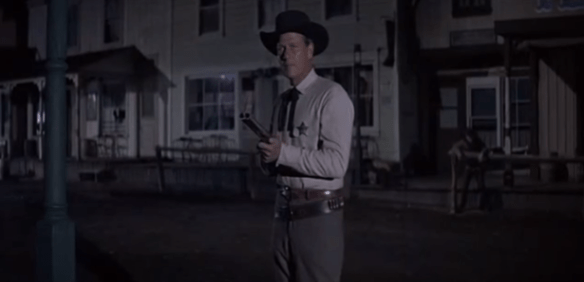
Twice already we have seen him use his gun but he embodies the archetype, an agile marksman who is hesitant to use his firearms and only under extreme provocation. But the final trigger comes when the cowboys from before roll into town with a hearty welcome. However, when their merrymaking devolves into belligerent hooliganism that leaves a young boy as collateral damage, Earp is finally ready to pick up the badge.

It ends up being a battle between the business-minded community members with political clout and a man whose number one priority is public safety. Others like Doc Black (a wily Edgar Buchannan) and even McCoy are willing to make concessions for what is termed progress but Earp once he’s taken his post is a hardliner.

He won’t budge an inch which is an admirable trait even as it doesn’t buy him many supporters. But sometimes that’s what the great men do and it is what few men seem willing to do now. Conceding their popularity for the greater good. However, I can hardly criticize any man for such a stance unless I convict myself too. As McCrea asserts it’s, “Not a question of who’s right but what’s right.” That’s the bottom line and he sticks to it.

In the final shot of Wichita as husband and wife ride off in their carriage together the image is all too familiar evoking for me High Noon (1952) one of the first westerns that truly moved me on a human level. This picture did much of the same though on a lesser more inconsequential scale. It caused me to place a magnifying glass to issues that we still see the U.S. confronted with right at this very moment.

“If men aren’t carrying guns they cannot shoot each other.” This common sense comes straight from the film and yet you can easily see how it becomes clouded with personal ambitions and polarizing politics. There’s no denying that. Sometimes it takes a personal tragedy to shock us into some form of action. The question remains what is the greater good? I feel like it comes into clearer focus when you get hit where you’re the most vulnerable.

4/5 Stars

“Serving God and serving the law are two different things.” ~ Bat Masterson

“To do either one, takes a dedicated man.” ~ Arthur Whiteside


Stars in My Crown (1950)

StarsInMyCrown.jpg

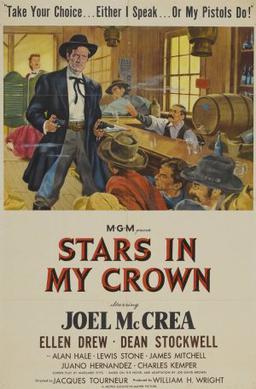
It speaks not only to the man but to this film, that Joel McCrea rated Stars in My Crown among his personal favorites. (Hint: It’s not because of the imminent reunion of two cast members in Gunsmoke). The story is framed by the nostalgic recollections of an old man and it’s a singular story in the way that one life is a story. There are constant offshoots, revelations, and daily interactions with other human narratives.

John’s life (Dean Stockwell) could have been very different; it could have been drama because he was orphaned at a young age. Except he had Parson Gray (McCrea) and Mrs. Gray (Ellen Drew). Much like this film, his life was generally a joyous affair growing up as a young lad. Certainly, it was not without its roadblocks, disagreements, or minor quarrels but what remains is generally uplifting and good.

Stars in My Crown for much of its run is a vignette-driven tale but that proves to be the utmost blessing for this particular film. That inevitably brings us to Joel McCrea and why he must have relished this part. He’s a man of faith and no shame-faced Christian. There’s no denying his spiritual leanings. Still, while he’s not a spineless pushover, there’s not a condemning word that leaves his mouth either.

What keeps him upright and a pillar of the community is a quiet boldness and a genuine care for his parishioners. But that means not simply calling on the people who enter into his church on Sundays. I’ve heard it said before that it’s easy for anyone to love people who are just like them or who they like already.

What’s truly a test of someone’s heart is whether or not they are willing to reach out to those who seem alien and contrary to their station in life. The Parson is such a man. Not only does he care for the physically sick or the self-proclaimed churchgoers who are sick in the soul, he is there for those on the fringes too.

He faithfully calls on his boisterous war buddy (Alan Hale Sr. in his final role) who is larger-than-life with a strapping clan of sons (including James Arness) and a penchant for joking about religion. He’s waiting for the Parson to get God to plow his fields for him.

The good-natured Gray gently ribs him about his coming to church. But what strikes me is the worth he sees in his friend. In one resounding instance, when the local gamekeeper Famous (Juano Hernandez) has his land trampled by local bigots, it’s not the Christian folk but Jed who immediately comes to his aid. His beneficiary rightfully proclaims with all candor, “You’re a real Christian.”

Parson Gray’s rounds never seem to cease though in one instance they meet with opposition. Dr. Harris (Lewis Stone) has long been the town’s apothecary but with his ailing health, his intelligent yet rather brusque son (James Mitchell) is taking over the family business. Though more than capable, what the younger fellow is lacking is a genial bedside manner, at least upon first glance.

He does show a certain sensitivity to the local school teacher (Amanda Blake) and the certain tightness in Mitchell’s voice is stellar for articulating the feelings of a man who is hardly unfeeling — he just has trouble opening up. In fact, he’s adamant that the religious leader stays out of his way because he sees no place for such ritualism when he has practical science to help people.

The days roll ever onward with young boys lazily kicked back in a hay wagon surmising what they’d do if they were God. Namely, have it always be summer. Even Christmas would be in summer. Another time a Medicine Man (Charles Kemper) and his Carnival Show pay a visit and bring the town out of the woodwork for an evening of magic tricks and showmanship.

Then come the bad times when the typhoid hits and people are dropping like flies. First, John is sick then a whole host of others. The Doctor criticizes Gray for potentially infecting the entire population of school children and for the first time in a long time we see the normally even-tempered man angered.

However, the Parson is man enough to consider that he’s wrong because he very well could have been. He’s also humble enough to give the doctor room to work. For the sake of the people, he becomes isolated and as a result poor, bereft of his usual resources. Because all he had was out of charity and the tangible blessings of those around him.

He even goes so far as closing the church for the first Sunday service as far back as anyone can remember. It soon becomes evident how very humble and meager his portion is without the bulwark of community around him.

But it’s one of those things, out of the Parson’s seemingly selfless act comes a reciprocal act from the young doctor — the man who shed his rough exterior and became one with the people knowing full well all their suffering as well as their joys. It was this chance in the trenches with the lack of the sleep and onslaught of the slow fever where he realized there was a need for something else that he never thought was lacking before. If Ordet (1955) has the most striking resurrection scene that I can recall perhaps Stars in My Crown has the most gorgeously understated.

The final stand that the Parson is compelled to take is also weighty with significance. The townsfolk have repeatedly threatened Famous and now they’ve reached the end of the road. Stringing him up and taking his property is all that’s left to do.

When they leave that burning cross and the note, cloaked in white like cowards, it somehow brought the same realization that floods over me far too often. In some ways, this film is meant to be so archaic, reminiscent of a bygone era far removed from our present. And yet as much as we might try and move away, it sadly remains relevant.

So the Parson goes to Famous’s home alone knowing what is coming for them. He forgoes the guns of his good buddy Jed. That’s not his way now. Instead, he speaks to them resolutely as they get ready to take Famous away. He confronts them with the man’s own words and in the most piercingly moving moment of the entire picture we see how one man can be so selfless in the face of so much hatred. He can boast so many riches even if his worldly possessions seem totally inconsequential. His character speaks for itself.

Years later Atticus Finch would have a confrontation akin to this one and yet it came to an impasse. Here the Parson is able to speak the truth into each of these men’s lives and make them human again. All thanks to Famous.

So while the picture might fall too easily back into place (Klansman aren’t rooted out forthwith for instance) there’s no begrudging such a gentle and virtuous film its closure. Because these are as much the fond memories of a young boy grown old as they are the tale of one man who left an indelible impact on a life and on a community. I’m reminded that perhaps a church is not so much a building as it is a people. Though the picture is capped by the proud moment where the Parson sees his old war buddy welcomed into the fold, I would like to think he doesn’t see that as the ultimate victory.

If anything his life reflects the outpouring of an existence lived outside of the Sunday framework. He does not have compartmentalized faith — the kind of religiosity that makes people hypocritical and prideful. I can respect a man like that even if he doesn’t pack a gun.

4.5/5 Stars

I am thinking today of that beautiful land
I shall reach when the sun goeth down;
When through wonderful grace by my Savior I stand,
Will there be any stars in my crown?

Will there be any stars, any stars in my crown
When at evening the sun goeth down?
When I wake with the blest in the mansions of rest
Will there be any stars in my crown?

In the strength of the Lord let me labor and pray,
Let me watch as a winner of souls,
That bright stars may be mine in the glorious day,
When His praise like the sea billow rolls.

O what joy it will be when His face I behold,
Living gems at his feet to lay down!
It would sweeten my bliss in the city of gold,
Should there be any stars in my crown.

Cat People (1942)

cat-peopleCat People has one of those sensationalized B-picture premises and there are moments when its meager aspects let slip that this is a low-budget effort, but within those restrictions, it moves with a certain purpose and chilliness. It’s true that producer Val Lewton had a B-movie renaissance going on at RKO Studios and Cat People is one of his treasures.
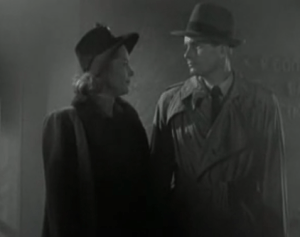
At its core is a streamlined love story between a Serbian artist/fashion designer and the local New Yorker who falls smitten for her in a whirlwind. Simon Simon is simultaneously sweet and bewitching as Irena Dubrovna who intrigues Oliver (Kent Smith) as much for her exotic mystery and feline figure as she does for her genial demeanor.

In several candid moments, Irena explains to her new admirer that she is a descendant from a long lineage of cursed individuals. The stories she tells of immense evil and witchcraft have the ring of gothic horror stories to Oliver and the audience.  Certainly nothing to be taken seriously. They’re legends, after all, except for Irena they are strikingly real.  And her palpable apprehension about such things allows an impending dread to set in and reach us.

With these strategic bits of exposition and foreshadowing, Cat People sets its story up well, revealing just enough to give some teeth to the impending doom as the narrative slowly descends deeper and deeper into the haunting darkness hinted at early on. But it’s the very fact, that that is not where it dwells all the time. It finds its plot in very mundane and ordinary things. The romance between two individuals. A young woman who is taken with walking through the Central Park Zoo to observe the animals.

cat-people-2At Oliver’s work, talk around the water cooler is made compelling in that his best pal and colleague is the sensible Alice (Jane Alexander) always ready to lend a listening ear. She’s genuine in accepting Irena for who she is because she can tell that Oliver earnestly loves her. But at the same time, she serves as a contrasting figure — someone who is completely different than this enigmatic creature.

But another thread involves Irena’s time spent in the counsel of the psychiatrist Dr. Judd at the behest of her love. And when she comes to him with her personal troubles it becomes evident that there is a great deal of trauma buried deep within her as there is with many of us I can imagine. The doctor rightly extrapolates that “childhood tragedies corrode the soul and leave a canker in the mind.”

It’s this that becomes the source of the horror. Because certainly, this is a fantasy on more levels than one– the man’s never been unhappy in his life until now (That’s a laugh) and the woman has unnatural impulses (You fear the panther, yet you’re drawn to him again and again). But it’s rooted in some sort of fact, whether personal, mental, or spiritual.  And, ultimately, it is a harrowing amalgamation of psychological duress, sexuality, and spirituality that makes for a spooky outcome indeed.

It even taps into the apocalyptic biblical literature (Revelation 13:2) to lend a certain amount of ethos to its story. And even if the interpretation of the texts is broadened and pulled completely at of context, as a narrative device, it works wonders.

One of the film’s greatest and perhaps most obvious assets is its aesthetic with a crepuscular atmosphere courtesy of cinematographer Nicholas Musurasca. He would partner with Jacques Tourneur later on in the decade with the much-revered film noir Out of the Past.  And what it truly adds is character, making the fears of these individuals actually legitimate and heightening the tension. Cat People does not pop out at you or repulse with gratuitous gore but it’s a completely unnerving picture all the same.

4/5 Stars

Out of the Past (1947) – Film-Noir

13659-outofthepastStarring Robert Mitchum, Jane Greer, and Kirk Douglas, this classic has every element of a good film noir.   Jeff Bailey (Mitchum) makes his living in a small town working at a gas station. He has an honest living and a girl. However, soon his past catches up with him when a man from his former life comes to see him, and he must explain it all to his innocent girlfriend.

Once he was a private investigator, who got mixed up with a powerful man named Whit (Douglas). He wanted some money found, but most importantly he wanted a deadly girl brought back to him. Pretty soon Jeff’s searching leads him down to Mexico. He has a chance meeting with the beautiful woman (Greer), and he understands why Whit wanted her back.

However, Kathie is not eager to go back, and they are attracted to each other. She and Jeff agree to run off together to San Francisco — away from the searching of Whit. They are nearly found out, but they get away. San Francisco is not a nice place, but they make do, until the day where Jeff is spotted by his old partner. He must split up with Kathie and they set a rendezvous. Only there is a hitch in the plan that Jeff did not foresee. He tries to deal with it in his own way, but Kathie takes more drastic measures. She left him there and went out of his life, or so Jeff thought. He had tried to forget his past dealings, and yet they creep back into his life. With a murder pinned on him, Bailey can do nothing but go along with Whit and Kathie. Soon he becomes embroiled in more treachery and backstabbing, which all has to do with the manipulative femme fatale.

With one last entreaty, she urges him to flee with her since they both have dark pasts. In the end, Kathie’s fanciful plan to escape is foiled by Bailey and it soon turns fatal. One last time she tried to control the situation, but this final time Jeff, or at least fate, got the best of her. After his violent death, Jeff’s girl wishes to know once and for all if he was running off with Kathie. A mute boy (Dickie Moore), who knew Jeff well lies so that the girl can continue her life. Because in Jeff’s case the past came back to haunt him. The kid goes back to the station, but not before looking up at Bailey’s name on the sign, because he did what Jeff would have wanted.

With its dialogue, extended flashback, voice over, and femme fatales played by Jane Greer and Rhonda Fleming, there are not many noir experiences better than this one. Obviously, the chiaroscuro cinematography is a major aspect of this film. Except for the shots in Bridgeport, it seems like every scene is veiled in shadow whether it takes place in Acapulco or San Fran, at day, night, inside, or out. Shadows are perpetual and they seem to reflect not only these characters but also the story. They are not easy to figure and none of them can ever be fully trusted.

Mitchum is perfect in the role of Jeff Bailey, thanks to his demeanor, his fitting voice, and the constant attire of a trench coat and fedora, with a cigarette clenched in his teeth. He is a man who looks like a saint compared to his acquaintances, and yet he is a man who can show a complex set of traits ranging from avarice, cruelty, love, and sometimes heroism. Kirk Douglas is great in his role as the crooked Whit, who acts the nice guy only to be cruel at heart. Every character from the henchman Joe, to the mute boy, the accomplice Meta  Carson, and even the loyal taxi driver are all memorable in the scenes they show up in. Jane Greer stands out, however, because she is one of the most notorious femme fatales in any noir. I think she toys with the audience as much as she does with Jeff. We find ourselves starting to believe her, then we have our doubts, and then we go on believing her again. It is a fine performance.

5/5 Stars

“She can’t be all bad. No one is.”
“She comes the closest.”
~ Ann and Jeff talking about Kathie