The Mortal Storm (1940)

The_Mortal_Storm-_1940-_Poster.pngOur introduction to The Mortal Storm feels rather flat. Bright and bland in more ways than one as we become accustomed to our main storyline.  Professor Viktor Roth (Frank Morgan) is held in high regard all throughout the community as a prominent lecturer at the local university and beloved by his colleagues and family. The year is 1933 and the Bavarian Alps are still a merry and gay place to live. That’s our understanding early on as the Professor celebrates his 60th birthday with much fanfare and receives a commemorative memento from his class.

In some ways, Frank Borzage’s picture shares a striking resemblance to All Quiet on the Western Front another film that makes its German roots blatantly obvious and yet it wears its incongruities like the ubiquitous use of the English language with ease. And as all the characters accept it, we do too as we begin to sink into the story. But crucial to this story is that they are not as accepting of other things. It feels a little like paradise. Life is good and people are happy. But we expect that at some point the time bomb will go off and it does. Adolf Hitler is elected Chancellor and just like that people begin to change. It’s a collective revolution — a youth movement of sorts.

Pastor, pacifist, and thinker Dietrich Bonhoeffer tore apart the Fuhrer concept straight away in a talk he gave in 1933, long before many of the later horrors during the Nazi reign of terror. But much as this film portrays, such an ideology only leads to destruction — a necessity to harm your brother. Bonhoeffer stated the following which feels surprisingly pertinent to this narrative:

“This Leader, deriving from the concentrated will of the people, now appears as longingly awaited by the people, the one who is to fulfill their capabilities and their potentialities. Thus the originally matter-of-fact idea of political authority has become the political, messianic concept of the Leader as we know it today. Into it there also streams all the religious thought of its adherents. Where the spirit of the people is a divine, metaphysical factor, the Leader who embodies this spirit has religious functions, and is the proper sense the messiah. With his appearance the fulfillment of the last hope has dawned. With the kingdom which he must bring with him the eternal kingdom has already drawn near…

 “If he understands his function in any other way than as it is rooted in fact, if he does not continually tell his followers quite clearly of the limited nature of his task and of their own responsibility, if he allows himself to surrender to the wishes of his followers, who would always make him their idol—then the image of the Leader will pass over into the image of the mis-leader, and he will be acting in a criminal way not only towards those he leads, but also towards himself…”

And so it happens in this film. We see it around the professor’s dinner table first. Formerly, a forum for high-minded debate, it’s quickly become a battleground of ideology. Roth’s step-sons and most notably his daughter’s fiancee Fritz Marberg (Robert Young) have all been caught up in the rhetoric and promises of Herr Hitler. All other forms of thought and free thinking have been discarded, these new ideals burrowing into their minds, dictating their actions, and ultimately poisoning their lives and the lives of all those around them. I never thought it was possible to despise Robert Young but when his mind is polluted by an ideology as rancorous as Nazism it’s far from difficult.

We don’t see Jimmy Stewart until quite a ways into the film and he disappears from sight for some time following an escape to Austria from the Nazi clutches, but he’s still our hero imbued with that same iconic everymanness. He is the man to continue the open-minded, compassionate forms of thinking that Professor Roth exemplifies and subsequently get torn asunder.

Margaret Sullivan and Stewart yet again make a compelling pair following Lubitsch’s Shop Around the Corner. She is the good little German girl Freya who actually proves to have a backbone and he is the humble farm boy who stands by his ideals like Stewart always did. They are caught up in a love story amidst a world that seemingly lacks any shred of romantic passion.

Undoubtedly the Production Codes forbade from mentioning Jews in the story — the non-Aryans like Professor Roth, but that makes this film even more haunting, the fact that the people without a voice are not even acknowledged. They are silenced and remain silent.

With its overt portrayal of the Nazis as menacing thugs and brainwashed ideology machines, The Mortal Storm is startling. For years and years most all of us have read, heard, and seen a great deal on the Nazis that we have unknowingly compiled but this film brings many of those common factors to the fore. It’s obvious that people saw them then. They knew them then. They weren’t blind. Thus, it makes us beg the question what were other Europeans and Americans actually thinking? Because although The Mortal Storm might be the exception rather than the norm, there had to be a general consciousness about the Nazis.

Because the film hardly sugarcoats anything nor does it mince words. It’s surprisingly blunt and utterly bleak in its portrayal even with a bit of a bittersweet Hollywood ending. What’s left is a lingering impact that’s terribly affecting. Only at that point do we realize the total transformation the film world has gone through. Those opening moments of The Mortal Storm are so vital as it is only in the waning interludes where we truly comprehend how far things have fallen into hell.

It’s a stunning piece of work and this is not simply the ethereal love story I was expecting. It is a thoroughly gripping indictment of the Nazi menace and far more candid than I would have ever imagined. The Mortal Storm suggests perhaps most audaciously that there were people who waded against the pervasive current of the time. They let their lives be dictated by good will, decency, and personal relationships rather than any churning force of a single political ideology.

The final quotation pulled from the moving work of Minnie Louise Haskins “God Knows” ends like so:

“I said to a man who stood at the gate, give me a light that I may tread safely into the unknown. And he replied, go out into the darkness and put your hand into the hand of God. That shall be to you better than a light and safer than a known way.”

4.5/5 Stars
What I Learned From George Bailey

its-a-wonderful-life

It’s a Wonderful Life is a perennial classic for many people but it was not until I saw it in a theater during high school and rediscovered it with new eyes that I  came to truly appreciate this film on a deeper level.

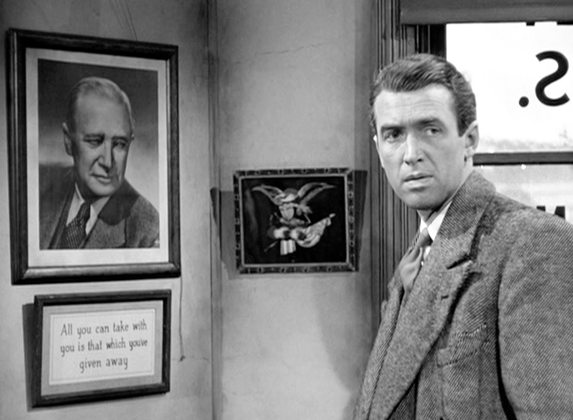
On subsequent viewings, so many scenes resonated with me and gained new profound meanings. However, one of the most prominent is really in the periphery. It came with looking closely at the wall of Mr. Bailey’s building and loan. Clearly visible on the wall of the old building is a short epithet. “All you can take with you is that which you’ve given away.” It’s a strikingly beautiful and pithy statement. I have no way of knowing who thought of having this quotation up on the wall but it perfectly encapsulates many of the central themes of the film.

More than anything, the rise, the fall, and the final redemption of George Bailey reminds me what the true meaning of life is. It is to strive to love others–loving them even as much as you love yourself if that’s your wife or your kids or the people that you cross paths with each and every day. Mary, Zuzu, Uncle Billy, Violet, Burt, Ernie, and yes, even the Mr. Potters.  Simple, everyday, common decency is something to be clung to. It might be unassuming and the people who wield it may remain unheralded but that hardly discounts their impact. They know what they’ve done and that’s enough. Trial and tribulation might come again and again, still they never tire of doing good.

“All you can take with you is that which you’ve given away.”

If we look at the life of George Bailey, he is precisely one of these individuals. This whole film is a culmination of his charity and love towards his fellow neighbors. He never wearies of doing good until the moment when his life comes crashing down on him. It’s at this moment where he finally begins to question the trajectory of his life thus far. He feels like a failure.

And this also speaks into our discontentedness as humans. Like George we want to do great things, gain acclaim, explore the world, and shake off the dust of our crummy lives. Often when life doesn’t wind up the way we want, we think that we’re failures. Our lives have seemingly become so mundane and insignificant. At least that’s what we tell ourselves. That’s what George tells himself for a time and he lets bitterness dictate his life.

But it’s precisely in those moments that he is reminded that no man is a failure who has friends–a community around him who is willing to lift him up and rally around him when he’s at his lowest. That’s why the final moments of the film always ring so sweet because to me they reflect the perfect community — surrounded by all these people that George impacted in one way or another. They are a testament to the life he led, all singing “Auld Lang Syne” in a joyful chorus. And the money they bring to bail him out is only a visible outpouring of their affection for him.

“All you can take with you is that which you’ve given away.”

Ultimately, George reaped the reward for all his sacrifices and everything he gave up for others. But it hardly seems like a matter of karma. George did these things because he truly cared about people. As his father did before him. He was never looking to gain anything from them. That was not his character.

And this always leads me to  a bit of soul-searching. George with the help of Clarence literally sees the world as if he never existed and we too can play this kind of hypothetical game. If I died tomorrow or disappeared off the face of the earth, would anyone care? It’s a sobering question, but if we look at George Bailey the answer is an emphatic “YES!” His not having existed has seismic consequences on his surrounding community. It’s entire identity literally changes when he’s not there.

George Bailey taught me and continues to teach me time and time again what it means to leave a positive impact on the world at large. In my life, every day, I want to make the most of the time I have with other people. Because each life has the opportunity to touch so many others. To put it another way, I’ve read before that there are no neutral encounters you either breath life into other people or you take it away. I do not want to squander the opportunities afforded me and George Bailey models that so exquisitely.

“All you can take with you is that which you’ve given away.”

4 Great Movies Set in a Single Location

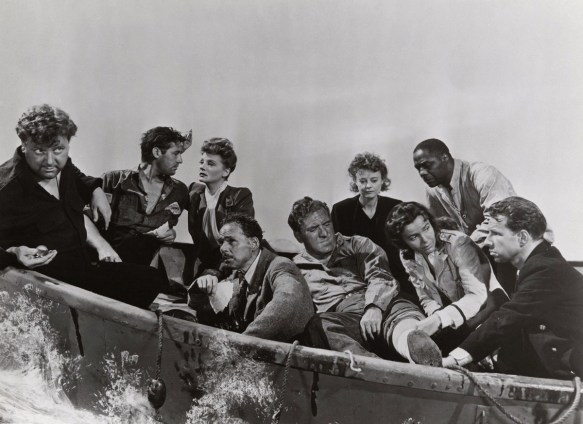
Lifeboat_(1944)_1

Great directors can take a restriction like a single, confined location and turn into something especially extraordinary. Because the likes of Alfred Hitchcock, Sidney Lumet and Louis Malle prove that these are not limits at all, but sources of cinematic inspiration. It what you do with that space that is of the utmost importance.

1. Rear Window (1954)
The ultimate thriller, utilizing one Greenwich Village apartment complex to the nth degree. Jimmy Stewart being confined to a wheelchair has never been so compelling as he begins to suspect that his neighbor across courtyard is a wife murderer. Hitchcock builds up the tension by not allowing his character to escape, and he becomes embroiled in intrigue as well as romance. It all leads to a crackerjack ending.

2.12 Angry Men (1957)

There have been many courtroom dramas, but the beauty of this character study is its new perspective. Sidney Lumet’s debut is a thing of beauty, because he lets his characters work and there are 12 wonderful actors all playing off each other. The story is simple. These men must decide if a young boy should be sent to the electric chair. Put them together in a room for an hour and a half and we learn more about mankind than we could possibly imagine. There’s nothing to make the temperature rise like 12 angry men in a room together.

3.Lifeboat (1944)

Hitchcock was always one for technical challenges and Lifeboat is a film that reflects his penchant for cinematic experiments. After an ocean liner is sunk numerous passengers are forced to board a raft together, including friends and foes. Perhaps the most surprising thing about the war drama is how Hitch is able to keep the story from being stagnant. It’s surprisingly compelling  for how simple it looks at first glance.

4.My Dinner with Andre (1981)

This film is less about dramatic tension and more about a concept. Two men sit together and share a conversation over dinner, full of all sorts of philosophical musings. Once again a simple premise gives way to interesting discussion led by Wallace Shawn and Andre Gregory playing fictional versions of themselves.

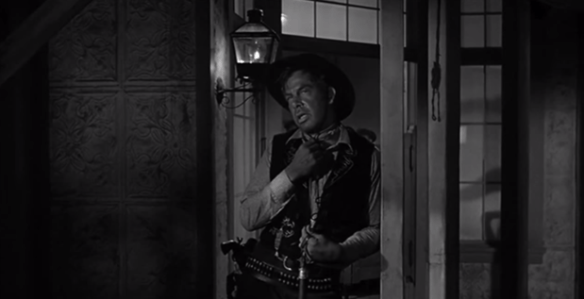
Lee Marvin as Liberty Valance (1962)

libertyvalance.png

I can enter into a discussion of The Man Who Shot Liberty Valance from two different avenues. Most obvious is the film itself. As far as star power, Lee Marvin is playing third fiddle to John Wayne and James Stewart, the undisputed stars of this film.

However, Liberty Valance is a wonderful role, because certainly this is about Wayne and Stewart, but on the other hand its Marvin who has his name in the title, and that’s not something to be taken too lightly. He’s at the core of this film, because it is his villainy and criminal activities that create the conflict in this story line and elicit a response from both of our leading men. He forces their hand and it becomes the call to action for a final showdown.

The fact that the film’s narrative is told, rather like a film noir, with a flashback creates this type of aura not only around Wayne’s Tom Doniphin but the notorious Liberty Valance himself. Because although we see Ransom Stoddard (Stewart) in the present along with his faithful wife (Vera Miles), the  two other men are only made available to us through eyewitness account. Around them is built a type of legend and that ultimately makes Liberty Valance a fascinating figure. Dressed in black, swinging his whip menacingly and boisterous as all get out, Lee Marvin is the perfect man to portray Valance.

In a sense, it feels like he’s at the crossroads of his career, in transition from his heavy roles to being a top billed tough guy. The Big Heat and Liberty Valance represent his earlier turns before he progressed to The Dirty Dozen and Point Blank as a silver-haired tough-as-nails leading man. Marvin was arguably never more larger-than-life than his time as Liberty Valance. Perhaps it was because he was forced to hold his own against Stewart and Wayne. As the famous quotation goes, “When legend becomes fact, print the legend..” Well in this case, Lee Marvin did make Liberty Valance in a legendary villain deserving to be among the pantheon of baddies.

However, there’s also Gene Pitney’s billboard charting tune also called “The Man Shot Liberty Valance,” which although it was not featured in the film, sums up its story quite impeccably.

The lyrics read like so:

When Liberty Valance rode to town, the womenfolk would hide, they’d hide
When Liberty Valance walked around, the men would step aside
‘Cause the point of a gun was the only law that Liberty understood
When it came to shootin’ straight and fast, he was mighty good

From out of the east a stranger came, a law book in his hand, a man
The kind of a man the West would need to tame a troubled land
‘Cause the point of a gun was the only law that Liberty understood
When it came to shootin’ straight and fast, he was mighty good

Many a man would face his gun, and many a man would fall
The man who shot Liberty Valance
He shot Liberty Valance
He was the bravest of them all

The love of a girl can make a man stay on when he should go, stay on
Just tryin’ to build a peaceful life where love is free to grow
But the point of a gun was the only law that Liberty understood
When the final showdown came at last, a law book was no good

Alone and afraid, she prayed that he’d return that fateful night, aw, that night
When nothin’ she said could keep her man from goin’ out to fight
From the moment a girl gets to be full-grown, the very first thing she learns
When two men go out to face each other, only one returns

Everyone heard two shots ring out, one shot made Liberty fall
The man who shot Liberty Valance
He shot Liberty Valance
He was the bravest of them all

The man who shot Liberty Valance
He shot Liberty Valance
He was the bravest of them all

So if Marvin’s portrayal doesn’t already make Liberty Valance into a mythical villain, then this number certainly does. We can read it a bit like a western folktale, emotive and surprisingly true to the film’s narrative arc. But what it leaves us with are the result of that showdown that happened so many years ago…

The point of a gun was the only law that Liberty Valance understood, and he was forced to pay penitence for his misdeeds under the barrel of that same law — at the hands of the hero christened only by the name “The Man Who Shot Liberty Valance.”

Written as part of The Great Villain Blogathon featured HERE


Review: Shop Around the Corner (1940)

Shop-Around-the-CornerA quaint, unassuming film, especially up against other more lavish Ernst Lubitsch works like Trouble in Paradise and Heaven can WaitShop Around the Corner still manages to be in the upper crust of romantic comedies — even to this day.
The story revolves around a little shop in Budapest run by the often curmudgeon and excitable owner Mr. Matuchek (Frank Morgan). Every morning he comes to open up shop and nearly every day he has something to complain about whether it’s his workers or the lack of business. His right-hand man is Alfred Kralik (James Stewart) who has been a diligent clerk in the store for well nigh nine years now.

He confides in his older colleague and friend Mr. Pirovich (Felix Bressart) that he has begun correspondence with a mysterious lady friend who was looking for a partner with whom to discuss culture and all the higher forms of art. Kralik is intrigued as he wants to expand his mind and he seems to have found his perfect match.

Meanwhile, the status quo gets shook up a bit when a Ms. Novak comes into the shop. At first, she gives off the sense of a flustered shopper, but in a matter of moments, she proves herself as a shop girl, acquiring a position even without a vacancy.

Over time, his relationship with Ms. Novak becomes increasingly more antagonistic, to begin with, because she wears a blouse unsuitable for the workplace. The prospect of his first meeting with his secret correspondent has Kralik on edge in expectation, but when he cannot sneak a peak, Pirovich looks for him and delivers a stunning revelation. It is, of course, Ms. Novak.

In such a way the dramatic irony begins as Kralik understands just who this girl is, and she continues to brush him off as the stiff, bowlegged man from the shop around the corner. Mr. Matuchek has unspoken problems of his own that cause him to abruptly fire Kralik, his most faithful counterpart. But their relationship is patched up and the crackerjack clerk gets his position back and then some.

There’s still the matter of Ms. Novak because he truly does feel something for her, even showing up at her home to see how she is getting on after calling in sick. It’s in this moment that she reads one of the letters in front of him. One of his letters.

Then, right before Christmas everything his bustling and busy in the little shop. All seems right as Mr. Matuchek is in good spirits with a Scrooge-like transformation for the holidays. He even winds up with someone to share a festive holiday meal with. It seems that Kralik has a fiancee and so does Ms. Novak. As it is Christmas they both try to leave the other on a positive note, and Klara goes so far as to mention her initial crush on her colleague. This then becomes the critical moment for Kralik as he still knows something she doesn’t. He frightens her stiff about her mystery man and then reveals him to be her pen pal. All it takes is a carnation in the lapel. She gets it right then. They embrace and share a kiss.

Although Stewart is far from a Hungarian clerk, he does exude a pleasant commonness, better than any other actor of his era. As such, he has the perfect demeanor and presence to portray Kralik, a man who seems altogether ordinary, although he certainly is more than meets the eye. Margaret Sullavan seems a generally forgotten leading lady, but there is an airy, almost ethereal quality to her. In real life, she proved to be difficult at times, but here she somehow fits rather remarkably with Stewart. The two leads prove to be adept sparring partners in Lubitsch’s altogether effortless romantic comedy.  It truly reconciles the lines between ideals and reality which allow two people, such as these, to fall in love for real.

4.5/5 Stars

Klara Novak: All my knowledge came from books, and I’d just finished a novel about a glamorous French actress from the Comedie Francaise. That’s the theater in France. When she wanted to arouse a man’s interest, she treated him like a dog.

Kralik: Yes, well, you treated me like a dog.

Klara Novak: Yes, but intead of licking my hand you barked.


The Best Years of Our Lives (1946): The Forgotten Counterpart to George Bailey’s Story

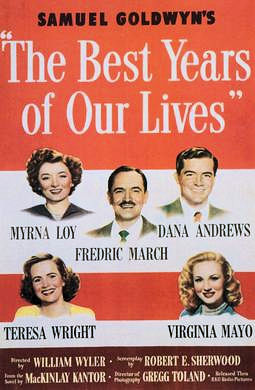
The_Best_Years_of_Our_Lives_film_Inherent in a film with this title, much like It’s a Wonderful Life, is the assumption that it is a generally joyous tale full of family, life, liberty, and the general pursuit of happiness. With both films you would be partially correct with such an unsolicited presumption, except for all those things to be true, there must be a counterpoint to that.
Upon watching both these films on subsequent days, that became markedly evident. George Bailey (James Stewart), of course, must go through a perturbing alternate reality where he never existed, and the consequences are catastrophic to all those he knows and loves in his community. But such a paradigm shift or new perspective, does truly revitalize his entire existence. It’s as if he sees the whole world through an unfaltering lens of hopefulness thereafter.

Although it lacks the dark fantasy that engulfs the latter half of It’s a Wonderful Life, Best Years has its own heavy dose of foreboding, that while more realistic, is no less disconcerting. All the boys have returned from the theaters of Europe and the Pacific, including our three protagonists Fred (Dana Andrews), Homer (Harold Russell), and Al (Fredric March). Upon getting back to their old abode of Boone City, sons talk about nuclear fallout in Hiroshima and men at drug store counters warn of the imminent threat of “The Reds.” Some soldiers like Fred have trouble landing work. Others struggle with getting the necessary loans from banks like the one Al works at,  or they come back to far less glamorous lifestyles. Homer copes with being a double amputee and simultaneously closes himself off to all those who love him, including his longtime sweetheart Velma (Cathy O’Donnell). He must learn not so much how to love, but the equally difficult life skill of allowing others to love him.

Derry also struggles in a loveless marriage with his superficial wife Marie (Virginia Mayo), while also battling with PTSD symptoms like recurrent nightmares. Even the subtle reality that the only African-Americans in the film work behind soda fountain counters or in nightclub jazz bands has greater implications. Theirs is a relegated status, even in a country of liberty like America. Unlike the former film, we do not see any ghoulish human cemeteries, but we do see plane graveyards like ghost towns where metal is slowly rusting just waiting to get demolished and re-purposed. At this point, it is only a sobering reminder of all those who fought and died in the war years.

Many of these topics are only mentioned for a brief moment or we can only infer them from visual cues, but still, they lurk there under the surface or better yet, right in plain view. These real-life unsettling concerns are worse than It’s a Wonderful Life because they fall so close to home even today.

Wounded veterans are still coming home to a country that doesn’t know what to do with them, or a country that seems ungrateful for their service. Married folks still struggle through marriage and divorce. Single people still struggle with figuring out if they should get married and so on.

I think part of the reason I admire The Best Years of Our Lives so much, despite its nearly 3 hour running time, is its ability to captivate my attention rather like a day in the life of someone I would meet on the street. Although Virginia Mayo and Mryna Loy seem the most Hollywood, most everyone feels rather ordinary. Certainly, Dana Andrews is handsome and Teresa Wright, as well as Cathy O’Donnell, are wonderful as multidimensional girls-next-door, but I feel like I could potentially know people like them. And of course, Harold Russell was unusual since he wasn’t a trained actor. That casting choice pays off beautifully in moments such as the final wedding scenes where in a dyslexic moment he switches up his vows. But it works wonderfully as an authentic addition.

Although Gregg Toland worked on revolutionary fare like Citizen Kane, and William Wyler dabbled in all sorts of genres from westerns to period dramas, they have all the necessary sensibilities for a perfect presentation given the subject matter. The visuals are crisp and beautiful, but never flashy or overly conspicuous. The use of deep focus concerns itself with the overall composition of the frame -never attempting to focus our attention on any singular action.  It all becomes equally important. Meanwhile, Wyler directs with a sure hand that makes the actions flow organically and at the same time his ensemble is given the space and the time to grow and evolve before our very eyes.

It’s a timeless film for what it brings to the forefront and also because of what it evokes out of the audience members themselves. There is an underlying somberness to it at times, but most importantly it rings loudly with the high unequivocal notes of hope. In the post-war years, it was a pertinent film, and it still has something to offer even now. More people need to know about The Best Years of our Lives.

5/5 Stars

Review: The Philadelphia Story (1940)

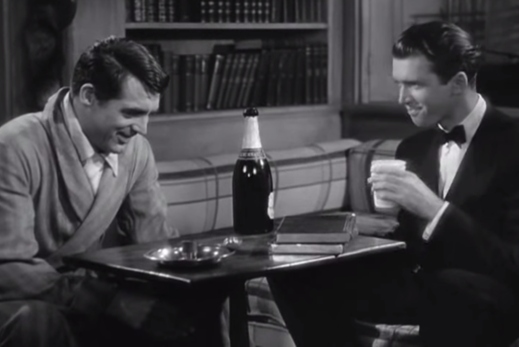
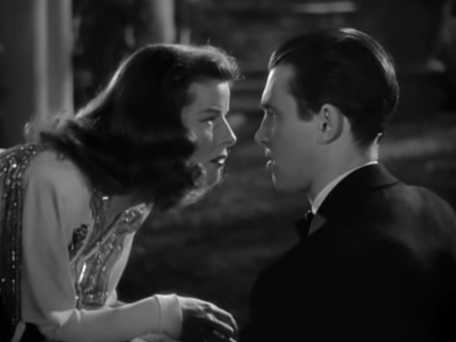
philadelphiastory1If there ever was a benchmark for the sophisticated, high-society brand of comedy, The Philadelphia Story is most certainly it. It’s less screwball because instead of Howard Hawks, George Cukor takes the helm and injects the film with his more refined sensibilities. It’s still very much hilarious and impeccably witty, but it’s not quite as scatterbrained as it could have been. Once more you have the iconic pairing of Cary Grant with Katharine Hepburn. Previously they had been in two other Cukor pictures (Sylvia Scarlett and Holiday) and of course Hawks’ romp Bringing up Baby. However, this time they’re joined by another cinematic titan in James Stewart and it proves to be a wonderful battle for command of the screen. The story ends up being a wonderful clash of classes and culture that also manages to illuminate a few bits and pieces of truth.

C.K. Dexter Haven (Cary Grant) had it out rather acrimoniously with his wife Tracy Lord (Katharine Hepburn) and now two years down the line, she is set to marry someone else. She couldn’t be happier to be rid of him and all his faults. Her new husband is a real “man of the people,” the wooden George Kittredge (John Howard), and he got his money doing an honest day’s work. In other words, he’s everything Haven isn’t when it comes to class and manners, but he’s also quite different than Tracy. But she doesn’t seem to mind. She’s on cloud nine to be rid of Haven.

Although Cary Grant does take a back seat at times, it’s only so he can manipulate and connive in the background, because he most certainly has an agenda. It’s great fun to watch. First, he brings in the folks from Spy magazine to do a full spread on the big wedding. There’s belligerent journalist Macaulay Connor (James Stewart) scoffing at all the opulence around him and then photographer Ms. Eilzabeth Imbre (Ruth Hussey), who has something complicated going on with her colleague.

They’re all here because the editor of Spy has a nice juicy expose piece on Tracy’s father and so C.K. advises her to go along with it. She suspects her old spouse has something to do with it, and it’s true, he didn’t put up much a protest when it came to taking part. However, Tracy’s not ready to let him ruin what she’s got going. She and her younger sister the crack-up Dinah (Virginia Weidler), put on a good show of upper-class snobbery to utterly bewilder their guests.

The funny thing is that while Tracy detests C.K. with the vehemence of the plague, her mother and sister quickly welcome the old gentleman back into their home with open arms. After all, what kind of trouble could he cause a couple days before the wedding, and Dinah is always game for a little chaos. She and C.K. have a mutual affection for each other. They’re both serial troublemakers.

After the surprise of Dexter wears off, the next person Tracy clashes horns with is the brusque newsman Connor, who is as turned off by her as she is annoyed by him. As she sees it, he’s invading her house as part of the paper’s plan to make her life miserable and steal away all her privacy. For him, she’s a stuck-up brat, who has had everything served to her on a silver platter in the west drawing-room. He thumbs his nose at the whole set-up. But a chance encounter at the library no less opens up a different side to these characters. Mike Connor is actually an accomplished poet far more skilled than his lousy journalistic pursuits would suggest. He learns just how perfectly imperfect she is.

philadelphiastory2It’s at a party the night before the big day that things get particularly interesting. A lot happens when you fill people up with a little bubbly, some wine, and some early morning gaiety. Tracy is absolutely swimming in exuberance partially thanks to alcohol, partially because of the dancing, and maybe in expectancy of tomorrow’s high. But when things come a little loose around the edges, things happen that you regret. As it turns out Tracy doesn’t remember quite what happened that night, but Dinah saw all the good parts from her balcony. It involved a drunken Mike taking a jaunt to Dexter’s home at a godforsaken hour followed by Ms. Imbrie with an inebriated Tracy in tow. What this sets up is a wonderful little sequence where a hiccuping Stewart helps Grant orchestrate a plot to get back at Spy magazine editor Sidney Kidd. Then, Connor gets to spend the wee hours of the morning rambling on and on. It’s innocent enough, but quite the evening no less. It makes Kittridge quite distraught finding his bride to be in the arms of a man who is singing “Somewhere Over the Rainbow.” And of course, with such an unfortunate moment so close to the wedding it looks like things will be called off. But Kittridge is willing to make amends. It’s Tracy who realizes she has to break things off because ironically this man is too good for her.

philadelphiastory3It looks like Haven has won, but in a split second Connor is proposing marriage and ready to tie the knot with Tracy to save the wedding. Once again Tracy makes a sagacious decision (which is surprising given her earlier condition). Hangovers on your wedding day are not usually a good thing. In this moment everything falls back into place as it should and as we want it to. These are characters that we grow to care about, despite their misgivings and class differences.

When reading up on this film I was astounded to hear that the film supposedly had no outtakes. Everything we see was as it was when it was first shot and that has to be a testament to the strength of these actors and maybe a little luck. It’s true that the film sometimes enters territory that feels unscripted and loose. That’s when it really gets fun. Stewart and Hepburn. Grant throwing a quick retort here and there. Imagine, this could have been a vehicle for Hepburn paired with Clark Gable and Spencer Tracy. I’m sure that would have been great, but the whole dynamic would be very different.

So who is the winner in this film? Grant as C.K. Dexter Haven? Hepburn as “Red?” Stewart as the “Professor?” The Philadelphia Story is a real winner for the audience. What more could you want in terms of high-brow comedy bursting with legendary star power?

5/5 Stars

Review: Vertigo (1958)

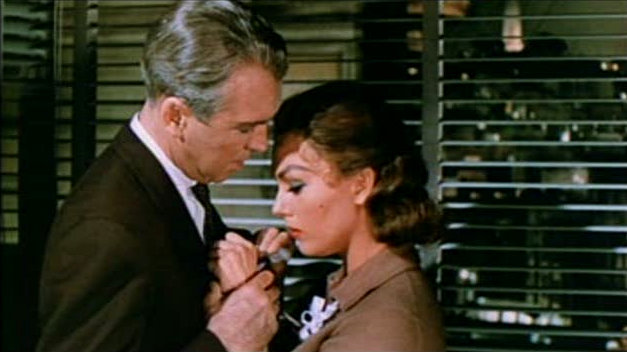
Vertigo_1958_trailer_embrace“The Greatest Film of All Time.” It certainly seems like an arbitrary title, but if nothing else it gives film aficionados something to discuss. And that’s what Alfred Hitchcock’s Vertigo is now being called for many reasons. Rather than join the debate, I wish to take a few moments to acknowledge what makes the film itself special.

On the surface, shall we say the first viewing, Vertigo is thoroughly enjoyable as a psychological thriller and mystery. The title sequence is haunting with an eye staring back at us from behind the credits and as an audience we are quickly thrown into the action, watching the opening chase scene unfold. In only a few moments one man is dead and the other John “Scottie” Ferguson (James Stewart) now has debilitating vertigo that takes him off the police force. We never learn why they were chasing a man on the rooftops. It doesn’t really matter. It’s a time later with his friend Midge (Barbara Bel Geddes) that we first see Scottie after the harrowing events. She obviously cares deeply for him, and he sees her simply as a good friend so we can undoubtedly expect her to be in the film more.

Then, rather mysteriously, an old school acquaintance named Elster (Tom Helmore) calls up Ferguson, hoping to get him to shadow his wife. It has nothing to do with infidelity, but fear, because the worried husband believes that something is wrong with his wife Madeleine. She disappears for hours at a time and is barely conscious half the time. He would describe her as possessed and Scottie is noticeably skeptical. But he relents and agrees to tail her sending himself spinning headlong into a mystery that will become his obsession.

Vertigo_1958_trailer_NovakHe gets to know Madeleine by following her, all throughout the streets of San Francisco, and much like Rear Window, this part of the film becomes a repetition of scenes followed by the reactions of Stewart. Hitchcock’s background in silents is seemingly at work here as he lets the images and score of Bernard Hermann take center stage along with Stewart’s expressions. We end up all over, from a flower stand to a cemetery, an art museum, and an old hotel. Madeleine goes from place to place like a solemn specter and we watch in expectation. Something must happen.

In an instant, she leaps into the water near the Golden Gate to commit suicide and that’s when Scottie swoops in to rescue her. He can’t lose her now because by this point he’s entranced by the icy blond who he only knows from a distance. And so their relationship progresses if you can call it that. They wander together and Madeleine shares her nightmares with Scottie.

The two of them head to San Juan Bautista and that’s when the nightmares become a reality for both of them. It’s devastating to Scottie, and the second phase of the film begins. He’s inconsolable and madly in love with this girl he cannot have. She’s hardly real. But then wandering the streets listlessly he spies Judy Barton, who coincidentally looks strikingly like Madeleine.

So he does the only thing that he can think of, meet her and try to turn into the girl he so desires. His obsessions are the only things that drive him, that and the haunting memories. Finally, he figures out the mystery, but the swirling cycle continues as he goes back to San Juan Bautista. A cruel twist of deja vu rears it’s ugly head once more.

Vertigo_1958_trailer_Kim_Novak_at_Golden_Gate_Bridge_Fort_PointHitchcock always was one for visual showmanship and it reveals itself whether it’s the parallel symbolism that Scottie notes in the painting of Carlotta Valdes or the out-of-body dream sequence that he suffers through. There’s also the dizzying zoom creating the so-called Vertigo Effect whenever Stewart looks down from a great height. These are obvious visual flourishes, but it’s almost more interesting to watch our main characters walk the streets of San Francisco, especially since there are so many real landmarks to work with (ie. Golden Gate, Mission San Juan Bautista, Muir Woods National Monument, and the Coit Tower among others). There’s something mesmerizing and trance-like about all these scenes that’s difficult to discount. It pulls us in as an audience. We want to see more. Bernard Hermann’s score is, of course, noteworthy and at its core, there is a constant disconcerting quality. It is strangely majestic and beautiful, but it pounds away menacingly. And it spirals in and out with the same sounds, the same crescendos. You think you would get sick of it, but strangely enough, you don’t. It enraptures us.

Vertigo_1958_trailer_embrace_2Then there are the players. Kim Novak has the dual role as Madeleine and Judy. She carries out both with the needed precision. Elster’s wife is elegantly beautiful, aloof and ethereal in a way that makes her the obvious fantasy of Stewart’s character. When she casts a sidelong glance or stares up at Stewart there is a faraway quality in her eyes. The clothes. The hair. How she talks. Even how she carries herself. She is spellbinding, otherworldly, and almost unattainable in all ways. Then there’s Judy, the epitome of a Midwestern girl. Pretty but not elegant. Smart but not cultured. But she falls for Ferguson as he falls for an impossible ideal.

Vertigo_1958_trailer_Stewart_on_a_laddderJames Stewart is an important piece in this film because it’s his character’s obsession that drives the plot. His instabilities, his desires, his anguish, his vertigo. It has been said that Stewart himself is a stand-in for Hitchcock and the own inner workings of the director’s being. His obsession and lusts. That may be true but something else that could be inferred is that Stewart is really a stand-in for all of us. After all, there was no greater every man than him, but there also is a universal quality to the baggage weighing on his being. Stewart’s every man is certainly being subverted, or could it be he is becoming a more accurate depiction of everyone? It’s a scary thought but what is buried inside of us? What are our own fantasies, obsessions, and lusts that lurk under the surface? Let me put it a different way.

For Stewart, he has three prominent women in his life. There’s the fantasy in Madeleine, the perfect ideal, who will ultimately ruin his life because intimacy with her is impossible. There’s Judy who has a passionate love for him, but it seems complicated in so many ways. She’s trying to measure up to his standards. The ideals and fantasies he has created poison what they could have. Then, there’s Midge who is practical, funny, and also completely devoted to Scottie. If his head were on straight he would go right to her because he would undoubtedly find the most satisfaction in that relationship, but his obsessions have undermined that.

There was an alternate ending of the film which showed Scottie with Midge once more, listening on the radio about Elster’s capture. The ending that was kept is more powerful, not because Elster got away scotch free, but because we don’t see Midge again. She all but disappears by the end of the film and with her goes all that could have been decent and good about reality for Scottie. He gets so caught up in fantasy and that tears his life apart. He’s literally spiraling in a web of never-ending hellish obsession.  Who knows what becomes of him? We can only guess.

5/5 Stars

Call Northside 777 (1948)

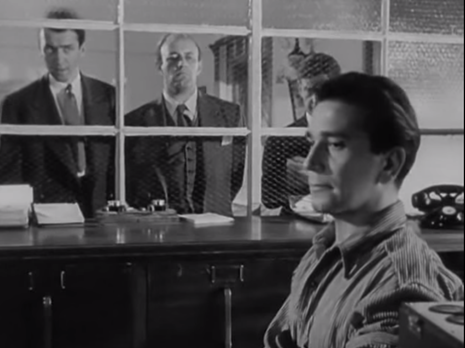
callnorth1It’s not really noir and it’s hardly a procedural. After all, it’s not from the point of view of the cops, but an intrepid investigative journalist who is looking to clear a man’s name after 12 years. Henry Hathaway’s film has the feel of a docudrama much in the same vein as it’s post-war contemporaries T-Men and The Naked City.

It’s methodical. It goes through the paces. Setting up the story by first going back to the prohibition era in 1932. That was the year that the unassuming Frank Wiecek (Richard Conte) was sentenced to a 99-year sentence thanks to some eyewitness testimony.

Years later the story catches the attention of a newspaper thanks to an odd ad in a paper offering a $5,000 reward for answers. The editor of the Chicago Times (Lee J Cobb) thinks there’s a story behind it and that sends his ace bloodhound P.J. McNeal (James Stewart) out to dig around for answers. Others have sympathy for Wiecek, but McNeal comes into the story as a skeptic. He’s just looking for an angle, a way to spin it to get a good story. But after testimony, lie detector tests, and bits and pieces of information he begins to change his tune.

However, the puzzle pieces just aren’t fitting together completely and he even begins searching around the Polish sector for the key witness Wanda Skutnik, but the state attorney’s office is putting pressure on him. In the end, it ends up being technology, in the form of blowing up a picture, that is able to set Wiecek free and it’s all thanks to McNeal.

Obviously, the main reason to watch this film is Stewart because this film feels strangely different than anything else he ever did. After the war, he was done with the idealism of Jefferson Smith and later on he would devote himself to westerns and thrillers steeped in psychology. Call Northside 777 is a rather straightforward film, about cold hard facts, and the truth. Almost like an episode of Dragnet with Stewart’s reporter standing in for Joe Friday. His dynamic with Helen Walker feels genuine and real so it’s a shame that his home life did not play more of a role. Richard Conte also does a good job at exuding innocence (very different from his role in The Big Combo). Aside from an understated role from Cobb, we also have E.G. Marshall, and we even see Thelma Ritter for a brief moment.

3.5/5 Stars

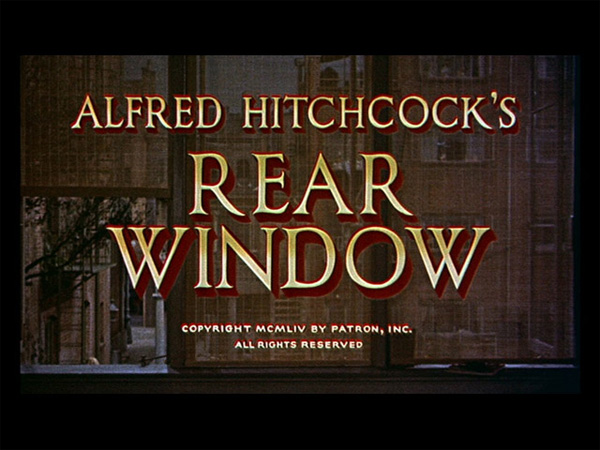
Review: Rear Window (1954)

Hitchcock_stills_0006_rear-windowWho in their right mind would make a film that takes place in a courtyard? Rear Window has always been fascinating from a technical standpoint, and Alfred Hitchcock is certainly not “The Master of Suspense” for nothing. He uses the confined space of a single Greenwich Village courtyard with an incapacitated individual to truly build the tension to immeasurable heights. The events within the film are often highly bemusing as Hitchcock has a wicked sense of humor, whether Jefferies is trying desperately to scratch that itch or the conversation turns morbid as he tries to eat breakfast.

The script has so many great little moments of back in forth repartee; some supplied by the always dynamic Thelma Ritter who plays the nurse with a lot of advice and opinions about rear window ethics: “We’ve become a race of peeping toms. What people ought to do is get outside their own house and look in for a change. Yes, sir. How’s that for a bit of home-spun philosophy.

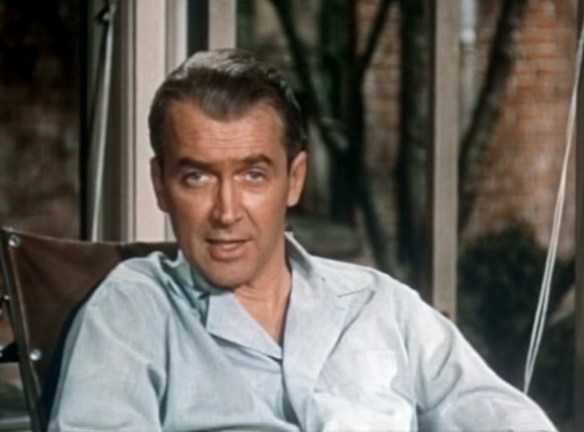
James Stewart is always a pleasure, but this time around he is perhaps at his most constrained as famed photographer L.B. Jefferies, who is laid up in his apartment for weeks on end with a leg in a cast. He got the injury thanks in part to his last big photo shoot where he ran in front of an oncoming race car. With nothing better to do, he spends his idle moments people watching and getting to know his neighbors. That’s one way to put it at least. As an actor, Stewart is stuck and relegated to conveying his whole performance through his gaze and the dialogue he speaks to those few who come in and out to see him. Most of what he’s doing is simply looking across the way and yet it works.

His neighbors are as follows:

There’s Ms. Torso who is an aspiring dancer and always the target of many men. There’s Ms. Lonelyheart who never can find the love she so desires. A washed-up composer spends the entire film trying to figure out his newest project (even getting a visit from Hitchcock himself). There are the newlyweds who hardly ever leave their bedroom because they’re doing something… Then, comes the older couple on the second floor with a cute little dog and the sculptor who lives below.

Most interesting of all is the couple directly across the way from Jefferies’ because that’s where a long-suffering husband and his wife live. All seems normal, to begin with, however, Jefferies begins to have his suspicions thanks to circumstantial evidence and no sign of Mrs. Thorwald. His first thoughts immediately shoot to murder, but it seems highly unlikely. Day and night he continues to watch seeming to get more evidence, only to have his theories crushed, and then gain new hope through more evidence.

James_Stewart_in_Rear_Window_trailerThe interesting part is that as an audience we are fully involved in this story. We see much of the picture from Jefferies’ apartment, because there is no place to go, and so we stay inside the confines of the complex. In this way, Hitchcock creates a lot of Rear Window‘s  plot out of actions occurring and then the reactions that follow. We are constantly being fed a scene and then immediately being shown the gaze of Jefferies. It effectively pulls us into this position of a peeping tom too. Danger keeps on creeping closer and closer as he discovers more and more. The narrative continues to progress methodically from day to night to the next day and the next evening.

In the climactic moments, he finally faces the man who he always looked in at from the outside and yet by the end the roles are reversed with Jefferies space being fully invaded, and yet he can do little to flee, because of his cast. Hitchcock cuts it in such a choppy and chaotic way which breaks with the smooth continuity of the rest of the film, but it works so wonderfully in stark juxtaposition.

This is one of the main appeals of Rear Window because it has this Hitchcockian story of murder, mystery, and suspense. However, I am constantly eager to revisit this story, since there are so many other intricacies that are of interest.

Although the film uses a score by Franz Waxman, the majority of the sounds heard are diegetic and they either are street noises or music wafting around the courtyard from one of the apartments.  Also, there is only one small outlet to the outside world. At times, it becomes fun to survey what is going on whether it is kids playing on the street corner or cars passing back and forth. It builds this sense of realism suggesting that this world that has been created is larger than this one set full of apartment buildings.

Another important element is themes of romance and love. Jefferies comes into the film with issues in his own love life. His girl is the elegant and refined Lisa Fremont (Grace Kelly), who seems perfect, too perfect in his estimation. In his mind, they just don’t seem compatible enough, and he cannot see marrying her. It’s something they have to work through because she truly loves him.

Really every character essentially has a different outlook on love and different struggles, because romance is never an easy thing. Like the lyricist’s song, it is so often fragmented, but in their case, Jefferies and Lisa seem to figure things out just as the song finally gets finished. The moment where you can see it in Jefferies’ face that he is both impressed and worried for Lisa’s safety seems to be the time when things change. He realizes his love for her since she is very dear. He quits his thinking and his analyzing of their relationship, as gut-wrenching emotions take over when she is caught. In a sense, he listens to Stella’s earlier advice: “Look, Mr. Jefferies, I’m not an educated woman, but I can tell you one thing. When a man and a woman see each other and like each other they ought to come together – wham! Like a couple of taxis on Broadway, not sit around analyzing each other like two specimens in a bottle.”

Wendell Corey, in his supporting role as Jefferies’ friend and the police detective, is a man who can be a skeptic and still prove his loyalty as a friend. They can be at odds and still poke fun at each other with mutual affection. It feels real. Raymond Burr as the villainous Lars Thorwald works well too because he is certainly an angry, unfriendly grouch, but he does not seem altogether evil. It shows how easy it is for the lines to be blurred.

rear-window-first-shot-of-gkAbove all, Grace Kelly shines opposite Jimmy Stewart. There’s no one quite like her, so elegant, eloquent, with a touch of playfulness and adventure. She is willing to fight for her man and even go out on a limb for him (ie. breaking into Thorwalds’ apartment). One of the film’s most extraordinary images, out of many, has to be when a shadow covers the face of Stewart as he rests. Then there is a close-up of Kelly, her face slowly descending towards him. It’s hard to forget and for the rest of the film, she attempts to not let him forget her.

It’s not often easy for me to make statements like this, but Rear Window has to be close to my favorite film of all time. Yes, I said it. It never gets old for me, and I pick out new things every time. It’s more than just a mystery thriller. Hitchcock made it a technical marvel that is also steeped in themes of love and ethical questions. The players are the best of the best from James Stewart, to Grace Kelly, to Thelma Ritter, all down the line. It’s at times deliberate, but never boring, completely immersing the viewer into this drama as a firsthand witness. It’s the type of cinema we just don’t get every day because it has everything and it cuts to the core — to the most visceral level. That is the sign of cinematic greatness.

5/5 Stars