Vincente Minnelli Films (1958-62)

Gigi (1958)

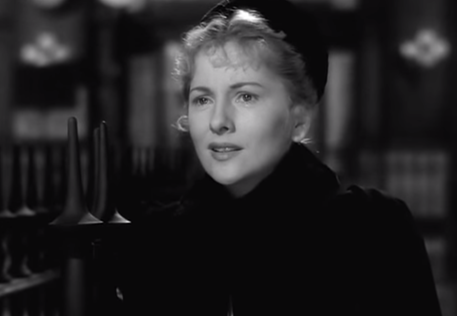
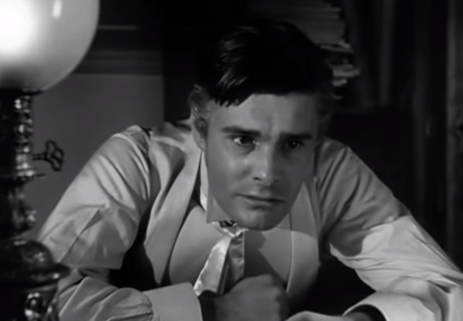
Lerner & Loewe’s adaptation of Colette’s Gigi is a picture accentuating the France of Hollywood’s most opulent dreams and confections frequented by the consummate French people of the movies: Maurice Chevalier, Leslie Caron, and Louis Jordan.

Whether it’s Ernst Lubitsch or Billy Wilder or Vicente Minnelli, Chevalier doesn’t change much. He’s convivial with the audience existing just on the other side of the camera. He gives off his usual cheeky, harmless charm that doesn’t always play the best seeing as his first tune is about the litters of girls who will grow up to be married and unmarried young women in the future.

Gigi (Caron) is one of their ilk, a carefree gamine who lives under the auspices of her Grandmama’s house, a startling domicile touched by Minnelli’s charmed palette of deep red.

In some manner, Gigi seems to represent the worst of Minnelli. Yes, it was wildly popular in its day, but all of its manicured embellishment and immaculate set dressings feel mostly fatuous and merely for their own sake. While one can easily appreciate the pure spectacle of the thing, the director’s best pictures show a deep affection for characters.

Here all manner of songs and tête-à-têtes are cheery and bright, while never amounting to something more substantive. It’s easy to suggest the movie revels in its own frivolity. Gaston (Jordan) is a ridiculously wealthy young man and Eva Gabor is his companion, though the gossips get ahold of them. They’re not in love.

Another primary reservation with the picture is how Leslie Caron is summarily stripped of most of her powers. At times, dubbing feels like an accepted evil of these studio-era musicals or a stylistic choice of European maestros. However, in Caron’s case, not only is she not allowed to sing, she can’t talk for herself either (dubbed by the cutesy Betty Wand). I might be missing something, but this seems like a grave misfortune.

You can add to this fact the further grievance she never really has a traditional dance routine, and there’s nothing that can be appreciated about the picture in comparison to the crowning achievements of An American in Paris. All that’s left is to admire is her posture and how she traipses across the canvasses Minnelli has devised for the picture. This alone is hers to control, and she just about makes it enough.

My favorite scene was relatively simple. Gigi and Gaston are at the table playing cards, and they exude a free-and-easy camaraderie. If it’s love, then it’s more like brother and sister or fast friends who like to tease one another. It isn’t yet treacly with romance. Instead, they break out into a rousing rendition of “The Night They Invented Champagne,” which distills its point through an exuberant melody.

The lingering power of the film is how it does its work and grows on me over time. It considers this not totally original idea of trying to become who you are not in order to please others. Gigi must learn the breeding and the etiquette, acquire the clothes, and in short, turn herself inside out in order to fit into rarefied society.

Gaston doesn’t want her to be like that, attempting to replace all the elements of her character that make her who she is. This is what he likes about her. If it never turns to eros, then at the very least, it’s shared affection. Caron and Jordan make their auspicious entrance at Maxim’s and, it feels like a precursor to Audrey Hepburn’s introduction in My Fair Lady. It’s not a bad comparison since most of the film is filtered through speak-singing.

Does it have a happy ending? In a word, yes, but Chevalier singing about little girls doesn’t make me any less squeamish the second go around. Thankfully, Minnelli is no less of a technical master with Gigi. Still, film was not meant to live on formalistic techniques alone.

3/5 Stars
Bells Are Ringing (1960)

The title credits are so gay and cheery with so many admirable names flashing by on the screen, it almost negates the sorry realization that this is the last go-around for the famed Arthur Freed Unit at MGM. Pick out any of the names and there’s a history.

Say Adolph Green or Betty Comden for instance; they were the architects of some of the era’s finest. Anyone for Singin’ in the Rain or The Band Wagon? The movie spells the end of the era, though there would be a few later holdouts.

Like It’s Always Fair Weather, Will Success Spoil Rock Hunter?, or Pillow Talk, Bells Are Ringing is well aware of its cultural moment, and so it reminds us about the necessity of telephone answering services. Actually, one in particular called Susanswerphone.

It’s easy to love Judy Holliday from the outset as she’s playing crazy gymnastics on the telephone lines because automation hasn’t been created yet. Originally, she was a comedienne best remembered for a squeaky voice and a ditsy brain. Bells Are Ringing, which she originated on the stage, allows us to see a different contour of her movie personality, one that might as well hewn closer to the real person.

She does her work ably only to suffer through a dinner date from hell (with her real-life boyfriend Gerry Mulligan). However, we couldn’t have a movie without a dramatic situation.

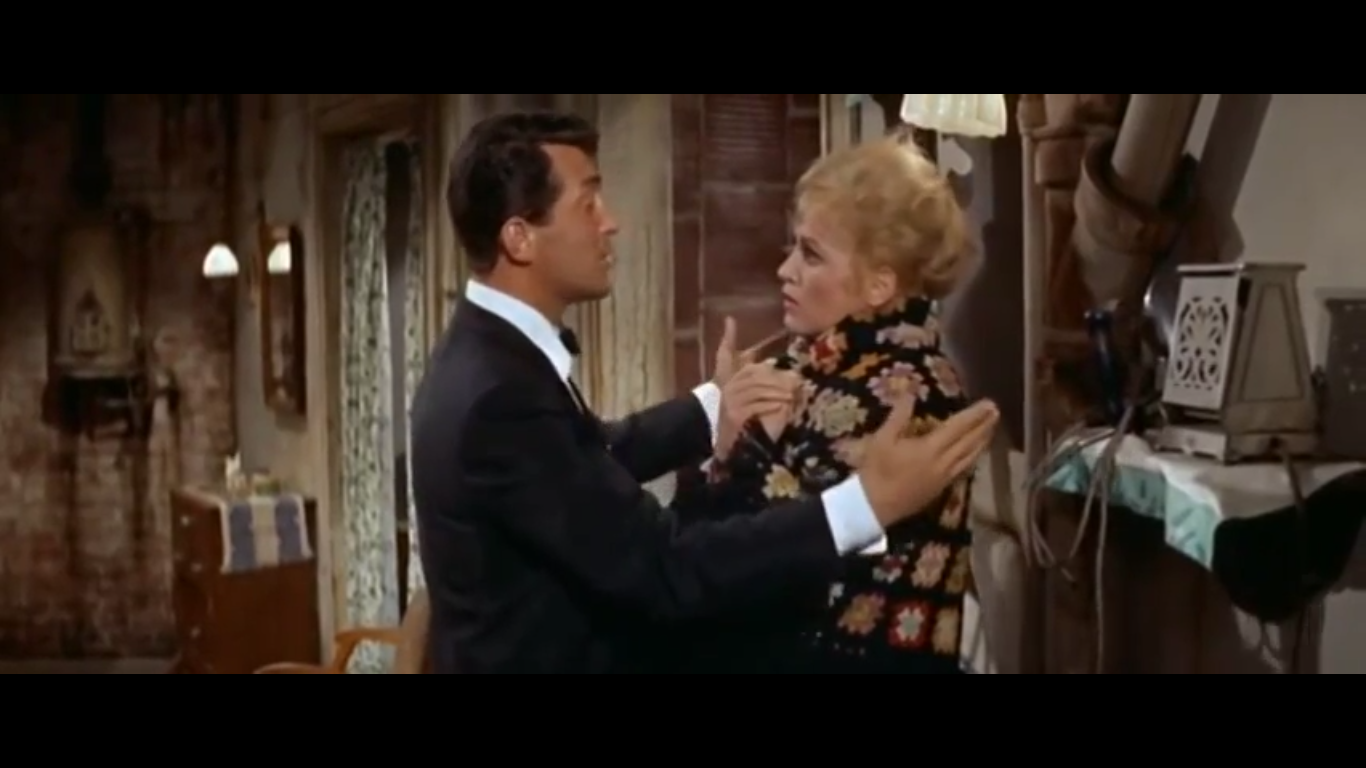
The staff are forewarned never to cross the line to “service” their clients. But she breaks the cardinal rule, overstepping the bounds of a passive telephone operator and becoming invested in the lives of those people she communicates with over the wires. Not least among them, one Jeffrey Moss (Dean Martin).

She’s just about lovesick over his voice. It’s no mistake that she puts on her lipstick before ringing him up to remind him about a pressing engagement, as if he can take in her appearance intravenously. Alexander Graham Bell never quite figured out the science behind that.

It’s not much of a mystery to us what Moss looks like. Because if you read the marquee, you know it’s Dino. But she doesn’t know that and scampers up to his room to save him. Surely there’s a Greek tragedy trapped in here somewhere. If it’s not about falling in love with a reflection or her own work of art, then it’s about the sound of a man’s voice. She wants to help him gain confidence in his own abilities as a writer.

But first please allow me one self-indulgent aside. Dean Martin had a point in unhitching himself from Jerry Lewis. Sure, Lewis had a groundbreaking career as an actor-director, but Dino was so much more than The Rat Pack and his TV program.

The string of movies he took on throughout the 50s and 60s never ceases to intrigue me. He could go from The Young Lions, Some Came Running, and Rio Bravo to pictures like Bells Are Ringing and Kiss Me Stupid. For someone with such a distinct professional image, he managed a steady array of parts.

The number “Just in Time” in the park is made by Holliday in striking red and Dino crooning through the night air. There’s a goofy brand of showmanship between them that we were lucky to see in many of the old MGM pictures. It’s their own rendition to complement Astaire and Charisse from Band Wagon showcasing Minnelli at his best and brightest as we are brought into a moment of fluid inspiration where all facets of the production look to be working on high cylinders.

At the nearby party, Holliday becomes overwhelmed by the Hollywood glamour scene, as all the folks jump out of the woodwork and start smooching as Martin descends down a spiral staircase. This only happens in the movies, and yet it’s a summation of her blatant otherness. She doesn’t fit in this crowd where everyone is on first name basis with the biggest names in the business (“Drop That Name”). It seems like their worlds are slowly drifting apart as her secret life is about to totally unravel.

However, Martin joins forces with a musical dentist and Mr. impressionist himself, Frank Gorshin, who puts on his best Brando impression as they bring the movie to a striking conclusion. The same woman has changed all their lives for the better. Now they want tot return the favor. Moral of the story, get yourself an answering service, especially one with someone who cares like Judy Holliday.

3.5/5 Stars

Two Weeks in Another Town (1962)

It might play as unwanted hyperbole, but when I look at Two Weeks in Another Town, it almost feels like a generational predecessor to Heaven’s Gate. Although Vincente Minnelli’s picture is well aware of the old hat and the emerging trends of cinema, it’s raging against the dying of the light, as it were. He subsequently bombed at the box office, and we witnessed the cinematic death knell of an era.

The director makes the transition from b&w to color well enough as you would expect nothing less from him. Kirk Douglas has what feels like a standard-issue role seething with rage thanks to a career hitting the skids. He’s bailed out of his sanitarium by a collaborator from the old days and shipped on-location to Rome.

There we get our first taste of a demonstrative Edward G. Robinson playing the tyrannical old cuss Maurice Kruger. He’s right off the set of the latest Cinecitta Studios big screen epic with George Hamilton, an Italian screen goddess, and Vito Scotti working the action.

But Two Weeks in Another Country is just as much about what is going on behind the scenes of the production. Robinson and Claire Trevor together again have a far from congenial reunion after Key Largo generations before. They’re part of Hollywood’s fading classes, though they’re far from relics.

Minnelli takes the personal nature of the material a step further. In a screening room watching The Bad and The Beautiful, the self-reflexivity has come full tilt as Douglas wrestles with his image onscreen from a decade before.

Meanwhile, Cyd Charisse makes her entrance on a jam-packed road flaunting herself in the traffic. She’s charged with playing Carlotta — Jack’s former wife — she’s bad and if her turn in Singin’ in the Rain is any indication, she’s fairly accomplished in this department. It’s almost a novelty role because she’s rarely the focus of the drama, only a sordid accent.

The pieces are there for a truly enrapturing experience as only the olden days of Hollywood can offer. I’m thinking of the days of Roman Holiday, sword and sandal epics, and La Dolce Vita. The movie is a reaction to all of them in the flourishing TV age with its glossy romance in beautiful cars, glorious rotundas, and luscious beaches.

It’s not bad per se, and yet it seems to reflect the very generational chasm it’s readily trying to comment on. George Hamilton utters the movie’s title and it’s all right there — utterly temporal and disposable in nature.

These moments and themes feel mostly empty and, again, while this might be precisely the point, it goes against our human desires. Either that or the movie is begging the audience to connect the dots. We want the critique wedded with entertainment. Because most of us are not trained to watch movies from a objective distance. Our mental wiring does not work like that especially when it comes to epics.

Jack is taken by a young starlet (Dalia Lavi) he meets by chance, thanks to her proximity to the troubled production. His and Veronica’s relationship becomes one of the focal points and one of the few deeply human connections in the picture.

Later, Jack’s bellicose benefactor, Maurice, falls ill. The added melodrama is to be expected along with raucous slap fights and the scramble to get the picture in under budget before the foreign backers try and pull out. The old has-been comes alive again — momentarily he has a purpose and companionship — until he’s besieged by new pressures.

Although it was purportedly edited down, it’s not too difficult to observe Minnelli doing his own version of Fellini’s earlier movie from 1960 with the dazed-out remnants of an orgy and a young Leslie Uggams singing her torch songs.

The apogee of the entire picture has to be Douglas and Charisse tearing through Rome in a mad fury. It’s the craziest, most chaotic car ride that can only be conceived in Hollywood; it’s so undisciplined and wrenched free of any of the constraints of realism. The back projections up to this point are totally expressionistic.

And as the car lurches and jerks around we realize we are seeing the film crossover: What we see behind the scenes and on the screen are one and the same, merely facades, and little more. It’s the kind of unbridled moment that could easily earn derisive laughter or genuine disbelief. There’s no way to eclipse the moment.

Instead, what follows is a cheery denouement out of a goofball comedy. Jack resolves to put his life back on track opting to leave behind his young leading man on the tarmac with a girl until they meet again. Hollywood, as is, was not totally dead — there was still some light in the tunnel — but if the box office receipts are any indication, tastes were changing.

3/5 Stars

Vincente Minnelli’s Films (1946-1955)

Undercurrent (1946)

Undercurrent hardly holds a substantial place in any noir conversations partially because Vincente Minnelli’s reputation in part seems antithetical to the dark style born out of chiaroscuro and German Expressionism. His background was squarely in luscious art design and stage productions.

Likewise, the combo of Katharine Hepburn and the two Roberts: Taylor and Mitchum, is not one that quickly springs to mind. However, there are some merits to it simply for the sake of it being different; not dramatically, these types of psychological women’s pictures were very much en vogue during the ’40s.

It’s the pieces assembled that feel unique if somewhat ill-suited. Still, the curious hybrid of tones and talents certainly is a historical curio more than intriguing to the invested party.

I almost have trouble buying Hepburn as a reticent, uncomfortable outsider among the D.C. elite her new husband Alan (Taylor) knows, a woman holding drinks in hand just waiting for someone to talk to. But if I don’t completely believe it, she does earn my empathy.

Mitchum, the legendary mule of RKO was simultaneously earmarked for 3 or 4 pictures at the time, and so he doesn’t show up in Undercurrent until much later. Still, he has the benefit of casting a Rebecca-like influence over the picture.

After an hour of building him up, we finally get sight of Mitchum, and we know where this story is going. Because he’s a real human being and fairly innocuous to the eye. As the presence of Mitchum begins to exert itself on the picture, the marital bliss of newlyweds grows more and more harrowing by the minute. We have a picture in the same vein as Suspicion and House on Telegraph Hill.

Despite choosing the part, the constraints of the role don’t feel totally in line with Hepburn’s talents. She isn’t a shrinking violet or the kind of timorous beauty befitting Joan Fontaine or even Ingrid Bergman. Robert Taylor is mostly adequate in the vengeful husband part. He flip-flops efficiently between these stints of gracious charm — a perfect husband and lover — then, becomes clouded by these perverse streaks of jealousy and rage.

3/5 Stars

The Pirate (1948)

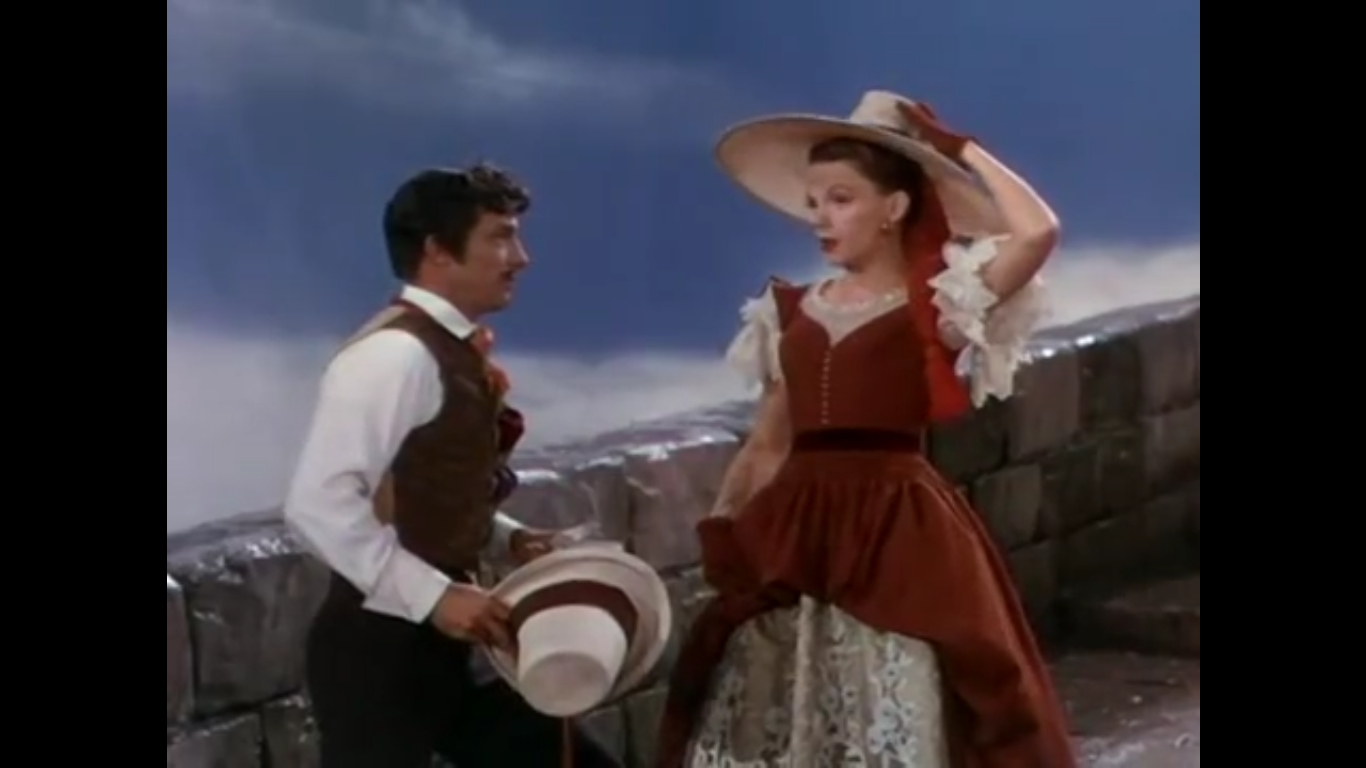
It’s plain that The Pirate is born out of the traditions of the 1940s Hollywood lineage like Blood and Sand or Black Swan, even Gene Kelly’s own Three Musketeers. However, between the bright evocative staging of Vicente Minnelli and the instant performance-driven rapport of Garland and Kelly, it works quite splendidly with what it has to offer.

Today it doesn’t hold much of a reputation, and I would stop short of saying it’s a minor masterpiece. What we do have is a picture banking on the charisma of its leads and a certain pictorial opulence supplied by its primary mastermind.

Kelly, taking all the niñas of the town by storm, is full of allure and his usual magnetism as he twirls, leaps, and bounds between all the pretty girls. It’s all about the patter between the stars as he plays the foxy street performer, and Garland is the put-upon maiden who is betrothed to another man. His vocation gives the director license to use these elements of theatricality and faux drama to tell the story.

What do I mean? It could be a story of tragic, unrequited love. It might just as well be a tale of marauding pirates, and yet somehow, between the song and dance, it becomes a kind of tongue-in-cheek comedy of two lovers perfectly suited for one another being thrown together.

There are moments where Garland and Kelly seem to be playing in a separate movie, or at least they are in on the joke with the rest of us, even as they mess with each other. Trashing his apartment feels like the highest form of romantic tension only for the drama to become slightly heady again: Kelly is set to be hung as the dreaded pirate Macoco. Is it a first to have a musical number performed under a hangman’s noose? I’m not sure.

Thankfully, he gets some stellar support. While I’ll be the first to admit “Be a Clown” feels like a less funny prototype for “Make em Laugh,” if you’ve never seen the Nicholas Brothers, it’s a small recompense to see them join Gene Kelly and get some commendation in the spotlight as his momentary equals. It feels like a flawed but heartfelt apex to a picture that could be described in much the same terms.

3/5 Stars

Madame Bovary (1949)

Madame Bovary is the kind of trenchant literary work the Production Codes would go to all costs to declaw. In one manner, it’s somewhat remedied by James Mason’s framing by providing a mostly blase narrative device to enter the story.

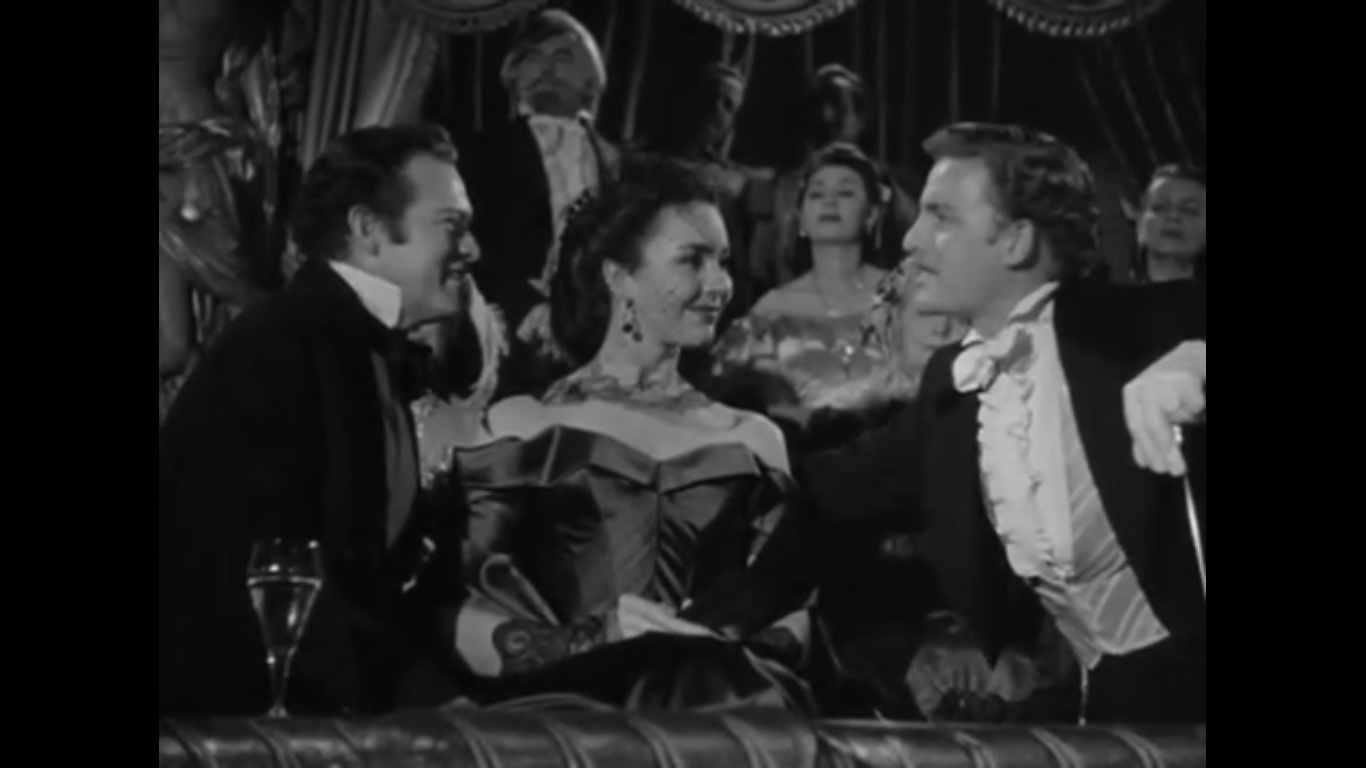
Even as something leaner in budgeted black & white (one could hardly confuse The Pirate with Madame Bovary), it’s still the same Minnelli. The ball sequence spelling the ascension of Emma (Jennifer Jones) as a society darling, while somewhat compact, exudes an impressive opulence.

The director makes sure to follow Jones’s incandescent form as she prances and waltzes her way across the dance floor with great distinction. Her gown alone is enough to make the upper classes stand up and take note. The dashing Louis Jourdan is certainly more than aware of her. It’s totally taken up by the kind of swirling euphoria also holding a place in the oeuvre of Marcel Ophuls — Letter from an Unknown Woman and Earrings of Madame Despring instantly to mind.

It becomes more and more of a gothic drama as things progress, overtaken by gales of wind, thunder, lightning, and an incessant downpour of rains to go with the equally tumultuous score of Miklos Roza.

However, more importantly, Emma becomes possessed by all of her own ambitions and preoccupations. She is emotionally distant from her husband (Van Heflin), absent from her child, and totally involved with other men. She entreats them to take her away from such a dreary life, constantly prone to these histrionic gestures of love and loss at the hands of her suitors and husband. They hardly know how to respond to her.

If the terminology was present at the time, she is cut out of the cloth of some kind of femme fatale, albeit born out of the annals of classic literature. Moreover, she is a woman who never seems to know what she truly wants. She sends out an array of mixed signals — living a life made up of so many contours and emotions — and never settling on anything honest.

It’s as if she’s fashioned a kind of fantasy life for herself woven out of her own personal whims though she remains self-destructive to the very last iota of her being. There’s something unnerving about her and Jones plays her as such; it’s easy to understand how society was scandalized by her because she does not live by societal norms. Mason’s concessions for her character aren’t enough to totally wipe out the harrowing impact of the performance.

3.5/5 Stars

The Cobweb (1955)

“What happens if you go into town to the movies? You start screaming or something? They’d think you’re a critic, that’s all.” – John Kerr as Steven

If it’s true you can make a screwball comedy like Easy Living (1937) about a fur coat falling from the sky, then it’s equally possible to make a portrait of psychological horror about drapes. The Cobweb busies itself with the vast array of interpersonal relationships taking place on the grounds of a psych ward. Richard Widmark does his best to aid his patients in their recoveries as he juggles familial and boardroom responsibilities. It’s no easy balancing act.

For a film that is mostly disregarded, it’s easy to clump it together with something like Executive Suite (also produced by John Houseman) with one of the most phenomenal assortments of players one could hope to cobble together during the golden era of Hollywood.

Lilian Gish is at her most ornery but lest we forget, she truly is the queen of the movies. Charles Boyer and Lauren Bacall are equally crucial touchstones of film history, playing two respective love interests as Widmark struggles to connect with his wife, Gloria Grahame. Even ’30s scream queen, Fay Wray, has a brief appearance in a picture that boasts Oscar Levant and then the up-and-coming talents of John Kerr and Susan Strasberg.

In one scene with all the various folks blocked throughout the room, it’s almost difficult to distinguish who’s a patient and who’s not, but if we are to appreciate this drama, it doesn’t half matter. Widmark falls for another woman. Grahame flaunts her charms and goes looking for love from Boyer, who is now mentally compromised. Gish is incensed about having her opinions disregarded. Some of them are petty and others are stricken with loneliness and actual psychoses.

The palette becomes such an evocative way to color the emotional undercurrent and elements of suburban life, not unlike some of Nicholas Ray‘s work or something like Strangers When We Meet. The visual world is beautiful; still, it lets loose an environment full of pain and inner turmoil. Although Minnelli handles his characters deftly, there’s no place for the film to go but toward a hysterical fever pitch.

3.5/5 Stars

Anne of The Indies (1951)

“What should it trouble a man to gain the whole world but lose his soul” – Herbert Marshall

There’s not a finer prospect I can think of than a Jacques Tourneur-helmed swashbuckler starring Jean Peters as a swarthy pirate who terrorizes the high seas. At this point in her career, Peters had yet to garner a starring role. Pictures like Pickup on South Street and Niagara were still in her future, but she more than proves her salt, taking to the role ferociously. The best part is that regardless of its humble running time, this is the kind of material an actor can really sink their teeth into.

Her Captain Providence proves fierce and stout-hearted in a sea of growling seafarers. Despite being one of the few women on the landscape, she’s a domineering captain of the ship who wears her sea legs well; there’s a believable pitilessness about her.

It’s the only way one survives such a climate. In their opening takeover of a ship from the British fleet, we get a perfect showcase for their merciless treatment of any foe. It primes our expectations going forward.

However, there is one uncharacteristic move our protagonist makes by pardoning a man they find shackled in the brig. He is a Frenchman (Louis Jourdan). Her right hand man is distrustful of such a rogue, but the enigmatic fellow becomes an addition to the crew after appealing to the captain’s judgment.

If she has anything close to a resident conscience, it would be the jaded doctor (Herbert Marshall), who cares for the crew’s ailments while also keeping her apprised of the words of scripture and what scrupulous men might do. This is very much the war playing out within the character. She tries to maintain her mastery of the sea while also grappling with love, opening herself up, and risking an admission of weakness.

For instance, femininity is not something to be flaunted, but Jourdan’s La Rochelle manages to coax it out of her. Like other wenches, she’s fallen for a man. He effectively comes between her and the only mentor she’s ever known.

Thomas Gomez takes on the larger-than-life task of Black Beard. He is both mentor and partial antagonist worthy of all the scurvy legends and tall tales that have been spun about him over the years. He’s armed with an agreeable bluster full of throaty good humor but also the edge of prickly menace. It makes him more threatening as the story progresses because he doesn’t forget a grudge easily.

Their initial fight is everything we could ask for in a rousing duel between a pair of boisterous daredevils. However, if this is what they do in a jocund company, you can only imagine what it will look like when animosity is stirred up between them.

Debra Paget is hardly a flash in the pan and for all the solid pictures she was a part of, more often than not it seems like she’s given very little to do. Once again she shows up as a pretty albeit sympathetic face. In this picture, she’s a fitting contract to Anne, if little else. She was rarely allowed anything more substantial.

It’s easy enough to summarize the latter half of the picture as a game of successive feints and parries back and forth with several lovely offensive thrusts from both sides. They’ll see it through to the end hell or high water, cannonballs raining down, masts crashing, fires burning all over. If it’s not obvious already, there can only be one victor in the fight to the death and the total subjugation of the sea.

The ending is another twist of romanticism. To me, it does twinge with the feelings of a cop-out, but it brings back Black Beard to fight it out with his old yard arm. They were meant to meet one final time. Except for this time, his old accomplice has been stricken with a momentary conscience. She takes her furious grit and puts it to use in one final stand of sacrificial defiance. Still, the famed pirate goes out much the way she came in as a titan among men.

There are few things I abhor more than a bloated picture where the scenery and the running time get away from the filmmakers. While Tourneur’s not anti-epic, he takes shorter, more compact material and still manages to give it the scale and import of much larger pictures. He did it with horror, westerns, and certainly swashbucklers like this one. Because genre pictures have the auspicious opportunity to offer their spectators atmosphere — all kinds of atmosphere — and we see it in spades with Tourneur. This surely is one of his finest attributes as a director.

Part of me still marvels that they actually made a movie like this in the early 1950s. But that quickly dissipates in lieu of a total appreciation for what this cast and crew are able to conjure up onscreen. It’s like they had the key to rousing swashbucklers that we’ve all pretty much forgotten. For a picture that very few people seem to remember today, Anne of the Indies is a good time, and a novel one at that.

3.5/5 Stars

Classic Movie Beginner’s Guide: Joan Fontaine

Although she probably wouldn’t like it one bit, with the recent passing of Olivia de Havilland, it seems necessary to acknowledge her sister and fellow actress Joan Fontaine.

Their sibling rivalry became the stuff of legend when they were vying for the same Oscars throughout the 1940s. What Fontaine portrayed on camera was this kind of alluring timidity, and her early work with Alfred Hitchcock remains one of the lasting creative partnerships of her career.

Her life off screen is more difficult to reconcile with her image, but regardless, here are  a handful of her films worthy of searching out:

Rebecca (1940) - IMDb

Rebecca (1940)

Joan Fontaine was a part of a couple epic ensembles with The Women & Gunga Din, but it was the early American classic from Hitchcock the following year that cemented her stature. Opposite the gail force of Laurence and Olivier and Judith Anderson’s ghostly Mrs. Danvers, she gets positively blown over. But part of the brilliance is how Fontaine plays the breathless young bride so effectively haunted by her husband’s past.

Suspicion. 1941. Directed by Alfred Hitchcock | MoMA

Suspicion (1941)

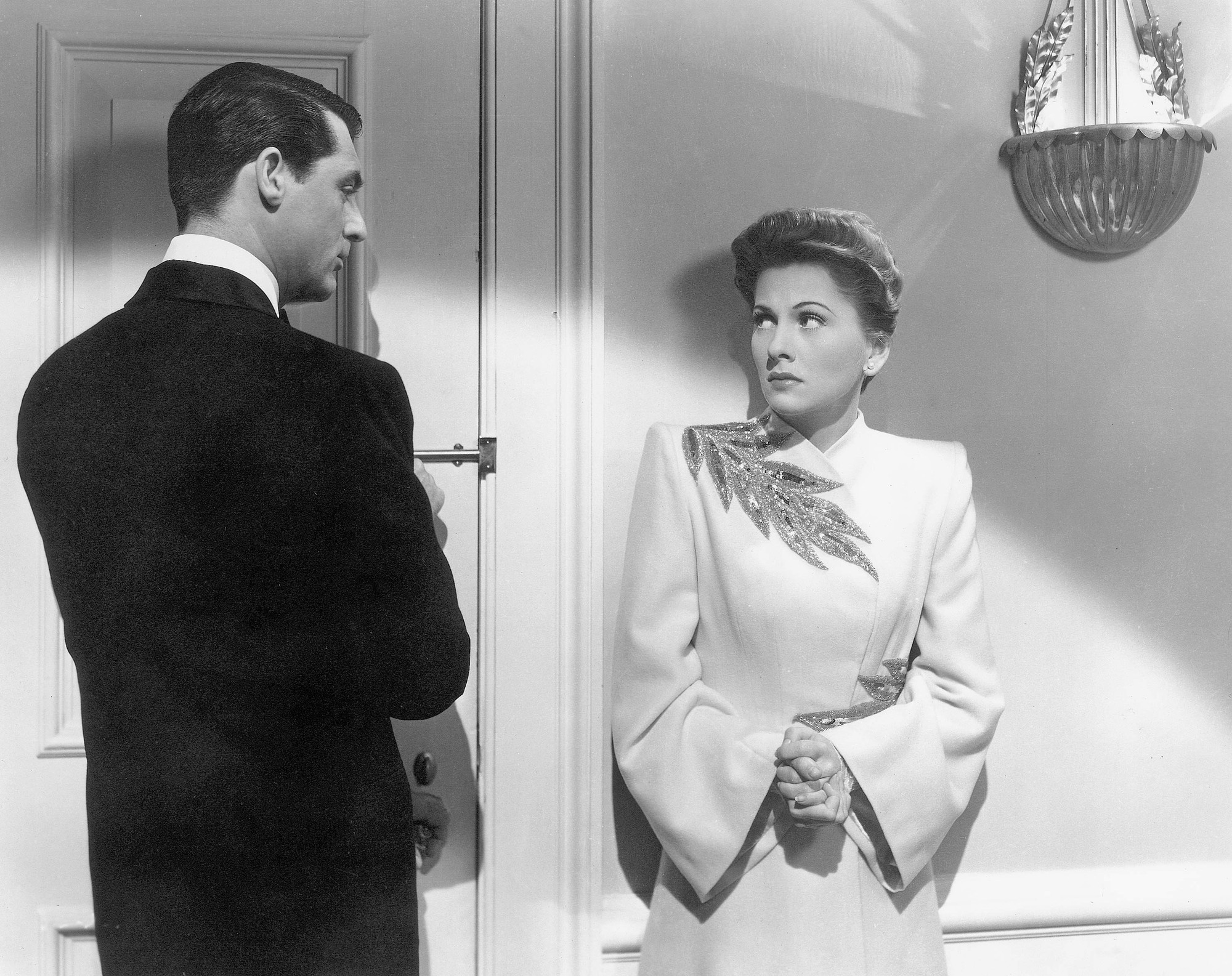
Hitchcock exploits Fontaine’s persona beautifully in this home thriller where her docile wife suspects her dashing husband — played by none other than Cary Grant — is out to murder her! It’s a tense set-up fraught with romance and peril. Both performers carry their assignments with impeccable aplomb although the ending might ruffle some feathers.

Jane Eyre spotlights Orson Welles' perfect romantic antihero

Jane Eyre (1943)

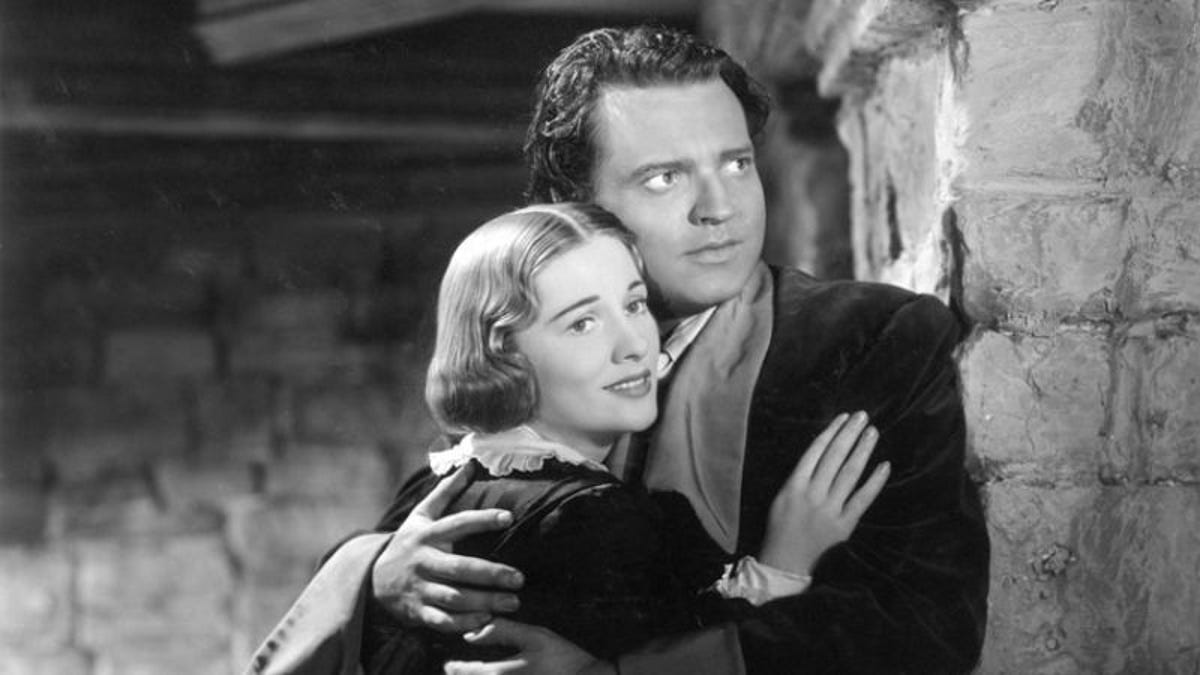
Joan Fontaine once again establishes a role pulled out a literary adaptation, and the parallels to Rebecca are quite strong. Orson Welles give the kind of brooding giant performance easily overpowering Fontaine. But it’s in her very reticence onscreen where she attains power and builds a sympathy with her audience, despite all the trials thrust upon her in Charlotte Bronte’s novel — adapted by none other than Aldous Huxley.

Letter From an Unknown Woman (1948)

Within the spiraling pirouettes of Max Ophuls and the tragic loves story of Stefan Zweig Joan Fontaine and Louis Jourdan take up their posts amicably. Fontaine’s performance runs the gamut of youth to adulthood as she falls in love with a famed pianist from afar and finds herself entwined in one of the most piercing love stories of the era. It’s a heartbreaker.

Worth Watching

You Gotta Stay Happy, The Bigamist, Othello, Island in the Sun, Beyond Reasonable Doubt


A Letter from an Unknown Woman (1948)

8cc43-letter_from_an_unknown_woman_posterThe place is Austria. The time around 1900. This tearful romance is framed by a lovely plot device in the form of a circular narrative. As the title suggests a woman writes a letter to the man who she has always loved. As she relates their story, he slowly pieces it all together.
Lisa was a shy and timid girl. She becomes acquainted with dashing piano prodigy Stefan Brand (Louis Jourdan) from afar as he has moved in next door to her mother’s home. She is a quiet observer of all he does, sharing in each one of his musical triumphs and seeing his friends (mostly women). Lisa even goes so far as to attend dancing school, so that she might learn good manners to impress him someday. Most of all his playing enchants her each and every evening as she silently listens to his gifted hands.
Thursdays were rug beating day and on one such day, she got her chance. She met Stefan’s kindly mute servant and secretly enters the shrine of her love for one blissful moment. However, things quickly change as Lisa’s widowed mother has a beau who wants them to come and live in Linz. So they move away from the oblivious Brand, but the wistful Lisa takes one last visit to her old home.
Soon she is introduced to the stately Liet. Leopold and as time passes he graciously asks for her hand. Taken aback, Lisa balks and mentions another in Vienna who her parents do not know of (and who does not know her). No one understands the reason why, only she does, and she is not one to tell. Lisa, however, moves forward and begins to model dresses for rich clientele. Finally, as a grown woman she has her first true face-to-face encounter with the man whom she worships.

Thus, begins their enchanted time together. He does not quite understand the gravity of the situation, but she is content in just being with him. That is enough. No explanations need to be made. Their evenings are spent eating lobster, walking through the streets, taking a train ride all over the world, and munching on caramel apples. Top it off with a passionate embrace followed by a kiss and the fairy tale ending seems to be imminent. But as we already suspected, it is not that easy, and a train rapidly takes him out of her life.

As time passes, she has a son who is Stefan’s boy, but she resolves not to tell him and raise him by herself. For a while, it is a struggle, but she gets remarried and she seems happy enough with a comfortable lifestyle, a gentlemanly husband, and a cute son. Stefan Brand is now a washed up has-been who used to have a wealth of talent 10 years ago. At the opera, he happens to cross paths with Lisa, a strangely familiar figure, and she realizes that she must go to him. She is absolutely ecstatic to be reunited with her first love, but all too soon it becomes evident he cannot remember her. He is fascinated by her the same way he was 10 years ago, but he has forgotten. Unrequited love hurts too much and a broken marriage is already upon her. As her son before her, Lisa’s life is taken by Typhus and all that is left of her is this letter for Stefan.
 
All that’s left for him to do is hit his head in despair. He let her slip through his fingers, if only he had known. If only his servant had not been mute, because he knew who the girl was. Brand has new resolve, however, and instead of running away he faces an unpleasant fate with honor. 
Joan Fontaine is as sweetly demure as ever, and she fits this role so beautifully with her narration being a wonderful guiding hand to the film’s story. Her character slowly grows and matures in front of us, and yet one thing remains unchanged, her love of Stefan Brand. In some ways, the label of a “woman’s picture” has a negative connotation, but really all it refers to is a film that takes the point of view of a woman, or it focuses specifically on women. These stories crafted by men during the 40s and 50s were meant to be weepy tales for women audiences. Looking back now, however, they can resonant with all audiences and in this case some of that is due to the direction of Max Ophuls. 
Ophuls camera is hardly ever stagnant, following Joan Fontaine as she moves, with gracefully smooth sweeps and tracking shots. Give him a staircase and it becomes almost a playground for him to move about as he sees fit. What we are left with is an elegant look, because the movement does not take away from the elegance but actually accentuates it. No one could accuse the camera of being hurky-jerky, and it makes the impact of the stationary camera that more potent.
At an approximately 86 minute running time, A Letter from an Unknown Woman is a marvel because it is laced with character development, romance, and drama that builds steadily and reaches a teary crescendo.
 
4.5/5 Stars