The Trouble With Harry (1955): Hitchcock, Humor, and The Macabre

jerry mathers trouble with harry

Idyllic is the word for The Trouble with Harry, and it positively crackles with the autumnal delights one can only know in locales where the seasons give way one to another.

Alfred Hitchcock’s filmography boasts many opulent and gorgeously shot sequences, but Trouble With Harry might have some of the most supernal. Part of this comes from the fact it comes in such stark contrast to his environs in Northern California.

Because the East Coast — Vermont in particular — affords him a very particular canvass and he uses them to full effect. The story goes that he went so far as to have leaves pinned back onto trees to try and replicate the shots on a sound stage. Whatever the techniques it boasts something distinctly tangible.

If the locale is not entirely functional, it still manages to be another integral character in the story just as the satisfying crunch of leaves underfoot or the thought of a lemonade out on the porch conjures up visions of a very specific sort. But of course, all of this connotation would be for naught if it was not juxtaposed with the typical Hitchcockian proclivity for the darkly macabre.

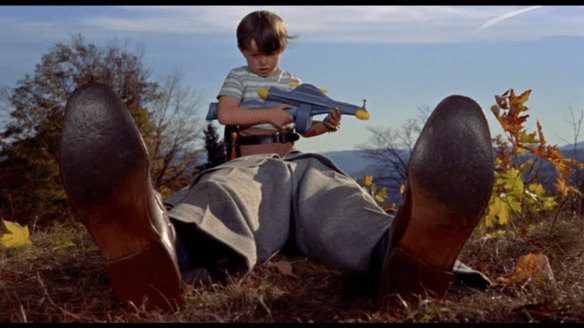
The Trouble with Harry might offer his lightest touch — it’s spritzed more evidently with humor than a great many of his movies — but the blackness at its core cannot go unnoticed. Take, for instance, that opening sequence. It’s emblematic of the whole picture. There’s tiny Jerry Mathers freakishly young (even before the days of Leave It To Beaver).

He’s running off on some boyish adventure his toy gun in hand, only to stumble upon the corpse of a man named Harry. The man’s nicely dressed. Laid out in the middle of an open pasture. More importantly, he’s dead.

Hitchcock employs a trick from the painterly masters using foreshortening to make the man’s body envelop the screen as the little boy stares down at him rather inquisitively, ready to run off and tell his mother. From the outset, Bernard Herrmann’s scoring is both rigorous and rather jaunty, perfectly in tune with the sense of place and tone.

But this is no conventional tale of malice or ill-blood. It is, however, the Macguffin to kick our story off. Edmund Gwenn is another fellow who comes upon the body quite by chance — he was out shooting rabbits unsuccessfully — could it be a stray bullet that took Harry out? He thinks it’s better not to risk it and decides to drag the body to more secluded terrain.

However, he’s met by one of his neighbors. John Michael Hayes’ script does splendidly in moments like these. It’s able to place small-town pleasantries up against a grisly murder as if it’s a small trifle — a mere afterthought to be dealt with in the manner of a pothole or a roach problem. In the end, Captain Wiles (Gwenn) and Ms. Gravely (Mildred Natwick), a kindly spinster, set up a date for afternoon tea with the promise of blueberry muffins and genial company.
forsythe macLaine trouble with harry

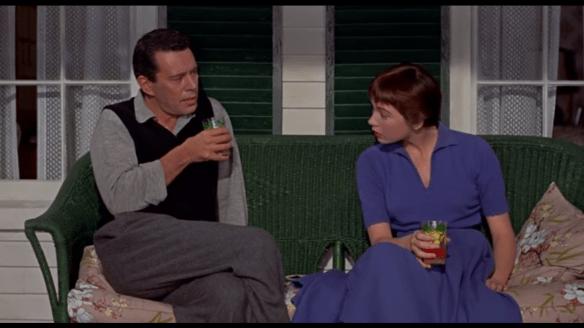
What of Harry? It’s true the whole world seems to turn up to find him. Soon little Arnie returns with his mother (Shirley MacLaine), and she hardly bats an eye. A local professorial fellow — his nose always in a book — trips over the body without much of an acknowledgment. Even local artist, Sam Marlowe (John Forsythe), has time enough to sketch a crude portrait of the dead man.

He’s your conventional starving artist. Kindly Ms. Wiggs (Mildred Dunnock) puts his particularly exuberant paintings out for sale near her Emporium, though he doesn’t stir up much business from the cows lingering across the pasture.

Ms. Rogers meanwhile is a twice-widowed young woman, and she admits her last husband was too good to live. She’s pursued by Mr. Marlowe even as the old-timers look to start courting in their own way.

The source of the frivolity and the casual delightfulness comes in painting the town as Hitchcock does — this combination of coloring the idiosyncrasies of the quainter side of life as well as the open-air mise en scene, whether pure illusion or not.

What’s lovely about Hitch is the way every movie becomes a sort of game or puzzle in its own right. Because The Trouble with Harry will never be held in the same regard as many of his most obvious successes — movies from this same period of time — but it’s ceaselessly interesting.

Audiences of the 50s would have had a time pinning it down in a conventional sense because it employs fairly frank dialogue whether riddled with innuendo or not, but it also lacks the kind of obvious star power big studios often banked on to sell tickets. Surely Hitchcock could have garnered the best talent and yet he chose not to.

This is a character piece, and it wasn’t meant for the Cary Grants or Jimmy Stewarts of the world — at least not in 1955. It called for something more mundane. And what of the humor? First of all, there are certain expectations from “The Master of Suspense,” and it’s hard to say they are met; it’s almost like he swapped the formula. He leads with the comedy with accents of suspense and the macabre.

A body buried and excavated, put back in the ground, and exhumed time and time again over the course of the day. It’s the film’s prolonged gag. One of the things that makes it feel continually comedic is the lack of a true villain of any consequence.

The closest candidate is Royal Dano, a slightly curmudgeonly sheriff who has a penchant for old cars. He’s sniffing around, always on the side of law and order. No, this is most definitely a comedy, and the two couples join forces to keep their local secret. Because they know quite literally where the dead bodies are buried. Though it’s quite possible none of them is the actual culprit. It’s typical of Hitchcock that his inclinations of Vermont are informed by murder instead of moonlight.

He is, after all, the man who keenly observed that the medium of TV “brought murder back into the home where it belongs.” The Trouble With Harry plays with the same form of morbid levity.

3.5/5 Stars
True Confession (1937) Carole Lombard, Fibber Extraordinaire

true confession

“Must we submit to this three-ringed circus in the guise of drama?” – Porter Hall

Carole Lombard is a comedienne of unequivocal talents. My guess is that it lies in that extra special dial she had. Yes, she was a Hollywood glamour girl and stylist of the 1930s — married to the King of Hollywood himself — but she also was totally at ease being absurdly silly. She would become frenzied and unhinged in a manner that feels rather groundbreaking for her generation. She was a very special performer.

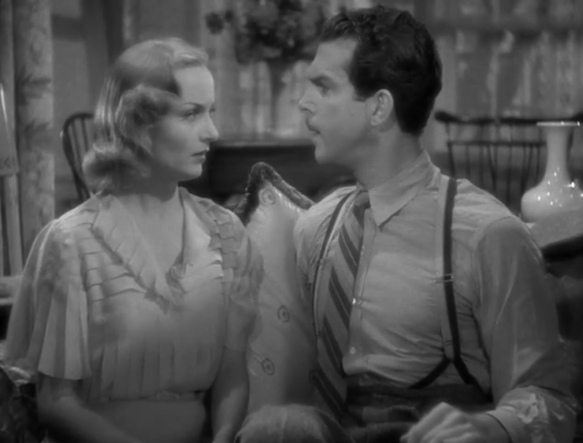
True Confession deserves to be acknowledged as a truly satisfying screwball for how it uses Lombard’s talents. Because, you see, her Helen Bartlett is a woman plagued by tall tales. Her fibs take on outrageous proportions. She’s the girl who cries wolf. Quite literally, tongue in cheek. We see it in full effect early on where she tells a string of increasingly wacky fibs to keep a man from impounding her typewriter.

However, the movie wouldn’t stand up if not for her husband. Ken Bartlett (Fred MacMurray) is tirelessly honest which, in the lawyering racket, isn’t always the most lucrative. He won’t represent anyone who’s guilty and that includes the referral of their local butcher who swiped some hams.

But he has that aching desire to exert his manhood and be the sole breadwinner of the house. He wouldn’t dream of having his wife work. No, she spends her days plinking away at the typewriter trying to finish her latest story. She’s got the personality but perhaps not the prose to be a successful writer.

So she conspires with her best friend Daisy (Una Merkel) over what she might do. Her plan is to take a job as a secretary. What of it that she’s never done shorthand or that her husband will have a fit? These are small potatoes and so she takes the job. Unfortunately, sleazy Mr. Krayler is a serial philanderer and as she skips and back peddles to avoid his advances, Helen realizes she has to get out of the secretarial racket.

This might very well be the end of it. But True Confession is forever altered by what happens next. Depending on the outcome it would end up a mystery drama. Thankfully for us, it remains a comedy.

Because she returns to the office to pick up a forgotten handbag only to find the dead weight of Krayler sprawled on the carpet. Soon the police are on the scene — their bald, hoodwinked leader (Edgar Kennedy) suspects her instantly. After all, she has motive. Soon they’ve drummed up a whole story supposin’ how she fled the crime scene.

But we know she is innocent so if the wheels of justice are actually just, there shouldn’t be a problem. A happy ending is easy enough to foresee. Instead, proceedings get strung out. Helen ends in prison suspected of murder and there’s an ensuing trial in front of a judge. Her husband is going to defend her.

Here’s the real screwball wrinkle. Wait for it. She decides to plead guilty. It’s the biggest lie she’s ever told, but if it pays off, then her hubby will be the talk of the town in the courts with a fledgling career to boot. She wants to give him his biggest stage to prove his acumen even if she has to risk perjury to do it. If it doesn’t work, well, the movie never really makes us consider the alternative.

We’ve alluded to the majority of the players, but one would be remiss not to mention two more. Porter Hall is one of the mainstays of Classic Hollywood entertainment and here he turns in a fine performance as a bellicose prosecutor on the prowl.

Then, who can forget John Barrymore hitting the eccentric heights of his career (and also the skids)? Because “The Great Profile” and titan of the great acting family, was now more of a caricature.

As Charley Jasper, he’s giggling maniacally with his ready collection of balloons, his hair rather unkempt, like a mad professor in the courtroom. Why is he here anyway? Why does the story need him? It seems quite thin. I would never dare spoil this little untouched secret.

Instead, the floorshow takes center stage. Mr. and Mrs. Barlett reenact events for the courtroom crowd in a highly irregular manner, but there is something giddy and glib watching Lombard and Macmurray break into playacting in the middle of the trial. It won’t let us forget for a moment this is a comedy, and it stays true to its roots.

I have to admit there’s an unsettling irony in the comedy’s main conceit: a white woman fighting to plead not guilty for a murder that everyone assumes she committed (though she hasn’t). Of course, there’s a historical precedent in antiquity for a woman’s testimony would not be taken.

Even watching something recently like Just Mercy, a different kind of courtroom drama in tone and content, it’s a reminder of how many people, whether black or marginalized in some way, find themselves in much the same predicament, and in their cases, there’s rarely a screwball plotline to conveniently spring them out of their misfortunes.

Social critiques aside, True Confessions is an underrated screwball gem, and it does itself a service thanks to Lombard and Kennedy, Merkel, and Barrymore. However, in our current context, as we seek a renewed sense of justice in the civil space, it must also give us pause.

3.5/5 Stars

Notes: This post was originally written in June 2020

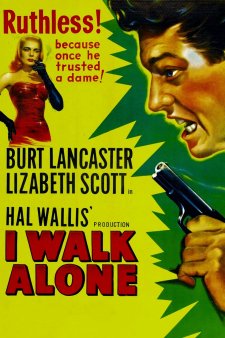
I Walk Alone (1948) with Lancaster and Douglas

i walk alone

“All the songs sound alike these days.”

The title of this movie inadvertently made me think of the Dinah Shore number “I’ll Walk Alone.” Granted, the title is slightly different, and it was birthed out of the WWII context where soldiers left their sweethearts behind to wait it out.

I Walk Alone could have easily made a play for this type of story. Instead, it replaces traumatic military experience with a long stint in prison and so our protagonist comes back to the outside world with a slightly different mentality. So there’s really no connection out all, and yet somehow music holds a crucial place in this movie because it comes to represent something about the characters. We hear, among other standards “Isn’t It Romantic?” and “Heart and Soul.”

Each of these classics plays as odd counter music to an otherwise rough and tumble story that might yield descriptions ripe with gangsters and noir imagery. When Dave meets Frankie at the train station, we understand the score instantly: 14 years behind bars and now he’s on the outside. Lancaster and Corey are holdovers from the previous year’s Desert Fury (along with Lizabeth Scott).

Ill-will has built up over the same period because back in the days of prohibition, Dave (Lancaster) used to be in cahoots as a rum runner with Noll “Dink” Turner (Kirk Douglas), who has now made a name for himself on the outside. After taking the rap, Dave feels slighted by his old partner, and true to form, his partner is trying to feel him out so he might know how to counteract him. It’s an instant conflict.

Coincidentally, it’s the first crossing of the dynamic wills belonging to Lancaster and Douglas who would continue a storied cinematic partnership over seven pictures. Even at this early date, they have fire in their bellies to drive their dramatic inclinations.

Having the two of them together is a singular delight in a way Desert Fury from the previous year could never deliver. Because in a sense they are on equal footing in terms of cinematic clout and charisma. Not that they’re the same person by any means, but it’s rather like Mitchum and Douglas sparring in Out of The Past. It makes for a far more absorbing picture.

Before he won the privilege to be an irascible hero, Douglas excels at being the cool and calculating criminal type. His voice is almost high-pitched and strung tight giving him an unnerving quality with pointed fury behind his eyes — as dark as ever. Still, he gladly maintains the pretense of friendship; it’s good for business.

When Frankie makes his way to the Regent club, he sees all the old crowd is still around, Dan the hulking doorman, then Ben behind the bar. It’s a bit like old times, but times have changed.

The veiled threats in their first meeting are an extraordinary barrage from the opening warning “Don’t move,” to the insinuations about his health on the outside, and the final flash of flame from a cigarette lighter. Intensions are made very clear.

True to form, Dink uses every resource at his advantage to defuse and exploit his old friend if possible. He’s the consummate businessman even when it comes to women. Lisabeth Scott, the club’s resident torch singer, is a whole-hearted sentimentalist who believes in love and in people — the fact they just don’t make songs like they used to. In this regard, she shares a conviction with Frankie. But she’s supposed to be Dink’s girl; at least she works for him.

However, there’s also Alexis Richardson (Kristine Miller) a refined beauty with a name “spelled in capital letters” and a cigarette pinched between her feminine fingers. She’s also filthy rich and she doesn’t mind her men philandering; for her romance is as much a business transaction as it is for Dink.

The script has its moments of lively snappiness especially leaving the lips of Lancaster who exerts himself as the brusque, no-nonsense tough operator. He’s not about to let other’s knock him off balance or get too far into his confidences.

However, I Walk Alone charts the changes that went into organized crime while Frankie was in the slammer. Whereas he represents the brawn of the old days, Dink is an emblem of the wily business practices necessary to get ahead currently. He’s able to cast off his old partner’s stake in the company with a convenient signature on a piece of paper.

What has developed is an age where big business steamrolled the olden days of hoods and backstreet gangsters calling the shots. Where three corporations can only be understood and operated through board meetings, diagrams, and dizzying bureaucracy. This web feels like a conspiracy to Frankie while only reiterating the helplessness found in a story like The Grapes of Wrath where modernity has overwhelmed the old ways.

He piles into his old buddy’s office with a posse of thugs including the smart-mouthed Skinner (Mickey Knox), the heavy Tiger (Freddie Steele), and the ubiquitous Dewey Robinson. What he realizes only too late is it’s not a matter of bringing knives to a gunfight. They are mostly outdated tokens just like him. As the brassy one quips he’s “swimming in it.”

What happens next is not unforeseen. There’s a manhunt and the man finds himself a woman who brims with his same spirit; someone who stands by the standards and sentiments of the past. To coin a paradox, they can walk alone together.

Beginning to end, what truly holds I Walk Alone together is the slimy impudence of Kirk Douglas struggling for dominance over Lancaster’s inherent tenacity. Without them, and then everyone else, including Scott, ably orbiting around them, it feels like the story might fall apart. Still, film noir aficionados should have more than enough to gorge themselves on.

3.5/5 Stars

Desert Fury (1947): Small Town Melodrama in Technicolor

desert fury 1.png

The draw to Desert Fury must begin with its intriguing cast running the range of personalities. John Hodiak and Wendell Corey (in his film debut) are driving into town. There’s this sense that their relationship is familiar but they feel like out-of-towners, somehow bringing a ting of noirish sentiment into what might otherwise be a straight-laced picture from director Lewis Allen.

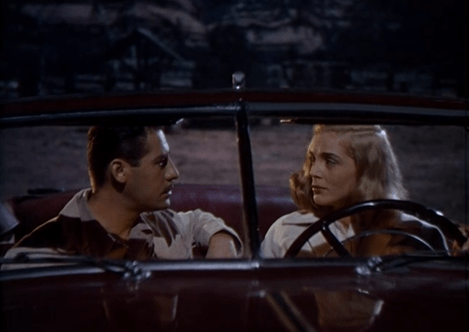
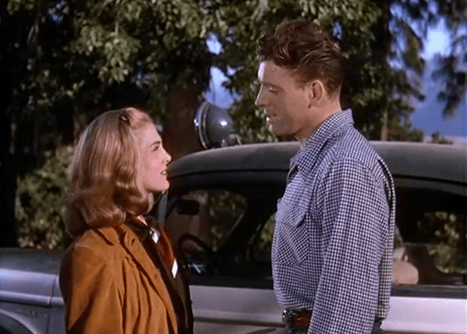
The town was doubled by Piru in Ventura County and the colors of Charles Lang are grand if a tad on the campy side. All the better to serve the visual melody of the film. Burt Lancaster is Tom Hanson, the sheriff in the small town where he happens upon Lizabeth Scott on Main Street, a rambunctious creature of trouble nosing around for romance in her wood-paneled Chrysler New Yorker Town and Country. He warns Paula Haller to watch herself, which she easily laughs off before driving home.

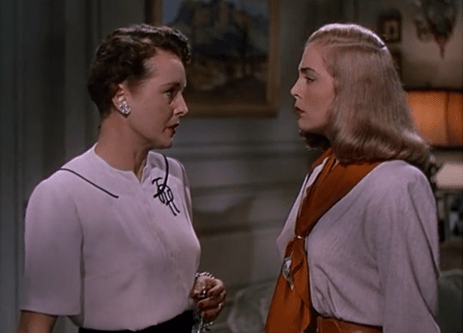
Part of her disposition must be genetic because while they couldn’t seem different, her mother is a very independent-thinking, straight-talker who lays it out like she sees it. Fritzi feels like the toughest dame Mary Astor has ever played — the cocksure proprietor of the local gambling joint — used to throwing around money and being on top of everything, and well-liked by everyone if she can help it.

That being said, she’s hardly the maternal type — in fact, she hardly feels like a mother at all — even as she’s vehemently against Paula following in her footsteps. Because hers is a tough life doing her best to shield the impressionable girl from the same trajectory. Surely, that must be it…

The Purple Sage proves its own self-contained world for the characters to lose themselves in. Our primary players are thrown together again and it never ceases until the final exhale.

Because out of everything Desert Fury can possibly offer, the relational dynamics are one reason to latch onto the film and stick around just to feel out what’s going on and where it possibly could be heading with each character exerting their own pressures on the story.

desert fury 4

Lizabeth Scott could be simpering but with her smoky voice and youthful looks, she always managed to be an enigma. Not always the most engaging performer but somehow she fits the curious makeup of a picture like this. As her mother observes with an inflection of eros, she’s “nice and fresh and alive.”

John Hodiak is generally curt, with an abrupt delivery and whether it’s his performance or his own nature seeping into the part, there’s no nuance or finesse to what he puts out. But as Eddie, he’s allowed the benefit of a past — a past that makes Fritzie wary of any advances on her daughter. It attributes menace to him regardless of what he is capable of offering.

Johnny is his lifelong companion since their youth, protective of him, even jealous for his affections playing as an inversion of Fritzie — as both housekeeper and bodyguard to his longtime associate. But the secrets run deeper still.

What A.I. Bezzerides and Robert Rossen’s script evolves into is this kind of tug-of-war with Paula acting as both the object of desire and the token with which to play out these feuds and affections. She gladly honks and smiles her way into all sorts of conflicts, driving her town car with a cavalier daring from the very beginning. Her sheer impetuousness propels the story.

She’s drawn to Hodiak, and he’s enchanted by her, showing her the door in another instance only to instantly revert back again to his charmed infatuation. It’s a tumultuous if moderately intriguing bedrock for romance.

Because Lancaster is invested in her too, warning against association with such a character. Whether it’s on account of her personal safety or his own guarded affections feels immaterial. Even as Fritzie offers a pact — land for the hand of her daughter — the proud lawman balks at the offer because he wants romance on his own terms.

desert fury 2

Fritzie knows where he stands but even she doesn’t get it. One evening Lancaster walks into her office searching and yet keeping his cards close to his chest. It’s as if he’s letting her try and figure it out.

Meanwhile, Paula and Johnny have their own strange war playing out over Eddie colored with its share of passionate kisses, flying fists, and slaps of disdain. The incendiary couple ignites most of it.

However, what’s even more important is what is alluded to not simply off-screen but from each individual’s past personal dosier and shared history. They know one another out of the confines of this hour and a half. The ensuing array of heightened dramatics and supposed revelations are nothing unusual or unforeseen on their own.

It’s the observable action speaking in the final stretch (along with the theatrical Miklós Rózsa accompaniment) with cars barreling down the desert highway in hot pursuit of one another.

It’s a Hollywood denouement — hardly a reinvention of themes from love triangles to shadowy pasts — but the melange of performances and the slight subversions teased out speak to something. Where the final kiss is not between Lizabeth Scott and her alpha male but with her mother.

While not a moral tale,  it’s a movie voicing the tangled, clouded, dysfunctional relationships plaguing a small town — and the world at large. The guise of  Technicolor melodrama is a fitting pretense.

3/5 Stars

One-Eyed Jacks (1961): Good and Evil is in the Cards

one eyed jacks Brando Malden

One-Eyed Jacks acts as a bit of an anomaly. It was originally meant to be helmed by Stanley Kubrick. Instead, Marlon Brando himself oversaw direction — his one and only time in the director’s chair. The results are as vibrant and totally Brando as they are messy, devolving into something more than indicative of its creative nucleus.

To its credit, the movie, set in the 1880s, earns its world more than Viva Zapata because there is an understanding of cultural differences inherent in the landscape. It does not try to insensitively blur ethnic lines with whites playing Mexicans.

Even Brando’s sense of Zapata, although plaintive, potentially falls prey to this blind spot. But One-Eyed Jacks is as much about the meldings of the cultures as anything. Yes, there are still obvious hierarchies and spheres of existence.  Chinese, for instance (represented by Philip Ahn), are tertiary characters, and the Latino cast is certainly secondary to the Caucasian leads, but this is indicative of the structures in place. There is some attempt at character definition that goes beyond menial stereotypes.

The scenes that strike me, in particular, are between Katy Jurado and Pina Pillicener. Instead of copping out, making these two women converse in English for the benefit of an English-speaking audience, there’s enough confidence in the emotion engendered (even if your Spanish is not up to par to catch every word). It feels wholly honest compared to typical Hollywood convention.

But, in order to explain this world, we must start 5 years earlier with a couple of outlaws. Before the days of Butch Cassidy and the Sundance Kid, Rio (Marlon Brando) and Dad (Karl Malden) are a pair of womanizing bandits robbing banks all over Mexico, living a merry life of crime constantly on the run from the authorities.

It does eventually catch up to them as they are left stranded out in the desert with Federales hot on their heels. The fateful choice to send Dad off to find horses while Rio stays behind winds up altering their steps for good. Rio gets captured and shackled up in a local prison with his compadre Chico (Larry Duran). Dad rides off to start a fresh life for himself without any kind of penance being paid. Their divergent roads spell out what the future must hold.

Even when it lumbers along or willfully bides its time — for instance, watching a couple thugs waiting it out on a porch by the sea — the color scheme as captured by Charles Lang is gorgeous. It’s one of the film’s persistent attributes though it has a handful of others.

My mind drift’s to a shot far later in the story when Brando rides his horse past a gnarled tree right out of Sleepy Hollow. Unbeknownst to him, one of his faithful companions lies shot to death only meters away, and he is riding toward doom — for crimes, crimes he didn’t even commit.

Brando often surrounds himself with interesting folks. Some are tried and true — allies he’s been able to rely on for a long time — like Karl Malden (reunited again after A Streetcar Name Desire and On the Waterfront). And yet even the likes of Katy Jurado and a promising international newcomer like Pina Pellicer bring their own sense of sober candor to the picture. She’s a striking contrast to her leading man even if they share a core sadness.

one eyed jacks

The Ben Johnsons and Sam Gilmans round out the assemblage of talent with the gruff essence of imposing masculinity. Slim Pickens, on the side of law and order, is his own version, equally snide and opportunistic — creating the kind of evocative characterizations that westerns thrive on.

It’s this kind of duality — represented foremost by Brando and Malden, then accentuated through their posses — causing one to mull over the meaning of One-Eyed Jacks. The phraseology is not something that gets used too often today. But its origins are from the profile image on a playing card. In this context, it comes to symbolize people who show off their “good side” while conveniently hiding all their faults through duplicity.

Rio is a pathological liar even in the context of people he likes. He knows no other way to go about it, holding onto his anger and letting it direct him toward revenge. But in one sense, he’s straightforward because he’s always taut with tension and the kind of angst Brando built a dynasty out of. There’s always sensitivity on the other side.

Dad is a jovial character. He’s made a life for himself and he has “reformed,” now on the side of the law. But the stroke of fortune that allowed him to get away from the federales 5 years ago and make a new life for himself, has never really left him. He’s a wheedling even deceptive fellow with a merciless, self-serving edge. He’s a man to be feared because he has popular opinion and legitimacy on his side. It’s a far more terrifying prospect.

Here’s yet another western playing with the conventions of heroics and villainy with this newfound muddied and greying sense of morality as Peckinpah would continually work through in the ensuing years. Because the final act is about a man sentenced to be hanged and the root of justice behind it remains totally immaterial. Brando is cast as a local villain even as he remains part victim to the audience. Malden and his crew are symbols of justice — swift and sure — with at least a couple of caveats.

Up until the final shots, One-Eyed Jacks remains a fairly engaging morality play rooted in a host of fine performances and its provocative imagery. Given the circumstances — how an inexperienced Brando captured exorbitant amounts of footage and remained indecisive in his directorial decisions — it feels like a bit of a marvel we got something as passable as this. Its imperfections only make its virtues all the more fortuitous.

3.5/5 Stars

Seven Days in May (1964): A Twilight Zone America Strikes Close to Home

Sevendays_moviepThe opening images of Seven Days in May could have easily been pulled out of the headlines. A silent protest continues outside the White House gates with hosts of signs decrying the incumbent president or at the very least the state of his America.  We don’t quite know his egregious act although it’s made evident soon enough.
The scene at hand rapidly escalates to violence. There’s an immersive cinema-verite quality to the mob that breaks out between rival protesters. It instigates the film’s overt sense of technical style even if it’s not always straight to the point.

What becomes imperative to John Frankenheimer’s movie is how this showmanship frames the performances at its core because the movie is driven by its robust melange of characters. Fredric March is president Jordan Lyman. He’s getting middling reviews for headlining a nuclear disarmament deal with the Soviets. This includes backlash from his highest-ranking military officials, and they’re not going to sit around while he lets America get annihilated.

It might seem like a slightly peculiar (if not entirely unfounded) reaction, seeing as in real life so many people would soon call for peace. Except in this world, the Cold War is literally reversed; now they have peace, and the outcome still remains the same. Everyone’s suspicious of what might really be going on behind the Iron Curtain.  If it’s not evident already, Seven Days in May effectively becomes an off-shoot of your typical Cold War doomsday drama.

Somehow it seems fitting Rod Serling adapted the script from the titular novel because this is a story planted in an inconspicuous and generally subtle near-future. It is its own Twilight Zone in that the logic feels slightly tweaked from what contemporary America was familiar with. At any rate, it’s concerned with an entirely different outcome than President Kennedy was currently faced with. What makes it truly startling is how much of a hop, skip, and a jump it feels from reality.

While it’s unfeasible to totally encapsulate public discourse during the early 1960s of the Kennedy administration, it’s often true movies act as an echo chamber of the times, reverberating the current issues in fundamentally different ways. I cannot speak to the anxieties Seven Days in May explicitly illustrates. But there are tinges of very real conditions, be it public protests and national marches (with the civil rights movement) and certainly the ongoing frozen-over politics of The Cold War.

Foremost among the detractors is General Scott (Burt Lancaster), who adamantly believes nuclear disarmament is a dubious peace — a sign of America’s weakness as they roll over and cave to Soviet interests — leaving the nation vulnerable. And it’s not an isolated opinion with close associates including Colonel “Jiggs” Casey (Kirk Douglas) sharing his line of thinking.

However, even their own private allegiances dictate drastically different courses of action. There would not be a movie if “Jiggs” did not uncover General Scott’s covert operations. Namely, a garrison of men training at an undisclosed facility in El Paso. It’s the first of several red flags.

The Colonel immediately brings a line of communication straight to the top triggering mistrust and paranoia as the inner circle of the president is overtaken with consternation. Although he seems admittedly quick to sound the alarm, it is indicative of the times. Especially because their fears of a military plot to take over the government seem overwhelmingly well-founded. Such a coup d’etat on the oval office almost feels unthinkable in the modern age of America; maybe this fits a more Twilight Zone sense of our government structures.

Regardless, Lyman heeds the warning and sends one of his closest allies, old southern boy, Ray Clark (Edmond O’Brien), to check out El Paso. Another oval office insider (Martin Basalm) ends up tracking down the one standout from the conspiracy — an admiral currently based out of Spain — who gives a signed statement of foreknowledge. Meanwhile, The Colonel is asked to continue in the uncomfortable position of an informer. The President must bide his time until he can back up the claims, lest he be seen as a raving madman by the general public.

While Lancaster might have the more high-profile post, it is Douglas who feels like the sinews holding the movie together, and rightfully so, because he was one of the major forces behind the film’s production. To his credit, it shows his ability to play a more restrained part — close to the vest — which still remains deeply impactful.

His scenes with Ava Gardner feel like a minor side note to this covert conspiracy of international importance, and yet it’s a tribute to both of them; it feels real and devastating in its own right. Their shared context means something.

Given the era, it’s hard not to consider the likes of Advise & Consent and then the more nuclear-oriented dramas like Fail Safe and Dr. Strangelove. And of course, John Frankenheimer had a well-documented pedigree with the political thriller from one of the most high-profile contenders, The Manchurian Candidate, and the criminally overlooked Seconds a few years down the road.

If we were to take his loose trilogy and compare it with Alan J. Pakula’s trifecta of thrillers from the 1970s, we can somewhat trace the evolution of the genre from one decade to the next.

As Lyman notes, the electorate is looking to elect a personal God for the duration, whether a McCarthy or a General Walker. They clamor for such a person to assuage their fears. The enemy is not other men but the nuclear age. We suspect infiltration and that the enemy is trying to blow us off this rock. Not until later would our own government be implicated, and then big business and our own systems be seen as a source of the problems.

Some of the best scenes take place in the privacy of the oval office because we sense the tension provided by the stakes. However, the whole drama is brought down to a manageable scale that can be quantified and understood through human relationships.

The intimate confrontation between March and Lancaster is probably a pinnacle of the storytelling, far more impactful in fact, than watching a full-scale conflict play out. Instead, it’s the whole movie hinging on one showdown between two incomparable forces, and what a showcase it is.

What makes the film smoke with legitimacy is how both men suggest, in their heart of hearts, that they are right and justified in what they are doing. And that’s what the great actors can do. Lancaster, in particular, is easy enough to cast as the power-hungry, possibly sleazy villain with a Napoleonic complex. But Lancaster’s ferocity is only matched by his steely delivery. There’s never a suggestion he is phoning in those lines of dialogue. They come off real and true and unflinching.

In the eleventh hour, there’s a sigh of relief and an equally perturbing sense of unease. We conveniently never find out if the peace treaties were a ploy by the Soviets. All we’ve done is live to fight another day. Tomorrow could signal oblivion. For this early in the decade, it feels surprisingly downbeat signifying the times certainly were a-changin’. The shift was inexorable.

4/5 Stars

*I wrote this review well before events at the Capitol on January 6th, 2021. 

The Uninvited (1944) and Stella by Starlight

To place my cards on the table, next to the ouija boards and ghost catchers, I’m not always fond of haunted house movies because how many truly original iterations can you have out of one premise? Granted, there are lots of houses in the world, but how do you make each one stand out among the crowd? If it’s not obvious already I’m already originating from a place of skepticism and apathy. There you have it.

There is some good news. Although The Uninvited won’t exactly make a convert out of me, it is freed up by the fact it was the instigator of many of the archetypes the genre holds onto even to this day. Since this is a movie from the 1940s, the onus is not on the picture to be pop-out scary; instead, it uses its assets of music, mood, and atmosphere to project an inedible impression.

The brother-sister relationship between Ray Milland and Ruth Hussey on the screen is not so common in movies, and you could easily see them playing romantic partners in another movie. The novelty is agreeable enough as they gayly happen upon an old house in Cornwall that they are just thrilled to see since it reminds them of warm childhood memories.

So they walk in of their own accord — their yippy dog scurrying after a squirrel in a fairly spectacular bit of choreography — waltzing around the place just as if they own the place. They have no misgivings until they walk up to an eery room overlooking the cliffside. Just being there makes them heavy and already we have a portent of things to come.

As it turns out, the siblings get an opportunity to buy Windward House and at a real steal too. The owner, a somber commander named Beech (Donald Crisp), is more than happy to get rid of it even as his earnest granddaughter (Gail Russell) can’t bear to see the place leave their possession. You might say she has an attachment, even a compulsion to be there. The old man goes so far as to say the house is filled with malignity against the girl.

Still, brother and sister get their wish, moving in, setting up their housekeeper, and trying to get acclimated. What the sibling dynamic does tease out are other romantic interests. Roderick, for one, is fascinated by the “sleeping beauty magic” about the girl Stella, even as they got off on a bit of a wrong foot.

When they finally do make amends, there’s a conviviality born between them. As a musician and one-time music critic, he plays her quite the tribute: none other than “Stella by Starlight.” It’s an immortal tune, and it also, coincidentally, was composed by Victor Young just for this picture. It becomes a haunting song of lament and romance on par with the entrancing theme from Laura also released the same year. It’s yet another case of music having such a mesmerizing grip on a movie.

If the aura around Laura is one adaptable touchstone, another closely related one is the unnerving ambiance of Rebecca. Daphne du Maurier’s novel, turned into the well-remembered Hitchcock drama, played with this same spectral sense of the otherwordly. The house, Manderley, became a character in its own right, and the deceased first Mrs. De Winter effectively made it into her eternal haunt. As an embodiment of obsessive devotion, Mrs. Danvers played so forebodingly by Judith Anderson, knows few equals.

Much of The Uninvited is about set-up and even the delay tactics bringing us to the point of release. It rarely confronts us only inhabiting the corners and peripheries of the story and milking Charles Lang’s delicious cinematography for every drop of darkness it’s worth. It has a lot to offer.

For instance, there are wailing and moaning noises in the middle of the night. Word of some apparition. Smells of mimosa that flood the air on other occasions. At a later date, their housekeeper raves about a crawling mist upstairs. It’s all very peculiar.

Alan Napier comes into the story as a voice of refined observation — a local physician who partners with them. He effectively brings clarity to the situation by disclosing some of the local history. You see, Stella’s mother died on the edge of the cliffs many years before under tragic circumstances.

If anything, it gives the Fitzgeralds more reason to worry about Stella’s well-being. They somehow decide the best option is to face the spirit head-on with a séance. It’s taken for granted that something exists; this is not a total figment of their overactive imaginations.

And it’s true, something fills up the room. There’s a look in the girl’s eyes of terrible happiness, a possessed euphoria. She’s resolute throughout the entire film; if they destroy that house, they’ll be destroying her. In some unexplainable way, it is a sanctuary for her.

Ultimately, the captain sends her away to a sanitarium run by a local plaster saint, Miss Holloway. Her reputation proceeds her; she’s renowned around town for her charity and stately benevolence. However, up close and personal, it’s only too evident there’s something suspect about her. She obviously still harbors a deep affection for the deceased Mrs. Meredith, championing her memory for future generations. It lends the movie yet another level of subtext.

From thenceforward we deal in ghosts, twists of exposition, and jumps in internal logic that must be parsed through. I’m often not a stickler for plot details, but it felt like The Uninvited ultimately relies on them too much. There are some genuine instances of dread or at the very least intrigue, but I’m more enamored with the Lauras and Rebeccas of the world. Their mystery manages to linger over me.

With The Uninvited my greatest takeaway was “Stella by Starlight” and the starring turn for Gail Russell. She, of course, would remain a bright hopeful in Hollywood for a few more years until alcoholism crippled her career and her personal life. However, within the frames of this movie, she is still brimming with the buoyancy of youth. It’s a pleasure to see her in such a place. If nothing else, I consider this a victory. “Stella by Starlight” might as well be a eulogy to a shooting star that burned out far too quickly.

3.5/5 Stars

Ruggles of Red Gap (1935): An All-American Gentleman’s Gentleman

Screenshot 2020-04-01 at 82751 PM

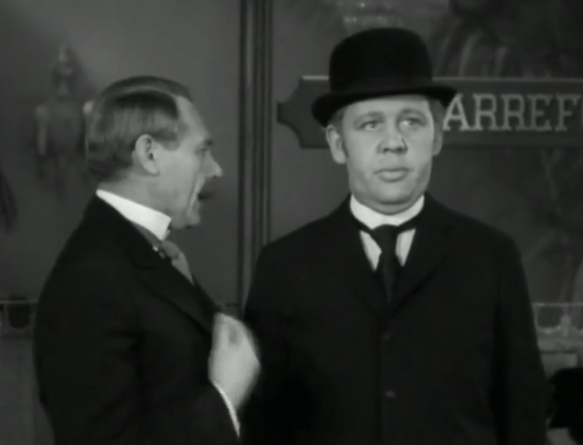
It’s Paris in the spring of 1908. The mumble-mouthed, rather sheepish Roland Young admits to his manservant Ruggles (Charles Laughton) he’s gone and lost him in a poker game. He was terribly good at the art of bluffing. A little too good as it were.

The kicker is the folks he’s handing him off to, vacationers from rural America! Ruggles does a deadpan double-take upon hearing he might be sent to the United States: the land of slavery. His former lord helpfully interjects a fellow named Pocahontas helped put an end to that.

The husband, played by Charlie Ruggles (Coincidentally, sharing his name with one of our characters), is Egbert Floud, a man of the land, totally at odds with hoighty-toighty Parisian high society. He has no qualms about his heritage. In fact, he’s darn proud of it. Handlebar mustache and all.

His wife (Mary Boland) is positively obsessed with social status — tone and Joyeux de vie — and acquiring Ruggles so they might gain a new sophistication. When her husband learns they are about to have a servant, his voice is exasperation personified.

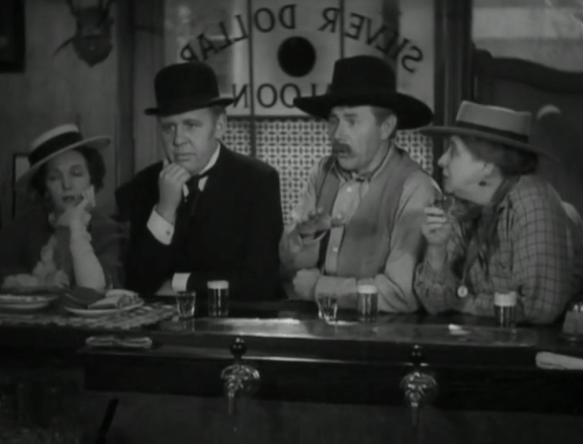
She makes him go off to get some culture, and he proceeds to drag his new manservant along to the nearest gin joint. He’s not a man beholden to any kind of hierarchy. Everyone is a neighbor and a friend. It’s quite unsettling to Ruggles at first, if not a totally novel concept. He’s never had cause to fraternize with Americans before.

Charles Laughton, eyes lolling about in his head, makes it one of the funniest situations I’ve been privy to in some time. To call him robotic is doing him a discredit. He’s so stiff it emphasizes his propriety and his station in life. He’s quietly beside himself performing his duties with these fits and starts. Then, he’s subsequently crawling inside his skin at the cavalier indecency of what he’s being subjected to; he’s too well-mannered to dissent of course.

Except the punchline is how easily he mellows in the company of Egbert and one of his buddies. The alcohol flows, they take to a carousel and wind up crashing Effie’s grand dinner party royally swacked, Ruggles most of all. Mrs. Floud attempting to apologize to the guests with her infantile French. It signals a change and the mistress of the house starts to disdain her help for leading her husband astray — even if it’s decidedly the other way around.

Screenshot 2020-04-01 at 83747 PM

But the great departure happens and with it comes Ruggles fateful arrival in Red Gap, a place he’s no doubt been dreading for some time. For him, it’s a distant incarnation of America and their antediluvian ways.

What a surprise it is that he makes a striking first impression. Everyone seems to take an instant shining to him as Egbert walks him around to introduce him to all his pals, bestowing him the good-natured nickname “Colonel Ruggles.”

He catches the eye of Mrs. Judson (Zasu Pitts) after complimenting her meat sauce. Meanwhile, the editor of the local paper takes an interest in this regal gentleman with military rank, ready to write an entire spread about him on the spot. Almost instantly he’s become a local celebrity.

He is quite taken with the life and the normally raw, rough and tumble lifestyle takes a genuine shine to him, at least the good honest folk who still have a love of the land and earthier ways. Ironically it’s the aspiring elites — like Effie Flowd — who are turned off by him, whether through misunderstanding or jealousy. He has breeding they can never hope to have.

The best part of Laughton’s performance is how he’ll slyly “break character” as it were, getting drunk on the town in Paris, stirred on by his jovial company, and then later giving a particularly aggravating man named Belknap-Jackson a kick in the seat of the pants in retaliation (the other man did it to him first). It’s these wildly conceived digressions making the movie for me because Ruggles suddenly breaks out of the convenient archetype we have for him as a gentleman’s gentleman.

I grew up watching (and reading) a lot of Jeeves and Wooster after all, where the comedy is born out of the continually failed plans and romantic miscues of the dopey protagonist. It’s his man Jeeves who must use his acumen to rescue his master from inevitable social suicide.

The beauty of this narrative is how it poses one obvious scenario before devolving into something else. Far from being a story of class clashes, it is a fish-out-of-water tale turned on its head. Ruggles is gradually transformed into a new man, exercising unheard-of freedom over his own life. He becomes a man whose future is entirely in his own hands, and he’s totally taken with the ideology of America.

One day he is unceremoniously fired by his rival just as he was sitting down with an improving book on the 16th president of the United States. At first, you think nothing of it — the book he’s reading. However, most crucially he rectifies his former historical blunder. It was not Pocahontas who had a part in freeing the slaves but Abraham Lincoln.

In the local saloon, he is reminded of who his friends really are and he, in turn, reminds them what their country is really about. What’d Lincoln say at Gettysburg? Everyone’s asking everyone else and nobody knows. Even in 1935, arguably in earshot of someone who could have been there, it’s still a fickle generation far too easily forgetting the past.

It’s easy to feel a bit tentative about themes of Lincoln as a white savior. That he single-handedly fixed the problems of America. That he was a martyr for a cause. But the movie never quite says any of this. I’m putting words into its mouth. What it does suggest is the egregious sin slavery engendered on American soil. Thus, it’s not totally Pollyanna.

Instead, Ruggles stands up and evokes the words of the great emancipator. I need not recite them and could not, but they instill in the people of Red Gap what are nation is called to — exemplifying the principles meant to set this land apart.  It’s a sober reminder that it’s sometimes those on the outside who recognize the great luxuries we are afforded and must give us pause.

Screenshot 2020-04-01 at 92857 PM

The final act keeps on riding these same waves with the grand opening of Ruggle’s new restaurant, offering two major developments. First, there is the return of the Earl of Burnstead — honored guest of the Flowds — who shows up late to announce his marriage to a local girl. Ruggles, having quite enough of the conceited Belknapp-Jackson, boots him soundly out of his establishment with added relish.

However, as a result of his unseemly behavior, Ruggles thinks his reputation and his business are finished for good. And yet he goes out the kitchen’s swinging doors to hear “He’s a Jolly Good Fellow,” not for the Earl but for him! If the Gettysburg address is the first moment of immense pathos, this is the crescendo — the camera turning to the reactions of all the town — these folks who all are part of his adoring crowd. They sing and smile and clap for him.

In my own sentimentality, I couldn’t help but think of George Bailey’s own serenade as all his friends gather around him to lift him up. There’s the same kind of communal exultation and the joy of being beloved by the company around you. It leaves Ruggles almost speechless. So Egbert pushes him through the swinging doors so he can snatch a kiss from his best girl.

I’m not sure I believe in love at first sight, regardless, I was positively charmed by this picture. The cast feels impeccably crafted to fit together, teasing out the comedy and making the story develop into a full-bodied piece of humor and All-American tenderness. It takes caricatures and stereotypes and somehow molds them into the most honorable and lovable ideals.

However, in the context of the times, Leo McCarey’s comedy — his first removed from the very particular influence of The Marx Brothers — feels more like a precursor to Preston Sturgess than a Capra picture. There’s the influence of the pure zaniness of the scenario, with the social elites being brought down a few pegs. Moreover, it feels like there’s a sense, this hope and hankering for America and humanity as a whole to still be something we can believe in.

The farce is of the most good-natured variety. Far from being vitriolic, we laugh with those we were meant to laugh with and laugh at all others who more than deserve it. It might be a simple, idealistic world, but sometimes it’s nice to believe that a gentlemen’s gentleman can make something of himself — like a  well-respected pillar of society in Red Gap, Washington. It works because the gags give way to something more.

For a first-time comedian, Charles Laughton is superb. But he’s hardly a one-man show. That’s the beauty of it. There’s a kind of genial comedic utilitarianism to the proceedings where all can be involved — audience included.

4.5/5 Stars

Bluebeard’s Eighth Wife (1938): Coop and Colbert

Screenshot 2020-03-21 at 31856 PM

The whole glorious entangled mess of the story feels like an obvious antecedent to Billy Wilder’s Love in the Afternoon (1957), which is one of his lesser films (even with the redeeming presence of both Hepburn and Chevalier). It seems like a fairly obvious observation to make because Wilder deeply admired  Ernst Lubitsch. Love in The Afternoon was an ode to his hero. Although it didn’t quite come off.

I have similar feelings about the screwball comedy Bluebeard’s Eighth Wife (1938). It doesn’t quite gel. But first let’s turn our attention to the illustrious opening gambit which, like many of the great Lubitsch beginnings, is too exquisite to pass up as the dramatic situation is brought to the fore.

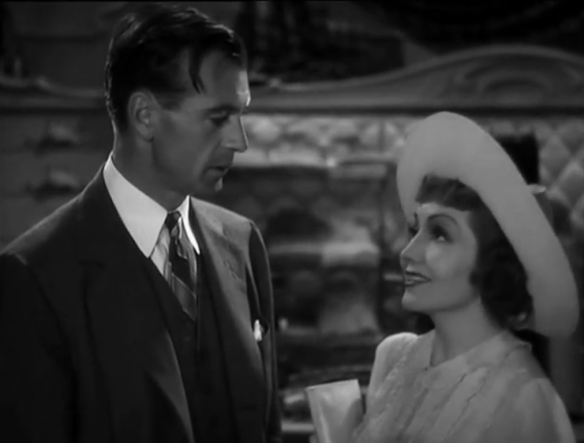
Gary Cooper staves off the sales floor spiel of the pertinacious shopkeeper with a touch of Parisian charm. All he wants are pajama tops. No bottoms. But in France, this simply is not done. It’s unheard of. The chain reaction is set off from clerk to head clerk — rushing up the stairs to the manager, regional manager…all the way up the president! In a moment of incredulity, the disgruntled fellow rushes out of bed at the words. He yells, “Communism!” only to reveal he has no bottoms. And we’re hoodwinked from the outset as only Lubitsch could do.

It all amounts to a national calamity. You can just imagine the papers printing up a nice spread on the scandal. But none of this happens thanks to a most propitious solution in the form of a woman; she only requires bottoms for her man. If it’s not apparent already, Billy Wilder and Charles Brackett’s script might as well have written the book on the rom-com meet-cute.

They’ve piqued our interest and pricked up our ears. If nothing else, thanks to some talk of “Czechoslovakia” in the dark. Far from being risque, it’s supposed to be a handy antidote to insomnia.  The man is obliged to the woman, and they go their separate ways.

The story too moves on from a department store to a hotel hallway where Gary Cooper is still being hustled and harried, this time by none other than the perennial Classic Hollywood hotel clerk Franklin Pangborn.

Better still is Edward Everett Horton, the Marquis de Loiselle, a man squatting in the hotel with rent backdated for months. He’s trying to pawn off anything he can to anyone who will bite including Mr. Brandon (Cooper). He’s also connected with the same pair of PJs in another winking Lubitsch touch before the conversation suddenly switches to bathtubs.

If you want to get technical, the pajamas spell it out for him. It’s the reason why he’ll buy the man’s bathtub, already preemptively planning a honeymoon in Czechoslovakia. It’s Lubitsch shorthand for wedding bells. You see, Coop is intent with getting together with Claudette if at all possible, and it is. She’s the marquis’s daughter.

These elements are wonderfully conceived and textbook Lubitsch execution making the most of the script. However, I failed to feel the same way about the entire movie. If you’ll permit me a digression, I recently saw Paris When it Sizzles and there’s no doubt Lubitsch’s film is head and shoulders above the later picture — more lithe and clever at any rate — but there is the same problem at its core.

It ‘s almost counterintuitive to acknowledge this. The premise in each case feels almost too inventive for the story’s own good. However, it’s rather like we are following the mechanisms of a clever bit of story structure instead of really getting to enjoy the out-and-out thrills of romance, be they comedic or overly dramatic.

We never get past the stage of logline, hook, or gimmick into truly uncharted territory where the two characters are allowed space to breathe and do things that feel, well, natural.

The remaining elements are intriguing enough. She finds out he’s been married so often. Thus, Nicole’s ready to call the whole thing off. Instead, she decides to make him suffer. No divorce, just prolonged separation. It galls him to be so close to his wife and yet so far. He mounts an offensive inspired by Shakespeare.

What follows is a barrage of slaps, spankings, and iodine for bite marks. Colbert is able to out duel him with her onion breath — his fatal flaw is that he positively abhors the miserable vegetable. It’s all potentially brilliant stuff and a lot of it truly diverting with David Niven and a private investigator thrown into the mix. However, the pieces somehow don’t fit together in a manner constituting a decisive story, beyond some hilarious premises and snappy dialogue. Rest assured the film has both.

If we’re able to consider where it goes wrong, we can look to Gary Cooper and Claudette Colbert sharing the screen together. There’s no clear antagonism between them per se. Instead of antipathy, they have a kind of anti-chemistry. That is, they’re meant to be opposites. But there must be a sneaking suspicion on the part of the audience that they do really have feelings for one another. At least, this is what all the great screwball comedies of remarriage banked on.

Coop and Colbert never manage the same kind of underlying inertia. I never feel like I’m sitting back and having a grand ol’ time gallivanting through escapades with them. In other words, it’s not quite screwball. That was never the Lubitsch calling card. That’s not what his Touch is about.

Admittedly, I had a similar issue with Design for Living (1933) a film that was quite good on paper (and even in technical conception. The acting talents are to die for. The director one of the greats of visually intuitive comedy. Here we even have a script from Billy Wilder and Charles Brackett.  It all comes to naught if the parts don’t completely mesh.

One idea I would like to court has to do with the point of view of the story. Obviously, Gary Cooper’s our lead, and he’s far from a virtuoso comedic wit. He is a movie star. Still, what is the essence of the story?

Is it about a woman winning her man over under the most absurd circumstances? The Lady Eve did that quite well: Barbara Stanwyck taking in Henry Fonda. But that will never do with Coop (Then, again there is Ball of Fire). He began as our focal point, and he’s the main focus until the end. Even with a straitjacket gag, he gets the final kiss.

Really this should be Colbert’s movie to win over, where we get to cheer her on and relish her amorous conniving. Heaven forbid our leading man be upstaged (Then, again there is Midnight). Instead, Claudette felt like the enemy, a bit annoying, and because Gary’s strung out a laundry list of wives and meets everyone with a scowl and a brusque dismissal, there’s not much to like about him either.

Maybe the film’s take is too modern or my sensibilities not modern enough, but I couldn’t help feeling letdown. I’m not sure if doing a more thorough anatomy of the screenplay will change this, and I’m okay with that. It’s only a shame I don’t like this movie more. I wanted to. At least I know Gary and Claudette won’t hold it against me.

3/5 Stars

Hands Across The Table (1935): MacMurray and Lombard

Screenshot 2020-03-21 at 72315 AM

Regi Allen (the inimitable Carole Lombard) is a manicurist schlubbing along, working away at people’s cuticles, and jamming away on the subway two times a day. She’s looking for a major catch to grab hold of. Ralph Bellamy is a charming man with money, albeit resigned to a wheelchair.

This could be the perfect start of a rom-com right here. However, in the year 1935, the thought of such a romantic “couple” might have been too startling for conventional Hollywood hegemony. There must be another, and he’s soon introduced.

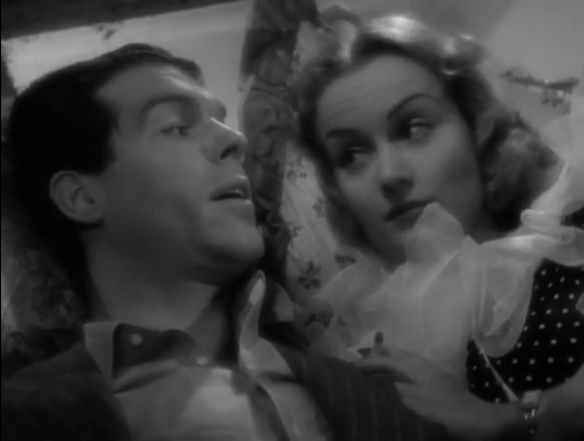
They meet as he plays indoor hopscotch like a weirdo right outside Mr. Macklyn’s apartment. The face belongs to the most boyish-looking Fred MacMurray I have ever seen. Because again, if you’re doing the math it’s 1935; Disney professorship and My Three Sons fatherhood would be decades in the making.

For the sake of this story, it’s fortuitous he too is another affluent moneybags or at the very least his family name has enough numerals after it to suggest he is a long-time member of the “vieux riche.”

Being an unabashed gold digger, she looks to seek him out even if he is a bit on the odd side. What matters to her is the bottom line. Namely, money. Of course, the perceptive viewer might have already guessed something is amiss here somewhere. There must be a catch or a gag or a complication of some sort.

To put it bluntly, he’s as much of a high roller as she is. Because The Crash conveniently took all his family’s fortunes in its wake. He now might as well be a member of the “new poor” though he still spends money like it grows on trees. To put a positive spin on it, he is radically generous with his capital.

They have a formal dinner date with an entree of the hiccups and onion soup. And their shenanigans continue even as she begrudgingly allows her new confidante to crash on her couch.

Fred is game now because they are actually quite alike — birds of a feather you might say. He does his most uncomfortable impression of a Japanese manservant as he becomes Ms. Allen’s live-in cook trying rather unsuccessfully to whip up dinner.

Imagine my surprise when William Demarest shows up behind the door as a new suitor for Regi. Ted has a ball of a time masquerading as her demonstrative husband scaring off the hapless chap from the adjoining room. Surely neither knew they would be reunited one day on the small screen. It’s a coincidental piece of happenstance only available in hindsight.

In turn, he tells Regi he’s supposed to be in Bermuda by now with his fiancee — an heiress of a pineapple empire — so they pay her a giggly prank call long distance. The way Lombard and MacMurray warm to one another is in one sense lovely but also a bit of a disappointment.

The best sorts of screwball, are the fall apart come back together passionately type of rom-coms involving red hot tension. All the elements are here, even the romantic foils, but for whatever reason, because the characters are so charming — no fault of their own I might add — it winds up being a lightweight iteration of the genre.

It’s funny in starts and spurts but never to the point of fever pitch or raucous absurdity. It’s never really prepared to go the extra mile off the deep end beyond hopscotch, hiccups, and heat lamps. Again, it’s a minor shame, but you also can’t take away from Lombard and MacMurray.

If you’re already a fan, it’s a delightful trifle courtesy of Mitchell Leisen who’s skill with this kind of material is often underrated. For their part, the Lombard-MacMurray partnership birthed three more pictures in rapid succession to meet the public demand.

If you’re like me, you pity Ralph Bellamy as he graciously contents himself playing the matchmaker for the two lovebirds running off into the street looking for the coin they flipped. Heads means they’ll get married. Tails they go out to lunch. The giddy couple instigates a traffic jam just to find out and wouldn’t you know it, the coin stands on end in a manhole cover. Ah, love. How sweet it is.

3.5/5 Stars