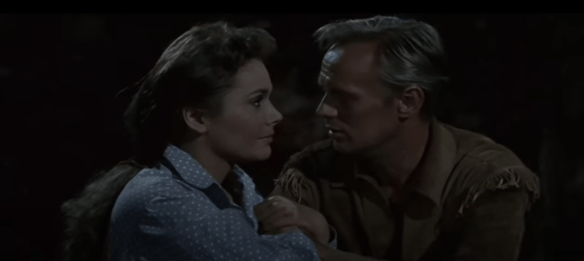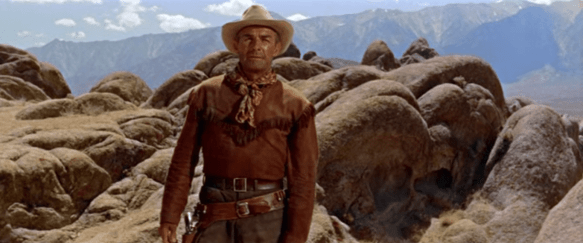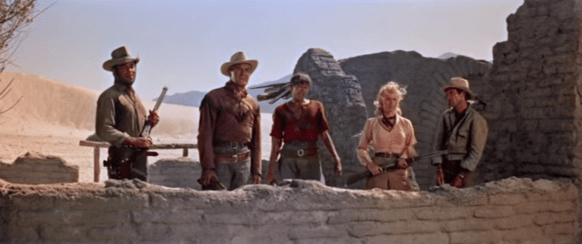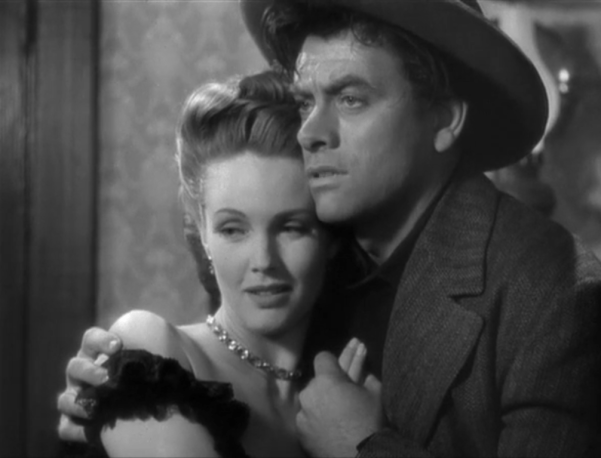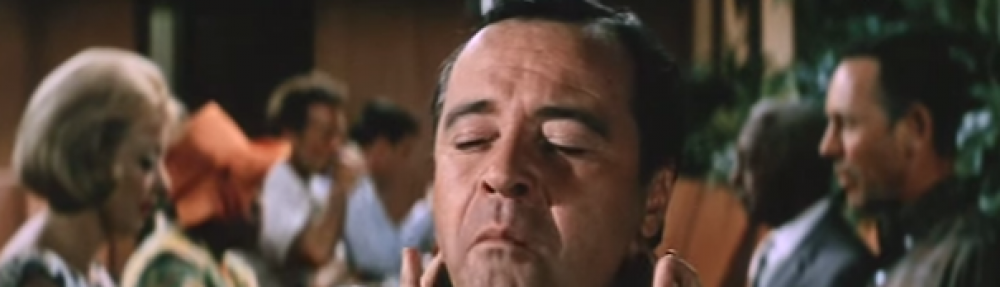
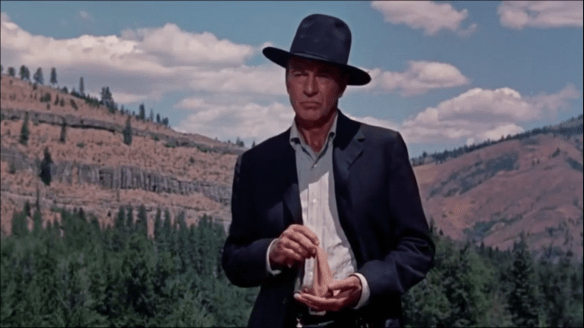
The Hanging Tree (1959): Delmer Daves and Gary Cooper

Screenshot 2020-07-15 at 5.59.37 PM

“You’re standing on the edge of a cliff. I don’t advise you going through life with your eyes closed.” – Doc Frail

Delmer Daves isn’t often remembered alongside the foremost western directors. Although in the 1950s, he crafted some stellar movies, and something less-heralded like The Hanging Tree is as much a testament to his legacy as anything he ever did. It puts a fine foot forward with a bouncy ballad courtesy of Marty Robbins and verdant imagery of epic proportions.

We’re in Montana, 1873, in gold country, and the local folks have caught the bug. Gary Cooper (in one of his last great performances) drifts into town on horseback. As he rides past, someone notes the local hanging tree makes people feel respectable. We know it will have imminent significance.

For now, he sets up shop as an M.D. named Doc Frail. The bustling town is being built as we speak, everyone in search of their own private “glory hole.” They are territorial and have no mercy for sluice robbers trying to pilfer their claims.

Frail is a curious figure because he hardly seems drawn to the same promise of riches as everyone else. There is a sense that this is as good a place to stop as any. Like Joel McCrea’s judge in The Stranger on Horseback, he is a man of vocation, who knows how to take care of himself while also adhering to a personal code of conduct. However, he also has a smoldering secret buried in his past creating a lingering specter over his present. Some men might deem him a saint and others a devil.

Could it be he has a higher calling altogether? His first good deed is to fix up the thief (Ben Piazza), who got winged in the arm. But he doesn’t let the young man named Rune off without payment. He salvaged the boy’s life and so he takes him on as a begrudging bondservant. Again, it feels like it’s all part of the veteran doctor’s plan.

Cooper takes to the role, and it informs the more casual even comical tone the film sets on initially. Sure there’s a lurking menace but for the time being Coop takes to the people and provides them the healthcare they desperately need. They’re obliged to him. What’s more, he’s not an outsider — some of the folks have made his acquaintance before — and he’s likable while ratting out the phonies.

Front and center is the jovial if slightly skeezy Frenchy, with Karl Malden turning in a vital performance to supply the story some direction. The other is a scripture-spouting drunkard named Bub (George C. Scott in an early role).

The rest of the tale is built out of the search for a lost stagecoach passenger. When she is found, the half-unconscious, blinded Swiss immigrant (Maria Schell) is nursed back to health by Doc. He shields her from both the light and the prying eye of the world outside.

If it’s not apparent already, The Hanging Tree gives off the aura of an entirely different brand of western, and it’s not just the Montana terrain. It also comes down to the pacing and how the characters relate to one another.

Over time, Rune feels beholden to Doc, and he becomes a loyal companion by association. The same might be said of Elizabeth as she has the doctor to thank for her health and her entire livelihood. For the time being, she “sees” only the good in him. But the movie would be too clean if he reciprocated directly.

He continually takes part in these elliptical games with others. His lady benefactor calls him cruel for bringing people close only to push them away, and she has a point. It’s true his decency and bedside manner is tempered by a bleakly cynical side. How do you reconcile such a thoughtful figure with the man in black who gambles by night?

One also comes to understand how ephemeral this community seems. Doc warns Elizabeth their current home is a crawling anthill that could blow away with the scum of the world. It’s true in six weeks it could be a ghost town. But she rejoins with a plucky resolve. There is no other way to tackle this world, and she takes to it gladly. She settles into her own grubstake, christened “The Lucky Lady Mine,” joining forces alongside Rune and Frenchy (and a silent partner).

The ending of the movie can only end in one place if it’s to make good on its title. It’s true we end up there. What’s curious is how joyous euphoria about striking it rich can turn people into a mob just the same if they were angry. Inhibitions get released and the world goes to hell with drink, lust, and incendiary male hedonism.

For me, everything falls together so conveniently I didn’t have time to consider the logic. There’s little need to. Gary Cooper sticks to his guns and does what he always has from the beginning of time and by that I mean The Virginian way back in 1929. His quiet boldness punctuates the madness, and it feels right, though not totally complete.

If nothing else, it’s worth the final shot and in case we didn’t catch the metaphor, a musical refrain reminds us, “The Hanging Tree was a tree of life for me.” Where the gold rush-crazed economy is gladly ditched for something more tangible and lasting. Where being granted eyes to see can be a sobering reality check while still leading us in pursuit of goodness. Because sometimes the hanging tree might just be the place we find salvation once we realize we’re not in control. We can’t always save others, especially when we are in need of saving ourselves.

3.5/5 Stars
The Last Wagon (1956): Morals Out On The Range

Screenshot 2020-07-14 at 8.29.15 PM

We’re in the Arizona territories. The year is 1873. Glorious overhead shots give us a sense of the vast panorama of the terrain in CinemaScope as Richard Widmark gets hunted down and returns the fire of his pursuers.

The distinctive red rocks have the hint of John Ford and if nothing else, remain a stunning reminder of America’s glorious topography. We really live in a gorgeous place if we take the time to get out in it.

For Widmark, it’s life or death as he kills one assailant only to get winged and dragged behind a horse by the wrists. It’s hardly water skiing. This is the untidy, rough-and-tumble law of the wide-open land. The victors are those who survive, whether through chicanery, brute strength, or guns loaded with lead.

It feels like we’ve been privy to a whole short movie before our main storyline has even begun. This is to The Last Wagon’s credit. It has robust beginnings and makes Widmark out to be an intriguing enigma right from the outset.

We find him finally, dead beat, strung up in a tree for safekeeping in the custody of a sadistic sheriff (George Matthews) as a wagon train of women and children scuttle by. They couldn’t be more diametrically opposed, but this is the entire premise of the movie right here.

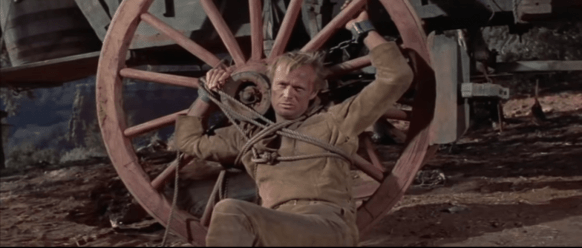
It’s their leader (Douglas Kennedy) who welcomes the lawman into their company, wary of both prisoner and his executioner. It’s an uneasy partnership to be sure. He makes his moral stance quite clear when he blesses their evening meal, “Teach us to live with open hearts and share with our fellow man our values.” It falls on the deaf ears of Bull Harper and “Comanche” Todd, who is trussed up to a nearby wagon wheel.

The wanted criminal doesn’t help his case when he murderers yet another man in view of a whole wagon train of incredulous witnesses. They aren’t accustomed to such savagery. He comes back sharply, “I had a right to kill him, but I suppose my side of the story doesn’t interest you none.” It plays as another pointed comment on who he is: both a murderer and a “white” Comanche, and then who they are, naive Christian pilgrims.

There are two individuals in their ilk, in particular, who show him a dose of Christian compassion. The young boy Billy (Tommy Rettig) brings him food, with all the candor in the world, asking him honestly if he thinks he’ll go to heaven. It’s hardly out of a place of browbeating or scorn, but genuine concern. He’d like to go scouting with Todd up in Heaven because Billy aims to be there. He wants the other man to be there too. His older sister Jenny (Felicia Farr in an amiable and lucid performance) also extends him a certain benefit of the doubt.

Unfortunately, the movie’s attempt at commentary on prejudice is partially undermined in all its good intention. It begins with Widmark. Although it’s partially explained away through exposition, he’s certainly no Indian by birth. Likewise, in a precursor to her mixed-race role in Imitation for Life, Susan Kohner is given the role of a half-Navajo girl, who faces bigotry with a stolid resolve. It is her bratty half-sister (Stephanie Griffin), white by birth, who encapsulates all the malicious prejudices festering on the range. This is made plainly evident.

However, Delmer Daves does not constrict his movie into being a mere morality play. In fact, The Last Wagon is hard to pin down. There are all these potential narrative offshoots, and it supplies some genuine moments of surprise while still mixing its messages and becoming an entirely different narrative on multiple occasions. One prime example is how the movie is both indicting prejudices against American Indians and still somehow using them as a mechanistic trope of the West.

Gratefully, the movie splits off from the pack and hones in on the most intriguing characters. One drastic turning point comes when all the adolescents sneak off to go skinny-dipping, including the scandalized Valinda and the foxy Ridge (Nick Adams). They’re the story’s resident imbeciles. For the time they can frolic gaily only for the rapids to give them a scare, and then worse…

the last wagon

They return to nothing — a camp totally decimated — Widmark is the only one left, cast aside on his wagon wheel. Valinda chastises him, “You got no right to be alive when our people are dead!” Here we find the meat of our story. It settles into being a survival western with Richard Widmark anchoring the youthful contingent following his lead. Their objective is obvious, making their way through the aptly bone-chilling “Canyon of Death.” They have no other alternative. Widmark is the only one who knows what it takes to survive.

The Last Wagon has some downright bizarre moments — setting traps for food and Widmark makes it look like a breeze ambushing their dinner in a cave. In a matter of minutes, snake bites, apache ambushes, and they just keep on coming; it’s the kind of western melodrama not averse to tossing out all sorts of wrinkles, and why not? There’s a lot to work with. Either you laugh it off as absurd or you admire the commitment to making the story lively. The same goes for the dialogue. It’s not the most nuanced job, but it keeps the pulse going.

There are obligatory interludes too as he hacks off his handcuffs across from Farr while sharing his life story. We get something of his own spiritual belief system. His father was a circuit-riding preacher — he was even baptized — and his daddy looked to carry the word of his God to the whole world, that is until he died. The operative word is “his” God because Todd was adopted by a Comanche chief and never looked back. If this God wasn’t concerned with saving his father, then he wasn’t interested.

Still, they just might receive a providential intervention yet in the form of some horse soldiers. However, their saviors in Calvary uniforms turn out to be a reconnaissance unit, and with Indians on the warpath fast approaching, it becomes Todd’s time to rescue all of them. He knows the dilemma: Get them out of their hopeless predicament only to find himself on trial for murder.

It becomes a layman’s civil discourse. Law is law — Comanche or white — if it is just. The question remains who gets to decide Justice? Jenny comes to her man’s defense: The Good Book says something about taking life but what about giving life back? This is what he’s done for them — provided a lifeline in a hopeless scenario. Needless to say, whatever the parameters most human systems are flawed and infallible. They don’t always hold up.

In the end, there’s a kind of swelling sentiment as we watch redemption at work. The young men and women sitting before the courts as a testament to Todd’s decency. After such a treacherous journey, it’s convenient and painless. So be it. It feels equally grand to watch Widmark ride off with Farr and Rettig. It hits all the beats like a western such as this is supposed to. Nothing more is required.

Delmer Daves puts together an oater with a gorgeous sense of the Western vistas in its many earthy hues. Any ways in which it feels heavy-handed or derivative are mostly smoothed over by a typically stalwart performance by Widmark (and the fact I’m fond of Farr and Rettig). The Last Wagon is a pleasant surprise, and it need not be more.

3.5/5 Stars

Ride Lonesome (1959): One of The Best Ranown Westerns

Screenshot 2020-07-15 at 12.37.17 PM

“You just don’t seem like the kind of man who would hunt a man for money.” 

“I am.”  

Ride Lonesome has a setup as obvious as it is simple, further indicating why the collaborations between Budd Boetticher and screenwriter Burt Kennedy were so plentiful. It comes with supplying a concrete premise with an intriguing overlay of character dynamics.

But you also need an inscrutable hero. Here a veteran bounty hunter has a man to bring in. The hero’s name is Ben Brigade (Randolph Scott) and his quarry, Billy John (James Best), sits waiting for him. Brigade comes up to him nice and easy-like to take him into custody.

It’s right then Billy John grins and lets him know his cronies are spread out in the rocks up above. He’s trapped. If he turns his back and walks away, there’s nothing more to it or else he commits himself to what he started along with probable death. Right here in a moment of immeasurable tension, we see Randolph Scott at his capable, laconic best. He’s totally inexorable and nobody’s gonna get him to back down. 

As the story progresses Santa Cruz becomes a kind of MacGuffin, as Alfred Hitchcock would call it. It’s where Brigade plans to take Billy John to be strung up. In case there was any doubt, he gets out of this opening scrape alive and with his prisoner still intact. So they mosey their way along the gorgeous craggy tundra of the West toward their destination. 

On their journey, they happen on a stagecoach outpost. It’s important for introducing three more of the film’s key players. Two of them are little better than bandits (Pernell Roberts and James Coburn), the third is a woman (Karen Steele) waiting for her husband to return with some much-needed provisions. She’s wary of her uninvited guests and not too pleased to have two more strangers passing through. 

With these newest additions, we have the requisite menagerie to give the story a renewed outlook because what are the Ranown westerns but character pieces with higher stakes than what meets the eye? Foes can come in many forms: a gang of outlaws, self-serving amnesty seekers, and who ruled the land before all others but the Native American population — out for blood to avenge the affronts to their cultural hunting grounds. 

ride

It makes for some of the most engrossing stand-offs and conflicts on multiple planes of contention. People are constantly being caught between other people. What makes it delicious is how it’s not totally vindictive. Some of these people form relationships and still feel compelled to kill one another for their own purposes. At least they stand prepared to and our hero is no different. 

Mrs. Lane drifts around with hardly any stake anymore with her husband murdered. She can’t understand why Roberts would want to save Scott’s life in one minute and hours later be meditating on killing him. They need him until the time is right, and then they have to take him down — as simple as that. 

It’s loose cannons like him giving this movie a new kind of dramatic depth. Because there are no longer any straightforward roads. Everything feels ambiguous.  We gravitate toward Scott as some kind of moral center because his pedigree in films tells us as much. Maybe we can sense the decency in him. Otherwise, his career path and his generally callous nature don’t do him many favors. But it’s a tribute to the picture. 

On a side note, it always astounds me how they were able to scrounge up such a stellar group of players for these westerns. Take stock of everyone for a moment. Of course, you have Randolph Scott but then Pernell Roberts, James Coburn, and Lee Van Cleef. That’s pretty remarkable for a low-budget flick.

Lee Van Cleef doesn’t have much to do aside from being a threat, and he’s good at this, prepared to search the bounty hunty out and reclaim his brother. Their meeting is inevitable. Roberts is chummy yet opportunistic, subverting his Bonanza infallible eldest brother on horseback in an agreeable way. Coburn plays a dimwitted second fiddle as he hasn’t quite ascended to the aloof heights of Britt in The Magnificent Seven. All in due time. Karen Steele doesn’t normally get much acknowledgment, as her career was mostly relegated to the small screen — you can’t quite call Ride Lonesome the big time — nevertheless, she is a stalwart in her own right and strikingly beautiful.  

 But we must remember, Brigade and his uneasy alliance still have a prisoner to get to Santa Cruz with Van Cleef’s Frank fast approaching for a showdown. It’s almost like the bounty hunter wants them to catch up…The question: Why? For that matter, if he gets out of one scrape, he still has two more guns to get past. He’s rapidly running out of time. 

The script quickly flips the inevitable on its head and instead of feeling like we’re subjected to the usual rhythms of the West or left hanging, so to speak, there is this sense of satiation. All loose ends are tied off, and the resultant humor comes with a sigh of relief. If there’s this touch of lightness, then the resolution is equally about making peace with the past as so evocatively captured in the final shots — an image that so easily becomes emblazoned in one’s mind. Brigade sets his specters ablaze ready to step out of the ashes a new man.

Ride Lonesome does its job well, and it’s such a delectable, economical delight. If it’s not the best of the Ranown cycle, it’s darn near the top and remains a classic reminder of why the Ranown westerns have maintained a pull on many of the genre’s aficionados. It’s a marvel that so much can be accomplished and so much emotion can be mined in a movie that clocks in nicely at under 75 minutes. 

4/5 Stars

I Shot Jesse James (1949): A Sam Fuller Western

i shot jesse james

I Shot Jesse James is an off-center western as only Sam Fuller could possibly conceive it. At the very least it brings a journalistic eye and a shift in perspective. Because distilled down to its most basic elements, it’s a psychological character piece with John Ireland at the heart of it as Robert Ford: the man who shot Jesse James.

It’s not quite as punchy as Sammy Fuller would establish himself to be, but there is a slew of compelling ideas, and it’s not as straightforward as the western genre often suggests itself to be. Sure, the opening scene feels like quintessential Fuller, prepared to rap us over the head with the brunt of his movie. Bank robberies can never be easy; they’re always contentious. Guns drawn and bank tellers intent on sounding the alarm.

The picture is also about as noirish as they come out on the range — part of this is indebted to the conflicted character psychology — as expectations fluctuate wildly and scenarios happen not as we expect, but as they are meant to in a dismal landscape where everything comes out to its pessimistic worst.

People are poison to one another. The cruel hand of fate is inevitable. The lynchpin moment where a frankly, conventional Jesse James (Reed Hadley) is gunned down by his best friend is hardly imbued with the mythical glory the tabloids would have you believe. It’s almost matter-of-fact, totally unsentimental.

Fuller’s script acts as an examination of mythos and the pariah-like celebrity that engulfs the man. It makes for a far more perplexing exploration when you consider Jesse James died a hero — a Robin Hoodesque legend — while Ford is totally disgraced in society. He shot his best friend. If not for money, at least for a girl.

His desires are normal. He wants to get a ring so he can marry her and settle down. The question remains whether this kind of humdrum life is available to someone in his station.

The thematic ideas of legends on the range are dissected in many other westerns, and there’s always a sense of notoriety catching up with a protagonist. He has a target on his back. They might not have modern technology but papers, telegraph, and word of mouth have more pull than we might imagine. Word gets around and, if anything, legends grow larger with every town dispelling their own half-truths about the man and the myth.

Every gunshot potentially has Ford’s name on it. And yet he doesn’t want to give up his name. He’s too proud for that. He does take to the stage circuit reenacting how he shot Jesse James, and yet he can’t bring himself to pull the trigger. The audiences watch with a kind of morbid curiosity. It’s another nail in the coffin. Surely they comprehend this is simply one pitiful man shooting another — not some gargantuan duel of ruinous proportions.

In an equally telling interlude, Ford offers to trade a drink for a troubadour’s ballad and gets an ode to the coward Robert Ford who laid Jesse James in his grave sung back in his face. You can imagine his chagrin when he finds out he’s been memorialized in such a manner and then the jovial performer’s surprise when he learns he’s singing to the craven legend himself.

i shot jesse james

In a flat western, Barbara Britton’s part would be tepid. Here she gets at least two moments in close-up where her face comes alive with a crazed expression you don’t soon forget. It’s fit for a femme fatale, but she’s not evil or psychotic. At worst, she’s torn apart by love, and it’s a force she can’t cope with.

If Ford is still madly in love with her, there’s another character who drifts through and vies for her affections. Whether real or imagined, it doesn’t really matter. Ford has it in his head that the genial prospector, John Kelley (Preston Foster), is his bitter rival.

As mankind follows the trail of prospective wealth, both Ford and Kelley wind up in Colorado in the midst of a silver boon. For the time being, Cynthy is out of the picture. Far from fighting, they share a room, right neighborly.

The final act doesn’t feel much like a western at all. It’s shed all the traditions long ago. Again, it is a character piece. It could be any genre. This one just happens to be set around saloons and hotels, mining towns, and grubstakes.

But there are two men and one woman, and she can only end up with one of them. Perhaps she only actually really loves one of them. Frank James comes back into the story — you might remember him too — but he’s only another mechanism, like Wanted Dead or Alive posters or climactic showdowns between good and evil. Here they always carry the persistent inevitably we attribute to noir. There can only be one conclusion…

To the very last iota, it feels like textbook Fuller as he announces himself on the cinema landscape. On top of writing and directing the picture, he purportedly shot it over 10 days on rented sets from Republic Pictures. What’s most extraordinary is how the movie hardly seems to suffer from these constraints. If anything, it set a template for how Fuller would maintain a degree of creative autonomy while still managing to create a wide array of compelling projects in years to come.

Although his visual style would continue to grow and sharpen, there’s a killer instinct proving a lightning rod for stories. As a journalist and a journeyman, there’s this sense Fuller had the “don’t get it right, get it written” mentality. However, this very rarely seems to harm his output, which somehow always manages to find a worthwhile point of view to grab hold of.

I Shot Jesse James is little different. Its inadequacies often wind up making it all the more intriguing. You’ve never seen Jesse James spun in this manner, and way back in 1949 Fuller had a kind of prescience in suggesting where the West would go after the 1950s.

3.5/5 Stars

The Strong Man (1926): Starring Harry Langdon

Screenshot 2020-07-09 at 8.01.22 PM

My knowledge of silent cinema is admittedly littered with blindspots. Some of this must be attributed to the sheer number of shorts the era engendered and also the number of extant films which will remain lost if not for some secret cache hidden away in someone’s perfectly insulated basement. The rest falls on pure ignorance.

If you’re like me, you might know Chaplin, then you turn to Keaton, and finally Lloyd. It was famed writer James Agee who might have well propagated this lineage to later viewers when it came to the silent clowns who formed the bedrock for the forthcoming film industry. And it’s true everyone seems to be indebted to these fellows on some account. But the one who rarely gets a mention in the same breath is Harry Langdon and I’ve done this as much as anyone else.

At last, I have rectified the situation and gotten to know the man who developed his own distinct persona from the others, “a Little Elf” built solely out of his meek even child-like affability in all situations.

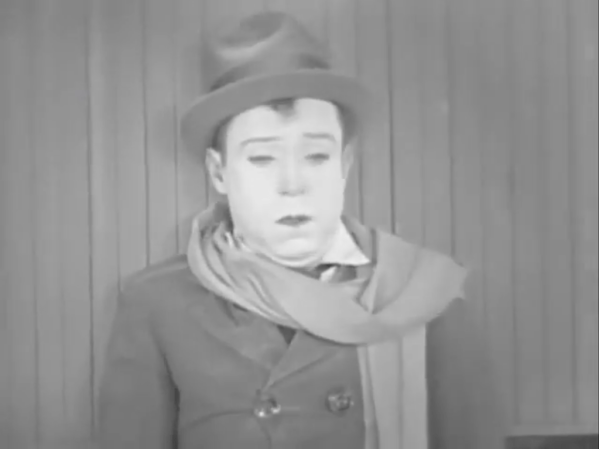
The Strong Man is arguably his most prominent picture then and now. Worth noting is Frank Capra who made his directorial debut and right from the outset you can see some of his imprint on the story. Harry Langdon is staked out behind a Gatling gun in Europe as a meek Belgium soldier fighting against the enemy. However, he’d much rather use his slingshot, and he’s quite effective in tormenting his burly enemy in the trench only meters away.

This is merely an opening gambit. Soon it becomes an unmistakable immigrant tale with all the iconography most Americans will be familiar with. An ocean linter. That majestic beacon of hope: Lady Liberty. And of course, Ellis Island, that customary weigh station where people stopped off to begin a new life.

By some strange development, the Belgian has joined forces with his former enemy playing sidekick to the severe-looking strong man. However, the big city brings with it a lot of distractions for someone just off the boat and easily targeted.

Standing at a street corner, Paul gets mixed up with an archetypal city woman who only pretends to seduce him so she can retrieve the money she hid on his person. All manner of taxi rides and rendezvous in her apartment leave him quivering with fear. He’s much too timorous and naive to know what to do with himself in such a position.

This is, after all, the source of his charms. It suggests the image of Harry Langdon quite candidly. Not only is he a meek and unassuming hero, there’s this prevailing innocence about him. We could say the Tramp has some of the same, but Harry feels even more forbearing. He could never raise The Kid. He is the kid. In fact, he’s almost manhandled by the city woman as she locks the door and looks to retrieve what’s hers. It plays as a fairly comical power dynamic. This is only one bit.

The latter half of the picture feels much more Capraesque considering themes of graft and corruption in the face of common decency. There are precursors to his Miracle Woman where a barn becomes a clearinghouse for the local town’s vices, whether it be gambling, carousing, showgirls, beer, or pugilism.

The lines are drawn fairly clearly when Cloverfield’s corrupt kingpin sits down with the local parson trying to literally buy him out. He tells the old saint to name his price, and he’s absolutely indignant at the offer. We read his retort: “The House of God is founded on rock. For the miseries you have caused, the Master will destroy you!”

It’s not quite fire and brimstone, but it is very close. His congregation piles onto the lawn in front of his house as he rallies them with the story of Jericho and the exploits of Joshua where the God of Israel caused the walls of the great city to come tumbling down in His divine timing.

What I can only imagine is a rousing round of “Onward Christian Soldiers” leads them into battle as they begin their crusade around the Palace. This might be the time to insert that the looped scoring is a bit nauseating and as with many such silent pictures, it doesn’t seem to do the movie justice.

But we’ve failed to talk about the Belgian. Rest assured, he’s still relevant as he was once pen pals with the preacher’s daughter: Mary Brown, and of course, to make her all the more sympathetic, she’s blind. He doesn’t actually know she’s in town. He’s there as a part of a show on the lascivious stage. And he’s thrown to the wolves when his boss gets drunk.

He becomes the strong man. It’s another pitiful setup. But it’s the heart of the movie and a Capra moment of David vs. Goliath exploits. The little guy standing up against the masses in this case, literally holding them off with a makeshift cannon as their temple of sin topples all around them, and they flee into the streets.

If he’s partially David, then he’s part Samson crossed with a flying trapeze artist. Far from being a piece of irony, if we are to recall the preacher’s scriptures, “When I am weak, then I am strong” never sounded more pertinent.

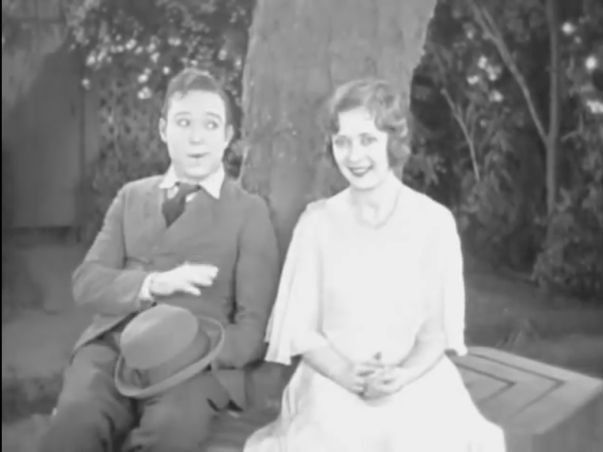
His final stand is ample enough to save the town and bring about a newfound tranquility where he is a beacon of law & order while still taking a helping hand from Mary Brown. Per convention, they walk off into the sunset together a very happy couple and all is right with the world.

Screenshot 2020-07-09 at 8.07.35 PM

Harry Langdon is not talked about that often amid conversations of silent cinema. Part of the reason might be because he doesn’t have a row of feature-length films that are easy enough to lay claim to as his personal masterpieces. The Strong Man is as close as he came and with the fledgling name of Frank Capra — directing his first feature, no less — it has the benefit of some added name recognition.

Langdon is a relentlessly amicable hero, but that might be part of the issue. What you see is what you get, and it doesn’t add up to anything more. His understated persona is highly palatable but rather blase even in comparison to a few of his contemporaries. At the end of the day, The Strong Man can be viewed as a stepping stone in Capra’s own illustrious career — a step forward in his maturation of a filmmaker. It might be for someone else to make the case for Harry Langdon and resurrect him for the modern generations.

3.5/5 Stars

Uptight! (1968): Jules Dassin and Ruby Dee

Martin Luther King Jr. was assassinated on April 4th, 1968. Uptight was released in December of the same year. It’s a rather unnerving circumstance because the movie was conceived well before the horrid tragedy, and yet this cataclysmic moment haunts the picture. If the struggle for unity was a tough proposition before, how do you begin to make sense of the moment afterward? Now a story that didn’t necessarily need this specificity was inextricably linked to very real events. The film in its updated form literally begins with the wake of MLK.

Only recently did I recognize two separate films that recontextualized Irish struggles during The Troubles with the black experience in the 1960s. John Ford’s The Informer became Uptight with Ruby Dee and Carol Reed’s Odd Man Out turned in The Lost Man with Sidney Poitier.

Although I don’t know enough about the nuance and minutiae of these respective histories, I am fascinated to learn if this was merely a coincidence, a marketing strategy someone actually employed, or a small cog in a broader genre conversation.

Jules Dassin and Ruby Dee are easy to tap as the primary architects, one a causality of The Hollywood Blacklist that forced him into European exile, and then Dee, along with her husband Ossie Davis, were two of the foremost black performers and social activists of their generation.

Given this context, it’s not surprising, the film hardly made a blip on the broader cultural landscape. In an era of COINTELPRO, this movie seems more timely than many people realize and a testament to that might just be that very few people recognize the movie. This is not the type of film that would get championed because even today it bristles against some prevailing sensibilities and causes us to reconsider the trajectory of our nation’s legacy.

The FBI purportedly had informants in the crew who helped them keep tabs on the production. The crew, including its director, was predominantly white while the movie was financed by one of the big studios: Paramount Pictures. This is the context of a picture that floundered at the box office.

The film itself is set in Cleveland, Ohio where tensions are high. The nonviolent philosophy of MLK has been brutalized, and the rest of the black community seethes with rage, understandably so. It sets the groundwork for fiercer insurrection. The emerging leadership believes it’s time for a new vision to take its place.

Growing sentiments of disillusionment are made clear early on: “The man from love got his head shot off, and all those people learned nothing.” And they derisively criticize what’s come before:  “Cry, march, pray, that’s the way to win Whitie’s heart.”

Crucial to the film’s core dilemma is the character of Tank (Julian Mayfield). The movie resculpts Victor McLaglen’s carousing tragic turncoat into an even more pitiful figure if it’s possible. Because McLaglen is at least physically imposing albeit neutralized by drink and his own weak-willed failings. Tank here feels like an even sorrier figure. James Earl Jones, who could have been slated for the role, is a muscular, stronger stage presence. Somehow it wouldn’t work in the same manner as Mayfield.

He’s a wretched cast-off grappling for some sense of belonging and searching for people around him who will trust in him and let him be an integral part of their lives even as he backslides. One is Johnny (Max Julien), a member of the local militant movement, but also a lifelong confidante. It seems like the tides of the times are moving and they will leave stragglers like Tank behind unless they get with it.

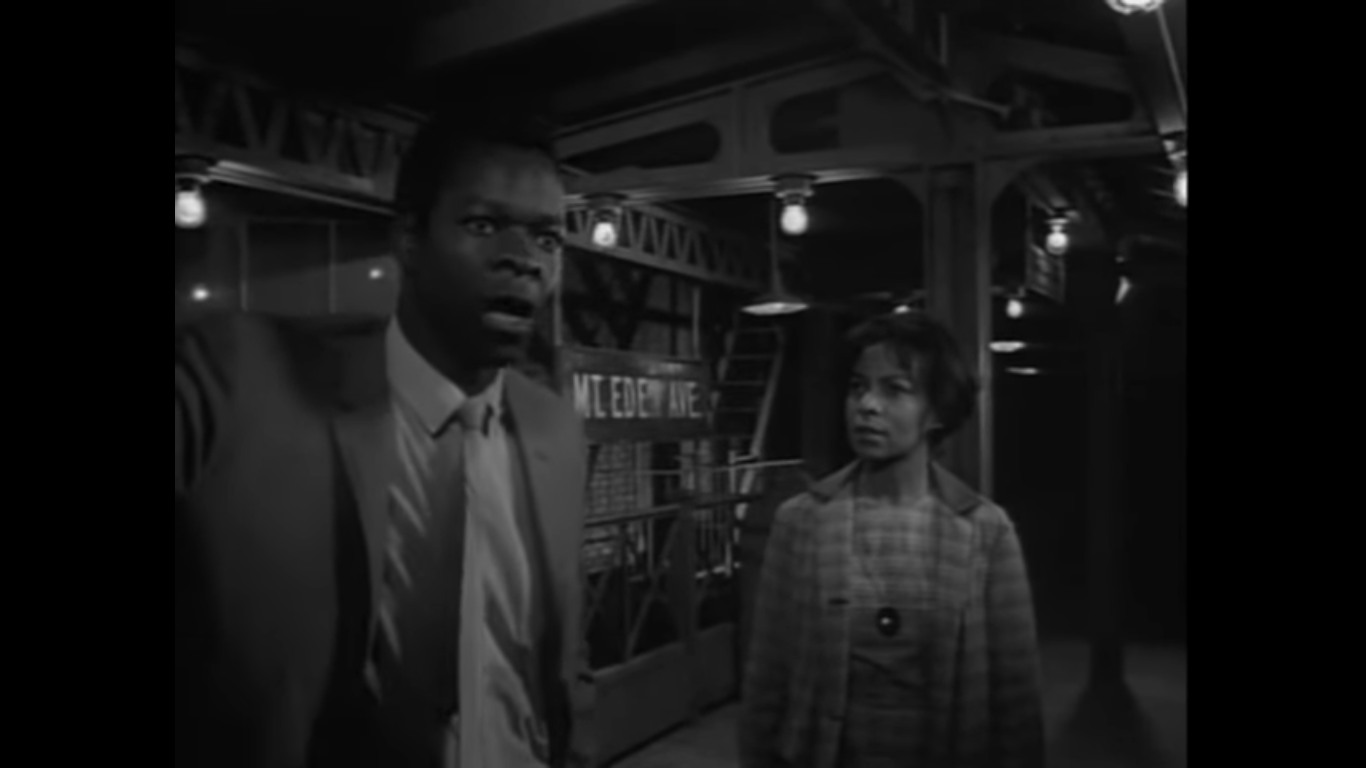
Ruby Dee plays the other crucial part as Laurie a single mother who carves out an existence for herself as a prostitute. I’m not sure if they’re immediately plausible as a romantic pair, although there’s a kindred spirit between them that feels real with affection as well as reproachfulness. Dee’s imbued with both playing a woman trying to eke by as the world continues to writhe around her.

Because there’s a heartlessness in the face of the impending revolution. Roscoe Lee Brown feels simultaneously crass and charismatic as a man who has gotten fat off a career as a police informant. Black men on street corners stand on their soapboxes preaching black power to the restless masses. Women preach an unswerving Christian rhetoric from their posts. The movement itself is represented by the quiet authoritarianism of a cool cat simply known as B.G. (Raymond St. Jacques).

A deserted bowling alley becomes a forum to air grievances and discuss courses of action within the differing factions: those who believe that Selma, Birmingham, and lunch counters are all old hat. Then, there are others still trying to keep the social doctrines of Dr. King alive maintaining there are legal channels to pursue change for the broader black community.

In this dialogue, one of the most intriguing figures is Teddy (Michael Baseleon). He feels like a James Reeb or James Zwerg type, a white man, and yet a man who earned his stripes in the tussles of Dr. King and Civil Rights. He’s been through the maelstrom. He’s counted the cost and yet to the emerging generation of young black power leaders, his skin betrays him. His ex-communication, even peacefully, from this space, seems to signify a point of no return. None of them know how prescient this will prove to be.

Because under the neon lights of Cleveland’s nightlife, Tank makes his Judas choice — to turn in his best friend — literally trudging through the muddy water of the gutter. He’s been besmirched both inside and out.

The film leans into campier moments from the bar where Tank lives it up and then the local arcade where he has a blast in the shooting gallery before scaring the heebie-jeebies out of some bubbleheaded whites in the funhouse. Blacks and whites alike seem to only exist to string out Tank’s delusions, becoming these grotesque stereotypes as reality (and morality) begin to fragment around him.

The wake for Johnny is one of the most arresting sequences where Dassin again exerts his influence over the material. I’ve rarely seen a sweatier face than Julian Mayfield as he drips all over the scene. The low angles stack towering figures all around that make Tank quake with fear in the presence of everyone. It’s a strangely tranquil space that he fills up with his totally unhinged paranoia as his guilt sets in and closes in around him like a noose.

And then he shares a scene with Ruby Dee running to her for comfort. I can’t quite describe the moment: she’s flailing, gasping for air through the tears, and trying to smack him until she falls over on top of him. She loathes him and loves him and feels sorry for him all at the same time.

As the story is stretched out, I got the sense, even as it remained pretty close to John Ford’s film, that Uptight deserved its own resolutions and universe with a level of nuance fit for its current events. But as we come to understand, this is more poetic and not a stab of purely social realism; it allows us the pliability to accept everything that happens on their own terms.

Whereas John Ford was going into expressionistic territory with inspiration nicked from people like F.W. Murnau, Dassin employs his own kind of stylized language to make sense of a story that he’s an outsider to and also probably still deeply sympathetic towards.

To that end, there’s no churchly absolution to absolve Tank from his sins. He’s literally left in a dirt heap, another sorry life, and another black man left for dead. The upbeat Booker T. and The MGs finale can’t do anything to negate the breadth of this tragedy. Even years later, as a nation, we’re still coming to terms with these events. Because we live in a progressive society encouraging non-violence, and yet in the face of inaction — when nothing seems to change, the call for a more aggressive response is hard to rebuff.

Uptight is not the film I was expecting, but my hope is that more people can see it as a segue into conversations. It tackles the issues of 1968 more overtly than the majority of films of the era. Although it hardly reaped the reward at the time, surely it deserves more consideration now. And if nothing else, it’s another crowning testament of two underrated icons: Ruby Dee and Jules Dassin.

4/5 Stars

The Informer (1935): John Ford and Victor McLaglen

The opening title card sets the stage in strife-torn Dublin in 1922 with a reference to Judas, the man who betrayed Jesus Christ to be killed. The allusive nature of the story becomes apparent only with time, connecting with John Ford’s own deeply religious inclinations as an Irish Catholic.

I won’t say Ford’s able to make a soundstage more atmospheric than the real place because reality would provide a grittier, more authentic ambiance, but here we have the mist, large vacant sets, and crumpled up newspapers that flutter around like tumbleweeds. It’s Dublin as can only be conceived in the dream factories of the studio system. 

Some might forget before John Wayne was one of his primary avatars, Victor McLaglen came to represent Ford’s version of hardy masculinity even earlier, and it’s no different here. Even when he was displaced in later years, he still found time to turn up in the director’s pictures, most notably in The Quiet Man and his cavalry trilogy. Ford never seemed to forget actors who had put in their service with him.

As The Informer set down its roots, it feels a bit like watching Hitchcock’s England pictures from the ’30s. You can see the early brushstrokes of the master, but it’s almost as if the technology hasn’t quite caught up with their ambitions and the capabilities of what they’re yearning to do. Sound, color, lighting, and the like would improve in the ’50s and ’60s as would both men’s budgets leading to some of their finest achievements and a plethora of the most lauded pictures Hollywood has ever known.

For now, they work with what they have and manage to spin a decent cinematic yarn all the same. Because necessity is the mother of invention; still, it’s also about how you utilize the time and resources on hand to make something as substantive as possible.

The Informer was made for RKO probably due to the fact no one else was willing to take a chance on it. It’s a meager picture in many regards, and this is easy to forget since it was a stunning success during that year’s award season. But it was a film made for a relative pittance over the course of a couple of weeks plus change.

While one would probably never call it Ford’s most profound achievement, you can tell he’s put his blood into it — his history as a proud Irish-American — and its core dilemma is a powerful bulwark to build a film around and an acting performance.

Gypo Nolan (McLaglen) is a man caught in the middle of civil unrest plaguing the lands since their inception. The British think he’s with the Irish and the Irish think he’s with The British. Mostly he’s out for himself just trying to subsist and earn himself a bit of merriment. Still, he can’t scrounge up a job from either side. It’s far from a desirable place to be.

He does have a few friends: Katie (Margot Grahame) is his lady although because he’s not good for much money, she works as a streetwalker to scrape out a living. Still, she’s devoted to the big lovable oaf. Another is Frankie McPhillips (Wallace Ford), a wanted hoodlum for the IRA resistance and a brother in arms for Gypo. They’ve grown up together and as is the prerequisite for a community like this, their friendship is forged in a life lived in proximity. Gypo loves the man, but he’s also penniless with no prospects.

It’s not exactly 30 pieces of silver, but Gypo makes a rash decision to sell out his friend — this isn’t so much of a spoiler — because this becomes the context for the rest of the movie. He’s tortured by his conscience even as no one suspects him in the wake of the tragedy he instigated against his friend and the man’s grieving family.

His only defense is to swim in self-absorbed debauchery. It gets him out of the moment providing a brief escape from his guilt. He belts a policeman and another lad on a street corner before wrangling fish and chips for a whole host of onlookers in a show of drunken generosity thanks to his newfound wealth.

In another scene, he stumbles in on a hotsy-totsy establishment run by a local matron where all the men and women wear top hats over drinks, conversation, and other things. He bowls them over with his rowdy entrance pushing down pipsqueak and gathering pretty girls up around him. These all feel like a part of his mental smokescreen.

Behind the scenes it’s a much grimmer scenario as the pragmatic Dan Gallager (Preston Foster) sends his cronies out into the streets to track down Frankie’s betrayer. This isn’t a mission of mercy. They live in a kill or be killed economy, and they’re prepared to take the necessary actions to preserve their cause against traitors, even those with deep roots in the community.

The drunken Gypo is pulled into a meeting with another suspect (Donald Meek) as the truth is slowly sussed out. The tribunal standing by has echoes of M, though it’s now been superimposed by this sense of Catholic guilt and justice.

McLaglen makes his way through the entire movie boisterous, gruff, and drunk like any good McLaglen performance except this easily must be the bar by which to judge all others. It’s either a really good job of acting or Ford helped him get into the part with a little trickery and added encouragement from the spirits. At least that’s how the story goes. Either way, it works with the actor dispensing this trail of blustering, sniveling, disoriented guilt, and gravitas making the picture go.

Dudley Nichol’s script doesn’t necessarily employ great prose — it’s not a thing of beauty — but Ford is able to utilize its framework to tell a worthy story. The final images culminate in the ultimate biblical picture.

Gypo stumbles into a church with one final chance to pay recompense for his sins. He gains absolution from the Mother (Una O’Connor), standing before the Crucifix, arms outstretched (May God Have Mercy on His Soul). The sentimentality doesn’t feel like typical Ford — though he could certainly be deceptive about it — and this form of religious iconography is something relatively apparent even in his final picture Six Women.

The Informer’s unparalleled success paved the road for him ahead with many great entries to come. Ford certainly was a master in blending classical storytelling with his personal vision. It shows how personal filmmaking can break through the barriers and resonate with audiences on an impactful level.

4/5 Stars

The Incident (1967): Psychological Torture on a Train

Before there ever is an incident to speak of in Larry Peerce’s film, we open on the lowest scum of the streets, played by Martin Sheen and Tony Musante, shooting pool and kicking up any trouble they can manage. Between catcalling after women and ambushing pedestrians for 8 lousy bucks, they’re still starved for more action.

It’s all a game to them, an adrenaline rush to get their Sunday night fix before the week sets in. What’s most telling are the perspective shots that can best be described as sociopathic POVs. Even momentarily they get us inside their heads, and we realize just how debased they are.

The opening display shows us who we are dealing with and what we are getting ourselves into. Because they all but evaporate from the movie for a time. But in the back of our minds, we know they will not be gone forever. It’s inevitable that they will return to wreak some kind of havoc.

The rest of the movie is an act of building out from here. We meet other supporting players from other cross-sections of society. There’s the husband and wife (Ed MacMahon and Diana Van der Vlis) who stayed out late with their daughter and quibble about hailing a taxi or not.

Another elderly couple (Jack Gilford and Thelma Ritter) bickers about their grown son who seems to have a perfectly situated life with a wife and kids and still seems ungrateful. Then, there the young lovers — the guy’s quite the Romeo (Victor Arnold), and he’s only interested in a girl if she puts out. His tentative girlfriend (Donna Mills) feels pressured but also anxious to win his aggressive affections.

If it’s not evident already, almost all of the characters come in couplets because there is something poetic and practical about it. Everyone has a talking partner, someone to nag and gripe with over the course of the movie. They all have their petty problems and individual relational dynamics.

These are the seeds of conflict, ready to combust under the right circumstances, and they do. One of the more light-hearted pairings includes two soldiers (Beau Bridges and Robert Bannard) who are currently on leave visiting some of their parents. Just wait…

We can see what the screenwriters are working towards already. All these stories are slowly interwoven together, crosscutting between each individual pair as they make their way to their respective train stops. Each group has its bit of business to take up as they file aboard all but oblivious of everyone else.

Although the black and white does wonders in making the film feel older than even its release year of 1967, there’s probably one thread that signifies the cultural moment better than most. Brock Peters and Ruby Dee play opposite one another, not as a groveling black couple but as a husband seething with militant desires and his high-minded social working wife who evidently listened more to Dr. King than Malcolm X. Even here we see the tension stretched out taut between them.

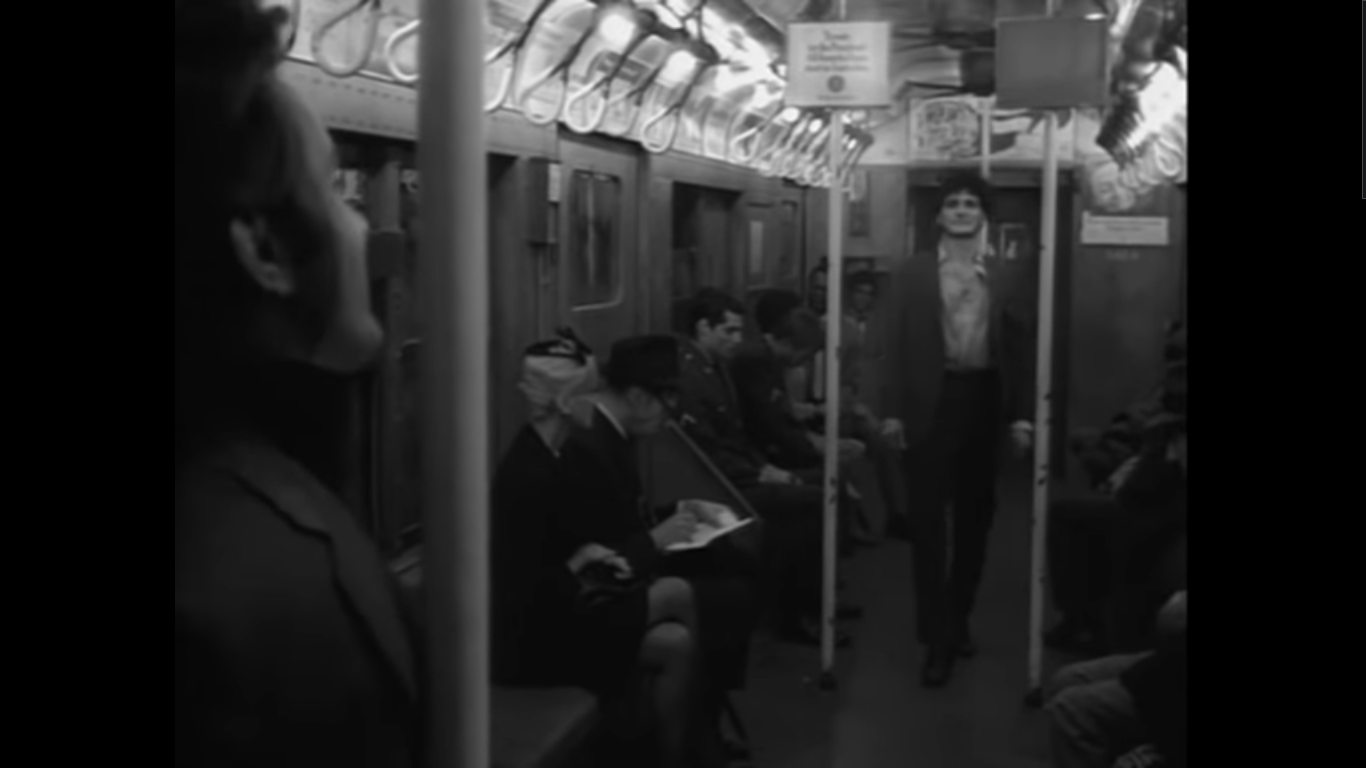
What coalesces almost feels like a psychological experiment put to film. Sure enough, Joe (Musante) and Artie (Sheen) come on the scene cackling and drinking like they have all night — going crazy and swinging their way through the train car like a pair of monkeys. For anyone who’s ridden the subway, you can witness some weird things to be sure, but there’s an immediate knee-jerk reaction to mind your own business.

This movie tests these principles whether it’s Good Samaritan syndrome or the diffusion of responsibility. The crux of our story is triggered when the two malcontents accost a homeless man snoozing on the train, prepared to light his boot on fire. Only one bystander (Gary Merrill) tries to casually get them to stop their antagonism, and it’s the first time where the invisible bubble is broached. When he encroaches on their anarchic freedoms, they look to intimidate him.

What’s made plain throughout the movie is the horrifying indifference as the thugs have free rein to perpetrate infractions and humiliations on the people around them. Sheen now is the big name of the two thugs, but Musante is arguably the most chilling, giving a performance that makes the insides crawl with its cruel manipulation. He literally walks through the camera, lumbering around and ruling the car like a vindictive prison warden where the prisoners are now running things.

Although all these moments of duress feel compartmentalized; no one is let out of their incisive games,  and each group is hustled and harried with all sorts of mind games laced with the threat of menace. Old men, old women, children, pretty girls, soldiers. Each one has a weakness and some pressure point to be prodded.

Oddly enough, this is the black man’s paradise watching white people degrade and torment each other for his personal pleasure. Little does he know, he can’t be an impartial observer forever. He too is thrown headlong into the fiery inferno. He too comes face to face with a mortifying breaking point.

By the end, Sheen and Musante aren’t human anymore, and not just because they are movie characters. They feel like evil demons looking to undermine everyone and bring their victims faced to face with their greatest fears and humiliations as they systematically make their way through the car triggering just about everyone.

There’s no conceivable end to this movie other than Beau Bridges taking on Martin Sheen as they look to beat each other to a pulp. It seems almost prescient because these men would become fairly big names in future generations, but for now, they represent the youth movement and where it could take us in the ’70s.

The aftermath of the picture feels equally indicative of the times. When the police rush on the scene, they are quick to apprehend the one black man and pin him down, only to realize their mistake and amend it in the heat of the moment.

There’s something poignant about the final coda: The drunk remains sprawled out on the floor and each and every bystander steps over him. It’s like one final symbol to show the threshold they’ve bypassed. There’s no turning back and whether they realize it or not, The Incident might embody an event that will haunt them for the rest of their lives. They managed to live another day but at what cost? It’s the kind of trauma causing heroes to come out of the woodwork and others to totally capitulate.

It feels like a film perfectly caught between two decades. It’s grittier and more audacious than I was expecting. But then again, this is a low-budget film and the year is 1967. We’re already getting Virginia Wolf, The Graduate, Cool Hand Luke, and Bonnie and Clyde, the forerunners to a generation of New Hollywood films that would blow the cover off what was permissible in the Hollywood scene. The Incident has some of that, but it also has a wealth of players and a premise that feels planted in a different era.

I recently watched The Silver Thread and it has the same distinction. Although it’s far less graphic, these are films totally suspended in time, hearkening back to the ’50s and still somehow forewarning the films of the future. The Incident, in particular, feels like an antecedent to Mean Streets, Badlands, The French Connection, and even Taking of Pelham 1, 2, 3. It’s fascinating to see glimpses of this emerging generation, especially in a film that, while rarely being discussed in a broader context, is still full of genuine heart-stopping drama. 

4/5 Stars

One Potato, Two Potato (1964): Love and Games

I was recently marveling how a theater actor I know predominantly from TV show appearances, William Redfield, could show up as an earlier incarnation of himself in an unorthodox film like The Connection. Then, about a week later, I had a similar revelation seeing Barney Miller’s wife, actress Barbara Barrie, doing something equally daring and landmark in One Potato, Two Potato.

Yes, it’s another black and white film of humble means, but it’s hardly short on ideas or purpose. Despite a childish title and production values that are a bit clunky around the edges, there’s still a fundamental sincerity to it in the tradition of something like Marty.

The very DNA of the picture is so fragile and tender, and yet it has a heart and exudes a kind of genuine candor capable of smoothing over a plethora of technical inadequacies. What I mean is that I like the movie — appreciate what it’s trying to do — and it feels bolder and braver than many of its contemporaries.

An all-knowing narrator helps bookend a story with court proceedings, but the crux of the matter must begin with Barbara Barrie and Bernie Hamilton. They meet in the carpool to work with their mutual friends, a pair of chatty lovebirds. Julie’s a white divorcee. Frank’s a black man who lives with his parents.

This is what the outside world sees, but in the movie, we watch how their temperaments meld as they are put in sharp relief with their friends. They gravitate to one another, not for some outlandish reason, but their simpatico and emotions are somehow attuned.

They have brief interactions. It’s tentative at first. There’s no intention on the part of either party. They have many walk-and-talks at night, quiet and pensive because they appreciate the company, and their demeanors are perfectly suited.

Then, in one of many grounding moments, maybe a policeman comes by, shining his lights on them, and ordering them away (what he sees as a black man and his prostitute). Either that or there’s some other sin of humanity, and they are shocked back to the debilitating frameworks that society has set up around them. These are blatant visual articulations, hardly subtle, and yet they acknowledge the prevailing cultural incongruities of the time: He’s angered; she thinks it’s funny, but together they must press on.

The resistance goes both ways because his own father (Robert Earl Jones) gives him a blatantly severe talking to. He brings up the questions of societal pressures and the prospect of kids: They’ll be outcasts, and it would be even worse to bring children into the world.

Frank almost buys it. He tells his beloved, “It won’t work.”

She responds, “What won’t work? Kindness and love?”

Yes, it’s true. The culture is entrenched with a deadly narrative of hate, riots, lynchings, and prejudice between their disparate people. But they want to push against this with their love. It’s all they can do.

In an earlier scene, after a friend’s wedding, they dance by lamplight, not like Astaire and Charisse in The Band Wagon, but like normal people would. Slowly and tentative, pressed up against one another. Instead, they play like a pair of kids with imaginary games of hopscotch and follow the leader. It’s a different kind of whimsical magic hearkening back to a world of possibility before children learn racism and are taught the limits placed against them by “reality.”

Their own wedding is punctuated not by joyous dancing and merrymaker but the jaundiced ire of a lady witness looking on in contempt. Because even if she’s not going to put a stop to it, we can read her face. She thinks this is repugnant, against nature or something. Her face is a canvas to reflect the peer pressure of an entire society. And it’s not the only one…

Julie’s ex-husband (Richard Mulligan) comes to visit his daughter after years away, and they have fun playing cowboys and shoot ’em up together. It’s another instance of play where the man is stripped of his responsibilities only for them to become firmly established again when he sees his estranged wife living in the home of a black man. He doesn’t want his daughter to somehow be sullied by such a sordid existence. One questions if it’s really for her well-being or his own reputation because people will talk.

It seems only realistic to encapsulate One Potato, Two Potato through the sum of its various sequences since it’s really a film of ellipsis as scripted by Orville H. Hampton and Raphael Hayes. Even when they feel a bit abrupt and unpolished, there’s an unparalleled potency to them because they speak into the moment like few films I’ve been aware of. What it lacks in fluidity, becomes bottled up in these perceptive moments that come to represent very specific even salient points of view and bits of trampled humanity.

Joe Cullen goes to a local preacher who admonishes him for wanting a God who has racial prejudice too. But God will not let him off that easy. His very commands adjure his people to “Love thy neighbor as thyself” without any kind of qualifying remarks or addendums. The man’s problem, along with so many cultural Christians, is reflected in their religion, which is such a self-serving construct rather than a way of life and relationship.

Then, the drama comes thick and fast. Julie confronts her former husband who still remains skeptical of her, full of outrage and insinuations (You talk about how he loves the girl, loves you, but can you love a black man?). And yet she remains resolute.

Frank feels successively beaten down as a husband, left emasculated and powerless because he cannot protect his wife based on the color of his skin. He goes to a college lawyer friend for help. He’s a jovial, accommodating fellow who grows scared and defensive when he learns about the parameters of the case. This is before Loving v. Virginia. Regardless of right or wrong, there is no legal precedent and a hot case like this could ruin him, and so he folds. Not because he’s a “bad person” but because he’s spineless and scared like you and me.

We stew in Frank’s powerlessness much like Ivan Dixon’s struggles in Nothing But a Man from the following year. They are kindred spirits. He gets some kind of catharsis by proxy watching the American Indians massacring the whites in the western at the drive-in theater. One can’t imagine he’s the first man to ever cheer for the other side even as he yells and shouts — slamming on his steering wheel.

The movie has an inevitable conclusion, if not an altogether just one. The judge (Harry Bellaver) makes a final decision predicated on economic viability rather than true measures of parental love and affection. It’s indicative of a culture that while acknowledging its fault lines — how a couple like that is made into social pariahs — nevertheless reinforces the status quo. Although it may be fictitious, this isn’t fanciful drama. It cries out with streams of all too apparent truth.

By the end, it feels like social horror, more heart-wrenching and harrowing than even something like Get Out because this was very real and no peppy nursery rhyme tune can wipe any of that devastation away. I still can’t believe this film. It feels like a small but mighty gem of a movie.

4/5 Stars.

In The Heat of The Night (1967): They Call Him Mister Tibbs

In The Heat of The Night is a testament to the collaborative nature of Hollywood. We watch Sidney Poitier step off the train. Haskell Wexler’s cinematography gives an instant texture to the world so the sweaty atmosphere is almost palpable around him.

However, one of my immediate recollections of the movie is always Ray Charles and Quincy Jones who help in creating a truly remarkable soundscape. Charles sings the title track (with lyrics by Alan & Marilyn Bergman) setting the mood for one of the formative movies of a turbulent decade.

Although Rod Steiger becomes one of the film’s primary focal points as the gum-smacking, narrow-minded Sherrif Gillespie, it’s Warren Oates, one of the generation’s finest character actors, who’s our entry point into this community.

He’s a police officer sitting at a diner drinking a cola as the scrawny, beady-eyed attendant shoots a pesky fly with his slingshot. It’s a sweaty night in Spartan, Mississippi and already despite these mundane activities, there’s an uneasy equilibrium to the place.

Poitier has to navigate the film’s space all alone for the majority of the movie. There’s a black family who puts him up for a night, a servant (Jester Hairston) who looks at him a bit disapprovingly, a phantom black woman (Beah Richards) who runs a business at night, and of course, the host of blacks working the cotton fields. Otherwise, he’s all alone, isolated and alienated from those around him as a blatant outsider. His only solidarity is in the score and soundtrack.

If it’s not apparent already, In The Heat of The Night continues a conversation that automatically puts folks at odds and in opposition to one another. You have blacks and whites. You have North and South. You have rich and poor. All of them are visible in the movie.

For blacks in particular there are these daily barbs of indignity pervasive throughout the southern culture and totally baked into the system. Norman Jewison’s film (and Stirling Siliphants’s script) only has time to acknowledge some of them, both explicitly and implicitly.

It’s plain that when an influential man is found murdered, the first person suspected is the black man sitting at the train depot. It’s a guilty ’til proven innocent economy. Black men must also suffer the subtle humiliation of being called “Boy.” An out-of-towner like Tibbs will never hope to get a hotel. And even after weathering any number of indecencies, he finds himself cornered and physically intimidated.

The whole movie is about this even as Poitier reluctantly stinks around to bail out the less-experienced, backcountry police force. He’s doing them a favor that very few people are ready to accept.

In The Heat of The Night can theoretically be distilled down to two defining moments. The first is in the police station where Gillespie is railing on him, badgering him for all he’s worth. He asks what they call him in Philadephia and he seethes, “They Call Me Mr. Tibbs! Poitier’s trademark intensity proves so gripping it’s maintained lasting resonance all these years later.

However, the film’s other defining moment is presaged by a lawn ornament calling to mind Flannery O’Connor’s wince-inducing short story “The Artificial Negro.” It’s found in an establishing shot of the Endicott Estate. Mr. Endicott (Larry Gates) owns the local cotton industry and effectively keeps the southern ecosystem alive and well from the antebellum days.

I hadn’t recalled how Tibbs trades small talk with Endicott when they pay him a house call in his greenhouse. They share a conversation about orchids, trading vernacular, and it feels amicable, at the very least. This is what they call southern hospitality. But then an ugly undercurrent is revealed and the conversation turns. Tibbs asks one question too many and gets a scathing response.

The old boy takes offense at being questioned on his own property, by a black man no less, and he lets him have it with the back of his hand. This is relatively unsurprising — another unseemly relic from the old days. What makes the moment is how Poitier strikes right back without a moment’s forethought or hesitation. It’s electric, and it’s as if all the years of southern tension are being brandished in one spontaneous reaction. It’s a show of righteous indignance, pride, and dignity. It’s also just such a human response.

Whether the moment was in the script, added later, or proposed by Poitier seems almost immaterial. It’s the fact that the moment is forever crystallized in cinema giving it a lasting cultural currency.

However, Norman Jewison’s movie does court a few more ideas. Oustide Gillespie prods Tibbs, “You’re just like the rest of us, ain’t yuh?” Poitier might be a shining knight, but his character is still wounded, proud, and simmering with pent of emotions submerged just below the surface. He wants to put Endicott away and make him pay. Gillespie’s just trying to do a job, but Tibb’s drive is something more personal. He’s looking for vengeance. It’s also enough to warrant deadly backlash.

I recently heard an interview with Jewison reminiscing about Poitier and the filming of In The Heat of The Night in the wake of his passing. The director said the following:

“I’d wanted to shoot in the South; the book takes place in Georgia and we’d moved the story to Mississippi for the movie. But we had to shoot it in a town in Illinois, called Sparta because Sidney would not go south of the Mason-Dixon line. He and Harry Belafonte…they had been arrested and attacked by guys in pickup trucks, so he refused to shoot down South.”

“Later in the shoot, I wanted to shoot some exteriors in actual Southern locations, so we talked about going to Tennessee. ‘I’ll give you four days, Norman,’ Sidney told me. So we all went down to this small town with one hotel…and it was ‘whites-only.’ So all of us, the cast and crew, ended up in a Holiday Inn a little ways away, which allowed both Blacks and whites.”

“And I’ll never forget, these pickup trucks came into the parking lot in the middle of the night, honking their horns and waking people up. I got a little nervous, so I called my crew and told them, “Get the biggest guys in the grip department and electrical department, get them over to Sidney’s room right now, we have to protect him.’ Then I called Sidney’s room and I said, ‘Don’t worry, Sidney, we will take care of everything.’ He said, ‘I’m not worried. I’ve got a gun under my pillow.”

“So the first one of them comes through my door, I’m going to blow them away.’ Thank god nothing happened, but this naive director from Canada suddenly understood the extent of American racism. I began to really get just how vicious things were.”

I’ve heard In The Heat of The Night labeled as a do-gooder film, but this seems to minimize not only the movie but Poitier in particular. I find it to be a fundamentally gripping police procedural and this is without thinking about a specific message potentially being crammed down our throats.

This is a testament to the unnerving milieu of the southern town being evoked. It’s the cinematography of Haskell Wexler that feels alert and alive in how it lights and considers the fully-colored spaces. It comes down to this antagonistic rapport of Steiger and Poitier, two very different actors who prove themselves to be exceptional sparring partners as mediated by Norman Jewison.

Surely Poitier had no illusions about what he was portraying. Jewison’s remarks make this very plain. And so he took his image and his part in the movie very seriously. Is it a fantasy about blacks bending over backward to help whites, and then irredeemable racists being redeemed right in front of us? You could say that. But even this seems to oversimplify the picture and sell it short.

This is the movie where Poitier burned with righteous anger and slapped a white man in retaliation, out of his own human pride. Surely isolated moments like these belie any facile interpretation. Because I can’t totally disregard how these scenes make me feel on a fundamental level — how they move me.

How can I have failed to mention Lee Grant, who was finally allowed to leave the Blacklist behind and prove her chops improvising some heart-rendering passages opposite Poitier. They show her ache and his tender concern toward a grieving widow, but also a fellow human being. It’s like some kind of dance they do together.

Or consider how Steiger, still chewing his cud, tells Virgil to “take care.” It’s not much; the exchange is almost sheepish, but it’s trusting we understand the implications. If it’s not an apology, then it’s some form of an olive branch.

This movie doesn’t remedy “the race problem” as it was called in generations past. Its fissures are still supremely evident and ugly. Still, these human exchanges with Poitier at the center, model something deeply healing. To see them on the screen feels validating and also like a balm. Righteous anger has its place, truth has its place, and so does seeing the inherent dignity in others. Rest in peace, Mr. Poitier. You were one for the ages.

4.5/5 Stars