Psycho (1960) – Alfred Hitchcock

Alfred Hitchcock is much appreciated now but this film especially stands out in American culture because it was a first rate horror film when that was an anomaly. It has a chilling score, a notorious villain, and a sequence that is one of the most famous in film history.

*May Contain Spoilers

Directed by Hitchcock and starring Janet Leigh, Anthony Perkins, and Vera Miles, this film is intense from the opening sequence. Marion Crane seems to be your average love-struck woman stuck in her job. However everything quickly changes for her after she runs off with $40,000 that had been entrusted to her. Before she can get it to her boyfriend she must stop for the night at the Bates Motel. She rents a room and meets the timid, unassuming proprietor Norman. Soon it becomes obvious that he likes her but his domineering mother does not approve. Then later when Marion is taking a shower she is brutally murdered. Soon the situation becomes even more confused when a private investigator winds up missing. Marion’s sister and boyfriend resolve to go to the motel themselves. Little do they know the shocking events that await them. Undoubtedly Hitchcock’s most famous film, Psycho shakes the nerves and excites. Furthermore, it solidified Norman Bates as one of the most notorious villains of all time .

5/5 Stars

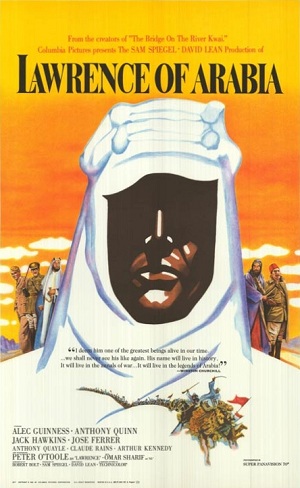
Lawrence of Arabia (1962)


A film of truly epic proportions, in length, scenery, and brilliance, Lawrence of Arabia is essential cinema. Peter O’Toole delivers a stellar performance as T.E. Lawrence, a British soldier during World War I. The movie begins with his death from a motorcycle crash, which gives an early glimpse of the character.

Then, a flashback goes to his time in Arabia where his task was to unite the Arab tribes, and lead them in rebellion against the enemy so the British might win. Against the better judgment of his commanding officer, a Mr. Dryden of the Arab Bureau suggests Lawrence be sent to assess the possibility of an Arab revolt against the Turks. Lawrence heads with his guide to pay a visit to Prince Faisal. However, his guide is shot by another man and Lawrence resolves to make the journey alone. Their paths cross again in the camp of Faisal. There Lawrence interests the Prince because his ideas are far different from his commanding officer.

Showcasing his audaciousness Lawrence suggests a bold attack on Acaba which would allow the British to bring in supplies. He leads a group of men across the brutal desert knowing that this will be less expected. Sheriff Ali (Omar Sharif) doubts it will work and disapproves that Lawrence takes two young outcasts as his servants. It is later during the journey that Lawrence truly wins over the other men, including Ali, because he is relentless, even going back for a lost straggler. With some luck, Lawrence is able to gain the help of Auda Abu Tayi, but it is not without tension. Ultimately, his forces are able to take out the Turks, and Lawrence heads back to Cairo to relay his progress. However, on the way back he must struggle with the loss of a servant and the guilt of executing a man.

Lawrence is sent back to Arabia and there he leads his forces in guerrilla operations against the Turkish railroads. His exploits are documented by an American newsman, and by this point, he has become a mythical hero among his followers. However, after going to scout a town the seemingly invincible Lawrence is ultimately flogged and tortured, leaving him a broken shell of a man. He insists on leaving Arabia but his new commander, General Allenby orders him back for one final push towards Damascus.

This final mission sees a change in Lawrence, who has hired killers and missionaries to help him in his siege. Against the better judgment of Sherif Ali, Lawrence leads a massacre of Turks as they move onward. He takes Damascus, but his fragmented counsel of Arabs are unable to unite, and the city is given back to the English. Major Lawrence is promoted once more to Colonel, and then gets shipped home because his services are no longer necessary.

This is one of those films you want to see on the big screen because the scenery and cinematography is just that impressive by itself. David Lean had a skill at making epics, and this is perhaps his masterpiece. The desert is often stark and desolate, and yet striking in the same instance. The expanse of space that is viewed in a single shot is often mind-blowing. A human being on the horizon is hardly a speck, and the ever-present camels are hardly any more substantial. To complement these grand images is an equally magnificent score by Maurice Jarre, complete with overture and all. The cast must be mentioned too with such supporting stars as Omar Sharif, Anthony Quinn, Alec Guinness, Claude Rains, Jack Hawkins, and Anthony Quayle.

Then, of course, there is the man who played Lawrence. As portrayed so wonderfully by Peter O’Toole, Lawrence is an intelligent and, at times, arrogant man, who can be odd, distant, audacious, and also unscrupulous. That being said, he was an extraordinary man who was a mover and a leader of men. A very unique, at times controversial, and long unheralded man, who contributed to the war effort in a far different way.  In many ways, he was an adopted brother to the Arabs, and their country was also his. He was “Lawrence of Arabia.”

5/5 Stars

Mr. Smith Goes to Washington (1939)

84a24-mrsmithgoestowashingtonposterAs both a political drama and feel good movie, this film cemented James Stewart as an acting powerhouse. Furthermore, despite its age, it acts as a timeless reminder of the evils of political machines. It makes us root for the underdog, and it is distinctively American. Here is a cast and a story that seemingly could never be equaled, but what this film really had going for it was an idealistic outlook. I can, myself, often be a cynical person, and still Mr. Smith never fails to make me acknowledge the numerous attributes that make our country great, whether it is through montage, monuments, music, and of course Jefferson Smith himself. 

In one of his best performances, Jimmy Stewart is an idealistic, naive boy’s troop leader named Jefferson Smith. The starry-eyed Smith trusts that our nation is founded on some very noble principles that should be fought for tirelessly in government and in society. Above all, he is a likable fellow, who earnestly believes in the merits of this country, and he is beloved by boys all across the state. Now, this all sounds fine and dandy, but it would never have come across on the screen if it had not been for Stewart. He emanates this awkward and innocent energy that puts life into the idealistic creation of Jefferson Smith. 

When the film opens, everything is in turmoil when a senator suddenly dies and a replacement is needed fast. Believing Smith will be a pawn, a powerful man named Taylor (Ed Arnold) gets Smith a seat in the nation’s Senate. There he joins the respected Senator and old family acquaintance, Joe Paine (Claude Rains), who is also a cog in Taylor’s machine. However, although he is out of place in Washington, the patriotic Smith does his best to be worthy of his position. He realizes that the press will not give him a break, and the other Senators do not take him seriously.

So, on the urging of Paine, he decides to come up with a bill for a boys camp back in his home state. He requires the help of the world-weary secretary Saunders (Jean Arthur) to get his bill done. Initially, she is disgusted by his naivete, but as she grows to know him, she realizes he is only going to get himself hurt. His action to propose a bill soon find him face to face with the political machine that elected him. Taylor also has stakes on the piece of land where the boy’s camp would be, and he wants it for a dam. 

Smith finds himself being accused of using his position for his personal gain, and pretty soon he is before a committee with false evidence piling up against him. With all odds and seemingly everyone else against him as well, Smith makes one last monumental effort. Thanks to the help and guidance of Saunders, Smith fights to plead his case through a filibuster.

Fatigued by many hours of giving impassioned speeches and reciting the Constitution, Smith finally collapses, but not before effectively succeeding at his task. I doubt this would ever happen in real life, but in the film, it is fantastic watching the Senate break out into complete and utter mayhem. Ultimately, a young man with “a little bit of plain, ordinary, everyday kindness and a little looking out for the other fella,” was able to win. True, it may be overly sentimental, but it is a wonderful piece of sentiment all the same.

Frank Capra was wonderful at these type of cheering tales and his stars were in top form. There is an absolutely wonderful supporting cast here including Claude Rains, Edward Arnold, Eugene Pallette Thomas Mitchell, Charles Lane, Harry Carey, William Demarest, Beulah Bondi, and numerous other familiar faces I don’t even know the names of. That’s the beauty of the studio system I guess. It may have the same director, same leading man, and some of the same general themes, but Mr. Smith Goes to Washington covers completely different territory from Capra’s later classic It’s a Wonderful Life. Mr. Smith should be seen as a unique, and very much American film.


5/5 Stars

Playtime (1967)

67d66-playtimeoriginalposterStarring and directed by Jacques Tati, this film is his most ambitious work yet. The film opens in a Parisian airport with droves of tourists. Then the audience ends up looking into an office high rise full of glass, cubicles, elevators, and escalators. All throughout we observe many characters including Mr. Hulot who seems strangely out of place in this modern, suburban city. He ends up at an international expo, visits a friend’s home in the evening, and then ends up taking part in the disastrous opening of a night club. Hulot becomes acquainted with an American tourist before she returns home from her Parisian adventure. At times this film is almost like a giant ballet, with often subtle humor, and a stream of events only connected by the characters they involve. The architecture picks up where Mon Oncle left off, the sets are on a grand scale, and even the clothing of  most of the people seem to fade into this world. This film is also international as well as universal because it is more about the image and sound than dialogue. After it all I was left with a satisfied smile. It may not be for everyone but for me personally it was a joy to watch.

5/5 Stars

Rear Window (1954) – Alfred Hitchcock

02805-rearwindowposterStarring James Stewart, Grace Kelly, and Raymond Burr with director Alfred Hitchcock, this is a superb film that takes place in a very limited space. L.B. Jefferies (Stewart) is a professional photographer who is incapacitated in his flat with a broken leg. All he has to pass the time is watching the people across the courtyard. Although he very rarely interacts with them, he slowly begins to know them just by spectating. Pretty soon he realizes something is amiss when the annoying wife across the way is no where to be seen and her husband (Burr) is acting strangely. With help of his ravishingly beautiful girlfriend (Kelly), Jeffries tries to uncover the truth. Everything escalates when Lisa breaks into the man’s apartment and it finally peaks in a climatic confrontation. In the end all is well and Jeffries realizes his true love. This is one of my favorite films because of its unique setting and it is possibly Hitchcock’s best. He takes an environment that is so confined and then makes a very entertaining and suspenseful film with it.

5/5 Stars

High Noon (1952)

14bd7-high_noon_posterThis may not be the greatest film of all time, but it is certainly one of the greatest westerns gifted to us so generously by Fred Zinnemann. It tells a very simple story, yet it is, in fact, so powerful simply, because of the hero it depicts. In its time it also served as a condemning allegory of the finger pointing going on in Hollywood.
*May Contain Spoilers

The film tells the story of Marshall Will Kane, who is willing to face his foes even when no one else will help him. Gary Cooper plays the newlywed lawman, who must flee town or face the killer coming on the noon train. He resolves to do just that, despite the pleas of his loving wife (Grace Kelly). The sheriff scrambles against the clock to get help. However, no one is brave enough to face the enemy with him. Even with the odds against him, he faces them in a showdown. Cooper is outgunned, but not outmatched — heroically prevailing.

This film is so powerful, because it is full of human emotions, and it feels so real since the events unfold almost in real time. The somber ballad, sung by Tex Ritter, also helps to create the mood right from the opening credits. In fact, I must admit that multiple times I have found myself humming or crooning the words, but then again I suppose it makes sense since the song is woven into the very fabric of the film.

The score by Dimitri Tiomkin utilizes the tune throughout to complement the images of the town. In that respect, “Do Not Forsake Me, Oh My Darlin'” is not just a song, but an important piece of this story. It is easy to forget the supporting players since Cooper often steals the show. Nevertheless, there’s Lloyd Bridges, Grace Kelly, Katy Jurado, Thomas Mitchell, Lon Chaney Jr.,  Harry Morgan, and even a young Lee  Van Cleef. Many have pasts with Kane that we cannot expect to fully know. All we can understand is the here and now that causes a person to weigh their options, and either follow or go against their conscience. Kane and then his bride both did what they thought was right even when others would not follow suit.

It struck me how simple the story is, and yet on the other side, it is a complex allegory that critiques humanity. Will Kane is a man, who helped make the town what it is, but when trouble comes and the odds are bad no one is willing to help him. Besides the obvious positives like a good story and a heroic protagonist, this film stands out because it feels so human. Here we are as an audience watching the events unfold almost minute for minute. Then we see the various town folk and their fear of getting involved, and to make matters worse a lot of them are Kane’s very good friends. It makes us question what we would have done in their position. Because some of them were obviously good people, who were scared to be involved. Of course, during this time McCarthyism was prevalent and it is suggested that this film alluded to that. However, whatever you think it is still unquestionable that High Noon is a powerful film, a love story, and at its simplest a classic western.

5/5 Stars


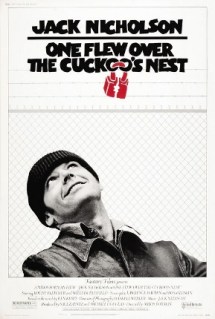
One Flew Over the Cuckoo’s Nest (1975)

This is a powerful film from the 70s that has such an intriguing conflict between Jack Nicholson and Louise Fletcher. There have been many chilling villains in the annals of cinema, but Nurse Ratched was arguably the coldest and yet understated of them all. She makes this a true battle for supremacy. Nicholson is supported very nicely by the rest of the cast who he helps to rile up.
*May Contain Spoilers

Originally adapted from the novel by Ken Kesey, the film tells the story of a criminal interned in a mental hospital, because he thinks it will be “life on easy street” with a bunch of crazies. Jack Nicholson plays this Randle McMurphy, who goes in ready to live easy and challenge authority whenever he can.

Meanwhile, the doctors observe him seeing if Randle really belongs. As he grows accustomed to the institution, he becomes the instigator of the other patients. Whether they are playing cards, talking with the group, taking medication, getting their exercise, or taking a fishing trip, he always looks to get his way and have the other patients rally around him. However, he must deal with Nurse Ratched, a cold and iron-fisted woman, who keeps everyone at bay believing it is for their own personal well-being.

In fact, she chooses not to send McMurphy away because he is their problem and Ratched is ready to deal with him in the way she sees fit. Not even McMurphy seems able to prevail over Ratched and her tactics in the end. He starts a riot in the ward after they are not allowed to watch the World Series, and as the final straw, he holds a wild Christmas party with girls and alcohol. He plans to get away in the aftermath with his new-found friend “Chief,” only to wake up in the morning to a very displeased Ratched. Her pressure causes one unstable young man to commit suicide, and with the opportunity to escape right in front of him, an enraged McMurphy strangles the nurse, only to be subdued. Things quiet down and the patients revert back to their old ways with “Mac” nowhere to be seen.

One night he is returned and in a Deja Vu moment, the Chief goes to talk to Randle, only to see a blank look on his face. Ratched’s methods have seemingly won. However, Chief is able to use Randle’s plan to escape and keep the hope alive. Nicholson was backed by a stellar cast including Louise Fletcher, Danny Devito, Christopher Lloyd, Brad Dourif, Will Sampson, Sydney Lassick, and William Redfield.

Although this film is rougher around the edges, it reminds me of the earlier dramatic classic 12 Angry Men, because both films have wonderful casts that are able to create such tension through their collaborative performances. Much like Henry Fonda, Nicholson is the undisputed star, but all the other players make this movie truly extraordinary. Early on there are some definite comedic moments, but the film begins to get darker as the story progresses, and Ratched gets more and more strict.

Furthermore, this film is shot in a realistic almost bleak documentary-like style that really adds to the film. It is almost difficult to watch the scene where Randle chokes Ratched because it is up-in-your-face and graphic. Despite, the fact that the ending is depressing, there is still a hint of hope. It is one of the things that makes One Flew Over the Cuckoo’s Nest so riveting. Much like many of the patients that inhabit the facility,  the mood constantly swings like a pendulum from humorous, to calm, to bleakness, and finally hopefulness.

5/5 Stars


Annie Hall (1977)

Starring Woody Allen and Diane Keaton, the film begins with Alvy Singer (Allen), a comedian with a good career and two unremarkable romantic relationships. That all changes when his friend (Tony Roberts) introduces him to the lively Annie Hall (Keaton). Over time they begin to grow fond of each other and they spend lots of quality time together in New York. However, after a trip to Los Angeles, they decide to split up and Annie stays in California. Alvy realizes his love and goes to see her again. His proposal of marriage is rejected, however after some time passes he comes across Annie in New York and they remember all the good times. This comedy romance is a quirky Allen movie that uses sight gags, breaks the fourth wall, utilizes voice over, and has lengthy camera shots.This film is a lot about simply talking and it certainly has its moments of brilliance.

4.5/5 Stars

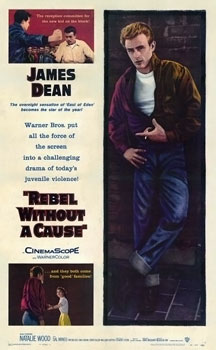
Rebel Without a Cause (1955)

A film starring James Dean, Natalie Wood, and Sal Mineo,  with direction by Nicholas Ray, Rebel Without a Cause follows three teenagers, who are confused and conflicted about their lives. 

The initial sequence rolling behind the opening credits has the inebriated Jim Stark lying in the street fiddling with a toy monkey. Then, he is brought into juvenile hall, and simultaneously the story gives us a glimpse of not only the rowdy Jim, but discontented Judy, and the distant boy Plato. Each one has their own personal pain, and thus this film from the beginning really focuses on three rebels, who embody the adolescent generation. James Dean is Jim Stark: the new kid on the block, who is constantly moving with his parents. In the station when his parents retrieve him, there is obvious tension on all fronts, which include heated arguments, and outbursts on the part of Jim.

The morning after being brought in he meets Judy only to get mixed up with her friends. Stark however also befriends the isolated loner Plato, who was in the station the night before. The trouble with the other teens starts with a switchblade contest during a school excursion to Griffith Observatory, but the stakes get bigger when they compete in a “Chickie Run” over a cliff. Stark lives but the other boy, Buzz, dies in the accident. Everyone flees the scene before the police arrive.

Stuck between a rock and a hard place, Dean and Wood’s characters gravitate towards each other. Their parents seemingly do not understand them, and so they find comfort in each other instead. Their new found friend Plato tags along as they hold up in an abandoned mansion for the night. They spend the evening lounging around, making light of their parents and just talking. 

However, all does not bode well when some of the high school thugs come looking for Stark. Plato flees the scene with a gun, and soon he has policemen on his tail. Plato is in a paranoid and unstable state. Jim tries to console him and bring him out peacefully. But despite his best efforts, tragedy strikes one final blow.  All is not wasted, however, because Jim’s father (Jim Bachus) vows to be a better and stronger parent than he was before. 

Following his breakthrough in East of Eden, Rebel would be the movie that defined Dean’s short but iconic career. His line “you’re tearing me apart!” would further define the angst felt by many teens at the time. There is a certain aura around this film for some reason, maybe because of Dean’s portrayal that is at times so moody, and at other times so subtle, but powerful nonetheless.

I think part of the credit must go to director Nicholas Ray, who gave Dean free reign to improvise and develop his character in the way he saw fit. The film is tragic in another sense because all the primary stars died at an early age. Dean’s is the most remembered, but Mineo and Wood, both died extremely young as well. In Rebel Without a Cause, they all gave memorable performances and there are other notable players in this film including the usually comedic Jim Bachus and a very young Dennis Hopper.

I think Rebel ultimately survives today because it tells a universal tale of a generational divide and a divide between young people fighting peer pressure. In the heads of teenagers the world can become jumbled and between school, fitting in, and home life it can be a struggle. This film dramatically illustrates that fact. So maybe the kids look different, the cars are older and such, but the struggles of Jim Stark, Judy, and Plato are still relatively the same.  I must say this film really makes me want to visit the Griffith Observatory too, because it became such an integral part of this film’s story, and it is still around to this day.

James Dean only had three major film performances and you could make a case for which was the best. I think it is safe to say that this role was his most iconic. It’s hard not to identify him with his red jacket, blue jeans, and the ubiquitous cigarette. He was the Rebel Without a Cause.

 
5/5 Stars

Duck Soup (1933)

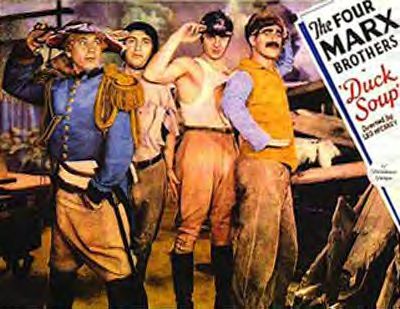
47a2d-duck_soupArguably the greatest movie of The Marx Brothers, Duck Soup takes place in the country of Freedonia where Rufus T. Firefly (Groucho) is appointed the new leader. All too soon he proves to be incompetent and the ambassador from the rival country of Sylvania wishes to start a war with Freedonia so he can take over the country. He enlists the help of a wily woman as well Chico and Harpo who are spies. Chico is caught and his trial ultimately leads to war. However, he is also Firefly’s secretary of War and with the Brothers leading things it is sure to be zany and wild. Beside the ever present puns and quips, some memorable moments include the opening serenade, the street vendor scenes, the famous mirror sequence, and of course the war at the end. This would be the last film with Zeppo but the other brothers would move onto MGM and keep their career going. This film is good but upon seeing more of their films I would say I appreciated A Night at the Opera more.

4.5/5 Stars