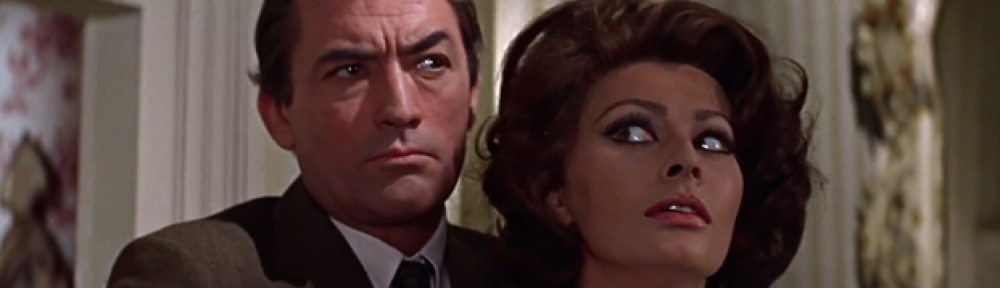
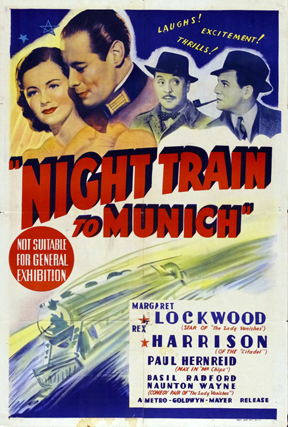
 We are met with the scourge of Hitler overrunning mainland Europe. It’s about that time. American isn’t involved in the war. Britain’s getting bombed to smithereens and the rest of Europe is tumbling like rows and rows of tin soldiers.
Carol Reed always proved astute at setting the stage for great human dramas and Night Train to Munich is little different. Anna Bomasch (Margaret Lockwood) wakes up to find that the Nazis are on the march for Czechoslovakia and her father, a renowned scientist, is fleeing the country. However, she’s not so lucky and gets intercepted by the Nazis ending up in a concentration camp instead of aboard an airplane to freedom.
It’s in these moments where the script develops a fairly frank depiction of the concentration camps denoting that they were hardly a day of wine and roses. But in that very harrowing climate, she meets a proud rebel named Karl (Paul Henreid) who uses his underground contacts to help them escape and promises Anna that they will find her father in England. Hope still exists.
The man they wind up reaching in the British Isles feels more like a nobody than a top government agent singing tunes at a beachside promenade. But Dickie Randle (Rex Harrison) proves to be far more than he lets on at face value. Still, he is not the only one who holds that distinction and no sooner have they been reunited then father and daughter find themselves kidnapped by Gestapo spies and carried on a U-Boat back to the Fatherland.
We know where the final act must go as Randle heads into the mouth of the lion’s den to try and pull off a daring rescue that looks like an absolutely ludicrous endeavor with not even a half chance of succeeding. He masquerades as a member of the German corps of engineers and pulls the wool over on some of his denser adversaries. Still, one man is not so oafish and they must thwart the insider Gestapo man looking to trap them.
In its day and even now the film was pitched as a sequel to Alfred Hitchcock’s thriller The Lady Vanishes (1938). The connection can be attributed to several aspects including similar locales — namely a train — the same studio producing in Gaumont, the screenwriting skills of Sidney Gilliat, and even the same leading lady in Margaret Lockwood. For these very reasons, it does become an interesting exercise to juxtapose this later work with The Lady Vanishes.
In fact, Reed’s film you could say was steeped in politics more than anything dared by Hitchcock. But it might be a stride too far to surmise that Carol Reed was a political filmmaker. He was a master at creating compelling worlds planted in the realities that were already known to us such as war-torn Ireland or Post-war Vienna. They are real moments but as is explained so exquisitely at the beginning of Odd Man Out (1947), these are not the particular aspects that connect us together. It is the universal quality of the human experience that reaches us…
That Man is evil. That love leads us to make choices that others would not. That Man often makes war instead of peace. Admittedly, Night Train to Munich is not such a rich exploration in environment, character, or cinematic themes, but it still has power as a fairly frank thriller. It can be hailed along with films like The Mortal Storm (1940) and The Great Dictator (1940), for being astutely aware of the historical moment that they were embroiled in — at least more so than most.
There are innumerable jabs at the Nazis including one minor gag involving the inflection of the phrase “This is a fine country to live in.” One rascally dissident uses this precise scenario to slither his way out of an appointment with a local concentration camp. Still, a moment like this and similar gags in barb-laden comedies like The Great Dictator (1940) or To Be or Not to Be (1942) come with a certain solemnity. Because we know the vast amount of carnage such camps were guilty of.
Surprise, surprise that everyone’s favorite British comic duo Charters and Caldicott crop up again proving to be as fussy as ever. Except in such an edgy climate, they too feel oddly out of place. Because maybe the threat feels all too real and as far as characters go they are caricatures not fit for such a realistic world. They’re just not quite at home with Nazis and concentration camps and how could they be?
Still, putting them back in their element, that is, back aboard a train, it feels like all is right with the world again. But even then, they act differently. This time they stick their necks out spurred on and put in a general huff by the indecency of the Nazis. And if they can all of a sudden get patriotic then the assumption is that most any convivial bloke can.
Whereas the train acts as the hallmark of The Lady Vanishes, in this film it is more of an important stop along the way in the overarching narrative. This story boasts a thrilling cable car finale with a subsequent shootout that’s gripping despite the inexhaustible amount of bullets or maybe precisely for that very reason. Carol Reed’s films would only improve as the 1940s went on but there’s no denying the intrigue and political clout here. He deserves to be remembered among the foremost of British directors if not only for his revered masterpieces like The Third Man (1949) but also the minor classics like Night Train to Munich (1940).
3.5/5 Stars
 “My father thanks you, My Mother Thanks you, My Sister Thanks you, and I Thank you.” – James Cagney as George M. Cohan
 Upon being thrown headlong into Christopher Nolan’s immersive wartime drama Dunkirk, it becomes obvious that it is hardly a narrative film like any of the director’s previous efforts because it has a singular objective set out.
 Sophie Scholl: The Final Days is a film that people need to see or at the very least people need to know the story being told. For those who don’t know, Sophie Scholl was a twenty-something college student. That’s not altogether extraordinary. But her circumstances and what she did in the midst of them were remarkable.
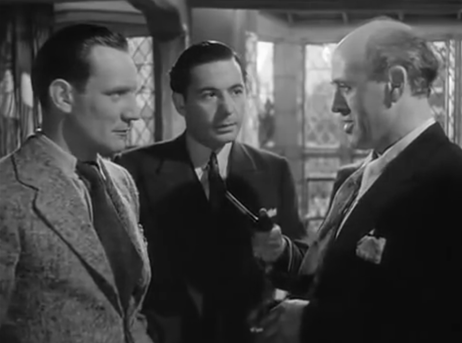 Green for Danger gives murder mysteries a good name because it is drawn up excellently but also with a degree of charm and that should not be taken too lightly or maybe it should. But either way, there’s no doubt that director Sidney Gilliat’s tale based off of a novel by Christianna Brand is quality entertainment.
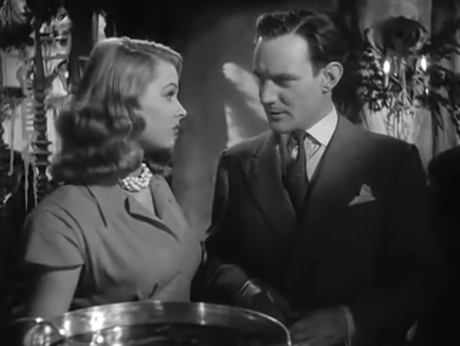 He comes in and steals the film but he does have some enjoyable castmates to work off of. Dr. Barnes (Trevor Howard) the anesthesiologist and the suave surgeon Mr. Eden (Leo Genn) are both in love with the same girl and understandably so. The attractive Nurse Freddi (Sally Gray) is a real prize but only one among a taut nursing staff including the fragile Nurse Sanson and the always lively Nurse Woods (Megs Jenkins). Before the Inspector arrives on the scene they are the true backbone of the storyline and it’s confirmed early on that the murderer comes from within their ranks. The age-old puzzle is left, to decipher who the culprit is and for what nefarious purpose.
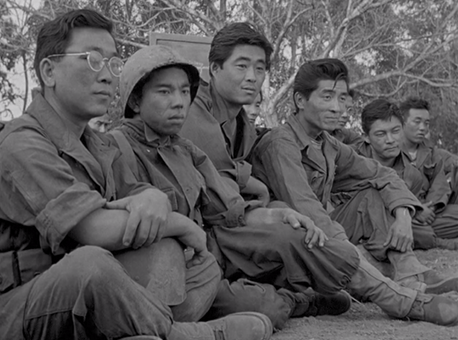 WWII is always a fascinating touchstone of history because it has some many intricate facets extending from the Pacific to the European Theater to the American Home Front and so on, each bringing with it unique stories of everyday individuals doing extraordinary things. One of the best-kept secrets is the 442nd Infantry Division later joined with the 100th and effectively making the first all Japanese-American fighting unit which served over in Italy and France.
 It’s the bane of my literary existence, but I must admit that I have never read Joseph Heller’s seminal novel Catch-22. Please refrain from berating me right now, perhaps deservedly so, because at least I have acknowledged my ignorance. True, I can only take Mike Nichol’s adaptation at face value, but given this film, that still seems worthwhile. I’m not condoning my own failures, but this satirical anti-war film does have two feet to stand on.
 The Chaplain (Anthony Perkins) doesn’t feel like a man of the cloth at all, but a nervously subservient trying to carry out his duties. An agitated laundry officer (Bob Newhart) gets arbitrarily promoted to Squadron Commander, and he ducks out whenever duty calls. Finally, the Chief Surgeon (Jack Gilford) has no power to get Yossarian sent home because as he explains, Yossarian “would be crazy to fly more missions and sane if he didn’t, but if he was sane he’d have to fly them. If he flew them he was crazy and didn’t have to; but if he didn’t, he was sane and had to.” This is the mind-bending logic at the core of Catch-22, and it continues to manifest itself over and over again until it is simply too much. It’s a vicious cycle you can never beat.
 But the tonal shift of Catch-22 is important to note because while it can remain absurdly funny for some time, there is a point of no return. Yossarian constantly relives the moments he watched his young comrade die, and Nately (Art Garfunkel) ends up being killed by his own side. It’s a haunting turn and by the second half, the film is almost hollow. But we are left with one giant aerial shot that quickly pulls away from a flailing Yossarian as he tries to feebly escape this insanity in a flimsy lifeboat headed for Sweden. It’s the final exclamation point in this farcical tale.
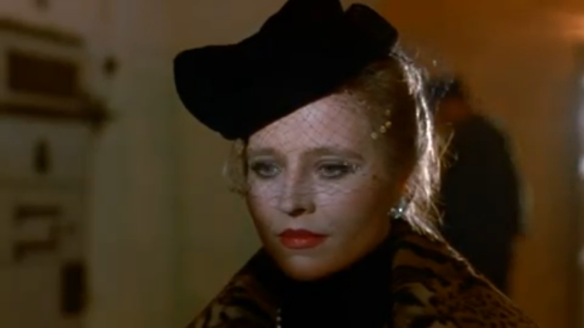 The Marriage of Maria Braun opens with a bang and a thud, literally, as bombs rain down on Germany in the waning hours of WWII. It’s perhaps the most chaotic wedding ceremony ever put to celluloid. And the story ends in an equally theatrical fashion.
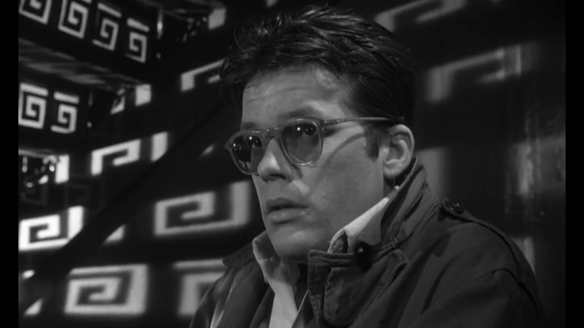 We’re used to getting our hands dirty in the thick of World War II, whether it is in the European theater or the Pacific, but very rarely do we consider the consequences that come in the wake of such an earth-shattering event. Things do not end just like that. There must be periods of rebuilding and rehabilitation. There is unrest and upheaval as the world continues to groan in response.
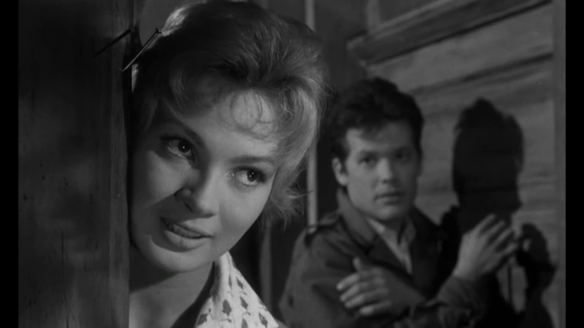 There are love scenes that are quiet, subdued, and truly intimate. In fact, it feels rather like Hiroshima Mon Amour where the camera lingers so closely on two figures in such close proximity. There does not have to be great movement or dramatic interludes because having two people next to each other should be enough. The historical context in itself seems to be enough. For that film, it meant Japan post-1945. For this one, it’s Poland after the clouds of war have lifted.
 4 Star Films