
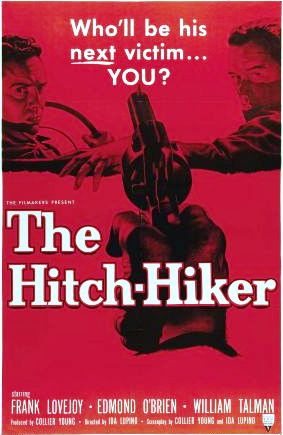
 Part of the harrowing allure of the Hitch-Hiker is that it’s actually based on a true incident that occurred only a year before the events shown. It’s not as if someone took artistic license with some murderers and made it into a horror spectacle. Hitchcock’s Psycho especially comes to mind.
Instead, director Ida Lupino takes a much more universal approach with an opening title card suggesting that the events that follow about a man and a gun and a car could really happen to any of us. Perhaps it’s a cheap plotting device but it does throw the audience into the passenger seat quickly as they are introduced to a rash of murders and the hardened killer behind the spree Emmett Myers (William Talman) who soon has the entire mobilized police force looking for him.
The meat and potatoes of the film involve the brutal murderer taking two vacationing fishermen hostage and grinding away at them as he utilizes them to flee the authorities and bends them to his will. After all, he’s the one with the gun, and he’s proved numerous times he’s not squeamish about using it.
It also plays into the narrative’s hands that both Edmond O’Brien and Frank Lovejoy are not necessarily classically handsome. But they work as everymen. If Joel McCrea was the poor man’s Gary Cooper sometimes I think of Edmond O’Brien as the poor man’s Humphrey Bogart but that’s neither here nor there. Because in little films like this O’Brien left an indelible mark on film-noir. D.O.A. and The Bigamist are two other such examples. Lovejoy on his part is extremely understated, not even being able to quite place his face but we cannot help but admire his quiet stalwartness. O’Brien’s character seems the flightiest of the three and within their ranks, we’ve found a triangle that creates the contentious dynamic that’s the foundation of the film’s entire conflict.
A film of this length and from this era doesn’t have any right to be as intense as it is, yet the Hitch-Hiker proves to be just that. It’s chock full of not only frank depictions of wickedness but enough psychological torture to send tremors up the spines of an audience. It’s a real sweaty thriller. William Talman is absolutely diabolical in a performance that is as vindictive as any other role that comes to mind. It’s that evil.
Meanwhile, the deeply underrated cinematographer Nicholas Musuraca (Out of the Past) flaunts his skills in low budget filmmaking while former husband-wife duo Collier Young and Ida Lupino team up in another surprisingly compelling project, despite its meager production values. I laugh derisively at any contemporary who might have suggested Lupino could only do so-called issue-driven “Woman’s Pictures” because The Hitch-Hiker is really all about three men where the tension mounts to great proportions. Forget any other category. This is a stone cold crime film that goes beyond a simple gimmick.
3.5/5 Stars
 It disappoints me that I was not more taken with the material than I was but despite not being wholly engaged, there are still some fascinating aspects to Panic in the Streets. Though a somewhat simple picture, it seems possible that I might just need to give it a second viewing soon. Let’s begin with the reality.

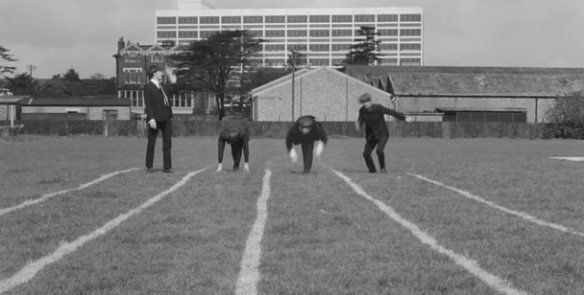
 Are you a mod or a rocker? ~ reporter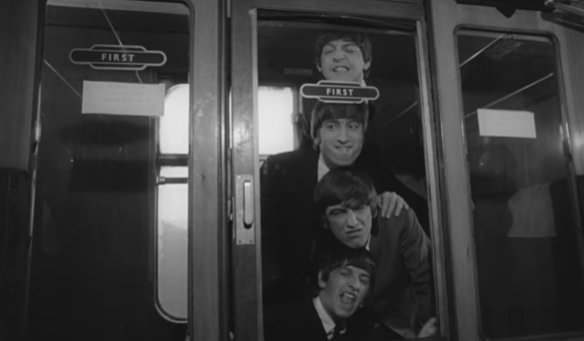
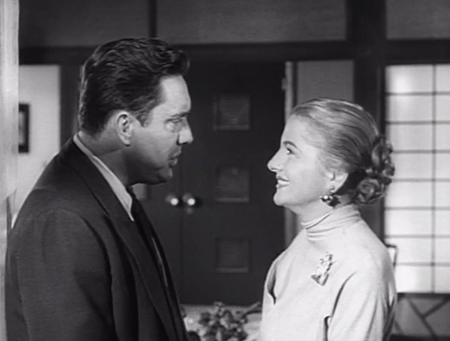 I despise you and I pity you. ~ Edmund Gwenn as Mr. Jordan
 Except at first what Harry does, does not seem like infidelity. In one integral scene Harry takes one of those bus tours to see the stars because, after all, Beverly Hills is that land of movie stars and their extravagant lifestyles. Jimmy Stewart, Jack Benny, Oscar Levant, Barbara Stanwyck, and Jane Wyman are all given a nod. There are even a few playful in-jokes to the always genial Edmund Gwenn who turns up as the adoption agent. All of this is essentially fluff but it’s on that same ride where he meets someone — a woman named Phyllis Martin (Ida Lupino).
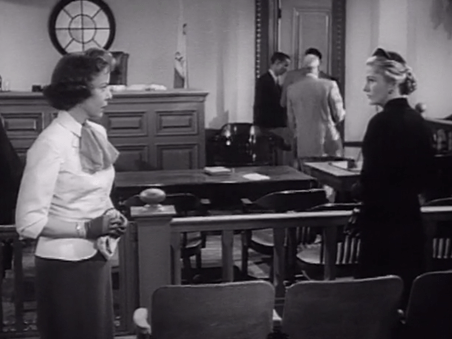 It strikes me how it’s often the small, tiny, unassuming pictures that impact me the most and this film did wrench my heart over the course of only a very few minutes. The final court sequence sums up the reasons quite well because it ends the film on a moral note setting up a rather convicting paradigm.
 Soldiers returning home from war is a recurring theme in films such as The Best Years of Our Lives and Act of Violence and given the circumstances it makes sense. This was the reality. Men returning home from war as heroes. But even heroes have to re-acclimate to the world they left behind.
 With Dashiell Hammett’s The Maltese Falcon making a splash just the year before and giving a big leg up to its star Humphrey Bogart as well as its director John Huston, it’s no surprise that another such film would be in the works to capitalize on the success. This time it was based on Hammett’s novel The Glass Key and it would actually be a remake of a previous film from the 30s starring George Raft.
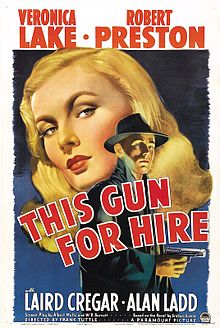 Alan Ladd and Veronica Lake found themselves partnered together on numerous occasions partially out of convenience (at 5’6 and 4’11 they were a perfect height match) but also there’s a genuine chemistry between them. And it all came into being with This Gun for Hire an economical film-noir where Ladd wasn’t even one of the top-billed stars.
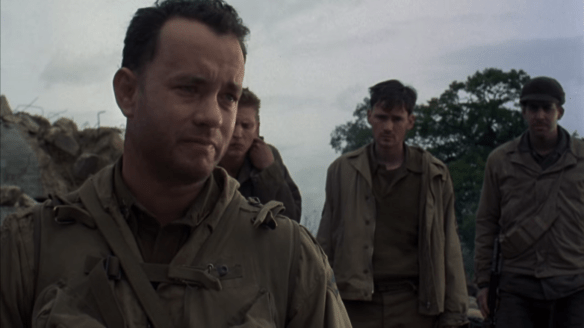 There’s something remarkably moving about the beginning of Saving Private Ryan. I’ve only felt it a few times in my own lifetime whether it was family members recognizing names on the Vietnam Memorial tears in their eyes or walking over the sunken remains of the U.S.S. Arizona at Pearl Harbor. It’s these types of memories that don’t leave us — even as outsiders — people who cannot understand these historical moments firsthand.
 4 Star Films