

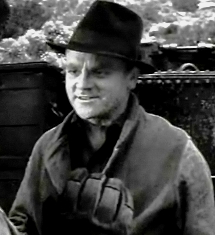
 White Heat burns like hot coals even today as the epitome of incendiary cinema. It’s a gangster picture from master Warner Bros. craftsman Raoul Walsh that’s volatile and intriguing, highlighted by the always fiery James Cagney as a crazed man-child with a mom complex.
Cagney had stayed away from gangster pictures that made him a star for nearly a decade and it’s true that now it’s easy to label this a film-noir given the sweeping tide of the times including other pictures like The Killers, Brute Force, and so on.
Still, everything that is truly inspired from this film stems from Cagney’s performance because we have seen gangsters before, bank jobs, inside men, gun molls, and the like but Cody Jarrett is one for the ages. He throws a twisted wrench into what is already a quality thriller by going absolutely ballistic and simultaneously jolting it in the most peculiar ways.
Before Norman Bates was even whispered on the lips of audiences Cagney burst onto the scene with his demonic characterization, very plainly evil personified as the psychotic Cody Jarrett. He smacks policemen, guns down the worthless, and schemes incessantly. However, he also has a strange sense of family and friendship. He’s prone to crippling migraines like his insane father and still parks himself on his mother’s lap. He even befriends a copper, except he doesn’t know it. He gets duped like a two-bit stooge.
Edmond O’Brien was on the rise at this point following such films as The Killers and The Web. He still owns a supporting role in the sometimes thankless job as the decent heartbeat of law and order. But he has so much more character than all the other stiffs with their fine looks and chiseled jawlines who simultaneously faded into the annals of history.
Although he’s playing support to Cagney, there are a lot worse gigs and the pair works well with each other. At one time strangers, confidantes, and finally bitter enemies in the constantly seesawing dynamic that comes when an undercover agent looks to get buddy-buddy with a certifiable psychopath. Not surprisingly it makes for a thoroughly engaging crime film because the characters actually have something to them.
The iconic Mess Hall sequence brimming with Cagney’s explosive bravado is representative of his flair throughout the entire picture. It just won’t let up. It never lets up. A line of “telephone” takes a message down the row of inmates (including sports icon Jim Thorpe) before reaching the waiting ears of the hardened criminal. Like a stick of dynamite, he goes off and becomes possessed by some unnamed force. It represents the manic, off the wall style of Cagney that still compels audiences today. It’s no longer a simple performance. This is not acting (or it doesn’t seem like it). This is feeling, hate, anger, rebellion, and violence all channeled into a transcendent moment where the man has completely lost himself in a role. No one can touch him. It’s fantastic.
Virginia Mayo finds herself portraying her particular sultry siren accustomed to mink and bubblegum. While Steve Cochran stands tall as the main crony with big ideas, the aptly name Big Ed who is looking to worm himself in on Jarret’s territory (and female company), while he’s incarcerated. Meanwhile, Margaret Wycherly who was previously known as the angelic mother of Alvin York takes on a maternal role on the complete opposite spectrum and she does a fine job as a woman modeled after the notorious Ma Barker.
Any great crime story needs a final set piece where everything can culminate in one ultimate crescendo. White Heat does not disappoint in this regard as Agent Hank Fallon looks to tip off his colleagues following the inception of a big heist of a chemical plant in Long Beach. What follows is a tense dragnet and shootout and it’s a fitting place for Jarrett to meet his maker or in his case his mother. He literally goes into the inferno, blowing up and entering the conflagrations of hell in the most startling of fashions — still clinging doggedly to his mom–his twisted guardian angel of death. It’s a curtain call worthy of such a performance and knowing it can do no better, the film ends there, no fanfare just a grimy picture where criminals aren’t as cut and dry as Hollywood once supposed.
5/5 Stars
 In his opening introduction, Kumail (
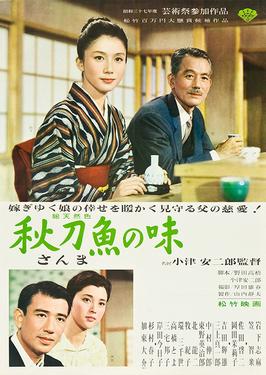 There’s something overwhelmingly soothing about Ozu, simultaneously slowing my pulse and calming my nerves. Yes, An Autumn Afternoon stands as his final film. Yes, he would sadly pass away the following year. But there’s a comfort to watching his films unfold — even his last one. The drama is everyday and somehow disarming and pleasant. We often take for granted that Ozu was not planning to end here. This was not supposed to be his last film. It just happened that way.
 Whaddya hear, whaddya say ~ Jimmy Cagney as Rocky Sullivan
 John Garfield was never the most dashing of leading men but nevertheless, he was always thoroughly compelling as ambitious working class stiffs during the 1940s. He had a straightforward tenacity about him like he had to fight his way to the top. At the same time likable and destined for trouble right out of the gates. You can cheer for him and still rue the decisions that he makes. That’s what makes his foray as boxing champ Charlie Davis all the more believable. His aspirations are of a very real nature and they give his character a genuine makeup.
 Father hear my prayer. Forgive him as you have forgiven all your children who have sinned. Don’t turn your face from him. Bring him, at last, to rest in your peace which he could never have found here. ~ Ida Lupino as Mary Malden
 Films Noir often find their hooks in lurid titles but also in metaphor. Ride the Pink Horse fits into the latter category as pulled from the pages of Dorothy B Hughes and adapted by Ben Hecht & Charles Lederer. The horse can be taken in the literal sense as one of the wooden animals that go round and round on the local carousel but there’s some symbolism in this opulent creature. In some distant way, it’s the fantasy of a different life that every man seems to crave when he doesn’t have it. But still, he strives and grinds to get closer and closer to it. More often than not he does not succeed in finding so-called contentment.
 And it’s from these opening moments that we try to get a line on Gagin by watching his every move and word. He’s brusque and abrasive with almost crazed features — constantly suspicious, demanding, and sour. He had a little too much cyanide for breakfast (although he does like fruit cocktail). Just as we watch him with interest, his probing eyes case every joint and every person he comes in contact with. Because, if it’s not obvious already, he’s not come to San Pablo for R & R. He’s come to town to avenge his dead army buddy, who was double-crossed and put out of a commission by a very big man (Fred Clark).
 Just as there is a cultured femme fatale (Andrea King), her counterpoint is the tentative Pila (played sympathetically but rather unfortunately by Wanda Hendrix), who floats in to watch over Gagin even when he doesn’t want her around. She stays anyways.
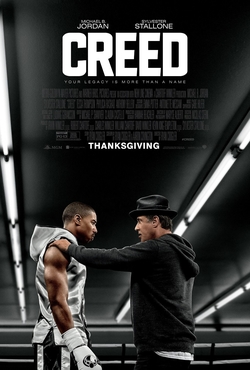 There’s a very special place in my heart for Rocky (1976) and I choose those words very carefully. The reason being, subsequent films lost the appeal of the original and I simultaneously lost interest in the franchise. Perhaps it’s because, after Sylvester Stallone’s breakthrough film, the series lost much of its unassuming charm. It was no longer an underdog story. It no longer felt as personal and intimate.
 Sophie Scholl: The Final Days is a film that people need to see or at the very least people need to know the story being told. For those who don’t know, Sophie Scholl was a twenty-something college student. That’s not altogether extraordinary. But her circumstances and what she did in the midst of them were remarkable.
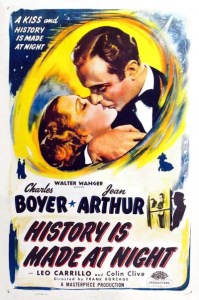 History is Made at Night molds love into the grandest of pursuits and it wouldn’t be altogether wrong in that assertion because for humanity it is one of the most euphoric, confounding, beautiful entities known to mankind. I have no qualms with saying that whatsoever.
 4 Star Films