

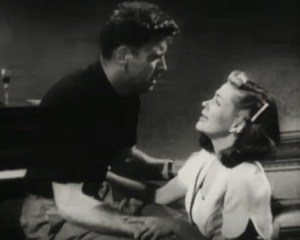
 Aesthetically, Robert Siodmak’s roots in German Expressionism are crucial to the formation of the film-noir world as we know it today and Criss Cross has to be one of the most diverting additions to his repertoire. Once more he’s paired with his star from The Killers (1946) Burt Lancaster with another raging score from Miklos Rozsa and yet again there is a heist involved. However, whereas the film inspired by Hemingway’s original story was a story about a washed-up boxer — a humble Citizen Kane if you will — with some criminal elements mixed in, Criss Cross is all thriller. It represents the subset of film-noir that is the heist film, but it would hardly be film-noir without something going terribly wrong. This event is integral to the plotting as is the love triangle that becomes the main axis of the ensuing action.
The location shooting throughout L.A. is put on display in the opening shot when the camera swoops down on a parking lot right outside a lively nighttime watering hole known as the Round Up. In these early stages, Siodmak reels his viewers in with a seductive close-up of Yvonne De Carlo looking straight at Burt Lancaster, her lover, except in looking at her man she’s also staring directly at the audience as well with those earnest eyes of hers. And from that point on her role as a femme fatale is cemented for good.
We know she’s undoubtedly nothing but trouble and yet we cannot help but be strung along with Lancaster. After all, someone that beautiful cannot be all bad, right? They never are, right? And we spend the rest of the film grappling with these questions, although the worst is always inevitable. So it goes with Criss Cross.
However, for the audience to try and understand the stakes of the story, most of the great film noirs develop the character’s pre-existing life as much as they magnify the moments of immense conflict. Criss Cross begins in the middle but soon flashes back to when Steve Thompson (Lancaster) first returns to Los Angeles, the sparkling city where his family lives as well as his former wife Anna (De Carlo). And despite the sirens going off and the chiding of friends and family including his mother and his concerned cop friend (Stephen McNally), he finds himself attracted to her once again like a moth to a flame.
He’s soon infatuated once more, embroiled in passion and at the same time petty bickering, tied up in complicated knots as Anna is also seeing the gangster Slim Dundee (Dan Duryea) who doesn’t take kindly to having another man around. In immaculate fatale fashion, Anna plays everyone off with a certain degree of vivacity and at the same time deadly innocence. One moment lively and carefree, the next biting and selfish. You can never pin her down and Steve never does. Still, he’s devoted to her. He goes half-way on a heist with his bitter rival just to save face and subsequently finds himself knee-deep in corruption that he never dreamed of, all because of a girl.
But aside from dealing with a guilty conscience, he still must survive a vengeful gangster. The number of crisscrosses isn’t all that important, only the fact that they happen and on numerous occasions. The film finishes up with a gloriously fatalistic ending that while abrupt, in typical Classic Hollywood fashion, still delivers a satisfying final conclusion, going out just as it came in, with a rewarding dose of noirish intrigue.
Echoing the words of Proverbs, “The lips of an adulterous woman drip honey, and her speech is smoother than oil; but in the end, she is bitter as gall. Her feet go down to death.” That about sums up Criss Cross: an exhilarating and altogether deadly exercise from Robert Siodmak. Those questions still burrow into the back of our mind to the very end. Was Anna really insidious or just misunderstood? We’ll never know exactly. But perhaps the results speak for themselves. Anyways, that’s for each individual to judge on their own.
4/5 Stars
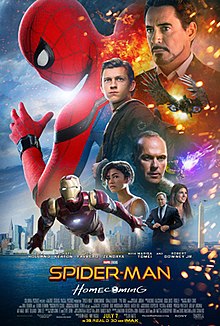 This was yet another pleasant surprise. Just when I think I’ve finally washed by hands of superhero movies the cineplexes are blessed by two pictures like Wonder Woman and then Spiderman: Homecoming. And they couldn’t be more different. Still, as much as Wonder Woman was invested in its heroine, you get the sense that the crew behind this film care some about Peter Parker too.
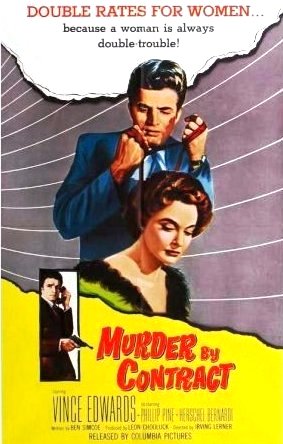 Every once and awhile when you dig through the treasure trove of cinema which includes the B film you can wade through the refuse and come upon something truly special — elevating itself from all the lesser offerings of the past decades. Murder by Contract is such a film.
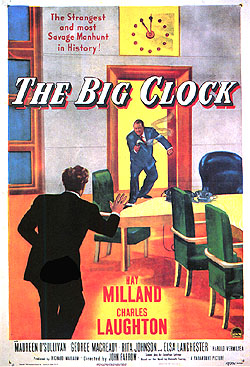 With its rather dreary title aside, The Big Clock is actually an enjoyable thriller that works like well-oiled clockwork. It’s true that oftentimes the most relatable noir heroes are not the hardboiled detectives, although they might be tougher and grittier, it’s the hapless everymen who we can more easily empathize with. Bogart, Powell, and Mitchum are great but sometimes it’s equally enjoyable to have someone who doesn’t quite fit the elusive parameters that we unwittingly draw up for film-noir. Ray Milland is a handsome actor and he was at home in both screwball comedies (Easy Living) and biting drama (The Lost Weekend). He’s not quite what you would describe as a prototypical noir hero.
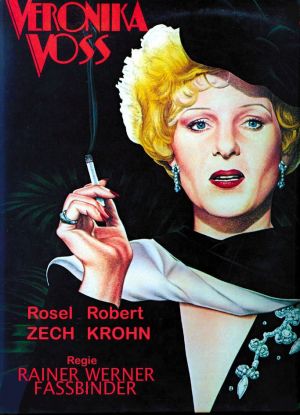 You get a sense that if they had ever met, Norma Desmond and Veronika Voss might have been good friends. Either that or they would have hated each other’s guts. And the reason for that is quite clear. They share so many similarities. Both are fading stars, prima donnas, who used to be big shots and now not so much and that seems to scare them so much so that they try and cover their insecurities with delusions of grandeur. Having to look at your near reflection would be utterly unnerving.
 Edgar Wright has a reverence for movies, he knows his movies, and when he makes his own movies there’s always an inherent understanding of the cinematic landscape–taking what’s already been done and proceeding to add his own affectionate spin on it.
 As one of the greatest B-films of its day, D.O.A. is framed by a crackerjack gimmick that actually pays heavy dividends. We watch a man making his way down a long corridor as the typically stringent score of Dimitri Tiomkin pounds away behind the credits. In this initial moment, our protagonist Frank Bigelow (Edmond O’Brien) rushes into police headquarters to report a murder: His own.
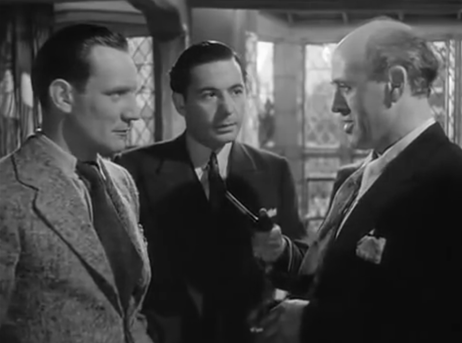 Green for Danger gives murder mysteries a good name because it is drawn up excellently but also with a degree of charm and that should not be taken too lightly or maybe it should. But either way, there’s no doubt that director Sidney Gilliat’s tale based off of a novel by Christianna Brand is quality entertainment.
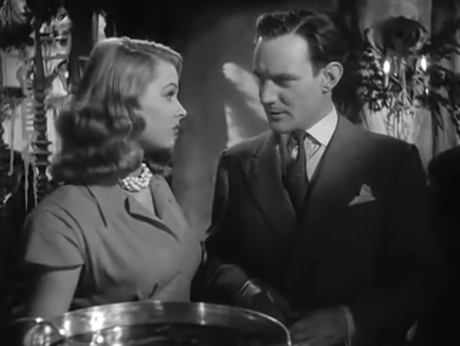 He comes in and steals the film but he does have some enjoyable castmates to work off of. Dr. Barnes (Trevor Howard) the anesthesiologist and the suave surgeon Mr. Eden (Leo Genn) are both in love with the same girl and understandably so. The attractive Nurse Freddi (Sally Gray) is a real prize but only one among a taut nursing staff including the fragile Nurse Sanson and the always lively Nurse Woods (Megs Jenkins). Before the Inspector arrives on the scene they are the true backbone of the storyline and it’s confirmed early on that the murderer comes from within their ranks. The age-old puzzle is left, to decipher who the culprit is and for what nefarious purpose.
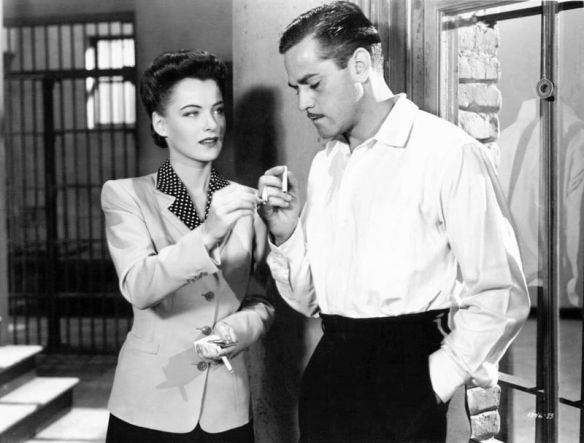 Robert Siodmak might not be the foremost of lauded directors, but it’s indisputable that film noir as a genre, a movement, a style, whatever you want to call it, would be a lot less interesting without him.
 4 Star Films