
 Before the exoticism of Casablanca, Algiers, or even Road to Morroco, there was Josef Von Sternberg’s just plain Morocco but it’s hardly a run-of-the-mill romance. Far from it.
Although it involves soldiers, it’s also hardly a war film but instead set against a backdrop that presents an exotic love affair as only Sternberg could. With a sultry Marlene Dietrich matched with a particularly cheeky Gary Cooper, it instantly looks to be an interesting dynamic because they couldn’t be more different.
She, a radiant German beauty with an evocative pair of eyes to go with a somewhat sullen demeanor. He, America’s ruggedly handsome ideal of what a man should be. And it in Sternberg’s film neither of them is what we’re used to.
He’s a renegade soldier in the French Foreign Legion. She’s a cabaret singer (that hasn’t changed) but she also manages to be French, not German. Somehow it’s easy enough to disregard because it’s not necessary to get caught up on the particulars.
All that matters is that they both find themselves in Morocco. He is traipsing through town with his division and spends some free time taking in her floor show along with the rest of the rowdy masses. Neither one of them has found someone good enough for them — they’re equal of sorts. He’s a gentleman cad if you will and she’s hardly an upstanding woman, making a living in a dance hall but there’s more to her. It’s hinted that she once had love, perhaps.
It takes so long for them to actually speak to each other but they’re flirting from the first moment they lay eyes on each other. They say so much through simple expressions all throughout the cabaret show. Things proceed like so. She slips him a flower, then an apple, and finally a key. At this point, he gets the drift and we do too.
Later that evening he winds up at her flat and they spend their most substantial time together. It’s full of odd exchanges, meandering conversations that run the risk of sounding aloof. In fact, their entire relationship is replete with oddities.
Another man (Adolph Menjou) is smitten with Amy but he’s never driven to jealousy. He’s good-natured and generous in all circumstances. People like him must only drift through the high societies.
She holds onto some wistful longing for the tall dashing Legionnaire who drifted through her life. But she’s slow to act. Meanwhile, he hardly seems to take it as a blow to his love life when she resigns to stay behind. After all, he’s quite the ladies’ man. He probably doesn’t need another woman. He’s always got several draped over each arm.
Morocco is a film interesting for the spaces that it creates and not necessarily for the story it develops. Visually, by the hands of the director and then simultaneously by Cooper and Dietrich as they work through their scenes both together and apart. Though it might in some ways lack emotional heft, its stars are still two invariably compelling romantic stars of the cinema.
Somehow it still manages to be quite lithe and risque when put up next to its contemporaries. It exudes a certain mischievousness of the Pre-Code Era. It’s not so much licentiousness and debauchery but it wishes to suggest as much. It can be implied without actually going through all the trouble of showing it.
Dietrich sums it up perfectly in her little diddy about Eve (What am I bid for my apple/ the truth that made Adam so wise? On the historic night/ when he took a bite/ they discovered a new paradise). In essence, the world got a lot more exciting when sex and deceit were brought into the equation. Maybe she misses the implications the Fall of Man but that’s precisely the point. Still more Pre-Code sauciness case and point.
In the final moments, where Dietrich abandons her heels and goes slinking across the sand chasing after her man, it feels less like a romantic crescendo or even a tragic turn and more like a ploy by the director to make his leading lady the focal point of his story one last time. She is granted the final bit of limelight. Because in many ways Gary Cooper could not win when it came to upstaging Marlene Dietrich orchestrated by her devoted partner/director Sternberg. Thus, Morocco turns out to be a rather curious love story different than some of the more typical Hollywood fare.
4/5 Stars
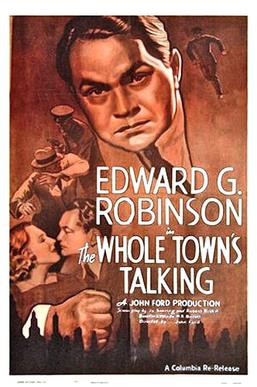 Comic mayhem was always supercharged in the films of the 1930s because the buzz is palpable, the actors are always endowed with certain oddities, and the corkscrew plotlines run rampant with absurdities of their own. Penned by a pair of titans in Jo Swerling and Robert Riskin, The Whole Town’s Talking opens with an inciting incident that’s a true comedic conundrum.
 Whaddya hear, whaddya say ~ Jimmy Cagney as Rocky Sullivan
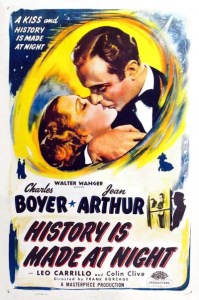 History is Made at Night molds love into the grandest of pursuits and it wouldn’t be altogether wrong in that assertion because for humanity it is one of the most euphoric, confounding, beautiful entities known to mankind. I have no qualms with saying that whatsoever.
 Early on, when she is growing up, it seems very easy to read Stella (Barbara Stanwyck). She is a young woman born into a humble background with a family that could at best be called earthy. Still, Stella wants to know what it feels like to live in the lap of luxury. She wants a more refined life and it’s easy for all the cynics to assume she’s making eyes at the handsome mill executive Stephen Dallas (John Boles) for what he can give her.
 You could say that Fritz Lang was fascinated, even preoccupied with issues of justice. M, Fury, and You Only Live Once all take a particular interest in crime in relation to systems of justice while still functioning as tense thrillers. Although Fury was his first film across the pond in Hollywood, Lang maintained his fine form in a potent debut.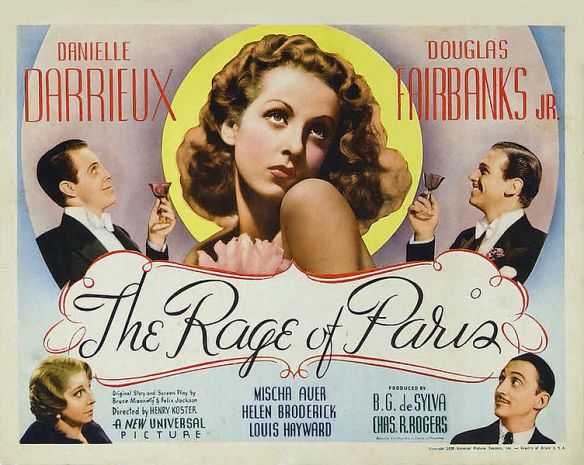
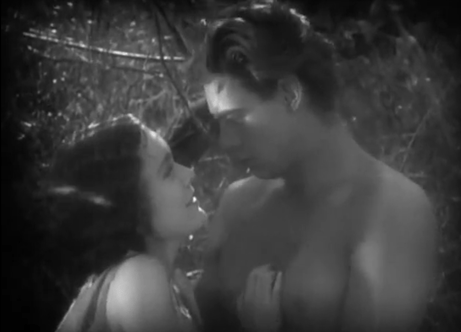 Despite being dated and marred by the imprint of imperialism, this initial entry of the well-remembered Tarzan serial of the 1930s and 4os, based on the works of Edgar Rice Boroughs, is a surprisingly gripping pre-code tale of perilous adventure.
 Furthermore, Johnny Weissmuller is not even the first Tarzan (purportedly the sixth incarnation) but he outshines all his predecessors who have been lost to history. It helped that he remains one of the most iconic Olympians and American swimmers of the 20th century, winning 5 Gold Medals. And he shows his prowess not only swinging from the treetops but in his true element, gliding through the water.
 As a young boy, no hero was greater in my mind’s eye than Robin Hood and only Star Wars held a more honored spot in my childhood imagination. Because, to this day, Robin of Locksley remains the quintessential hero of mythical lore. Part historical truth mostly canonized myth and that’s the beauty of him. We can believe in him — see how he was in so many ways real but in the same instance larger than life.
 From what I know from Robin Hood folklore, specifically Howard Pyle’s seminal edition, the film is surprisingly true to many of the origin stories and tales that have long since proliferated. As an audience, we become privy to the first meetings of Robin and the formidable Little John (Alan Hale) who lays him out in the local stream after a bout with quarterstaffs. Then, in another instance, Robin provokes the portly Friar Tuck (Eugene Palette) who happens to be a master swordsman and a lover of good food and drink. Still, other vignettes include Robin’s successful masquerade as a lowly archer who wins the grand prize at the Sheriff of Nottingham’s Archery Tournament.
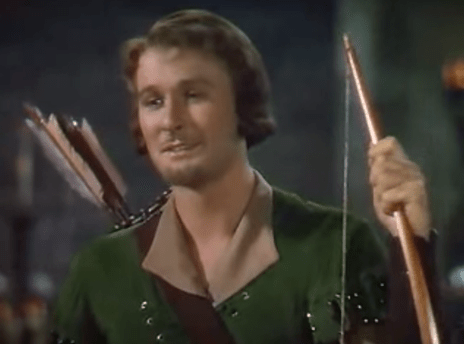 For me, the reason very few heroes surpass Robin Hood is based on his innumerable qualities. He’s a superior fighter with bow, sword or staff. He’s blessed with a wonderful wit and impressive leadership capabilities. He wins over the girl with his charm. He gets to live out in the forest with his best friends, eating great food. But most of all, he’s a rebel with a heart of gold, robbing the rich to feed the poor.
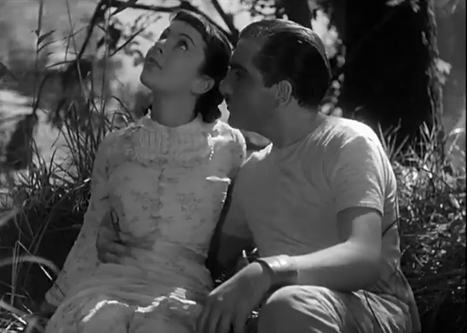 It’s only 40 minutes — hardly a feature film and more of a featurette, but Jean Renoir’s truncated work, A Day in the Country, is nonetheless still worth the time. Admittedly, I still have yet to venture to France and I hope to do that someday soon, but this film propagates marvelous visions of the countryside that resonate with all of us no matter where we hail from. Those quiet jaunts out in nature. Sunny days perfectly suited for a lazy afternoon picnic. Peacefully gliding down the river as men fish on the bank contentedly.
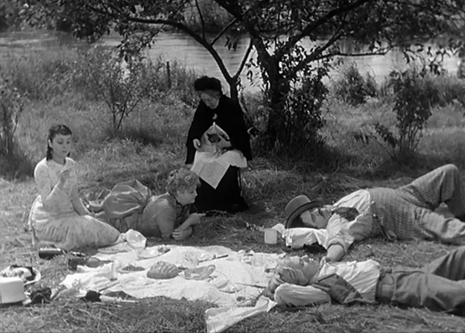 As always these characters set up Renoir’s juxtaposition of luscious extravagance with the earthier lifestyle of the lower classes. However, there is a geniality pulsing through this film, with Mrs. Dufour exclaiming how polite these young men are–they must be of good stock, obviously not tradesmen. Even Mr. Dufour is a good-natured old boy who gets fed up with the elderly grandmother, but he willingly takes the boys charity and advice when it comes to the prime fishing holes.
 We get the essence of what is there and we can still thoroughly enjoy Renoir’s composition. His is a fascination in naturalistic beauty where he nevertheless stages his narrative to unfold in time. But really this mise-en-scene created by the woods, and meadows, trees, and rivers really function as another character altogether. And when all the players interact it truly not only elicits tremendous joy but an appreciation for Renoir’s so-called Poetic Realism. Whether he’s capturing a woman swinging jubilantly on a swing or framing a shot within the trees, we cannot help but tip our hat to his artistic vision. If his father Auguste was one of the great painters of the impressionist era, then Jean was certainly one of the most prodigious filmmakers of his generation, crafting his own pieces of impressionistic realism. In fact, with father and son, you can see exactly how art forms can overlap on canvas and celluloid. They truly share a fascination in some of the same subjects. Universal things like nature and human figures interacting in the expanses of such environments. It’s beautiful really, even in its pure simplicity.
 4 Star Films