Review: Miracle on 34th Street (1947)

miracle on 34th street.png

From its opening motif of a man nitpicking the arrangement of reindeer in a shop window, Miracle on 34th Street skates away on a delightful journey that evokes both fanciful whimsy and a liberal amount of holiday sentimentality. However, it’s also one of the finest examples and greatest purveyors of holiday cheer ever and that’s in spite of an original theatrical release that Daryl Zanuck slated for the summer of 1947.

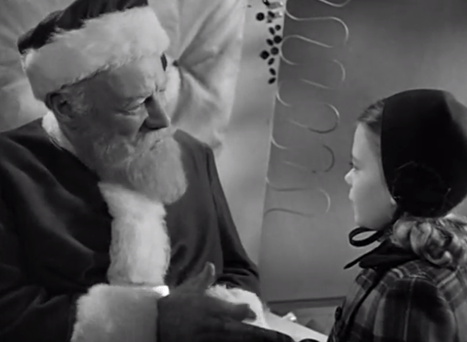
Still, all of this aside, the major heartbeat and the effervescence of the picture falls on the shoulders of that precocious gentleman Edmund Gwenn in the most iconic performance of his career. No matter your leanings, be it a sentimentalist or a pragmatic realist, at the very least, he makes you want to believe in Santa Claus. And what’s striking is how he embodies such a man.

Because we could get into a debate on whether he is the real thing or if he truly is delusional and thus, we would have to be alarmed by this entire ordeal. Yet the results speak for themselves as do the fruits of his labor which help to uplift an entire city.

It’s true that he lays down a trail of hints from the outset at the Macy’s Thanksgiving Day Parade about his origins. If you’re paying attention and know the score they are easy enough to notice. However, he’s never pompous in proclaiming his exploits.

What draws everyone to him is this genial charm that cannot be fabricated. It’s all him.  There is no shred of an egomaniac or a mentally disturbed person. In fact, he feels the complete antithesis of many of the adjectives we might toss out to describe the commercialized Christmas so prevalent today (and even back then).

Alfred, the young janitor, and a personal favorite expresses the sentiment aptly. “It’s all about, Make a buck. Make a buck. There are a lot of bad “isms” to choose from but arguably the worst is commercialism.”  And it’s Kris who helps to rail against that holiday status quo when he finds himself working as Macy’s floor Santa.  In fact, it almost feels like a necessity that all these things come to pass because not only are people forgetting about him but more importantly, they are forgetting the core tenets of the season.

There are several scenes in particular that put a heartbeat to a little bit of the magic that courses through this picture — a picture that director George Seaton dearly wanted to make as did John Payne. Because it exudes something so remarkable that has proved timeless in years since. Even Maureen O’Hara, though initially skeptical of returning to Hollywood from her oasis in Ireland, relented because she was taken by the story.

miracle on 34th 2.png

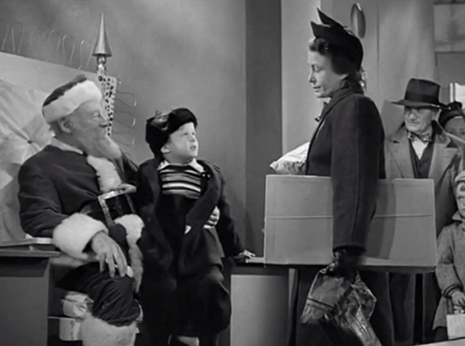
As someone always interested in the periphery, one of my favorite moments involves Thelma Ritter. It’s only a small sequence but she plays a harried mother who wants to go home and soak her feet after struggling to find her son a toy fire engine. The joy is watching Santa put the color back into her face when he incredulously evokes the spirit of giving. She’s flabbergasted by this unprecedented piece of goodwill. It’s the calling card of a true Santa.

Then there’s the little Dutch girl who pleads with her foster mother to see Santa. And it’s pure magic, again, because they form a connection when Santa breaks out into her mother tongue and they’re able to sing a Christmas song together. There’s so much underlying context made beautiful by the fact that we have to read deeper to extract the meaning. Surely viewers knew this girl was a casualty of WWII but beyond that, the fact that Santa is able to cross this perceived language divide is in itself a near miracle.

As someone who does not speak Dutch, I’m not privy to the precise conversation but it’s easy to empathize because here Santa Claus has made someone on the outside feel known and loved. It’s telling these precise events strike a chord with young Susan (Natalie Wood) also.

Certainly, it’s about time to fill in the story’s nucleus and of course, sandwiched in between this broader narrative, involving so many people, is a very personal one. It really is a case study and it’s noted as such by Kris Kringle and his devoted follower Fred (John Payne). They fight a two-front war to work on the most obdurate, rational minds in New York, Doris (O’Hara) and her pragmatic little girl Susan (Wood) who has been trained up by the best.

Ironically, Kris’s war on commercialism very much subverts the longheld spirit of capitalism as we watch the foremost toy companies, namely Macy’s and Gimbel’s pitted against each other looking to outdo one another in the realms of helpfulness and good cheer.  It’s simultaneously hilarious and downright uplifting.

But there must be more because goodness very rarely moves forward wholly unimpeded. The antagonist in this scenario is a curmudgeon, insignificant company psychologist named Sawyer (Porter Hall in a particularly testy role) whose own misgivings about holiday cheer cause him to suggest Kris be put in a mental institution. The case of the holiday season begins when Santa is put on trial.

There is a logical conclusion with a respected judge (the character journeyman Gene Lockhart) presiding but don’t expect it because this is a story about miracles and a film about intangibles and a jolly old man spinning his spellbinding magic for the good of mankind.

miracle on 34th 3.png

To the last knowing wink, it tests our faith in the man but even today it never seems like a picture to outright shirk reality. Instead, it’s more founded on cultivating all that is good and life-giving when you tone down the hard-edged pragmatics that leave no room for imagination or faith of any kind.

Because oftentimes, when those reservoirs are sucked completely dry, you are left with people who lack joy, contentment, charity, and goodwill for their fellow man. From such wastelands come the Mr. Sawyers. If you close yourself off completely to this season or this film, you might just feel yourself left a little empty inside.

More than anything else, Miracle on 34th Street is a story of childlike faith as this is much of what the season is supposed to be indicative of. The ultimate gifts of love, joy, and peace require an openness in order to receive them fully.

All there is left to do is to close with an excerpt of prose far more learned and impassioned than my own, penned to an inquisitive girl named Virginia. Because this film very well could be the proof behind the words:

Yes, Virginia, there is a Santa Claus. He exists as certainly as love and generosity and devotion exist, and you know that they abound and give to your life its highest beauty and joy. Alas! how dreary would be the world if there were no Santa Claus! It would be as dreary as if there were no Virginias. There would be no childlike faith then, no poetry, no romance to make tolerable this existence.

We should have no enjoyment, except in sense and sight. The external light with which childhood fills the world would be extinguished…Only faith, poetry, love, romance, can push aside that curtain and view and picture the supernal beauty and glory beyond. Is it all real? Ah, Virginia, in all this world there is nothing else real and abiding.

5/5 Stars

Meet Me in St. Louis (1944)

meet me in st louis 1.png

One thing that can be said of Meet Me in St. Louis is that it captures the milieu of an era while simultaneously being quintessential Vincente Minnelli. Every man, woman, and child is dressed to the tee and enraptured by love and the grand promises of the World Fair full of dancing the Hoochie-Coochie with their special Tootsie Wootsies.  It’s cheerfully opulent in such a fashion that some might consider it almost garish and others will deem it the height of turn-of-the-century elegance.

There’s no doubt that the director had one of the most phenomenal palettes of any filmmaker from any time period. Certainly, this extends to the mise en scene and the costumes adorning his stars — pulled right out of Sears Roebuck circa 1900. But the other crucial aspect is that Minnelli seems to handle his talent with kid gloves or at least he creates an environment for them to flourish.

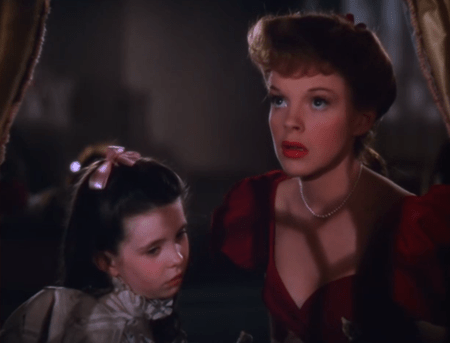
Of course, front and center of the Technicolor extravaganza is Judy Garland who would marry her director the following year and you get the sense that she had fallen in love with how beautiful he was able to make her on film. It’s true that she’s a striking sight to behold, only magnified by the world she traipses through, surrounded by her kin and singing to her heart’s content.

Still, if the set design is such a grand expression of the film’s potency and visual appeal, it’s necessary to point out again that this is far from a Judy Garland show; there is an ensemble component even if she’s the scene-stealer.

Margaret O’Brien is a riot because she plays little Tootie in the most ingratiatingly precocious way possible. Though it must be admitted she has a bit of a morbid side too. We meet her on an ice wagon telling a man how she’s going to give her doll a nice funeral and later on, of course, she takes the heads off all the snow people.

However, there’s also a whole Halloween interlude starring Tootie and their sister Agnes that feels more like a ghoulish Guy Fawkes day than its modern incarnation of door-to-door candy grabbing. Maybe Halloween has gotten tamer than we give it credit for. Put up against the film’s more mirthful moments, it comes off a tad alarming.

But then again, the story continually goes back to its roots in the centrality of the family unit. Its very integrity is in jeopardy of being disrupted when Father (Leon Ames) drops the news that they will be moving to New York from St. Louis. It comes off horrifically. It’s imperative to remember that in order for those heights to be so gay there must be a steady stream of romantic heartbreaks and personal roadblocks which the picture gladly provides.

There’s a lovely scene staged around the piano between Mr. and Mrs. Adams (Ames and Mary Astor) where like in so many other instances song becomes the perfect expression of the current mood. Based on where the camera is situated, the stairwell in the back is visible and you see the shadows of figures before they inch back into the frame and subsequently back into the family room. It’s a visual representation of the family staying rooted together even after a spat — constantly retracting — then contracting back together in continuous motion.

Without question, the well-remembered “The Trolley Song” is a giddy number that outshines any of the others but that’s because it is the summation of romantic euphoria that Esther (Garland) is feeling for her beau (Tom Drake). Meanwhile, “Have Yourself a Merry Little Christmas,” though hauntingly melodious, is quite easy for me to rip out of the context of this film.

meet me in st louis 2.png

Meet Me in St. Louis has never been a yuletide film for me in a similar fashion to how Holiday Inn (1942) is not so much attached to “White Christmas” or holiday cheer as the Michael Curtiz picture from 1954. Perhaps its influence isn’t as deeply rooted in my childhood recollections as some of its contemporaries. But then again, Meet Me in St Louis evokes Christmas in the same way that some of the cinematic adaptations of Little Woman (1933, 1949, or 1994) conjure up the season in the context of family. Perhaps that’s how it should be.

In its day, the film was a smash hit only to be outshined by that prior behemoth from David Selznick Gone with the Wind (1939) and it’s easy to draw up parallels if not simply visually speaking. Both films boast breathtaking imagery and extraordinary color photography for the era that even today can rightfully be considered landmark stuff. Still, that doesn’t mean that everything else has improved with age. Make the concessions where you will and the film can be a good-natured classic or even a Christmas perennial favorite. In my estimation its middling in both categories. Still, that can’t completely detract from its finer attributes. Namely Minnelli’s striking color scheme which remains second to none.

4/5 Stars

Impact (1949)

Impact_1949_poster.jpg“In this world, you turn the other cheek and get hit by a lug wrench.”

Impact is literally bookended by a dictionary that is opened and then closed with a concise description of the titular phrase to frame our narrative. It couldn’t be more uninspired but the word “impact” gives us some reason to hope the movie within those covers will offer some thrills.  We must brace ourselves.

The story follows Walter Williams (Brian Donlevy) the world’s most perfect industrialist and husband. He can overturn deadlocked board meetings with his stunning entrances and continually rains down affection on his wife looking forward to a weekend away in Tahoe together.

Of course, his wife (Helen Walker) has other ideas. She plays the docile and lovey-dovey wife but really she’s up to something. We see it all too quickly. Mrs. Williams is looking to get rid of her husband with the help of her boyfriend and her hubby isn’t any the wiser. He’s a sitting duck.

The script penned by Jay Dratler relies on the fact that though he gets left for dead at the side of the road, it’s a botched attempt and while disoriented, Mr. Williams is still alive.

The film is mostly encumbered by its length as it starts to sag in the middle so that even Ella Raines’ entry about halfway through the picture isn’t enough to salvage the wreckage. She shows up in all places as a mechanic in a small Idaho town and business hasn’t been good lately.

Once again Mr. fix-it Walter Williams is there to save the day. Conveniently, he keeps his past a secret. He’s happy with this simple life away from the drama that’s happening back home. Here he can go to church on Sundays and have lazy strolls out in nature. One frenzied sequence involves the volunteer fire department stirring into action which Walter readily joins.

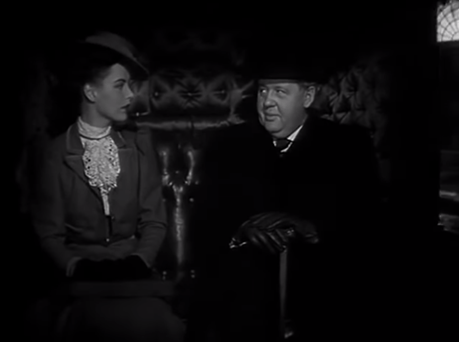
Back home a Lt. Quincy (Charles Coburn) is making a routine going over of the case and Mrs. Williams is making arrangements of her own unaware of the unfortunate turns her plans took.

The film would have done well to have a leaner line of action because it comes out of the mayhem feeling like 2 or 3 separate movies. There are the delightful noir bits of an unfaithful wife trying to work with her lover to end her husband a la The Postman Always Rings Twice (1946). Then, there’s an ensuing court case where Williams finds the murder rap turned on him. Again, not unlike the high stakes scenario in the former film.

But in the middle, bisecting the picture in half is a warm slice of Middle America by way of Idaho with its palpable geniality acting as an oasis. It could have used with some shaving down. Otherwise, we have some great location footage of San Francisco and the Sausalito area circa 1949. The performances are fine though neither Donlevy or Raines particularly pop.

Anna May Wong essentially plays the movie from the sidelines as a maid until she’s absolutely necessary to save the story; it’s a major pity she was not utilized better. Helen Walker, however, gives a deliciously malicious performance as the wife who never denies loving another man and yet looks to get out of her fix to save her pretty little neck. It’s individuals such as herself that make film-noir a veritable breeding ground for truly degenerate reflections of humankind. However, Impact could have been so much more potent.

3/5 Stars

The Web (1947)

The Web 1.png

An effort like The Web is precisely why many people would “die” for film-noir. Unless I am simply speaking for myself. But I don’t think so. Personally, I perked up upon reading the name William Bowers in the opening credits as one of the architects of the script because it’s quite easy to imagine some of the film’s choicest flirtatious patter being penned by him. He and his accomplices give our stars something to talk about in what otherwise might seem like idle moments. In fact, if it weren’t for its ultimately sinister outcomes, The Web carries a certain lightness of being through much of its run.

That brings us to our stars who are a fine teaming of talent for a B-grade picture. In fact, they are probably about as good as you could get considering. We have Edmond O’Brien, a personal favorite as a noir hero (The Killers, White Heat, D.O.A, etc.) and then Ella Raines, another often unsung but no less important noir heroine (Phantom Lady) of the 1940s.

Vincent Price is impeccable playing his at times beguiling businessman with that usual mixture of charm and slithering cunning. Between his lankiness and those distinct imperious eyes of his, he’s rarely been better. Our last prominent figure is the coolly perceptive William Bendix who despite his persona, knows far more than he lets on, as a generally competent member of the police force.

One morning a cocksure young lawyer named Bob Regan (O’Brien) goes barging into the offices of Mr. Andrew Colby on the pretense that his client, a man named Emilio Canepa who had his fruit cart upturned by negligent driving and he’s calling for $68.72 in damages. The businessman amusedly agrees to it, after all, it’s only a small trifle. But along the way, Regan tries to pick up the man’s loyal secretary Noel (Raines) as well as unwitingly piquing Colby’s interest. He could use someone with guts.

It’s such a dandy and a rather outrageous sequence that we almost forget the actual opening shot showing an elderly fellow being released from prison after a five-year stint. The only person there to greet him is his daughter. We gather he has a bone to pick and that is important for all that is inevitable in the near future.

For now, it’s all Edmond O’Brien. He notes that they have a snug little setup going on within Colby’s closest inner circle. They seem real buddy-buddy in all facets of their affairs. However, straight away Regan joins the operation when $5,000 is waved in front of him to act as a bit of an unofficial bodyguard and it comes with a gun permit he’s able to finagle out of his old friend at the Police precinct.

Of course, he doesn’t realize that just the following day he will be unloading the pistol on someone and killing a man no less — the same man who was just released for prison with the charge of embezzlement. But it was all done with clear intention as bitter Mr. Kroner was going to kill Mr. Colby so in that regard Regan has little to worry about.  And yet he can’t help but start to get ideas because between the police and nighttime visitors he’s given a lot to chew on.

the web 2.png

The film’s script has its share of veiled double talk both sensual and then increasingly threatening as it pertains to the curious events at hand. Because what reveals itself is a deliciously twisted reality that calls for the reevaluation of what we know to be true and who we trust as an audience.  The rational and yes, even the believable might very well fly out of the window but what a noir like this gives us is something arguably more satisfying in terms of impending doom.

Where something like a net — a web of destruction — begins to descend upon and close in around our heroes. It’s been cleverly orchestrated with the clearest of intent clearing up all the loose ends and framing them handily.

The police nab them easily in this case, involving multiple murders, a whole lot of money, and two tickets to Mexico. The question is who will gain from such a resolution and since that question is quite simple to answer, the better one yet is how might they possibly catch the culprit?

I’m not too proud to admit thoroughly enjoying The Web because it embodies everything that the dark genre is promoted as being and you leave the picture satiated after being caught up in something supremely sinister. It was never high art nor did it claim to be but that’s all part of the immense allure. O’Brien, Raines, Price, and Bendix might as well all be character archetypes. The parts they play do the picture a distinct service.

3.5/5 Stars

The Suspect (1944)

the suspect 1944.png

It is very much a male-oriented film in subject matter and frame of reference with Charles Laughton commanding center stage. He is the very figure that we are meant to empathize with as an audience. But it’s precisely those qualities, along with the presence of director Robert Siodmak, that make it remarkably straightforward to read The Suspect as film noir even given its Edwardian setting.

Veiled in the murky London fog are the mundane strains of noir popping up within the home and the shrouds do well to imprint the British streets with a certain darkness in tone and shading.

In fact, it would be similarly done in other pictures such as The Lodger (1944) and Gaslight (1944) but this one, in particular, can be tied back to the genre’s unhinged male paranoia. Because the dark predilections of noir have often been tied to an overwhelming form of matrimonial suffocation. Not only wives nagging but also the embodiment of the femme fatale to reflect men’s fears returning from WWII to find a new movement of independent women.

The Suspect fits seamlessly into the former category. Is it right to read all of this into the movie in hindsight? I will allow others to enact final judgment but for my own purposes, I will choose to see it in this light. Though it lacks a true femme fatale, it is loaded with blackmail and the threat of scandal that leads to an underlying sense of utter despair.

But it’s necessary to backtrack and explain how events come into being. Charles Laughton is an honest gentleman who works as a bookkeeper only to go home to the ball and chain.

We get a taste of his insufferable wife (Rosalind Ivan) amid turbulent interactions with their grown son (Dean Harens) who vows to leave their home for good because he can’t stand his mother. It feels as if she’s been cast as the devils incarnate and she might as well be next to Laughton’s portly angelic character. There’s a glassy-eyed sincerity to him that plays softly to our ears thanks to an at times rasping delivery. A quiet charm exudes from him all the time. Everyone but his wife seems capable of seeing it.

One such person is Mary Gray (Ella Raines), a woman with the most stunning of wardrobes, both prim and proper and certainly capable of employment. Except she’s had an awful go of it trying to find a job and kindly Mr. Marshall can’t be of much help in that regard. However, what he can offer is a bit of innocent companionship because he imagines that they are both a bit lonely — which of course is very much the case.

At this point, he’s finally found a little enjoyment and there’s nothing more than a desire to have someone to relate with. Still, Mr. Marshall deems it most prudent to break off his friendship with Ms. Gray because after asking his wife for a separation, he is alerted that there is nothing doing. Worst yet, the cackling witch makes his life even more horrible; because that’s precisely what she has been created to do.

The next major event is all too expected, so expected in fact that the film doesn’t even bother showing it. The death or murder or accident is left off of the celluloid though certain outcomes are heavily implied. It’s partially jarring as we hardly have time to track with this jump in the sequence of events.

Again, there are happier times ahead as now Philip has married the lovely girl and they are blissfully content together as companions. But another villain is invented (or rather has been waiting in the wings). A lecherous next door neighbor who’s an incorrigible wife beater adhering to a “hurt or be hurt philosophy.” He is willing to falsely testify that he heard Mr. Marshall arguing with his wife the night before her “murder.”

Something must be done about it. This time the desperate Philip takes the firmest course of action he can muster to stop this affront. And suddenly events turn slightly intriguing becoming Rope (1948) for a man that we hold some empathy for and that’s where any amount of tension is born.

In fact, the duality in the marriages is one of the most fascinating motifs. Because you could easily see in an alternative turn of events some sort of killing off of respective spouses for an agreeable partnership to be forged. And that’s very well what this picture might have been if not for the presence of Ella Raines. She’s very much vital to the outcome without ever trying to be. Since it’s true that she has no motive, what she offers is seemingly so amiable and a very legitimate reason to murder in one man’s eyes.

To Laughton’s credit, whatever he was supposed to have done, he never ceases to have a conscience nor a capacity to love. Thus, it makes the police investigation surrounding him one that is imbued with meaning. We care what happens to him and to Mary as well. While we aren’t given much of anything, the final notes hint at something not completely inhumane. That’s all I can give you.

3.5/5 Stars


Whirlpool (1949)

whirlpool 1.png

Despite being ludicrously absurd, it’s impossible not to get whisked away by the swirling cauldron of psychological drama found in Whirlpool. Otto Preminger adds yet another perplexing noir to his filmography and it seems reasonable that Whirlpool along with The Fallen Angel (1945) and Angel Face (1953) deserve more recognition though, it’s true his debut, Laura (1944) will forever be the benchmark.

But these three films share such fascinating themes beyond beautiful photography and quality staging. They find roots in some odd bits of quack chicanery like fortune tellers and astrologers while interesting themselves in psychologically unstable women and male confidence men who like nothing more than taking advantage of others.

Whereas Laura (1944) works exquisitely because the title character casts a spell on everyone else, Whirlpool functions in part because our protagonist falls under another man’s spell. But it takes something else, something in her past that he can prey on and exploit.

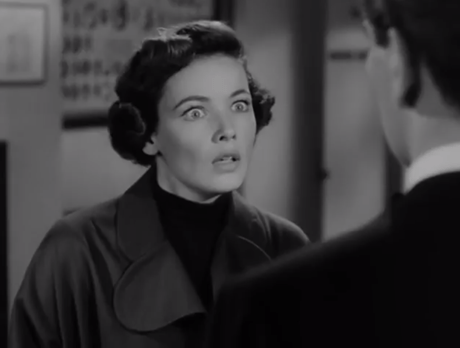
You see, in the opening moments of the film we find out something about Gene Tierney’s character. She’s a kleptomaniac which in itself is a fairly startling albeit intriguing revelation. And we don’t see it occur just the aftermath that follows. But here is a dilemma already. Her husband (Richard Conte) is a renowned psychoanalyst. How would it look if his wife was found shoplifting from a reputable establishment? The house detective catches her. The manager is looking to bring in the police. The wheels of justice are turning and scandal looks all but inevitable.

Then, in walks David Korvo (Jose Ferrer) a man with a certain magnetism that still makes him a tad unsettling. In fact, it’s pretty easy to assume he has ulterior motives. Because he so easily smooths things out for Mrs. Sutton so she is, to a certain extent, indebted to him. Something like that can quickly turn into a splendid opportunity for blackmail. Except the check comes and he rips it up so from thenceforward it’s a little more difficult to discern his intentions and it proves to be a wonderfully enigmatic performance from Ferrer start to finish.

It’s true. He is a charlatan. He’s preoccupied with astrology and then hypnotism which he uses on his new “patient” supposedly for her own good. But he’s had other women who have called on his services before. In fact, one of them has now sought help from Mrs. Sutton’s husband. Because Korvo had made her life miserable coaxing her to withdraw her daughter’s inheritance and leeching her happiness. Soon Theresa Randolph is found dead with Ann at the scene of the crime — the prime suspect.

By this time, you almost forget that Charles Bickford is in the film because the bewitched Tierney and stolid-faced Ferrer steal the show. But it is Lt. Colton (Bickford) who must get to the bottom of this whole twisted affair. He and Dr. Sutton are quick to write off the poor woman with a closeted kleptomania hidden under the cloak of a respectable suburban housewife. However, after hitting the beat, they know it stinks to high heaven but there’s no proof.

What can be said of Ben Hecht’s script is the very fact that it relies on unbelievable occurrences in both its beginning and ending. But in this very reality, there’s a certain continuity where the psychologically dubious extrapolations become the new normal. That in itself is unsettling.

It’s notable that when he has multiple figures Preminger never seems content to be stagnant, instead constantly utilizing close-ups and see-sawing camera movements that readily change the dynamics of scenes. The climactic moments proving a prime example.

The power struggle dictates itself in other ways too, namely in the physical staging of characters. Ferrer hanging over Tierney as he begins to hypnotize her. Bickford questioning Ferrer who himself looks so vulnerable lying in his hospital bed. But even that composition in itself is at times a put on as we soon find out. However, it’s phenomenal that the very projections up on the screen are indicative of what is going on with the film’s main point of conflict. This quality we can safely assume can be attributed to Preminger himself. He has an intuitive understanding of cinematic space and how to utilize it to his greatest advantage.

3.5/5 Stars

Daisy Kenyon (1947)

daisy kenyon 1.png

Otto Preminger always moves through space so fluidly with his camera, and Daisy Kenyon is introduced with a single scene, but it’s the perfect post for the film to hang its hat on.

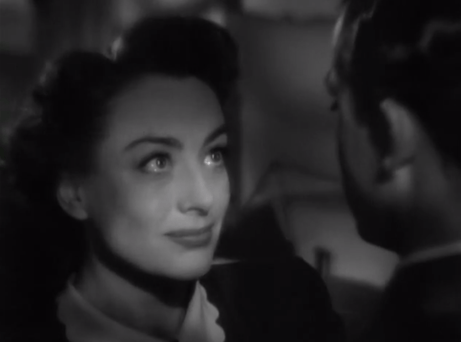
There’s Dan O’Mara (Dana Andrews) trying to get the cabby to keep the meter running only to relent when the cabby gives him the statistics on New York’s taxi shortages. Joan Crawford’s punching pillows as Daisy Kenyon, a successful artist who has had an amiable fling for some time with the man. He already has a wife and kids. It’s not where she wants to be. She’s not looking to be a homewrecker. But it’s partially O’Mara’s fault, a successful lawyer who walks in and grabs himself a cup of coffee as nice as you please — all part of his normal routine.

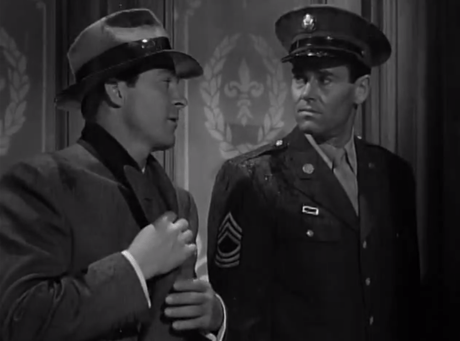
Moments later, another cab appears with Henry Fonda, the understated G.I. Peter Lapham, who winds up on Daisy’s doorstep to call on her for a date. In this opening moment, it takes us so long to know how these characters relate to each other. Maybe it’s the fact that for two people not married to each other Crawford and Andrew’s characters have such a casual, even comfortable, relationship. This isn’t the passionate tryst we’re accustomed to seeing. That’s a beginning and it only gets more fascinating as time marches on.

Henry Fonda feels like he should be the third wheel of the picture and though recognized as a phenomenal actor, he had been out of the game so long like his buddy James Stewart; it’s hardly possible to know what to expect from him. We have My Darling Clementine (1946) and that’s about all. When he pops up, we almost lose him behind the personality of Crawford and Andrews’ own brand of charisma.

But that’s why I’ll always admire Fonda as an actor, because his natural delivery leaves an impression that’s a perfect counterbalance, almost to the point of undermining what his costars are doing.

Meanwhile, Dana Andrews doesn’t appear to make a very convincing father, because every time you hear him say “Baby” to his daughter, a noir dame like Gene Tierney or Linda Darnell springs to mind. The associations have already been made long before this picture. It makes it hard to go back now. Remarkably, in all other respects, he fits the bill and he hardly places a foot wrong. It’s the side of Boomerang (1947) that’s rather more interesting. A big-time lawyer’s family life going to shreds outside the courtroom, spilling into his work as well.

Thus, Daisy Kenyon rolls out the carpet in the fashion of a romantic love triangle and we can make that assumption right off the bat with the stars whose names flash above the title. But what sets this picture apart mostly has to do with the account of the ensuing melodrama. Because it’s hardly melodrama at all, or at least, it’s a more authentic, even honest strain that feels noticeably genuine compared to what Hollywood generally seemed capable of in the 1940s.

daisy kenyon 2.png

Case and point is a very simple sequence around a table at a bar. Our three stars are gathered there together to talk things out like rational-minded adults. They’re the kind of conversations that can be unpleasant and most certainly of a private nature. Still, in another picture, they might have continued the dialogue as the waiter comes up without a second thought, but here the conversation ceases because that’s more like real life. The film itself seems openly aware of this fact as well.

What becomes equally noticeable is the lack of the kind of soppy manipulative scoring we might see in other works. Embraces and kisses and sweet nothings but none of the same mood created. Again, a little like the real world. Choirs only play in lovers’ heads.

I do greatly appreciate David Raksin’s score, his work in Laura (1944) being transcendent, and here it fits the mood with its sparing arrangements around certain moments to accent nightmarish attacks and more tranquil interludes. It’s almost counter-intuitive if not refreshing.

Subsequently, we witness the most painful sequence of infidelity. Just watching things unravel gives me a heavy heart and I want to grieve even if this is only a cinematic space within which the events are taking place. Because it feels so brazenly real as the lines get crossed and irreparable damage is done.

A part of this messy process is the ensuing complications like divorce, settlements, splitting up custody of the kids, and all the future roadblocks that make people more embittered and jaded when it comes to life.

Though by title and content alone it doesn’t let much slip, there were also murmurs that Daisy Kenyon featured Japanese-Americans in its storyline and as one myself I usually jump at the chance of any such story. Because normally, they are few and far between in Classic Hollywood. That makes any picture with such content a minor revelation for me whether it was Preminger’s impetus or not.

At any rate, The Civil Rights Association comes a calling on O’Mara to represent a Nisei war veteran named Tsu Noguchi who came home to find his farm had been legally taken away from him. We never see the man and there’s not that much more said on the issue except that “It isn’t anyone’s kind of case” but Dan takes it up, assumedly because he wants to impress Daisy and there’s an inkling that he has a shred of decency in his being too.

Now here is another picture to add to that modest but still formidable list including The Steel Helmet, Go for Broke!, Japanese War Bride, and The Crimson Kimono. It proves to be a victory for even conceding that such a world and such a history existed. That is enough for me.

It’s an extension of the entire film really, constructed of minor intricacies that succeed in making this picture an unprecedented example of 1940s Hollywood. It’s ending is wonderful for how it defuses everything we expect from a courtroom drama or a woman’s picture or any other genre convention. It ends on a natural, smooth note like a nice glass of bourbon cradled in the palm of your significant other. Like clockwork, there’s Henry Fonda again. The man we should never, ever write off. What is the age-old adage? He who laughs last, laughs loudest? Yes, indeed.

4/5 Stars

Boomerang (1947)

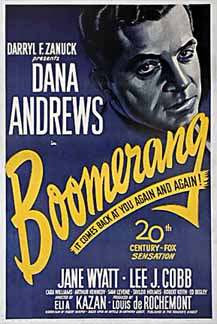
Boomerang!Boomerang shares some similarities to Call Northside 777 (1948) and Panic in the Streets (1950). Like the latter Elia Kazan film, this one boasts a surprising amount of real-world authenticity and a loaded cast of talent. Those are its greatest attributes as Kazan makes the bridge between the stage and the silver screen. He brings with him a sensibility for a certain amount of social realism matched with quality acting connections he had accrued in his career thus far.

The only problem is it’s not very compelling just a good, solid, well-made human drama without much fanfare. At the very least, it hits all the procedural beats it’s supposed to. Sometimes that’s alright and it is interesting the narrative goes fairly in-depth into actual events which occurred back in 1926.

In that year a beloved local preacher in Connecticut was gunned down by a fugitive who ran off in the night before he could be apprehended but not before seven witnesses caught a glimpse of his face. The rest of the film is a buildup of the frenzy churned up in the aftermath. The police frantically try and catch the man-at-large with the papers on their back and several political reappointments hanging in the balance.

It’s true Boomerang does become a more interesting exercise once we’ve entered a courtroom and a man (Arthur Kennedy) is put on trial for the murder of the aforementioned minister — a defendant who has pleaded his innocence since the beginning although the evidence is stacked up against him including a vengeful witness (Cara Williams). Except the district attorney (Dana Andrews) takes a stand to promote his innocence. In this case, it’s not quite so straightforward.

True to form and all parties involved, the acting is a great joy to watch with a mixture of untrained actors filling in as the locals of a sleepy Connecticut town and then bolstered by a formidable supporting cast.

We have Dana Andrews at the center but he is buttressed by some quality performers who would make a name for themselves in subsequent years on the stage and screen. These include Lee J. Cobb, Ed Begley, Karl Malden, and, of course, Arthur Kennedy.

Not one of them is a classically handsome or groomed Hollywood star but in the post-war years, they would be crucial to the trajectory of noteworthy films of the decade. Look no further than Death of a Salesman, A Streetcar Named Desire (1951), On the Waterfront (1954), or 12 Angry Men (1957) as living proof.

The underlining moral conundrum of this film is evident as Henry Harvey is faced with political opposition and heady threats with his doting wife (Jane Wyatt) acting as his pillar of strength. The sides begin to get drawn up as the District Attorney takes a stand to uphold real justice and not just win another conviction and approval from the local populace. It’s a risk but also a move of immense integrity.

The real-life inspiration for this man, Homer Cummings, far from becoming governor took on another position instead, as Attorney General of the United States under FDR. Not too shabby.  The same can be said of this picture. Not too shabby as far as docudrama noir go.

3.5/5 Stars

The Window (1949)

The_window_1949.jpg
The main conceit is just too delightful to ignore. It posits the following dramatic question: What if the boy who cried wolf saw a murder being committed immediately afterward? Because that’s precisely what happens to little Tommy Woodry.

He’s one of those imaginative little boys who likes playing Cowboys and Indians while telling his contemporaries that his family has a large ranch out west where they raise horses. It all seems perfectly innocent except in close confines such stories take on a life of their own. Soon the landlord assumes that the Woodrys will be moving out shortly.

It’s not just this incident either but Tommy has a history of dreaming up all sorts of stories and wanting to teach their son good old-fashioned American values and honesty, his parents say there will be consequences if he lies again.

What happens next is so absurd and outrageous Tommy is sunk even before he’s begun. He spies the upstairs neighbors Mr. and Mrs. Kellerson (Paul Stewart and Ruth Roman) take part in a grisly murder. He does the fairly logical thing and goes to wake up his mother to let her know what he witnessed. But it’s not so logical based on what has already happened.

First, she dismisses his stories as a bad dream but after he goes down to the police station to get them involved, his mother is even more alarmed. Mr. Woodry comes back home from the night shift to hear about his son’s behavior and as much as he doesn’t like to do it, he does the fatherly thing and punishes the boy.

He’s meant to stay in his room and that wouldn’t be so bad if his father didn’t work nights and his mother wasn’t called away to take care of her ailing kinfolk. Because the Kellersons know he’s been snooping around and they’re not about to be found out — especially not by an inquisitive kid. When they figure out what he knows, he’s little better than a sitting duck.

If it wasn’t obvious from the outset the picture sets itself up for a claustrophobic finale that’s quite the piece of entertainment. Rear Window is one of my favorite films and it’s hard not to draw up comparisons between the two pictures because they both utilize their limited space well and allow us to get inside the plight of our protagonist in a way that’s excruciatingly disconcerting.

For L.B. Jeffries it’s the fact that he’s trapped in a wheelchair with a purported murderer living right across the courtyard from him. In this picture, it’s that little Tommy has his freedom revoked and finds himself made prisoner in his own home with his parent’s gone because they are angry with his constant fits of fibbing.

But more so than Rear Window which is a fairly opulent picture, The Window suggest the impoverished state of the characters at the fore, living on the Lower East Side as they do. Their lives are not glamorous at home or at work. They have a tough time scraping by and it shows in their dress and how they present themselves every day.

Arthur Kennedy and Barbara Hale do a fine job as Tommy’s parents because they feel like decent folks, generally humble and wanting to raise their son the best way. That doesn’t make their immune to parental blunders but, nevertheless, they love their boy.

Likewise, Paul Stewart is a bit menacing and thuggish veiling it with a good-natured facade while Ruth Roman normally remembered for fairly upright roles is cast as a wife who seems more frightened by her circumstances than anything else. She’s hardly a villain but that doesn’t make her any less complicit in this whole affair.

Bobby Driscoll was on loan out from Disney and he embodies the precocious nature of a boy in a way that’s completely believable and at the very least compelling.  It’s a wonderful live-action performance to fit right alongside his voice work before his life took a tragic dive into drug addiction.

It might be an unnecessary connection to make but director Ted Tetzlaff was formerly a cinematographer and one of the films attributed to him was Alfred Hitchcock’s Notorious (1946) from only a few years before. Hitch would come out with his home thriller in 1954. I’m still partial to the later film — it’s one of my personal favorites — but there’s no doubt The Window proves itself as a harrowing family thriller in its own right.

3.5/5 Stars

They Won’t Believe Me (1947)

they won't believe me.png

We open in a courtroom and with a flashback but what’s stunning is that the man relating the information is on the witness stand and also the defendant in a murder trial. So much hangs in the balance of the perspective he’s about to disclose and that’s how the picture nabs us. Often there’s no import to the use of voiceover. It’s only a stylistic choice or a bit of lazy storytelling utilized without a great deal of forethought. This testimony actually matters.

The man in question is one Larry Ballentine (Robert Young). His Saturday afternoons most recently have been spent in the company of his “Skipper” Janice Bell (Jane Greer) and their relationship is full of good humor. You can see it on their faces that they enjoy each other’s company tremendously. But he has a wife of 5 years. It’s the old story. He’s only realizing now when another woman comes into the picture that he never really loved Helen (Rita Johnson), marrying her instead for her healthy endowment. She’s quite rich.

We can discern already a tale of adultery is in the works as Larry plans to break the news to his wife and leave with Janice for Montreal though the other woman wants no part of being a homewrecker. Still, Helen loves him dearly and tries to do everything to salvage their marriage so Larry relents and vows to stay with her. He ditches Janice without even a word of goodbye.

But he’s a man with a pathological problem and although his wife has set him up with a cushy job, he’s already up to his philandering ways again. One day his alluring secretary (Susan Hayward) saves his neck with the boss and starts to flirt with him. It begins again. Secluded cafes. Hidden spots — a game of “hide and seek with fate” as Larry so aptly puts it. He’s hardly phased by Virna’s admission to being a gold digger and while Helen vows never to divorce him, he plans to clean out their joint checking account and run off with Virna.

they won't believe me 2.png

Up to this point, They Won’t Believe Me is an engaging albeit straightforward tale of infidelity but then it goes wildly out of control as Larry’s life careens off the tracks. He leaves his wife a note with no forwarding address as he goes off with his latest gal toward fateful consequences. Later, he winds up meeting an understandably aloof Janice again in Jamaica of all places. He is clearing his head. It’s unclear how she got there. But it’s yet another prime example, to evoke Detour (1945), of how so often fate can put the finger on you. There’s no chance of getting away from it.

There’s also the sense this is a picture and a version of film noir that is akin to the common everyday circumstances of James M. Cain’s crime novels. But this is spun in such a way where we still have empathy for our perpetrator. The same can hardly be said of Double Indemnity (1944) or The Postman Always Rings Twice (1946).

However, the moral ambiguity is still very much apparent to the final moment when an explosive action twists up the narrative threads in such a way that’s meant to evoke some form of cognitive dissonance. How are we suppose to respond to it all?

Because the film’s title is almost beside the point. It’s one of those lurid melodramatic billboard toppers meant to make you look up and take notice. But as per usual, it doesn’t actually get to the core themes of the film nor does it really matter. Whether or not he is believed is an arbitrary issue. Larry might as well have been a killer. This is the quintessential role (aside from The Mortal Storm) if you are looking for something to subvert your view of Robert Young as the world’s perfect father. Here he’s the perfect cad.

They Won’t Believe Me also deserves note for its producer Joan Harrison who began as Alfred Hitchcock’s secretary and eventual co-screenwriter before she became one of the pioneering female producers in Hollywood and a great one at that.

This picture can be added to an illustrious list of noirs including The Phantom Lady (1943) and Ride The Pink Horse (1947). Perhaps her influence is most obviously felt in the fact that our female characters have a rather refreshing resonance. Though they might be unfairly used and manipulated there’s a certain traction to the roles that give them an extra dimension often lacking in other works. Each performance adds something of value to the picture.

3.5/5 Stars

Note: The reissued version of They Won’t Believe Me put out in 1957 was cut down to 80 minutes.