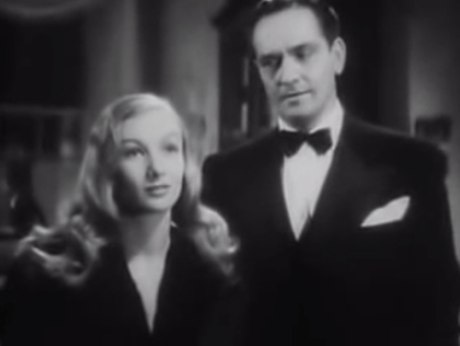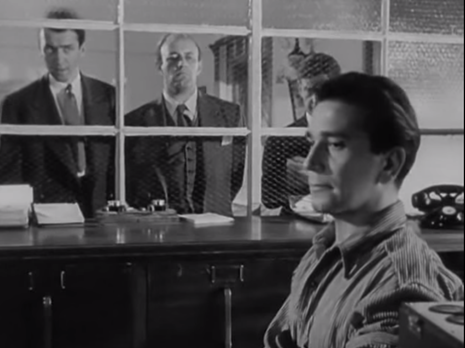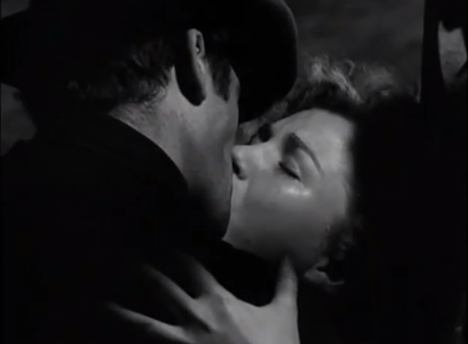
Call Northside 777 (1948)

callnorth1It’s not really noir and it’s hardly a procedural. After all, it’s not from the point of view of the cops, but an intrepid investigative journalist who is looking to clear a man’s name after 12 years. Henry Hathaway’s film has the feel of a docudrama much in the same vein as it’s post-war contemporaries T-Men and The Naked City.

It’s methodical. It goes through the paces. Setting up the story by first going back to the prohibition era in 1932. That was the year that the unassuming Frank Wiecek (Richard Conte) was sentenced to a 99-year sentence thanks to some eyewitness testimony.

Years later the story catches the attention of a newspaper thanks to an odd ad in a paper offering a $5,000 reward for answers. The editor of the Chicago Times (Lee J Cobb) thinks there’s a story behind it and that sends his ace bloodhound P.J. McNeal (James Stewart) out to dig around for answers. Others have sympathy for Wiecek, but McNeal comes into the story as a skeptic. He’s just looking for an angle, a way to spin it to get a good story. But after testimony, lie detector tests, and bits and pieces of information he begins to change his tune.

However, the puzzle pieces just aren’t fitting together completely and he even begins searching around the Polish sector for the key witness Wanda Skutnik, but the state attorney’s office is putting pressure on him. In the end, it ends up being technology, in the form of blowing up a picture, that is able to set Wiecek free and it’s all thanks to McNeal.

Obviously, the main reason to watch this film is Stewart because this film feels strangely different than anything else he ever did. After the war, he was done with the idealism of Jefferson Smith and later on he would devote himself to westerns and thrillers steeped in psychology. Call Northside 777 is a rather straightforward film, about cold hard facts, and the truth. Almost like an episode of Dragnet with Stewart’s reporter standing in for Joe Friday. His dynamic with Helen Walker feels genuine and real so it’s a shame that his home life did not play more of a role. Richard Conte also does a good job at exuding innocence (very different from his role in The Big Combo). Aside from an understated role from Cobb, we also have E.G. Marshall, and we even see Thelma Ritter for a brief moment.

3.5/5 Stars

The Dark Corner (1946)

Dark_Corner_1946“I’m backed up into a dark corner and I don’t know who’s hitting me.”

It’s always satisfying to find another little gem of a film-noir, and I think this thriller from Henry Hathaway fits that bill. Our stars include a serious and quite beautiful Lucille Ball along with Mark Stevens as gumshoe Bradford Galt. He’s more of a Cornel Wilde type. A rather nondescript lead compared to Bogey or even Dick Powell, but he works well enough as the focal point of this story.

He served a stretch in prison after he was framed for a murder wrap and now he’s a P.I. trying to keep himself on the right side of the law. But nevertheless, it’s a dirty business that’s bound to catch up with him. He’s being shadowed by a man in a white suit and almost gets mowed down by a car that had his name on it. His secretary Ms. Kathleen Stewart genuinely worries for his safety and tries to help him, so he reluctantly lets her into his life.

Everything seems to point back to one man. Anthony Jardine was the attorney who set Galt up and sent him off to the clink. It only makes sense that he would want to silence the P.I. for good. After all, if not him who else could it be? Except things get especially dicey when Galt gets framed once more and this time he knows for sure his old nemesis cannot be involved.darkcorner1The race is on for the real murderer because Galt must also attempt to clear his name before he gets charged with another killing leading to a date with the electric chair. This is when a juicy piece of dramatic irony comes in since as the audience we know who has it out for the P.I. We just don’t know why… Some sleuthing leads Galt to another crime scene and finally to an art gallery where he follows a hunch. His suspicions were on point, and he finally fights his way out of the corner.

It should go without saying that The Dark Corner is beautifully shot with a lot of wonderful low lit sequences that are deliciously moody. Interestingly enough, the storyline is infused with a lot of Culture whether it is jazz music or pieces of fine art. It’s a weird juxtaposition of this noir world bleeding into these higher echelons of society. The people and places criss-cross and intertwine in a web of the urban and the urbane. It proves that treachery can rise up from any level of society.

3.5/5 Stars

Champion (1949)

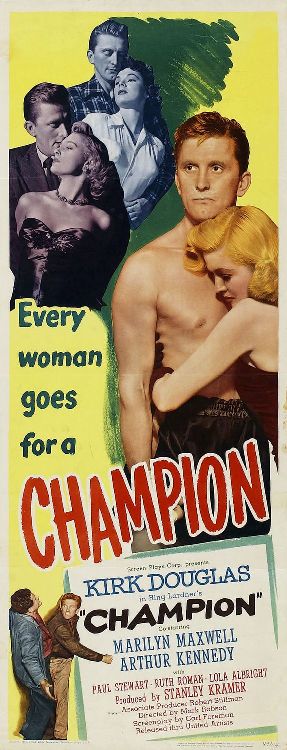
Champion1949filmA premier boxing film and Kirk Douglas‘s big break, Champion is in the company of other Noir such as The Killers, Body and Soul, and The Set-Up. This story is about one man’s rise to the top of the business and in his business, the blood and corruption actually show.

Douglas is Midge Kelly, a fiery nobody who is trying to make ends meet with his crippled brother Connie (Arthur Kennedy). When work at a hot dog joint falls through, Midge willingly takes some quick money sparring in the boxing ring. He’s got guts, but no skill, so he thinks that’s the end of his chances. Back to working at a Diner it is, and Midge has his eyes on the proprietor’s daughter (Ruth Roman), but then he’s forced into a shotgun wedding that he’s not too fond about.

Fed up with this kind of life, he searches out a manager so he can begin the long hard odyssey to make a name for himself as a boxer. His faithful brother Connie sticks by his side as does his manager Tom Kelly. City after city, Midge keeps knocking them out rising up the ranks until he is called on to throw a match. It’s all set, but in a brief instant, the reluctant slugger splits with the program. It’s a turning point that gets him in trouble with the big boys and yet makes him a media darling with the press. The opportunistic platinum blonde Grace Diamond (Marilyn Maxwell) realizes the tides are shifting and begins pursuing Midge.

It’s at this crossroads that Midge’s relationships begin to splinter since Diamond convinces him to take on the bigger fight manager Mr. Harris who can help catapult him to the top. The one thing Midge always had going for him was his loyalty to brother and manager, but in the pursuit of “happiness,” he lost both.

Connie returns to the home of his mother and pleads with Emma to come back with him. Their romance quietly builds as Midge’s star continues to rise. His infidelity also ascends with it. His next object after Diamond is the beautiful and more cultured Palmer Harris (Lola Albright), who also happens to be the young wife of Jerome Harris. However, he soon ditches the genuinely lovestruck girl when Harris gives him a wad a money to lay off of her. That’s the kind of man he’s become, but at least he’s Champion.

In one final effort, he tries to patch things up with Connie and Emma following the death of his mother. A rematch with Johnny Dunne is coming up and Midge hints at retirement, while also bringing Tommy back for one last hurrah. In rather predictable fashion, the fight plays out as we expect and yet as with any good noir their needs to be a little wrinkle and there is.

This film is by no means Citizen Kane, but in a sense, it is Kirk Douglas’s version of it.  Because he got the opportunity to play a character following the mold of the American Dream. He rose from the depths of poverty to become the champion of the world! And yet along the way, he became a cold-blooded, money-grubbing, scumbag who lost connection with all the people who actually cared about him. It’s the inverted American Dream — a cautionary tale on the most archetypal level. He plays Midge with the same tenacity of some of his earlier roles where he balances cold-hearted corruption with a nevertheless infectious charm.

Something else it has is a Cain and Abel type complex  — much like Force of Evil. There are the two brothers at odds, except instead of murder, there’s more of a self-destruct going on. In this respect, Connie is far from the most important character, but he is an interesting character thanks to the earnestness of Arthur Kennedy.

Also, I find it particularly interesting in terms of the women in Midge’s life. Thanks to posters I assumed Marilyn Maxwell was the main love interest, but in the film, he’s actually married to Ruth Roman’s character almost the entire film, and it seems to be Lola Albright’s character who is the only one who actually loves him. It makes for an interesting dynamic because these women are drifting in and out of his life. And he doesn’t end up with any of them. That’s the life of a Champion sometimes.

4/5 Stars

My Favorite Wife (1940)

My_Favorite_Wife_posterThis is a film that I arrived at by a rather roundabout route indeed. Let me explain. I genuinely loved Cary Grant and Irene Dunne’s chemistry in The Awful Truth, but I wanted to watch My Favorite Wife before moving onto their final film together Penny Serenade. Time passed and I found two other films.

First, Something’s Got to Give which was Marilyn Monroe‘s final project that remained unfinished after her death. Only about 30 minutes were completed and it was scrapped, only to be reincarnated a year later as a Doris Day vehicle co-starring James Garner. Being a fan of Day and especially of the late-great Garner, I had to indulge in this romantic comedy Move Over, Darling.

All that is to say that the Monroe film and ultimately the Doris Day film were both based on this same basic plot. A man just recently gets married only to learn that his wife who has been missing for seven years is alive. He must figure out how to break it to his new wife, only to learn that she was shipwrecked on a tropical island with a strapping young man.

After three renditions it certainly feels over-trod, but the beauty of each adaptation is that they only have this basic framework intact. A lot of the really juicy bits are filled out by the cast. Of course, your stars change. Because James Garner is no Dean Martin is no Cary Grant. And the same goes for Monroe, Day, and Dunne. However, the same goes for the crotchety judge, the desk clerk at the hotel, the bookish shoe salesman who takes part in a deception, or even the friendly neighborhood insurance salesman.

It becomes a fun game of compare and contrast, but these different performances also free you up to watch these films on their own merit and enjoy that three times over. I have found myself to often be a proponent of characters over plot and this is another case of that.

Grant and Dunne are a lot of fun together once more even if I have seen these predicaments before because Day and Garner are great to watch, but for different reasons. And of course, all the locales and fashion trends changed a lot in two decades.

Also, I will not pass judgment on who my favorite wife was out of the three and, truth be told, I saw them out of order — I would usually pick the original. In this rendition, the judge played by Granville Bates was a real scene stealer so I was sorry to discover he passed away the same year and had very few other roles.

My only question is, would this film have been propelled to greater status if Leo McCarey had been able to direct it? Also, I am now excited I finally feel clear to watch Penny Serenade and I might just have to go back and revisit The Awful Truth because it has been a while.

3.5/5 Stars

Yellow Sky (1948)

yellowsky2From William A. Wellman comes an unheralded western with an intriguing cast dynamic. Gregory Peck is the undisputed star as the boss of a group of outlaws who ride into town, pull a quick bank job, and are forced to flee from the Cavalry across the desert wasteland. It’s the prerogative of “Stretch” (Peck) to continue across the desolate terrain, despite the obvious drawbacks. But everyone else reluctantly follows although a few are opposed including his biggest rival Dude (Richard Widmark).

The story could end there with the band of fugitives dying of thirst in no man’s land and it nearly does happen, but like a mirage, they come upon a ghost town. It’s like a sick joke because it seems that all the people have picked up and left. All that is except an old prospector and his plucky Granddaughter (Anne Baxter). She is wary of these marauders, and she is extremely protective of her old grandpa. The men get a bit lustful since they have not seen a woman for some time and she catches the eye.

Again, the path of this story seems like it will be stagnant once more and yet that’s before we knew that the two relations are sitting on top of a gold mine. That catches the attention of the outlaws and the avarice grows in the hearts of the men. Not to mention their lustful desires.

yellowsky4That’s what makes “Stretch” such an interesting villain as portrayed by Gregory Peck. Certainly, he does wrong in the eyes of the law, but he has his morals in a sense. He vows to the old man that they will keep their agreement to split the gold. It’s the honorable thing to do and he is smitten with the attractive Mike. But Dude is not so excited about this act of charity and so he gets the boys to turn on “Stretch.” They try and pin him down and thus unfolds the necessary gunfight. The power struggle reaches its apex in the shrouded saloon where “Stretch”, “Dude”, and “Lengthy” face off for one final showdown. Shots are fired and a desperate Mike goes charging in to witness the outcome.

The bad boys get their comeuppance and the stooges including Walrus and Half-Pint (Harry Morgan) are okay. Most importantly “Stretch” is now a straight arrow for the girl he loves by pulling the world’s first reverse bank robbery.

Yellow Sky was a thoroughly enjoyable story because it felt surprisingly dynamic and even graphic for a 1940s western. Highlights include Anne Baxter slugging Gregory Peck and dishing out the ultimate insult that he smells bad.  Peck is such a commanding presence, and it’s fun to see him in a darker role. Baxter was also deadly in a very different way than her backstabbing Eve Harrington. Richard Widmark and John Russell were worthy adversaries while Charles Kemper was the token fat guy. And I still cannot get over how young and dare I say, scrawny Henry Morgan looks.

I must confess that I have never read The Tempest, but this story is supposedly based on that Shakespearean tale. Well, now I know.

4/5 Stars


Miracle of Morgan’s Creek (1944)

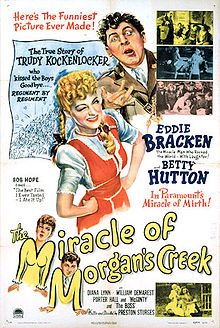
220px-The_Miracle_of_Morgans_Creek_1944_posterPreston Sturges was a revelation when I first saw Sullivan’s Travels and then The Lady Eve. His scripts are always wildly hilarious and full of memorable characters, whether they are headliners or just supporting the stars. The Miracle of Morgan’s Creek (1944) was a lesser known film to me, starring Eddie Bracken and Betty Hutton, but I was ready to see what this screwball could deliver.

With the start of the war, there began a push on the home front to strengthen morale by throwing parties and drinking victory lemonade in honor of the boys going overseas. Young Trudy is intent on dancing the night away with a lot of soldier boys. She just wants to do her part in the war effort after all. Her grumpy and domineering daddy Mr. Kocklenlocker (William Demarest) forbade her from taking part in such a shindig.

She sullenly goes to the movies with Norval Jones (Eddie Bracken), the young man who has been infatuated with her since they were kids. However, she somehow talks Norval into letting her go off to a party, and she spends the night living it up, while he waits dejectedly at the theater. When she finally returns its late morning of the next day and Norval knows her father will kill him.

However, Trudy also discovers a ring on her finger signifying that she married a soldier in her wild stupor the night before. The only problem is she cannot remember who it was, there were so many soldiers that she danced with after all. On top of that, add the prospect of a baby and you have a real doozy that has small-town scandal written all over it.

Norval tries his best to help remedy things for Trudy, only to wind up in jail with a big to-do building up — even making its way to the governor! Things don’t look good for poor Norval until Trudy gives birth and it’s a MIRACLE! When he finds out about what happens he has a little fainting spell.

That’s the craziness that is the Miracle of Morgan’s Creek, thanks to the rapid-fire dialogue and caricatures created by Preston Sturges. William Demarest is especially memorable as the hard apple Mr. Kocklenlocker who is always bossing his daughters around, but he’s not all bad. By now Morgan’s Creek looks dated, but all the same, it is still a memorable piece of WWII homefront cinema. Supposedly it was standing room only back in the day and honestly, it’s surprising that this film ever got past the censors. Bigamy, pregnancy, and so much more all comically mentioned in a 1940s film. Who would have thought?

4/5 Stars

Kiss of Death (1947)

kissof1Film-Noir gets interesting when the stylized, more formalistic world of this dark genre begins to seep into the familiar human drama that we as an audience are more used to. Many of us have families. We have jobs so we can provide for our families.  Or maybe some of us don’t and that makes for some tough decisions.

In Henry Hathaway’s Kiss of Death, Nick Bianco (Victor Mature) has been out of work for a long time now, so on Christmas Eve, in order to get presents for his two little girls, he robs a jewelry store with a few other accomplices. What sets him apart is he’s not your stereotypical ruthless criminal. He’s a family man, but he’s also bought into the idea that you don’t squeal. So inevitably after he gets caught and booked, Nick will not talk and he gets sent to the clink. The assistant D.A. (Brian Dunleavy) tried to help him, but Bianco took the three years in Sing Sing instead.  After all, his wife is doing fine and so are his daughters.

While he’s in the clink, however, he gets tragic news that his wife committed suicide and his two girls were sent to an orphanage and that changes his entire outlook. He needs to get out of there, and he’s ready to sing if that means getting to see his girls. He begins communication with D.A. Louis D’Angelo again, and he also begins to receive visits from a pretty young woman named Nettie (Colleen Gray), who used to babysit his girls back when his wife was still alive. As his relationship and gratefulness in Nettie grow, Nick also comes in contact with Tommy Udo who is also serving time. He’s a thug with a maniacal laugh and psychopathic personality if there ever was one. He’s not a good guy to cross.

The dkissof2ay finally comes when Nick gets out and he has Nettie waiting for him with his two girls. They are a beautiful happy family and Bianco has remade his life possibly better than it ever was before. However, he’s still beholden to the D.A. and they want him to get dirt on Tommy Udo. They don’t know what they’re asking, but still, Nick goes through it reassured that depending on what he can get, Udo will be put away for good. But of course, the slimeball beats the rap and Nick’s now a sitting duck. He sends his family away and waits for a confrontation with Udo.

His home life has all of a sudden been shattered, and he’s a wreck. Udo’s sadistic laugh undoubtedly ringing in his ears. In a different era, this film could have spiraled deeper and deeper into the darkness after the final confrontation. Supposedly there was one cut of the film where Widmark’s character actually got away and Mature was left for dead. The ending that was decided upon is still harrowing but holds a Hollywood silver lining as Coleen Gray’s narration ties up the story in a nice bow.

There potentially was also a scene in Kiss of Death with Mrs. Bianco where Udo took advantage of her and drove her to commit suicide, but it was deemed too graphic at the time. Although I would admit that such a scene would have made Udo even more despicable, he really did not need much help. Widmark plays him to a tee with a chilling laugh that would make the Joker proud. Mature is certainly not the standout, but he’s a necessary every man who we can empathize with. The demure Colleen Gray (who unfortunately just left us) is also fun to watch as the girl who stands by him. She also serves to narrate our story informally. Maybe it’s just me, but I really do not grasp the importance of this title. It gave me major misconceptions going in, but that’s not necessarily a bad thing.

4/5 Stars

They Were Expendable (1945)

They_Were_Expendable_posterThere’s nothing very intriguing about a film entitled They Were Expendable. In essence, we already know what the conclusion of the film is, however it is important to understand the context of when this John Ford World War II docudrama was coming out. In 1945 the Nazis and Japanese had finally been quelled, and the Allies could look back at the sacrifices that had been made.

One such example was in the Philippines after Pearl Harbor. Despite being undermanned and without much support, the brave men in the navy wreaked havoc against the enemy trying to hold onto their strongholds as long as possible before being forced to evacuate. It is far from a glamorous moment in the war because the war seemed to favor Japan and our forces were made to flee. However, in those moments of distress and tragedy, bravery seemed to flourish and our resolve only greatened. General Douglas MacArthur summed up the sentiments of every man when he promised, “I shall return.”

That being said, John Ford’s They Were Expendable is not always easy to follow; it can feel slow and deliberate, however, it exudes a gritty realism that is hard not to appreciate. It certainly is patriotic, but it does not often over sentimentalize war with high drama. We see it for what it often is. It means smoke, explosions, shipwrecks, death. It means breaking apart friends, crews, and men and women who care about each other.

Part of that realism is probably helped by Ford’s work filming a documentary of the Battle of Midway and lead Robert Montgomery (who plays Lt. Brickley) also fought on a P.T. boat during the war. Although he was not ever in the military, John Wayne always has a knack for reflecting American ideals of grit and determination. That’s why he was made for westerns as well as war films. This time around playing the fiery but loyal Lt. Rusty Ryan. Donna Reed on her part has a rather small role, and yet it is an integral part because she represents the brave nurses who support the military. She is the lifter of morale, the girl next door, all these ideals that fit this pretty young lady from Iowa. It’s hard to know if she’s just playing herself or not.

At times it’s a hard film to follow because it often seems to jump or skip events. Maybe it happens in an attempt to cover more story or maybe Ford did not want to hold his viewer’s hand, I’m not sure. I do know that I am far less of an informed viewer about this time period or this moment in World War II history. It often seems like most of the limelight is given to mainland Europe and not the Pacific.

As much as I was drawing connections and finding similarities, this film is far from McHale’s Navy. The story is far more somber, more realistic, and at times depressing to watch. It’s the kind of film that could only be made after we had won. It affirms our American resolve and honors those who paid the ultimate sacrifice. That and the film’s beautiful low lit images make it worth watching. The cinematography makes numerous scenes far more interesting by layering characters in darkness and accentuating the shadows in a hospital corridor for instance. Rather than making everything feel stylized, it only helps to augment the realism that makes They Were Expendable a worthy testament of WWII.

3.5/5 Stars

The Spiral Staircase (1945)

spiral5The Spiral Staircase plays out like an Agatha Christie murder mystery with a moody, old mansion acting as the backdrop and numerous individuals filling out the cast. It seems to be some type of gothic-noir hybrid, with its ghostly interiors, torrential thunderstorms, and creaky shutters. However, with director Robert Siodmak at the helm, I am inclined to call it noir, not just because of his pedigree, but it certainly has the atmosphere and dim interiors that are expected of the genre.

The action opens at a movie hall after a woman is murdered by an unseen killer. But most of the actual drama takes place in the before mentioned mansion of the sickly Mrs. Warren (Ethel Barrymore). She resides with her son Steven and step-son Professor Albert Warren (George Brent) who never see eye to eye. Nearly on her deathbed, Mrs. Warren distrusts her nurse and only allows the mute girl Helen (Dorothy McGuire) to even help her. The rest of the cast is rounded out by servants, a secretary named Blanche (Rhonda Fleming) who Steven loves, and the constable and a young doctor who cares about Helen. It’s a wide array of figures and we quickly begin to analyze them for any hint of killer tendencies.

spiral3In fact, Helen is our main character and we experience much of the film from her perspective. The truth of the matter is that all the girls who were killed had some sort of defect, so the line of reasoning is that Helen might be next in line. It seems all too possible with a pair of mysterious eyes constantly watching from the shadows, but Helen does not heed Mrs. Warren’s advice to flee.

The film ultimately spirals into darkness as the killer takes one victim and looks for another. Helen must protect herself, while also confronting her past where the source of her muteness lies. Although simple in conception, The Spiral Staircase is no less an engaging mystery. It is not the best from Siodmak either, but Dorothy McGuire gives an expressive performance that deliverers so much heart and feeling without the use of words.

However, the film does ultimately allow her to find her inner voice in the midst of all the silence. She finally conquers the fear in the moment when it is most harrowing. Although her role is rather minor, Rhonda Fleming is as strikingly beautiful as ever. It’s a rather expected resolution, but there are enough quirks and twists to makes things enjoyable to the end. It goes without saying that gothic noir most definitely should be a thing if it isn’t already.

4/5 Stars

Late Spring (1949)

latespring1Late Spring is a film that I found in some ways more rewarding than Tokyo Story, another acclaimed classic from Yasujiro Ozu. Both films share a few of his trademarks. They are home dramas with basic, everyday plots, termed Shomin-geki. Also exhibited are a stationary camera and low camera angles that Ozu often used to focus on his characters while sitting. In this way, he invented the quintessentially Japanese viewpoint known as the “tatami shot.” We see it most certainly in Late Spring as the daughter Noriko interacts with her widowed father or when they have friends over in their home. It may look somewhat similar to Tokyo Story, but it does differ in subject matter.

Late Spring is a film about fathers and daughters. Marriage and divorce. All the things that make up a life that remain the same whether you’re in modern America or post-war Japan. Noriko is a pretty young woman who is devoted to her aging father through thick and thin. He likes having her around and she likes being there for him.

It’s the culture, namely aunts and friends, who tell Norkio that she must get married. She’s 27 years old, and she needs to find a husband before it’s too late. Her father won’t be around forever. She’ll need to make a new life for herself. But Noriko is content with not listening to the voices trying to sway her. Only when her father talks to her about marriage does she finally begin to listen. He makes conversation about getting remarried and encourages her to think about an arranged marriage that her aunt has waiting for her.

We never meet this man who supposedly looks like Gary Cooper, but Noriko seems to genuinely like him. And yet there still is something that isn’t quite right. In Japan there is great importance in “reading the air,” and it seems like some of the characters in Ozu’s film fail at this or they see only what they want to see.

latespring3In the end, Noriko gets married and it should be no surprise because it was what was ultimately expected of her. Her father, on the other hand, acknowledges to a friend that he had no intention of getting remarried, it was only to prompt Noriko. Professor Somiya took on a great sacrifice in the eyes of society and goes home alone.

This is a bittersweet tale that is surprisingly funny on many occasions, but it is also topped off with human tragedy. Not death or dying, but something potentially worse in loneliness and discontentment. It is only a thought, but it seems like Noriko and her father would have both been happy with the status quo. However, their sensibilities and society said otherwise, so they acted as they were expected to. From this simple drama comes one of the most powerful films on father-daughter relationships ever.

I must admit, at first, I really was not fond of Chishu Ryu’s character, but over the course of the story, he grew on me. As for Setsuko Hara, she is an amazing example of kindness and servility, but also the undisputed muse of Yasujiro Ozu.  Late Spring also plays off the conflict between the old and new not to mention the traditional Japan and western culture. It’s not a blatant presence, but the allusion to Coca-Cola and Gary Cooper reminds us that this is a post-war Japan still recuperating from an awful war. That’s the backdrop of this film and its part of what makes Ozu’s human drama all the more striking. Despite, where it is situated in the historical context, Late Spring is a timeless film giving calculated insight into human relationships.

4.5/5 Stars