Witness for the Prosecution (1957)

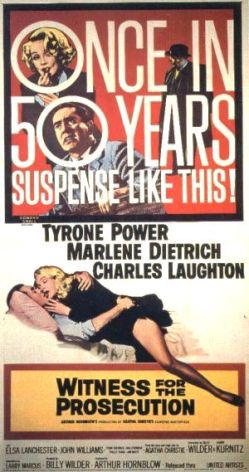
Starring Charles Laughton, Tyrone Power, and Marlene Dietrich with direction by Billy Wilder, this courtroom drama follows the trial of a man accused of murder. Laughton is an English defense attorney just recovering from a heart attack. However, soon he gets so intrigued by Power’s case that he agrees to defend him. Power’s character Vole seems to be falsely accused for the murder of a widowed woman he hardly knew. He does have an alibi in his wife (Dietrich) but she seems to refute Vole’s words and the case takes a bad turn. Through a flashback we see into their complicated past. The befuddled Laughton finally catches a break and is able to prove Dietrich is lying. He has been victorious in defending Vole but then the plot takes a cruel twist. What was reality before now seems to be completely false. Adapted from a story by Agatha Christie, this film has good characters and a brilliant climax.

4.5/5 Stars

Tokyo Story (1953)

42390-tokyo_story_posterThis critically acclaimed Japanese film directed by Yasujiro Ozu has a relatively simple plot having to do with a kind elderly couple going to Tokyo to visit their adult children and extended family. They are excited to see the big city but it is not quite like they had expected. Furthermore, all their relatives and family have very busy lives making it difficult for them to spend time with the couple. The eldest son who is a doctor and then a daughter who owns a salon decide to send their parents off to a spa. Unhappy, the elderly couple return to Tokyo but they feel like they are imposing. Finally, the two of them head home and there the wife becomes ill. Because she is dying, her children do decide to visit. However, after she has passed away it seems they all too soon forget her and go on with life. This film is an interesting study of the void between generations. It also uses realism and focuses on the manners of the Japanese without fully criticizing them.

4.5/5 Stars

Ikiru (1953)

4b946-426px-ikiru_posterDirected by Akira Kurosawa and starring Takashi Shimura, this drama is loaded full of irony. As the film opens, right away we learn the protagonist has stomach cancer, except he has yet to find out. He has spent 30 years of his life working at a monotonous job as a bureaucrat. Only after he discovers that he barely has 6 months left does Watanabe-san actually begin to live his life again. He tries the night life of Japan and it does not satisfy. Then he starts spending time with a lively, young worker that he used to know. All the while he thinks about telling his son about his condition but he cannot bring himself to do it. However, Watanabe-san finally finds a way to leave his mark on this life. And yet 5 months later he is dead and his fellow bureaucrats seemingly dismiss his accomplishment  Through a series of flashbacks they ultimately realize what he really did. I found this film to be powerful because this idea is so powerful. It makes me question if I am really living my life to the fullest extent.

5/5 Stars

Rashomon (1950)

Directed by the famed Akira Kurosawa, the film starts off with two men eventually joined by a third. Both seem very melancholy and they explain this is because of something that happened three days earlier. Apparently a bandit met a husband and wife on the road and raped the wife with the husband being killed. However, this event is shown in four different accounts all varying greatly and we never learn what is fact and what is actually fiction. Because of this horrible event, one of the men who is a priest loses faith in mankind. The film ends just as it began with the two men alone under a pagoda watching the driving rain. However, an act of kindness quickly renews the priest’s belief. Kurasawa’s film certainly has an interesting plot device and camera work. Historically, it is also important because it introduced the world to Japanese cinema

5/5 Stars

Throne of Blood (1957)

Directed by Akira Kurosawa, this film is an adaption of Macbeth placed in a Japanese setting. Two great warriors come before their lord to be honored but before they arrive a spirit gives them a prophecy. One of the men who was initially loyal, decides to take the throne for his own after hearing the prophecy and being goaded by his wife. Soon he has become an overconfident madman bent on defeating everyone. Again the spirit in the forest gives him a prophecy that all but ensures his victory. However, all too soon his good fortune ends and that’s not all. This film has some slow parts but many of the images are very striking and atmospheric while the ending is also enjoyable. This is arguably the best adaption of Macbeth to film.

4/5 Stars

Ben Hur (1959)

Ben Hur, directed by William Wyler and starring Charlton Heston, tells the tale of Christ in connection with the young nobleman-turned slave, Judah Ben Hur. We follow Hur as a friend turns against him and he and his mother and sister are imprisoned. Soon he is doomed to a life rowing on a galley but on the way there a kind , mysterious stranger gives him a drink to quench his thirst. It takes a few years but Hur’s fortune turns and he is no longer a slave but a great chariot racer. The time comes to seek revenge and he beats his former friend in the ultimate chariot race. However, his victory is shorlived since he learns his kin are now lepers and the man who showed him kindness years before is now to be crucified. Returning the favor, he gives the suffering man water before He is hung on the cross. Despite the man’s death, miraculously his mother and sister are freed from leprosy. This epic is monumental and tells a wonderful story intertwined with the Gospel.

5/5 Stars

An American in Paris (1951)

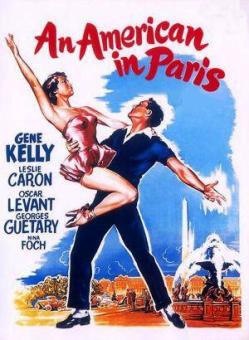
18e5b-an_american_in_paris_posterStarring Gene Kelly and Leslie Caron with director Vincente Minneli, this musical follows an American painter in Paris (Kelly) as he struggles with life and love. Jerry Mulligan is a painter who loves Paris and has made friends with many of the locals. The only problem is that he has no money. That all changes when a rich patron begins to sponsor him and his luck begins to change. Soon he becomes enchanted with a French girl (Caron) and after initial conflict they try to meet up whenever they can. At the same time Jerry is tied up with his patron and Lisa is engaged to a kind Frenchman who Jerry knows. When Jerry learns this he is devastated, however in the end he does get the girl. Although the final dance sequence seemed out of place, awkward, and too long, much of the rest of the musical is enjoyable. I Got Rhythm and The American in Paris Theme are catchy Gershwin tunes that Gene Kelly performs to perfection.

4.5/5 Stars

A Streetcar Named Desire (1951)

The film adaption of the Tennessee Williams’ play, A Street Car Named Desire was directed by Elia Kazan and stars Marlon Brando as the rough Polish husband of Stella Kowalski. Vivien Leigh plays the role of Stella’s airy and superficial sister Blanche. The film opens in the French Quarter of New Orleans where the Southern Belle Blanche DuBois comes to live with Stella and Stanley. Over time we learn of her past full of forbidden love and other problems. Stanley is a brutish, dominating man and the arrival of Blanche upsets his relationship with his wife. A friend of Stanley’s, Mitch (Karl Malden) is drawn to Blanche but the conflict between her and Stanley make the relationship impossible. Now Stanley knows of her past and confronts Blanche about it. His cruelty and violence lead to her final breakdown. Ultimately, Mitch is angered, Stella is grief-stricken, and Stanley shows his dependence on Stella. This film is full of drama and at times you dislike both Stanley and Blanche. Mitch is one of the characters you actually feel for.

4/5 Stars

From Here to Eternity (1953)

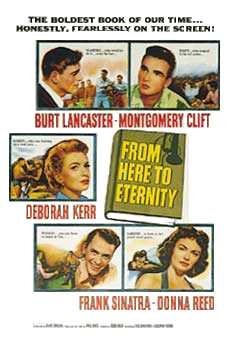
b0508-from_here_to_eternity_film_posterDirected by Fred Zinnemann, the film has an all star cast including Burt Lancaster, Monty Clift, Deborah Kerr, Donna Reed, and Frank Sinatra. Clift is a former boxer and bugler who has been transferred to a post in Hawaii. The commanding officer wants to have him fight for the company but Clift is adamant that he will not. From that point on life is made difficult for him on the base. However, he still finds time to go to a club with his friend Maggio (Sinatra) where he meets Lorean (Reed) and falls in love. At the same time the intelligent company sergeant Lancaster, finds himself falling for the commander’s wife (Kerr) who has an unhappy marriage. However, he feels he cannot become an officer effectively terminating their relationship. The dramatic events culminate in the attack on Pearl Harbor which overshadows a smaller tragedy. This movie certainly had a cast full of famous people, but I have to say it was not my favorite film. All the same there definitely are some good moments.

4/5 Stars

All About Eve (1950)

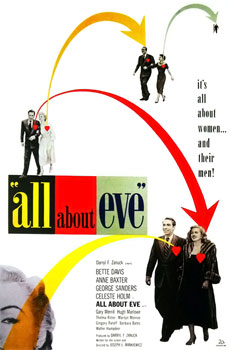
f37d4-allabouteveEve Harrington (Anne Baxter) is a seemingly modest and conscientious girl who gets the chance of a lifetime. She is able to meet a great Broadway star (Bette Davis) as well as her close circle of friends. Soon she is helping this Margot Channing by taking care of errands and odd jobs. This ambitious girl finally convinces one of Margot’s friends Karen (Celeste Holm), to let her be an understudy. And so when Margot is detained the night of a show, Eve gets her chance at the big time. However, Eve soon shows a different side of herself; one of back-stabbing and blackmail. Through her manipulation, she meets a famous critic (George Sanders) and wins an award. However, he has her pegged and the truth becomes evident. By the end of the film, Eve seems to have fallen for the same trap that Margot had. This film was pretty good and featured a good cast including Thelma Ritter and a young Marilyn Monroe. As Davis exclaims, “fasten your seat belts!”

4.5/5 Stars