Breaking Away (1979): Bloomington Indiana on Wheels

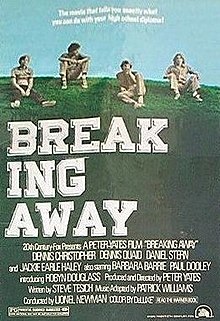
220px-breaking_away“When you’re 16, they call it sweet 16. When you’re 18, you get to drink, vote, and see dirty movies. What the hell do you get to do when you’re 19?”

Oftentimes sports films are memorable for merely pioneering underdog stories or analogous themes meant to inspire. But then we get a whole slew of imitators coming afterward. You see it with baseball, basketball, football — most of the big ones — each one already boasting a substantial fanbase and accepted canon of classics. However, cycling has never been as popular in the States and thus, watching Breaking Away, even today, feels like it’s own unique experience.

Sure, it’s the age-old, small-town coming-of-age story. There are too many of those to even begin counting the good ones (much less the bad). We’re supposed to care for four dreamy highschoolers going out against the world. There is so much that could feel hackneyed and overdone. But married with cycling, Breaking Away has yet to meet its equal. Off the top of my head, there is no other cycling film that channels this same sense of exuberance or captures a certain time or place like the Bloomington, Indiana featured herein.

Because along with Hoosiers, Breaking Away is in the running for the most Indiana movie of all time. It lives and breathes the tangible air made very apparent in Steve Tesich’s script. He has an intimate understanding of this area, having lived there in college and even having been a member of a cycling team.

So for every forgettable yarn that I’ll graciously refrain from mentioning, we get an American Graffiti or Dazed and Confused. Breaking Away is very much the same. Their skill comes in taking the individual and the deeply personal memories, only to realize them in a way that cannot help but be universal.

It grabs hold of those strains and feelings that we all can relate to, no matter our background or race or creed. In some circles, it has to be the greatest common denominators. Like not knowing what you’re doing with your life. Having a difficult relationship with parents. Even being the underdog forced to prove yourself against Goliath.

In this case, our protagonist is a scrawny kid (Dennis Christopher), nevertheless, obsessed with cycling and therefore, Italian culture. He’s going through a phase that’s just about driving his father up the wall. He’s a man who won’t have any “inis” in his house from Fellini to Zucchini.

 Dave’s a cultural sponge where imitation is and always will be the highest form of flattery, even going so far as to thank the saints on one particularly fortuitous occasion (“Oh Dave, try not to go Catholic on us”). Along with the constant biking comes the Italian language used in the home, opera records, and shaving his legs (like an Italian).

It’s how he’s able to make a unique identity for himself aside from being the former sick kid who doesn’t know what he’s doing with his life. We’ve all been there. At least he’s added a little flair to his existence while he still can.

What ensues is a cringe-worthy romantic introduction as he submerges into his Italian persona just to get acquainted with a girl. It’s almost a defense mechanism because he’s too unsure to be himself; it’s much easier to put on a larger-than-life, sing-song facade. If it gets rejected there’s no harm. Moonlight serenades outside the sorority house window follow and stirring heart-to-hearts.

If Italian culture and a girl become his main extracurriculars, then most of his formative time is spent in the company of his buddies. Mike (Dennis Quaid) is the tough guy with the chip on his shoulder. He’s protective of his turf and always ready to rumble with the more affluent sects of society. He’s not about to back down from anyone.

If there’s a Mike in every crowd, there must also be a lovable airhead like Cyril (Daniel Stern), good for a few laughs so tensions simmer down. The last amigo is the shaggy-haired and affable pipsqueak Moocher, who is no doubt in the most serious relationship of all the boys. In his own way, he might actually be the most mature.

Regardless, they are constantly reminded of the realities of living in a college town. Part of this is the socio-economic aspect. They spend their summers swimming in the local quarries, as opposed to the sleek indoor swimming pools and co-ed decadence of all the out-of-town college kids.

They proudly wear their somewhat derogatory label as “Cutters,” the local blue-collar families who either don’t have enough money to get into the school or perhaps they aren’t bright enough. I’d be willing to believe the former more than the latter.

However, if Dave Stoller thinks he’s found who he is, events cause him to reevaluate his very identity. Not about being a cyclist — he still can ride faster than just about anybody in town — but there’s more to him than that. He’s forced to sort it out.

Because the day he’s been waiting for finally arrives, and he realizes his dream to ride with the team from Italy who have come to Indianapolis. Being in their stead provides him with a rude awakening. When he gets sent careening off the tracks by some foul play, his idols tumble right down with them. He realizes the necessity of being his own man and so he goes out on another limb.

He admits to the girl his whole Italian shtick was an act. He made it all up. Not surprisingly, she lashes out in bitterness over his bout of deception. It sends everything spinning into a tizzy. The untouchable, alluring college girl has a moment of genuine frailty and our hero is ousted for what he was — not simply an insecure adolescent — but a jerk for putting her on.

There is also tangentially the obvious paralyzing fear of stepping off into the great unknown that is the future and out of his father’s life into his own. What Breaking Away does a fine job at is coloring the relationships, not just between peers but a father, son, and mother.

Barbara Barrie is sublime as a steady ever-understanding wife and calming maternal figure. She performs the role seamlessly. Equally important is Paul Dooley as Ray Stoller. He’s full of irritations and hilarious punchlines that give way to real feeling.

He’s born out of a generation that does not know what affection is. They are proud and they work hard and grit it out. He helped excavate the land that became the university, and now he’s a used car dealer. Looking at his son he sees someone who is soft and inexperienced. And yet when he’s really honest and speaks his heart, he wants something better for his boy than what he had.

This is how you know parents care. No matter how much they might grumble and gripe, most everything they do is to set up their children for a better future. It’s no different in Breaking Away. Coincidentally, parents almost always make the greatest cheerleaders because they’re always there.

 If Dave’s tumble off the bike and the renunciation of his girlfriend were subsequent slaps in the face to his ego, then the Little 500 Race is the obvious chance at redemption. Again, the beats are oh-so-familiar but at this point, it doesn’t matter. The wheels are spinning and we’re ready to cheer on the boys as they seemingly take on the world or at least all the hotshot fraternities dismissing their very existence. It’s superfluous to mention the ending.

The euphoric joys of a goosebump-filled finale cannot be totally dismissed. It makes one realize the power of characters that we are able to empathize with. Knowing what will happen doesn’t take away one ounce of the excitement because we feel for them and are urging them to succeed.

We are a part of the Cutters team and every burn, every lap, every push they make against adversity, means something to us too. There is nothing self-important about it and this above all else allows it to be a sheer delight.

Peter Yates career, while somewhat uneven, boasts some quality outings if you consider the likes of Bullitt and Breaking Away. They could not be more different (the settings alone are starkly juxtaposed) and yet they do capture a very specific milieu — in this case, through a free-and-easy coolness — with kinetic energy utilized to its utmost degree.

Both are a reminder that far from taking away from the human experience — vehicles can be an extension of them, in allowing characters to realize greater potential. Bullitt in his charger, bouncing through the streets of San Francisco and then Dave blazing down the highways and byways on his bike in and around Bloomington.

The evocation of a specific place with corresponding feelings is so important. Content doesn’t matter as much as long as it manages to leave a lasting impression on us. Evocative narratives do just that.

4/5 Stars
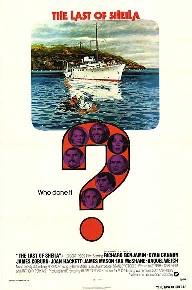
The Last of Sheila (1973): A Mystery Missing Its Columbo

Last_sheila_movieposter“That’s the thing about secrets. We all know stuff about each other; we just don’t know the same stuff.”
The Last of Sheila is an intricate murder mystery with origins in real-life parlor games put on by Anthony Perkins and Stephen Sondheim for some of their socialite friends in New York. While these mapped out scavenger hunts did not involve actual murder, they are easily adapted to fit such a storyline. Because all we need are a group of folks thrown together, some friendly competition involving misdirection, and a boatload of lies, and we are on our way.

James Coburn takes up his position as the grinning master of ceremonies inviting a group of his closest “friends” aboard his yacht. In the wake of his wife’s death from a hit-and-run driver, he plans The Sheila Green Memorial Gossip Game in her honor. Aside from being rather facetious, it becomes obvious it’s a chance to get some wicked revenge.

The rest of the cast reads easily enough. You have Dyan Cannon playing a bubbly talent agent modeled after Sue Mengers (her real-life agent), Richard Benjamin as a struggling screenwriter, and Joan Hackett as his well-off but generally sincere wife. Raquel Welch is her typically alluring self and Ian McShane fills in as her husband/talent manager. James Mason is our final guest bringing his gravitas as a veteran director, probably in the mold of Orson Welles.

Soon enough, they are all thrown together on the yacht, floating off the coast of France. The ever-conniving Clinton (Coburn) develops quite the complex ordeal to throw them into with each obliging player given a specific card because this is a game with double meaning. It is part leisure and the other more sinister aspect is meant to unveil deep dark secrets.

The first clue is a sterling key that sets them off exploring the local digs like giddy school children out for a lark. This is the fun and games portion. Then, the following afternoon, someone turns on the turbines causing a near-traumatic accident or a very insidious murder attempt.

The next locale for the escapades is a deserted island monastery meant to be the showcase for another clue or personal secret. But the frolicking goes awry when our master showman is found dead, brutally bludgeoned to death by a stone column. It becomes obvious one of our company is a murderer. It’s just a matter of deciphering who it might be.

Since this is a type of parlor game, it’s fitting everyone gets gathered together for the obligatory convening to begin sifting through the facts and slipping the pieces together. These new conjectures don’t keep another member from being left for dead in the bathtub. Our number of suspects is beginning to dwindle.

If it’s not exactly a false climax, it does feel like the picture peaks too early, and it kind of peters out. Because there are still some variables to plug in, but there’s nothing astonishing about the final resolutions.

What’s most important to the architects is the stalwartness of the story, making sure all the pieces fit together into a fundamentally sound puzzle. Unfortunately, the characters are then pushed to the fringes and become of lesser importance. When you’re boasting such a wide-ranging and potentially intriguing cast, it does feel like a bit of a waste.

The Last of Sheila is a tantalizing prospect with less than stellar results. The mysteries feel mostly compartmentalized, and they string us along without ever completely gripping us. This is no Agatha Christie who-done-it nor does it have the intriguing characterizations of a Columbo episode holding it together.

The star power is there but not the actual concern in the story. Because there is no Columbo to hold it together with levity and groggy charm. In fact, it’s as if the whole cast is filled out by Mystery Movie guest stars. Any of these players might have easily crossed over. Cannon does the most admirable job of bursting out of a ho-hum characterization to leave a real living, breathing impression.

But again, it is a story of first world problems, of Hollywood glamour, feuds, scandals, and ultimately, excess. Somehow the murders of such people in the context of this film, where we never truly get to know anyone, feels relatively pointless and blase at best. Because these are icy cold individuals. There is no emotion (only Hackett shows a sensitive side); everyone else feels hardened or fickle, made callous by the world and the lives they have chosen.

If it had dipped more deeply into the cynicism earlier, it might be different. But this is hardly a commentary. It’s merely a decent excuse to exercise some mental ingenuity for the benefit of an audience. This narrative could have been so much more, but we are forced to settle for something gleaming with star power and only moderately compelling as a mystery drama. Sometimes high expectations can sour an experience. The Last of Sheila would be another prime example of this phenomenon.

3/5 Stars

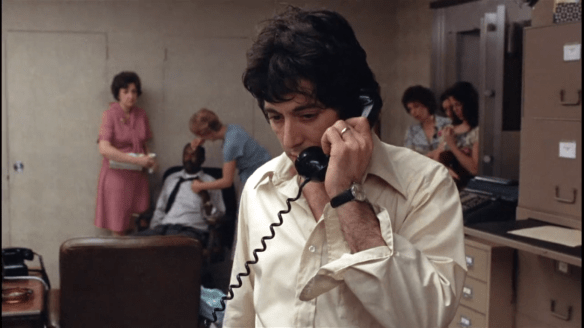
Dog Day Afternoon (1975): Al Pacino’s Fury in a Great Heist Film

dog day afternoons 1.png

We usually think of filmmakers like Woody Allen or even Noah Baumbach for their portrayals of New York. There’s no doubt they have left their imprint on the city, so it’s difficult not to envision it without their influences. However, in his own right, Sidney Lumet also deserves to be viewed in this light, even if it originates from a fundamentally different perspective.

Lumet is a director who seems to know this place intimately, but he hardly sugarcoats it. He gives us something loose and engaging, full of human drama. We saw it in everything from 12 Angry Men (1957) to Serpico (1973). With Dog Day Afternoon it’s much the same.

The film starts with a boat, before making its way across the city with imagery of both the vocational and leisurely activities of the general populous. People are bumping tunes as these city-wide scenes hum with the familiar rhythms of daily life. It seems a curiously wide net to take from the outset, only to make concrete sense minutes later.

Alongside these typical shots is something highly irregular within this same context: The attempted robbery of a local bank. One can easily champion Dog Day Afternoon as the greatest heist film for the very fact it is a comedy of errors because the sub-genre has always been defined by all hell breaking loose as everything eventually goes awry.

This picture never even gets there. It’s the purest articulation of the core tension flowing through any heist movie, going back to the days of The Asphalt Jungle (1950) or The Killing (1956). However, in this case, we are provided none of the same space for a setup or earlier preparation. It’s all the mechanisms of the job going haywire right in front of our eyes. It’s not even that the perfect plan hits a fateful snag or there’s a turncoat or what have you. These robbers are obviously sunk before they’ve even begun, and the story pivots on this, becoming something novel in itself.

It commences with their youngest accomplice who doesn’t have enough stomach to go through with it, and he literally bales on them during crunch time. Sonny (Al Pacino) and his buddy Sal (John Cazale) muddle through because the gun has already come out. They’re committed to what they’ve started. Soon the manager and female tellers are rounded up along with the security guard. No one’s looking for trouble.

But this is just the beginning. Because when they finally get to the issue at hand — the money in the vaults — there’s barely any cash. It was all taken out in the latest shipment. Strike two.

Though Sonny professes to know the ins and outs of bank work, he’s none too bright and in one of his most gloriously idiotic blunderings, he burns up the bank’s register only for the smoke from the wastebasket piquing attention out on the street. Just about everyone needs to use the toilet; they’re the kind of complications you don’t usally make allowances for in such a scenario.

Meanwhile, the police swarm the sight and Sergeant Eugene Moretti (Charles Durning) takes on the point to strike up a line of communication with the criminals. This is phase two where Dog Day evolves into a story where the aftermath of this event takes the most prominent place but for altogether different reasons than we usually expect. We reach this point of extended stalemate.

dog day afternoons 2.png

The security guard is plagued by asthma and gets sent as a sign of good faith, but Sonny’s not about to take any double talk. In the galvanizing moment that forever vaulted Dog Day Afternoon into the conversation of anti-establishment cinema, Pacino walks out on the streets and dares the cops to back down.

This is his stand, and it catalyzes the rest of the film’s action. He knows he has power because the crowds are watching him — if not the entire city. In a moment of inspiration, he starts screaming “Attica” and as his chants, evoking the contemporary prison riots, sweep through the onlookers, and they begin to cheer him on almost as if he’s one of their heroes, and he has found solidarity with them.

TV coverage makes everything live and visible to the viewing public, and it’s the same game we can play with Network (1976). If the media was invasive back then, just imagine how much more of a parasite it is now with smartphones capable of capturing everything.

One might say Dog Day Afternoon documents a very specific cultural moment because we have only continued to progress from there with the media getting more and more intrusive as time goes on.

This strange almost absurd strain of insanity becomes acceptable. Where we have stalemates and compromises with people trying to communicate and defuse a situation of the most volatile nature. All because of a measly bank robbery running afoul.

The drama settles into a strange equilibrium where everyone is trying to work with everyone else to get out of the current situation. The captors and their captives on the inside form a rapport over time. A type of Stockholm Syndrome sets in. Then you have the uneasy symbiosis of the perpetrators and the cop on the outside looking to defuse the situation so the hostages get away safely.

It’s a shortlived truce blowing up again when someone tries to sneak into the back and a shot goes off, sending the police and crowds into a frenzy. On the inside, it isn’t much better. Pacino is at his most intense following up the slow burn of the Godfather Part II (1974) with something equally grating. It’s not exactly documentary, but there is a certain sensibility to it that makes it continuously tense and strangely funny, in its most organic moments.

It only falters with its substantial length, because after losing some of its tautness as an out-and-out thriller, it falls into the strangely comically strains of theatrics before getting distracted by any number of things. These are the lulls that are weathered by the sheer ferocity of Pacino’s performance.

There’s the complication of paying for t the sex change operation of his partner. His mother comes to the scene of the crime to coax him to give up, and it’s another distraction he could do without, in between the phone calls he’s constantly fielding with the police.

In his semi-delusional mind, he develops grand plans to get a car to take them to the airfield where they’ll head to Algeria. Sal is menacing but generally composed, played with matter-of-fact sentience by John Cazale. You almost forget he’s there. The only moment he seems obviously perturbed is when the news outlets make out that he’s gay. He wants Sonny to set them straight.

At the center of this insanity, sweating it out and trying to balance all the pressures thrust upon him is the man himself. He orchestrated this whole thing only for it to blow up into a local phenomenon he could hardly control. He becomes the ringleader of his own form of media circus — albeit on the inside — on par with anything whipped up by Kirk Douglas in Billy Wilder’s Ace in The Hole (1951).

The ending wallops equally hard like cold air hitting the face. Again, we met with this weird sense of total equilibrium restored. Life can settle back into normalcy. It’s simultaneously a welcome sigh of relief and still a hollow victory.

Because even if it was momentary, we were in Sonny’s corner too — right there with his hostages — and maybe after spending so much time with him, we were inflicted with a bit of Stockholm Syndrome ourselves. There is this wishful hope that he just might get away and things could turn out. In this austere, pragmatic world of ours, such sentiment seems like folly.

Lumet documents the milieu while Pacino captures its ensuing despondency with his usual unflinching fury. At its best, Dog Day Afternoons is driven by performance, and its director creates an impeccable world for incubation.

4/5 Stars

Mean Streets (1973): Martin Scorsese’s Intimate Crime Film

mean streets 1.png

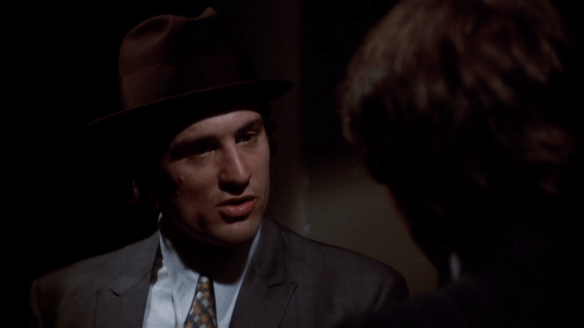
Martin Scorsese will always be synonymous with Taxi Driver, Raging Bull, and Goodfellas, but if we want to truly chart his ascension as a singular creative mind, Mean Streets must be our genesis. Because it essentially lays the groundwork for his entire career.

In truth, it’s the strangest gangster film of its kind; it’s emphatically Scorsese’s, full of his pulse and life-blood –his love of cinema. It is a gritty and intimate creature born out of the American New Wave, further imbued with religious imagery and the imprint of something starkly personal.

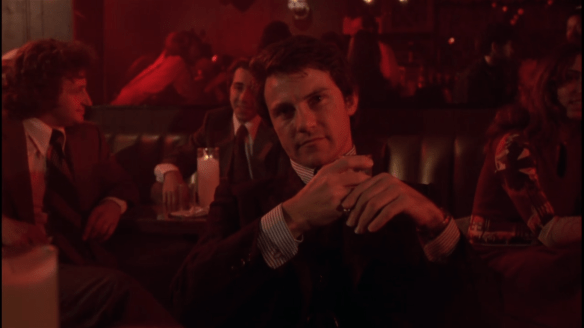
Though Robert De Niro might seem the obvious figurehead to gravitate toward, in this instance Harvey Keitel is our true vehicle to move through the picture. We get a line on him from his opening lines lying in bed, “You don’t make up for your sins in church. You do it in the streets.”

Because here’s a good kid trying to look out for his friends, while working for his uncle who happens to be a powerful loan shark. There is no grandiose story arc here. At the most mundane level, most of the story revolves around the even-keeled, responsible Charlie trying to vouch for cocky local hothead Johnny Boy (De Niro), who has the continual insolence to dodge his creditors, perpetually trying their patience with his brazen excuses. He’s the type of jerk you’re never going to straighten out.  He just never learns.

The majority of the film has Charlie playing peacekeeper, though he also has the preconception that he holds his own fate within his grasp. The moral issues still gnaw at him. He wants to be his own savior. He’s proud and self-sufficient. 10 “Hail Marys” and “Our Fathers” will not satisfy him. They’re just words. He wants to make his own penance for his own sins.

Meanwhile, his uncle tells him to stay away from Johnny Boy. He starts seeing Teresa (Amy Robinson), Johnny Boy’s cousin (and a lapsed epileptic), which is another rocky relationship, partially due to her own hatred of her cousin. Michael (Richard Romanus), a small-time shark gives him fair warning multiple times; he’s not about to take any more of Johnny’s crap. Somehow Charlie seems able to assuage him.

He hasn’t accounted for just how extreme of a hot-headed punk the kid is. In one isolated event, he finds Johnny Boy on a rooftop firing off a piece just for kicks and giggles. He seems to think it was a perfectly good idea, and he holds no respect for any form of social honor. This is near blasphemy in such a time-honored traditional society.

mean streets 2.png

As with anything Scorsese, it’s not simply about narrative but form as well, and one of Mean Streets‘ most notable successes is in the cutting of the footage to music. Charlie’s life is brought to us via home movie newsreels and The Ronettes “Be My Baby.”

De Niro certainly makes Johnny Boy pop, but his introduction shouldering two women in a bar, sashaying toward the camera in slo-mo to the pounding jagged edges of “Jumpin Jack Flash” is nothing short of virtuoso. It’s hard to even imagine the images outside of the context now. Because it’s totally indicative of the world Scorsese is introducing, bathed in red hues with a swaggering Robert de Niro, and Harvey Keitel watching from the bar.

The oddly discordant matching of “Please Mr. Postman” with a pool hall brawl instigated by Johnny Boy (surprise, surprise), provides a similar mental association as does “The Shoop Shoop Song” played over a brief image of Charlie just about to stick his hand into the flame of a stovetop. The reason is immaterial. The emotion is what speaks.

It’s true American Graffiti might be the quintessential soundtrack movie, but Scorsese’s soundtrack for Mean Streets deserves laud in its own right. Not only is it packed full of classics, they are such effective pieces of this narrative helping to cultivate the mood at any given point in time.

Obviously, Scorsese is a lover of movies, but in the context of this story, they also have a very personal function. They provide a cutaway from the world — existing as diversions and distractions from the daily grind whether it’s The Searchers or The Tomb of Ligeia. It makes no difference. Scorsese allows a reverence for everything, whether it be on late-night TV or a cramped, musty old movie theater.

Even when taking this into account, it’s easy to write Mean Streets off initially as just another gangster movie, especially if you try and analyze it retroactively. But this could not be further from the truth.

Because while rock soundtracks are the norm now, George Lucas and Martin Scorsese were invariably at the forefront of this trend. They make the sound work seamlessly within the context of their stories. It adds layers that would be lost otherwise. There’s something powerful provided by the music working counter to the typical beats of non-diegetic scoring.

Consequently, I cannot help but recall Scorsese talking about his infatuation with Force of Evil (1948) because, within its poeticism, it manages to be equal parts small-time corruption and family drama, all in one.

The world of Mean Streets is analogous. It feels every day and unsentimental, ringing with an obvious authenticity. Because Scorsese is sharing a bit of his childhood neighborhood with us. These characters. The relationships and the business they find themselves in. There is nothing glamorous about it and when someone is willing to bring us something so close to them, they should be rewarded.

Without a doubt, Scorsese expresses deep affection for Hollywood, but he readily bursts forth with his own shot of individualistic adrenaline. These are the kind of efforts that made The American New Wave a boon of cinematic creativity and Mean Streets, with Scorsese as its maverick, must be kept front and center in the collective conversation. There’s no question the collaboration of Scorsese and De Niro is still one of cinema’s most transcendent.

Mean Streets forces us to extend more love to Harvey Keitel as well. The film could not be realized to this extent without all their talents coalescing. Somehow they share a joint language adding up to a shared experience. They know these people and these places on an intimate level, and it shows.

4.5/5 Stars

The Boatniks (1970): A Balboa Island Sit-Com

boatniks.png

I won’t make any pretense that The Boatniks is a great movie by any means but surely it speaks to some favorable quality when you enjoy something for its sheer goofiness, a certain sense of nostalgia, and the overall familiarity that pervades the material.

Yes, it’s a long sitcom episode but in this case, I have no qualms with such light and fluffy fare because so many good friends from my childhood came aboard for the ride. Norman Tokar, a prolific figure behind Leave it to Beaver directs with a script worked on by among other people Arthur Julian of Hogan’s Heroes, one of my dearest childhood favorites.

The cast has all sorts of sitcom mainstays of the 60s including Phil Silvers (Sgt. Bilko), Bob Hastings (McHale’s Navy), Joey Foreman (Get Smart guest star), Al Lewis (Car 54 Where Are You?, The Munster), Joe E. Ross (Car 54 Where are You?), Shaaron Claridge (Adam-12), and last but certainly not least Vitto Scotti, arguably the most prolific sitcom actor of all time. If you don’t know who he is, it’s all too obvious you haven’t seen enough of the classics.

The Boatniks (a not so clever play on Beatniks) wears its goofball wonkiness on its sleeve. We have a hapless hero who must come out from under the shadow of his prestigious father to take over command of the local Coast Guard in Balboa Bay.

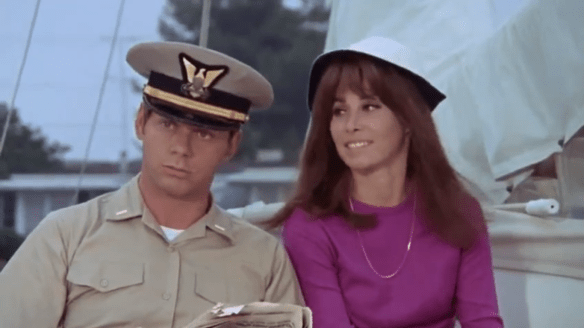
Ensign Garland (Robert Morse) doesn’t start off too successfully as he lands a plethora of citations and winds up instigating a traffic accident all on his way to the docks. Then, at the docks, he clumsily splatters a sun-soaked Boat Rental and Sailing Instructor (Stefanie Powers) with yellow paint much to her chagrin. Everything is going just dandy only to get better.

He subsequently bumbles his way through his duty, first getting beached on a rock and having to be towed by the smug instructor, followed by any number of issues from a husband locked in a cabin to a pretty girl whose skirt got caught in her boat’s controls. A Mayday goes out on both accounts. Despite handling some of these problems about as successfully as possible given the circumstances, Garland’s commanding officer (Don Ameche) is far from impressed by the compromising situations he always seems to be in but at least the girl starts to like him.

Simultaneously, three thieves led by, of all people, Phil Silvers, have absconded with a payload of priceless jewels. Their car is the one that gets rear-ended by the same awkward Ensign and with roadblocks dotting the coast, all the way from Orange County to San Diego, their only chance is to head for the sea which they do despite having no nautical knowledge whatsoever. For those who didn’t gather already, it does not bode well.

They lose their priceless picnic basket into the great wild blue yonder and in an attempt to recover their spoils the trio trawls for everything in the bay except what they’re looking for. First, they snag a gigantic sea bass that sends their boat reeling. Then, they go deep-sea diving. It’s all to no avail and flustered by a shark attack, the commodore picks up the phone and makes a long-distance call to his buddy in Tokyo for leads on pearl divers. A young Japanese woman arrives and the failure to communicate is used to great and awkward comic effect even as Phil Silvers tries to use Spanish to speak with a pretty diver (Midori). Of course, when it counts she knows how to speak the language.

The Bay is also inhabited by an assortment of other weirdos including Wally Cox and his floating harem La Dolce Vita; it’s a constant party at his place that never leaves the docks. One oddball sailor does his best to practice lashing himself to the mast in preparation for his trip around the world, conveniently leaving his wife and children behind. Another bungling seaman nervously huffs before he performs his daily ritual of bouncing his boat off the dock. It has no bearing on the plot but each is good for a few stray laughs of sheer corniness.

The scenery remains another point of interest for me because the fact is the film was all but shot in my backyard or at least quite close to where I grew up (albeit a few years before I lived there). We grew up hearing stories of John Wayne, Shirley Temple, Buddy Ebsen, and Joey Bishop only a few of the prominent figures who resided in the area at one time or another.

We have brief views of Balboa Island and seafront homes visible in the background as the buffoonery takes center stage. Boatniks would precede the Columbo episode “Dead Weight” starring Eddie Albert and Suzanne Pleshette with Peter Falk’s title character, making use of the same scenery. Except Boatniks is a great deal lighter.

In the modern age of Disney as a mega-conglomerate, these are the kind of family-friendly movies that I dearly miss. It feels like part It’s a Mad, Mad, Mad, Mad World (1963) and some of McHale’s Navy sprinkled in with dashes of so many other things. I enjoyed it far more than I probably had any right to but why shouldn’t I? It’s unabashed, quality fun for the whole family.

3/5 Stars

Review: Network (1976)

network 1.png

“We’re not talking about eternal truth or absolute truth or ultimate truth! We’re talking about impermanent, transient, human truth! I don’t expect you people to be capable of truth! But, you’re at least capable of self-preservation! That’s good enough!” – Peter Finch as Howard Beale.

Throwing around the term auteur and you’ve already set yourself up for a grievous debate with some diehard cinephile. There are those ardent disciples as well as those who vehemently oppose what they deem a simplistic notion.

Because the main tenet is that the auteur or “author” who exacts his vision on a movie is namely the director. However, if there was ever a subject to cast in the role of “screenwriter as auteur,” Paddy Chayefsky just might be the perfect candidate. He came of age in the medium of television, an adamant humanist and purveyor of social realism. His most prominent work of those early years being the heart-warming classic Marty, which first starred Rod Steiger and then did great things for Ernest Borgnine in the film adaptation.

Network is conveyed by a veteran Chayefsky who has weathered the industry for a long spell now and looking at it presently, we observe his wry bit of commentary. Because the beast of a medium made him but he seems to derive some glee from confronting it head-on. He’s taken the systems in place and very conveniently added his own spin.

Along with the Big Three, CBS, NBC, ABC, he has created his own outlier, a dark horse, and the littlest giant UBS. The landscape is one familiar to anyone who lived through the 70s. Nixon got the can. There have been two recent attempts on President Ford’s life. It’s the wake of Watergate and Vietnam, with the throes of inflation and depression. America is looking for an escape valve for their dissatisfaction.

I’d like to think that the world of The Mary Tyler Moore Show has some semblance of truth to it with its camaraderie and the humanity of its comedy, but then we see Network and are provided another harsh alternative that bears the uneasy feeling of its own truth.

In this same world of civil unrest, television networks with their programming regimens and new shows are bloated with all sorts of agendas. You have the continually clashing horns between warring executives and self-serving angles in their neverending quest for higher ratings and a bigger share of the viewing public.

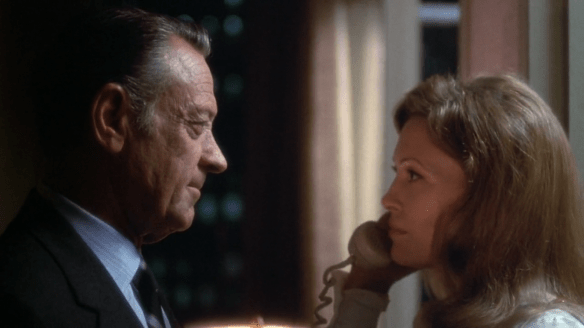
Max Schumacher (William Holden) is a remnant of television’s bygone era where men like Ed Murrow and Walter Cronkite were symbolic purveyors of truth in all facets of America. Maybe the nation was naive but at least they believed in something. Times have changed. Sensationalism and stories to stir up some form of controversy are of particular interest especially with Diana Christensen (Faye Dunaway) who aims to use such material to bolster the network’s abysmal ratings.

network 3.png

Meanwhile, abrasive big whig Frank Hackett (Robert Duvall) is tired of the news division’s lackluster performance, and he’s ready to instigate some new changes within the business conglomerate. Schumacher feels slighted as his former allies seem to crumble around him.

Now’s about a good time as any to introduce Howard Beale (Peter Finch). He’s one of Max’s best friends from the old days and due to plummeting ratings, he’s been given the axe. I never felt sorry for Howard Beale before because he’s so often lost in the shuffle of the movie. He’s used by not only the network but the film itself as a kind of diatribe. It seems like the man is all but forgotten.

Finch plays the role so pitifully at times and that becomes easily overshadowed by his attention-getting histrionics.  However, when he makes his initial announcement that he will take his life on air, in two weeks’ time, it’s very matter-of-fact. There’s little agenda to it. Here’s a man who’s lost his wife and now is losing his job after 11 years of service to the network. Soon he’ll have nothing.

The utter disinterest in his plight is what’s most striking when you look down the line of producers and behind-the-scenes employees who sit in the dark in front of the monitors chatting rather than actually paying attention to their anchor. Apathy seems to reign.

Simultaneously, Christensen is exploding with harebrained schemes of inspired lunacy that she seems all too serious about enacting, from a docudrama called The Mao Tse-Tung Hour to keeping Howard Beale on the airwaves. She’s the foremost proponent of angry shows to articulate the angst of the general public through counterculture and anti-establishment programming. That’s her agenda.

In this very way, Network is a film of bewildering disillusionment in the world full of crises and absent of reason and maybe even God. Howard is a voice to all those absurdities and when he calls B.S., he turns the heads of the entire country. It blows up but as any publicity is good publicity, Diana convinces her boss to keep the mad prophet on.

She positions Howard Beale as a prescient even messianic figure calling out the hypocrisies of the age. Her boss openly objects, “We’re talking about putting a manifestly irresponsible man on television,” which Dunaway promptly nods her head in response to. Maybe she’s a bit crazy in her own right.

Then, when the fad keeps on going and he’s now got people yelling out their windows or sending their grievances straight to the White House, Christensen is complaining that he’s too irascible, not apocalyptic enough, recommending some writers be brought on to pen some juicy jeremiads for him to spout off. In spite of the ludicrous nature of it all, the results speak. Soon Howard Beale’s antics have landed him 4th in the Nielsen ratings surpassed only by The Six Million Dollar Man, All in The Family, and Phyllis.

Hackett is deliriously happy about the success and becomes power-hungry. But as Beale’s sole friend still kicking, Schumacher can’t help but feel Howard’s being used, even as he himself gets involved with Diana (she harbored a girlish crush on him in college).

network 2.png

The film’s trajectory seems all but predestined. The fad of Howard Beale begins to wane and ratings go down with him. Max Schumacher’s job and then his marriage go down the tubes as well, all because of Diana. For her part, Diana is so completely consumed by her work that everything, even her personal life, works in scripts. However, the rendition of The Blue Angel that she’s unwittingly been playing with Max doesn’t end as she initially thought.

As a satire of the medium we know as television, Network certainly has few equals. Chayefsky spends a good spell of time orating off his soapbox as he does in many of his pictures. The ideas are there. The words are coming from voices and we’re taking them in, and they are spiced up with rhetoric and wit. If anything, one can marvel at his work even when it doesn’t take. It bears his mark.

The one thing about Network that is still harrowing today is the mere implications. Television was being considered an institution systematically destroying everything it touched through its manipulation and backstabbing industry practices. It only exasperates the situation by breeding a public that’s both vacuous and apathetic.

There is no call for human decency anymore. There are no true glory days. People are depressed, lonely, bitter, and helpless. If that all came to pass, theoretically, because of a box sitting in a family’s living room, 21 inches in size, that could be turned off, and had bad reception more often than not, what is the internet doing to us?

Now we’re in constant interface with our devices, warring for our attention and promising us comfort and convenience. Meanwhile, our ghost machines suck us dry. We’re shells of human beings. There are some figures in Network that I dislike, played most convincingly by Duvall and Ned Beatty. They seem opportunistic, crass, and merciless. But most everyone else of note I feel somewhat sorry for. The Max Schumachers, the Diana Christensens, and of course the Howard Beales. What did we do to deserve this madness?

4/5 Stars

Norma Rae (1979)

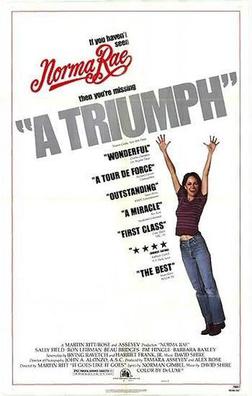
Norma_rae_ver2.jpgIf you had any trouble possibly liking Sally Field before — consequently, one of the sweetest actresses ever to cross the screen — then there’s little gripe to be had with her any longer. Norma Rae really does feel like a gift for her. Both as a story to be a part of and a character to portray since both speak to us intuitively as an audience. 
Marty Ritt offers a story that is as close a representation of his work as you might find — a narrative that’s not flashy but more importantly and yet still meaningful and chock full of human characters and conflicts. However, it’s not just sharing those elements for the sake of it. There is a rational impetus behind it all, setting out to shine a light on social grievances in order to enact some form of change. 

Again, he gets a script from husband and wife powerhouse Harriet Frank Jr. and Irving Ravetch who fortuitously helped define his career with stories such as The Long Hot Summer (1958),  Hud (1963), Hombre (1967), and this feature.

Its authentic inspiration stems from real life textile champion Crystal Lee Sutton, a worker in Roanoke Rapids, North Carolina. She spearheaded the unionization of her textile mill in an industry that has long held out against any regulation partially due to bullheaded leadership and ignorant lay workers who didn’t know any other life. There’s the arc in a nutshell. 

 Because Norma Rae (Field) is one of those people and she’s lived within a community of the very same folks all her life. Her father struggles to keep up with the strict regimen, her mother is losing her hearing systematically, and Webster has a couple young kids though she’s never officially married. As they might say, when she was a young woman, she knew a couple of men in the Biblical sense. 

Part of what makes her so likable is the trait of a genuine straight-shooter with the alacrity to do what she sees fit. When Reuben Warshowsky (Ron Leibman) sets up shop in town long-term, to try and get support for a union, most of the locals are wary of the outsider. Norma Rae asks him almost innocently, “Are you a Jew?” He responds in the affirmative and she responds that she’s never met one before. 

Though Reuben is a congenial fellow, he’s the definition of a fish-out-of-water, bred on New York society with a quality education, Dylan Thomas, and an attorney girlfriend waiting for him who his mother loves.

Ron Leibman does a fine job in the role because he doesn’t just play it charismatic and likable through every beat. He manages to skirt this fine line where there are genuine flashes of malice where we question Reuben as a person. Is he simply taking advantage of people or forcing others into a vision of what he thinks will be good for them? He even acts like a grade-A jerk and a bit of an instigator when he’s feeling up to it. 

Thus, Norma Rae grounds him as someone who does have a full stake in this fight, in this community, and this story. This is her job, her family, her reputation all put out in the open — all on the line and she’s willing to go for it. That takes true gumption and a fighting spirit few individuals can muster. Boy has she got it. She’s also capable of the southern cajoling that made men like LBJ such effective movers and shakers. 

However, the film constantly plays with this tension within her. Because she’s not a rich person by any means. When she’s given a promotion to a spot checker, her hourly rate goes up incrementally and she subsequently loses the respect of all her colleagues as someone who has gone to the enemy. The relationships mean more to her than the pay just as a better future has greater precedence over sacrificing her time and pouring heart and soul into Reuben’s cause.

Norma Rae also has a pulse of the ultimate good which is admirable. She goes to the local church — an all-white establishment — posing two questions to the reverend she has known all her life. First, asking if he would call her a Christian? He smiles and nods, with a lapse or two, yes.

But then, more pointedly, she asks if he would call himself a Christian? He’s still so caught up in the idiotic dogma that blacks and whites cannot mix. And yet for Norma Rae, the bottom line is there ought to be justice — and the church, if it’s really going to practice what it preaches, must be involved in this same dialogue.

It’s not always the words spoken but the images seen that leave a lasting impact. A funeral sequence in the rain. No words just a hearse being lowered into the ground inch by inch. The point is made better than any eulogy by man There’s Norma Rae transcribing an anti-union message on toilet paper to pass on to Reuben or the heart-to-heart she has with her kids to head-off any of the scurrilous slander they might pick up. There’s her furious struggle as two policemen try and drag her to a police car. 

Likewise, Field standing up with a cardboard cutout simply scribbled with the block letters “UNION.” She slowly circles around, resolutely, again and again. People notice her, stop for a moment of consideration and then all turn off their machines in a simultaneous act of solidarity and defiance. 

This particular sequence goes on for several minutes and the sequence is allowed to unwind wordlessly as we slowly hear the din grow progressively dimmer. It could have easily been cut down to its bare essentials and yet in this way the full brunt of the impact has been made apparent as we are forced to contemplate the full gravity. It’s an everyday action that takes on monumental dramatic importance. 

The same could be said when the ballots are read in consideration of the new union. It’s back and forth. The tension again is palpable but it’s the jubilation on the faces that captures me. In every one of these instances, Ritt gives the immaculate illusion he lets it happen. No tricks. No extra flourishes. Just all right there for us to be a part of. He’s at his best with human stories of fully realized people working through things of seemingly genuine importance. That is Norma Rae to a tee. 

4/5 Stars

Sounder (1972): A Family and Their Dog

sounder 1.png

In adolescence, you are inundated with stories about dogs. The Red Fern Grows, Shiloh, Homeward Bound, Ginger Pie, Marmaduke, Lassie, Rin Tin Tin, Air Bud, Snoopy, and Old Yeller. And that’s just the tip of the iceberg, off the top of my head. Sounder belongs to the same storied tradition based on humanity’s infatuation with canines which is certainly well-founded.

Except some will be surprised to find that this Depression-era tale brought to us by Martin Ritt is hardly about a dog at all. True, we are met with the eponymous hound dog right off the bat. What greets our ears is the bouncy staccato harmonica-twanging behind the visuals of a frantic tear through the underbrush that goes with the territory of a coon hunt. It’s an instantly recognizable image to introduce our characters.

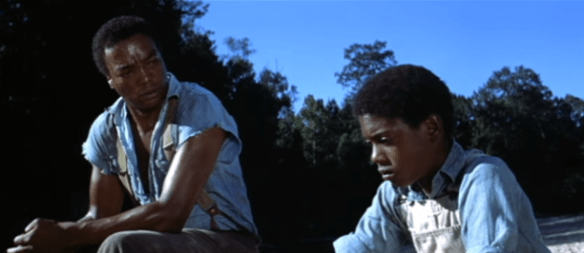
Not just Sounder but a boy named Henry Lee and his father, the jovial but hardpressed Nathan. The year is 1933 and we’re in Lousiana in the midst of the Depression. With society sectioned off as it is, as a black family, the Lee’s have been forced to scuttle through by sharecropping for a white farmer. It’s the fate faced many African-American families of the day.

They’re perpetually in debt, have trouble keeping food on the table, and live with the most meager means possible. All in all, with two parents, Nathan and his wife Rebecca (Cicely Tyson in a fiercely unvarnished performance), there are also three kids, and of course, Sounder.  Writer Lonne Elder III takes this atmosphere, the environment, and the family living within it and builds the framework of a story with great care and concern for their everyday reality. The plights and the joy that they still manage to have.

Taj Mahal, while also providing the film’s music, does a fair number in front of the camera as well as the energetic neighbor named Ike who drifts in and out of the story as he pleases. There are baseball games where Nathan Lee comes out the hero striking out his last opponent with runners in scoring position. From the local church, you can hear Gospel spirituals like “Old Time Religion” ringing out with fervor.

But in the same community, there’s a segregated schoolhouse and Nathan gets jailed and sent away for a year of hard labor for what seems like a trivial infraction. White men, including the local sheriff and the shopkeeper, will hardly budge an inch for a black man. That’s what seems so pernicious. Sometimes it’s not even outright violence but it’s this inability to change or have any amount of grace or understanding. There is no clemency to be had based on this rigid narrowmindedness.

When you begin watching more movies sometimes you fail to acknowledge those that are unpretentious and good-natured — the kind of stories that are meant for the whole family and wholly uplifting to the soul. Sounder is one of those movies. Surely there was a social hierarchy in place of oppression and de facto segregation. And yet around the nucleus of the family, there is a decency that pervades the picture and ultimately lifts it up. While it doesn’t completely eradicate ill-will, it does push it to the fringes of the frame.

Family reunions have never been so poignant — considering the moment where Nathan finally comes home after innumerable trials and his family has toiled and sweated day after day to hold onto their land. What they have in that instant is a small slice of heaven. It’s written over every face as the space between them rapidly fades away and they meet in an embrace that brings their world back together as it was meant to be.

But Sounder also manages to be a tale of empowerment for one lad in particular, young Henry Lee. The movie places people in his life who are willing to give him a leg up. There’s old Mrs. Boatright who is one of the few whites who will take any kind of stand — even a slight one — and she blesses him with things like The Three Musketeers.

It’s these people and books and knowledge that give a glimpse to a world of greater freedom and opportunity. An avenue to a life where people cannot keep you down no matter how hard they try because with ideas comes a power to think and to be your own person, set on improving yourself and the world as you go forward.

Yet another woman, a schoolteacher, takes an interest in Henry Lees improvement since she perceives the quiet wisdom that can be cultivated into something fully-realized. Her gift to him comes through education and elucidating him about figures like Harriet Tubman, Crispus Attucks, and W.E.B. Dubois — people who were shapers of history big and small — just as he has the opportunity to be.

Granted, it does feel as if the family’s pet is pushed to the periphery for much of the film, but in a way, it feels like a realistic depiction. He doesn’t need to be front and center. By their nature, if dogs are really man’s best friend, what makes them so meaningful has to do with their loyalty — they are always there — consistently reliable.

Because the life of an impoverished family like the Lees is the epitome of hardship. They need all the stability they can get. You will come to realize it is not really about a dog at all and certainly not one of those family-friendly films marketed as such because they feature some extraordinary, nearly superhuman animal.

No, Sounder is for the family because it takes care in documenting the realities of this particular family in a way that is thoroughly candid. It might still stand as faulty advertising but for the plethora of folks who are moved by the movie, they probably won’t be complaining when the credits roll. What we get is far better than a run-of-the-mill boy and his dog narrative. What I am reminded of is one subtle parallel. Sounder is winged by a shotgun when Nathan is taken away. He doesn’t come back for a long time. But when his wounds are healed, he returns good as new. There’s a startling resilience present in both the canine and the family.

4/5 Stars

Big Jake (1971)

Big_jake_ver2.jpg

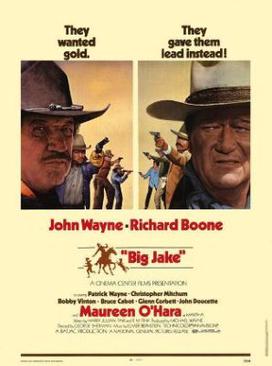
The film has an opening gambit that nearly feels unbecoming of a John Wayne picture and yet there’s something simultaneously quite riveting about it. You can’t quite take your eyes off of it, waiting to see what will come to pass.

Our narrator sets the scene in 1909 where, while the East is rising in a constant deluge of modernization, the West is still as ornery as ever. What follows is a full display of that reality as a band of thugs led by John Fain (Richard Boone) rides into a sprawling ranch with one thing on their minds.

There’s a sense that this late-period work from veteran director George Sherman, his last film, in fact, is well aware of Butch Cassidy and The Sundance Kid (1969) and The Wild Bunch (1969) generation and it readily ups the violent content. Although it is a modern western in this sense, there are still blatant signs of not only antiquity but the deep-rooted hierarchy of the West along ethnic lines.

With his good buddy from the early days behind the camera, John Wayne has another personal vehicle on his hands. There’s no doubting the centrality of his presence on the plot even if his entrance is delayed. The stock company is rich and deep as per usual but there is a myriad of young guns too and Duke had a habit of making his work a family affair.

Bobby Vinton gets a near token cameo while little Ethan Wayne becomes crucial to keeping the plot chugging forward as the thugs run off with the boy expecting a ransom in return for his life. Duke’s other two grown sons are played by Patrick Wayne and Bob Mitchum’s boy Christopher. Though not quite family, Maureen O’Hara makes a lovely appearance as the strong-willed ranch matriarch who has long been estranged from her husband Jake McCandles. The scenes with her longtime costar end in a blink of an eye but with such a meaningful cinematic history together they leave the necessary impression.

Like most of these later works, similar to a McClintock! (1963), Big Jake is unequivocally a must-see for the John Wayne faithful — people who could watch him in just about anything will find time to be heartily entertained.

It’s somewhat of a menacing western drama but there’s still ample room for a cheeky and rip-roaring good time. Big Jake, though more violent than some of Duke’s predecessors nevertheless has his mark of approval all over it. There are falls in the mud. He gets plenty of time to smack his sons around and also receives his share of wallops as retribution. Pulling buckshot out of backsides and dousing them with whiskey is all in a day’s work. And Duke is as vociferous as ever.

That’s what will get people to stay. Because it’s one thing about John Wayne that is rather refreshing. Like him or not, you know full-well where he stands and how he’s going to play it. Larger-than-life and tough-as-nails but with unquestioned integrity. I’m drawn to that like many others because I come from a wishy-washy generation. But far more than that, even if I don’t necessarily agree with everything he does, the Duke never seems to do something purely out of spite. Instead, he has some deep-seated convictions.

He plays Big Jake McCandles with his typical presence that knows few equals in terms of longevity or sheer durability. Wayne certainly understands how to command a room and while everyone else tries to upstage him no one has the gumption. Richard Boone is probably the only old-timer who has the wiles and the pedigree to try to steal his spotlight and he’s, of course, the ringleader of our villains.

Despite being a man who left his family long ago, McCandles returns on a moment’s notice to rescue his kidnapped grandson. He’s a no-good old coot but there is that aforementioned sense of moral integrity. He’s has a funny way of showing it but he cares about family.

The truth is, he sees out his objective with his typical dogged resilience laced with worldly wisdom and tenacity. The conflict spawns from one son who is rightfully bitter and another son who seems like he’s traded out the past for new-fangled gadgetry. In the end, it seems the tried-and-true methods prove most effective. Wayne is joined in the task at hand by his feisty canine named “Dog” and a veteran Apache tracker named Sam.

Elmer Bernstein’s scoring automatically evokes layers upon layers of added richness from any western scenery and he’s somehow able to perfect everything that is resplendent and majestic about this way of life. There’s a deep abiding understanding of what The West meant and what men stood for.

Their final destination comes in a bustling boom town with thugs milling about and everyone looking to get a hand in on the cash payload that the McCandles have hauled around in order to save their young kin.

We know it’s only a matter of time before things come to a head. Of course, Duke gives it a bit of a kick in the rear by instigating barroom brawls to rile up the masses as a quality distraction. The resulting payoffs are as expected and gut-bustingly uproarious. And of course, John Wayne gets the last laugh of all from inside the shower stall of a barbershop followed by a final showdown where every member of the McCandle clan gets their own chance at redemption.

There’s nothing cutting edge here but this is a story of the dwindling West and so when that’s what your story is about, I think it can be said that Big Jake succeeds in these modest regards. After all, it’s a self-selecting film because anyone who wants to see it will be satiated and anyone else probably won’t search it out anyway. John Wayne has that influence on people even today.

3.5/5 Stars

Review: What’s Up, Doc? (1972)

whats up doc 1.png

I’ve always been fascinated with individuals who have blurred the line between the film critic and actual contributors to the industry. Notable examples, of course, being the boys at Cahiers du Cinema, Frank S. Nugent, James Agee, Paul Schrader, even Roger Ebert, and certainly Peter Bogdanovich.

It’s this bridge between the intellectual and the actual practicality of the craft that seems so crucial. Because Bogdanovich might come off as an erudite individual who would end up making stuffy philosophical pictures. But What’s Up Doc is nothing like that. He loves the cinema and it shows.

Yes, this movie becomes a tossed salad of cinematic references and yet in the midst of the chaos, there is the finest rejuvenation of the screwball genre we’ve probably ever received. If neo-screwball were to be readily adopted in academic circles, you just might have to start the conversation here. It’s crazy; it’s destructive; it goes careening out of control. Maybe it’s just me, but I find it genuinely uproarious like a sprawling sitcom episode. It’s what the genre was made to be.

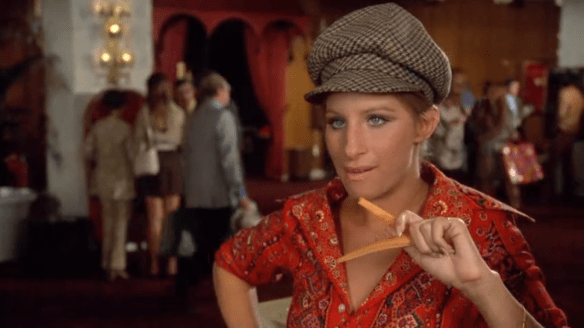
“You’re The Tops” plays, as the credits roll, sung by Barbra Streisand in a very casual manner that hints at the enjoyable jaunt we are about to undertake. Using the most basic terminology to break down the picture, What’s Up Doc is essentially a comic shell game. Except the shells are replaced with four identical plaid overnight duffles and the con is simultaneously being pulled on everyone on the screen and in the audience alike.

One bag holds the prized rocks of a musicologist Howard Bannister (Ryan O’Neal) who is traveling to San Francisco from his conservatory in Ames, Iowa to vie for the prestigious Larabee Grant. If he is lucky enough to reel in the award, it will help fund his research on the musical properties of igneous rocks. Don’t ask me to explain.

The other case comprises the possessions of one Judy Maxwell (Streisand). It’s not the contents of her bag as much as her whirlwind personality that will wreak havoc on the picture. Then, a third bag holds one lady’s prized collection of jewelry and the fourth holds secret government documents. Again, don’t ask.

But everyone seems to have a shtick. That’s a product of a screenplay crafted by Buck Henry, David Newman, and Robert Benton. There’s a repetition to the script’s comedic cadence that puts an indelible stamp on the material. Coming from such people like Madeline Kahn it can almost drive you insane while O’Neal is playing a stereotypical sterile intellectual type that generally goes against his well-suited image.

Still, with some people playing the film straight, or at least as flat and square as they come, it makes other people pop even more. Is that Barbra Streisand I hear? She drives us crazy but in a different way — arguably a much better one.

whats up doc 2.png

She throws the anal Eunice (Madeline Kahn) off the scent and winds up accompanying Howard to his important dinner to schmooze Mr. Larabee (Austin Pendleton) and outfox the competition represented by the snobbish Hugh Simon (Kenneth Mars). Alone Howard wouldn’t stand a chance but taking on the name Burnsy and masquerading as his fiancee, this intolerable girl who accosted him in a gift shop essentially wins him the grant.

Pendleton is an utter dork but there’s also something personable about him. He finds Burnsy to be just delightful and soon they’re on a first name basis. Howard’s trying to explain all the mix up as the real Eunice attempts to claw her way into the affair putting on a hissy fit. Meanwhile, Howard doesn’t know what to do because Burnsy’s got him all turned around amid the ruckus.

Various side plots continue crisscrossing as people sneak around the periphery involving the aforementioned travel packs. A concierge and the house detective are in cahoots to abscond with the priceless treasure trove of glittering gems. Meanwhile, a mysterious man is tailed every which way by another man saddled with a golf bag as a measly attempt at a disguise. It would be astoundingly absurd if we weren’t already distracted by everything else going on in front of us. As it is, these diversions only succeed in adding to the cacophony of it all. A perfect visual articulation comes in the form of a hallway lined with doors, leading to rooms, and the people inside.

whats up doc 5.png

It comes to an abrupt end when they all wind up in Howard’s room with one girl out on a ledge, his outraged Fiancee asking him to turn the TV down, and everyone else making a cameo appearance. What follows is the total annihilation of a hotel room suite, a fitting foreshadowing of coming attractions.

Even if it can’t quite reach the same heights, What’s Up Doc is unabashedly homage to Bringing Up Baby (1938). We have a man’s coat being ripped, dinosaur bones being traded out for rocks, and the similar antagonizing relationship between our leads. However, I didn’t realize that we also have much of the character dynamic from The Lady Eve (1941) because Streisand like Barbara Stanwyck before her has an incredible aptitude for manipulating her male conquest. Katharine was the whizzing hurricane of constant disaster. Stanwyck was whip-smart. Streisand channels a decent dose of both legends.

The Larabee Gala hosted at Frederick’s estate proves to be the beginning of the floor show as the camera leaps into action and the final act kicks into a frenzy of slapstick, flying pies, and all sorts of comedic violence.

This might be blasphemy, but as much as I admire Bullitt (1968), Bogdanovich’s film might feature my favorite car chase through San Francisco. It involves a famed giant pane of glass, wet cement, offroading down stairs, a Chinese dragon, and a big splash in San Francisco Bay among other visual kerfuffles. We even have a courtroom drama on our hands!

The laundry list of other references is nearly endless from Cole Porter to nods to Bogart and “As Time Goes By” in Casablanca. Ryan O’Neal even drops a fairly inconspicuous “Judy, Judy, Judy” in the airport terminal, no doubt a nod to Cary Grant’s misattributed catchphrase.

His plane is leaving to return him to his life of everyday tedium. But between in-flight Bugs Bunny shorts and one lethally pointed barb aimed at Love Story (1970), there’s also one final smooch. And we’re done. This is a movie you’re lucky to survive. It’s certainly laced with references, and, more importantly,  it’s a successful giggle fest. The screwball comedy proves to be alive and well in San Francisco.

4/5 Stars