Talk of the Town (1942)

0db8e-the_talk_of_the_townThis comedy-drama begins with a rather stark montage chronicling how the unfortunately named Leopold Gilg (Cary Grant) was accused of arson, murder, and finally imprisoned by one owner of a mill named Holmes. After escaping from prison and an imminent conviction, in a torrential downpour, the hampered Gilg seeks asylum in a nearby house. It just happens to belong to Miss Nora Shelley a local teacher in Lochester and an acquaintance of Gilg. She reluctantly allows the injured fugitive to hold up in her attic, but then her new tenant arrives a day early, the distinguished professor Lightcap (Ronald Colman).

After Gilg finally reveals himself to Lightcap as the gardener Joseph, what forms is an interesting triangle with the two men on the sides and Ms. Shelley in the middle. Both men take a liking to each other despite their difference in opinion on justice. Lightcap is much the academic and he goes by the book. “Joseph” on the other hand has a more practical approach.

It does not matter much until the professor finally learns Joseph’s true identity and now he feels it is his duty to report Gilg no matter his affinity for him. But after Gilg gets away once again, the professor is finally coaxed to look into the case that he has been so reluctant to involve himself in. Both men make concessions out of respect for the other. The professor involves himself, buys some borscht, and cuts his beard, while Gilg turns himself in. It almost drives Ms. Shelley up the wall with grief. You see she loves both of them.

In his final search, Lightcap finds something very interesting indeed. The town mob bursts into the courtroom as Gilg stands trial again, but the professor shows up with a surprise of his own. He ends up as the next Court Justice, a very happy man and Ms. Shelley and Gilg are very happy for him. They don’t have much to complain about either.

George Steven’s film has a bit of a contrived plot much like The More the Merrier. Things certainly feel set up, but that’s okay because the cast is so wonderful it makes the set-piece work. Jean Arthur is in top form when she is exasperated and sneaking about making little white lies as people file in and out of her home. Gilg seemed like a rather odd role for Grant, but he pulled it off with his usual charm and charisma. Someone else might have made Lightcap unbearably stuffy, but Colman’s portrayal is always tolerable and very often charming. This had a lot more drama than I was expecting, but it was not short on the comedy either. My only complaint is that it ran a tad long, but it just meant more screen time for the leads. That’s not so bad. They were The Talk of the Town after all.

4/5 Stars

The Bad News Bears (1976)

c75ba-bad_news_bears_1976The Bad News Bears is the quintessential sports movies about a ragtag group of misfits and losers. If there was ever a worthy heir to Charlie Brown’s club it was these fellows, but that’s not the end of it. Rome wasn’t built in a day, and the Bears pick up the slack after numerous drubbings. They somehow acquire Morris Buttermaker’s reluctant pitching prodigy Amanda (Tatum O’Neal), and their new star is town delinquent Kelly Leak (a boy who smokes cigarettes and rides a Harley). They begin to climb the ranks, and Buttermaker realizes his squad has a fighting chance to make it to the championship game.

Things become more and more competitive culminating in the final showdown against the hated Yankees, coached by Roy Turner (Vic Morrow). Buttermaker has recently become a hard-nosed jerk solely focused on winning, but he has a mid-game change of heart. He lets his boys play, clears his bench, and the results are good if not great. However, The Bad News Bears can be proud that they left their heart out on the field, and the Yankees will be going down the next year for sure. The most important thing is that they played together as a team with a lot to be proud of.

Walter Matthau has enough of the lovable grouch in him to make it work, although he does have the foul mouth to go with it. Amanda is the perfect counter for Buttermaker because they both have spirit and fiery impudence. O’Neal perfected the pout after Paper Moon (1973) and it’s still going strong here. However, she is not the only one. On a team that is populated by a few nerds and weaklings, there also are a share of sharp tongues and real potty mouths.

Carmen is a nice touch during the rout scenes,  and it makes me think they never heard of the mercy rule, but I guess it is the 1970s and we have to have drama after all. This is far from a kids movie, but it probably resonates with the many adults who played organized baseball as kids.

The film is a satire of American’s Pastime for this audience because even on the smaller stage of Little League the game often gets blown way out of proportion. It becomes a question of are we playing it for the love of the game or to win at all costs (even if it means family turmoil). Morrow’s character epitomizes just how far parents will go because they become so involved in the lives of their kids. Wanting to live vicariously through them, they push their children until they can no longer be kids, but must be perfect instead. The Bad News Bears choose to play the game for fun as it was meant to be played, and that is partly thanks to Buttermaker. They are not done yet though because there are still many more life lessons to be learned. I’m not sure if I said this yet, but this film actually made me laugh a lot since it began as a comedy of errors and only then did it turn into a satire. The comedy was certainly present, but not the most important.

4/5 Stars

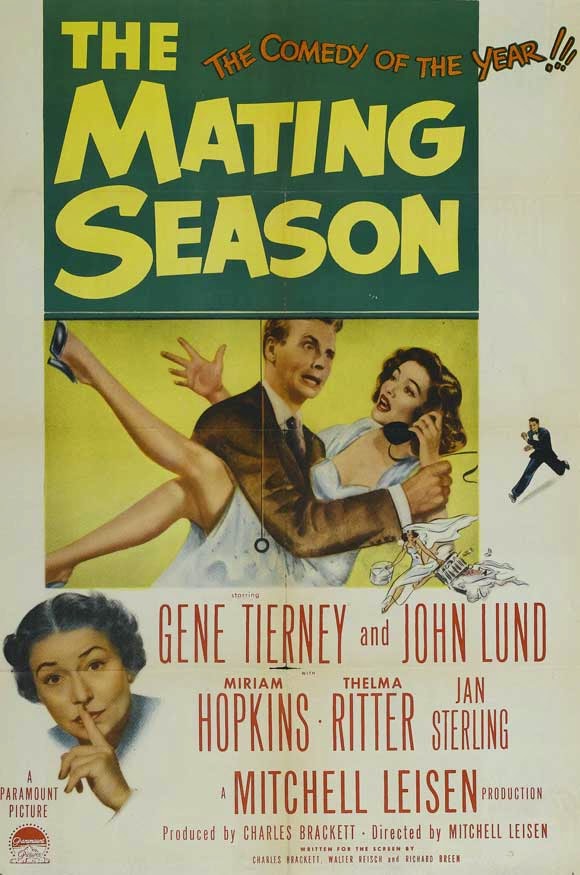
The Mating Season (1951)

b3d8e-the-mating-seasonThelma Ritter was always a scene-stealer, upstaging the stars, but perhaps it is no more evident than in this comedy starring Gene Tierney, John Lund, and Miriam Hopkins. She runs a hamburger stand in New Jersey, talks plain, and works hard. Her son Val McNulty is a college graduate and a kind, gentlemanly figure who also loves his mom for who she is.

In one of the fastest meet-cutes/courtships I have ever seen on film, Val marries the lovely socialite Maggie, a woman above him in status who falls for him, because he is nothing like the stuffy upper crust she is used to dealing with.
In a classic screwball type development of mistaken identity, Ellen McNulty arrives to live with her son after her stand was closed down. But when calling on the house she is mistaken for a cook, and she willingly plays along with the mistake in order not to embarrass her son. Imagine his surprise when he sees her and yet he does not explain who she is. She tells him to play along with the little deception and Val reluctantly goes along with it.
When Maggie’s own stuffy mother (Miriam Hopkins) comes into town, she disapproves of her daughter marrying below her and nothing will make her like Val. Just think what would happen if she knew who Ellen really was?
One evening the unlikely couple goes to a party held by the Kalinger Family who run Val’s firm. There Maggie is insulted and runs out of the party in a huff. The lady she has a spat with is a prestigious person, and Val forces her to apologize. Needless to say, the marital sparks fly. However, things heat up even more when Maggie finds out by accident who Ellen really is. Now Val has a lot of explaining to do and his wife feels lied to. She is furious that he would think her too proud to welcome in his humble mother. Maggie gets ready to leave for Mexico, a destination for attaining an easier divorce.
Interestingly enough, it is an unlikely outsider in Mr. Kalinger Sr. (Larry Keating) who gets the couple back together through a shameless ploy. However, they are not the only unlikely love story, he has a budding romance of his own.
Mitchell Leisen seems to be a little-known director, but after seeing this film I was quite impressed. This movie works because of the conflict in class and the complications and laughs that come out of it. It is this type of conflict that hearkens back to the scatterbrained screwball comedies of the 1930s. Perhaps it is a little hard to believe that Lund was Ritter’s son, but they had enough chemistry to make it seem plausible. It was also hilarious to see Gene Tierney struggling in the kitchen, and Miriam Hopkins was a decent inclusion playing Maggie’s opinionated and overblown mother. Call me plebian if you want, but I know which mom I would take…
4/5 Stars

Something’s Got to Give (1962)

e3ac1-somethings-got-to-giveWell, this is a first for me, if my memory serves me right. I have yet to do a write up for a film without having a rating to go with it. Something’s Got to Give eventually and now it has.

I honestly was surprised that this “film” even existed. I knew about Marilyn Monroe’s last film project which ultimately was unfinished thanks to her tragic death. I assumed the project was ditched and never thought about again. I certainly did not give it a second thought then. Then, quite by accident I came upon it in all its 37 minutes of glory. Apparently others had given it a second glance and we have them to thank for this unfinished addition to Montroe’s filmography.

It looks like production quality with a few missing parts and quite the cliffhanger ending. We do not even quite know the extent of the cliff yet.
However, it was an interesting look at Marilyn Monroe in her final days. You also had a fun cast of handpicked players including Dean Martin, Cyd Charisse, Phil Silvers and Wally Cox. Not to mention one of Hollywood’s prominent directors in George Cukor. It seems likes all the makings for a light ’60s romantic comedy.

This certainly was not going to be a masterpiece (It was actually a remake of My Favorite Wife (1940) and was given a face lift for Move Over Darling). That’s okay. It is a interesting piece of history in its own way.

Rating: N/A

The Women (1939)

6cabb-poster_-_women_the_01Starring a cast including Norma Shearer, Joan Crawford, Rosalind Russell, Paulette Goddard, and Joan Fontaine, this film is all about the lives of these women. Mary is a member of New York high society who is happy with her marriage. However, when her gossipy friends begin to talk about her husband with another women she is hurt. She eventually  files for divorce and while waiting for the conformation in Reno she meets some new friends and is finally able to find a way to get her husband back. Needless to say the ending is happy and a few women get what they deserve. This film had an enjoyable introduction, a sequence in Technicolor, and an all female cast. Most of all it characterizes the various women in this walk of life. Some are kindly, others foolish, and still others are treacherous.

4/5 Stars

Review: Butch Cassidy and the Sundance Kid (1969)


Not that it matters, but most of it is true…

The film opens with some old sepia-toned footage of a notorious gang from the turn-of-the-century and that is when we meet our two anti-heroes Butch Cassidy (Paul Newman) and the Sundance Kid (Robert Redford). Butch is the brains behind the operation (I got vision and the rest of the world wears bifocals) and Sundance is the brawn, with the most accurate gun in the West.

They make a living robbing banks and trains, but due to their lifestyle, they seldom come out ahead. Life becomes more difficult with tumult within the gang, a crackdown by the authorities and a price tag on the heads of Butch and Sundance.
Soon it becomes evident that their life of crime will never be the same with a professional tracker on their tails and a posse formed to see them hang. They are chased through hills, rock, water, and the like before finally getting away in one final desperate attempt at escape.
With one last brilliant piece of inspiration, Butch decides they should head for Bolivia to lay low, and soon enough they pack their bags and bring along The Kid’s girl (Katharine Ross) to the promised land of South America. They get more than they bargained for thanks to the language barrier and a lack of decent plunder. However, even abroad, their legend grows, winning them the new moniker “Banditos Yanquis.” The pair takes a stint on the right side of the law for once, but it somehow seems bleaker than their early days as bandits. It is evident that the hourglass is running out on them. And so it does, but not without one final glorious battle to cement the aura around two legends of the West.
I will not go so far as to call Butch Cassidy and the Sundance Kid a masterpiece because I have read too many reviews to know that there has been a great deal of division over the film. I can only speak from my own experience when I say that I quickly grew to love this story. This appreciation stems from the spot on chemistry of Paul Newman and Robert Redford. Their outlaws are not your typical thugs but lovable buffoons you cannot help but cheer for through all their screw-ups and pratfalls. Paul Newman has his ever-present mischievous smile plastered on his face, and Redford plays the cool and collected Kid to the tee. Perfect casting for the roles and to think it might have been Steve McQueen and Warren Beatty.
 
They got together again in The Sting, which was another good film, although I will always be partial to their first collaboration. William Goldman’s script can only be described as a fun romp that accentuates the comradery of Butch and Sundance. The musical score by Burt Bacharach with the inclusion of “Raindrops Keep Falling On My Head” is often at complete odds with what we have come to expect with classic westerns, but that suits the film just fine.
 
You see this is not your typical western by any means. It’s not supposed to be. Butch and Sundance are working in the twilight of the West. The horse is soon to be replaced with the future: the bicycles. Bank vaults are becoming more complex, fervor for the Spanish-American War is at its peak, and lawlessness is no longer going to be tolerated. Whether people realize it or not, this film is one in a final wave of classic westerns that finally petered out in the 70s. Now the western genre, just like the West before it, is dead. A dying breed of genre much like film-noir or even musicals.
 
That’s why Butch Cassidy works for me. People have criticized the constant change in tones, but this story never claims to be the absolute truth, and it would not be the same film if it did. This story of outlaws is not a history lesson but a legend about two infamous bank robbers. There are moments where we love these antiheroes and moments where we do not know quite what to think of them. They become disillusioned and beaten down by the changing times. Their ambush in Bolivia has only one apparent conclusion. It ended in a bloody and violent death. However, we do not have to see that for the sake of the legend of Butch Cassidy and the Sundance Kid. In one mythical moment, they regained their previous status. They went out as they came in, and they will forever be remembered as Butch and Sundance of the Hole in the Wall Gang. They have since been replaced by superheroes on the silver screen, but in their day and age, they were the original supermen — tarnished as they were.
What is amazing is that the film has not only resonated with audiences for generations, but with the leads themselves who really identified with their roles. That is perhaps the greatest compliment to its characters. 

5/5 Stars 

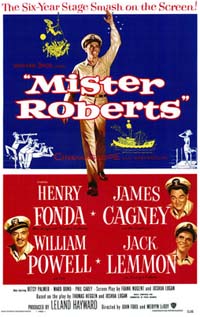
Mister Roberts (1955)

Starring an all star cast including Henry Fonda, James Cagney, William Powell, and Jack Lemmon, this comedy-drama chronicles the happenings on an unimportant boat during World War II. Mr. Roberts (Fonda) is one of the officers on The Reluctant and he is good to his men but constantly at odds with the difficult captain (Cagney). The ship doctor (Powell) is a kind and sagely old fellow while Ensign Pulver (Lemmon) is spineless, lazy, and still somewhat likable. due to an agreement with the captain, Roberts loses the respect of his men. However, when they realize what he has done for them, they honor him and help him get transferred so he can see some action. Pulver who is happy for Roberts, had tried to impress him earlier. After some bad news Pulver finally does something and it is fearless. I enjoyed this film because of the cast and its good combination of drama and comedy.

4/5 Stars

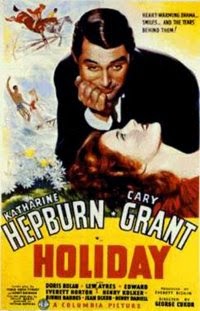
Holiday (1938)

2c3de-holiday_posterJohnny Case (Cary Grant) is a happy go lucky fellow who is crazy in love with the girl of his dreams. He returns to town telling his friends the Potters that he has plans to marry this girl he met 10 days ago at Lake Placid! He is ecstatic and not afraid to show it.

However, he must become acclimated with her family and their lifestyle. Most important is gaining the approval of her sometimes stuffy and always money-minded banking father. Julia Sefton is by all accounts a lovely girl who seems to truly return Johnny’s affection. Honestly, though he is not quite used to her type of society. He makes his entrance by arriving through the servant’s door and wanders around the stately manor marveling at all the trappings. Doing the rounds he runs into her drunken but genuine brother Ned (Lew Ayres). Then, there is sister Linda (Katharine Hepburn), the so-called black sheep of the family, although her only fault is being an energetic free-spirit.

Immediately she and Johnny hit if off, and she soon realizes that her sister has a real catch on her hands. The wedding is finally agreed upon by Mr. Seton, and a big New Year’s Eve Party is thrown much to Linda’s chagrin. The night of the big to do there are two parties that take place. Downstairs all the snobs and high society mingle with Julia parading Johnny around. Upstairs is a different matter where the quarantined Linda is eventually joined by the Potters,  Ned and even Johnny.

The little gathering gets quashed and that is not all. Father and daughter are adamant that Johnny works at the bank and make money because that’s what any respectful husband would do. They take little heed of Johnny’s dream to take a holiday once he has raised enough money to live off of. He just wants to live life free of distractions for awhile, but they just do not understand. Finally, Johnny is feeling too restricted by all the obligations to bear it any longer, because he simply cannot live that way. Again, both father and daughter do not understand. But Julia does, and she finally realizes what she must do. It’s time to take a holiday.

Here is a formidable trio in Cary Grant, Katharine Hepburn, and director George Cukor. It makes me beg the question, how this film has become so overshadowed by Bringing up Baby and The Philadelphia Story? Johnny Case is a wonderfully vibrant role for Grant, and his acrobatics alone are worthwhile viewing. Hepburn on her part plays an equally spirited individual but without the scatter-brained or feisty edge that she often carried. Instead, she is just wonderfully footloose and fancy-free. Edward Everett Horton and Jean Dixon are an absolute riot, and I would love to have friends like them. Lew Ayres role was rather an odd one, but both Doris Nolan and Henry Kolker had an adequate amount of stuffiness to pull off their parts. That juxtaposition was necessary for the film to work and it did.

4/5 Stars

Review: City Lights (1931)

 86b16-charliechaplincitylights2A comedy romance in pantomime. That’s just exactly what City Lights is, because, despite the fact that talkies had been around for approximately 4 years, Chaplin was hesitant to transition his Tramp over to sound. In many ways, I can understand why since the universality of his character would be gone and Chaplin’s own voice would give a very different feel to the little man. With his great popularity and artistic control, Chaplin made this film and Modern Times without dialogue. All he used were synchronized sounds and musical scores. As audiences can attest to, it worked out just fine for him.

This film opens with the Tramp in all his glory sleeping on a statue during its public unveiling. He is rudely awakened and shooed off on his way. He drifts down the boulevards finally meeting a lowly flower girl, showing her kindness before moving on. Although I am partial to Paulette Goddard, Virginia Cherrill plays the blind girl believably and she is a wonderful love interest for Chaplin’s character.

His next acquaintance is a drunken millionaire (Harry Myers) bent on committing suicide. His attempt is unsuccessful partially in thanks to the Tramp. He even gives the man a few positive words as is his custom (Tomorrow the birds will sing, be brave, face life!).

And there you have it. Chaplin introduced his audience to the two people who would be closest to the little man. The two new chums head to a high society hang out where they nearly get in a fight over everything from a bottle of seltzer to a chair, and even the floor show.

The Tramp goes back to the girl, and as another act of kindness he purchases her whole basket of flowers for $10 and continues to masquerade as a high society swinger. As the next title card reads, the sober dawn awakens a different man. Thus, The Tramp is initially rejected by his friend from before, but the drunken millionaire gets reincarnated once again and they begin a wild rager. The next morning the cycle begins again with the Tramp being thrown out.

The Little Man has taken it upon himself to be somewhat of a guardian angel for the blind girl who has become his love. Money is needed if she wants to have a home, and despite getting fired from his job, he resolves to get the funds the next best way. In a boxing match. This is where my favorite sequence, which plays out in the ring, comes to fruition.

The Tramp is seemingly outgunned, but that does not stop him from duking it out. He uses the referee, hugs, and anything else at his disposal to try and not get clobbered. The scene had to be choreographed extensively because at moments it looks just like a dance perfectly synchronized between the three characters. The so-called dance becomes even more uproarious when he begins to tackle his opponent and then unknowingly takes out the ref next. The fight seems even with each man falling down repetitiously as the ref tries to say the count. Unfortunately, the little man cannot hold out and he loses the pot.

One final time he runs into his millionaire friend just back from Europe, and he gets the much-needed money for his girl. Matters are complicated by burglars and a misunderstanding with the police. All works out in the end and the flower girl has her home and enough over to get a surgery to allow her to regain her sight.

Chaplin’s character pays the cost though, winding up in jail because of the “stolen” funds. When he gets on the outside he is more destitute than ever, but the girl’s business is now flourishing.

He runs into her and eyes her happily. Little does she know who this man is. This is not the debonair gentlemen she was expecting. She laughingly proclaims, “I’ve made a conquest.”

Only when she touches his hand by chance, reverting back to her old self, does she comprehend who this really is. This is her savior, the one person who radically changed her entire life. He is dressed in tatters and barely has a penny to his name. But he did have kindness and compassion for her.

A lot has been said about the final moments of the film where she has her “aha” moment, and he responds accordingly. What strikes me is how Chaplin so effectively reveals the nervous charm of his character. His fingers are constantly near his mouth, flower in hand. He states the obvious (You can see now). Then, the film closes with his face lit up with another nervous smile, fingers still in mouth.

It is hard to say where the story goes from this point. That’s not the important part here, though. The important part is that in both of The Tramp’s relationships his two friends cannot see who he truly is. The girl is physically blind and the millionaire is blinded by his stupor. They easily accept him in certain circumstances and yet they truly do not know him.

He, on the other hand, seems to accept them no matter the person they are at that moment. He is faithful and compassionate to them in all circumstances. It seems that perhaps the Tramp truly knows them because he is not blinded like they are. Again, I marvel about how so much can be pondered thanks to the actions of an unassuming vagabond. He is a remarkable little man with a very big heart.

5/5 Stars

The Band Wagon (1953)

4c8bf-the_band_wagon_posterGoing into this film I must admit that despite hearing good things, I had zero expectations. I must say I was pleasantly surprised by this Minnelli musical because it was a deft and often beautiful production. Channeling the same vein as Singin’ in the Rain and The Red Shoes, this film is a spectacle in its own right. You have headliners Fred Astaire and Cyd Charisse matched nicely. Oscar Levant and Nanette Fabray act as wonderful comic relief as the wedded playwrights, who also do some song and dance. Finally, there is Jack Buchanan, as the stereotypical theater maestro Jeffrey Cordova.

It all begins with Tony Hunter (Astaire) a washed up has-been who is headed to New York for some relaxation. There is little fanfare during his arrival except coming from his friends the Martons, who have a new production for him to star in. They get the famed Cordova on board and next comes an up and coming choreographer and his girlfriend, who is none other than the young starlet Gabrielle Gerard (Charisse)

Following an initial misunderstanding, the leads finally clear up their differences and push forward to make The Band Wagon the smash hit it is destined to be. However, Cordova has turned it into a modern-day Faust and when opening night comes the after party is more like a wake.

All the players seem strangely nonchalant and then the idea hits! Make The Band Wagon over again and take it on the road. Everyone in the cast from the bottom up is excited for the second chance with Hunter at the helm. All that is except choreographer Paul Byrd.

Despite Paul’s departure, Gaby is still enthusiastic and they turn the Band Wagon into the production that the Martons had envisioned from the beginning. Tony is a success once again, and he receives a round of rousing cheers from his new family. Gaby speaks for all of them (and herself) when she says they love him and believe that the show will go forever.

I immensely enjoyed many of the numbers including: “Shine Your Shoes,” with the camera following Astaire as he frolics around at an arcade with a shoeshine man. The extras, the exquisite set, and Astaire himself all culminate in an often comical and always upbeat number that is great fun to watch. Then, of course, there is the ever memorable “That’s Entertainment,” which even spawned a series of musical documentaries, and for good reason. The words and melody are quite a catchy ode to the stage. Perhaps the most beautiful sequence in the film involves Astaire and Charisse in “Dancing in the Dark” where they positively glide through Central Park together in perfect cadence. They move not as individuals but as a poetic unit in motion. It is fitting that it was their first dance together in the film.

For never seeing Cyd Charisse in another film (except briefly in Singin’ in the Rain), I must say that I really did enjoy her performance opposite the always likable Fred Astaire. Furthermore, I am in complete agreement with her character, “I don’t think a dancer should smoke,” it’s bad for the lungs.

The cameo of Ava Garner was an odd surprise (especially due to her resemblance to Charisse). Furthermore, I never thought it could exist, but this film proved me wrong. There is such a thing as a film-noir musical! That’s The Band Wagon for you folks! That’s Entertainment!

4.5/5 Stars