Review: On The Waterfront (1954)

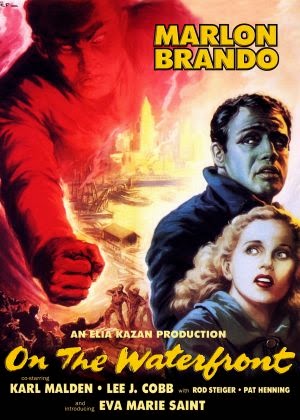
8542a-on_the_waterfront_poster“They always said I was a bum, well I ain’t a bum Edie.” That is what washed up prizefighter Terry Malloy (Marlon Brando) must try and prove to himself and others for the entirety of this crime-drama. On the Waterfront is ultimately his story of conscience and redemption that we watch unfold. It’s not pretty, but you’ll soon see for yourself.

Living on the waterfront is a tough existence. The mob decides who works and who won’t. Longshoremen are expected to be D & D (Deaf and Dumb) or else they have something coming. That’s how big shot Johnny Friendly (Lee J. Cobb) and his boys can run the entire area. They utilize fear and money to keep the working masses at bay. No matter what police or the crime commission might try to do, they have no hold on the waterfront. It’s a jungle out there and if you want to survive you look out for number one, don’t ask questions, and live another day.That is Terry Malloy’s philosophy and it suits him just fine. His brother Charley is Friendly’sright-handd man and he’s made a good life for himself thanks to his brains. Terry is more brawn than brain, and he does what his brother says. One night he blows the horn on a young man named Joey because he called out Johnny Friendly. That same evening Joey is knocked off, literally. Terry tries to justify it. He only thought they were going to “lean on him” a bit. With that incident begins Terry’s inner battle.

The moral compass of the film is supplied by two people. Edie Doyle (Eva Marie Saint) returns to her town from school with her beloved brother Joey now dead. She cannot understand why no one else will speak out about it or do anything to carry his cause. It is ultimately Father Barry (Karl Malden) who does just that realizing that his parish is the waterfront. He must fight against the injustice of the mob and hope others will join him. It’s a tall order. At the first meeting he holds in the church, a window gets busted, and thugs wait outside for people to beat up on. Terry was sent by Johnny to check it out and it is there that he meets Edie. He is immediately taken by her, and she warms to him. She sees him differently than the others without knowing what role he had in her brother’s death. The Father and Edie encourage Terry to testify at the crime commission after another man is killed in an “accident.”

Friendly can’t have a canary and its Charley’s job to straighten out his brother. That’s when they take their fateful car ride. Terry spill his guts (I coulda had class. I coulda been a contender. I coulda been somebody, instead of a bum, which is what I am, let’s face it. It was you, Charley.) and Charley responds the only way he knows how. He saves his little brother who he has always looked out for and pays the price.

Now Terry has his reason to testify and soon enough he goes before the crime commission to call out John Friendly. He has broken the waterfront code and gone canary. All respect for him is gone and Friendly wants his hide, but Edie is overjoyed in him. Finally, Terry has left the shackles on the waterfront and freed his conscience. He confronts the big man himself and is beaten to a pulp. But as Father Barry says he may have lost the battle, but he won the war.

Before getting to Brando, I must acknowledge the other players for their stellar performances. Eva Marie Saint is just that, a saint, and she gives a heartfelt performance as Edie. It is her love and care that leads Terry to turn himself around because she sees a little piece of humanity left in him. Karl Malden has perhaps one of his finest roles as the Father who represents a man of the faith remarkably. He is no joke, and he does not cave to hypocrisy. His waterfront sermon is one of the most powerful moments:

“You want to know what’s wrong with our waterfront? It’s the love of a lousy buck. It’s making the love of the lousy buck – the cushy job – more important than the love of man! It’s forgettin’ that every fellow down here is your brother in Christ!”

However, Rod Steiger’s poignant scene with Brando in the car is similarly extraordinary, because he realizes where he has failed. He does not need the words. He just stays silent, and we see it on his face. He is the one who pays for the mistakes, though, and he is far from a bum. Then, of course, there is Marlon Brando himself. He is often hailed one of the greatest actors of all time, but he usually played corrupt undesirables or rebels. Terry Malloy is perhaps his best role, and he is the good guy for once. He must struggle to do what is right by him, and he must struggle to prove himself to others. Brando plays him with some much genuineness, heart, and vulnerability at times. He is far more than the brusque meat head we take him for initially.

Elia Kazan was a champion of hard- edged dramas especially in the 1950s and he never succeeded more so than with this film. The black and white cinematography with perpetual fog drifting in fits the dire mood nicely and Leonard Bernstein’s score further compliments the drama. This is a fine example of Classic Hollywood cinema which was praised back then and lauded now. Our fake blood may have gotten better, but otherwise, it’s hard to top this film.

5/5 Stars

Review: 12 Angry Men (1957)

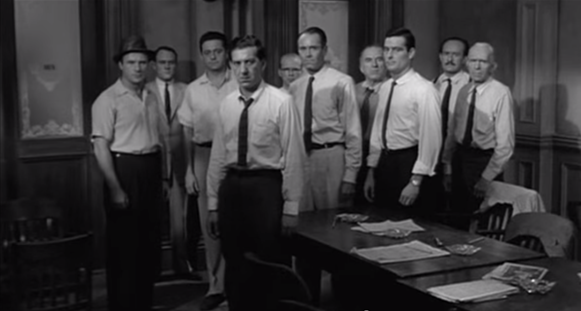
ebd81-12angrymen1With a title like 12 Angry Men you might come away with the false idea that all the characters in this film are the same, emotionally and otherwise. That is far from the truth. The reason a film like this stands up even today is because the fellows who sit down around that table are everymen that each and every one of us can relate to in some way. Yes, they are all male and all white, but they reflect little bits of us and our own humanity.

But getting down to the specifics, what is 12 Angry Men really and truly about? If you want to break it down, all it boils down to is 12 men gathering in a room to talk out a murder case. It sounds pretty dull and it had the potential to be so. In fact, calling it a courtroom drama is partially a misnomer because we hardly spend five minutes there before the jury is deliberating. We see the members of the jury, hear the final statement of the judge, and get a last look at the young defendant.

What comes next is the beginning of the decision-making process and seeing as it looks like an open and shut case, an initial vote is called for. If everyone agrees, this boy will be sent to the electric chair for killing his father. The vote is taken and it is 11 to 1 with one man holding out. Juror Number 8 (Henry Fonda), an architect, cannot bring himself to send the boy off without talking some more and so, begrudgingly, they do talk.

That is where the true heart of this film comes out, through the discussion and back and forth of the characters. They get around to evidence like the switchblade which the boy supposedly dropped. There were two witnesses: One being an old man living downstairs and the other a middle-aged woman who lived across the train tracks. Then, there is the business about the boy’s flimsy alibi about going to the movies. All are hotly debated and quarreled over.

It just happens to be the hottest day of the year and about an hour in it starts pouring cats and dogs. Tempers reach their apex, feelings are hurt, and major prejudices are revealed. The beauty of this film is not simply the sentiment that the jury switches its decision. The beauty truly comes from this wonderfully colorful ensemble of actors under the direction of Sidney Lumet in a confined space. But before mentioning the direction it is important to acknowledge the players because they are the heart and soul of this story.

Juror # 1: (Martin Balsam) He is the foreman who moderates, and he tries to keep the discussion civil with a relatively calm demeanor. All we know about him is that he is an assistant coach for a high school football team.

Juror # 2: (John Fielder) He is one of the younger members of the jury and a quiet individual with a timid voice. He is a banker.

Juror # 3 (Lee J. Cobb) The main driving force of conflict, he holds out when everyone else switches their vote. He is a businessman who also has familial issues with his son that come into play.

Juror # 4 (E.G. Marshall) A rational and measured broker, he holds that the boy is guilty until some facts are laid out that make him think otherwise.

Juror # 5 (Jack Klugman) A meek man and Baltimore baseball fan who also has a fiery side as well. It comes out that he grew up in the slums when he was a kid.

Juror # 6 (Edward Binns) A straightforward and kindly painter who is respectful in his conduct.

Juror # 7 (Jack Warner) The jokester of the group who makes his living selling Marmalade. He is looking forward to a Yankees baseball game and tries to push the proceedings forward as fast as possible.

Juror # 9 (Joseph Sweeney) The eldest member of the jury and the first to side with Juror # 8. He has a fighting spirit and also some thoughtful observations on the case.

Juror # 10 (Ed Begley) A loud-mouthed older man with a penchant for insults and unsavory remarks about foreigners.

Juror # 11 (George Voskovec) He is a watchmaker and the foreigner in the group. However, he is obviously quite intelligent and passionate about American democracy. He takes seriously the duty that comes with being a juror.

Juror # 12 (Robert Webber) Lastly comes the wisecracking man in advertising who tries to lighten up the conversation. He is the major flip flopper in the group.

A mention now must be made of Sidney Lumet’s direction, because for his first film he was extremely bold to film it essentially in one room. He does it so wonderfully, however, because the confined space only heightens the drama thanks to his progressive change in camera angles. They start above eye level and slowly get lower as the drama increases. He is very rarely stagnant either, having the camera on the move or cutting to different characters. A great example of this is the tracking shot as the jurors enter the room. We are introduced to almost every character in such a fluid, natural way that sets up the story nicely.

There is so much else that could be said about Fonda’s performance and individual actors who I admire, but I will leave this discussion by saying that this is one of the greatest ensembles I have ever seen brought together. The intensity they created makes me want to get up right now and serve on a jury. Too bad I already served my jury duty this year!

5/5 Stars

The Roaring Twenties (1939)

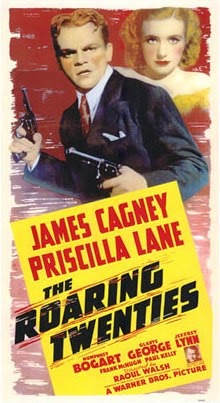
e08f7-the-roaring-twentiesHere is a retrospective gangster film reminiscing about the Jazz Age and Roaring Twenties extending from the post WWI period  of prohibition to the election of FDR.
Two mainstays of the genre including the original gangster James Cagney and hard-boiled Humphrey Bogart star as two men in a group of three soldiers who meet during World War I. In the ensuing years Eddie Bartlett (James Cagney) initially has difficulty getting back into society, but after meeting Speakeasy owner Panama Smith (Gladys George) he finds himself climbing the ranks in the bootlegging business. Soon through grit and a ruthless drive Eddie makes good racketeering by utilizing taxis with booze to make it big. 

Through it all Eddie becomes smitten with a young singer he used to know when she was a young girl (Priscilla Lane), except she does not share his affection. Pretty soon his ol’ buddy George (Bogart) comes back into the picture, with a some shifting dealings of his own. Eddie practically runs the town now but when the Crash happens he gets pushed out by George and now Jean is off and married to her lawyer beau. Eddie is a washed-up taxi driver still hanging around Panama and he has time to do one last favor for Jean.

This is one of the last great gangster films of the 1930s following in the wake of other Cagney classics like The Public Enemy and Angel with Dirty Faces. Raoul Walsh directs this film and it develops as another dynamic, action packed film with a lot of drama and heart thanks to Cagney and George. It is however different from previous gangster flicks in that it plays out as a history although it keeps the nitty-gritty look of the previous films. Like Angel with Dirty Faces especially, there are also some sentimental moments because Cagney is not a complete scoundrel, just mostly. Not wanting to continue being typecast Cagney took a break from the genre not coming back until White Heat in 1949. He did pretty well for himself during the 1940s though with performances in The Stawberry Blonde and Yankee Doodle Dandy. There was another fellow who did not do too bad in that interim period either, new found leading man Humphrey Bogart.

“What was his business?”
“He used to be a big shot.”
 
4/5 Stars

The Big Sleep (1946) – Film-Noir

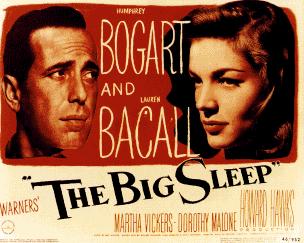
e3d1f-bigsleep2This noir, crime-drama starring Bogey and Bacall with director Howard Hawks, follows private eye Phillip Marlowe (Bogart) in Los Angeles. His difficult and ever changing case has him interrogating every one under the sun and following every lead. In typical Bogart fashion, Marlowe is a tough guy who does not shy away from danger and he has the eye of many a woman. What starts off as a normal case quickly turns deadly, setting the plot off. The constant twists and new characters complicate Marlowe’s case and get him in numerous messes. However, thanks to his grit and wit he comes out on top, falling for the girl, and overcoming his adversary. One word that sums up this film is incomprehensible. Despite the confusion with the plot, this film is very enjoyable and seems to work itself out.

4.5/5 Stars

In honor of Lauren Bacall

Dark Passage (1947) – Film-Noir

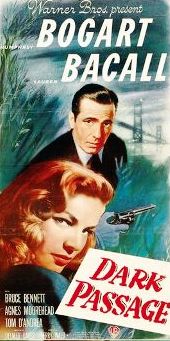
74b1d-dark_passage_film_posterStarring Humprey Bogart and Lauren Bacall, the film opens with a man escaping San Quentin prion for supposedly killing his wife. Along the way he is helped by a sympathetic young artist, a friendly cabbie, and a plastic surgeon. He must evade the police while getting mixed up with another murder and some nosy people. Ultimately, he does find the actual killer but he has no way of proving it. He flees to South America where he is finally reunited with his love. This film is memorable for being shot from Bogart’s perspective early on. It makes good use of San Francisco scenery and some of the supporting characters are enjoyable to watch. However, the film’s ending seemed anticlimactic and abrupt without any real closure.

3.5/5 Stars

In honor of Lauren Bacall

Key Largo (1948) – Film-Noir

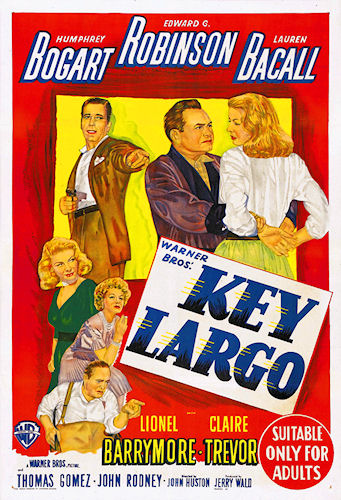
5b446-key_largo432Starring Humphrey Bogart, Edward G. Robinson, Lauren Bacall,  with director John Huston, the film takes place on a sweltering day during the hurricane season. Bogart is passing through Florida to say hello to the relations of a dead war buddy. In the process he and the others at the hotel are held hostage by the mobster Johnny Rocco (Robinson). Bogart seems to back away from conflict but he is only biding his time with the villainous gangster. Through a series of events the war veteran is supposed to pilot the mobsters to Cuba, however he ultimately turns on them and brings justice. This is a fairly good film with Lionel Barrymore, Claire Trevor, and Jay Silverheels in support. It must be mentioned that this was the final film pairing of Bogey and Bacall. Get ready to sweat it out in Key Largo.

4/5 Stars

In honor of Lauren Bacall

To Have and Have Not (1944)

1b537-to_have_and_have_not_1944_film_posterStarring Humphrey Bogart, Lauren Bacall, Walter Brennan, Hoagy Carmichael, and with director Howard Hawks, this film is very reminiscent of Casablanca. On the small Vichy-controlled island of Martinique, a hardened seaman spends his days steering his boat and his nights at the local hotel. The French resistance stir up his life by asking for his help but he refuses. Everything changes however when he meets a mysterious young woman (Bacall). Their playful banter eventually leads them to a mutual affection. Wanting to help his new found girl get home, Harry Morgan finally does agree to help the French and in the process he shows his true colors. Cementing Bogey and Bacall as a star couple, and immortalizing a certain line about how to whistle, this film is a good one. It has everything you come to expect with Bogart and it gives you something special in Bacall.

4/5 Stars

In honor of Lauren Bacall

Some Like it Hot (1959)

54e4b-some_like_it_hot_poster

Often considered one of the greatest comedies of all time, this film is certainly hilarious and special. This was one of Marilyn Monroe’s best performances, and her costars were absolutely brilliant. As far as humor goes it cannot get much zanier and crazier than this.

*May Contain Spoilers

In this Billy Wilder directed comedy, Tony Curtis, Jack Lemmon, and of course, Marilyn Monroe teamed up in making a great movie. In the era of Chicago gangsters, two male musicians witness a shooting that they wish they had not. In order to escape, they join a traveling band. The only catch is that it’s an all-women group, and so they get dressed up to win the job.

The rest of the film follows their crazy cross-dressing antics with the band as they spend their time at a beach resort in Florida. It includes two tremendous love stories on completely different ends of the spectrum! One involving a wealthy young yacht owner and Sugar. The other involving Daphne and well…The movie was filmed in black and white to camouflage all the makeup but as you will find out no movie’s perfect! However, the script from Billy Wilder as well as Lemmon’s performance are the real attraction to keep an eye out for.

Watching this film certainly gave me tremendous respect for the writing. The double talk between Josephine and Daphne is great. There is tremendous comedic irony, and some of the sequences are downright hilarious. First and foremost, I think Jack Lemmon is a wonderfully funny man, but he plays so well off of Tony Curtis, Marilyn Monroe, and Joe E. Brown. The basic concept of male musicians masquerading as women was a good idea, but I think these actors with Wilder’s directing really made it work well.

The juxtaposition of the two love stories is important too because you could call Some Like it Hot a romance or even a crime-drama initially, but above all, it is unabashedly a comedy. All you need to see is Jack Lemmon with maracas or hear the last line of the film and that remains completely evident.

It was fun to finally see the  Hotel Del Coronado, as I thought to myself that this is where some of the film was shot. Tony Curtis even spoke those four eponymous words on the same beach over 50 years ago now. It may be over 50 years later, but in my mind this film is timeless. I could not help but think of Jack Lemmon’s line as I reclined on the beach, “I’m a boy. I’m a boy. I wish I were dead. I’m a boy. Boy, oh boy, am I a boy.” Hopefully, I never run into the same problems they did.

“Syncopators. Does that mean you play that very fast music…jazz?”
“Yeah. Real hot.”
“I guess some like it hot. I personally prefer classical music.”
~Tony Curtis to Marilyn Monroe

5/5 Stars

Cape Fear (1962)

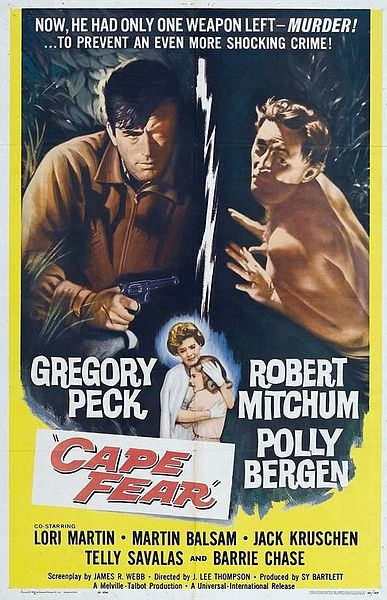
a05ec-387px-cape_fear1960sStarring Gregory Peck, Robert Mitchum, and Polly Bergen, the film is an ominous and intense thriller.Peck is an attorney in a small town and he has a beautiful wife and young daughter. However, Max Cady (Mitchum), a man he helped put away, is now out. He makes it clear he wants revenge and he will bide his time to get what he wants. He constantly torments, stalks, and plays mind games with Peck and his family. All the police and private investigator can do is keep him under surveillance. Desperate, Peck decides to set a trap, moving his wife and daughter to a house boat on Cape Fear river. Sure enough Cady comes and shows his animalistic and brutal side. In the final showdown, Peck and Mitchum face off in a tense confrontation. Cady gets what is coming but not without doing damage. Following the Night of the Hunter, Mitchum plays an even greater villain here because he fills you with anxiety without doing anything.

4.5/5 Stars

The Naked City (1948) – Film-Noir

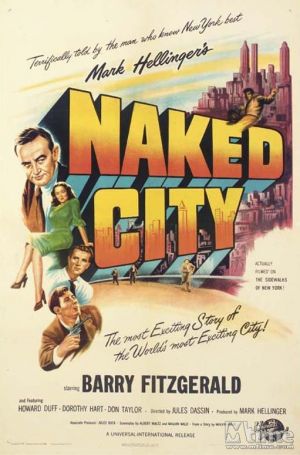
58f41-nakedcityposterDirected by Jules Dassin and starring Barry Fitzgerald, Howard Duff, and Don Taylor, this documentary-style police procedural is an intriguing film. It begins with an omniscient narrator explaining the setting in New York. Soon we witness the aftermath of a murder. Then, we are following the detectives in Homicide as they try to follow the case. A beautiful model is dead and the suspects are few. Furthermore, they must figure out how stolen jewelry and a drowned man fit into the case. As Lieutenant Muldoon suspects, everything leads to an unknown culprit, a McGillicuddy. Little does the perpetrator know the police are closing in on him and it is only a matter of time. I found this film to be unique because of it’s narrator, semi-realistic approach, and relatable characters. On top of that the progression of the story was interesting and the ending sequence was entertaining. There truly are 8,000 stories in the Naked City. Enough to make a TV show.

4.5/5 Stars