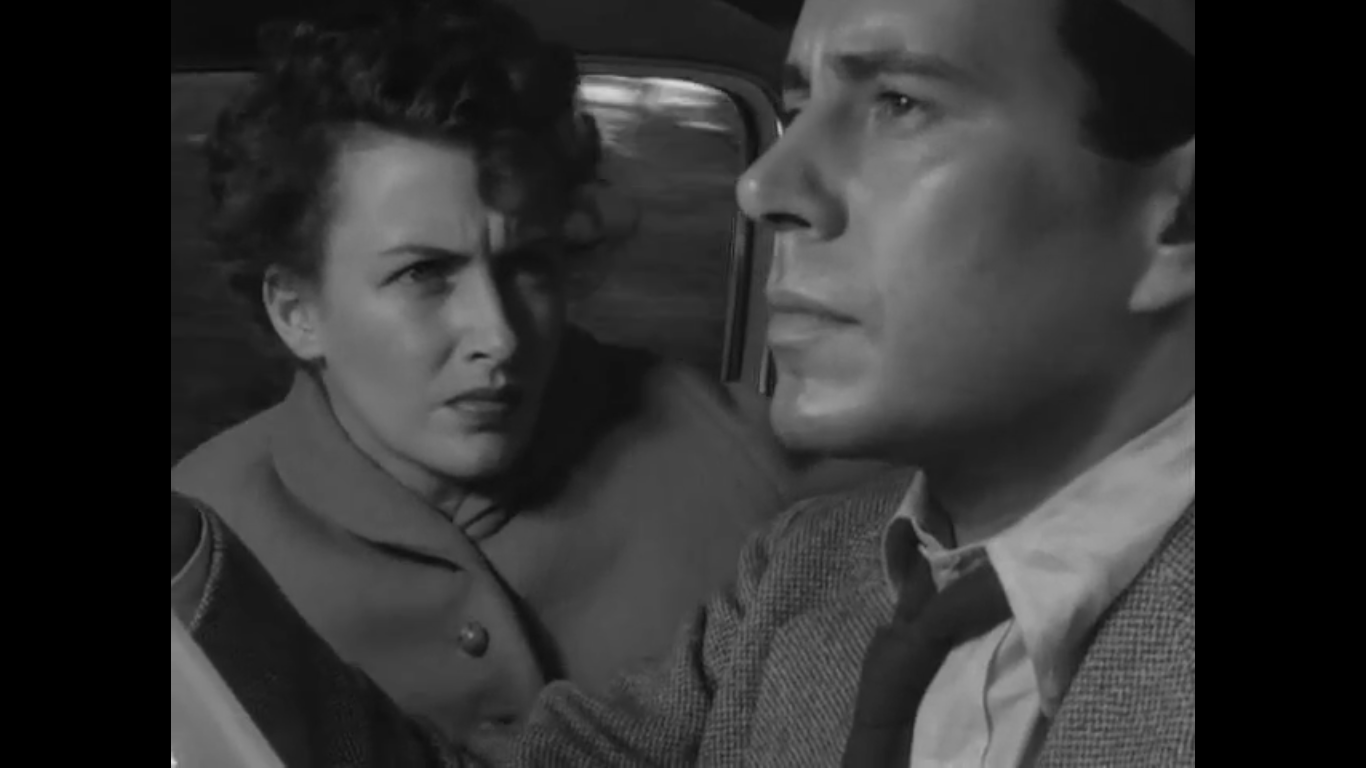
The Sound of Fury – Try and Get Me (1950)

The Sound of Fury opens with a kind of portent. A demonstrative street preacher yells out at the pedestrians walking by to “Prepare to meet thy God and Repent of their sins.” He pretty much gets trampled with all his pamphlets ending up on the ground in a sea of humanity. It’s really not all that important why it happens, but it does show the indifference and the frenzy that so easily overtakes the masses.

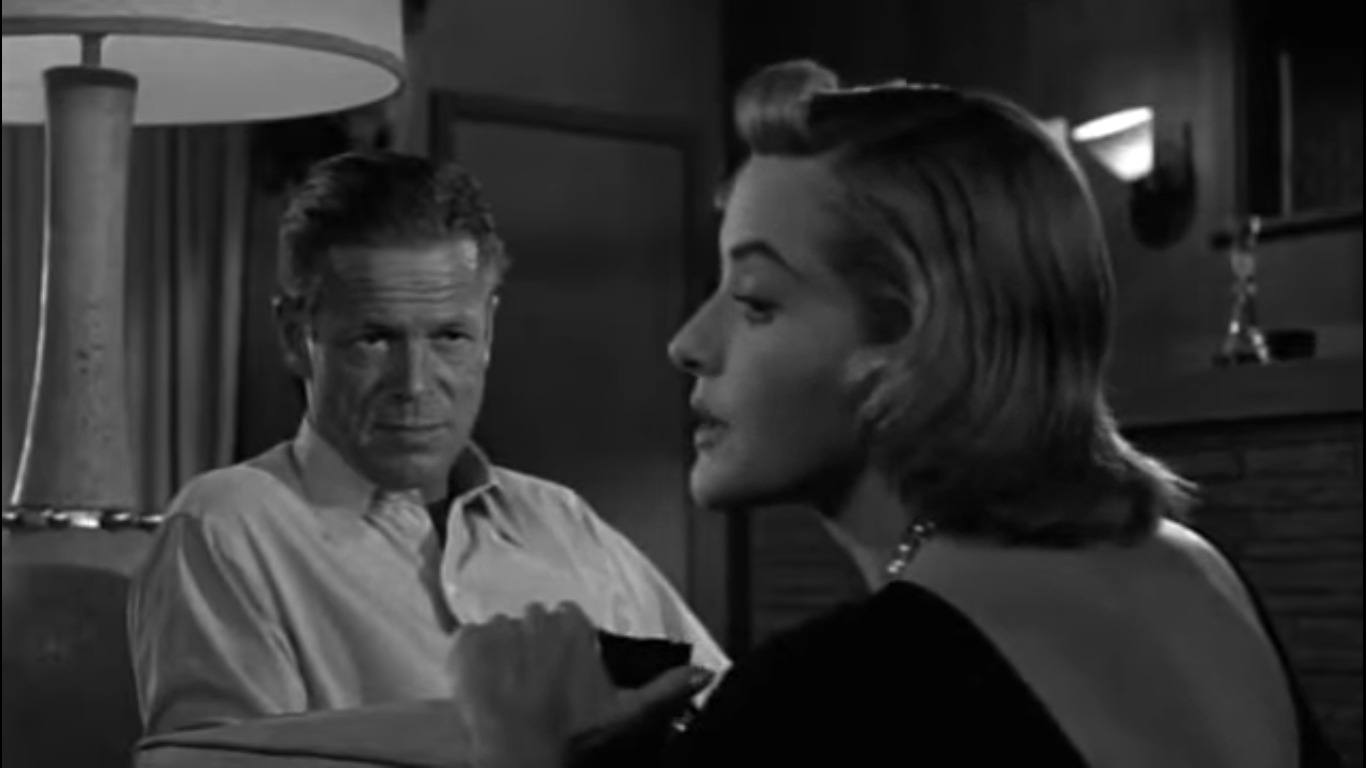
Howard Tyler (Frank Lovejoy) is a man down on his luck with a wife and son to provide for and no job. Life has hit the skids. At home, his demure wife (Kathleen Ryan) pleads with him to find work because every day she’s begging for groceries, and trying to make ends meet. With her pregnancy and a little boy always asking his Pop for stuff, it’s enough to make a guy despondent. He feels totally useless.

It’s in moments like these where honest living seems to give you zilch, only heartbreak, and it’s easy enough for decent men to get enticed by evil. It starts innocently enough, and it’s all for the sake of a buck as Tyler gets seduced by the sirens of noir.

I use this metaphorically because what really does it is a meeting in a bowling alley. He goes there to drown his sorrows. Instead, he meets a confident man finishing up a frame named Jerry Slocum. Slocum’s swimming in dough with fine threads and not a care in the world. Howard looks at his life with envy.

Years before Michael Jackson, Lloyd Bridges proves himself to be a smooth criminal. You probably already can see where this is going without it being spelled out. However, in order to make it explicit, Howard signs on as a getaway driver. He keeps the motor running as Jerry cleans out the cashboxes of local gas stations.

Suddenly, they’re both implicated in a life of crime. At this point, there is no salvaging their lives, as they submerge deeper and deeper. They go so far as to kidnap the son of an influential man. This is far bigger than Howard ever dared to imagine, but he cannot get out — not now.

The Sound of Fury looks to integrate a few more characters. Initially, we don’t know how they fit exactly. It’s a dinner party. A man and his wife. They have a house guest and then his editor (Art Smith) from the newspaper drops by. He’s trying to get his top columnist to look into some local robberies. They hold a discourse on the destruction of public health, sensationalism, and social responsibility of the press. It all feels a bit didactic if altogether well-meaning. It also has no power to save Howard.

The kidnappers send out a ransom note and wait. For Jerry, he plays it cool. It comes naturally as he reunites with his best girl (Adele Jergens), an opportunistic blonde who has dreams of leaving her crummy life behind for the exoticism of Havana. She doesn’t care how Jerry bankrolls it; she’s just impressed that he can. They’re like fire and ice constantly scorching each other and making up just as ferociously.

Lovejoy is coupled up with the other girl (Katherine Locke) in the back seat. If not for the fact that he’s already married, they might be a decent match because they both have a similar propriety and quiet humility. Alas, it can never be. Not only because of his family life but they’re also embroiled in a crime that cannot be easily brushed off. There’s no turning back.

When they pull up to a club with the girls it’s almost like watching a film through funhouse mirrors or something with contorted angles distorting the floorshow and all the gaiety on the floor. It’s totally unnerving. This is just the beginning as Lovejoy’s character falls to pieces. He’s not made for this life of duplicity. It unhinges him as he implicates himself and the film begins to run on this wild energy that will see it through to the end.

It’s the final moments of the film where it stakes its entire reputation as we face an onslaught on so many fronts: visual, emotional, and psychological. We watch the masses descend on the courthouse to gawk, condemn and belittle the criminals after they are brought in. There is no quelling the tide of the momentum and from thenceforward the movie gets carried away by the mob.

Evoking the same ardent energy of Fritz Lang’s Fury (adapted from the same source material), it’s a bit like a modern storming of the bastille. The culprits fly through the jail like apes and howling banshees, and the feeble attempts by the police to maintain any semblance of law and order are quickly snuffed out.

Many generations later, The Sound of Fury feels like one of the most obvious pleas against the swells of McCarthyism in the company of more notable indictments like High Noon or even Invasion of the Body-Snatchers. It’s not merely about the narrative speaking volumes, but the resulting effect on many of its cast members. Cy Endfield was soon forced to flee to England, and he would finish the rest of his career abroad.

The great character actor Art Smith — memorable in everything from Ride the Pink Horse to In a Lonely Place would watch a reliable career go down the tubes. Lloyd Bridges was also affected although he was able to find some relief by cooperating with HUAC. So while they weren’t lynched, it was men like these who were given a damning choice.

They could name names or hold fast and commit career suicide, receiving all the ignominy that came with such a choice. Neither could they stop the tide of fury leading to blacklisting and self-exile, and worst still, they probably more than saw the writing on the wall. There’s nothing more terrifying. You see the malevolent forces at work, and you’re powerless to do anything about them.

The parallels between the movie and real life hardly point-for-point between two killers and accused communist sympathizers. What’s relevant is the wide-ranging reaction top-to-bottom, be it fear or this kind of embittered, hate-filled retribution. Suddenly there is no place for civil discourse. Emotions, which are not inherently bad, begin to boil over and dominate the social spheres.

I’m not an authority on the Red Scare or McCarthyism, nor did I ever experience the full brunt of the Cold War, but even as the issues change and the times with them, at our core, human nature always seems to adhere to the same patterns. True, we are predisposed toward avarice and turpitude, but even our battle cries for justice fall far short.

The fact that the movie was released under two titles and never truly caught on or that Endfield is not more of a household name feels like a cruel sign of the times. Watching it now, from its opening images of a fire and brimstone street preacher to the devastating final acts of violence, it’s sure to rattle the cage. Hopefully, now, we’re better able to appreciate it, and heed its warnings on the state of humanity.

3.5/5 Stars

The Underworld Story (1950): Cy Endfield and Dan Duryea

“You know what’s inside of ivy Mike? Little crawling things. You should feel right at home there.”

The Underworld Story is full of these wild narrative beats forming the foundation of a new normal. It’s like playing an unwieldy game of connect the dots. Take the opening scene. It’s straightforward enough. The district attorney and a gangster informer named Turk are injured on the steps of the hall of justice. They didn’t fall down. There’s a deliberate hit put out on them.

But this particular story has no special investment in apprehending these perpetrators with shotguns and a high-powered car. It plays like more of a misdirect than a primary plot point. Instead, the story slingshots to The Times Gazette‘s hard-bitten reporter Mike Rees who is on the chopping block for not withholding a story.

It’s this breaking news flash that got those same men killed. It’s all his fault, and he finds himself blackballed throughout the industry for breaking their unspoken code of conduct. He’s finished — a leper in the industry.

Dan Duryea is nothing if not a journeyman actor. He went through a number of phases even for the uninitiated. I can think of seeing him in things as diverse as The Little Foxes and The Pride of the Yankees (also as a journalist). Then, came the days of ill repute in everything from Scarlet Street to Too Late for Tears. These were his bread and butter, and he fit the mechanics and the malaise of the material like few others.

What’s marvelous in a picture like The Underworld Story is how he gets leading man status — he was an actor of that caliber surely — but he still plays a starring role as slick and unprincipled as ever.

It goes to show he can play either side of the spectrum — good or bad — and it still comes off mostly the same. There’s something in his delivery that makes it always sound like he’s sneering, disgusted with every human being he has the displeasure of running across. The feelings are mutual.

With nowhere else to go, he sets up shop in Lakeville. In an apt bit of exposition, we learn it is home not only to a church lane but also to a church street…and a graveyard. This is the world he’s walking into. He does his best to play the part of an honest-to-goodness, salt-of-the-earth American. He’ll do anything to survive.

In fact, he gets out of the big ocean so he can poison the water somewhere else. In a small pond where the water’s stagnant, all his rancid practices can fester and congeal into pond scum. The humble paper itself is run by Catherine Harris (Gail Storm) wet behind the ears and her faithful colleague Parky who is a veteran, but he’s used to a leisurely, benevolent sort of reporting. Harris wants none of Mike’s local news with a slant.

When the daughter of the local newspaper magnate (Herbert Marshall) is found murdered in the woods, they have no recourse to run the story. Reese is way ahead of it, prepared to nuke the news flash and blow up circulation all around town. It’s the kind of tactics that might easily get him back into the big leagues.

It also occurred to me right when we see the hustling, bustling frenzy around the murder scene, it plays a bit like a B-side to Billy Wilder’s Ace in the Hole (though it does sit on the right side of history having premiered a year earlier). We have some of that media circus going on here albeit in an alternate small-town setting.

The waves of swirling melodrama are the movie at its most overwrought and tiresome. None of this is original or attention-grabbing in the way a good news story might be. It also pushes the envelope on plausibility with these wonky near-nonsequiturs cropping up every which way.

As such, The Underworld Story proves to be a wildly uneven picture. At times there’s so much to latch on to and ruminate over. Other passages of the film feel downright tacky, whether it’s the dialogue or the rather fervent scoring providing a rampant array of dramatic underpinnings.

When it’s grounded in ideas of the press of what it stands for and how it can be used to manipulate and capitulate situations, that’s when the movie sings with something wielding a definite voice.

We watch Reese continually taking advantage of the situation. First, he’s rather comically running up the bargaining price for their exclusive to his liking by juggling two phone calls at once. He’s also prepared to use Molly Rankin. She’s the girl wanted as a suspect in the young woman’s murder.

The Sentinel vows to prop her up, but far from championing her as a symbol of prevailing justice in the town, it feels dangerously close to a trial, with free publicity attached for the paper. Of course, that’s because that’s exactly what it is. The Defense Fund becomes his latest scheme, which actually proves itself to be very successful in earning public support.

Alas, the public is fickle. The local paper starts sinking in quicksand as they meet a media juggernaut and watch Molly lose all credibility. The last thing to be done is to concede and plead guilty. However, Molly comes from a place of integrity — all she has are her personal convictions that she’s innocent and she won’t give it up — even if pleading guilty to manslaughter might actually allow her to keep living. To pragmatic, unscrupulous sorts, throwing in the towel makes logical sense. She, however, must abide by the truth.

Ultimately, Mike pleads with a newspaperman in his ivory tower — there’s actually some genuine concern there for once — but he also gets fingered by the jovial gangster who lays out threats with a smile. Howard da Silva makes an early appearance only to show up later and practically steal the show. It’s not simply about malice; it’s how he’s able to mask it with this kind of menacing conviviality. There’s a dissonance between the threat in each of his measured words and his outwardly cordial manner.

In the end, true to form, Duryea gets the crud beaten out of him, enough that he earns a date with an ambulance at the end of the picture. Even then when his girl steps in to ride off by his side, it’s hard not to consider their chemistry in the moment. They never felt like a couple, at least not to the degree such an action implied. Gail Storm, no fault of her own, is written to flit back and forth between indignation and admiration. She isn’t allowed to really stand on her own two feet.

It’s a final dagger in a movie that’s a bumpy excursion and still a calculated risk for Dan Duryea aficionados. The movie certainly isn’t averse to risks, taking on the theme of a black woman accused of murder and theft. It has a lot of potential, although the incisive edge is neutered by whitewashing the part and casting Mary Anderson in the role, no doubt to placate southern audiences. It’s a shame.

There’s only one last point that I feel compelled to bring up given the historical moment. The Underworld Story oozes Blacklist from the moment Duryea gets forced out of town and can’t win a favor, even from his friends. This is indicative of the story, but we can also consider all the personnel involved. Cy Endfield and Howard da Silva among them would wind up victims of HUAC destined for ex-communication from the Hollywood majority.

Mind you, these weren’t coincidences. People on both sides knew what they were doing. It proves that art really does have an impact on life. I would use the term art loosely with Endfield’s picture, though it does have a certain trashy allure around the corners — flaws and all.

3/5 Stars

Brothers Rico (1957): Richard Conte and Dianne Foster

I’ll say it again, but Richard Conte is one of the unsung heroes of film noir. He could play ominous villains (Big Combo) or charismatic everymen caught in the pincers of fate (Call Northside 777). But the most important piece is that we buy him in either, whether he’s earnest or simply hard to take our eyes off of.

Digging around in his backstory, it’s telling that he was actually discovered by two fairly auspicious figures in the film and stage community: Elia Kazan and John Garfield. I wouldn’t have immediately drawn the line between them. To my knowledge, they rarely collaborated, and yet Conte does offer something robust and genuine in the majority of his roles. Like a Richard Widmark or a Robert Ryan, he doesn’t get enough acknowledgment, and the dark genre would feel slighter without him.

In The Brothers Rico, he and Dianne Foster are surprisingly frank, and they have a playful rapport between kisses, shaving kits, and showers. It’s all telling character work to set up a more rudimentary story.

It’s difficult to imagine any business more innocuous than running a laundry, but then again, that’s the point because Rico’s somehow connected with a different kind of business: something hot. Although he gave it up long ago with a past that is never fully disclosed, his two brothers are still knee-deep in it.

The film conjures up what can best be described as the fatalistic throes of doom coming back into his life. This growing pull somehow signals the undeniable undercurrents of noir. He gets a clandestine visit from a frightened Gino and learns his other brother Johnny is wanted in the underworld. He’s married a principled woman, and the mobsters are afraid she’ll make him talk. We see the worlds colliding, one engulfing the other, and eating it up.

Eddie’s own marriage is strained as is their dream of adopting a child. Because an old family friend, the kingpin Kublik (Larry Gates), calls on Eddie to search for his missing brother. He needs to straighten the boy out for his own protection. He’s sincere and they have a history. They’re like family. Thusly, Eddie is pulled back into the world.

It deals in terms of family, business, rivals, and all the codes we’ve become familiar with in movies forming the traditions of The Godfather and even an earlier Conte picture like House of Strangers. The family comes first and religion maintains such a crucial moral grip on people and how they make sense of guilt and retribution.

Eddie quickly becomes the seeker hero questioning folks, looking for leads, and going across country to track down Johnny. It’s a bit too convenient how the old world comes out of the woodwork to meet him bearing pretty girls in New York or boasting about gambling in Phoenix, but the point is made.

Finally, he finds his brother (James Daren) in an isolated town, far away from the prying eyes of the urban jungle and salacious gambling parlors. He’s contented himself with a simpler, purer life. Their meeting is inevitable, but it also comes to represent the divergent paths young Johnny wants to take.

It’s curious how Conte who is forever cast as the hero in another’s eyes becomes almost like a specter and executioner himself, representing everything he’s trying to negate. Kathryn Grant has even less to do than in Phenix City Story, but the way she tears across the set beside herself with anguish serves a tangible purpose.

In all his good faith, Eddie has signaled the end for his brother. And even as he finally shows up at his destination, things suddenly seem more tenuous. Although we know what Kubik is capable of, Conte almost makes us believe that some semblance of honor and integrity still exists in the world. And yet it grows more and more suspect.

When he finally reaches Johnny, it’s like the motor of the movie is gone. The story drags until it finds a new focal point. It recognizes the renewed tension in the moment: Eddie is made to talk with Johnny over the phone knowing full well what is going to happen. His little brother is forced to reckon with the welcoming committee that’s waiting for him. And then the picture can only go one place, with Conte on the run like his brothers before him.

The climax is the film at its most mediocre, overblown, and disposable. In a matter of seconds, it brushes off all of the strenuous work of the picture, settling on histrionics over a clear-cut actionable ending. It doesn’t even give us the pleasure of one of Phil Karlson’s patented fistfights.

The resulting denouement is one of those overly twee numbers no doubt forced upon the production by the censors. Because as Mr. and Mrs. Rico, that couple we came to appreciate in the opening moments, finally show up at the orphanage to claim their child, there’s something uneasy about the whole scenario. It feels false and disingenuous given what we have experienced already.

Noir sentiments like these can never be so easily smoothed over. It’s almost sickening to think something so saccharine even deserves to be in the same picture. Particularly because it doesn’t seem to be earned. In the end, there are so many shortcuts and liberties taken and while the groundwork is in place, including character dynamics, and the like, Brothers Rico fails to have a viable payoff.

Regardless, there is much to recommend. I’m fond of both Richard Conte and Dianne Baker. They had varying degrees of career success, but have much to offer the movie. For Phil Karlson aficionados, it’s worth consideration.

3.5/5 Stars.

Phenix City Story (1955) and The Voice of The American People.

“From the ashes of Phenix City has risen the symbol of democracy at work. The power of the ballot will always be the voice of the American People.”

The cut of the film I watched had a rather unique opening prologue complete with interviews by esteemed reporter Clete Roberts (You might remember him from MASH’s Interview episode), and he supplies an instant ethos and credibility to the proceedings.

Faux-newsreel segments have actually been dropped in lieu of actual documentary as he stands on the steps of one of the city’s civic buildings. He takes a moment to talk with a couple notable players including the journalist who broke the story — Ed Strickland — as well as a lifelong resident, Hugh Bentley, who had his home dynamited.

Of course, if we didn’t know any better and we didn’t know these men or see their faces, we might guess this was all for the cause of civil rights. That’s not actually the case. The Phenix City Story is a tale of the criminal syndicate that controlled the city, providing much of its commerce, but also employing rampant coercion tactics.

It’s evident from the first images of Phil Karlson’s actual film, there is an instant dichotomy being created and the two layers of the society. There is the world belonging to the simple, hard-working, God-fearing folks and then the swindlers, gamblers, and generally corrupt subset of society.

Karlson introduces the latter with a knowing visual panache backed by a bluesy dance number. The saucy come-hither floorshow is the epitome of 14th street, and it beckons all men like a greedy seductress looking to bury them. It’s Sin City U.S.A.

What becomes plainly apparent is how evil can come in all shapes and sizes. Rhett Tanner has a gift for southern hospitality. He knows how to schmooze with the locals, chat about the preacher’s Sunday sermons, and keep up appearances. He’s also a shrewd customer behind closed doors as he is the go-to man maintaining the city’s thriving undercurrent of vice. In fact, he’s set himself to be an impregnable despot. No one can topple him because he’s so integrated into society.

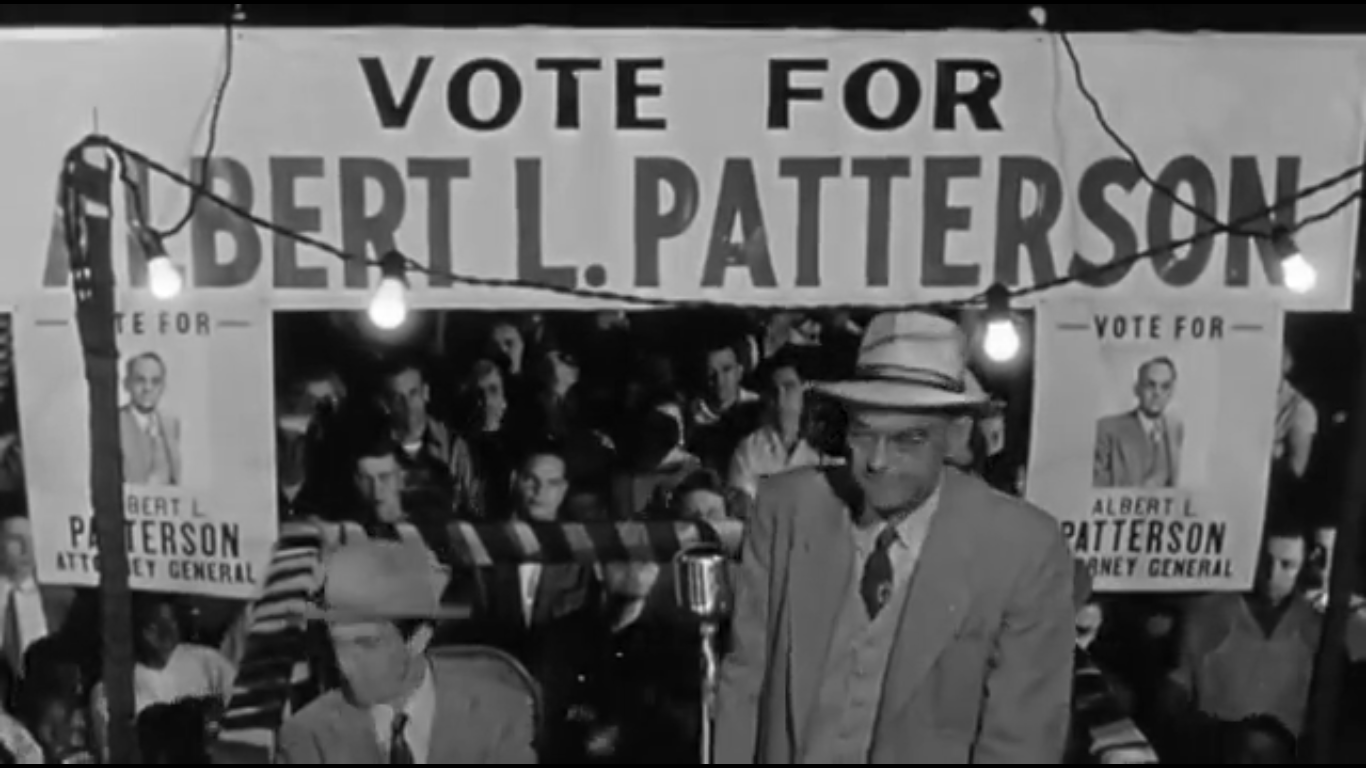
Albert Patterson (John McIntire), as portrayed in this storyline, is one of the men who is reluctant to get involved. He’s a lawyer and a good one — he’s one of the town’s best — but he’s also old and feels the fight is not his. He can live on his side of town in relative peace.

It’s his boy, John (Richard Kiley) who really shakes up the status quo. He is a war vet returning to Phenix with his young family after time away, and he’s disillusioned by what he found. He’s faced with the bitter irony of fighting fascism overseas only to see it have such a deathly grip on his childhood home. He’s prepared to fight to give the town back to the good folks around him.

Kiley’s part is actually conveniently whitewashed to make him a more sympathetic hero. In real life, John Patterson ran on a segregationist ticket — although it might have been more pragmatic than anything — he also didn’t have the best track record as a family man.

But in an effort to probe this topic more, James Edwards is one of the characters we must gravitate towards. Edwards certainly never reached star status, and he’s rarely remembered outside of the classic film circles, but through a series of war films, it’s as if he was given an opportunity to exert himself and represent black characters with dignity.

Phenix City Story is one of the few films where he’s not in uniform, and Zeke is not a revolutionary part; he’s only a humble janitorial type, but he has a strong moral conscience. The fact that he, his wife, and his daughter (who becomes a tragic victim) are the only black characters, is also a salient reality of the film’s world.

The movie feels like a microcosm of the whole society, both what is shown and what is not. My historical geography leaves something to be desired, but I think of 1957 and Orville Faubus, or the 16th Street Baptist Church Bombing in Birmingham in 1963, and the brutality of Selma after that. My mind starts going places. If this is how they treat other whites in a movie, imagine how it is with blacks. To its credit, the movie resolves to show some of this.

Pound for pound, it doesn’t feel like the Sunday school truth it’s trying to project itself to be, but in the world and qualities of life — especially the exteriors — we do get a real eye into society circa 1955. This is the aspect of many classic films that’s the most enlightening even if the actually perceived mimesis of the film itself is still beholden to the tenets of Hollywood drama. Thankfully, for all its forays into docudrama, it still holds onto Karlson’s always reliable sense of bruised and bloodied physicality.  It wouldn’t be one of his pictures without it. But of course, even this has real import.

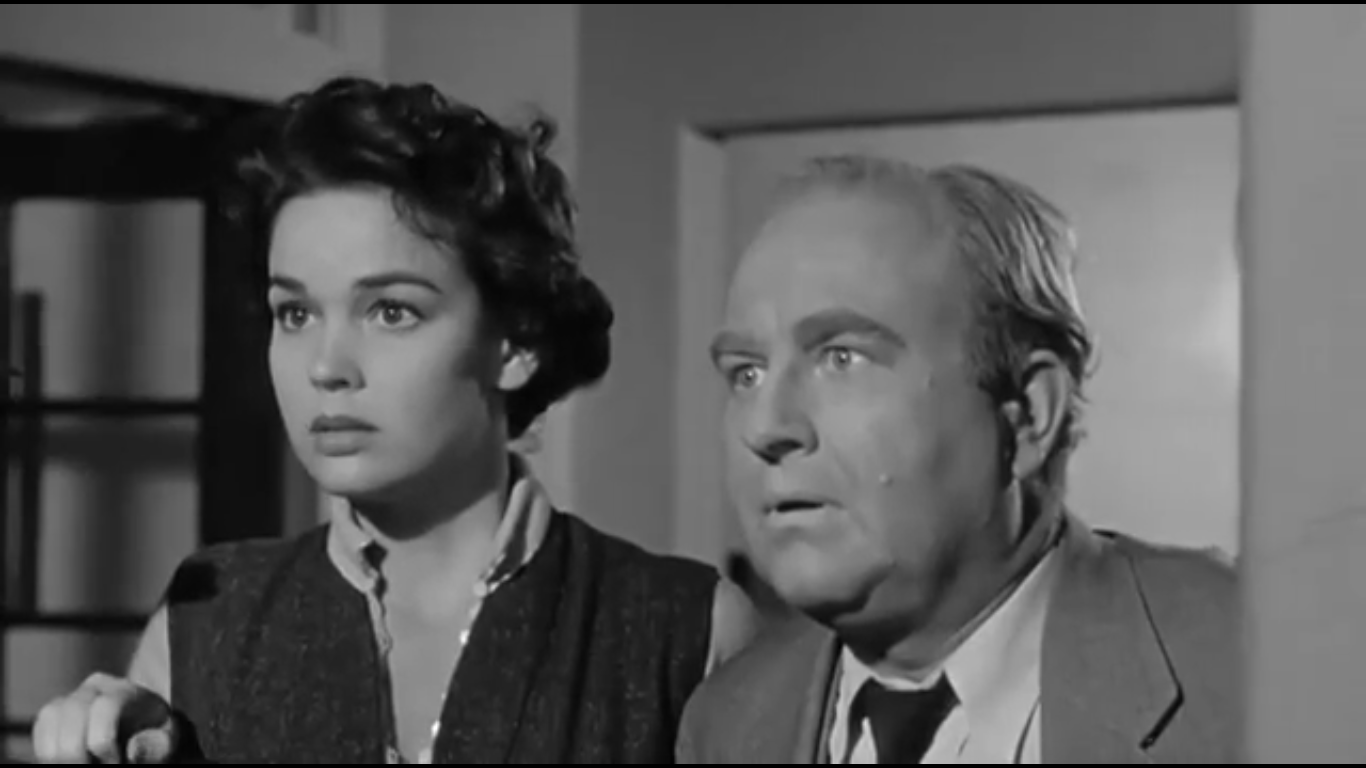
The ensuing climax feels like a foregone conclusion. People feel a tug or a pull to do something and take a stand. Bystanders can no longer watch. They must act to turn the pervasive tides of oppression. One of them is the young woman Ellie Rhodes (Kathryn Grant before she met Bing Crosby), who saw her boyfriend ruthlessly disposed of. Finally, Albert Patterson resolves to fight as well, and he takes it to the top, running as attorney general. Both of them stick their necks out and pay the consequence. However, these weren’t rash decisions. They knew full well what they were getting into. They counted the costs and pushed forward anyway.

If we are to scan the contemporary movie landscape, something like The Captive City is a comparable movie. Whereas the actual visual plane is more pronounced in individual shots of the earlier movie, Phenix City has the advantage of its world, and if it’s not entirely more expansive, then it certainly feels more evocative. In the dark shrouds of night, we feel the sinister threat hanging over the city’s population.

The Captive City also calls on gangsters who feel like callbacks to the 1930s. The tone verges on social horror. Karlson’s picture is probably even more perturbing because it alights on something that feels fresh and honest in how it pertains to current events in 1955. There’s no escaping reality in this case. We’re still struggling against them over 65 years later. Suddenly, that corny rhetoric at the movie’s opening remains prescient. “The power of the ballot will always be the voice of the American people.”

3.5/5 Stars

The Captive City (1952): John Forsythe and Joan Camden

The movie opens briskly with a man and a woman racing through Middle America in their car. The shots provide a lovely, claustrophobic framing and closeups of our characters making the moment especially palpable. From what I can glean, this was actually attributed to a man named Hoge, a former grip for Gregg Toland who made this noticeable advancement with deep focus. This Robert Wise project was purportedly the first movie to use this new technology, and it pays great dividends over the course of the rest of the movie.

The couple continues to fly down the highway until they pull up outside of a police station in a small town to find some support. They don’t fit the surroundings, but journalist Jim Austin (John Forsythe) asks to record his testimony just in case anything should happen to them…

This kicks off the film’s all-encompassing flashback covering most of the movie. James T. Austin (Forsythe) was the local newspaperman in Kennington, which might as well be Everywhere America. There’s nothing too exciting there, but they find ways to keep busy, and life is generally calm and anodyne.

As such Austin has a generally chipper attitude and very little can sour his mood on the beat. He likes what he does and being a member of the local press avails him certain privileges. However, an inauspicious encounter with a P.I. named Nelson in the local library, leaves him feeling queer. The man is positively paranoid. He says he was working on a run-of-the-mill divorce case, but then sounds the alarm suggesting underworld syndicates and other entities are taking over the town. It’s utterly ridiculous. But he won’t stop looking over his shoulder.

That same day an accident takes place in town late at night. Although it’s actually a hit and run, and the man killed is none other than the same P.I. Austin starts to get queasy feelings. At the very least his interests are piqued, and he does what he does best: investigate. His character was built for such a film as this.

It leads him to a divorced couple, Mr. and Mrs. Murray Surak, who are somehow implicated but don’t want to talk. They’re scared of something. This goes far deeper than one or two people. The Police Chief, a genial enough fellow named Gilette encourages the journalist he might as well back off. In truth, he’s running interference for the bookies in town, and some of Austin’s pals even call gambling harmless fun. At any rate, it’s pervasive throughout town — everyone’s complicit — and it all goes back to one man named Dominick Fabretti.

With a conviction to seek out the truth for the sake of his readers and the community, Austin enlists the help of the paper’s budding photographer (a young Martin Milner before his Route 66 and Adam-12 days). They stake out Fabretti’s home base outside of town and grab a drive-by shot of the elusive kingpin. However, the victory is short-lived after Phil is pounded for the negatives. It’s another warning.

The film soon passes the point of no return as the journalist spies a car watching his house from across the street and his greatest allies at the paper start to turn on him. They can’t understand why he’s willfully stirring up the populous. In some ways, it plays like an early prototype of Invasion of the Body Snatchers without the Sci-Fi element as the world closes in on him and no one believes his story aside from his faithful wife (Joan Camden).

Here’s an unrelated observation but watching the movie you begin to understand the plague that beset people like Dr. King who had their lines tapped and were constantly hustled, harried, and intimated by forces in power. Even then this is only a very small representation of this kind of conflict between the powers that be and the righteous rabble-rousers.

Ultimately, Austin feels compelled to go to the local ministers. Surely they can speak truth into the current mendacity they find themselves enveloped in. And yet even in spite of this blatant hypocrisy, the religious leaders do not feel they are able to take on their own communities in this way. They too feel powerless to reach their audiences in the pews on Sundays. In essence, that’s the extent of their powers because for the rest of the week people go and live their own lives as they see fit.

Eventually, we circle back around, and in another sequence predating Body Snatchers, Forsythe, much like Kevin McCarthy’s character, tries to seek help in the present as the story comes back around. All due respect to Senator Estes Kefauver and his civic pursuits, but the last 2 or 3 minutes kill the movie.

It becomes yet another heavy-handed Hollywood public service announcement in the guise of entertainment. Up until that point, it’s a tense newspaper noir brimming with deadly, full-bodied conspiracy. We truly empathize with John Forsythe as the world begins to cave in around him. He makes it take.

3.5/5 Stars

Confidentially Yours (1983): Fanny Ardant, Hitchcock, and Truffaut

This is my Entry in the Classic Movie Blog Association’s Fall Blogathon Movies are Murder!

Although no one knew it at the time, Confidentially Yours would become the makeshift curtain call to Francois Truffaut’s career as he died of a brain tumor shortly thereafter. The movie in no way makes up for the works we lost out on, but there are some fitting summations worth appreciating. Truffaut cast his latest muse, Fanny Ardant, in the lead role — subverting the prototypical blonde Hitchocockian heroine.

Like her predecessors, Ardant is winsome and brave, whether in stage garb or a trenchcoat in the tradition of noir working girls like Ella Raines or even Grace Kelly. They’re capable of being both intrepid and alluring on screen as the dauntless motor behind the story.

It’s true the film’s plot, execution, and sense of style owe a debt of gratitude to Truffaut’s cinematic hero. Like Alfred Hitchcock’s film Stage Fright, Confidentially Yours covers murder and the performative aspects surrounding it.

There’s a kind of duality because Ardant is not only a secretary embroiled in a local murder, but also moonlights as a stage performer at night even as she dons various parts throughout the movie to aid in her detective work. Much of this fades away as mere pretense as we get deeper and deeper into the nitty-gritty world of old-fashioned noir.

Confidentially Yours boasts a brisk beginning befitting a more contemporary film: A man is brutally shot out at a pond, and there’s only one obvious suspect. Truffaut implicates his own star through the cut because the first image we see after a bloody murder by a faceless perpetrator is Jean-Louis Trinitnant walking back to his car. He sees a nearby car door left ajar, and he closes it before returning to his own vehicle and driving off. When the police come to question him later, he seems to slip up in his story.

Surely he’s a guilty party. He has motive. His wife was unfaithful, and now one of her many boyfriends is dead. What’s more, Trintignant plays him as a brusque character — he’s not winning any awards for likeability — and yet these are not the metrics for guilt and innocence as we’re probably already all aware of. To use a staid figure of speech, people are often more than meets the eye.

Also, there’s the question about fingerprints. He left them all over the crime scene. Either he’s an incalculable fool or there’s more to the story. Ardant occupies an unenviable position. She seems to be working for a guilty party, she’s given the ax by her embittered employer, and yet she still finds some compulsion to begin poking around.

She starts sleuthing, coming into contact with a melange of lawyers, policemen, and shadowy undesirables. It’s easy to get bogged down by what feels like an incomprehensible cascade of plotting, but isn’t this the point? It’s not the particulars but the means of getting there proving the most important, and Ardent is one of the most supernal vessels we could possibly imagine. Somehow she seems like the predecessor of Hayley Atwood with the poise of Isabella Rossellini thrown in for good measure.

One of the film’s other lasting assets is the gorgeous monochromatic tones of Nestor Almendros. It proves to be an immaculate act of mimesis plucking the movie out of the ’80s and allowing it to drift into that timeless era of yesteryear that only lives in the thoughts and recollections of our elders who experienced the world and dreamed in black and white.

As her employer stays mostly anonymous behind his shuttered-up storefront, Ardant becomes his hands and feet, searching out a ticket taker at a movie house, and then leading to a nightclub. Later, she looks to infiltrate a prostitution ring using all her wiles to spy out the window of the lavatory. Eventually, her tenacity is rewarded, and she does what the police seem incapable of through normal channels.

Truffaut for me will always be one of the most ardent cinephiles with the likes of Martin Scorsese and a handful of others. Men who often made fantastic, exhilarating films, but not out of a debt to mere craftsmanship or technique. It’s so palpable how much they love these things. Their films can’t help but smolder with a boyish fanaticism they were never quite able to shake.

Scorsese still seems to make a young man’s movies with an old man’s themes, and even though we lost Truffaut at 53, hardly in the autumn of his life, he had some of the same proclivities. He loves the genre conventions of old. There’s almost a giddy enthusiasm to do his own Hitchcock movies like Shoot The Piano Player, Mississippi Mermaid, The Bride Wore Black or even this final entry.

And yet on the other end of the spectrum with the likes of Antoine Doinel, The Wild Child, and Pocket Money, he managed to tap into these deep reservoirs of emotional soulfulness. It feels as if adolescence is incarnated and imbued with empathy by someone who never quite left that life behind.

Since Godard still manages to have an influence on cinema culture as one of the revered old guard throughout this century, it remains a shame we lost Truffaut so prematurely. He still lives on through his films and the admiration of others like Steven Spielberg, but I do feel like if he was still alive today, his love of the movies would be equally infectious if not more so. I suppose it makes the catalog he left behind all the more important.

I didn’t consider until this very moment, but with “confidentially yours” the director is leaving us with his final valediction before signing off. It seems fitting his complementary farewell drips with the pulp sentiments he relished starring a lady whom he loved.

4/5 Stars

Note: This review was originally written before the passing of Jean-Luc Godard on September 13, 2022.

He Walked By Night (1948): Richard Basehart and John Alton

He Walked by Night is akin to T-Men or Border Incident in its pervasive use of “Voice of God” narration. Today, all of this feels blasé and staid like newsreel footage without much substance. Over time, the voice feels a bit like a pesky mosquito not so much in tone or frequency but simply in his tendencies. He won’t leave us in peace. What he is worth are a few minutes of civic history circa 1948 for those invested in knowing something about the distant past.

The real juicy bits are when noir seeps into the equation. To set the scene, there’s a cop returning home from his beat late at night; he sees a mysterious-looking figure loitering around a shop. He confronts the passerby, and the fugitive opens fire.

Quickly, the wheels of justice are notified on the switchboard, and the police force is mobilized to track down the fugitive who vanishes into the dead of night. Like any of these sorts of police procedurals, most of our “heroes” are innocuous types with a chiseled jaw and voices made for straightforward “just the facts” television — Scott Brady and Jack Webb among them.

In fact, Webb would use the experience of this movie to bring a little program called Dragnet to the radio waves. It would take on a life of its own with two subsequent runs on the newly minted medium of television. He Walked By Night is of the same ilk.

Very few of the characters impose any sort of will or inventiveness on the story. It’s strictly by the book with John Alton putting everyone else to task. Boy oh boy could he shoot a gorgeous movie; it shows in every frame.

There is one challenger to Alton’s preeminence because Richard Basehart’s performance stands out, and it’s the most visible and elegant opportunity at something memorable. Everyone else is an average Joe or a victim. He actually gets to do something and embody an enigmatic character with multiple layers and compulsions. Set off by his matinee idol good looks and tentative demeanor, he erupts with wrath creating an indelible impression.

If there’s any downside, it’s only a minor qualm he probably had little control over. There’s never an appreciation or at least an understanding of the killer. In 1948 the movies weren’t ready for that, but it’s part of what makes the movie feel rather sterile. It’s all about the case, which while somewhat contentious, plays out in conventional parlance. The exhibition in style more than makes it worthwhile, but He Walked by Night feels fairly paltry in narrative terms.

It’s true that the real events have a tinge of cinematic drama and in the post-war years, these kinds of hard-fact docudramas were in vogue. But with this being based on a real killer and genuine terror, the creators cannot sketch too much in any way that makes the audience too uncomfortable.

Again, where it deviates or rather executes to the most sublime is through the photography of Alton. It punctuates and accentuates the story in ways that are irreducible. You simply have to marvel and people have done so for generations. If you want a solid representation of film noir, this is it, hook, line, and sinker.

Take a scene midway through the movie where the cops have gotten in touch with a shop owner (Whit Bissell). He unwittingly did ongoing business with the wanted man — not knowing the evasive Roy was actually a violent kleptomaniac. In fact, Roy returns to the electronic dealer’s office wary of a trap.

It’s here where Alton finally gets another chance to spring into action, exerting himself on the movie and forever changing its course. The shadowed interiors bisecting Basehart’s face as he slinks back into the darkness are positively sumptuous. The sound design proves equally striking; we don’t hear any scoring, not one foot hitting the ground. It gives it this almost illusory quality. These are phantoms at work.

When they put out his description, and he’s forced on the lam, it’s the next progression in the picture’s glorious dragnet of immersive chiaroscuro. Basehart makes a daring escape on the rooftops with a getaway set up for just such an occasion. Then, he escapes into the catacombs of the city evolving into a full-fledged storm drain noir. I’m accustomed to the waterways of Vienna as opposed to the sewers of L.A. They play just as well in what becomes a defining moment of the film.

Pounding feet and flashlight beams spell impending doom as they encroach on the fugitive’s position. It relies even more on the juxtaposition of light like a knife in the dark. I know my own timeline is not chronological, but if I had never seen The Third Man, He Walked by Night’s finale would feel even more novel and like a truly slam-bang finish. It accomplishes so much through visual tension and delivering on the manhunt that has been going on throughout the entire movie. There really is no better way they could have gone about it.

Until the very end, He Walked by Night is a performative war between the by-the-book sense of realism that feels like post-war convention, and then the manic, slightly repressed expression that burst forth only after hours. It’s no contest and this bodes well for this ’40s crime procedural.

3/5 Stars

Desperate (1947): Anthony Mann Noir

It’s easy to imagine Steve Randall (Steve Brodie) has the life of many men circa 1947. He’s a war vet, and he makes an honest wage as a truck driver. Brodie and the effervescent Audrey Long are stars befitting the budget of the film, but I rather like them for it. There’s nothing prepossessing about them, and we appreciate them for their sheer likability; they’re humble, honest folks.

From the first instance they’re in a room together, they also prove themselves to be an adorably in-love couple, between flowers, anniversary cakes, and news of a baby on the way. It certainly is an auspicious beginning, and yet it’s all so wholesome; it feels like an instant tip-off that this picture is going to hell very fast. It proves to be the case.

Because Steve gets a call to carry a special load of goods. He doesn’t think anything of it, and he could use the extra dough on his salary. Only too late does he realize his old friend is asking him to haul stolen merchandise. This wasn’t what he signed up for, but they don’t care.

Raymond Burr fortuitously has a reputation for playing the pertinacious district attorney Perry Mason because without that there’s little doubt he would be forever immortalized as one of the most vicious baddies ever conceived in the age of noir. There’s something between his piercing eyes, the command of his voice, and his formidable frame that just leave an instant impression. He knows how to use them to his full advantage in the role of Walt Radak, a merciless criminal who also has a protective streak when it comes to his kid brother.

This is crucial because, in the botched burglary, it’s his brother who is taken by the authorities; the other thugs are frazzled but get away, and all of a sudden Steve is in a load of quicksand sinking fast.

Arguably, the creative apex of the film — or at least its fundamental allure — is suggested in a low-lit sequence in the gangster lair. Steve is cornered and Walt is ready to rough him up, literally knuckling the camera. Moments later, the man’s face is disfigured by a jagged bottle, and he’s pounded to a pulp under a swinging light fixture. We don’t see it explicitly, but the scene is so violently expressive; it’s all the more evocative thanks to this very specific stylization. It’s noir at its finest courtesy of Anthony Mann.

Although maimed, Steve does get away, and he whisks Anne out of town, disregarding her pleas for him to go to the police. He’s scared, worried for his wife’s safety, and he wants to vindicate himself before going to the authorities. What it means is that both Walt and a wry police detective named Ferrari (Jason Robards Sr.) are looking for him, and only time will tell what happens when one of them finds him.

They trade out the urban apartments, trains, and trucks for rural farm life, which becomes a kind of escape valve accentuated even visually. It’s the film’s moment of reprieve as they are immersed in Anne’s doting family who agree to throw her a true Czechoslovakian country wedding — what they never had time for before — and they dance the day away.

The ending is already inevitable. Walt’s slimy private dick (Douglas Fawley) is able to locate Steve, and the vindictive mobster comes ready to pay the fugitive a call. With his baby brother’s impending appointment with the electrical chair, he’s bent on having Steve knocked off at the exact same hour. He might not be able to save his brother, but he can get some semblance of revenge. It’s an eye for an eye mentality with noirish stakes.

When they’re finally thrown together in Steve’s apartment, Mann’s not messing around, and the film’s climax delivers both in its theatrics and as an extraordinary exercise in substantive style. Between the music, the smoke, and the nervous rat-tat-tatting creating the cadence of scenes, he goes into those fabulous claustrophobic close-ups of all his main players and the ticking clock smashed together as one. They create an excruciating effect because we know when the time runs out so does Steve’s life.

Mann milks the moment for everything it’s worth and his handling of time is so very effective. There’s not an ounce of realism in the scene. Maybe we have a dining room table, a kitchen, a fridge, but everything else is fabricated and manipulated to ratchet up the tension of the moment. The results speak for themselves.

The final shootout on the stairwell of the apartment building is yet another feat of ingenuity using everything at his disposal from the visual motif to the shadows, even frightened neighbors opening their doors momentarily only to slam them again.  It all culminates in the final crescendo and the ultimate release of anxiety.

It’s easy to see Anthony Mann coming into his own and what a stunning creative force he was. Desperate doesn’t garner too many laurels today, but it capably highlights what makes Mann such a popular journeyman filmmaker. There’s so much grit and tenacity stamped into the very fabric of his genre pieces, whether film noir or his later westerns with Jimmy Stewart. There’s nothing lifelike about them, and yet he magnifies the tension so much so that they function as such a blistering exploration of crime and vindictive human psychology.

3.5/5 Stars

Ossessione (1943): Luchino Visconti Does James M. Cain

You half expect cinema to have remained dormant in wartorn Europe during the 1940s. That’s part of what makes Ossessione such a fascinating curio within this context. In fact, the film almost never made it out of the decade alive. One can only imagine how unpopular the picture might have been with the reigning government.

It doesn’t exactly preach good old-fashioned fascist values and Mussolini looked to exterminate the picture completely. Legend has it that Visconti, who had also joined the communist party, managed to salvage a copy so that his film debut could live on and he got out of the war as well with a sprawling career still to be determined ahead of him.

I learned only very recently that Visconti started out as an assistant on the films of Jean Renoir of all people. Not only does that seem like the most propitious of apprenticeships, but it’s also easy to trace the lineage of the Italian from the Poetic Realism of the French Master that would eventually coalesce into Italian Neorealism.

The films of Renoir and Michel Carne are fully present in this early work with the opening images of a train evoking something like Le Bete Humaine or Toni. Gino Costa (Massimo Girotti ) is the kind of working-class hero you’d expect in one of those earlier pictures or even some of John Ford’s work.

He’s an itinerant bum who used to be a soldier and then a mechanic in a former life. Now he’s hitched a ride on a truck bed only to be dumped outside a roadside tavern. And Visconti proceeds to introduce his primary couple through the visual synecdoche of two pairs of legs.

Finally, we see their faces together. They’re in a kitchen. Although Anna Magnani was originally meant to have the role, Clara Calamai channels the sultry come-hither coquettishness quite well even when it’s impossible to unsee the platinum blonde of Lana Turner in the part. But they have their own instant spark, like flint — burning with a consuming passion tantamount to spontaneous combustion.

If you’re well aware of the story already, she is a young woman married to a chubby misogynist named Bragana (Juan da Landa), who thinks he’s more than deserving of the marital comforts afforded by such a wife. He calls on her to rub him down after a long day, and she can’t bear to touch him. She has designs for someone else.

While her husband goes off with the local priest to do some duck hunting, in an early example of a bike-and-talk, Giovanna is quick to stoke the flames of romance with her much more desirable confidante. Visconti’s unauthorized rendition is purportedly more faithful to its source material although it’s hardly as streamlined as MGM’s later adaptation, essentially leaving more space for narrative asides.

When Giovanna clings to the security of her current life, Gino sets off on his own alone soon falling in with a hospitable street salesman, “The Spaniard,” who entertains the crowds. In what can only be expressed as noir sentiment, the tides of the narrative bring the couple together quite by chance.

Bragana is pleased to see their old friend and Gino gets pulled back into the whirlpool taking in some opera at a local tavern. This more than anything betrays Visconti’s affections for the stage.

Consequently, it’s also a film where arguably the biggest moments play out off-screen. I’m thinking of the illicit couples’ first rendezvous and then the fatal accident altering the course of the entire picture. Not all of this is due to content concerns either, but it does highlight how Visconti and his scripting compatriots, Mario Alicata, Giuseppe De Santis, and Gianni Puccini, conceived the story.

It offers another kind of dissonance because we don’t get to see what actually happened even if we’re well aware of their mutual intentions. We must wait for events to play out to see how the canker and unrest reveal themselves in due time. The most explicit response comes when Gino peels off  some bandages and then a violent struggle over a trinket ends in a passionate kiss. This might be the movie summed up in visual terms.

They must reckon with an unsettling state of limbo: freedom that feels more like purgatory as they stew in their infidelities. A man of the cloth suggests that they part ways because people do talk about their situation, real or imagined, and of course, it is very real.

Instead of detonating the story to be a full-blown melodrama like The Postman Always Rings Twice, Ossessione maintains these high levels of human intimacies. Gino reunites with his old pal again beyond delighted to see a familiar face, and yet it ends in fisticuffs because his fellow traveler is able to put words to everything he’s currently tormented by.

Then there’s a demure “ballerina.” Gino meets her knitting on a park bench, and they share an ice cream. I had to acclimate myself, thinking only momentarily that she was Giovana, but the emotions in the scene are enough to give this away. Because being around her Gino feels different; it’s as if, ironically, her purity is able to cover all his sins or at the very least help him forget them.

But the digressions only aid in leading him back to Giovana. If they aren’t totally a destructive pair, frolicking on the beach together, having rekindled their chemistry, then there’s some kind of fatalism that needs to be satiated.

In passing, Ossessione might earn the labels of Italian neorealism for its striking, ever austere imagery emblematic of the post-war working class. But it’s also often designated as film-noir for its sordid details and futile finale. However, I can’t stop but marvel at how Visconti was able to make the picture to begin with. Even after its initial release, it was hit with so many roadblocks of censorship and copyright problems only to gain a second life.

What an auspicious way to start a career, especially under such tumultuous circumstances. Much of the finest pieces of art are born out of the burnishing fires of the furnace and, for that matter, a certain level of creative obsession.

4/5 Stars

A Colt is My Passport (1967)

Nikkatsu studio’s reputation for these kinds of down and dirty pieces of noir pulp employed action and gangster plots to entice the youth market. Obviously, the influence of the American canon cannot be disregarded, and yet the films came into their own given Japan’s own turbulent history with syndicated crime.

However, A Colt is My Passport does something more with the genre archetypes. It starts with this mythical weapon, not traditionally of mobsters and hitmen, but western heroes and villains dueling out on the range. Wherever the firearm might have progressed, it always carries this mythos about it.

As such, the movie is introduced with a whistling, stringed, and partially staccato score that might as well be plucked out of a  spaghetti western. Further strengthening the ties is Quick Draw Joe, a movie Joe Shishido starred in that was also directed by Takashi Nomura. Now half a dozen years they meet again to build on their collaboration.

The initial beats are familiar if you’ve seen any of these types of pictures. There’s a target to knock off. His name’s Shimazu, and when he’s not constantly being shadowed by a bodyguard, he’s stashed away behind bulletproof glass. It’s a tough job with only one day to see it out.

In this world of guns and souped-up automobiles, Shishido, the chipmunked-cheeked cult hero of cool, somehow feels right at home. It’s all part of his work as he studies his target, sets himself up with a hotel room, and then prepares to get in and get out with surgical precision behind his sniper rifle.

If there’s a methodology here it suggests how Colt is a film built out of a regimen and the setting of its protagonist in an architectural world. He is always completely cognizant of his location and how he functions in relation to the spaces around him. Thus, it becomes as much about mood and milieu as it is focused on action and violence.

Take for instance, how the story is constantly switching contexts. It’s in a car, about getting to a plane at the airport, holding up in a hotel, then fetching a barge out of the country, and when that fails, commandeering a big rig to retaliate against the enemy.

Of course, there must be a love interest. In the subplot, Mina, a young woman who works at the Nagisakan hotel, offers them asylum from their pursuers. What draws her to them? She says the god of death follows in her wake. Her former beau must have been like them, and as she spends her days serving the riffraff and sewer rats always loitering around, she looks to take back her life in some way. This is her form of rebellion in a world generally dominated by men.

However, even with the proliferation of gangster imagery and this kind of masculine bravado, the contours are the film consistently emulate the West with its own recurring motifs. There’s a musical aside of guitar not unlike Ricky Nelson or Dean Martin might knockback in Rio Bravo (Your star is a lonely little star…but now your face is a ghost town in the mist”).

It’s a way to bide the time before inevitable showdowns while also distilling this sense of male camaraderie in such a way as to make it palpable. It evokes the loyalty forged between two men, one mentor and his pupil, who have been through so much together. He shields his partner by giving himself up.

He knows where he must go. Where else would we end up but a deserted, windswept landfill where we half expect to see a tumbleweed roll by? Instantly the urban world and streets, even the maritime port of Yokohama, all but evaporate and fade into the periphery. The entire film culminates in one definitive moment where the sides are drawn up all but prepared to have it out in an instant. While the final showdown is fairly spare, it still manages to blow the lid off the picture with its gritty cross-pollination of the noir, western, and yakuza inspirations.

It’s hardly drawn out — finished in what feels like a few suspended moments of chaos — and yet it might be one of the most monumental standoffs you’ve ever seen. As Shishido digs a hole (what might as well be his grave), then sets a charge of dynamite, which might as well be a self-destruct mechanization, and then finally fights for his life, we are inundated by the full brunt of the impact.

There’s hardly any mistaking who came out victorious, but then again it might be just as difficult to claim a hero as a man totters away from the wreckage.  I’m not altogether familiar with the etymology of “borderless action” cinema as marketed by Nikkatsu, but here it feels like one meaning is about this unabashed melding of genre and inspirations.

Shishido channels hitman, gunslinger, and jaded antihero all rolled into one. He’s got a dash of Eastwood, maybe a bit of a Melville assassin, but also a distinctly Japanese sensibility. It creates this pleasing amalgamation that finds something rather gripping in its myriad of influences. There’s an indiscriminate and still somehow an artful freedom to it drawing me in all the more. 

4/5 Stars