A Woman’s Face (1941)

The movie’s faux Scandinavian backdrop can be traced back to its origins in an early vehicle for Ingrid Bergman back in her native Sweden that was released in 1938. Since I haven’t seen the original, I cannot attest to Bergman, but she doesn’t immediately spring to mind in a role that calls for some amount of moral ambiguity — at least on screen.

Still, A Woman’s Face was a stepping stone part for Joan Crawford, from her effervescent flapper days and pertinacious working gals to something vulnerable and bold for a fresh decade. She sheds all glamour, something used so often as a mask in Hollywood, and willfully puts on a different facade of scars and perceived ugliness. It’s a move her rival Bette Davis readily made as well.

Here Crawford is a creature tormented and self-conscious about her own appearance. She’s crawling with shame. Mildred Pierce always gets the plaudits, and rightfully so, but surely there’s room in the conversation for this picture. Still, let’s not get ahead of ourselves.

We stand by as a prisoner is marched through the hallways of a court. A menagerie of witnesses has been called to testify in the wake of a murder trial. The very same woman, her face hidden by her hat brim, stands accused, and the film effectively uses each of these disparate individuals to elucidate her story for the sake of the jury (and the audience).

It’s not an unheard-of device, but it’s rather clever, starting on the outer ring with a peculiar sort of character before getting closer and closer to who she is as a person with each subsequent flashback. As such, a sprightly waiter (Donald Meek) and a more guarded manager (Reginald Owen) recount their days serving at a local tavern.

One of the guests, Torstein Barring (Conrad Veidt), is a curious fellow. He’s the life of the party and expects certain privileges. One of those is running up an overflowing tab at the establishment after a merry night of wining and dining. He exhibits a piercing kind of magnetism, sleek and somehow unnerving.

When the lady of the tavern steps out of the shadows and excuses his bill, he’s immediately taken by her. She’s scarred over her face, and yet all he sees are those striking Joan Crawford eyes. There’s something immediate between them, and it comes out in the courtroom that the whole tavern was essentially a set-up for petty blackmail. When people get giddy their tongues loosen, and they are availed of all their faculties.

There’s a level of dubiousness and doublespeak with her underlings providing another layer to the film involving both humor and intrigue. Because they ran a fine and highly lucrative con game complete with all manner of deception. Now they’re looking to save their necks.
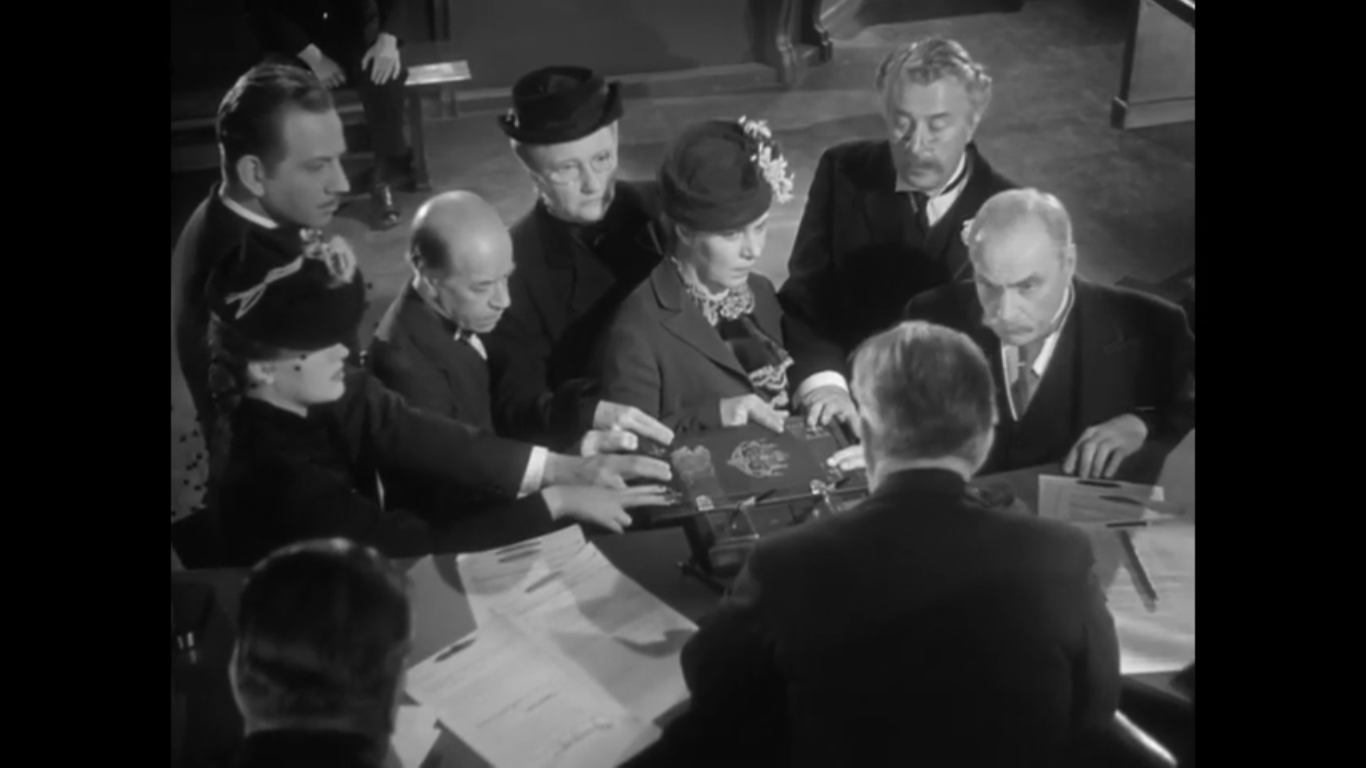
The ready victims are the adultress Vera (Osa Massen) — wife of reputed surgeon Gustaf (Melvyn Douglas) — and then her latest beau. The joy of A Woman’s Face is how there are building blocks for melodrama. In literary form, it might come off as convoluted and unclear, but the cinema screen makes it sing.

In one moment Anna (Crawford) is trying to peddle some stolen letters for a weighty sum with a level of vindictiveness. She scoffs at others. In another, she meets Gustaf, who returns home unexpectedly both catching this woman in the act and becoming genuinely interested in her. His wife doesn’t want any of her dirty business getting out so she reluctantly plays along.

Almost everyone has an enigmatic side, some sort of angle or self-serving motive we’re trying to detect. Melvyn Douglas is the one character who is straightforward and easy to read. He offers to transform her face. Not with an ulterior motive, but out of a sense of decency.

There’s a fine level of suspense waiting to see Anna’s face reconstructed. We know what it will be and yet are forced to wait for moments with the camera working to evade a direct shot of her; it adds something, a level of expectation.

It’s yet another soap opera contrivance that works wonders. Because Joan Crawford takes this blemish and turns it into something powerful and ultimately beautiful. With it comes new confidence and new life. Anna and Torstein grow closer and closer and he’s even more drawn to the vision of her rebirthed self. Also, her disposition shifts.

Still, he has almost a Nietzschean charisma, and he coaxes Anna into playing nursemaid to a young relative who’s set to inherit a large fortune. She’s become a governess of the Phyllis Dietrichson persuasion.

Watching Crawford come down the stairs with the precocious little kiddy, I couldn’t help but think of those old glossies of Marion Davies parties except this is a party at a Scandinavian version of Hearst Castle. Images of piano and dancing superimposed over Crawford’s face say everything.

Actually, I misspoke earlier because aside from the young tyke and the kindly Gustaf, the Consul Barring (Albert Bassman) is a jolly old man, who welcomes Anna cordially even as his housekeeper (Marjorie Main) remains distrustful of their latest guest. In truth, they’re both right. They see the two different sides of Anna on display.

There’s an old Hollywood axiom about getting an actor’s good side, and I couldn’t help noticing how A Woman’s Face plays with this practically. Crawford’s right side is kept hidden for much of the first half of the movie and traditional 180-degree filming means it’s all but masked from us.

I noticed the change at the party when she meets the good doctor again. Finally, she’s on the left side of the frame fully unmasked and open to us. It’s true we see her in a different light just as he does too. Perhaps she’s changing — softening even — and he has something to do with this.

Arguably the best scene of the entire movie comes when Crawford’s with her charge in the trolley over the waterfall. It’s the moment akin to Gene Tierney letting the crippled boy drown in the lake in Leave Her to Heaven. There’s the intent. We know what’s happening, and we watch the mechanisms on the face of Crawford. It’s totally wordless and, thus, so effective because the whole sequence is borne on her features. She has a choice to make — caught in a moral conundrum — and it’s a showcase for the total evolution of her character.

In some strange sense, it feels like the dissolution of a femme fatale starting out one way and then slowly changing and eroding until she has a heart of flesh and blood again. She chooses her inclinations to protect over those to destroy. It comes with consequences. Watching a crazed villain disappear into the snowy rapids below is mesmerizing in black and white. Somehow something so deadly looks equally gorgeous.

The ending itself is pat as Anna is exculpated in the courtroom, and yet it somehow works contrary to a whole generation of noirs made in its wake. In other words, I don’t mind the happy resolution because it leaves just enough to the imagination.

4.5/5 Stars

Vagabond (1985): Agnes Varda’s Empathetic Kane

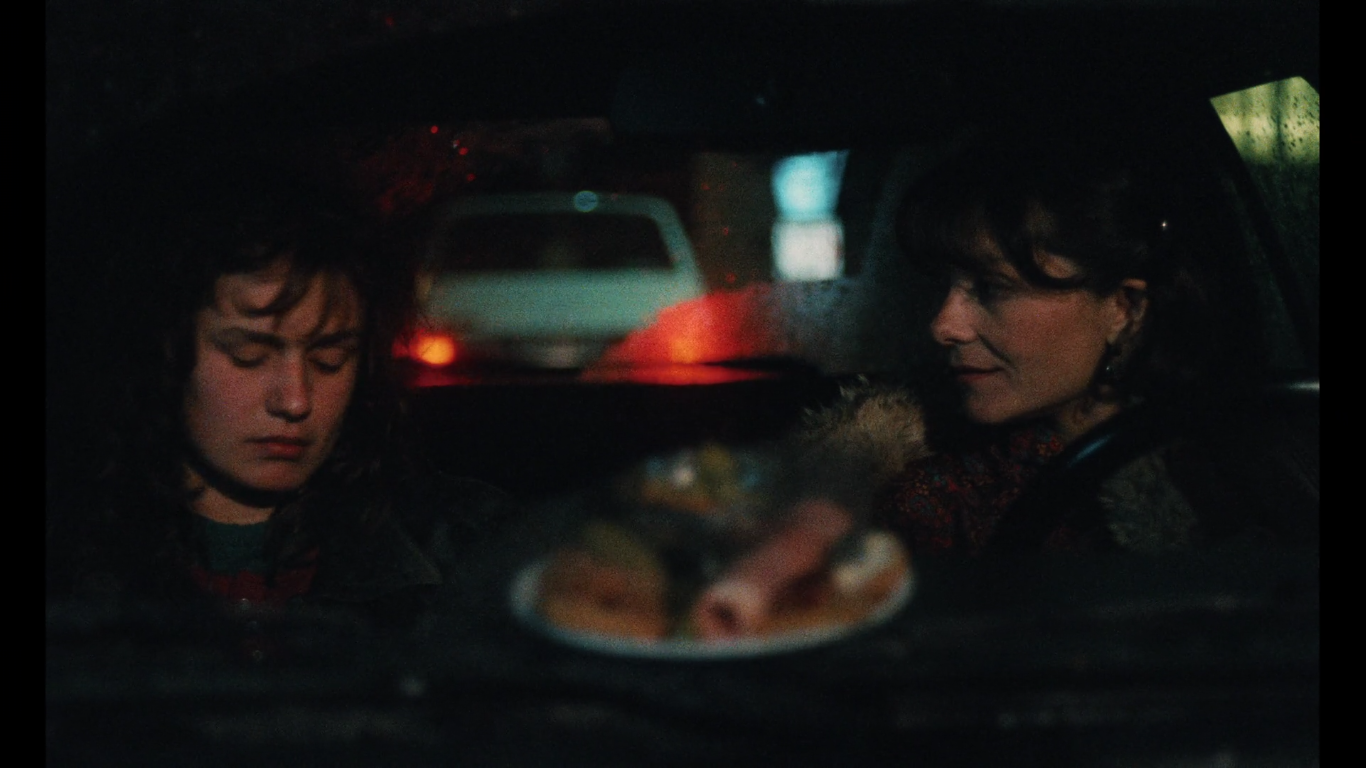
Vagabond (or Sans toit ni loi, in French) plays as the sum of a fairly dismal life but not an unworthy one. For those familiar with Agnes Varda’s filmography, whether the penchant for seascapes or her concerted empathy for the discarded, it’s easy to see how this picture fits in with the others. In many ways, it blends her sensibilities for narrative fiction and her later documentary work like The Gleaners and I.

However, from a storytelling perspective, Vagabond also plays as her Citizen Kane, except she sets her sight on someone on the complete opposite end of the human spectrum. It’s curious how the paragon of money and power could somehow share fundamental things in common with a proud, young drifter. They feel so isolated and in some sense unknowable because they rarely allow others in.

Citizen Kane is a veritable jungle gym of technical invention and play. There’s never been anything quite like it, but the qualm I always maintained on early viewings is how there’s no connection. Because this is the point. It feels a bit hollow. We never get to truly know Charles Foster Kane because he never really let anyone know him.

The curious thing is how Varda derives so much concern for her subject. If we don’t end up knowing a great deal about her personal biography, it does feel like we at least appreciate her as a ceaselessly proud and increasingly worn-down human being.

I have so little history with Sandrine Bonaire and know only that she made an auspicious appearance in Maurice Pialat’s A Nos Amour (1983). However, watching her is a pleasure; she looks like a more stoic predecessor to Brie Larson.

In many ways, Bonaire’s character informs the structure of the film and so it functions well. She is an itinerant young woman, free and apparently happy with her lifestyle. It’s easy to label her as a vagrant and a loafer. She never holds down a consistent job and maintains a brusque belligerence in the face of others. It makes her fiercely independent, and skeptical about the prevailing philosophies of life.

Through it all, we don’t know where she will go; she fosters these short, finite relationships that have a definite beginning and end, and then she moves on to her next destination. There’s no goal or visible endpoint. All we have is the frame of the story to give us some reference to make sense of her life.

It’s composed of scenes featuring these kinds of visual ellipsis as people she interacted with recount their meetings. Each person views her in a different light, and we must come to understand her in this piecemeal fashion only through the perspective of others.

There’s a bohemian family of shepherds who used to be a part of the establishment but now live a rural, much simpler life taking care of livestock. The closest thing she has to a friend and a saint is a beautiful academic (Macha Méril), who has spent her life researching a fungus brought over during WWII that is slowly killing the local trees. She has a conscience and a warm spirit. Far from deterring her, the girl’s standoffish nature of cigarettes and glowering glances only seems to bring out greater adulation. There’s a hint her benefactor feels it too.

A Tunisian farmhand with a welcoming spirit is another person of generosity in her life. They seem to have nothing in common, and yet they bond because they have shared a similar experience of the world as perennial outsiders. He’s the only person she actually shares her birth name with: It’s Mona.

But our protagonist opens herself up only to get hurt. He offers to let her stay in their quarters and help take care of the local vineyards. It’s another brief promise of something beyond a drifter’s life, however small. Still, upon his coworkers’ return, they’re not agreeable to having a woman in their midst. She’s forced to push on again. It’s the life she’s used to, and yet the circumstances make the moment a far more painful point of departure.

There are signs that this is not sustainable no matter how romantic it might seem. Mona befriends an old white-haired lady slowly dying in her grand estate after posing as her maid. Would Mona have been a friend of Charles Foster Kane? This is the closest thing we have to answer, although it too becomes a closed door as the woman’s only kin, a young nephew is anxious to get what’s coming to him.

In a bit of serendipity worthy of Varda’s husband Jacques Demy, there is a kind of interwoven fate to these relationships as some of them begin to fold over on one another and interconnect with Mona in the middle. But this must not be mistaken for Providence.

Her lot becomes increasingly bleak, and there’s obvious intent here. There’s no other place to go. Whether Varda failed to show them before or not, I started to notice the makeshift carpet shoes Mona wears on her feet. She feels all the more pitiful falling in with dubious company and beginning to drink more.

She’s also accosted by some local practical jokers who run about town throwing paint bombs in a mad show of anarchy and artistic expression. There’s no rhyme or reason to it per se, although it leaves her more disillusioned and covered in brown paint that makes her look even more feeble than before. Then, a fire takes her belongings, and she must flee in the wake of an angry confrontation. She’s offered no respite.

At once such a proud and independent individual, she looks so dejected when we finally leave her shivering in her blanket trying to stay warm as a dog barks at her from right outside. It does feel as if the window has closed for her. She had glimpses of other lives and yet they all amounted to nothing. And she is left with nothing.

Freedom is such an exhilarating thing, not being totally beholden to the strictures of the world around us. But it’s equally terrifying being cast out into a life where we have no one to care for us, no one there to love or be loved by. Here again, Vagabond and Kane are so closely related. Whether we die in a luxurious bedroom or a ditch by the roadside, it doesn’t much matter. The outcomes are the same. There’s something ultimately deceptive and debilitating about their respective freedoms. It’s not freedom at all.

4.5/5 Stars

Le Bonheur (1965): Varda’s Sunshine Horror Film

The aesthetic of Agnes Varda’s Le Bonheur is strikingly deliberate. Her title cards are filled with sunflowers. All her characters — members of a lovely little family — wear a rainbow of colors. There’s a verdant gaiety to the forest landscape around them. The score comprised of the buoyant elegance of Mozart does wonders to accentuate this very salient mood. In short, it’s gorgeous. Surely this is happiness personified.

In the middle of the 1960s, that turbulent time of upheaval and the nouvelle vague, it deigns to be domestic and cheerful in a way Godard would never dare and Truffaut could only manage through a boyish point of view.

But it has such a vibrant and daring color palette on par with anything in Contempt (Bardot included), Pierrot Le Fou or Weekend. In fact, this could very well be her answer to a glorious Jacques Demy musical (her husband) and a predecessor to Stolen Kisses and Bed and Board.

The couple’s children are adorable as they toddle around, ride in the back of the family truck or feed sugar cubes to their daddy’s horse — the bicycle he rides home from work every afternoon. Like any young kids, they like to imagine, they’re enthralled by a newborn baby, and they take naps (under the mosquito netting their mother puts out in the forest for them).

By this point, the movie could feel sickening and twee, but there’s an impulse to see the movie out and where it might go. It leaves some questions about a dramatic situation with its title (especially with how fiercely unironic it resolves to be from the outset).

When they return home to their idyllic town, it’s little different. True, the husband, Francois (Jean-Claude Drouot), wants to see a western at the cinema — a prototypical American film. His wife Therese (Claire Drouot) is enchanted by a French film, the first pairing of “[Bridgette] Bardot and [Jeanne] Moreau.” Otherwise, they seem perfectly aligned, going to work and raising their family together.

This all quite effectively lulls us into a false sense of security. Varda knows quite well what she’s doing. As an audience, we want to believe this is what life is like, but we are privy to a movie and so something must change…If there is a source of drama, it’s when the man starts to flirt with a local telephone operator Emilie (Marie-France Boyer). Even this tête-à-tête is light and affable. They feel innocent enough. Hardly prepared to wreck a home.

His wife and his lover aren’t mirror images exactly — they look different — but Varda does very little to distinguish their visible traits (ie. blonde vs. brunette or juxtaposed costuming choices).  They’re both pretty young blondes, affable, draped in bright colors. It feels like a curious coincidence until it builds into something more.

This trifling love affair morphs into exactly the kind of circumstances the exterior does its best to dispel. Surely infidelity does not have license to break into such reverie and tear a family apart. This does not fit with the perfect marital equation or the glorious mise en scene.

So we begin to discover a kind of perturbing even disheartening dissonance about the picture as it continues to break with reality. It builds and begins to ambush us with new contradictions.

Here is a man deliriously happy, both with his wife and then with another woman. He assures his new love, “I have enough joy for both of you. Happiness works by addition.” Then when he cordially breaks it to his wife he says, It’s as if he has 10 arms to love her and he has extra arms (to love someone else).

It doesn’t matter how emphatically or candidly he says those words. They come off poorly. Even as he continues to live in his rapturous dream world without consequence, for the first time the words ring out in the landscape with an inherent hollowness. It’s yet another signal of paradise lost. We have hit upon a point of no return.

Le Bonheur is devastating in a manner that I never would have imagined. Because Varda finally does allow the film’s glorious bliss to crack even if the tone and coloring never waver or fade. The way the young carpenter relives one horrifying moment over and over again in front of the camera feels reminiscent of C.S. Lewis when he wrote about grief and how “The same leg is cut off time after time.”

However, now we have a suspicion of where it might go. The final few minutes of Le Bonheur are not a total surprise; they do feel like a shocking betrayal of our initial assumptions. This is not a criticism; it simply shows how effectively the movie evolves over time while maintaining a certain surface-level palatability. It’s ceaselessly beautiful to look at even as the currents turn.

Whatever its reputation, Le Bonheur feels commensurate with some of the most unnerving psychological horror films and thrillers I’ve seen through the ages. I think of the uneasy denouement of Gone Girl or the unsettling conspiracies in Rosemary’s Baby or Get Out. The curious part is how the perpetrators have no idea what they have done. It’s not a film of premeditated plots, more “happy” accidents, and this in itself is terrifying.

Because we have the same set dressings, the same motifs — almost everything feels the same — but we have an entirely different context. If we’ve settled back into a comforting equilibrium, then something almost imperceptible grates at us. Something has soured with the happiness set before us. It establishes a level of disquietude I won’t forget for some time. Surely something is not right here. I leave it to each viewer to reconcile it for themselves.

4/5 Stars

A Kiss Before Dying (1956): Technicolor Noir

A Kiss Before Dying signals its intent with a score befitting a light musical or frothy romantic comedy headlined by youthful heartthrob Robert Wagner. For the uninitiated, the story is based on Ira Levin’s novel and remains all but prepared to plunge into the depths of deceitful drama. This happy pretense only remains for an instant.

The first scene of Gerd Oswald’s picture is between two people we would come to know quite well. Joanne Woodward is turned away from the camera and the handsome profile of Robert Wagner is on full display. They share an intimate conversation as she bawls, and he tries to comfort her. The word “pregnant” was a trigger in 1950s society and so much of the dialogue dances around, but the point gets across clearly enough.

This young woman has gotten pregnant, and she’s not married to her young man. They’re still in school. If you’ll allow me the first of many comparisons, Bud Corliss (Wagner) feels like a less conflicted take on Monty Clift’s protagonist in A Place in the Sun. As a sociopath and a man of ambition, he is an even fiercer aberration of the Horatio Alger archetype. He has no intention of remaining with this girl even as he continues to soothe and placate her.

It’s true that premeditated collegiate crime feels so involved in the 1950s. There’s no worldwide web so Bud nabs a book from the school library on toxicology and sneaks into the chemist supply room to mix a deadly cocktail for his girl. His objectives are explicitly clear.

Mary Astor is almost unrecognizable a generation after her greatest successes as Bud’s mother, but she’s still got spunk. Jeffrey Hunter feels a bit out of place in the picture. It’s true his holding court with a pipe throughout the entire movie is not the most believable bit of business for him. If I’m getting my dates right here he is the same year he was cast as young Martin Pawley in The Searchers.

Whether it’s purely bad casting or the fact he gets shoehorned into a convenient role as a college lecturer and part-time police detective, it’s a shame he was not set up for greater success. Regardless of his handsome face, he usually displays an incisive earnestness propelling him into more interesting territory. It plays rather like the inverse of Wagner’s turn here since Wagner pushes past his outward appearance to give us a brooding performance full of palpable malice.

If there is an element of A Place in the Sun in the movie, then the pessimistic adolescent worldview, specifically in the classroom, feels reminiscent of Rebel Without a Cause‘s Griffith Observatory scene. In a brief classroom discussion of man, reconciling predestination and free will and theological determinism, there’s this same sense of young people having no idea what to make of the philosophy they’re being force-fed. At their worst, they totally disregard its bearing on their lives.

Then, Joanne Woodward’s unceremoniously tossed from the picture. One wonders if it’s her early exit or the fact that it was an early film credit that made her rate the performance lowly.

Regardless, the most obvious touchstone going forward is a bit of Psycho. The intrepid sister (Virginia Leith) of the deceased starts by joining forces with a man to get to the bottom of the death, though she lacks the plucky fire we might easily attribute to Vera Miles.

As a fairly curious filmgoer, I’m always drawn to performers I’ve never been familiar with before. My own viewing habits have a way of fastening onto new faces that intrigue me — often those who I’m unfamiliar with — but they carry the screen in an impressionable manner. Even in a picture like Violent Saturday, Leith turned an eye with a performance that stood out. Here it’s generally amicable but never electrifying.

The film also has two moments that might be considered dramatic “setpieces,” and they both feel generally corny. They lack the Hitchcockian ingenuity, the unrivaled commitment to the vibrant theatricality of Douglas Sirk, or the impassioned emotion of Nicholas Ray. It really is a shame because otherwise, buoyed by a gorgeous palette, the movie suggests all sorts of kinetic energy.

A lot of it flows directly from Wagner, who is delightful front to back as a conniving devil. I only wish there might have been more of Astor and George Macready and that Hunter and Leith were put to better use. The same might be said of Woodward who was on the road to bigger and better things.

We’ve seen this story done better in so many other forms. I’ve listed many of them off quite shamelessly all throughout my discussion; here is part of the core issue. How can you begin to compare A Kiss Before Dying with all these bona fide classics? How do you even begin to compare it with its source material? Instead, if we allow ourselves to remain present, and invested in the individual experience, A Kiss Before Dying is a tantalizing Technicolor noir.

3.5/5 Stars

Violent Saturday (1955): Richard Fleischer Heist Movie

“It’s so stupid and pointless to be alive in the morning and dead in the afternoon.”

There’s a lovely contradiction in crafting a De Luxe noir in Cinemascope. It’s visually luscious and still shot on the kind of cheapo budget Richard Fleischer was able to make sing early in his career. This fits its ambitions as a bit of a genre hybrid.

The town of Bradenville is butted up against the mountains with a prominent mining industry. They also happen to represent everything that’s good and decent about an American town in the 1950s. Stephen McNally appears to be one of their ilk, just returned to town on business by bus. He chats up the desk clerk at the hotel and settles into his room.

However, anyone with any familiarity with McNally, knows he must have an angle. True to form, he will shortly be joined by two accomplices as they plan out their robbery of the local bank. The train goes hurtling down the tracks toward town with Lee Marvin and J. Carroll Naish.

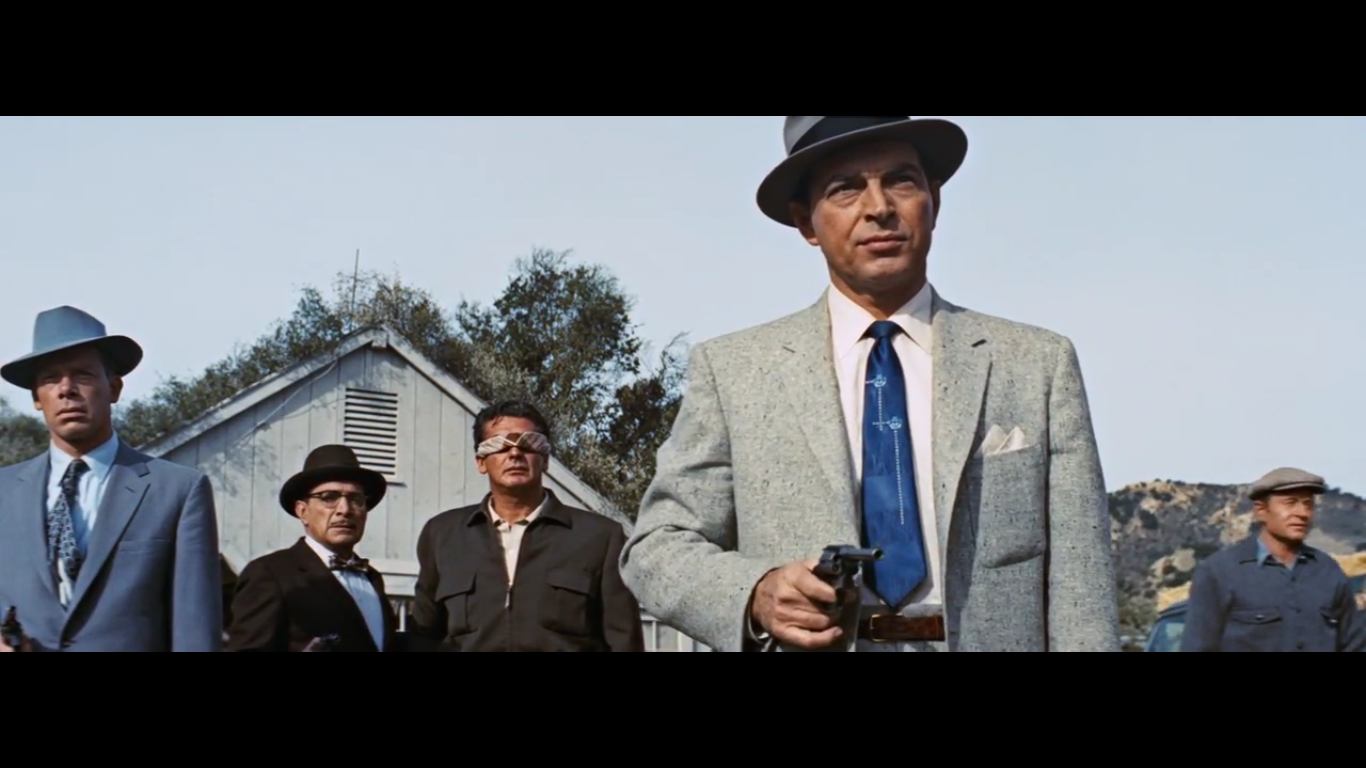
It’s a visual cue that feels rather reminiscent of Bad Day at Black Rock, and in some general sense, the comparison is not too far off base. For one, we have the return of both Marvin and Ernest Borgnine. The former is a sickly thug in gray, who doesn’t go anywhere without his inhaler, while still burning with that typical sadism. Borgnine, for his part, has a rather twee role as the patriarch of an Amish family. It’s true the crucial element of the plot revolves around these three criminals convening in the hotel to case the local bank and lay out their plans to break in.

However, there’s also this sprawling, rather unnerving gravitas to the whole scenario. The story introduces a number of key figures throughout the town, and it does a fine job of building out the world from there to make it feel alive and expansive beyond just a handful of main players.

Bespectacled Mr. Reeves at the bank (Tommy Noonan) holds down a reliable job. Like much of the local male population, Nurse Linda Sherman (Virginia Leith) has his heart all aflutter. It doesn’t matter much what she’s doing. Sylvia Sidney is a librarian who has fallen on hard times with the bank threatening her with punitive action.

Victor Mature is a family man who helps run the copper mines alongside the company manager (Richard Egan), who has a troubled marriage. He spends more time with a bottle than with his wife. She in turn can be found on the golf course with a dashing gigolo (Brad Dexter). It seems ridiculously easy for such a patchwork to feel convoluted and yet it rarely loses itself.

Because the pieces always feel attached and deeply entwined in the town’s buried indiscretions. And I’m not just speaking of the clandestine heist. You have the moment when a thief and a peeping tom out walking his dog meet on the street late at night outing one another.

In another scene, the local siren and the equally alluring wife have it out over the man who now lies in sleepy inebriation on the couch of his gorgeous mansion. These mini-conflicts aren’t the point of the movie in so many terms, but they leave an impression adding up to a kind of tableau that’s ripe with all sorts of sordid bits of drama. It’s a world where children get into fights in the streets and small-town love feels tainted.

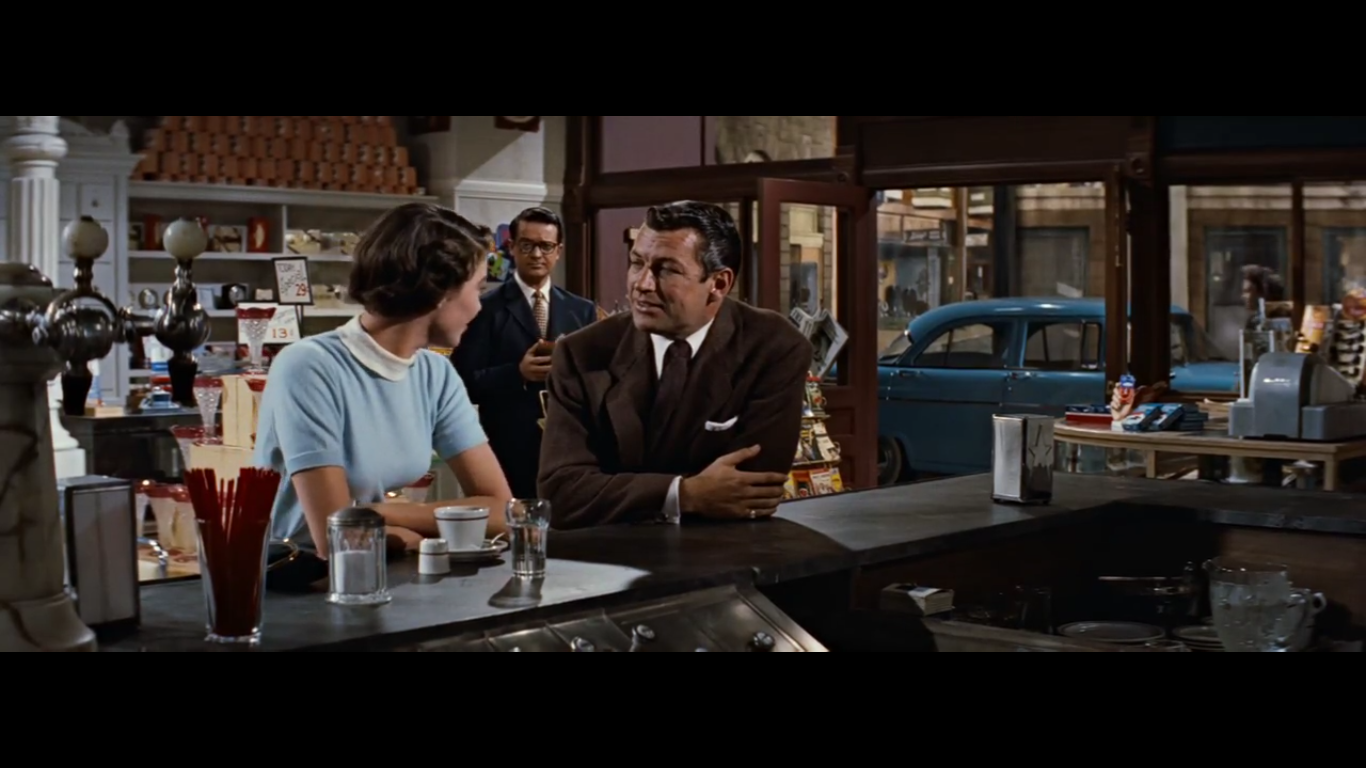
In one of its most sublime moments it takes a drugstore, that beacon of Middle America you often see represented in pictures like The Best Years of Our Lives and It’s a Wonderful Life. They’re a local watering hole of sorts and in this film, it serves to tie all the movie’s various strands together in one moment of choreographed synthesis.

From thenceforward we see it all unfold. The tension is a bit like watching all the plates spinning and not wanting them to fall while at the same time realizing a bank robbery is about to take place. The moment arrives and it gives off all the alarms. However, there are other moments built into it. Take how one of the bank robbers — the bookish one — hands a feisty kid a piece of candy, and it quiets him down. He performed the same act on a train with a group of Amish. These are the types of touches allowing you to recognize the humanity and something beyond the mere cookie-cutter objectives of a movie script.

It’s a horrible thing to realize lives we’ve come to understand if not totally appreciate are not sacred. They too can be snuffed out like any of us. Nor does it desist with the violence. In its day, it was probably deemed graphic. Whether or not that remains entirely true now, Violent Saturday is another one of the old movies that actually lives up to its name as much as can be expected.

Victor Mature and the meek Amish patriarch played by Borgnine must hold their own against the three bank robbers after being locked away in a barn silo. In a different time and place, they might throw out the key that the bandits needed and then they would go their separate ways. However, the very sinews of the characters whether its their religious sentiments or moral fibers, make it imperative that they stand up against this evil even if it’s not the devil himself and only a group of man overtaken by avarice and human corruption. In some small way, they redeem or at least preserve the American ideal. They are projected as heroes to the awe of the neighborhood kids.

The only perceivable letdown with the picture might be the way it wraps up. In some sense, it gives us more than we need in terms of denouement. In others, it leaves us guessing, but even in this, there’s something apropos about the movie sinking back into this status quo of post-war America. It gives the illusion of everything being patched back together like all those folks in the hospital, but you never know what future threats will present themselves. Until then, some men get to live as heroes and others have to grieve irreplaceable losses. It doesn’t seem fair.

4/5 Stars

The Long Haul (1956): Diana Dors and Victor Mature

Although it was distributed by Columbia, The Long Haul is a bit unique from your typical Hollywood offerings. Victor Mature is an American G.I., who settled in England with his English wife following the end of the war. He has a cross-cultural marriage in a post-war landscape and since this is a British production, you have an American as the outsider.

While Victor Mature often comes off as a pretty face, even a plastic one, movies like The Long Haul offer him something to work with, and he gives it an earnest turn. There’s also some audience identification for the sole fact he is one of us (I’m speaking as an American), and if you’ve ever lived anywhere where you felt out of place, it’s easy enough to relate.

The Long Haul is also subtly a movie of family favors. Even as his bride is hesitant to leave her home country for the purported prosperity of America, she gets Harry a job with her uncle’s trucking company. There aren’t many prospects and it’s tough work, but he doesn’t have much choice if only to placate his wife.

It also turns out to be a dirty business, run more like a black market operation than a legitimate business and those with the most brazen tenacity are the ones who get ahead. Right at the center of the racket is Joe Easy (Patrick Allen).

As far as characters go, he’s probably the most intriguing with his lascivious, take-no-prisoners mentality. Again, he’s a heavy not unlike what we’re accustomed to seeing. Still, it’s up to the performer to make something out of it, and Allen has a brutal kind of conviction that makes him a worthy adversary. He’s not the kind of man you want to cross.

Harry does it unwittingly and finds himself thrown out of the man’s office in the presence of his sympathetic moll (Diana Dors). She’s with Joe, and also finagled a job for her brother — he’s off a stint in prison.

Sans the interludes of out-and-out melodrama and complementary scoring, there’s a lot to enjoy about the world in a noirish sense. We watch Mature as he is handcuffed, trapped in a life and a world he cannot get out of, and he finds himself doing a deal with the devil.

He tries to do the right thing, but the prevailing forces against him all seem corrupt. At the very least, the most powerful cogs are handled by the most devious hands. Over the course of the movie, he vies for the affections of the blonde draped in furs. She’s treated like a tramp, and Dors, while not given a whole lot that’s novel, tries her best to make the part a bit more fragile. She does garner some sympathy caught between all the loveless shows of affection.

Although it’s probably the weakest of the lot, it comes out of a solid tradition including They Drive By Night, Thieves Highway, and even Wages of Fear. The Long Haul of course offers its own British flair (if not exactly Liverpudlian).

The beginning of the end comes when he agrees to take one final load. They are racing against the clock whether it be creditors or the police, and they are forced to take the road less traveled. Their giant cache of furs rumbles through the woods, the rocky passages until it’s finally derailed in a stream. As the wheels come off, we’ve reached a tipping point. The uneasy alliance between Harry and Joe is terminated for good.

Depending on how you look at it, Harry is either aided or hampered by a conscience. Despite all the chaos, there is light at the end of the tunnel. He has a taxi with Lynn headed to the coast. They can catch a boat to America and begin a new life. But he’s not a selfish man. His heartstrings still tug at him — no matter the state of his home life — he feels compelled to be there for his son. The beautiful blonde watches her own plans crumble around her.

While Mature’s protagonist maintains his own private sense of integrity, it’s crucial in adhering to the tenets of noir. Heartbreak is the only answer, and there’s a dour question mark for an ending. While it’s nothing spectacular nor particularly original, there is some enjoyment gleaned from Mature and Dors being cast as tragic companions. In a cutthroat world, it just wasn’t meant to be.

3.5/5 Stars

Yield to The Night (1957): J. Lee Thompson and Diana Dors

“For the night is already at hand and it is well to yield to the night.”

There’s immediate traction to Yield to The Night’s opening visuals. We look on at pigeons scuttling about, outdoor waterfalls, and Diana Dors’s heels clicking across an open plaza. Of course, we don’t know it’s her.

J. Lee Thompson’s introduction is almost Hitchcockian in how he utilizes the feet as a kind of synecdoche for the whole body distilling the action down to its most basic form. Because soon enough those feet make their way to an apartment belonging to a fashionable woman about to go inside.

In the chaotic sequence that follows, she gets shot in the back as Dors makes plenty sure her victim is dead in her tracks. Her first closeup almost crushes her face or closer still her face overwhelms the screen and she stares down at her handiwork. She’s just murdered a lady in the street. Riddling her in the back with bullets. There’s no doubt that she’s dead as the frenzied onlookers rush to the scene.

What makes the moment so effective is how purposeful it is from the outset, punctuated by this terrifying act of violence. However, what makes it even more startling is the fact we have no context. Is Dors good or evil? Is she on the side of justice or lawlessness?

Surely she has a reason for what she did. We half expect a flashback right about now — this seems like an opportune place if not the most original. Instead, we get the credits and the story keeps on moving forward.

Hilton’s in prison, but whether it’s a sign of the British civility in the prison system or only a result of the movie mills, there’s something rather congenial about the whole set-up. It’s not exactly Buckingham Palace or Balmoral for that matter, and there are bars like any prison, but the wardens, lawyers, and priests who all cycle through seem like generally decent people.

Hollywood alternatives like Caged or even I Want to Live! in one form or another feel like harsher, less forgiving films. The tone of Yield to the Night functions out of its own dissonance. As a fitting development, Mary’s story materializes in fragments, and it actually becomes a fairly absorbing way in which to take in the narrative.

The presumptive flashback actually comes a few minutes later than expected. Mary Hilton formerly worked in a beauty shop. One evening she encounters a particularly jovial client at a club. He’s at the piano when she sees him. His name is Jim, and he gives her the pet name “Christmas Rose.” She became madly devoted to him even as his own demons and self-destructive habits find him dallying with other women.

His primary romantic partner is a rich socialite named Lucy, who remains faceless and nearly unseen throughout the entire movie. For not having an overt showcase, she certainly holds a major sway over the picture as she effectively dominates and cripples Mary and Jim’s relationship. Mary loves him madly, but he can never be tied down to her, preferring the benefits the other woman affords him.

The ensuing bout of voiceover is a bit much, but there’s a pleasant gossamer quality in Dors’s readings — the lightness in her voice — somehow it juxtaposes with her place as a murderess, and in some small way, it humanizes her.

Back in the present, she receives a number of visitors. Her kid brother, a genial lad who is looking to lift her spirits joins their quibbling mother for the visitation. She’s trying to come to terms with how the girl she strove to raise the right way could end up like this.

Mary also gets called on by her husband Fred. He comes faithfully, leaving work to come check on her.  Suddenly it becomes plainly evident the reason they are separated is on account of Mary. He seems like another decent sort of chap, too decent in a way. He bores her and so there is a defined distance between them. It’s depressing to witness.

Finally, there is Mrs. Bligh, who feels like yet another embodiment of all the benevolent souls.  She’s a kindly old lady, a lover of flowers, and a prison reformer. What she also provides is a social conscience. Strangely, all this goodwill from both the attendants and visitors only emphasizes the disconnect between the warmth of all these people and the punishment at the other end of the hallway.

But the final stroke has to be how the movie foregoes any form of serpentine plotting and focuses in on an individual life in torment. It becomes a far more intimate meditation. Mary is caught in a debilitating cycle of unrequited love, watching her man destroy himself for another woman, and it tears her apart. She’s powerless to save him. The only flaw in the picture might be the suspension of disbelief, that is, how likely would someone rebuff Dors for someone else, albeit someone with higher social standing?

Otherwise, as we bide our time alongside of her in the confines of her cell, constant light streaming in, and guards playing chess, we are introduced to her every monotony. It builds a level of sympathy you can attain no other way. Dors is known as a great glamour girl — Britain’s answer to Marilyn Monroe — and yet when we see her stripped of all pretense, it’s a startling and impressive showcase of vulnerability.

In her own words, the actress acknowledged it was “the first time I ever had a chance to play such a part. I was very thankful to Lee J. Thompson for having faith in me. Until then everybody thought I was just a joke, and certainly not an actress to be taken seriously, even though I knew within myself I was capable of playing other roles.”

She exhibited emphatically she was far more than a pretty face by delivering some emotional resonance as well. One is reminded of the telling exchange with the Preacher.

“This day I shall be with thee in paradise. I think those are the most beautiful words in the Bible.”

“If you believe them.”

It sums up her entire experience. He is a man of faith and he burgeons with hope — hope for her, even in death — in spite of her shortcomings in this life. But her conception of the world doesn’t allow her to believe this. All she has is the melancholy and the pain stockpiled from her romantic heartache. Her outlook more than fits the shabby interiors of the film. It’s a dreary world to be privy to, and it’s just as depressing leaving it behind. Yielding is not in her nature. It doesn’t come easy to many of us.

4/5 Stars

The Burglar (1957): Dan Duryea and Jayne Mansfield

The Burglar is instantly established with a pleasing visual geography. In fact, this kind of pervasively engaging visual landscape is constantly being reinforced, and in his first feature, director Paul Wendkos shows off his perceptive eye. Though he was a workhorse in television, it does lead one to wonder how an industry can so easily canonize certain names and so easily forget others.

But let me take a moment to laud the talents of Dan Duryea. He is such a fantastic bulwark to build a film around. He’s never one to garner prestigious fare, but all the pictures he was allowed to anchor have a certain predetermined grittiness to them that makes them feel inherently watchable. By now he’s older and not as sturdy as he used to be. But that face and his demeanor are still very much the same.

Jayne Mansfield had yet to reach meteoric stardom when the film was first made, although it was re-released a couple years later to make a profit off her newfound celebrity. What a stark and thrilling contrast it is to her usual bombshell image in the likes of A Girl Can’t Help It and Rock Hunter. It feels reminiscent of Marilyn Monroe in Don’t Bother to Knock or maybe Niagara.

When glam girls are allowed to be something more than just a pretty face, it can be remarkable because we see them less and less as objects and more like human beings. Their emotions touch us, and they feel real with problems and issues in drab black and white as opposed to luscious shades of Technicolor.

The Burglar is conceived in such a depressing world. It opens with a Newsreel about Sister Sarah a pseudo-religious figure who lives lavishly thanks to the goodwill of some of her faithful benefactors. This subject in itself feels worthy of more dissection, but it’s really only an opener.

We realize of course this is all pertinent exposition. Nat Harbin (Duryea) and his cronies plan to get within the iron gates of her mansion and run off with as much as they can. However, they know they only have 15 minutes to pull the job while Sister Sarah watches her favorite news broadcast. That’s not much time barring any further complications…

It’s such a sweltering opening full of tension and real dramatic heat. Surely, the movie cannot maintain this kind of fervid criminal activity for the rest of the movie. Of course, it can’t and part of this is the function of the story.

They get the loot but now they must wait it out — we watch their nerves and relationships unravel around them — as the authorities begin their search. Except it feels less and less like your typical police procedural. It has more going for it — partially thanks to David Goodis’s script.

The pieces don’t all fit together seamlessly. They sort of bump up against one another and slide into place. It’s not always taut, cogent, or particularly pithy, but there’s an inbred existentialism and weariness dancing around the corners; it’s difficult to shake.

This melds quite well with the grungy, sweaty cinematography that feels suitable for the burgeoning TV market. At one time it can be both claustrophobic and artful in its construction of mise en scene. It’s the antithesis of decadence, but that doesn’t mean the frame isn’t packed with intriguing visual landscapes.

Martha Vickers also gets her second noteworthy femme fatale role a decade after The Big Sleep — too bad she couldn’t be bequeathed more of them. She had a knack, and it’s no different in The Burglar, although she doesn’t show up until well into the movie.

Simultaneously, the manhunt continues and Nat finds himself being tailed by a shadowy stalker who seems to have a far more private interest in what they are doing. If neither one of these threats comes to fruition, then the gang will probably end up imploding out of mutual distaste. Though they work together out of necessity, they also come to loathe each other’s guts, especially in such close proximity under constant duress.

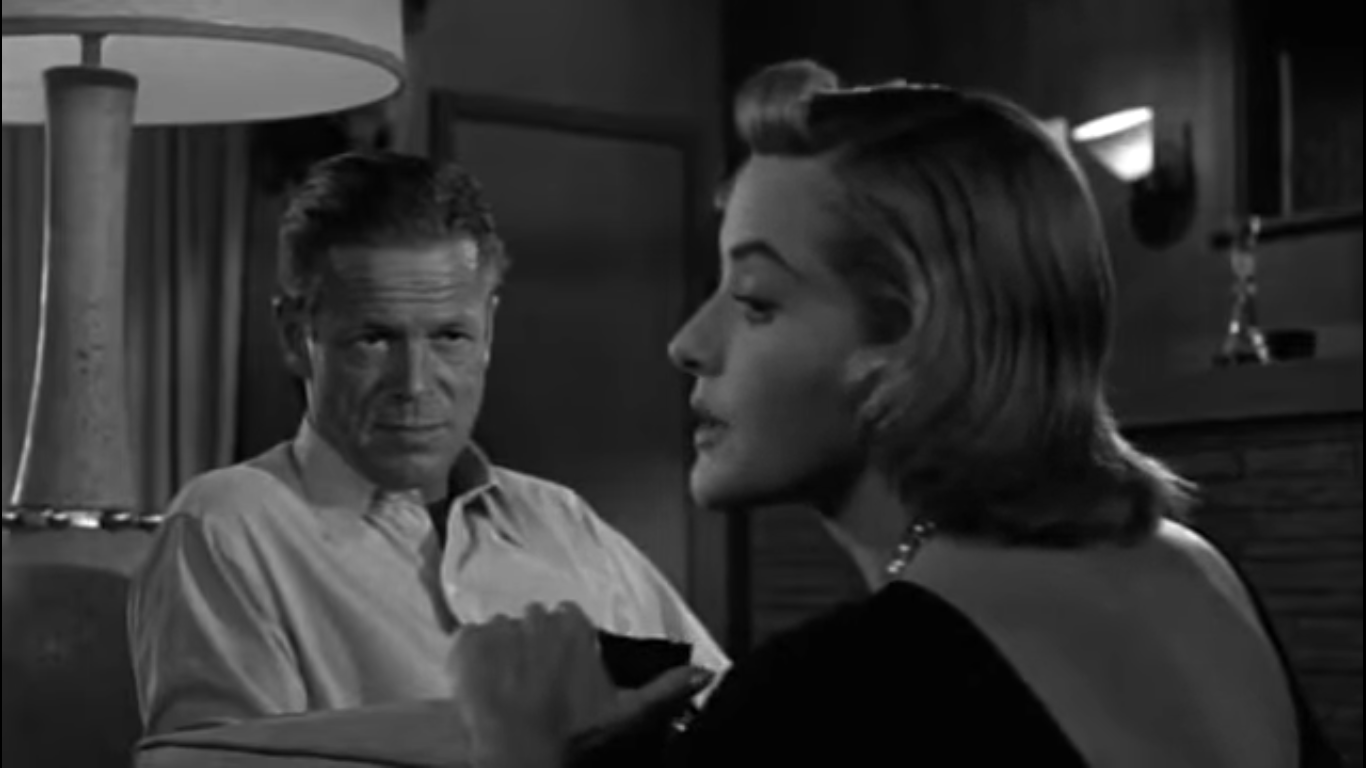
Duryea is protective of Mansfield, but it’s more of an obligation than affection. He’s made a vow now buried in their past somewhere. He sends her off to Atlantic City for her own safety, but as the movie bowls over, he has no recourse to follow her there, regardless of the danger he brings in his wake.

Coney Island-like atmosphere provides a wonderful visual contradiction to play off the criminal elements that hold the impending tinge of noir-filled doom. It uses the shrieks and ghoulish attractions of a carnival show like many of its great noir predecessors — Brighton Rock, Lady from Shanghai, Woman on the Run, and Strangers on The Train all spring to mind. It certainly deserves at least a mention in this company.

Duryea and Mansfield make full use of the place going from the boardwalk to a house of horrors to a water show, and as the benches clear out and they’re left alone in the cavernous space, it signs the end of the story with one fatalistic final act. Of course, it feels like a foregone conclusion. These pictures rarely end another way. The inevitable catches up with them.

But what I will remember indelibly are some of the individual shots. The Burglar has some of the most epic perspective shots I can recall in recent memory. They punctuate the film like many of the close-ups, and we are left with something so resolutely impactful. It feels like a flawed diamond in the rough. It’s the kind of unwonted gem you won’t soon forget even as the blemishes slowly fade away.

3.5/5 Stars

The Sound of Fury – Try and Get Me (1950)

The Sound of Fury opens with a kind of portent. A demonstrative street preacher yells out at the pedestrians walking by to “Prepare to meet thy God and Repent of their sins.” He pretty much gets trampled with all his pamphlets ending up on the ground in a sea of humanity. It’s really not all that important why it happens, but it does show the indifference and the frenzy that so easily overtakes the masses.

Howard Tyler (Frank Lovejoy) is a man down on his luck with a wife and son to provide for and no job. Life has hit the skids. At home, his demure wife (Kathleen Ryan) pleads with him to find work because every day she’s begging for groceries, and trying to make ends meet. With her pregnancy and a little boy always asking his Pop for stuff, it’s enough to make a guy despondent. He feels totally useless.

It’s in moments like these where honest living seems to give you zilch, only heartbreak, and it’s easy enough for decent men to get enticed by evil. It starts innocently enough, and it’s all for the sake of a buck as Tyler gets seduced by the sirens of noir.

I use this metaphorically because what really does it is a meeting in a bowling alley. He goes there to drown his sorrows. Instead, he meets a confident man finishing up a frame named Jerry Slocum. Slocum’s swimming in dough with fine threads and not a care in the world. Howard looks at his life with envy.

Years before Michael Jackson, Lloyd Bridges proves himself to be a smooth criminal. You probably already can see where this is going without it being spelled out. However, in order to make it explicit, Howard signs on as a getaway driver. He keeps the motor running as Jerry cleans out the cashboxes of local gas stations.

Suddenly, they’re both implicated in a life of crime. At this point, there is no salvaging their lives, as they submerge deeper and deeper. They go so far as to kidnap the son of an influential man. This is far bigger than Howard ever dared to imagine, but he cannot get out — not now.

The Sound of Fury looks to integrate a few more characters. Initially, we don’t know how they fit exactly. It’s a dinner party. A man and his wife. They have a house guest and then his editor (Art Smith) from the newspaper drops by. He’s trying to get his top columnist to look into some local robberies. They hold a discourse on the destruction of public health, sensationalism, and social responsibility of the press. It all feels a bit didactic if altogether well-meaning. It also has no power to save Howard.

The kidnappers send out a ransom note and wait. For Jerry, he plays it cool. It comes naturally as he reunites with his best girl (Adele Jergens), an opportunistic blonde who has dreams of leaving her crummy life behind for the exoticism of Havana. She doesn’t care how Jerry bankrolls it; she’s just impressed that he can. They’re like fire and ice constantly scorching each other and making up just as ferociously.

Lovejoy is coupled up with the other girl (Katherine Locke) in the back seat. If not for the fact that he’s already married, they might be a decent match because they both have a similar propriety and quiet humility. Alas, it can never be. Not only because of his family life but they’re also embroiled in a crime that cannot be easily brushed off. There’s no turning back.

When they pull up to a club with the girls it’s almost like watching a film through funhouse mirrors or something with contorted angles distorting the floorshow and all the gaiety on the floor. It’s totally unnerving. This is just the beginning as Lovejoy’s character falls to pieces. He’s not made for this life of duplicity. It unhinges him as he implicates himself and the film begins to run on this wild energy that will see it through to the end.

It’s the final moments of the film where it stakes its entire reputation as we face an onslaught on so many fronts: visual, emotional, and psychological. We watch the masses descend on the courthouse to gawk, condemn and belittle the criminals after they are brought in. There is no quelling the tide of the momentum and from thenceforward the movie gets carried away by the mob.

Evoking the same ardent energy of Fritz Lang’s Fury (adapted from the same source material), it’s a bit like a modern storming of the bastille. The culprits fly through the jail like apes and howling banshees, and the feeble attempts by the police to maintain any semblance of law and order are quickly snuffed out.

Many generations later, The Sound of Fury feels like one of the most obvious pleas against the swells of McCarthyism in the company of more notable indictments like High Noon or even Invasion of the Body-Snatchers. It’s not merely about the narrative speaking volumes, but the resulting effect on many of its cast members. Cy Endfield was soon forced to flee to England, and he would finish the rest of his career abroad.

The great character actor Art Smith — memorable in everything from Ride the Pink Horse to In a Lonely Place would watch a reliable career go down the tubes. Lloyd Bridges was also affected although he was able to find some relief by cooperating with HUAC. So while they weren’t lynched, it was men like these who were given a damning choice.

They could name names or hold fast and commit career suicide, receiving all the ignominy that came with such a choice. Neither could they stop the tide of fury leading to blacklisting and self-exile, and worst still, they probably more than saw the writing on the wall. There’s nothing more terrifying. You see the malevolent forces at work, and you’re powerless to do anything about them.

The parallels between the movie and real life hardly point-for-point between two killers and accused communist sympathizers. What’s relevant is the wide-ranging reaction top-to-bottom, be it fear or this kind of embittered, hate-filled retribution. Suddenly there is no place for civil discourse. Emotions, which are not inherently bad, begin to boil over and dominate the social spheres.

I’m not an authority on the Red Scare or McCarthyism, nor did I ever experience the full brunt of the Cold War, but even as the issues change and the times with them, at our core, human nature always seems to adhere to the same patterns. True, we are predisposed toward avarice and turpitude, but even our battle cries for justice fall far short.

The fact that the movie was released under two titles and never truly caught on or that Endfield is not more of a household name feels like a cruel sign of the times. Watching it now, from its opening images of a fire and brimstone street preacher to the devastating final acts of violence, it’s sure to rattle the cage. Hopefully, now, we’re better able to appreciate it, and heed its warnings on the state of humanity.

3.5/5 Stars

The Underworld Story (1950): Cy Endfield and Dan Duryea

“You know what’s inside of ivy Mike? Little crawling things. You should feel right at home there.”

The Underworld Story is full of these wild narrative beats forming the foundation of a new normal. It’s like playing an unwieldy game of connect the dots. Take the opening scene. It’s straightforward enough. The district attorney and a gangster informer named Turk are injured on the steps of the hall of justice. They didn’t fall down. There’s a deliberate hit put out on them.

But this particular story has no special investment in apprehending these perpetrators with shotguns and a high-powered car. It plays like more of a misdirect than a primary plot point. Instead, the story slingshots to The Times Gazette‘s hard-bitten reporter Mike Rees who is on the chopping block for not withholding a story.

It’s this breaking news flash that got those same men killed. It’s all his fault, and he finds himself blackballed throughout the industry for breaking their unspoken code of conduct. He’s finished — a leper in the industry.

Dan Duryea is nothing if not a journeyman actor. He went through a number of phases even for the uninitiated. I can think of seeing him in things as diverse as The Little Foxes and The Pride of the Yankees (also as a journalist). Then, came the days of ill repute in everything from Scarlet Street to Too Late for Tears. These were his bread and butter, and he fit the mechanics and the malaise of the material like few others.

What’s marvelous in a picture like The Underworld Story is how he gets leading man status — he was an actor of that caliber surely — but he still plays a starring role as slick and unprincipled as ever.

It goes to show he can play either side of the spectrum — good or bad — and it still comes off mostly the same. There’s something in his delivery that makes it always sound like he’s sneering, disgusted with every human being he has the displeasure of running across. The feelings are mutual.

With nowhere else to go, he sets up shop in Lakeville. In an apt bit of exposition, we learn it is home not only to a church lane but also to a church street…and a graveyard. This is the world he’s walking into. He does his best to play the part of an honest-to-goodness, salt-of-the-earth American. He’ll do anything to survive.

In fact, he gets out of the big ocean so he can poison the water somewhere else. In a small pond where the water’s stagnant, all his rancid practices can fester and congeal into pond scum. The humble paper itself is run by Catherine Harris (Gail Storm) wet behind the ears and her faithful colleague Parky who is a veteran, but he’s used to a leisurely, benevolent sort of reporting. Harris wants none of Mike’s local news with a slant.

When the daughter of the local newspaper magnate (Herbert Marshall) is found murdered in the woods, they have no recourse to run the story. Reese is way ahead of it, prepared to nuke the news flash and blow up circulation all around town. It’s the kind of tactics that might easily get him back into the big leagues.

It also occurred to me right when we see the hustling, bustling frenzy around the murder scene, it plays a bit like a B-side to Billy Wilder’s Ace in the Hole (though it does sit on the right side of history having premiered a year earlier). We have some of that media circus going on here albeit in an alternate small-town setting.

The waves of swirling melodrama are the movie at its most overwrought and tiresome. None of this is original or attention-grabbing in the way a good news story might be. It also pushes the envelope on plausibility with these wonky near-nonsequiturs cropping up every which way.

As such, The Underworld Story proves to be a wildly uneven picture. At times there’s so much to latch on to and ruminate over. Other passages of the film feel downright tacky, whether it’s the dialogue or the rather fervent scoring providing a rampant array of dramatic underpinnings.

When it’s grounded in ideas of the press of what it stands for and how it can be used to manipulate and capitulate situations, that’s when the movie sings with something wielding a definite voice.

We watch Reese continually taking advantage of the situation. First, he’s rather comically running up the bargaining price for their exclusive to his liking by juggling two phone calls at once. He’s also prepared to use Molly Rankin. She’s the girl wanted as a suspect in the young woman’s murder.

The Sentinel vows to prop her up, but far from championing her as a symbol of prevailing justice in the town, it feels dangerously close to a trial, with free publicity attached for the paper. Of course, that’s because that’s exactly what it is. The Defense Fund becomes his latest scheme, which actually proves itself to be very successful in earning public support.

Alas, the public is fickle. The local paper starts sinking in quicksand as they meet a media juggernaut and watch Molly lose all credibility. The last thing to be done is to concede and plead guilty. However, Molly comes from a place of integrity — all she has are her personal convictions that she’s innocent and she won’t give it up — even if pleading guilty to manslaughter might actually allow her to keep living. To pragmatic, unscrupulous sorts, throwing in the towel makes logical sense. She, however, must abide by the truth.

Ultimately, Mike pleads with a newspaperman in his ivory tower — there’s actually some genuine concern there for once — but he also gets fingered by the jovial gangster who lays out threats with a smile. Howard da Silva makes an early appearance only to show up later and practically steal the show. It’s not simply about malice; it’s how he’s able to mask it with this kind of menacing conviviality. There’s a dissonance between the threat in each of his measured words and his outwardly cordial manner.

In the end, true to form, Duryea gets the crud beaten out of him, enough that he earns a date with an ambulance at the end of the picture. Even then when his girl steps in to ride off by his side, it’s hard not to consider their chemistry in the moment. They never felt like a couple, at least not to the degree such an action implied. Gail Storm, no fault of her own, is written to flit back and forth between indignation and admiration. She isn’t allowed to really stand on her own two feet.

It’s a final dagger in a movie that’s a bumpy excursion and still a calculated risk for Dan Duryea aficionados. The movie certainly isn’t averse to risks, taking on the theme of a black woman accused of murder and theft. It has a lot of potential, although the incisive edge is neutered by whitewashing the part and casting Mary Anderson in the role, no doubt to placate southern audiences. It’s a shame.

There’s only one last point that I feel compelled to bring up given the historical moment. The Underworld Story oozes Blacklist from the moment Duryea gets forced out of town and can’t win a favor, even from his friends. This is indicative of the story, but we can also consider all the personnel involved. Cy Endfield and Howard da Silva among them would wind up victims of HUAC destined for ex-communication from the Hollywood majority.

Mind you, these weren’t coincidences. People on both sides knew what they were doing. It proves that art really does have an impact on life. I would use the term art loosely with Endfield’s picture, though it does have a certain trashy allure around the corners — flaws and all.

3/5 Stars