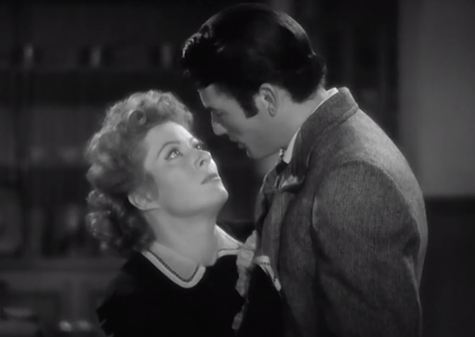
Cheyenne Autumn (1964): John Ford’s Western Swan Song

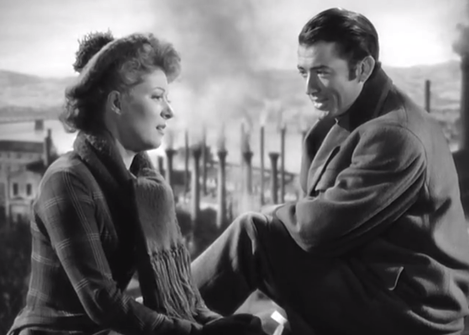
If we had to provide a broad sense of Cheyenne Autumn, it would be all about the mass Exodus of the Cheyenne in 1878 as they journey from the arid land they’ve been subjugated to back to the land the white man had promised to return to them all along.

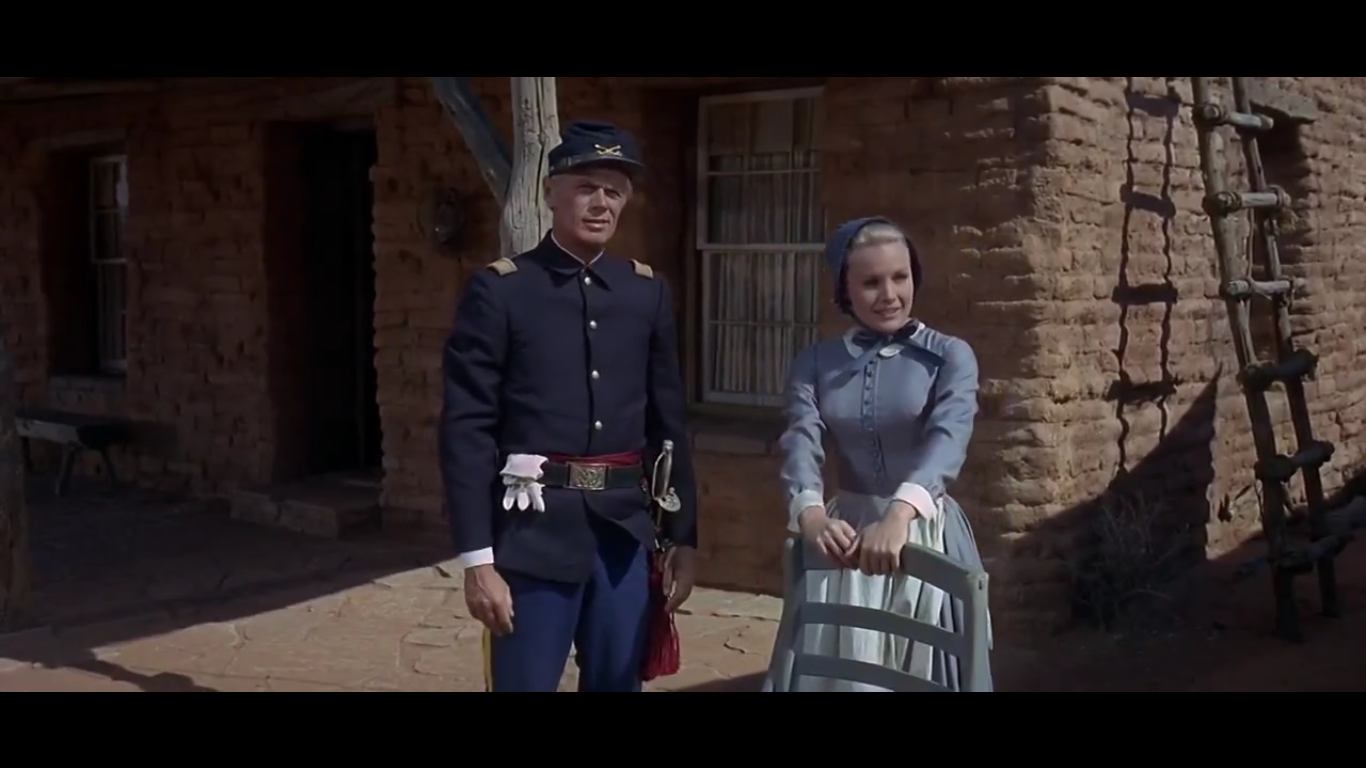
This is a Hollywood rendition so, obviously, it’s not expected to stick strictly to facts nor does it. The extras John Ford used throughout the picture were in fact Navajo, who spoke their native tongue. He also loaded up on a Hollywood cast headlined by Richard Widmark returning after Two Road Together, portraying an officer in the U.S. Army, Captain Thomas Archer, far more disillusioned in his post than his predecessor.

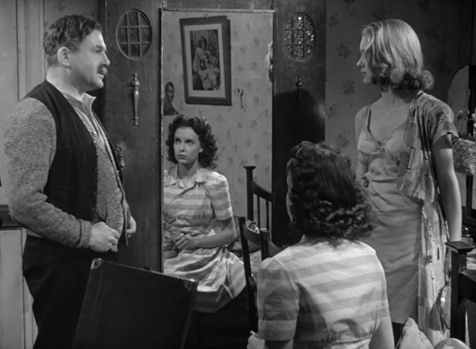
In the film’s opening grand gesture, the Cheyenne make the long trek hours early, in preparation for their meeting with the white man — a meeting that was supposed to come through on a wealth of promises. Everyone is there waiting anxiously at the military encampment. Among them, Deborah Wright (Carroll Baker) and her uncle have made it their life’s work to minister to the Native Americans as suggested by their benevolent Quaker faith.

The only people who don’t show up are the big wigs from Washington, offering yet another rejection and another sign of disrespect. As they leave the encampment, empty-handed once again, there’s in a sense of unease about it. Though the pompous blaggards back east have no concept of their egregious blunder, there’s no question reckoning will come in some form.

This is made apparent and for once in a Ford picture, beyond simply casting a sympathetic eye, the director finally seems to be acknowledging the grievances against the American Indians. Because they have to face arrogant, deceitful men who fatuously believe they have a right to everything they touch. They have no respect for the land, only what they can acquire from it. Soldiers who are supposed to be peacekeepers, as well as tacticians, are equally suspect.

In a fine bit of casting, Patrick Wayne plays a young upstart who has waited his whole life to have it out with the Cheyenne, and the circumstances make no difference to him, even if he has to create them himself. Other soldiers like Karl Malden’s commander espouse unprejudiced mentalities only to be frozen by the chain of command. It proves equally inimical, if not more so.

Under Archer’s command are also numerous steady, career soldiers like Mike Mazurki, Ben Johnson and Harry Carey Jr. To have the latter two in yet another Ford picture is certainly a fitting remembrance. They were as crucial to his work as any of the larger stars like John Wayne or James Stewart (more of him later).

Wagon Master and Rio Grande, from 1950, would be enough for many actors to build a reputation on. Even over a decade later, it’s a testament to this close-knit bunch that they still remained steadfast to the end. These are when the sentimentalities of the picture are most apparent.

In all candor, Cheyenne Autumn is long, at times arduous, but within that runtime, it speaks to so much, including Ford’s own legacy. This is what makes it such a fascinating final marker in his career. Again, it’s the side of the western movie he never truly showed before. It’s as if age has softened him to what he did not see before.

We’re in Monument Valley on the eve of a skirmish. We’ve seen this scene before but from the other side. Native Americans digging in to fight the cavalry on the other side of the canyon. This is not a battle between the heroes and villains but the victors and the victimized.

Whatever flaws come to the fore with a white director making a movie about Native Americans, so be it. They are present, but none of this can totally discount the interludes of natural beauty and deep affecting sympathy on display.

Initially, Ford had wanted to cast some version of Anthony Quinn, Richard Boone, or Woody Strode in the roles of the Indian chiefs. All men consequently had some Native American heritage. The parts of Little Wolf and Dull Knife ultimately were given to Mexican-American actors Ricardo Montalban and Gilbert Roland. The addition of Dolores Del Rio and a wordless Sal Mineo also feel equally peculiar. Mind you, these are only caveats mentioned in passing.

Cheyenne Autumn feels like a glorious mess of a film. It’s as epic as they come and striking for all its splendor; it’s also all over the place in terms of narrative. Perhaps Ford’s not totally invested here. This was never his main concern nor his forte. And in his final western, he does us a service by coming through with what he does best.

What else can we mention now but Monument Valley — the locale most closely identified with him — and yet it could just as easily be turned around and commended as the place he most identified with. Again, we can almost speak in parables because it can represent so many things from beauty to ruggedness from life and then death.

Take, for instance, when the chief elder is finally laid to rest, and the rocks are dislodged to form his burial chambers — off in the distance more of his people ride across the plateaus — it says everything that needs to be said. It is a moment of closure on all the images Ford himself ever captured in his home away from home.

As a short respite, John Ford provides a highly comedic Dodge City intermission with Jimmy Stewart, Arthur Kennedy, and John Carradine among others. You’ve never seen Wyatt Earp and Doc Holliday quite this jocular as they play poker, ride around in a buggy, and help rescue a floozie (Elizabeth Allen) running around with a parasol and a ripped dress.

Now it doesn’t make a whole lot of sense. It would be easy to cry foul for mixing disparate tones and totally flipping the script of the movie. This isn’t wrong, but it doesn’t fully take into account Ford’s intentions. He knows full well what he is doing, using the language of the moviegoing public bred on the epic. It injects brief levity into an otherwise dour picture. In fact, it might be too much levity, although it could make a fine comic western all its own.

Because I won’t pretend the drama doesn’t wear on. The beginning is far more compelling than the end, but the journey is of paramount importance and what it represents. Although Edward G. Robinson plays one voice of reason back east and Widmark plays another enlightened savior out in the field, not to mention Baker’s tireless quaker acting as a protector of the Cheyenne children, they are not all-powerful.

It’s as much a story of loss and failure as it is of tragedy and miscommunication. Again, this is not to say any of this is to be taken as truth and lines drawn in the sand when it comes to what the history books say. But Ford is working the only way he knows how, with the strokes of a painter on this canvas illuminating a story. He is making amends in an imperfect, fragile way. Do with it what you will.

While it’s not the glorious heights one might have guessed for John Ford’s final picture in Monument Valley and his final western, somehow it feels like a fitting capstone just the same. The tone says as much as anything else in the picture. It’s yet another elegy reminiscent of She Wore a Yellow Ribbon and many of his earlier works. Except this would be the last one. It was the autumn of his career as well.

3.5/5 Stars

Sergeant Rutledge (1960): Starring Woody Strode

“It’s alright for Mr. Lincoln to say we’re free, but that ain’t so. Maybe someday, but not yet.” – Sergeant Rutledge

Sergeant Rutledge rarely gets talked about with the greatest westerns or even the greatest westerns of John Ford. Without getting overly effusive with my praise, it should be heralded as an underrated gem worthy of far more scrutiny. History is more than on its side. The movie preceded To Kill a Mockingbird by at least a year while examining similar themes of a black man on trial for rape, albeit through the specific settings (ie. Monument Valley) and lens of its director.

As purely a courtroom drama, it’s probably more engrossing because the other film is just as impactful for its relationship outside the court’s walls. The familial relationship is the core of the story. In Sergeant Rutledge, Ford gladly builds up the atmosphere of the courtroom while allowing it to bleed out and color the rest of his narrative, set against the backdrop of apache raids.

Willis Bouchey stands out as the demonstrative head of the court marshall tribunal, Lt. Col. Otis Fosgate. The turn might be one of his most substantial and enjoyable roles on the big screen. Not only did he have an extraordinary career on the small screen, but he was an often called upon member of John Ford’s stable of actors. His foray in this picture makes it plain enough. Every time he asks for “water” or scolds his wife, it provides instant texture.

Because his wife, Billie Burke, is one of the goody-two-shoes in the peanut gallery, prepared to watch the court case in their finest clothes with their mouths agape and their eyes agog. Meanwhile, the rowdiest fellows stand impatiently in the back smoking their pipes and raising a brouhaha. The judge has enough gumption to clear them all out.

There’s no doubt Ford is in control of the courtroom scenes, from its initial clearing to the subsequent stage lighting to highlight witnesses on the stand. It’s quite extraordinary rather like when Hithcock worked through The Paradine Case breaking the stagnant sequences up with purposeful moments. These are bulked up through substantial flashbacks where we are allowed to invest in the drama firsthand, becoming involved more and more in something that feels like a traditional murder mystery.

The first to take the stand is Mary Beecher (Constance Towers), a quivering young woman who caught Sergeant Rutledge in a compromising and nevertheless now comes to intercede on his behalf, not to accuse him. She recounts how, left in a deserted town, it was the honorable soldier who willfully saved her life.

Next, Fosgate’s own wife (Burke) takes the stand with her usual tittering mannerisms, relaying the last time she saw spunky young Lucy Davenport alive, before she was brutally raped. She came to the general store and shared a conversation with Rutledge. This was no surprise as he was the man who taught her how to ride a horse and practically raised her. To the eyes of all those on the outside looking in, it leads them to burn with indignation.

The dialogue throughout is often curt if not altogether mundane, even overly twee in the lightweight moments, but the scenario itself and Ford’s interaction with it, make it worthwhile viewing. It’s what he’s able to build up around them, devolving into a fairly unheard of exploration of racial tensions on the range. When it gets talky and the message is made obvious, it loses its impact — looking all the more of its time.

What builds a lasting impression are the images — watching the 9th Cavalry of Buffalo Soldiers — appreciating their discipline and fortitude. Surely seeing these representations say enough about how American society treats non-whites, both in life and on celluloid. They are deserving of the same amount of human dignity and not having the burden of proof thrust upon them merely based on the color of their skin.

Because this is what it comes down to. Sergeant Rutledge (Woody Strode) is on trial to be hung, accused of rape and murder. This is not a pleasant affair whatever the outcome might be. As Jefferey Hunter headlines another Ford Western (following The Searchers), he holds a crucial stake in the case as both one of Rutledge’s superiors but also his defense counsel, and, ultimately, his friend.

Woody Strode might be buried in the credits, but there’s no doubting his prominence at the heart of the drama. It’s his stalwart characterization that allows it to stands out from the crowd of westerns from the era — and in Ford’s own lineage — because it gives him a place of cinematic significance. One scene, in particular, is easy to call upon.

In the dead of night, there’s a refrain of “Captain Buffalo” as Sergeant Rutledge stands on the ridge, the moon in the foreground behind him, looking down at his men; it’s only a brief aside, but something in me stopped still because these are the kinds of moments, if you’re lucky, you’ll see in a Ford picture. How do we quantify them? They’re a feeling, a sense, speaking to so much of who we are and what our country means. It’s history, both rich and also riddled with honor and disgrace. I look at Rutledge and I’m proud and a moment later ashamed for how a man such as this is treated.

Woody Strode was used quite well by John Ford on several occasions; he gained some repute for his role in Spartacus; but to my knowledge, he never had a role more extraordinary than that of Sergeant Rutledge. It’s indicative of the industry that Strode — once a football star alongside the likes of Jackie Robinson — was never a bigger movie star.

Here is a picture that allows him the opportunity to show his talents, and he does so with unsurpassed strength and dignity. Captain Buffalo, as eulogized, is a mythical figure surpassing John Henry in his larger-than-life gravitas, and Woody Strode is as close as we could have gotten to seeing him in the flesh.

Part of this is the man himself, quiet yet formidable, and of course, Pappy Ford does him the greatest service. He allows him to be great and sets him up in such a sympathetic yet empowering light.

I’m glad we have this movie, and I’m delighted Ford had the guts enough to make it. Woody Strode deserved many more pictures like this one. For that matter, so did the eminent Juano Hernadez and all these men. It has to do with what this film represents.

We rarely get to see eulogies to the Buffalo Soldiers and this one is as good as anything I’ve ever had the pleasure of experiencing. It’s captured as only John Ford can do it — enamored with the American myth — while still beholden to our own hardened reality. To come to terms with both is one of Ford’s great gifts.

4/5 Stars

Two Rode Together (1961): The Community of a John Ford Western

With such a robust body of work, it’s no surprise John Ford often gravitated toward certain images to represent the West and Two Rode Together is little different with the director returning to familiar iconography. This time it’s Jimmy Stewart, not Henry Fonda, propped up against a railing with his feet kicked up casual-like.

As an aside, my mind wonders if it was Ford who made actors reputable because of his pictures, or were his pictures made better by the memorable actors — the John Waynes, Henry Fondas, and Jimmy Stewarts? Because it’s true they left an indelible mark on his filmography as he did on their movie careers. It’s not altogether surprising that the greats would get together — with their talents coalescing — since they were made greater through collaboration.

In this picture, Guthrie McCabe (James Stewart) is the town’s Marshall. He has a fairly cushy life to lead and his reputation does all the talking. Thus, he can live in relative peace. He has his drinks brought out to him on the veranda and the only grief he gets is from Belle (Annelle Hayes). The tough-talking, deeply perceptive proprietor runs the local saloon, which remains all but empty during its off-hours.

A group of Cavalrymen rolls into town done and dusted. McCabe welcomes them in and reconnects with one of his pals: Lt. Jim Garry (Richard Widmark). What becomes evident is how friendships exist outside the confines of the movie. This in itself is powerful. The reason they came to town was actually for McCabe. They have orders to take him on the 40-mile jaunt back to their outpost.

We still don’t have a point or a reason — an inciting incident for the movie — but by this point in this career, maybe Ford doesn’t have to explain himself. The secret to his success is making us revel in the experience, and I’m not just saying that.

There’s a camaraderie, a good humor, and a beauty in being thrust into his world. He obviously takes great care in photographing it, but he also cares deeply about his players. Hence the reason he always held onto his tight-knit stock company.

One of the defining moments plays out in an extended take with Widmark and Stewart sitting at the water’s edge. It’s the essence of the movie in a nutshell as they smoke cigars, chewing the fat, and enjoying one another’s company. The moment gained some notoriety as Ford, in his typically tyrannical manner, made his cast and crew work in the icy water all day rather than have a simpler set-up. However, the extended nature of the sequence adds to the relaxed atmosphere. Time slows down for even a few minutes.

The story arc itself isn’t much good or at least it pales in comparison to something as incisive as The Searchers that culls the depths of revenge and human vindictiveness. None of this is surprising. Stewart finds himself dealing with folks holding out that their loved ones, abducted years ago by the Comanche, are still alive and capable of being rescued.

In what feels like a holdover from his pictures with Mann, Stewart is individualistic and more cynical than some might initially recall. His explanation of what Comanche do to white men — a young woman’s little brother — is enough to make the girl squirm with grief, and there’s no tempered dose of sympathy in any of his words. He’s not aiming to assuage fears and play savior to a bunch of people.

Against this, you have the typical broad comedy. In this case, Ken Curtis and Harry Carey Jr. vie for the affections of Shirley Jones only for her to dump a liberal amount of flour in their faces. Widmark sets up an equally comical duel for the hand of his girl only to have Andy Devine come to his rescue, essentially bodyslamming the rivals into the drink with his substantial girth.

Still, it does revert back toward its dark and bitter inclinations. Stewart and Widmark make contact with the Native Americans, but completing their mission supplies only small comfort. They bring back one feral youth raised by Comanche and a timorous senorita (Linda Cristal) who was the wife of one of the buffalo warriors (Woody Strode).

Both become social pariahs to be gawked at for different reasons. For the woman, though her life was harsher, she was treated with more respect, and with more dignity, by the Comanche.

The showcase for all of this to play out is the typical affair cropping up in all Ford’s Cavalry pictures with a dance put on by the military at the outpost for all the soldiers and their wives. It’s a sumptuous event. However, Ford effectively subverts the usually sensible, civilized space creating the most traumatic of moods. Here even this kind of life-giving community has been sullied and soured by human bigotry.

There are few places to hide as prejudice is expressed so perniciously out in the open, between whispered gossip and disparaging looks. Meek Elena (Cristal) stews in it all under the weight of all their sidelong glances, cringing out of her skin. She knows she is unwanted, that she doesn’t fit in, and frankly, it becomes the most heartbreaking scene in the picture.

Oddly enough, the bookends of the story are probably for the best, consisting of the vistas and the world they help to accentuate — the journey and how we got there, opposed to the actual particulars. You wouldn’t be wrong in observing Stewart and Widmark are too old for their parts, but it’s easy enough to stop caring and drop it altogether. What they provide to the movie is something else.

Because even as Ford literally called the script “crap,” and it’s true the tale’s not exactly the most cohesive, taut foray in storytelling, between the actors and director, there is so much bounty to be appreciated. There are also some lingering questions. What will happen to Shirley Jones and Widmark? We hardly know if the Comanches have been satiated. Then, Belle Aragorn is back, and it feels like a whole different movie was going on with her and the deputy while we were away.

Still, we end up with Stewart propped up against that railing once again and my mind couldn’t help but drift back to my opening thought. Ford and his actors collectively made stories richer and more vibrant so they could add up to something more than fragments of narrative strung together. They operate on different levels, bringing together all these bits and pieces of pulchritude, relevance, and meaning.

Two Rode Together is downright venomous at times, but it never loses sight of its prevailing good-humor. With the likes of Andy Devine and Jimmy Stewart holding down the fort, how could you not? And all of this is very much in keeping with John Ford.

Ford was a paradox — the inexplicable cipher to the end — who played both the taskmaster and also deeply loyal friend to kith and kin. It’s that tension that holds this picture together. For all the hell he put his stock company through, he’s also the very same man who shut down production for a week so he could set up funeral arrangements for one of his dear friends: Ward Bond.

It’s quite simple, but really all you need to know about this picture and John Ford is in the title. It’s not about the individual so much as the collective unit. Only then do we get humor and progress and friendship. As much as he might have masked it, he desperately needed other people, and his films reinforce this.

3.5/5 Stars

Elmer Gantry (1960): Sinner & Saint

“You not only put the fear of God into them, you scared the hell out of them.” – Arthur Kennedy as Jim Lefferts talking about Elmer Gantry.

Elmer Gantry opens with a disclaimer, which no doubt plays as a defense tactic against the National Legion of Decency. However, taking a page out of some of the gangster pictures of decades gone by, while the filmmakers don’t condone the behavior, they find it within themselves to represent it. The caveat reads like this:

We believe Revivalism can bear some examination — that the conduct of some revivalists makes a mockery of traditional beliefs and practices of organized Christianity…Freedom of religion is not a license to abuse the faith of the people…due to the highly controversial nature of this film, we strongly urge you to prevent impressionable children from seeing it. 

Elmer Gantry is really the brainchild of writer-director Richard Brooks although it was adapted from the eponymous short story from years earlier by Sinclair Lewis. If you allow me to use the term, the picture boasts an embarrassment of riches, with actor-producer Burt Lancaster headlining, revered cinematographer John Alton, and the music of the much-esteemed Andre Previn. In most regards, they do not disappoint.

For his part, Lancaster delivers his most ingratiating, charismatic street preacher act. He seems to understand the inner anatomy of the character even as he seems to embody bits and pieces of Gantry himself. If you recall Robert Mitchum in Night of the Hunter, Lancaster does his own rendition or for that matter, he shares some small resemblance to Lonesome Rhodes from A Face in the Crowd.

By day, he makes ends meet as a traveling salesman — a tramp in a silk shirt — with a penchant for booze, women, and tall tales. As he sees it, his real calling is as a “Man of God,” though his definition seems pretty thin. Still, in the grassroots world he lives in, if you’re compelling, carry big ideas, and have a sprinkling of the Good Lord’s holy scriptures hidden away in your heart, it goes a long way.

Is it just me or do Lancaster’s eyes have a certain lecherous glint to them? It seems to rise up in him unsolicited, whether singing a gospel spiritual, looking around a big revival meeting, or quoting passages of scripture with extra panache. It’s true; he knows the hymnal by heart and the scriptures like the back of his hand, or at least just enough to use them effectively.

He gives us a little taste of his magnetism on one fine Christmas night, interceding on behalf of some Salvation Army charity workers as they call on the good graces of his fellow bar mates. However, after taking on a cattle car full of hobos, he ends up lugging his suitcases to the nearest town alongside the railroad track. Regardless of what he tells his mother over the telephone, he’s barefoot and, by all accounts, destitute.

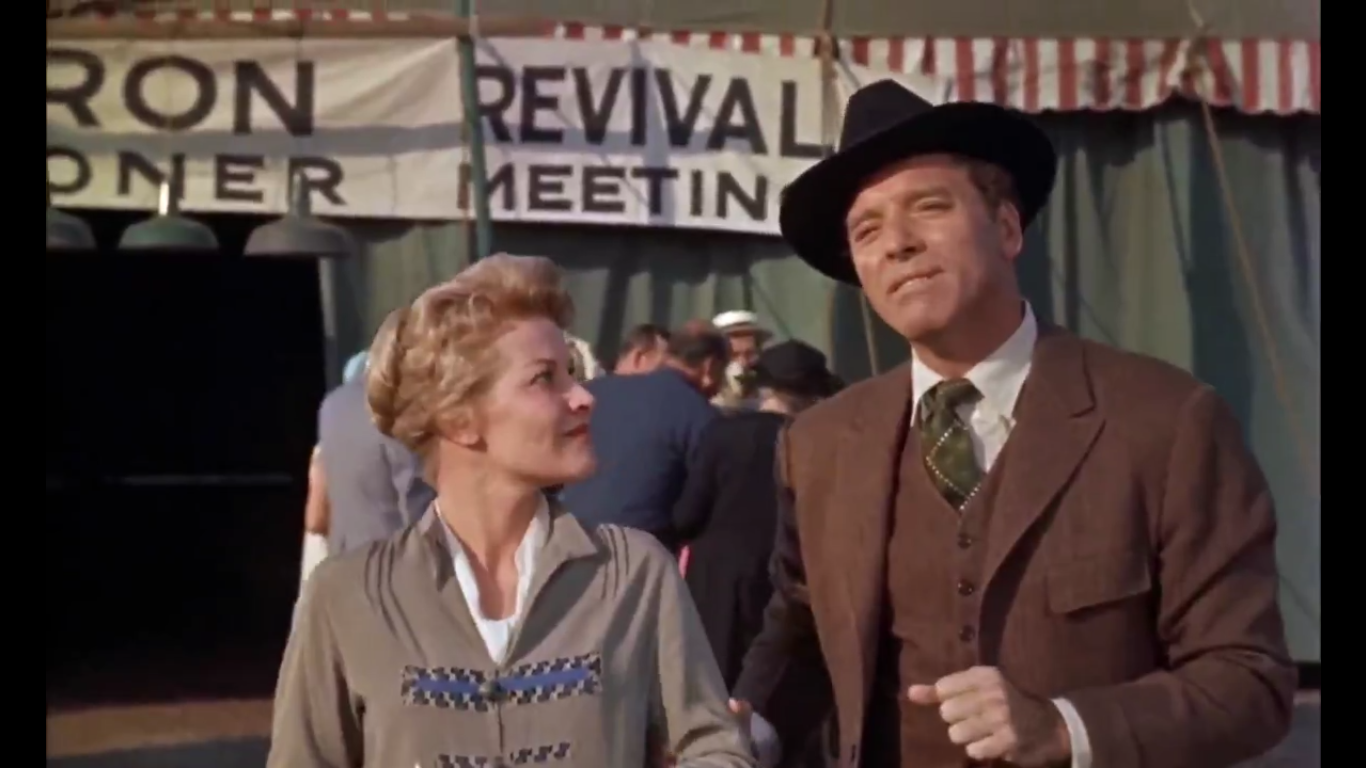
In the very same moment, we catch a glimpse of some prominent signage, “Sister Sharon Falconer — can save you!” If Gantry is our wheeling-dealing main attraction, Sharon is his foil. Jean Simmons plays the role as a truly empathetic champion of the cause, who nevertheless runs her crusade like a business.

Patti Page is one of her devotees with the voice of an angel, while Dean Jagger, her right-hand man maintaining the facts and figures, ensures they stay on schedule. They also have their personal entourage of journalists, including Arthur Kennedy, who make quite sure they get the necessary press support. Everyone agrees she’s quite the lady, and it’s a well-oiled operation as they travel across rural America.

But Elmer takes them to another level. When he joins the team, his impassioned messages make the good people swell with emotion; his sights are on an urban revival. He wants to take religion to the cities. After all, that’s where the money is.

Soon they are courting the community leaders in the city of Zenith and all they have to offer. The name is apropos because it really is the pinnacle of what they are trying to accomplish. If they can succeed here, there’s no question where they might go.

The local leaders and ministers bandy about what they might do about the competition from entertainment industries, diminishing church attendance, and pervasive financial problems. They’re all real-world issues no doubt plaguing the church today and in most any generation. It’s a Mr. Babbit who opines that they need to get the young people back in church and keep the train on the tracks.

Arthur Kennedy might be the voice I appreciate the most. Because Elmer Gantry is born out of a deeply religious context. People have the rhetoric and a certain cultural liturgy down, but if I am aware of anything about Jesus Christ, so many of the people who call themselves Christians, don’t know him. They use his name, evoke his words, and then choose to live by their own standards.

Jim is one of the few characters in the movie who lives as a searcher. He’s still trying to find the answers to life’s questions. In a single moment, he turns the public against the sister and Gantry with his honest, albeit incisive news reporting. However, when he could embroil them in greater scandal, he elects not to. That’s not his game. When he lambasted for his lack of Christian faith, he says his doubt is not blasphemy. On the contrary, it makes him the most honest character in the picture.

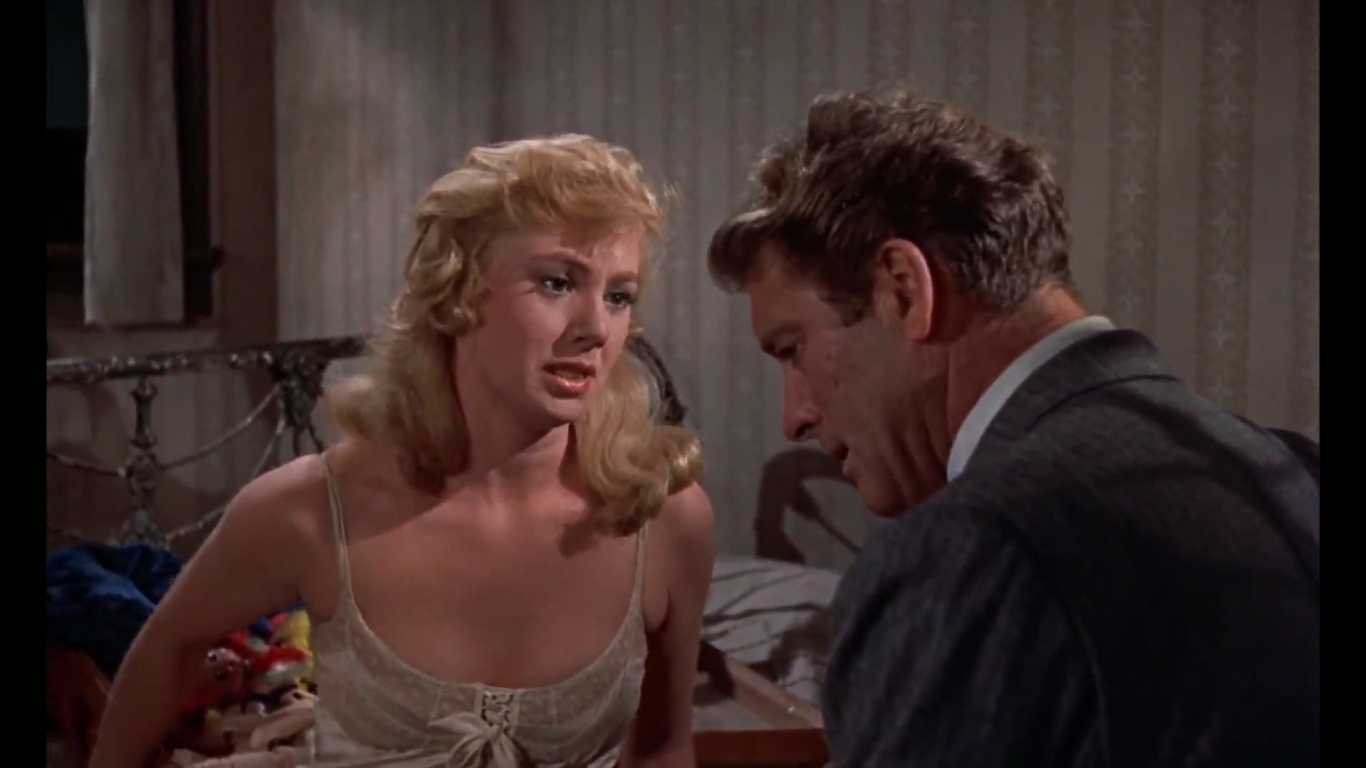
Shirley Jones doesn’t show up until well into a picture and yet soon enough Lulu Banes becomes what feels like the lynchpin character to the whole drama unfurling before us. She lives a life of ill-repute in a brothel, but she wears her profession as a badge. More importantly, she has a history with Elmer Gantry. In their earlier days, Gantry was kicked out of seminary and she was disowned by her ministerial father, for their indiscretions. She knows Gantry more intimately than most, and she can use it against him.

It’s a foregone conclusion that this religious empire must come tumbling down. The images when an ensuing scandal breaks out are some of the film’s most definitive. From the podium he once enraptured audiences, Gantry is pelted by fruit, eggs, and hot jazz under the big top. He’s ridiculed as a total hypocritical disgrace — and in a fit of irony, it’s the single moment where he feels the most Christ-like. No, he’s not sinless and not a saint; he is very human in that regard, but in this moment of immense humiliation, he’s forced to bear the brunt of all the shame.

This is only superseded in the final moments in what feels like a hellish conflagration as the tabernacle bursts into flames. it’s such an evocative image as holiness and hell meet in a fiery inferno with Sister Sharon and Elmer Gantry right in the middle of it. From dust, you came, and to dust, you will return.

Considering the historical moment and Burt Lancaster’s own religious leanings, there’s a sense he intended the movie to be his response to such stadium preachers as Billy Graham.

Lancaster relishes the opportunity of being a louse and also very easily undermining religious thought and rhetoric — telling half-truths and appealing to religious fervor — while conveniently looking after his own ambitions. He slinks his way into other people’s life like a worm (or a serpent) laughing and cajoling and spouting his own brand of religion. His tongue flatters all, and he’s good at it, but he’s always looking to gain something from others. Mind you, he’s not the only one. We all have that tendency.

I am by no means an authority on Graham, but despite any unpopular opinions he had, he was also a very faithful man of God and he had such a profound impact on generations of people, literally, millions of people all over the world. Thus, the parallels to Graham never were of a great deal of interest to me and feel mostly immaterial.

It’s easy to draw out the movie as an indictment of Gantry and to a certain extent maybe it is, but it says something more endemic to our society and our systems. Those people still exist today. Sometimes it’s fire and brimstone and sometimes it’s inverted into a prosperity gospel.

However, then scandals come out, lives unravel, churches schism, and hearts are hardened. We put these religious figures on a pedestal and almost without fail they let us down in some manner. Some have misguided beliefs in themselves like Falconer. Maybe they burn with the human lust and passions of Gantry.

Is it scandalous to say, I rather like him? He seems like a genuine fellow.  Like Sister Falconer, he seems to generally believe what he’s preaching; this I didn’t expect. But he’s hardly a saint. The fallacy comes with building him up to be one.

None is righteous, no, not one; and no one understands. Lefferts is getting there. We must seek after the truth. We would do well to not just cave to feelings and emotions. Still, intellect will only get us so far. We must have ears to hear. Because true wisdom, true discernment, is proved right by what we do. It’s up to each of us to figure out what that is.

4/5 Stars

The Courtship of Eddie’s Father (1963): A Father and Son Story

The Courtship of Eddie’s Father gives off all the signs of a light and frothy romantic comedy. You might envision it already: a widower-about-town with his son playing matchmaker as he tries to navigate the plethora of pretty girls who just happen to orbit around him.

But we must make some distinctions. This is also a film about a little boy and his father after the death of someone very precious to both of them. A wife and a mother. You cannot easily laugh this plot point away, and the movie never does.

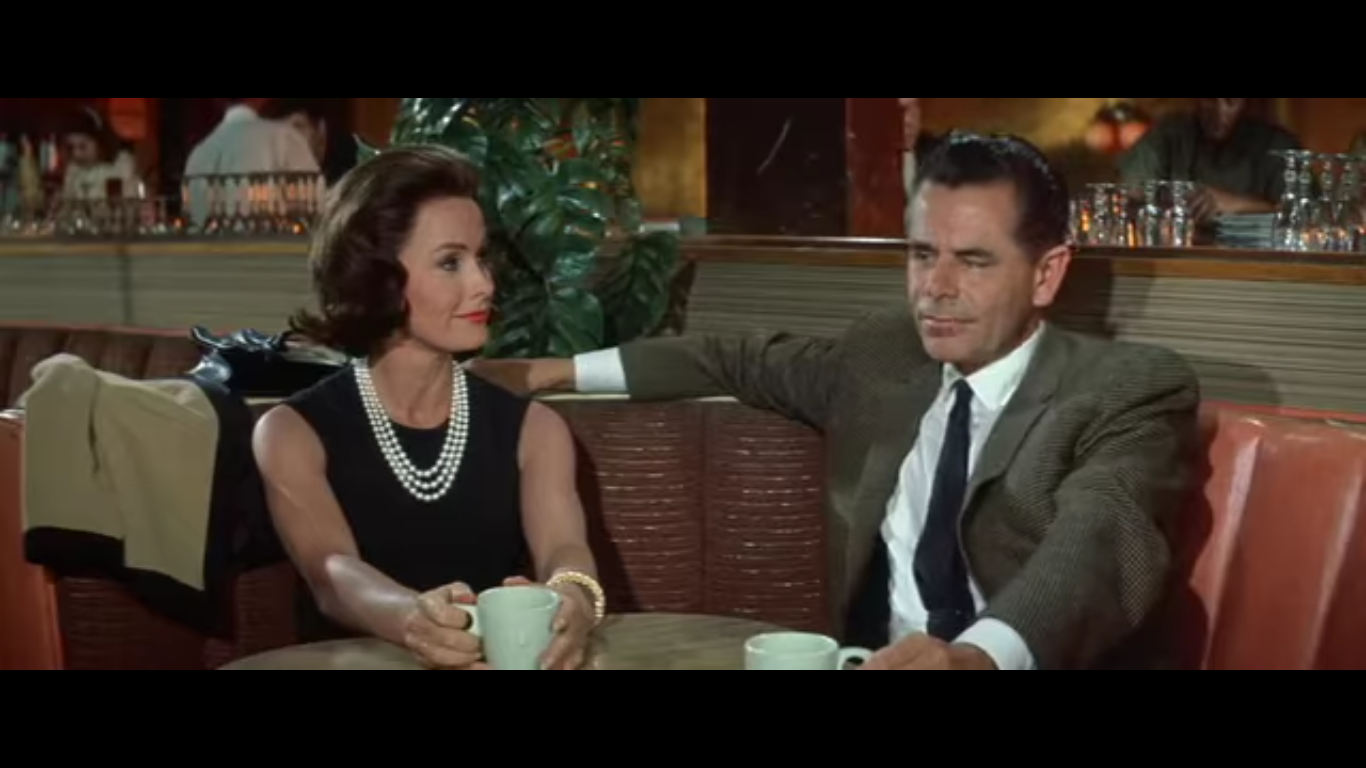
It’s equally important to note who our director is. No one would wager this is the artistic height of Vicente Minnelli, but it’s not a throwaway rom-com either; no matter what contemporary audiences might have been led to believe. I’m thinking most specifically of the scene early on where Ron Howard erupts, bawling over his pet goldfish now floating upside down in the tank. His father storms out of the room to go find his bottle and glass as his little boy is comforted by their neighbor from across the hall (Shirley Jones).

Does Minnelli dare include this scene? It risks feeling overwrought, and it absolutely kills any of the convivial feelings the movie looked to engender. But there are plenty more of those to come, and here we get something actually grasping for some kind of meaning; it’s an attempt to make sense of real-life issues, albeit through the Hollywood guise of gorgeous Panavision Metrocolor. This is Minnelli at his best with substance breaking through his usual lavish photography and expert set dressing.

And yet here is some of the quintessential essence of the picture, daring to be more than meets the eye. We are reminded grief is okay and it is natural — they will both miss “Mommy” — and instead of holding in their feelings, they must be open with one another. It’s the only way they can hope to cope. The whole film is a progression along this theme. Lest anyone get the wrong idea, this is really a father and son picture.

While I won’t say Glenn Ford is as obvious a father figure as Andy Griffith, he still manages the necessary rapport with Ron Howard, and I always do marvel at Howard’s poise for such a young actor. They often tell the stories of child actors who had an expiration date because once their cuteness wore off they didn’t have the acting chops to make it.

Although Howard has transitioned to the director’s chair, I watch him in individual episodes of Andy Griffith or a movie like this, and it does feel like he was capable of range beyond his years. Yes, he’s cute. That’s the easy part, but he also navigates his way through the more labored scenes where there are other emotions. The picture’s always able to fall back on that core relationship.

However, before I overcompensate, The Courtship of Eddie’s Father has plenty of the kind of goofy, at times cringe-worthy, rom-com moments of a certain era. It allows the movie to remain innocent at heart even as it courts other issues.

Take one evening where the two bachelors stop off at an arcade only to make the acquaintance of bodacious Dollye Daly (Stella Stevens). They meet when she asks to borrow Tom’s son for a couple of minutes to ward off the local mashers as she tries to build up her self-confidence. Then, there’s Ford’s colleague at work. Jerry Van Dyke’s flirty radio personality has a habit of proposing dinner dates on the air.

Dina Merrill is a career woman who knows what she wants, and her brand of quiet and mature sophistication is rightfully attractive to Tom. She’s looking for a man to love her on equal terms and despite what her aloof elegance might say against her, she’s another deeply sympathetic figure.

A movie that looks to be about a man and three women actually is at the same time simplified and made vastly more complicated. Dollye and Norman fall in together over bowling. So Eddie’s first choice of partners for his dad falls through. Now to the nitty-gritty. The main tension is between a boy’s feelings and his father’s.

Elizabeth is familiar and comfortable; both a good friend to their deceased mother/wife and an ever-present figure across the hall. She’s a cinematic creation and the kind of person brimming with well-meaning affection. Tom’s feelings for her are complicated. Eddie’s are simple. He feels safe in her presence. There’s a kind of maternal understanding and trust between them already.

Although it’s never stated explicitly, Rita, on the other hand, is attractive because she is so different. When Tom looks at her and spends time with her, he’s rarely reminded of his wife. With Elizabeth, he can’t help but see her. For his boy this is security and for him, it’s a kind of crippling torture. He cannot bear it.

Like any bright kid, Eddie’s extremely observant and precocious in many ways. He asks all the innocently probing questions about how babies are made etc. For him, differentiating cartoon villains from the good guys is a matter of round eyes and thin eyes (along with other salient features).

In one scene, he gives a comical appraisal of Ride the High Country. Meanwhile, for a few brief moments, his father falls asleep to Mogambo‘s screen passion playing out between Clark Gable and the much younger Grace Kelly. I’m not sure if it’s a subconscious reflection of Tom’s own yearning to have the love and affection back in his life. If anything, it’s a striking portent.

His jovial housekeeper (Roberta Sherwood) warns him of such a woman looking to take advantage of what he has to offer. Graciously, there aren’t any such women found in the frames of this picture. A New Years’ party with Rita is lovely, and he comes home late at night in a mild euphoria only to bump into Elizabeth. She had a night out with the same old successful doctor; it’s hardly love.

Later, they hold a frenzied birthday party for Eddie that’s chaos personified with all the little kiddies running around. Elizabeth is right in the middle of the adolescent maelstrom and Rita is absent. Then, as his father grows more serious and Eddie has his heartbroken at summer camp, he makes an irrevocable decision. He runs away and seeks refuge with the one person who makes him feel safe — his maternal rock of Gibraltar. If you follow the dramatic arc, there’s only one place the romance can lead.

Yes, it’s rom-com wish-fulfillment, but I’d like to think there’s also a sense of clarity with the movie resorting back to where we needed it to go. What a lovely admission it is that the women are not the easily caricatured heroes and villains of Eddie’s comic book imagination, nor are they completely trivialized down to their appearance. If anything, we get past the superficiality promoted by marketing campaigns.

It’s a father and son movie, first and foremost, and yet we end up admiring all of them. What a lovely person Shirley Jones is. Stella Stevens brims with unparalleled intelligence, and Dina Merill is blessed with poise. Jerry Van Dyke’s not completely repulsive. If he’s the weakest link, then there are worse prices to pay.

3.5/5 Stars

Dance, Girl, Dance (1940): Lucille Ball and Maureen O’Hara

dance girl dance 1.png

Scanning the opening credits, I noticed two talents on the rise including Russell Metty and Robert Wise, but make no mistake; the focal point in the director’s chair is the criminally-forgotten Dorothy Arzner.

In retrospect, she certainly is a primary draw to this picture because, with the dearth of female personnel actually credited behind the camera within the film industry, she stands as a pioneer for those who are aware. This is a fine starting point.

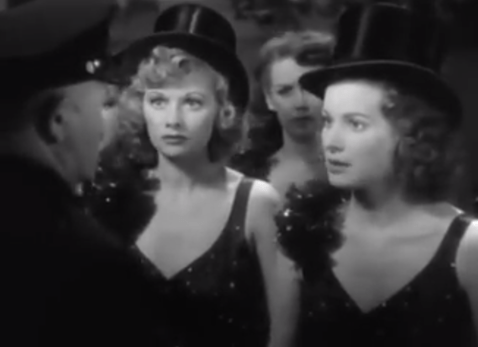
For those drawn to talent more than technicians Dance, Girl, Dance boasts a seemingly disparate pair of heroines in Lucille Ball and Maureen O’Hara, with both women making their living in a chorus line.

In their opening introduction, they are performing in some two-bit, slightly dubious joint only for the place to be raided by the cops mid-routine. It’s a sorry state of affairs as they come to terms with the fact they will not be getting any reimbursement for their night’s work.

In fact, it’s one of their good-hearted, slightly tipsy patrons who puts out his hat to take a collection. It’s not much, but the girls are grateful for his neighborliness. He’s the first of many side characters to drift in and out of their lives.

In the subsequent storyline, our two aspiring performers aptly reflect the two divergent paths with which to tackle a career in such an unstable environment. Bubbles is Ball as a full-on glam girl. She handles the part quite well because with her iconic career in humor, in some fallacious way, it often undermines just how alluring she was as a performer. Here Bubbles is shrewd when it comes to getting ahead and using all her assets to move up the social totem pole — both personally and professionally.

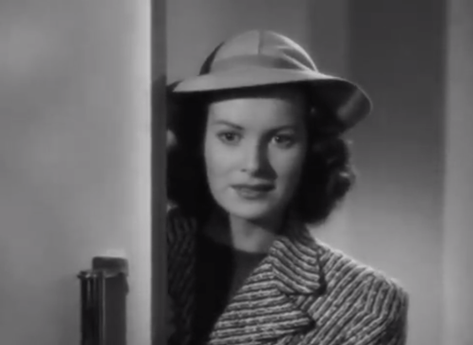
Meanwhile, O’Hara, in only her third Hollywood release (following Jamaica Inn and The Hunchback of Notre Dame), is called upon to exude the radiant exuberance of an ingenue named Judy O’Brien. She’s trying to do dance the right way in a callous world.

As it turns out, Louis Hayward isn’t actually attached to either of them even as they make eyes or have fancies of being with him. He’s currently still connected to Virginia Field. Yes, they are going through a divorce, but there’s still something amicable in their antagonism. Even as they play the field a bit, there’s this ongoing sense they’re still clinging to the thought of salvaging their relationship. It remains to be seen where this separate piece fits in with our two ambitious dancers.

Ralph Bellamy makes his own entrance as a dance impresario, and we also wonder how he figures into the puzzle. Though the man is never quite satisfied with the company’s choreography, he’s still Ralph Bellamy, armed with his usual lanky and unassuming charm. More than anyone else, his perceptive secretary Miss Olmstead (Katharine Alexander) is capable of getting a heartbeat out of him.

As the girls look for work, they are met with the hurdles that come with any profession. They lack transportation, they lack means; no one seems willing to give them a chance unless they degrade themselves in some manner.

Bubbles really starts raking in the dough under her new persona: Tiger Lily White. Of course, she is forced to hold court with a bawdier brand of onlooker, but she more than obliges them a la The Awful Truth’s with a slightly risque “Gone with the Wind” number. It fits her personality because she is, above all else, an opportunist, and this is the easiest, fastest way she can get ahead.  However, running with this personality trait, she also signs O’Hara on to be her stooge to milk the lascivious audience for more.

It’s less an act of goodwill and more so a calculated way to bring Judy down a peg with the rudest of awakenings. It’s the height of indignity for the idealistic girl to be relegated to such a state. Still, she pushes through it with fortitude, throwing aside her initial apprehension only to replace it with renewed determination. It’s in these interludes where our naive heroine matures and comes to terms with the world around her.

dance girl dance 2

One of the most striking elements of Dance, Girl, Dance is how each and every performance reaches out into the audience in some way. It doesn’t necessarily feel like a typical song and dance musical, but it plays up the communal, reactionary elements of film and, especially, the stage.

Even as the plot is strung along and feels flimsy and detached, at times, there’s something rather freeing and appealing about the oddball supporting cast all but drifting in and out of the main narrative as nice as they please. Hayward’s playful feud with his wife Field feels all but an unrelated subplot until it somewhat ties into our main story.

Then, Bellamy and “Ommy” have their own individual, rather serendipitous encounters with the young hopeful Judy, whether in a waiting room, on the lift, or waiting for a bus in the rain. The moments do not mean too much on their own, aside from providing dashes of character. However, as they begin to stack, one on top of another, the interactions create a renewed appreciation for our characters. Even Bubbles, despite her conniving, is a memorable part elevated by Ball’s innate kineticism.

However, the most poignant scene comes to pass when O’Hara does the unexpected. There’s a steely resolve born in her eyes as she walks into no man’s land, into the space of the crowd, and confronts them in their poor, sad little lives. They pay their lousy 50 cents so they can jeer and ogle and go back to their wives and sweethearts and feel like men. There’s no integrity, no strength, nothing worthwhile in them.

The most curious thing is how she wins them over by cutting into the bawdy filth with the sharpest truth anyone’s ever dared to utter in the skeevy burlesque joint. Tiger Lily is instantly out of fashion as she and her stooge have it out because her opener has finally gained her own resolve. She’s not about to roll over and take it anymore. Far from just being a comical image in the wake of this film, it signals a change in the balance of power, as corny as that might sound.

It is the crowning capstone. Our ingenue has grown up. She simmers with fire for the first time, and it feels like we are seeing the real-life fire of Maureen O’Hara. It’s the finest, most definitive moment of the picture, allowing her to finally break out of the demureness initially fashioned for her. Before she had to mask herself. By the end, she realizes her true nature.

In the very same instance, she is able to impress something significant upon her audience, both on the screen and those watching from their theater seats. This continual relationship is Dance, Girl, Dance at its best. It’s not a supernal musical, nor the brightest backstage drama out of the age, but there are some amiable performances fostering a kind of self-reflexive symbiosis. This and its striking perspective on a patriarchal world, brim with a certain agreeable ardor. Lucille Ball and Maureen O’Hara don’t harm its prospects either. I cherish them both dearly.

3.5/5 Stars

Merrily We Go to Hell (1932): Directed by Dorothy Arzner

merrily we roll to hell.png

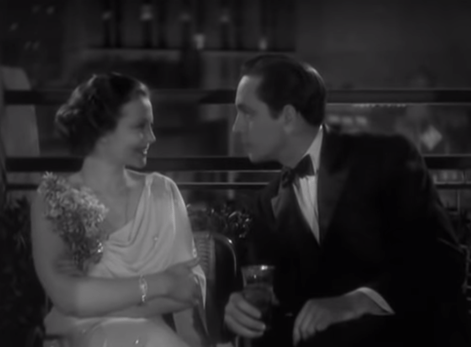
Bubbly is flowing and the gaiety abounds. Alcohol is not an evil, just a tonic to loosen morals, tongues, and dour countenances. When Joan Prentice encounters Jerry Corbett for the first time at a party, she’s immediately taken with him. He’s a few drinks in and has let the merriment overtake him. It comes off charming if a bit dopey.

Merrily We Go to Hell feels like a provocative title, and it’s true this alcohol-drenched drama is a predecessor to the likes of The Lost Weekend and Days of Wine and Roses.

Sylvia Sidney is about as winsomely sweet as she ever was and ever could be playing a socialite at a party. Frederic March has momentary glimpses of warmth and allure, though it’s hardly his finest hour on the screen. However, it is a testament to how phenomenal his career was at points, and even a picture like this seems to suggest how often he is an underappreciated star of Classic Holldywood.

There’s also a third far more surprising presence in the movie filling what might be considered a minor bit part. Cary Grant is all there, but it’s a bit like seeing John Wayne in Baby Face or James Stewart in Wife vs. Secretary. We’re there but not quite there when it comes to their career trajectory. He still needed to meet Mae West and then Leo McCarey to really get the wheels rolling, thus entering the stratosphere of quintessential screwball suavity.

As it settles in, Dorothy Arzner’s picture is all for hitting the journalistic beats contemporary to the day and age. It’s a perfect arena for modern, capitalistic America. An arena of vocation, class, and in this case, alcohol. One easily recalls Platinum Blonde though March, despite all his able acting prowess somehow cannot muster the same fitting charisma Robert Williams managed as a newshound. The former performer lent almost a screwball sensibility to Frank Capra’s picture.

It’s the same kind of affable charm that made Jack Lemmon so effective even as he dipped into similar depths of hell in Days of Wine and Roses. But back to Platinum Blonde. It’s hard not to see the earlier movie’s imprint being reworked within this material (even unconsciously) with less handsome results. Because some of the same dynamics are present. We have a lead infatuated by a platinum blonde (Adrienne Allen) and then opposite him is the endearing “other girl” we know full well will actually win out his heart. At least, in theory.

And if that isn’t enough, both newsmen dabble in playwriting, suggesting the menial pavement-pounding, all for the sake of making a buck, giving way to a higher calling of art and patronage. It handily reflects rungs in the social ladder to mirror contemporary society, as the film’s of the Depression-era all have a habit of doing. Obviously, they can’t help it. This is their world.

However, in Merrily We Go To Hell, playwriting holds a more substantial role aside from being a narrative device for the sake of parallelism. It brings Jerry Corbett the highs and lows of such a career while throwing him back together with his former flame, the glamorous thespian Claire Hempstead. The scenario feels rudimentary and mediocre going through these typical dramatic progressions.

Before it becomes complicated, the film is a basic love story of the lowly working stiff smitten with the heiress, although not for money’s sake. As it predictably dips into drunken stupors, strained relations, and infidelity, the film actually loses some ground. Corbett rounds up his chums, partakes of some merriment, and resigns himself to the platinum blonde rival. In an act of preservation more than rebellion, his wife deflects by digging up her own beau (hence Cary Grant) in an attempt to be equally “modern.”

What resonates most fundamentally are some of the more curious shot selections by Arzner. She certainly manipulates the camera and the images in such a way we are aware of them as an audience, whether through early forms of product placement or a curious rear-view of two men sauntering through a mansion. It feels sporadically alive with invention and a very particular vision, even as it spirals toward an unimaginative soap opera denouement. The accompanying  Pre-Code elements are there, but the picture doesn’t entirely douse itself and drown in the melodrama.

This proves to be a key because any such digression could have been its final death. Instead, the sense of restraint and understatement proves a far more powerful tool of storytelling. It subtly undermines stock Pre-Code sordidness for something nominally more intriguing. This nor the actors, totally save the movie, but they keep it from completely sinking. More people are finally starting to talk about Arzner, and Merry We Go to Hell feels like a worthy touchstone in her career.

3/5 Stars

Battleground (1949): Bastogne and The Screaming Eagles

battleground 1.png

“We must never again let any force dedicated to a super-race or a super-idea, or super-anything become strong enough to impose itself upon a free world. We must be smart enough and tough enough in the beginning to put out the fire before it starts spreading.”  ~ Leon Ames as the Chaplain

This is the story of Bastogne in 1944 and the renowned Screaming Eagles. Admittedly, if you’re like me, this means very little, but fortunately, we are in good company because the men we get to know over the course of two hours didn’t know anything about the city either when they first arrived. This was not the Battle of the Bulge; it was simply a stepping stone or a weigh station on the road to their future destination. That is until it became, you guessed it, a battleground in its own right.

For the time being, they can be found drilling in smartly executed formations and getting ready for an unnamed assignment ahead. This is our chance to feel them out before they get in the thick of everything.

Director William A. Wellman does them a service in the first full scene together spread out in their cots. There’s barely enough room for the dust to settle but within the close confines, camaraderie is immediately palpable as is each man’s personality.

What a great group of guys they are covering a lot of the bases of humanity. Van Johnson and even a Don Taylor are easy to pin down because of their broad appeal and charm. They make most any armed forces picture a little more affable. Among their finest traits is exuding good old-fashioned Americanism.

There’s old college grad Jarves (John Hodiak), who gets jeered for his presumed stuffiness. There’s the gruff cynic (Douglas Fowley) always playing around with his set of false chompers like his most prized possession. (They kind of are because without them he can’t eat). Squished in with them is the gangly and drawling southern boy (Jerome Courtland), who feels like an easy trope to target in these pictures. The new recruit (Marshall Thompson) can be found nervously bed-hopping from cot to cot trying to find one he can take.

In something genuinely unusual for the period, even a Latino from L.A. (Ricardo Montalban) is represented. His best bud Pops (George Murphy) all but has a ticket home on a hardship discharge. A young Richard Jaeckel rounds out the band along with a chaw chewing James Whitmore, acting as their weathered drill sergeant.

What is meaningful about these relationships is how they reach outside the confines of the film with this inferred history we don’t know explicitly, and yet we can read into it. We know what guys have a bone to pick with the army and the ones who are trying to make the best of it.

The perilous journey ahead is riddled with enemy planes overhead, and the fog of war is quite literally laid on thick, complimenting the mud the army trucks slog through on the road. One minute they’re diving into ditches at the sound of sniper fire, and the next they are tasked with the backbreaking toil that goes with digging in for the evening, only to be pulled away on revised orders.

battleground 2.png

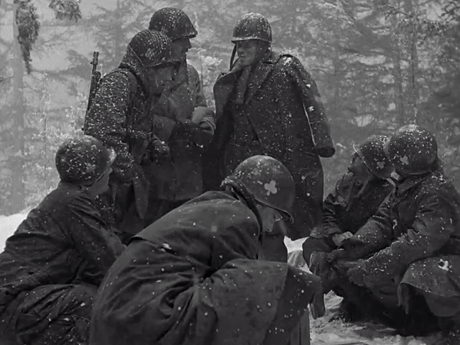
There’s absolutely nothing permanent aside from the constant patrolling, lack of sleep, and perpetual snow. Battleground is one of the snowiest war movies I can recall, at times, deeply striking and equally relentless

Private Holley scores quite a cache of eggs, dreaming of the scramble he’s whisking up in his helmet time and time again — only to get pulled off for another assignment. Watching the yolk drip from his helmet is one of the defining images of the film for me as is his utter indifference. You’re never clean so why even bother.

As a fitting inflection of the Cold War, we have Germans in G.I. uniforms sneaking behind Allied lines to wreak havoc and sabotage important strategic assets like bridges. More than anything, it continually triggers this terrifying threat of infiltration. Thus, one cannot help but draw a connection to the Chaplain’s stirring speech later on (reference at the top of this page).

Amid the paranoia, it’s almost hilarious to think that the best way of telling friend from foe is baseball terms, idioms, Terry and the Pirates references, and the relationship status of the war’s favorite pinup Betty Grable (Note: Cesar Romero is out for Harry James).

When they do come upon the Krauts, Wellman captures the firefight and the subsequent hand-to-hand combat in a stylized manner to conform to the Hollywood production codes. Regardless, he manages to accentuate the rough-and-tumble brutality through boots pounding on the snow and violent inferences.

Battleground leaves unabashed sentimentality behind and it is not squeamish about death. People get picked off one by one leaving a trail of dead and wounded in their plucky company. This carnage hurts because of the rapport we build up. But even in the face of these micro-tragedies, there is no time to mourn, and their stand against the Germans proves a gutsy one. There’s no other alternative in their minds.

As we bunker down, it’s true the ensemble melds together nicely with no one actor totally upstaging the others. Certainly, Van Johnson is just left of center, if not the undisputed headliner, but even he has to navigate conventional feelings of fear and loathing when it comes to military service. He is by no means impervious to the toils of war.

In a moment of duress, Holly looks all but ready to turn tail ignominiously, but he finds his courage in the urging of another man who looks up to him — as they double back on the German lines and catch them off guard. They’ve girded their loins about them now and when ceasefire agreements and surrender are suggested by the enemy, they unceremoniously scoff at the very idea.

As alluded to already, in the thick of the hard pelting enemy artillery fire, the Chaplain holds an impromptu service. He’s of a certain denomination, but a very succinct point is made of the fact his service and his message is all-inclusive. In fact, it’s hardly a spiritual homily at all but a candid rallying cry against the forces of evil. It’s one of the most blatant examples of the film getting on any sort of didactic soapbox.

In response, each man kneels down to pray in his own way the enemy artillery fire still bursting in the background. The results are a stirring image of solidarity. They have not yet begun to fight.

Even in the simulated soundstage action, there is a compelling commitment to the atmosphere, which aids rather than hinders the story being told. It brims with the elements and forces of nature on all sides. In a last-ditch effort, all the terminally ill are moved out of the makeshift hospital, and the walking wounded are brought in for one final stand of desperation.

There is a slight sense Robert Pirosh’s script skipped over what might have been the most rousing scene. Wellman tackles the counterattack from the rallied forces with their new batch of airlifted ammunition, gasoline, and K rations in only an extended montage.

battleground 3.png

Although the ending of the war is a foregone conclusion, it very nearly could have been a letdown that we don’t get a more pronounced action scene. However, it’s quickly salvaged by the effectiveness of the final scene. It says all the same things and exudes all the same battered but resolute emotion with one simple drill, leading them off toward the rear. The men sound off with a renewed vigor knowing theirs was a job well done.

In my book, James Whitmore is the unsung hero of the picture because his grizzled mug brings so much understood texture to the world of the movie. Van Johnson is the vision of what an idealized American G.I. is and Whitmore is the more likely reality. And in the final minutes, he’s the one who leads them to the finish line. He maintains an unswerving grit and pride as tenacious as anyone.

Battleground is quite the sensational war picture while also holding the distinction of being one of the most high profile WWII films following the conflict’s cessation. It allows for this strange limbo of sorts where the war is still fresh and within grasp of the collective consciousness, but there is enough wiggle room to begin looking back in hindsight.

Surely it’s not a complete portrait, but it does well to blend shades of action with the everyday gumption needed to make it through such a conflict. What a pleasure it is to be reminded each of these soldiers is a singular human being.

It’s refreshing to have their warmth and their fears in plain view along with their courage. It feels like we can look them in the eyes and truly marvel because they are not a whole lot different than us in many ways. Their courage is extraordinary in just how ordinary it appears.

4/5 Stars

It Always Rains on Sunday (1947): Drizzly British Noir

it always rains on sunday 1.png

“Lovely weather for a manhunt.”

Childhood vacations to England have given me a lifelong cache of fond memories of the British Isles. Tea and scones conjure up only good things as do Cathedrals and cobblestone streets. Somehow even the daily drizzle, when it feels quintessentially English, is something I don’t altogether mind. It has to do with it being novel as I always came from sunny California. We romanticize it.

However, It Always Rains on Sunday is nothing like that. It is a film generally for people who have lived in these locales all their lives. The novelty quickly dissipates; it’s always dreary, dismal, and damp. They have their slickers turned up and their Wellington boots on, if they have any. Of course, in a cinematic sense, rain functions as instant atmosphere. It sets a very specific tone while being an evocation of England through and through. It proves to be an ongoing theme.

Furthermore, the picture was produced by Ealing Studios, that British film institution, known for their Alec Guinness comedies of the 1950s and, subsequently, directed by Robert Hamer, most well-remembered for helming one of those Guinness’ comedies, Kind Hearts and Coronets.

But with It Always Rains on Sunday (the title fits the weather and therefore the environs), they found themselves crafting a proto-kitchen sink, day in the life drama that really dug into a community of post-war Britain. We get everything from the daily grind, the mundane activities, and the dodgy dealings playing court with everyday life.

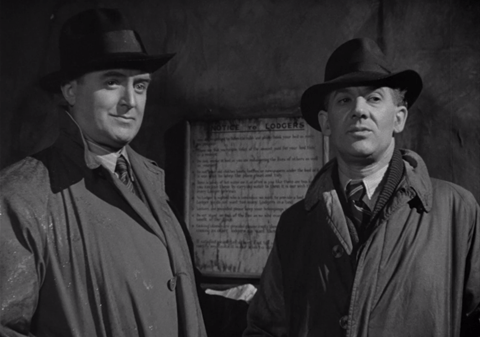
As the rain pours outside, perpetually, men have their papers open. The front pages are plastered with the biggest headline: Dartmoor Escape. Escaped criminal Tommy Swann (John McCallum) is on the run! Coincidentally, three cronies are milling about. Could it be they have something to do with this man or maybe a load of rollerskates that were nicked?

it always rains on sunday 2.png

A typical British family becomes our anchor and Hamer is constantly drawing the story back to them. The husband is a generally benevolent chap content with his morning newspaper and the breakfast at the kitchen table. He’s remarried to Rose (Googie Weathers), a former bar hostess, who is not altogether horrid, but there’s an undercurrent of this being a marriage of convenience — at least for her. It becomes most transparent in her sometimes callous dealing with the step-children.

Two daughters, one dutiful the other blonde and bodacious, when it comes to the boys, and a young son bent on getting some extra spending money to buy a new mouth organ. She doesn’t seem to have any maternal concern for them even as she dutifully runs the house.

The question remains how these seemingly disparate strands might possibly be tied together. But this is a day in the life long before the Beatles ever cornered the market. We come to understand It Always Rains on Sunday is this type of story. It readily covers the beats of the city with all its shadings. This is the joy of the picture, especially all these decades later. It envelopes us in the highly colorful world of the East End, with its smells, markets, fish shops, and pubs.

The local policeman, Inspector Fothergill, goes about his usual business, making his rounds, followed by a cheeky journalist ready to pounce on a scoop. He’s looking for any news on Swann that might be of interest to him.

The best human interest story of the movie is actually behind the scenes romance. Because, upon meeting one another on the set of this picture, Googie Weathers and John McCallum would fall in love and get married soon thereafter. Their union lasted over 60 years, well into the 21st century.

The crucial reveal is that the current Mrs. Sandigate knew Thomas Swann in her previous life. Now he comes calling for a favor since he has nowhere else to turn, setting up a chilling reunion. For now, all we have is in front of the camera. It certainly heightens the available stakes as she harbors the wanted man, and he looks to coax her to remember the former life they had together. It’s obvious the situation can only end in some form of tragedy.

Simultaneously, one of the local gangsters, the angular-faced Mr. Hyams, checks in on one of his game parlors and offers a job then flowers to Doris Sandigate — claiming there are no strings attached though she unsure — he’s just feeling charitable.

Coincidentally, he also catches wind of some roller skates on the market, but he’s already had his hand in fixing the local fights. The dirty money is already being siphoned off from somewhere else. His generosity continues when he donates a large sum of money to the local gymnasium to counteract his shady dealings. One questions the state of affairs when we must turn to criminals as a primary source of charity.

In another vignette, a record store shopkeeper is caught kissing with one of his pretty clients, this time Vi Sandigate, who can’t stay away from any handsome face. He dishes out a pair of mouth organs to keep the blackmailing tykes quiet — including Vi’s baby brother Alfie. They proceed to stomp around town to the tune of “Colonel Bogey’s March.”

The music store owner’s wife Sadie is not stupid. She arrives at the local bar one day to let him know definitively, she’s walking out on him. In response, her weak-willed philandering husband goes scampering after her. Far from feeling like a sordid love triangle, it’s a pointless mess with at least two out of the three lives ruined for good (if not all of them).

Implicit to the movie is this context of a Godless nation. At least no one goes to church or has the normal Christian view of the world you half expect in mid-century Britain. However, given the context of the hell they went through during the war (and even after), I’m not sure the change is unwarranted.

One resident yells at the boys to pipe down with their infernal racket because they are desecrating the sabbath. Then, we see the priest running the orphanage in another scene. But these are isolated almost unimportant moments in a broader narrative.

it always rains on sunday 3.png

Otherwise, this world feels devoid of such religiosity. Maybe it’s simply from coming from an American perspective, but in films of the 40s and 50s, there’s a commonplace aspect to God in some way, shape, or form. Here such ritualism feels almost absent, if not done away with altogether. If nothing else, it does speak to something about our characters and the lives they lead.

It’s based on currencies of love and money. But everyone seems dissatisfied and always longing for something better. And to be completely clear, there is reason to gripe with the world set before them. America, more than possibly any nation, could recoup from the war without a physical need to regroup. Britain did not have such a luxury.

And while the police chase after a fugitive across brick-paved streets, train tracks, and train yards, not unlike the pursuit of Harry Lime, it all feels indicative of a broader problem. I’m not sure if we ever get to it. We are left with a climax and a conclusion that’s stirring enough. But the tale nevertheless leaves so many of its narratives in a state of indefinite suspension.

A lot like life, we do not know how or where they will fully resolve themselves. This illusion is powerful. Not only that, the stories extend outside the confines of a film, but also a happy ending, as it were, is not going to be handed to us blithely.

In short, It Always Rains on Sunday deserves to be named among the best of British noir alongside titles like Odd Man Out and Brighton Rock. The key comes with integrating the everyday occurrences with the criminal element. It makes us aware of how closely related they are. It’s pointless to try and pull them apart.

4/5 Stars

A Walk in The Sun (1945) with Dana Andrews and Company

a walk in the sun 1.png

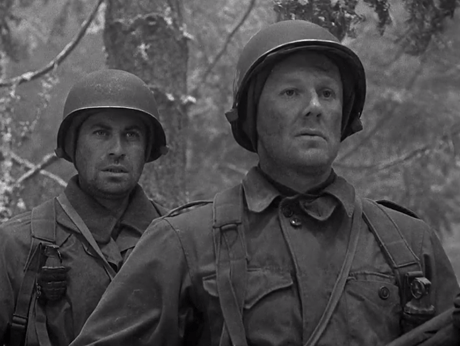
Opening as it does with the cover of its source material, A Walk in The Sun makes itself out to be a bit grand and simultaneously undermines a certain amount of its ethos as a gritty war picture. Is it a fallacy to think a book can never capture all the textures of life? Does the same hold true with film? I’m not sure.

Regardless, the story is set in 1943 in Salerno, and, keeping with this novelistic form, an all-knowing narrator (voicework provided by Burgess Meredith) gives a brief word on each of the soldiers who will walk through the frames of the film. Some of them are quite familiar.

The real opening of the action feels a bit like further delay tactics. We are on the loading dock of a troop transport. The side has yet to go down, and the assault has not started. We are forced to wait in this pervasive dourness fashioned for the soldiers out of the cinematic mise en scene.

It’s our first indication of what this film will be about, and yet it concerns itself with the interims and the in-between-times when men wait for what’s next. The nervous chatter of the men matches the nervous new sergeant who is meant to lead them. Already we have some internal conflict with everyone unsure of what is ahead.

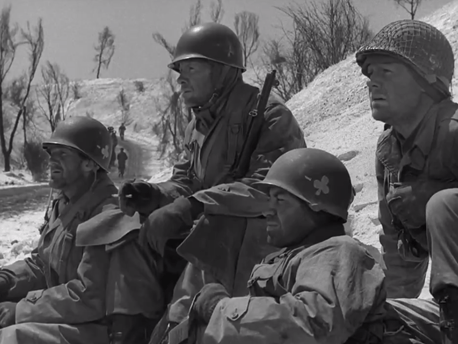
It feels a bit like D-Day, but this is Italy. Instead of meeting steep opposition, they take the beach relatively easily, entrenching themselves and waiting. Their most mettlesome member (Dana Andrews) never said a truer word when he notes, “you can’t fight a vacuum.” All there is to do, for the time being, is dig in.

Their subsequent mission is to blow up a bridge and take a farmhouse. Simple enough. For the conventions of a movie narrative, it makes following the action lines quite efficient. Except, A Walk in The Sun is rarely about its objective, until it finally is. In other words, it takes so many meandering trails and paths, riding conversations to the eventual outcomes.

Robert Rossen’s script is probably too self-aware and witty for a fox hole, but this is Hollywood, after all. At any rate, it ably captures the nervous ticks — the repetitions making up human speech patterns. We have catchphrases. Norman Lloyd comes to mind (“You guys kill me”) as the company’s wry misanthrope, observing the world around him, drolling on about some future battle in Tibet to end all wars.

A jocular Richard Conte seems to relish the chance to run off his mouth as the talkative Italian-American, Private Rivera, always up for razzing his buddy and touting his own exploits as a gunner. There’s the ubiquitous nature of cigarettes or “butts” on the warpath, looking particularly anachronistic in the hands of a G.I. played by Sterling Holloway. Lloyd Bridges is one of the staff sergeants and an imposing fellow but the real center, equal parts cynical and indomitable, is Andrews as Sergeant Tyne.

a walk in the sun 2

Of course, in the army, it’s not always the most capable soldiers who are calling the shots. Between wounded superiors and casualties, this mantle falls on Sergeant Eddie Porter (Herbert Rudley), an indecisive brain with little practical military experience. The prevailing question remains, is he going to crack under pressure?

Certainly, a lot happens in the ensuing scenes, however, what feels most pertinent are the aforementioned lulls because a majority of our time is spent passing time with the soldiers. In these interludes, the narrative is intercut with song and score while being lent an introspective edge thanks to Meredith’s constant omniscient input. Here again, is this trace of self-importance cropping up.

However, A Walk in The Sun settles into something genuinely compelling as we realize we are getting the alternate portrait of war. Lewis Milestone chooses the theatrical nature of all the G.I.s crammed together in the frame just as his lateral shots capture the minimal action setpieces at their most dynamic.

We observe the shades of insubordination and passive aggression in the chain of command, a result of the lack of confidence in superiors. This is further compounded by lapses in judgment and real-world miscues, like forgetting your only pair of field glasses back down the road. It’s not so much atmospheric or authentic as it gives a sense of the personal truths of war. It brings the war picture down to ground-level, to its most intimate and idiosyncratic. In other words, it’s the epitome of human.

They must leave their wounded along the road to be picked up later. The sound of planes overhead is an infantryman’s worst nightmare. And still, they bide their time. Each man’s mind becomes distracted by anything but the war. They reminisce about Norman Rockwell’s paintings and the future of the covers of Time magazine.

Maybe it’s someone recalling their favorite records from Russ Colombo or Bing Crosby. The fat life would be getting The Andrew Sisters autographs and playing music all day long. For his part, Sergeant Ward, a farmer by trade, can’t stop thinking of nice, juicy apples, nowhere to be found in an arid environment like Italy.

During one telling interaction between an Italian-American soldier and two native Italians straggling through the countryside, I couldn’t help thinking this would have never happened with Japanese-Americans in Japan. In fact, the irony is that the all-Nisei 442nd Unit was also stationed in Italy on their way to rescuing The Lost Battalion in 1944.

There might be a single instance of heightened conflict in A Walk in The Sun; it’s when they come upon an Axis armored car and proceed to blow it up. But these types of moments are dealt with quickly, and the film sinks back into tentative homeostasis.

a walk in the sun 3

We can easily condense the narrative by jumping to the final push in realizing their mission. It’s relatively straightforward. We know what they need to accomplish, but the execution and the synchronization are key. It feels unnecessary to expound upon the results in great length. It’s about what you’d expect from an all-out ground assault. Of course, there’s a cost.

More intriguing is a fabled backstory to A Walk in The Sun. Fresh off his own military service and already a prolific journalist and screenwriter in his own right, Sam Fuller brazenly lambasted Milestones’ picture for its fictions even as he praised the earlier All Quiet All The Western Front. Because it is true the film from 1930 is a crowning achievement in pacifist cinema and a tour de force for the director.

Certainly, juxtaposing the final images alone, All Quiet on The Western Front goes out unsparingly. The full brunt of the gut-punch is felt as we see how much war has ravaged humanity. Its successor does not elicit the same guttural response. Then again, to parry Fuller’s point, it might be safe to concede its primary intentions were of a different nature altogether.

It becomes even more compelling to consider a brash young Fuller’s statements in lieu of his own forays into war pictures. He had several actioners of note including The Steel Helmet, which is easy to tie to A Walk in The Sun.

This earlier film perhaps is wordier — the characters mouths are filled with plenty to go on about. However, where I feel they can be linked together is through this sense of utter disillusionment with war. These are not career soldiers driven by dreams of valor and accolades in the service of their country.

Certainly, they are human. They have these kinds of thoughts too. Most of the time it’s idle chatter. It’s the mundane moments in-between where they are just people in a soldier’s uniform. What becomes apparent are their preoccupations, fears, and foibles, cutting through their daily existence. It comes down to survival.

Again, A Walk in The Sun might be a tad verbose and a bit too manicured and manufactured for a wheeling-dealing future maverick like Fuller. What it doesn’t sell us short on is the reality of wartime conflict. It’s not a pretty or mythic business between the gods. It’s brought down to earth into all our messy human concerns.

The message it preaches implicitly feels sharply antithetical to typical propaganda pics. It lives out apathy and levity as much as bare-knuckled heroics. Somewhere in the middle of it all, we’re provided some essence of what war truly is.

3.5/5 Stars