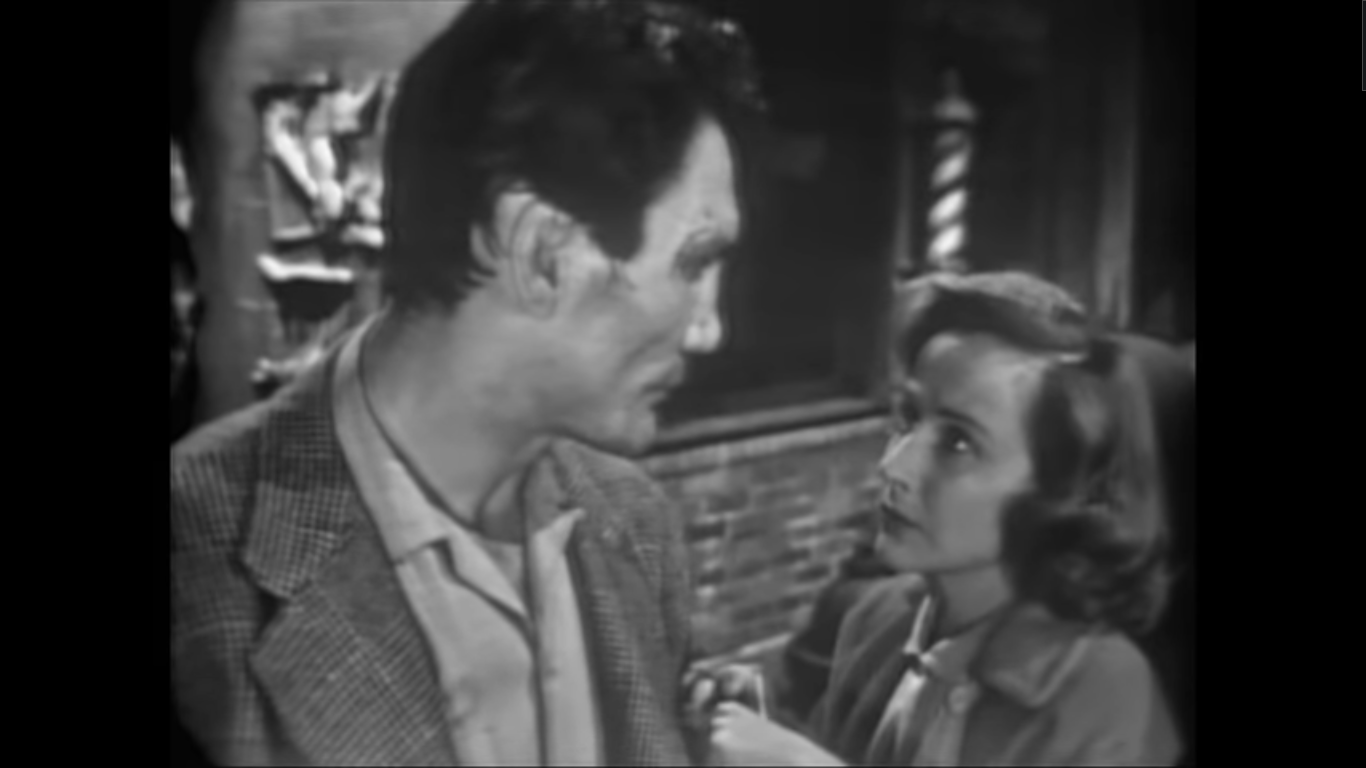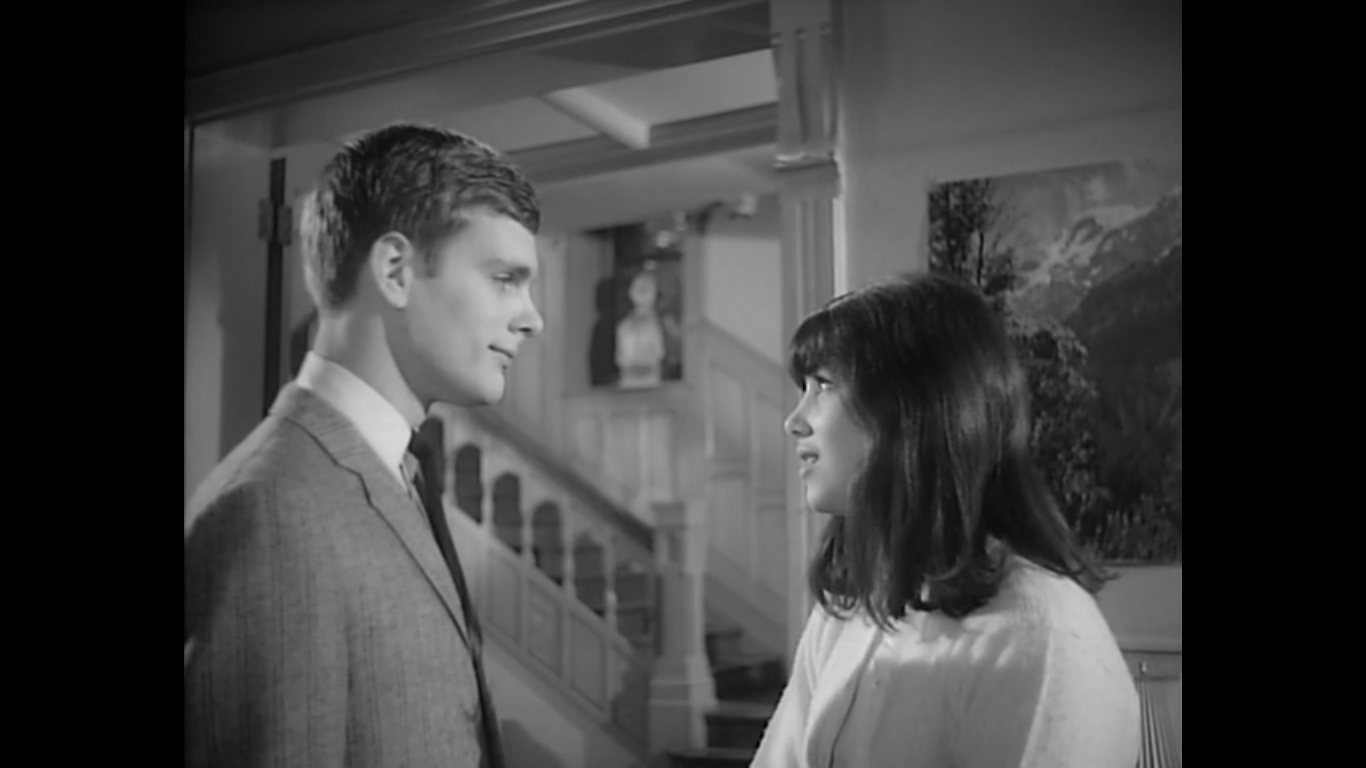
Beijing Watermelon (1989)

Nobuhiko Obayashi is known to a pocket of western moviegoers for his crazy, unhinged haunted house flick Hausu (1977), but as I’ve gotten more familiar with at least some of his filmography, I’ve come to appreciate his more grounded works.

Using this phrase has the danger of giving the wrong impression about him. This doesn’t imply boring or anything of the sort. Still, some of his later works are told with such humanity through relationships, humor, and often a wistful nostalgia that comes on the tails of youthful optimism.

Beijing Watermelon hardly makes a blip on the radar. I consider myself fairly well-versed in film (albeit with many noticeable blind spots), but I had never heard of it.

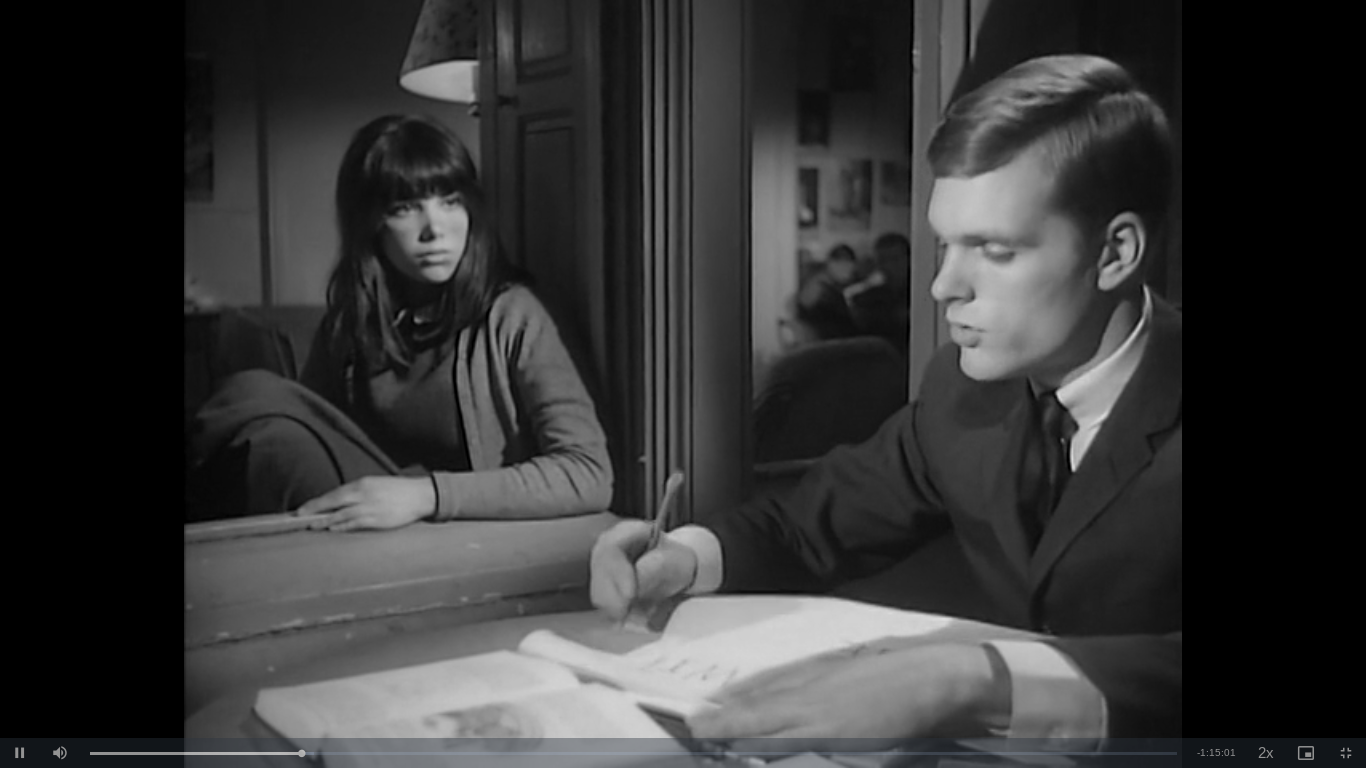
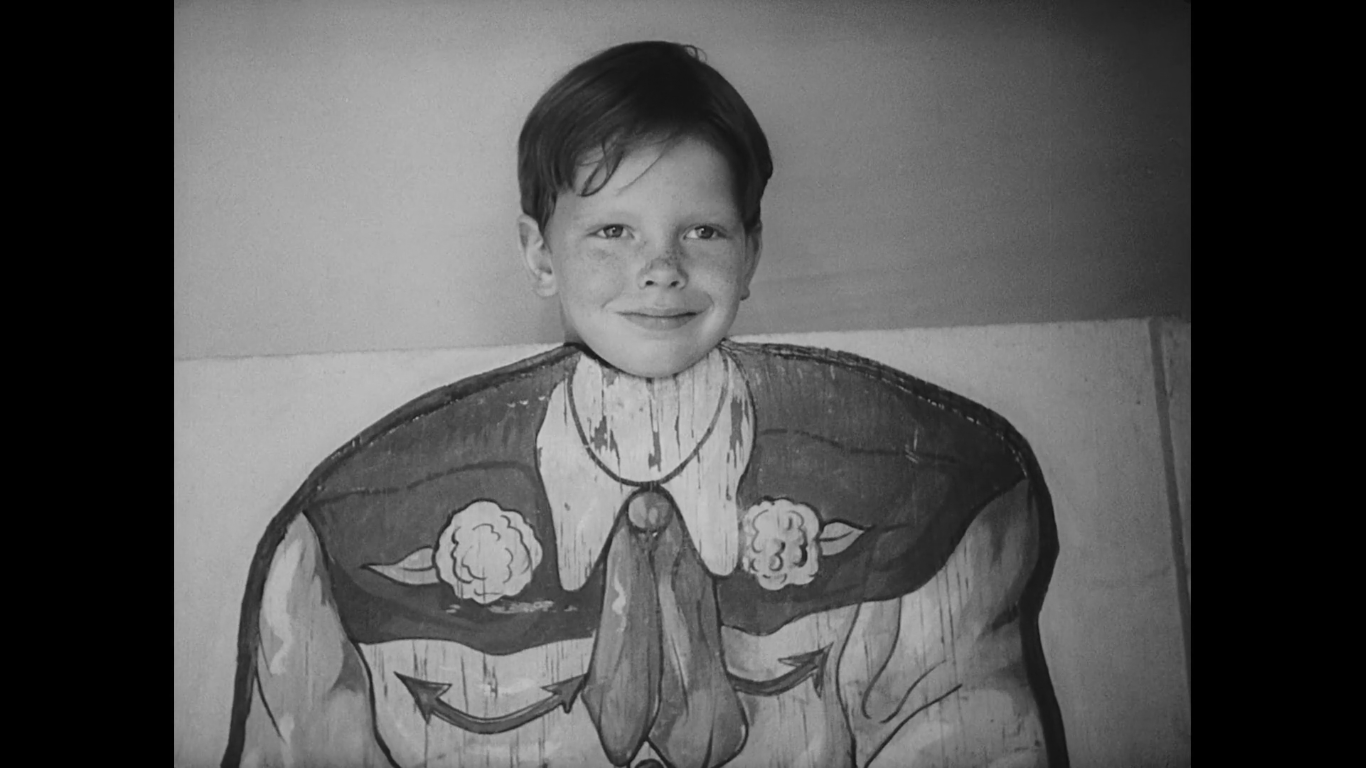
Still, this film spoke to me through its simple rhythms. It’s easy enough to introduce the premise and still fail to totally articulate what makes this movie such a meaningful experience for the right person. Because it a mundane slice of life tale following a grocery store owner who comes to form a bond with a contingent of Chinese students studying and living in Japan.

It begins inauspiciously enough when a poor Chinese student tries to barter with him. He’s a bit offended by it — his prices are already reasonable — but events cause him to take an interest in the young man’s life and his well-being. He meets Li and a host of local students who are many miles away from home. It feels inexplicable at first, but as time progresses, they form an unalienable connection. I’m not sure if other’s find this cross-cultural relationship to be unbelievable or at the very least somewhat whimsical.

As someone who has lived abroad in Japan of all places and relied on other people’s good graces, there was something so resonant about this scenario. It spoke to me on a profound level, and it was not in spite of the mundane nature but rather because of it.

The comedian “Bengal” who stars as the greengrocer Haruzo Horikoshi, somehow reminds me of the Tora-san character. It’s almost like he’s an extension of the Japanese comic prototype. He’s at times a buffoon and outlandish, and yet he’s imbued with so much heart and by extension pathos. If we stretch the Tora-San metaphor, he feels a bit like the Japanese everyman who brings back nostalgic reminisces of a different era. There’s something hilarious and tragic and warm about him all at the same time.

I must admit that there’s a point where it feels like the Chinese students are taking advantage of Mr. Haruzo. Perhaps it’s just a cultural difference and a way of showing good-humor and affection, but as an outside observer and someone who has a modest appreciation for Japanese courtesy I felt bad for the man.

At the same time, he continues to grow more and more accustomed to providing them discount goods, maintaining letter correspondence with Li when he returns home, and then picking up a new arrival at the airport named Zhang.

As a side note, there are two airport sequences that feel so authentic. The callow student looks downs and realizes his bags are missing! Of course, they are nearby where a thoughtful lady has set them aside out of the way. Also, a local Japanese man brags about his English prowess. Except the moment an English-speaking tourist asks for directions, he has no help to offer and sheepishly walks away.

By this point, we must ask the question: why does Mr. Haruzo feel compelled to do all this? There’s something in his constitution that makes him different, causing him to go against the tide of Japanese convention. Because what he does transcends polite niceties and keeping up appearances. Dare I say, it’s true sacrifice.

Could it be he’s slowly falling in love with the earnest Pingping? A lesser film would have played this up for the sake of drama. But while the affection is evident, it never goes further than that.

Meanwhile, his local neighbors joke that he’s caught the “Chinese disease.” If that’s so I’d probably wish I had it too. Of course, eventually it seems to derail his life. His business isn’t profitable anymore, he’s less present with his family. His long-suffering wife (Masako Motai) is trying to pick up the slack because he feels mostly absent. His kids feel ashamed by how he’s acting. Even his shaggy-haired employee vows to go to a rival supermarket where he won’t be a laughingstock.

It feels like Mr. Haruzo’s ruined — entirely thrown away his life — and soon the tax board comes to impound his belongings while he’s also detained for a hilarious public disturbance while requesting a loan. The heightened blood pressure leads to an extended stay at the hospital. Surely this cannot be the fruit of his troubles? He’s in such a dejected space with his family unsure what to make of him.

It’s a bit on the nose, but I think of that immortal line that “no man is a failure who has friends” and of course, the friends Mr. Haruzo has in his life come to his aid when he needs it most. It’s a beautiful sentiment and something I’m sure many of us recognize if we’ve ever been enmeshed in a close-knit community.

The watermelon becomes one of the substantive cultural metaphors of the film, and as someone who lived in Japan as a westerner and has spent many years working in international spaces, this film speaks to me on a deep level.

Surely you don’t need this in order to appreciate the film, but as I watch this Japanese man build cultural bridges and become a kind of local institution with a spread in the paper and then getting treated like a king by all his grateful beneficiaries, I was fundamentally moved.

I think of the people in my life overseas who watched over me at my most vulnerable or lifelong friends my parents and siblings have made when they were abroad. If we let it, film can be one of the great universal unifiers, a language unto itself that connects us and transcends cultural origins or international borders. That’s what it’s often been for me and Beijing Watermelon is such a winsome portrait of what I aspire to in my life.

I’m not sure if anyone else has made this comparison, but Haruzo Horiko feels a bit like a Japanese Mr. Chips because with his name comes a lasting legacy and impact. It turns out to be an extraordinary life.

There is one last aspect of Beijing Watermelon that deserves some comment. I acknowledged already that this is one of Obayashi’s more formally traditional films, and yet he still breaks out of narrative convention — not for want of ostentatious showmanship — but because it serves the story he wishes to tell.

I could not track down any definitive details, but Beijing Watermelon is supposed to be based off real events that happened. However, Obayashi takes this biography and gives it a Brechtian ending, somehow working with the negative space of the film and what it does not show.

Bengal speaks to us and tells us we are back on a Japanese set in a studio. He and his movie wife journey to China and yet it’s made explicit that they are in the cabin of a plane set and not an actual plane for a reunion with all their Chinese friends.

If you’re like me, you question why have this break with the cinematic reality? The movie was humming along beautifully without the distraction. But then it slowly becomes more apparent the longer you sit with it, especially considering the cultural moment and what was happening in China — the Tiananmen Square massacre of June 4, 1989 being a particular inflection point…

Because even if you are not aware of any of this, there’s something imperceptible and still intuitive about the melancholy that comes over the viewer. It’s all there in the movie both the warm feelings welling up inside of us, but also this inherent sense of sadness carried with those Chinese students as they play and sing their bittersweet song on the beach with the credits rolling against them. The postscript of the movie is what does it for me as a final rallying cry and call for greater cultural understanding:

“We dedicate this film to all our young Chinese friends.”

What an extraordinary film. I hope more people can search it out and enjoy it as much as I did.

4.5/5 Stars

CMBA Blogathon: The Last Hurrah (1958)

This is my entry in the Spring CMBA Blogathon Debuts and Last Hurrahs.

In the isolated occasions when I had to debate in high school classes those who did this kind of thing for fun and seemed most destined for politics, were all people I would never want to vote for regardless of affiliation.

Because it seemed like there was a self-selecting bias. The people who wanted, nay desired, this kind of world, were not ones I necessarily respected.

How could a decent person of moral fiber get through and win? The cynical answer is they can’t unless they are propped up by a political apparatus of some kind. However, before I sound too jaded, I still am optimistic there are good people working in government.

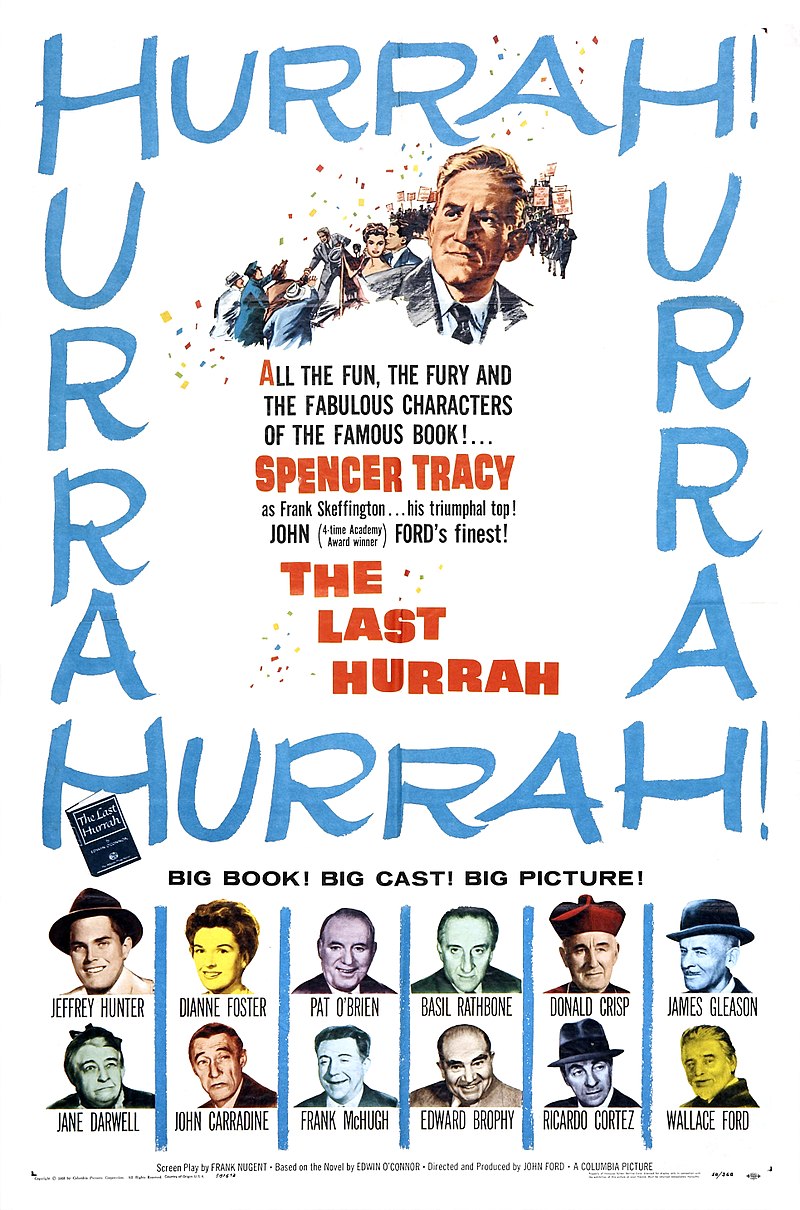
No one would confuse John Ford’s The Last Hurrah for a tirade against big government and political machines. This is not a Frank Capra picture. Instead, there’s a certain level of give and take, a nuance, celebrating a style of old-fashioned politics while acknowledging the need for political strategy and networks.

No director brought more of the Irish-American experience to film than John Ford and you see it from his Calvary westerns to his West Point hagiographies, and even a portrait of his homeland like The Quiet Man.

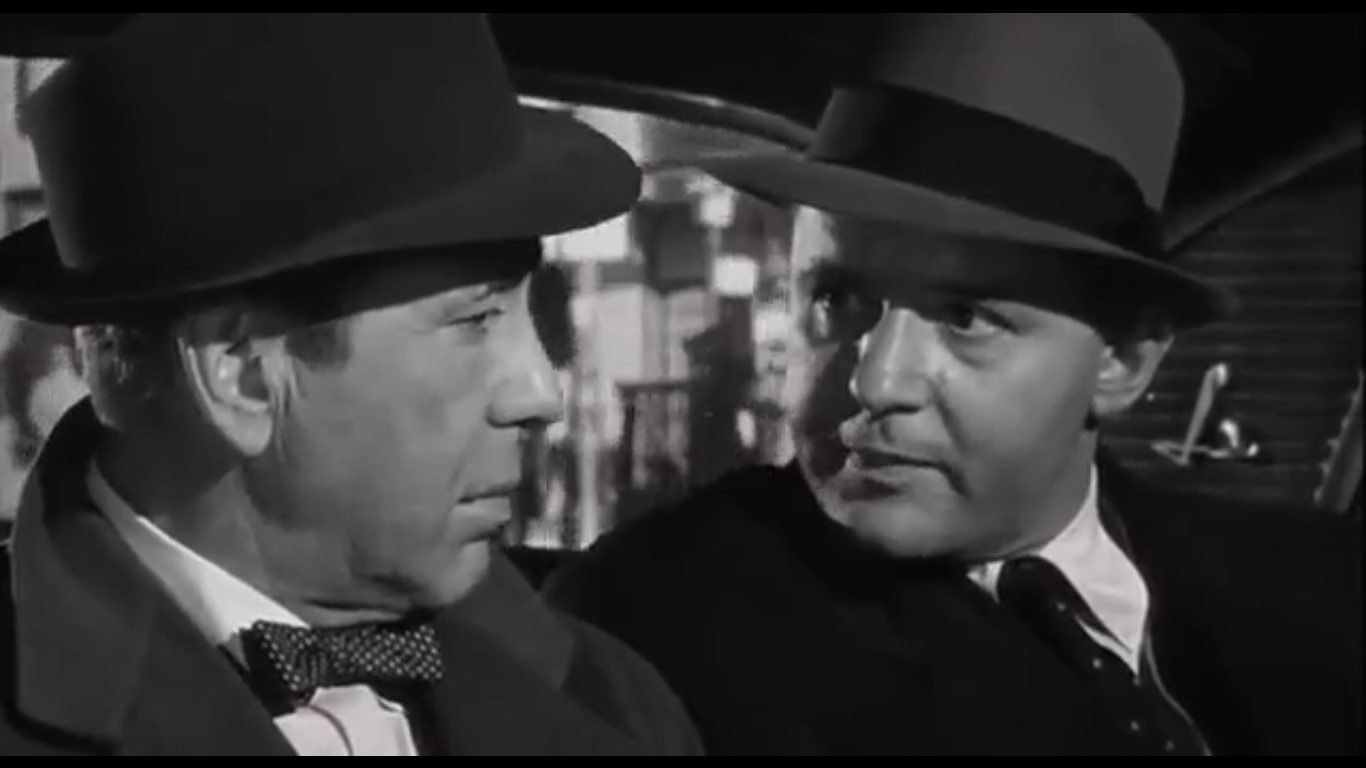
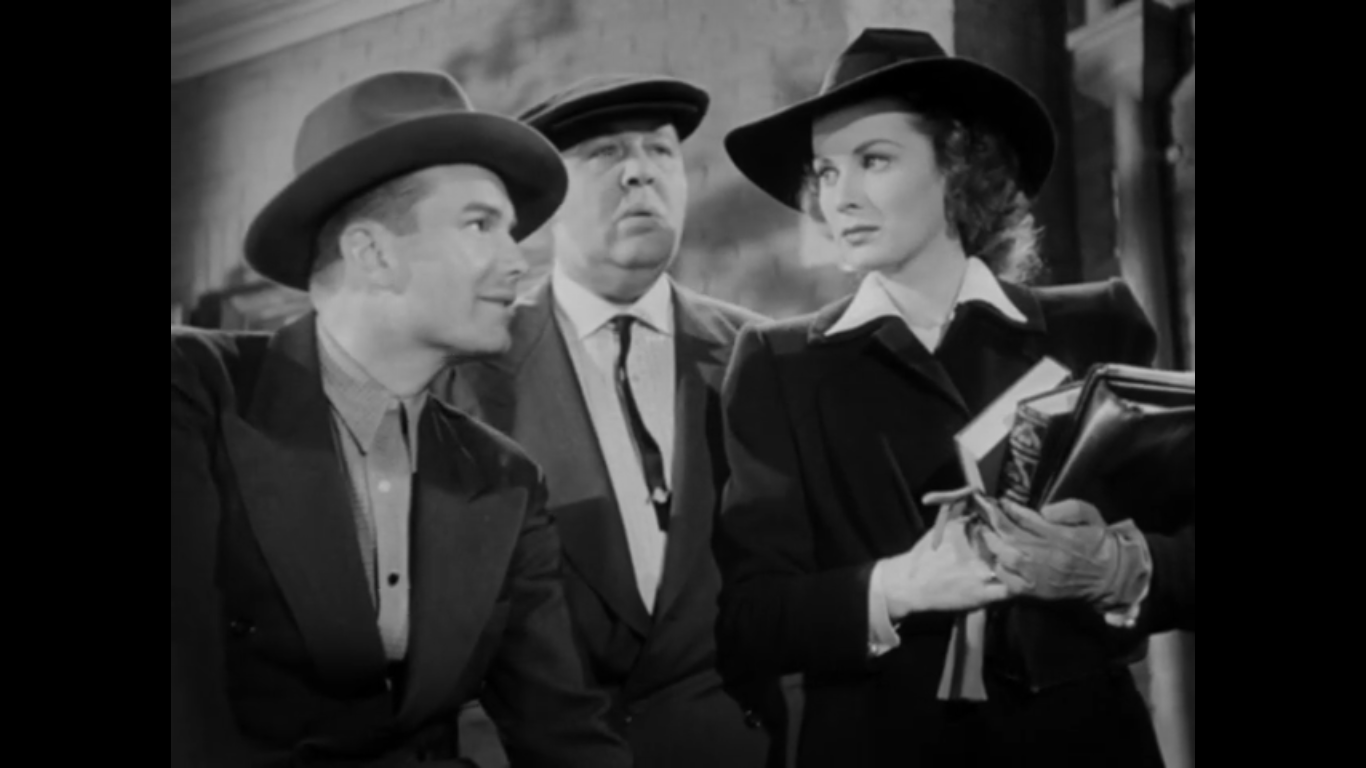
Frank Skeffington (Spencer Tracy) is in the midst of his latest and perhaps final foray campaigning for the mayorship in a New England town. His personal entourage of right-hand men in bowler hats (including Pat O’Brien and James Gleason in his final role) have seen him through everything.

My initial observation is that this is a mature man’s game. The young (including myself) seem like idiots. His son (Arthur Walsh) isn’t registered to vote, doesn’t watch the debates, and is always running off after golf or other frivolous entertainments.

Another local magnate (Basil Rathbone) who opposes Skeffington has a son (O.Z. Whitehead) who makes a fool of himself by unwittingly accepting the position of local fire commissioner. Skeffington has instant leverage against his old adversary. Then, there’s an up-and-coming appointment — a young Catholic war hero and lawyer. More on him in a moment.

Skeffington is not naïve. He knows how to play the game. He’s continually pragmatic, pressing his advantages and the alliances at his disposal and knowing what it takes to win. You don’t maintain the office year after year without knowing the rules of the game. Perhaps Ford casts him with a rose-colored, nostalgic tinge, but at least he has some scruples or at least a sense of who his people and electorate are. Because he’s been knee-deep in the community.

His most obvious opponent is an unknown newcomer named McCluskey, and it becomes apparent he feels like a caricature cutout of John F. Kennedy if the man lacked charisma and intelligence.

Of course, JFK was a famously photogenic figurehead who used Frank Sinatra jingles, his public image, along with a platform to beat out Richard Nixon in 1960 (He also hailed from one of the most influential families of its day thanks in part to his father Joe Kennedy).

Nixon himself practically instigated the political television revolution with the pathos appeal of his Checkers speech in 1952, and thenceforward the televised debate presaged a radical new kind of American politics. The rules changed.

Adam Caulfield (Jeffrey Hunter), Skeffington’s nephew, works as a sportswriter at a local paper. His editor (John Carradine) fights tooth and nail against Skeffington with an obsessive grudge, throwing every iota he has behind McCluskey so he might vanquish his mortal enemy. Adam is far more accommodating and has a congenial relationship with his uncle.

When he pays the seasoned politician a visit, Skeffington calls politics the greatest spectator sport! He invites Adam to cover the events and tells him in confidence that he wants to try and win a campaign race one last time the old-fashioned way; he’s astute enough to know his days are numbered thanks to television and other readymade forms of advertising.

Although it’s not mentioned explicitly I can imagine Skeffington admired the political acumen and rhetorical vigor of a great American stalwart like Abraham Lincoln. John Ford of course made a whole film about his early years and rise to prominence before he ever became president.

I mention this only to echo the thoughts of Neil Postman in Amusing Ourselves to Death. Our culture shifted drastically from a literary culture where arguments were well-thought-out and expounded upon in debates hours long. And yet in the 1950s and 60s, we see this concurrent shift to a visual, image-based society.

Suddenly we watch campaigns being won and lost by optics, the most beautiful people, or those with the largest media share. It’s a far cry from the past and this is part that’s being memorialized. It’s a strange thing to be reminiscing about a world cataloged most comically in a movie like The Great McGinty, but there is something rather quaint about it compared to the juggernauts of media and consolidated power at work today on a global scale. It dwarfs anything out of the past by sheer scope and reach.

The whole film might easily be encapsulated by a few adjoining sequences. There’s a quiet scene with Anna Lee. Her husband Knocko has passed and left her little to nothing to subsist on. In an act of sheepish compassion at the kitchen table, Tracy offers her a sum of money on behalf of his dead wife. It feels like a pretense he’s made up, and yet here no one sees his kindness aside from the camera.

However, he sticks around for Knocko’s wake, and it becomes an extension of his political campaign. When word gets out, everyone seems to be coming by to pay their respects too, though it feels more like posturing. These moments can be humorous, darkly cynical, and still somehow have glimpses of communal warmth.

Taken on the whole, The Last Hurrah is a grand picture with a lot of cast, story, and ambition. But all that space gives Ford the opportunity to move around in and go to work with his gaze set on humanity. It’s the communal events or moments of ritual where Ford is at his finest: dances, weddings; here it’s a wake and a funeral.

I mentioned Capra before and his pictures, Mr. Smith Goes to Washington in particular, decry the mechanism of the political machine. However, the adapted novel and surely Ford as well had a prescience about them.

He somehow bridges a gap between Capra’s cinema, Sturges’s McGinty, and the emerging landscape. Because Elia Kazan in some ways would depict our certain future with A Face in the Crowd. It offered up a harsh critique focused on a country bumpkin turned charlatan who uses television to captivate the public and wield his newfound influence for political gain.

In such a climate the old guard like Skeffington can no longer exist. Part of this is the march of time. There are aspects of him that feel archaic and ugly with his back parlor dealings. And yet in the same breath, as we look at the vitriol that is shoveled today and the proliferation of social media, it does feel almost quaint. Again, this might be naivete speaking. We so quickly forget the political muckraking of prior centuries because we were not there.

I had to sit with this film, and the longer I was with it the more it moved me. Ford does what he does best by eulogizing someone he deems to be an everyday American hero. The flaws are laid bare and still, he can be lauded as a great man by all those he groused so bitterly with all through the years. On his deathbed, before he is about to be given the last rites, the local Cardinal (Donald Crisp) comes to ask his forgiveness. They have been at odds, bitter rivals, and yet, in the end, there is grace and mutual respect.

It feels like a beautiful testament, like a bygone sentiment we rarely see in politics today. Because Skeffington does signal the end of something — maybe it’s the classical statesman or something else.

Spencer Tracy lying on his deathbed is a picture of blissful contentment, and he has the feisty spirit of an Irishman to the end. The film has all the hallmarks of a swan song, but thankfully he and Ford still had so much to offer us respectively, and in their final years they continued to deliver some of their most rewarding work.

4/5 Stars

Double Feature: Requiem for a Heavyweight (1956) and (1962)

Rooney, Gleason, and Quinn in the film version

Requiem for a Heavyweight was an early live television production that was so popular it garnered a feature-length adaptation a few years later.

It’s relatively easy to see the merits in both because although they enlisted the same director and screenwriter, the actors and the medium do quite a lot to make them feel textured and different. I couldn’t necessarily pick a favorite.

The original is bare-boned but intimate, and there’s a darker more caustic theatricality to the film version. It really comes down to preference. Here are my thoughts on the two versions:

Palance and Hunter on Playhouse 90

Requiem for a Heavyweight (1956)

This early showcase of the Playhouse 90 live TV format introduced the fragile and most sensitive version of Jack Palance. He’s a hoarse and husky-voiced journeyman boxer named Mountain McClintock.

One of his greatest claims to fame was that he was almost heavyweight champion of the world. But he’s most proud of his integrity. In 111 fights, he never took a dive. That includes his most recent bout. He got pulverized and still managed to make it seven rounds.

Between Rod Serling’s script — the writer called upon his own memories as a one-time boxer — and Palance’s endearing performance, you have the emotional heart of the tale. Because Mountain is proud and principled in his own way. He didn’t get into fighting to murder people or make a ton of money. It’s just the only thing he’s ever known — the only thing he was good at — and he took solace in it.

Now he’s on the way out. The Doc says he’d better quit before he earns more permanent damage. Somehow he’s impressionable like Lenny in Of Mice and Men. Despite his physical presence, he needs protectors and others to look after him. There are certain people in his corner he deeply trusts just as all his words and pearls of wisdom come from the mouths of others.

The real-life familial bond of Keenan and Ed Wynn is equally key because they play the two most important people in Mountain’s life. There’s Maish, his manager, who’s currently in a bit of a bind. Then, Army, his cutman, who’s more resigned to the inevitably around him. He’s seen a lot.

Keenan can exhibit a kind of gruff intensity role to role, but since I know Ed Wynn as such a jovial figure, I almost didn’t recognize him. Both of them exhibit an earnestness in their respective parts. Maish has compromised his integrity and now feels bitter toward Mountain, a has-been fighter he sunk so much time and money into. How is he supposed to get any recompense?

Mountain looks a bit pitiful walking into a job agency with no work experience and a kisser as roughed up as his. However, the attendant behind the desk (Kim Hunter) sees his goodness and drops her business spiel for something more personal.

She responds with heart, tracking him down to his favorite watering hole and vowing to try and help him resurrect his life. The bar serves as the graveyard and burial ground for all the hard-up fighters who wither away inside their own heads. Mountain might easily be headed toward this end and worst yet, he might lose his dignity in service of Maish’s debts…

We must remember what the medium of television accorded the makers. Visually, they were working in fuzzy black and white with tiny boxes of composition but also a more familial viewership. This ultimately impacts the creative choices and the film takes on a hopeful final note.

It’s fascinating to watch the production since it was being taped live and throughout I only noticed one flubbed line rushed over by a mother on the train. Otherwise, around all the orchestrating and simple sets, there’s very little taking us out of the story and disrupting the primary performances. Given the restraints, it’s quite a startling achievement.

3.5/5 Stars

Quinn and Gleason

Requiem for a Heavyweight (1962)

Ralph Nelson was the same director who filmed the original TV version. Instantly the big screen is more cinematic thanks to the subjective point of view in the ring. We see a solemn Jackie Gleason, the yelling Mickey Rooney, both standing just outside the ropes.

Then, the announcer calls out the name Cassius Clay, and there he is in all his youthful glory beating back the camera! It does feel like a bit of a gimmick, but then we finally see the face of Anthony Quinn battered and bruised and we have our movie.

I assumed the older Gleason was Army and having just recently been introduced to what Mickey Rooney was capable of in The Comedians, it seemed only too reasonable that he would play the more mercurial Maise. How wrong I was.

Quinn seems especially old for his part, but it’s intriguing to see how his character mythology was altered to fit his own Hollywood legacy. Mountain Rivera came out of New Mexico, he ditched school in the 6th grade (instead of 9th), and he’s been fighting longer than Palance’s counterpart. Still, like Palance, Quinn’s larynx sounds like it’s been beaten out of him positively eviscerated by his years of punishment in the ring.

The movie’s milieu is not too far away from The Hustler (also featuring Gleason) or the sensibilities of a TV-to-film scribe like Paddy Chayefsky. The jump to film also means it owns a sharper even more melancholic edge than its small-screen counterpart.

Maish (Gleason) is tailed and tracked out into the ring reminiscent of The Set-Up, and he’s threatened into paying up on his recently accrued debts. He needs the cash fast. Later, he willfully gets his dwindling prize fighter drunk. It’s all part of a ploy to keep him from getting a real job so he can earn money as a sideshow attraction in some trumped up wrestling showcase.

This time it is Julie Harris, who is tasked with helping Mountain turn a new leaf in his life. Her character never shared consequential time with Maish in the original version, but here they share dialogue on a stairwell adding an alternate dynamic to the picture. He says, “The rich get richer and the poor get drunk.” Mountain’s finished, and he’s skeptical of any do-gooder looking to peddle their charity. The edge of cynicism is deeply entrenched.

Also, in the previous rendition, there’s this happy denouement as we recognize Mountain entering into his post-boxing career. It’s possible for him to make something of himself and gain fulfillment beyond the ring by imparting his knowledge to younger generations.

Here it almost feels like the movie has been shifted and the focal point is Maish. Because he is the person who must come to terms with what he has done by totally denigrating Mountain for his own desperate gain.

When he’s marched out into the ring, totally racialized and trivialized, it sears with a level of pain television would have never dared. And we realize all the self-fulfilling prophesies have come true. Mountain really has become the geek, a kind of carnival show attraction, but it’s not out of his own desperation. He’s doing it for someone else. Mountain willfully subjects himself to the ignominy, but Maish is the one who must live with his conscience. I’m not sure what’s worse.

3.5/5 Stars

The Harder They Fall (1956): Bogey’s Last Film

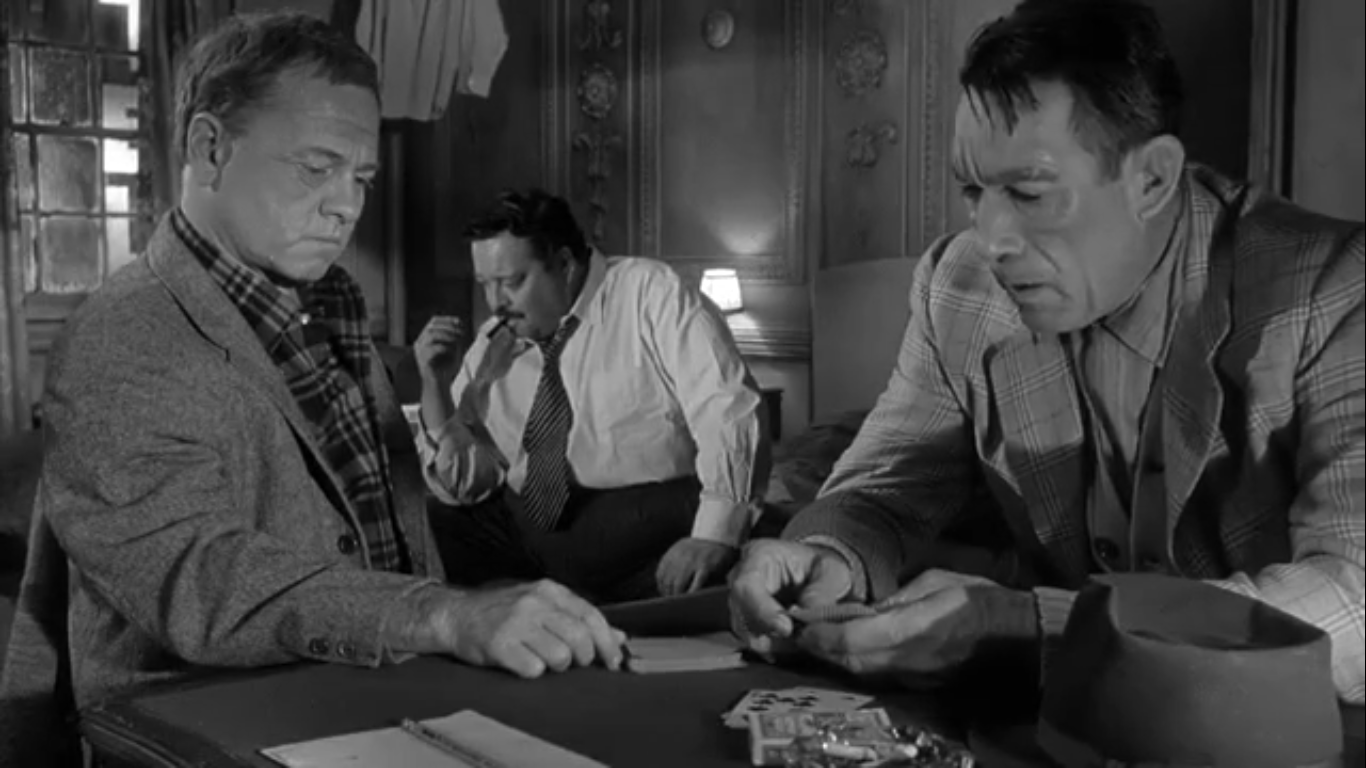
As the saying goes, the bigger they are, the harder they fall and Toro is a big man. He’s a sculptable Argentinian bumpkin who will quickly be fashioned into a killer in the boxing ring. Rod Steiger plays Nick Benko, a shifty promoter looking to groom his latest talent and set him up for success. It has nothing to do with actual training.

First, he calls in a veteran sportswriter to stir up some good publicity. Things have changed. No one wants to fight anymore when they could go to college. It’s more like playacting than an actual sport. You’ve got to give the audience a show and that means publicity (and staging the results). Eddie Willis (Humphrey Bogart) has long been concerned with holding onto his self-respect in the journalistic profession. Now he’s finally caved to Benko’s racket because he wants to get ahead for once in his life. His coffers aren’t as full as they could be.

It becomes increasingly apparent, in spite of all of Nick’s high words and cajoling, he’s obviously no good. Eddie knows what it all means as he watches a dirty fight and the ensuing repercussions of each subsequent business agreement. Nick’s operation is taken care of by an army of hoodlums. All these faces pop up here and there, making appearances and showing up ringside or in hotel rooms. Bogart joins the king of the creeps by pocketing 10% for himself if he can keep them out of jams.

While Bogart carries the picture, I couldn’t help thinking about some of the intriguing sparring partners he has — not the big names but the likes of Harold Stone and Edward Andrews. Because the movie feels like an analysis of the entire ecosystem and why people do the things they do. An added tinge of realism is given by real-life fighters like Jersey Joe Walcott and Max Baer.

Jan Sterling appears in a role reversal playing the principled wife watching her husband slowly slip away from her as he’s swallowed up by his all-consuming job. At first, I was intrigued until she slowly evaporates in a part that does not avail her the opportunity to do anything substantial.

It’s necessary to take a brief moment to mention screenwriter Budd Schulberg too. Like A Face in the Crowd, it’s a story documenting the perils of television and media in general. Toro is no Lonesome Rhodes; he’s a bit of a stooge, but the men behind him are able to orchestrate everything to easily manipulate a response out of their target audience, and it’s all for monetary gain.

I’ve always heard mention of the collaboration between Schulberg and Spike Lee focusing on the bouts between Joe Louis and Max Schmelling. Although the younger director vowed to get the production made after his friend’s passing, it’s still reassuring to know Schulberg already had a portrait of the boxing world put to the screen. Not surprisingly, The Harder They Fall is unsentimental, and yet it still manages to humanize many of the fighters as victims of a system.

What strikes me about the film is what it decides to spotlight and what it leaves to our imaginations. We know the reason for all these back parlor deals — it’s to prop up the gambling — but the movie rarely pays this much heed. It’s simply understood. And also the movie focuses on the families and the business outside the ring. It’s as if everything between the ropes is already a foregone conclusion, and it is, so we hardly need to focus there.

Instead, it’s the drama beforehand: Chief (Abel Fernandez) won’t take a dive because his family is in the audience. Then, there’s Dundee (Pat Comiskey) an old journeyman dealing with head trauma from his last fight. He’s barely ready to face off against the new challenger, and it doesn’t bode well. Still, each fight paves the way for Toro’s chance at the champion (Max Baer) and some real promising money. This is what Nick has been striving for from the beginning.

There’s an abrasive whininess to Steiger’s whole performance that keeps everyone on edge. I can understand any complaints of the actor being too intense, but he’s also one of the primary attractions because his unscrupulous fixer personifies everything crooked about the racket. It’s always gangsters or businessmen in suits with all the power, but Steiger effectively makes these skeevy mugs into slimy parasites. He feels like a new, different brand of antagonist, and frankly, he makes Bogey and the audience sick. The movie wouldn’t work without him.

It comes off as one of the most bloodthirsty and unsentimental boxing pictures of the era because they let this boy get absolutely butchered in the ring — building him up — only for him to get annihilated. And it’s all for money.

By the end, it’s almost ludicrous. Like A Face in the Crowd or even Network. Toro gets his brains beat out; he’s fully commoditized and then sold like chattel, and he comes out on the other side with nothing and no one to look after his interests. He’s been cast to the pavement as disposable goods.

Eddie holds the only grain of decency left and with his moral character eroding, he must make the decision to finally stand up for something greater. It’s a nervy performance from Bogart because it never resorts to bravado or any grand showing. He’s an older, wearier man now, and it shows.

Cancer would take his life far too soon, but by relinquishing the gangster roles, he offers up a different side of himself that we could not have expected without an earlier movie like In a Lonely Place. He really is a great one. I realized part of the reason I was reluctant to see the picture was that I didn’t want to acknowledge his career actually came to an end. Even if it was well over 70 years ago, I still miss Humphrey Bogart to this day.

4/5 Stars

George Sanders: The Picture of Dorian Gray, The Ghost and Mrs. Muir, Ivanhoe

We’ve been doing a rather casual retrospective on the films of George Sanders and as part of the series, we thought it would be fitting to highlight three more of his performances. They run the gamut of literary adaptations, fantasy romances, and medieval yarns. Sanders remains his incorrigible self through them all, and we wouldn’t have him any other way.

Picture of Dorian Gray (1945)

“Lead us not into temptation, forgive us our sins, wash away our iniquities”

Whether you say he cornered the market or simply got pigeonholed, George Sanders could always be called upon to play snooty Brits bubbling with wry wit and aristocracy. His Lord Henry Wotton is certainly wanton — an incorrigible influence on many a man — and his latest acquaintance becomes Dorian Gray.

Hurd Hatfield is the picture of handsome youthfulness, dark and aloof, though his piano playing leaves much to be desired.  His reputation must precede him and perhaps an actor with greater gravitas could have done more with the part. Hatfield feels generally inert and uninteresting. Over time, it’s hard to confuse his distance with inscrutable mystery.

The primary object of his desire begins with Angela Lansbury, an entrancing tavern singer with an equally gorgeous voice to go with it. Lansbury and then Donna Reed (his second flame) both deserved better, at least in their romantic lead if not the roles they were given.

It’s a quite loquacious film thanks in part to Sanders, who always has a cynical word for every situation and thus lays the groundwork for Dorian’s total immersion into hedonism.

The movie must work in mood and tone because there isn’t much in the realm of intemperate drama, and for some reason I found myself crying out for something more substantive than elliptical filmmaking. Whether it was merely to assuage the production codes or not, so much takes place outside the frame, which can be done artfully, and yet the distance doesn’t always help here.

The impartial narrator discloses Gray’s internal psychology to the audience as he’s perplexed by his evolving portrait — the lips now more prominently cruel than before. The ideas are intriguing in novel form in the hands of Oscar Wilde. Here it’s all rather tepid and not overtly cinematic watching a man traipse around his home tormented by his own inner demons.

It’s easy to contrast them, for their exploration of warring psyches and the duality of man’s morality, but this is not Jekyll and Hyde. However, on a fundamental level, I must consider my own criticisms because this is a story about pride, narcissism, and the selfish roots of evil in the human heart. They can be unnerving as we consider the portrait that might be staring back at us.

I find it a drolling, monotone movie other than the inserted shots of color that shock us into some knee-jerk reaction. It’s made obvious there’s a moral leprosy eating away at Dorian and the ending showcases much the same, doing just enough to hammer home the core themes of the story in a rousing fashion. Though your sins be as scarlet, I will wash them white as snow. It’s possible for the portrait to be remedied, though not without consequence.

3.5/5 Stars

The Ghost and Mrs. Muir (1947)

“Haunted. How perfectly fascinating!”

If you don’t love Gene Tierney before The Ghost and Mrs. Muir, surely you must adore her afterward. She’s totally her own person; strong but not unpleasant thanks to her ever-congenial manner. She has immaculate poise and knows precisely what she wants.

Even in her mourner’s outfit in honor of her late husband, she has a regality drawn about her, vowing to leave his family and take her daughter (Natalie Wood) and their housekeeper Martha (Edna Best) to carve out a life of their own.

The film has a score from Bernard Herrmann post-Citizen Kane and pre-Vertigo that’s warm, majestic, jaunty, and frantic all at the precise moment to counterpoint Joseph L. Mankiewicz’s rather peculiar take on a romance film.

I realized an appeal for the picture I had never considered before. I find old haunted house movies, aside from those played for comedic effect, mostly overwrought and uninteresting. And yet even this early on in the lineage, The Ghost and Mrs. Muir effectively subverts the expected conventions.

Instead of merely being frightened off by the specters in an old seaside haunt of a deceased sea captain (Rex Harrison), it becomes her pet project. She’s intent on making it her home because she’s an obstinate woman — a descriptor she takes as the highest of compliments.

It’s pleasant how their immediate distaste and ill-will soften into something vaguely like friendship (and affection). They take on a literary voyage of their own as she helps transcribe his memoirs and vows to get them published for him.

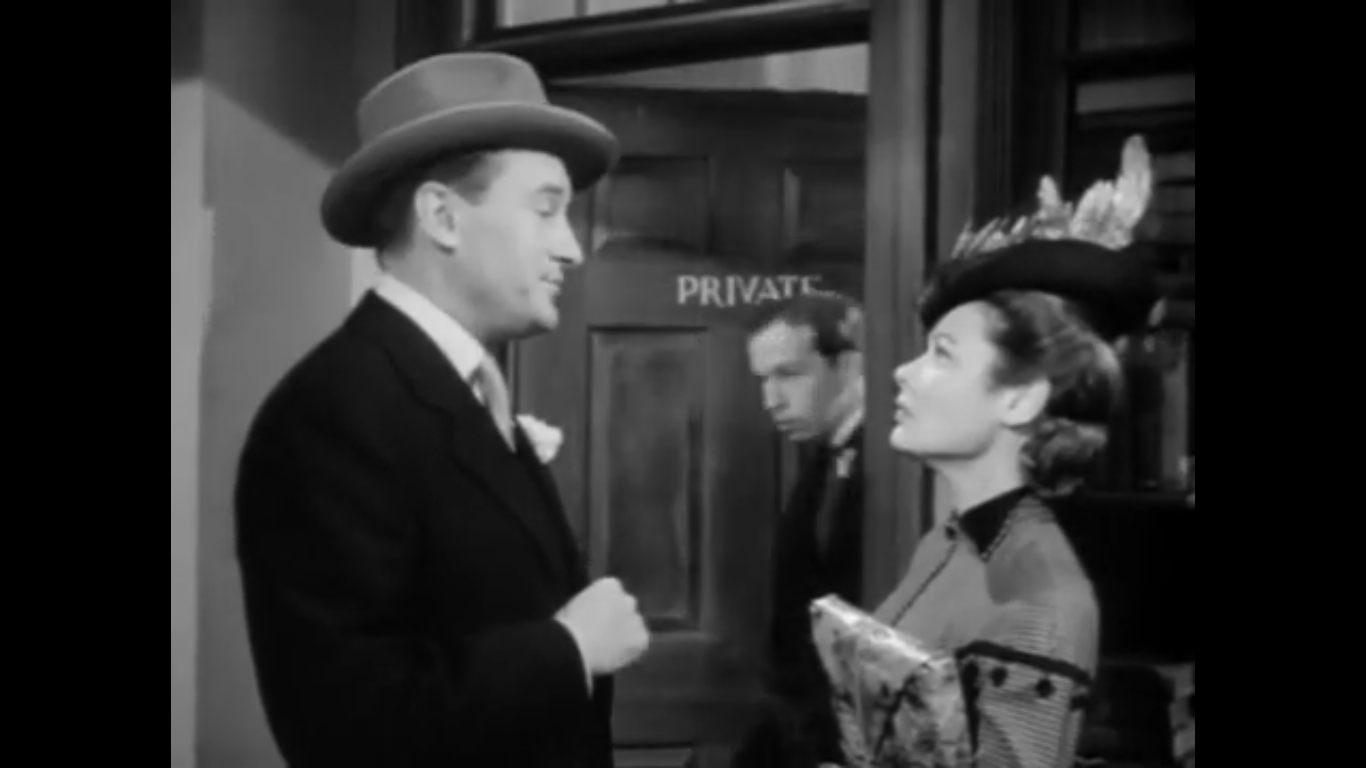
George Sanders — always the opportunistic ladies’ man — shows up with his brand of leering, if generally good-natured impudence. In this case, he’s living a double life under the beloved pen name of Children’s book author Uncle Neddy. If his introduction seems sudden, its purposes quickly become evident. He is a real man of flesh and blood. It only seems right that Mrs. Muir makes a life for herself with him…

It’s curious how both men evaporate around the same time: one out of sacrifice, seeing her happy in reality, and not wanting to complicate her life more. The other’s gone because, well, he’s a cad. For those fond of Rex Harrison, it’s rather a shame he is absent from much of the picture, but this is by design because it is his very absence — this perceptible passage of time developed within the movie — that allows for such a meaningful conclusion.

It’s what the entire film builds to and between the rapturous scoring of Hermann and the simple but efficient special effects, it allows them to walk out together arm in arm as they were always meant to be. If they are apparitions, then at the very least they are together again no longer separated by chemistry, mortality, or anything else. These themes have been melded together innumerable times before but rarely have they coalesced so agreeably.

4/5 Stars

Ivanhoe (1952)

As a child, Sir Walter Scott’s Ivanhoe always lived in the shadow of Robin Hood. The same might be said of this movie and The Merry Adventures of Robin Hood from years prior. By now Ivanhoe is both a feared and beloved mountebank and although late-period Robert Taylor is a bit old for the part and removed from his matinee idol days, it’s easy enough to dismiss.

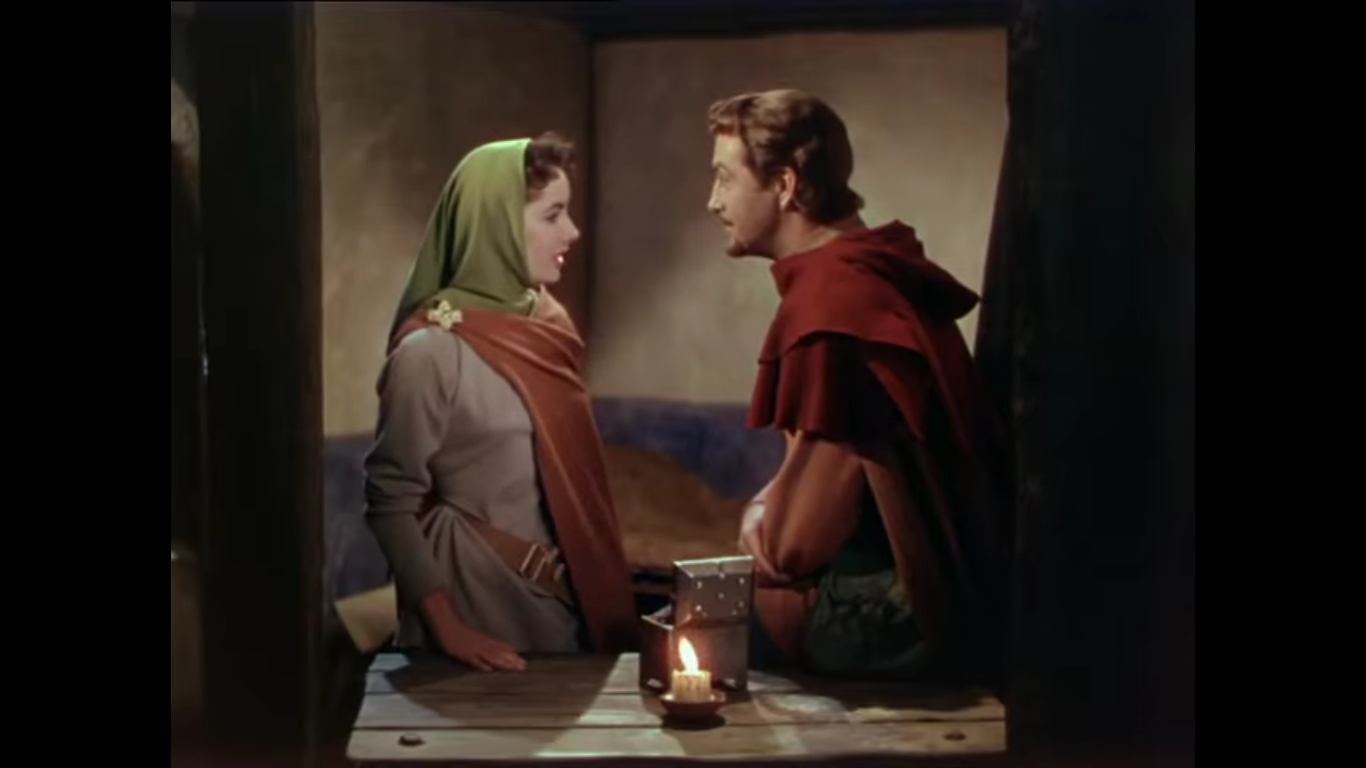
Taylor and Errol Flynn were both heartthrobs around the same time. Now a generation later he looks a little weathered and threadbare for his tunic though he proves stout-hearted enough. Joan Fontaine also effectively replaces her own sister as the guiltless romantic interest.

However, there are some other intriguing elements I would have not expected of the film. It becomes a fairly robust dialogue on anti-Semitism and the relationship between the Jews and the Gentiles. We always think of British history or this particular period as a war merely between the Saxons and the Normans. Here we are met with a bit more complication.

Ivanhoe must play the rebel in the absence of his beloved King Richard, but he is also called upon to be a friend to the downtrodden even those of a different religious faith. In the moments where he’s called upon, he’s an unadulterated hero, and it’s all good fun watching him bowl over his rival knights like a row of five bowling pins. However, this is pretty much expected. It gets far better when he’s faced with mortal wounds in the wake of a duel (with George Sanders of all people).

Both Elizabeth Taylor and Joan Fontaine stand by ready to dote over him. The ambush by the Normans sets up a rousing finale every lad dreams about. Because my old friend Robin of Locksley comes to their aid prepared to lay siege to the enemy’s castle. Meanwhile, Ivanhoe leads a rebellion on the inside, freeing his friends and stoking a fire to smoke them out into the open.

Watching the choreographed craziness full of arrows and swords, shields, and utter chaos, I couldn’t help relishing the moment because we feel the magnitude of it all being done up for our own amusement. And it is a blast. Regardless, of the romantic outcomes, it’s a fairly satiating treat; I do miss the age of Medieval potboilers.

3.5/5 Stars

This Land is Mine (1943): Renoir, Laughton, and O’Hara Take on The Nazis

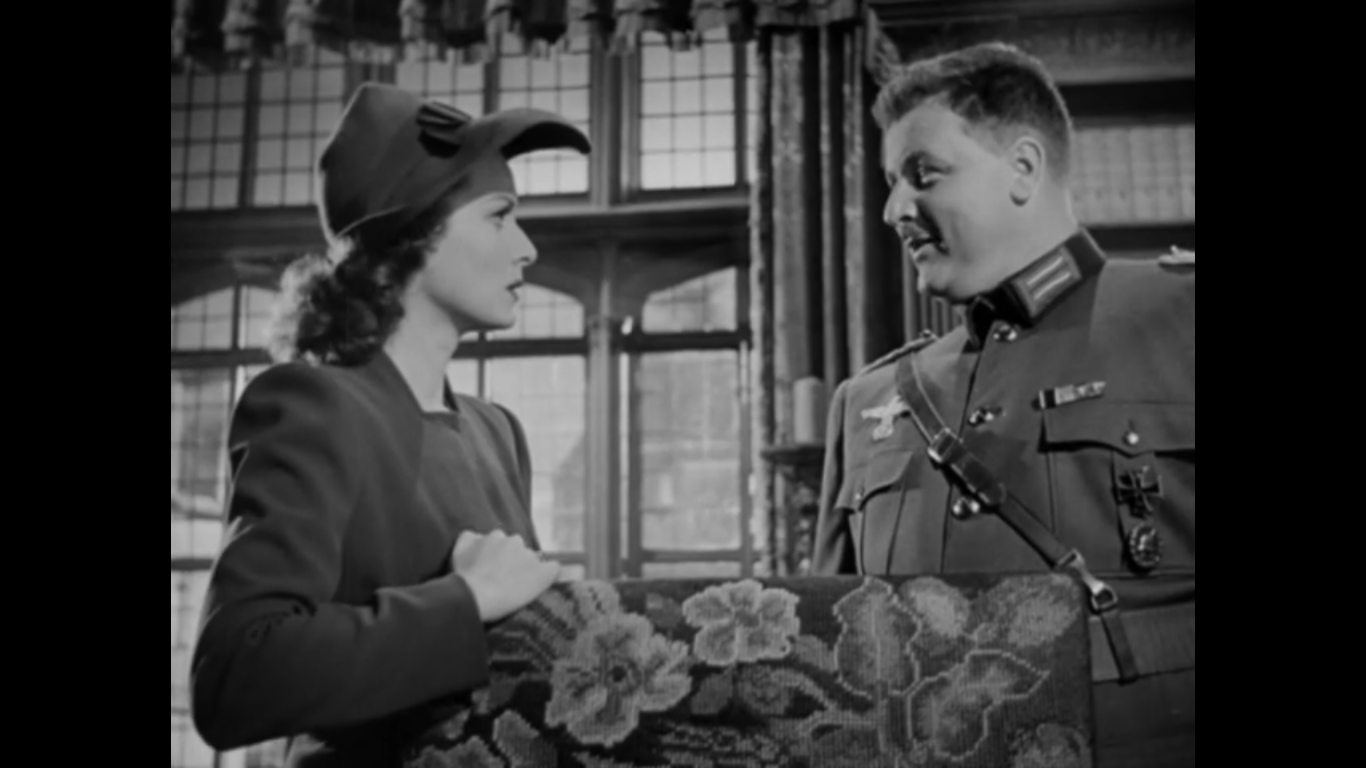
This Land in Mine initiates itself as a memorial to WWI. We see a statue with a crouching soldier. It’s inscribed with the following message: “In memory of those who died to bring peace to the world.” In the foreground, the Nazi juggernaut rolls into town. Peace did not last thanks to Hitler’s voracious appetite for “Lebensraum.”

The juxtaposition is key, and it says everything Renoir wants us to know without putting words to it. A newspaper is strewn on the ground with a very prominent headline featuring Hitler’s latest invasion. We’re seeing it firsthand.

There is only the very beginning, and it suggests something elegant about Renoir’s critique of the Nazis. In his case, it doesn’t come in the guise of a thriller like we might see with Fritz Lang or Hitchcock — this fit their own proclivities and doubled as pulse-pounding entertainment.

For Renoir, the story is a drama of a different sort. The local school is run by only a handful of teachers who must do their best to keep the school of rowdy adolescents afloat even with so many outside distractions. Suddenly Plato’s Republic and Voltaire’s writings are deemed dangerous by the new administration.

The school’s beloved Professor Sorrel (Philip Merivale) muses what the Nazis have before them is a delicate operation — cutting out the heart without killing the patient. Put in such terms, it sounds tenuous at best if not doomed to fail. Something must give way and perish.

The movie’s not about force or sheer strength, but the resoluteness and free reign of ideas. Because this is what brings people together and allows them to think for themselves about the true tenants of good and evil.

The two primary teachers are the middle-aged, ever-reticent Albert Lorry (Charles Laughton), who still lives with his mother, and the fiery soon-to-be-engaged Louise Martin (Maureen O’Hara). They are tasked with “correcting” their textbooks, though Ms. Martin’s act of passive rebellion is to hold on to the miscreant pages for the day they can be pasted back in. If all this sounds harrowing and positively medieval, stinking of Fahrenheit 451, that’s because it does.

Still, we live in a modern society of self-censoring. Not of ourselves mind you, but we like to cut out all the pages of the culture and the world with ideas we don’t find palatable or don’t summarily agree with. It’s so much easier to insulate ourselves with things that are innocuous and inoffensive from our own tribe. Then, as a result, we’re left with an ill-fated and potentially disastrous conception of the world.

This is partially what allows tyrants to take over and also what allows bipartisanism to poison people, since they never see the human being sitting across from them. Does it say something that I often feel less proud of my country than ever before? It’s not so much for the historical sins, because I’ve always known them to be there, but it’s for what feels like our current failures. And not just our failures but the persistent callousness and cynicism pervading our world.

Walter Slezak was always a fine performer in a bevy of roles as diverse as they come. Here his Nazi is in the mold of military efficiency; he’s totally pragmatic — just trying to do his duty and get by. He knows from experience he wants no sabotage and no martyrs. Because this churns up emotions and will blow up like a powder keg.

Later, he preaches how the children of today are the soldiers of tomorrow. No one knows that better than the Nazis with their Hitler youth regimen and indoctrination. But with that, you have the muddied center that a man like George Sanders train station manager must contend with. He lacks the idealism of the academics, namely, his fiancee O’Hara, the principled young woman who gathers the children together to sing rousing songs in the air raid shelter while the Allied bombs fall overhead.

You have this rowdy boy’s hall out of Mr. Chips set against the backdrop of an occupied city during wartime. It makes for a strange marriage but not an inauthentic one. Because, as we’ve already suggested, it’s another crucial battleground for the hearts and minds of the next generation. These are life-altering battles to be fought on their behalf, and it’s not solely with guns and bombs.

Since it has not been mentioned already, This Land is Mine is an unofficial reunion of The Hunchback of Notre Dame and not just the same players. It’s an extension of this same sweet but painful romance as reflected by the bashful Laughton. He has feelings for his young colleague — they care for one another — but she is with another.

Mrs. Lory (Una O’Connor) is a demonstrative lady, with deep-seated opinions, but her maternal love knows no bounds, and it’s phenomenal to watch in action. Her son is imprisoned, no fault of his own. In a world of daily paranoia, he’s one of 10 innocents imprisoned in recompense for two German soldiers murdered in the streets by a saboteur. It’s a debilitating moral dilemma for those who know the perpetrator intimately. After all, it is one life weighed against ten others.

It occurs to me that the man who made Le Grande Illusion could not sell his characters short in time of war. The generation changed and brought with it a new enemy — and we’ve toiled with history to make Hitler and his ilk a different kind of evil — but that almost makes it too easy. We can keep them at arm’s length with a clear conscience.

George Sanders says something telling as he commiserates with the town’s mayor. They are both in undesirable positions of power where they either compromise with the powers that be or fall under fiercer tyranny. Their acquiescing is deemed to be spineless. Sanders retorts:

“It’s easy for people in free countries to call us names, but you wait to see how they behave when the Germans march in. They’ll shake hands. Make the best of it.” A lesser film would have made them mere stooges and collaborators. I made the mistake of believing this was all they were. However, although the moral gradient is quite nuanced, it doesn’t mean Renoir doesn’t have a clear preference.

It comes in the form of Albert, a seemingly diffident man who nevertheless evolves when challenges are thrust upon him. Laughton has every opportunity to save himself quite easily, and yet he resolves to stand for an idea with his fallen friends.

When Laughton gets on the stand and talks about the Nazis’ assault on working-class people, making them into slaves pitted against a middle-class afraid of chaos and disorder, it’s very plainly Renoir’s point of view aided by scribe Dudley Nichols. Truth under any form cannot be allowed to live under the occupation. This is what Laughton stands up for because it is far too precious to go down without a fight.

There’s a lot of rousing defiance in the final act, good for stirring up the patriots, but what did it for me was Laughton’s exit. He gets his kiss and is unceremoniously shoved out of his classroom. But he’s a new man pushing the guards away, hands in pockets, perfectly at peace with the moment. His newfound courage is evident to all.

After watching the film, I had to ask myself the question: If this land is mine — the land I call home — why don’t I start acting like it? It’s so easy to cast aspersions on others and quite another thing to take personal responsibility.

4/5 Stars

Swamp Water (1941): Jean Renoir in Okefenokee

A place with a name like Okefenokee feels immanently American and this is an inherently American story though expatriate Jean Renoir feels sympathetic to these types of folks. He wasn’t a working-class filmmaker but in movies from his home country like Toni or La Bete Humaine, you see his concern for people in this station of life. They work in the fields, on the trains, making a good honest living, and sometimes their existence gets disrupted.

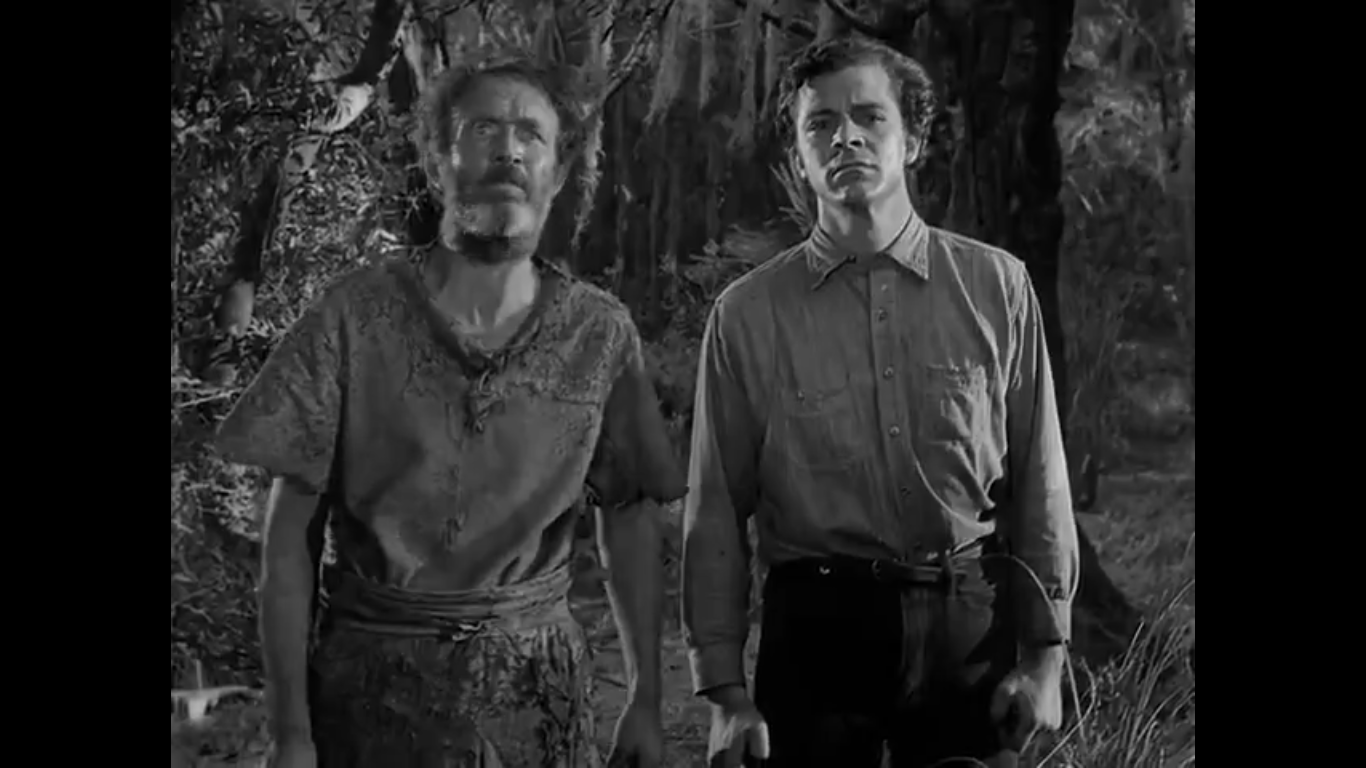
Granted, it’s early in his career trajectory, but it flabbergasted me that Dana Andrews is billed fourth. His Ben Ragan is our most obvious protagonist as an obdurate young man aiming to get his lost bloodhound back from the nearby quagmire of Okefenokee swamp, a cesspool of gators and crosses mounted with skulls. Worse still, it’s said to be the hiding place of wanted mankiller: Tom Keefer (Walter Brennan).

Ben’s father is an ornery old cuss named Thursday (Walter Huston), who remarried a younger woman. She’s a sign that he can be an affectionate man; he just has a difficult time showing it to his son.

Given these origins in a real place, I’m thoroughly intrigued by the world especially because it wasn’t completely fabricated on a studio backlot but was shot on location. This level of mimesis blends actors we know from all the Classic Hollywood projects with something that lends itself to greater authenticity. It’s not stark realism, but it adds a layer of tangible reality to the picture aside from some unfortunate back projections.

When Ben goes in search of “Old Trouble,” he sounds his horn like the Israelites marching around Jericho. Instead, he finds Walter Brennan who comes off like a fugitive mountain man with almost shamanistic qualities. Nothing can bring him down; not even a cottonmouth. But he also carries the film’s core dilemma with his fate. The town wants to string him up for killing a man; he pleads his own innocence, and Ben must for the time being keep his secret.

Swamp Water doesn’t get much press and The Southerner is usually touted as Renoir’s best American offering, but the link between the two pictures seems increasingly evident. The film has some of the same pleasant surprises. Some people are a whole lot better than you think they are and some are a whole lot worse.

The mercantile where Ben sells his furs is full of a gang of actors you relish seeing in these old Hollywood productions. Their prevalence is only surpassed by their instant recognizable character types. I’m talking about the Ward Bonds, Eugene Palletes, and Guinn ‘Big Boy’ Williams.

Whether John Ford got it from Renoir or Renoir got it from Ford, they both seem to have this enchanting preoccupation with dance even if it’s merely on a subconscious level. With The Grapes of Wrath and Swamp Water or The Southerner and Wagon Master we see firsthand how these communal events engender personal connections between the masses.

Except in a small outpost like this, they also bring all the local feuds and all sources of gossip to the surface. Ben’s flirtatious beau (Virginia Gilmore), comes off a bit like a blonde Jane Greer, albeit with a lightweight spitefulness. In contrast, Anne Baxter owns a curious role as a near-mute social pariah thanks to the notoriety of her fugitive father.

Rebuffed by his own girl, Ben vows to bring the ostracized (Baxter), now gussied up and quite presentable, to the gathering. It’s a bustling dance floor of dosey-does which is just as easily replaced by fisticuffs. It doesn’t help that Mr. Ragan is intent on searching out the man who accosted his wife, and he’s not squeamish about making a scene.

But beyond this, the Ford and Renoir connection can be seen in the stable of actors shared between Ford’s usual company and this 20th Century Production. It’s easy to say most of this falls to coincidence. This might be true, but in men like Walter Brennan, Ward Bond, and John Carradine, there’s something intangible we might attribute to the characters at the forefront of both these directors’ works.

When I look at these faces, they do not look the part of movie stars, but they are iconic faces like Jean Gabin or even John Wayne. They can carry the weight of drama, and yet when you look at them, it seems like they’ve already been through drama enough in life. And so when we watch them, we appreciate their struggles and every wrinkle and whisker on their face. Because it’s these things that put them on our level as an audience. They are our fellow human beings.

If the legend holds, I can’t understand how Daryl Zanuck wouldn’t let John Ford remake Le Grand Illusion for fear he would ruin it, and then Zanuck turned right around and meddled in Renoir’s picture. It’s something I would like to learn more about, although it’s possible only the unspoken annals of history can tell us now.

What we have as a mud-caked monument is Swamp Water: A vastly interesting curio imbued with the fractured imprint of Jean Renoir. It proves you don’t have to be born in America to tell a profoundly American story. I’m not surprised Renoir was a naturalized citizen by 1946. If his cinema is any indication, we would gladly consider him one of our brethren because movies know no bounds.

4/5 Stars

The Thing Called Love (1993): River Phoenix and Samantha Mathis

Seeing the Twin Towers on celluloid always brings a bit of a wistful reaction because there presence represents so much. It feels like a line in the sand and there are those who know that far better than me. The last time I recall having this sense was watching Peter Bogdanovich’s They All Laughed, and it’s little surprise The Thing Called Love begins with a very similar visual shorthand.

It says so much in a matter of moments as we watch Miranda Presley (Samantha Mathis) wearing her Yankees baseball cap, ride the greyhound bus with her guitar case by her side. Bogdanovich returns to another salient element of They All Laughed because The Thing Called Love is also a film enmeshed in the country music scene. New York might feel like an unusual mecca, but Nashville is not. That’s where Presley (no relation to Elvis) is heading. She’s got grand aspirations like so many wide-eyed dreamers.

Our hearts drop a little bit when the bus pulls into the parking lot of the Bluebird Cafe. It’s given the start to many fledgling talents and yet the line of eager musicians ready to audition quashes any optimistic expectations. Miranda’s no doubt destined for an arduous journey ahead.

Mathis and her real-life boyfriend at the time, River Phoenix have a meet-cute born out of circumstance. He jumps out of his truck late for the weekly auditions and pulls her into his lie so they can squeeze into the lineup. She doesn’t take kindly to his tactics and let’s him know.

It would be so easy to dismiss or even roll your eyes at these obligatory moments in the script. They feel to clean and conventional, but somehow the metanarrative and the candor of the young performers make it feel worthwhile.

Miranda gets her first rejection only to fall in with a community of her peers. She meets her momentary acquaintance James Wright (Phoenix) when he does a rendition of his tune “Lone Star State of Mind.” The track was actually written by Phoenix himself, an enthusiastic musician in his own right.

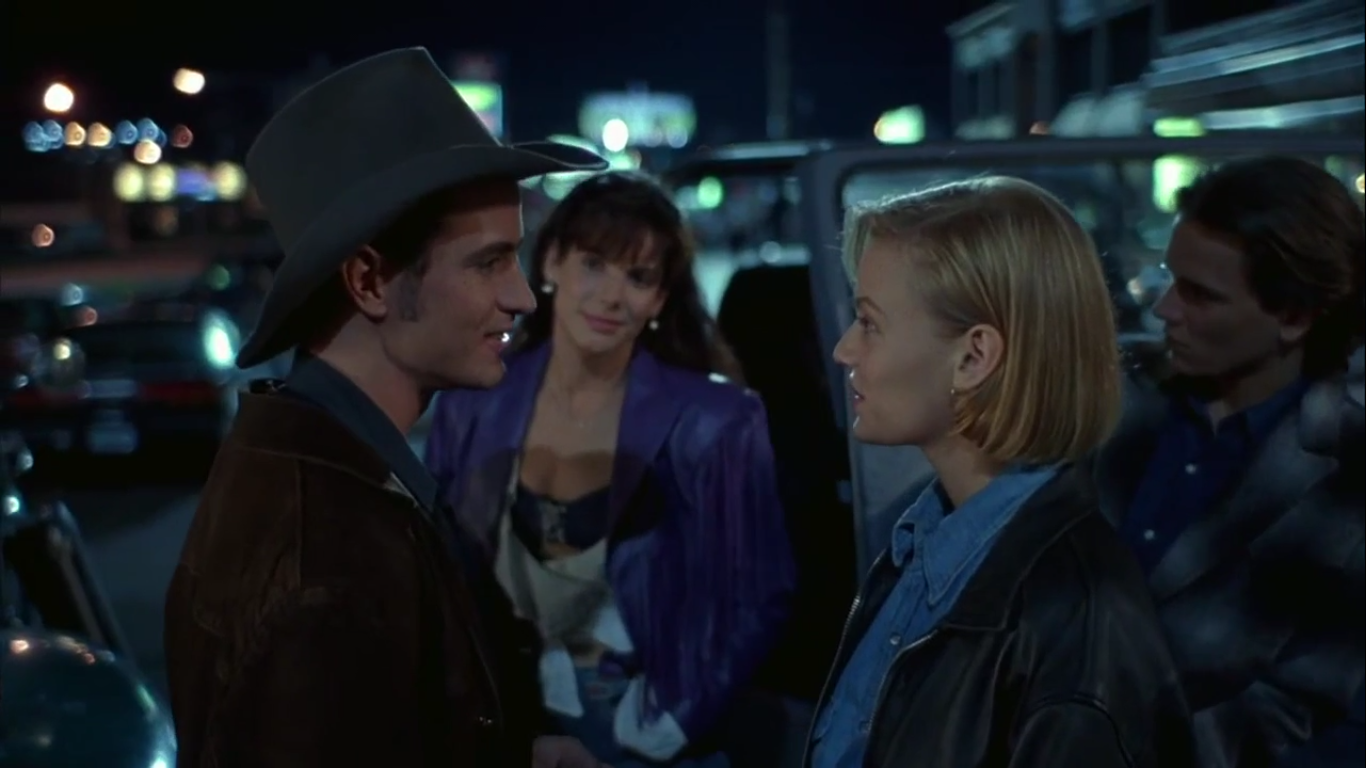
Their relationship is one mostly born of looks and mysterious glances that suggest so much in a way that is tantalizing and hardly anchored. Meanwhile, the Stetson-wearing Kyle (Dermot Mulraney) takes an immediate shine for Miranda, and it reveals itself through candid conversation and encouragement. Perhaps she knows as much as anyone else that he likes her. When you’re feelings are so genuine it’s hard to keep them concealed.

The movie feels need to make it into a love triangle as Miranda resigns to dance with Kyle and settle in a sense. But James is the mercurial artist with a caddish, manipulating charisma. He’s good with the lines to feed her even as he’s good with lyrics to sing in front of an audience and record deals he’s trying to finagle his way into.

There’s no continuity to him, and yet it’s hard to judge his intentions because even with mixed signals, he does seem to be drawn to Miranda. In one scene in the studio, he mostly ignores her and then in the heat of his performance, he pulls her onstage for an impromptu duet in front of the audience. He even takes her to a drive-in screening of The Man Who Shot Liberty Valance, and they write a song together. I suppose the rivalry between John Wayne and James Stewart for the affections of Vera Miles is a Hollywoodized version of our story.

Their trajectory is exemplified by wanderlust and spontaneity. James pulls Miranda away from her new gig waiting tables at the Bluebird so they can make the pilgrimage to pay tribute to the King. They must hold the title for one of the most unconventional wedding ceremonies as they get hitched in a Memphis supermarket, dancing the night away as the rain comes pouring down outside. It’s life without consequence.

However, cohabitation as a married couple is fraught with conflict. They weren’t meant to live this way with their personal dreams pulling them apart, and their marital expectations far from unified. James’s capricious tendencies reassert themselves, and Miranda feels defeated.

In the wake of an argument, she seems all but prepared to leave her dreams behind. She quits her job and hops on a bus back home only to turn right back around with one last mission to accomplish. She holds up in a cafe to pen her latest song, and as anyone who’s tried to conjure the creative muse knows, some ethereal inspiration just comes to her. Out of nothing something is born fully formed.

She plays her song, singing lucid and tender, all colored by her newfound heartache and experience. It’s not for anyone else, only an audience of one, and yet it’s through this creative paradox her songs finally discover an audience.

One of the movie’s most agreeable assets is Sandra Bullock who was still on the way up with Speed and While You Were Sleeping in her near future. She’s not immediately identifiable as a loquacious southern belle — it’s not what we immediately attribute to her persona — but it’s easy enough to like her candor.

And if Linda Lue Linden is a foil for Miranda, then Dermot Mulroney’s portrayal of Kyle fits opposite River Phoenix coming to represent not only a physical juxtaposition but a philosophical one as well. What holds them together is a love of country music even as their friendship is now complicated with the suggested ambiguity of a ménage a trois. Not everything is resolved.

Nashville will always be the ultimate film about the country music industry for how wide-ranging, pointed, and tender a portrait it is in the hands of Robert Altman. I won’t even feign a comparison with The Thing Called Love because it is a movie for a new generation reaching out to realize their dreams. And while it paints in this tangible atmosphere of southern twang and steel guitar, it’s best as a story of close-knit relationship.

I’m not sure if anyone would call me a staunch champion of Peter Bogdanovich’s films. I do like them a lot, and it does feel like a handful of them got a bad rap through faulty marketing and unfortunate circumstances.  If They All Laughed was marred by the Dorothy Stratten tragedy, then, The Thing Called Love carries the specters of River Phoenix’s untimely death.

He was in the company of his siblings, his girlfriend Samantha Mathis, at the club partially owned by Johnny Depp, as they performed some of his songs together. It seems like such an ill-fated conclusion. This isn’t the way life is supposed to end. For fans of River Phoenix, The Thing Called Love stands as a final testament to his talents, and it’s an unmitigated pleasure to see his passions for music and acting blended together. If the movie’s not his best, then it’s still a fine way to remember him.

3.5/5 Stars

Dogfight (1991): River Phoenix and Lilli Taylor

If you’re a bit of a finicky nerd for cultural context like myself, you realize right when we hear Brenton Wood’s “Oogum Boogum Song” wafting down the city street from a car radio, we can carbon-date the scene to around 1967. A marine steps off a bus with a slight limp. He must have been in Nam, but we don’t know what waits in front of him.

Nancy Savoca’s Dogfight gets its name from a particularly uncomfortable ritual where a group of soldiers looks to scrounge up the ugliest girl they can find for an evening to dance and (hopefully) win the crown for finding the hag to rule them all.

The story takes us back to November 1963 on the eve of JFK’s assassination. The Vietnam conflict has yet to escalate and in the youthful age of Camelot, the peace corps, space races, and enduring American exceptionalism, the world still feels very naive indeed.

We are inundated by the rowdy bravado of four youthful marines, led by Eddie Birdlace (River Phoenix), who have a short stopover before heading overseas. The collective group mentality that bonds them fast and fierce also churns up this festering culture of vitriol and misogyny.

It’s probably just as much a part of what will give them a fighting chance to stay alive. Because even their boyish cajoling and catcalls ring with untrained naivete. They have yet to see death in the face, and for now, they feel indestructible.

Birdlace is just one of the boys, bellicose and burning with rage and impudence. Phoenix wears this quality behind his eyes to go with his high-and-tight haircut and the casual profanity permeating every conversation. He’s constantly operating through an economy of fear, payback, and entitlement. That means a snooty waiter gets dressed down with such a pointed outburst that not even Ferris Bueller could have conceived.

But he also knows how to turn on the charisma in a smarmy sort of way. It sets the stage for their competition as he winds up in a late night coffee shop trying to romance the young woman working the after hour shift.

Lilli Taylor transforms from a moody rocker in Say Anything or even her animated turn in Mystic Pizza, in a change involving more than a poofier hairstyle. Her entire constitution is different. She falls quite easily into her role as a sensitive waitress with dreams of folk singing and maybe meeting a boy to love. We believe that she might just fall for him. He could make her fall for him. But she’s also not a moron. She’s sincere and sees through the insensitive game.

It makes for an uncomfortable evolution as we sympathize with her compromising position and also watch Birdlace grow increasingly conflicted. This girl is a lot more than he assumed (and it’s not just about her looks).

The most compelling comparison I could offer is The Clock starring Judy Garland and Robert Walker. They’re both films about capturing a moment in time with a relationship that has a defined, even finite, beginning and end lending this heightened sense of meaning to every interaction.

Dogfight‘s vulgar and much more a movie for the ’90s even as it’s a film for the Vietnam era so different than the WWII reality Vincente Minnelli developed decades earlier. There’s often something a bit twee about these period efforts partially because we’re accustomed to experiencing the world through the nostalgia of black and white.

Dogfight also provides a more cathartic resolution. I’m not sure if it’s too rushed or what it adds exactly, and yet as an audience member, it gives us some form of wish fulfillment seeing two people reunited in a changed world. It makes the ambiguity of the prologue a bit clearer. There’s a purpose to the time jumps.

It can be summed up in an image: Birdlace is the one who’s come back from the shores of Vietnam 4 years later. He finds that same cafe and limps in. There she is. Surely she wasn’t waiting all this time? And yet they share an embrace in that cafe that’s long and awkward — extended out. The way Phoenix hunches over on her shoulder almost feels like the posture of a little boy. That’s it. We want to believe that these kinds of small, intimate connections are in fact possible in the unknowable chaos of the world at-large. It’s a vein of hope in a tumultuous world.

Phoenix’s career was always morphing and maturing in all manner of ways. In hindsight, we can watch how he took early nebbish roles like Explorers and Family Ties guest spots only for Stand by Me to be a stepping stone to a varied future. Running on Empty garnered critical acclaim, but then he zigzagged his way through an array of projects as diverse as I Love You to DeathDogfight, My Own Private Idaho, The Thing Called Love, and yes, even Indiana Jones and The Last Crusade.

He never seems to be duplicating himself, and it makes for a mostly enthralling viewing experience. Because here is a performer who seems locked in and totally engaged with not only his craft but the poetry of moviemaking and at such a formative age too. Dogfight is an imperfect film built out of period artifice, but it also has these pockets of magic thanks in part to Phoenix and Taylor.

3.5/5 Stars

Mask (1985): Eric Stoltz and Cher

Peter Bogdanovich lost his girlfriend Dorothy Stratten to tragedy in 1981 and after the release of their picture together, They All Laughed, it was anyone’s guess if he’d ever be able to return to directing.

I’ve heard an often-repeated anecdote that he ultimately decided to take Mask as his next project as a way to honor Dorothy. The reason isn’t immediately obvious. However, he explains that Dorothy was fascinated by the Elephant Man, who shared the same condition as Rocky in Mask. But she was a highly sought after beautiful woman. How could she relate?

It seems that extreme ugliness and extreme beauty by the world’s standards puts you outside of the normal purview of society. It’s not something individuals asked for. They are born with it or given it by circumstance, and as a result you have the world’s prying eyes looking at you. So both of these films are about this kind of social “others,” who must make an existence for themselves in a world where they’ll never quite fit in.

The greatest epiphany of Mask is how Rocky (Eric Stoltz) does exactly that. We’ve seen movies about people lashing out because of the hand they’ve been dealt. This is a reasonable reaction, but this movie is never about that.

It’s my own human inadequacies making it so I look at him and feel discomfort. But it’s a classic example of not judging a book by its cover. Outward appearance doesn’t define the mark of an individual.

The brilliance of this teenager is how he rewrites the script and subverts the expectations around him. He’s the personification of all our outcast inclinations when we’re in middle school and high school. None of us would have envied him during those formative years. And yet he rarely gets rattled by any of it, even when he might have the most excuse to do so.

Rocky has a level of supreme confidence so in a manner of weeks teachers know he can succeed and look after himself and his fellow students come to appreciate his wit and his near-Encyclopedic knowledge. He has a high view of himself and this allows him to be self-deprecating. I like the idea that we don’t think less of ourselves, but we think of ourselves less often. It makes our lives centered around others.

Part of this is the family unity around him. They support him and love him for who he is even as he does yeoman’s work to look after his mother. It’s almost as if he’s her guardian sometimes with the lifestyle she leads, a holdover from the ’60s with drugs and a conveyor belt of male suitors.

Cher is a powerful force and she always has a natural charisma in front of the camera that suggests so much about her. Although their relationship is the backbone of the whole movie, they have an entire motorcycle gang to watch out for them including the old family friend and Cher’s past lover Sam Elliot.

He’s a quiet enigma of cool, but with his laidback demeanor and a “Moustache Rides” tee, a character who could easily be a vehicle for outside conflict becomes more of a stabilizing force.

Rocky is even granted one of the loveliest adolescent romances of the 80s as he begrudgingly decides to spend his summer volunteering at a camp for the blind meeting Diana Adams (Laura Dern).

It’s reminiscent of City Lights with a love story based on personality and kindness as opposed to superficial appearance. In other words, it is a deeper bond and even as she’s an equestrian girl with an affluent background and he’s been raised on the road with a motorcycle gang, they relate on what’s most important.

I couldn’t help myself and seek out the writing on the wall. Rocky can’t last forever. In real life Roy L. “Rocky” Dennis passed away at 16 years old. If you didn’t know him you might think this was merciful and yet having watched his life play out on screen, we see the tragedy of it. He was such a loving, vibrant, jovial force to behold. He could have accomplished so much. And one can only imagine his mother was devastated. Because her boy was special and the bond they held was incomparable.

Bogdanovich augments the story with his trademark use of dietetic sound to fill out the world on top of some of Bruce Springsteen’s finest tracks. I watched the director’s cut which included a few extra scenes and all I can say is that I’m thankful to Bogdanovich’s conviction to get his version out there without compromise. This included working with Springsteen himself to get the original recordings licensed for the rerelease. It pays heavy dividends.

Regardless of the director’s shortcomings, I will dearly miss his classical sensibilities as a filmmaker. He made films imbued with joy and melancholy. Both speak to me and surely I’m not the only one because life becomes a subtle dance between a panoply of emotions.

Like the masters of old, he was able to take a story and personalize it so the core themes are somehow made manifest and evident in his own life. It’s a lovely brand of storytelling, and it allows Mask to constantly ambush us with some winsome surprises. This is how movies should be.

4/5 Stars