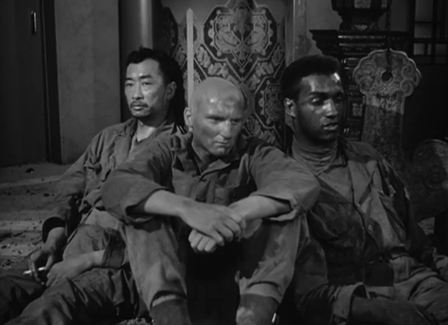
Review: Some Like it Hot (1959)

somelikeithot1Only Billy Wilder would dare to make such a film. Somewhere amidst the St. Valentine’s Day Massacre and men dressed in drag, he could find the inspiration for one of the most high-powered, zaniest, even subversive comedies of all times. There’s very little overstatement in that assertion because Some Like it Hot is all that and most importantly it’s just good unadulterated fun.

It finds its genesis in the Jazz Age of Chicago circa 1929 where gangsters like Spats Colombo (George Raft) are running the streets, the crash hasn’t quite hit yet, and the Dodgers are a long way away from leaving Brooklyn. George Raft takes on a parody role hearkening back to the days of Scarface, but this time, there are a lot of laughs in the wake of his destruction.

Small-time musicians, Joe and Jerry, are living paycheck to paycheck and things aren’t going so hot for them when the authorities raid a not so legitimate establishment. Immediately they high tail it, but they’re not safe for long when they unwittingly stumble upon the St. Valentine’s Day Massacre. They frantically flee the scene of the crime knowing the mobsters will soon be after them and to make matters worse they have no money. What to do? What any desperate pair of musicians would do, dress up as women and join an all-girl ensemble for three glorious weeks in sunny Florida. Sounds ludicrous when Jerry (Jack Lemmon) first drops the idea half-serious, but after the hot water they find themselves in, Jerry (Tony Curtis) takes him up on the masquerade.

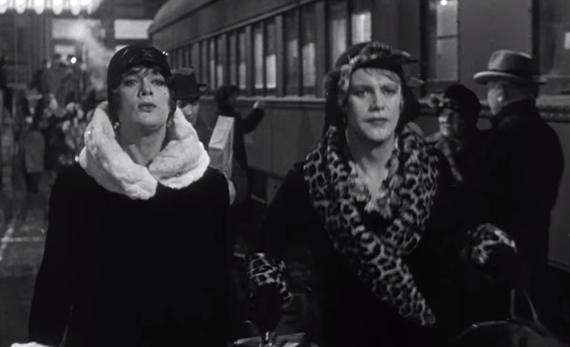
somelikeithot2So they pack their bags, do up their faces, and change their voices an octave or so higher. They wobble to the train station on top of their heels as Josephine and Daphne, just what the band leader Sweet Sue ordered and our two effeminate fugitives get aboard for a wild ride indeed.

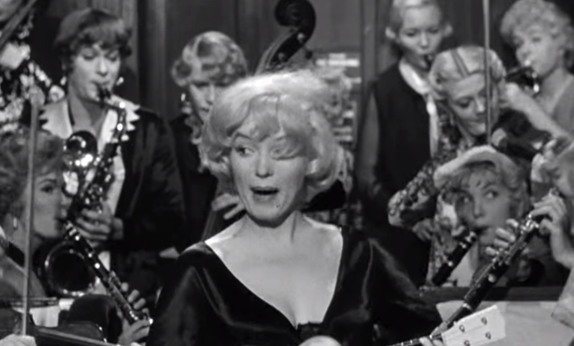
They soon meet the other gals including the vivaciously scatterbrained Sugar Kane (Marilyn Monroe), who already has a strike against her for getting caught drinking. It looks like bad news for her during a bouncy rendition of the 20s tune “Runnin’ Wild.” Amid the toot-tooting of Josephine’s sax and the bass twirling of Daphne, Daphne also finds time to bail Sugar out. She’s quick to make friends too during an after-hours get-together in her compartment. It’s one of the uproarious moments where Jerry/Daphne must go through the battle of the sexes. He’s so giddy to have so much female company and yet he must maintain his facade. What’s brilliant about Lemmon is he actually seem to genuinely relish his part. Whether it’s his character or not I’m not sure, but he buys into his role especially when it comes to his budding romance, but that comes later.

All things are bright and cheery when they arrive in Florida with palm trees and bachelors galore, all ready and waiting for a little tete-a-tete. One such bachelor is Osgood Fielding (Joe E. Brown), who immediately has his eyes on Daphne. And let the comedic irony and romantic entanglements begin. What follows are two absolutely preposterous tales of romance that crank up the absurdity.

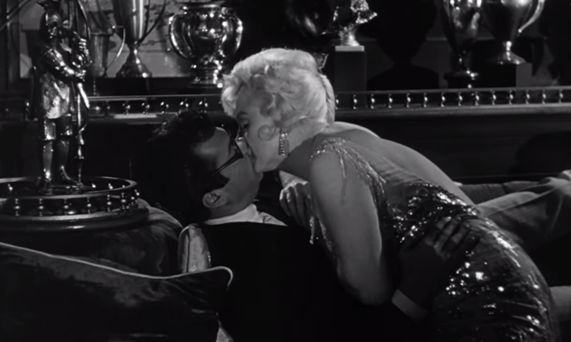
somelikeithot4Joe swipes a sailor’s cap and a pair of glasses while donning his best/worst Cary Grant impression to woo Sugar as an aloof magnate complete with oil fields and a yacht. It’s all part of his plan to win her love, and Daphne views the whole thing disapprovingly, hoping to catch his buddy in the lie. Thus, now Joe has committed himself to two roles and somehow he’s able to keep the plates spinning by borrowing Osgood’s boat for a romantic night with Sugar and using a bicycle to rush back to the hotel and put on the whole Josephine act.

Meanwhile, Jerry gets more and more invested in the whole Daphne performance dodging Osgood’s playful advances, while finally dancing the night away to a killer tango. It’s the diversion Joe needs in his plan to get with Sugar, and he’s succeeding. But Jerry, or should we say Daphne, isn’t doing so bad either. With a flower between her teeth and when she’s not trying to lead, they make quite the couple. Could there be wedding bells?

All that hilarity goes on halt when Spats Colombo and his gang come to town for a conference and the girls avoid suspicion at first, but their nervousness tips the mobsters off. The chase continues and the boys must finally drop the act if they want to get out alive. But Joe delivers one final gesture to Sugar not wanting to ditch her completely. They plan to catch a ride with Osgood who will elope with Daphne. But in a last-ditch effort, Joe finally lets everything drop and breaks all pretenses. It makes for an awkward situation when he gives Sugar a big kiss in front of a full audience, still dressed in drag.

As they get away in the little motorboat, Joe pleads with Sugar not to stick by him, because he really is a bum. But she doesn’t care, does she? He’s Tony Curtis, a Cary Grant type. Now it’s Jerry’s turns as he tries to cook up excuse after excuse why he cannot marry Osgood, and of course every time he’s rebuffed. Finally, in exasperation, he pulls off the wig, loses the voice, and yells, “I’m a man!” Without missing a beat, his beau shoots back, “Well, Nobody’s Perfect.” The look on Lemmon’s face is priceless and this moment is the perfect capstone on one of the wildest films you could ever imagine.

somelikeithot5It’s absolutely astounding that despite all the headaches and troubles Marilyn Monroe brought to the set, including constantly flubbing lines and being generally difficult, her performance bubbles over with a playfully ditsy sensuality that captivates the screen. I for one can hardly ever see the turmoil going on underneath because the role of Sugar is so vibrantly joyful, innocent, and genuinely funny put up next to her great co-stars. Her numbers like “I Wanna Be Loved by You” exude the friskiness that she was known for and there’s no question that Monroe has a magnetism on the screen that was unequivocally her.

Joe E. Brown plays the giddy playboy with devilish hilarity, the perfect comic companion for Lemmon. While Tony Curtis is great, he plays the straight man in the sense, that it feels like he’s just doing this out of necessity. Lemmon is an absolute riot, taking on this role willingly and bubbling over with enthusiasm that is palpable. He has that cackling laugh that adds an exclamation point too many of his conversations and when he starts dancing around with those maracas, shaking his hips, it’s hard not to crack a big goofy smile.

Billy Wilder always had a gift for films with wonderfully entertaining characters and plot lines that poke holes and find humor in modern sensibilities. He gets away with so much by dancing the fine line of what is acceptable for the 1950s and yet he puts it together in such an engaging and uproarious way that it remains a classic. Not just of comedy but of film in general. I’m not ashamed to say that I do like it hot. Although air conditioning is nice every once and awhile.

5/5 Stars

Review: Citizen Kane (1941)

citizenk3“That’s all he ever wanted out of life… was love. That’s the tragedy of Charles Foster Kane. You see, he just didn’t have any to give.” – Jedediah Leyland

It might seem rather trite to attempt to write anything on Citizen Kane, but as someone who can admittedly be trite sometimes, there seems to be a need to give it a go. Here it goes. Citizen Kane is forever an enigma, in the sense that it was fully under the control of the independent-minded and ultimate auteur Orson Welles during the studio age. It didn’t come out of some movie making assembly line, but instead, it’s a debut that exhibits so many elements that have befuddled and fascinated audiences for generations. There’s certainly the technical and production aspect which became the watermark and inspiration for countless millions. Then you have the human aspect which also deserves some attention.

Swirling around a film with this much mythology there is always bound to be hearsay and rumors, but supposedly in later years, Welles considered Citizen Kane a comedy, in the sense that everything is over the top camp, much in the same way that Welles the man was a larger than life caricature. He played the part of an alienating artistic mastermind to a tee, and it fit the way he made this film. Grandiose in scope,  infused with inspired vision, and really an all-out war for acknowledgment.

Because of the many stories about Kane which have now become the stuff of legend, the parallels between Charles Foster Kane and news magnate William Randolph Hearst stand out. Whatever his opinions of the actual film ended up being, Hearst did his best to besmirch the film and keep it out of theaters. And so it goes Welles’ debut did not get much of an opening, ironically because of a man rather like his main character. It would be interesting to know what Welles would have thought of such a situation. Would he have been greatly incensed or taken it rather like a compliment that he had created something so volatile? Because it’s true, Citizen Kane is still smoldering today, and it retains a constant place in cinematic discussions even 70 years after its release.

There’s so much to talk about and so much that most everyone has probably already talked about. It has such an intriguing narrative structure, and it models time in such fascinating ways. Because a lot of this film is about the passage of time as it pertains to one man’s life and the memories of his life. He is dead after uttering that immortal word “Rosebud,” but his memories live on through the recollections of those around him.

We get access to the story through a newsreel, but like such a reporting device we leave it knowing very little about the man except for his material possessions and maybe a little about his career. What we really want to know is the man, and the nameless reporter becomes our stand-in.

He pieces together Kane’s childhood by sitting in a musty vault and reading over the thoughts of the boy’s caretaker and financial adviser Mr. Thatcher. With one particularly memorable match cut, we jump a number of decades in a matter of seconds as the banker speaks to a young Kane only to turn around speaking to a young man. But he’s not much help except that Kane put Thatcher under fire with his brand of yellow journalism.

citizenk2Mr. Bernstein is a kindly fellow and an old man by now who used to work with Kane at The Inquirer when it all began. He knew the man who had a song named after him, who bought out the staff of the rival paper The Chronicle, started his own war, and married the niece of the president.

From the now elderly and slightly infirm Jedediah Leyland (Joseph Cotten), we learn of the rise and slow decline of the man along with his friendship with Leyland. There is a sequence here with Kane’s first wife that wonderfully shows the degradation of a marriage over the years as he is more devoted to the paper than his spouse. It’s tragically sad, and there’s more heartbreak in that one scene than most films can muster in their entire runtime. Because Kane could love, and he wanted love, but he also seems to love himself more than any other person. He’s married to his work and the personal independence that comes with it. Ultimately, Kane’s political career suffers from scandal and his own bullheadedness. Leyland switches branches to get away and becomes a drama critic prepared to lambaste the operatic debut of Kane’s second wife. It really is bad though Kane will never hear of it. He’s always in need of proving himself to those around him.

Our investigative journalist returns to the nightclub of Susan Kane to get the rest of the story from her, and it only becomes more depressing. After being forced into an opera career she has no ambition for, Kane finally relents and Susan spends her days in Xanadu, the fortress he built for her sake. But she wants more than the stuff that he can give her. She wants to get out, have fun, and have companionship. Kane doesn’t know how to do that, and soon after she left him.

What was left behind was a deeply troubled, isolated old man with nothing but material possessions to weigh him down in a river of loneliness. His life was a jigsaw puzzle and yet when we get the piece pertaining to his final word, it fails to help us make any headway. Because the reality is that no one word can explain a man’s life. It is interesting how Kane desperately wanted love so you would think that his last words would refer to a person. It just shows how messed up his relationships were. He thought he could get joy from possessions so it’s only fitting that his final words were another thing. It’s sad really, so if Orson Welles wants to call Citizen Kane comedy, there seems to be a need to qualify that and christen it a “tragi-comedy.”

Herman Mankiewicz’s script with Welles is the quintessential tale of the rise and fall of one man and with the ever-changing times, that archetypal narrative has remained prescient because America is still built on those sorts of individuals. It can be the nation of visionaries as well as tragedy. Wealth and loneliness.

As for the great Bernard Hermann, his score personifies the changes in Kane over the years and this was the first time I noticed the wonderful reprises of his theme song. It can be heard throughout although it seems to lose all the gaiety and luster it had years before.

citizenk1Gregg Toland’s cinematography is strikingly beautiful utilizing the distinctly clear, deep focus to frame shots wonderfully. Background and foreground remain equally important becoming a wonderful way to convey distance. Also, the camera always seems to be making the viewer crane our necks, getting a slight view of the ceiling or it has us looking down at the figure below us. We very rarely see them head-on as they appear. Furthermore, Kane is steeped in trick shots, mirror images, and all sorts of things that I cannot even begin to do justice to. It could be a nurse walking into a room or Kane solemnly plodding through the vast corridors of his domain. It’s a veritable paradise for the eyes because we are always being met with visual marvels. Citizen Kane has grown on me every time I see it since it’s not simply narrative, or backstory, or history, but also at the most basic level, it’s one of the most prominent expressions of this highly visual medium called film.

5/5 Stars

Commissar (1967)

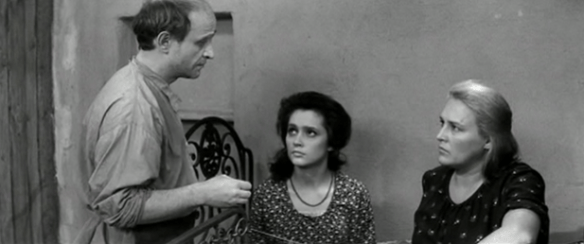
commissar1

Even with the so-called Khrushchev Thaw, it’s pretty amazing that Commissar even got made and perhaps even more astounding that it made it to the viewer all these years later. Some of that might be because it originated from Russian Civil War literature and anything else we can attribute to luck.

It is, as it titles suggests, about a commissar: an official of the Communist party, but this one seems special. First of all, she’s a woman which in itself is an interesting piece of commentary, but perhaps more so is the transformation she goes through.

From the outset, she is what we conjure up in our minds. Brutal, tough as nails, masculinized and mechanized by the collectivist agenda of the party. She’s the perfect comrade cog in the communist machine. Except then she receives the startling news that she is pregnant, and she must seek refuge in the home of a nearby Jewish clan. They are forced to quarter her, serving the greater good. She’s aloof to the whole idea and their diminutive patriarch puts up a fuss.

You see, he already has five children, a wife, and a mother to look after. He can’t afford to have this unwanted extra baggage, and she’s no friend of theirs. In this sense, the film feels reminiscent of Melville’s Silence de la mer. However, Commissar evolves into its own creature, just as all parties involved change over time. Yefim and his wife make their guest comfortable the best they know how and following the pregnancy they take good care of her.

Seeing her with a newborn is an altogether strange and foreign image, and with the cult of motherhood, the commissar’s whole demeanor shifts. She looks on at this family with contented eyes and stares back at her former life with some reluctance. It seems impossible to traverse the same paths she once did.

Perhaps most frightening are the images that are interwoven into the plot. They are disorienting, paranoia-filled, listless dreams that swoop in during pregnancy and restless hours of sleep. In the present, there are the children playing their militant games, terrorizing their sister, a sad reflection of the things going on outside of their own homes. There are constant contributions and pogroms always hanging over God’s people.

Whether it’s a hopeful fairy tales or a truth which you are willing to die for, the film paints a fairly bleak picture of what it means to live life. Our commissar is wholly disillusioned and the shadows of the Holocaust hang over the narrative because they lurk in the near future, not the past.

Director Aleksandr Askoldov’s favors a  fluid camera that nevertheless feels unrefined more times than not in its blunt and most certainly chaotic movements throughout the frame. It’s as if it’s not confident keeping still  — needing to prove its mobility in all circumstances. Still, the film boasts a lasting power that feels counter-cultural. This is not the film we expect coming out of the USSR circa 1967. These characters feel conflicted, their story feels sobering at best. It also offers up a strangely haunting dance sequence like no other, but then again this is far from an ordinary film. The director would soon be fired, expelled from the party, and exiled. The KGB would lock his film away and throw away the key for 20 years. He undoubtedly struck a cord — then and now.

3.5/5 Stars

Still Mine (2012)

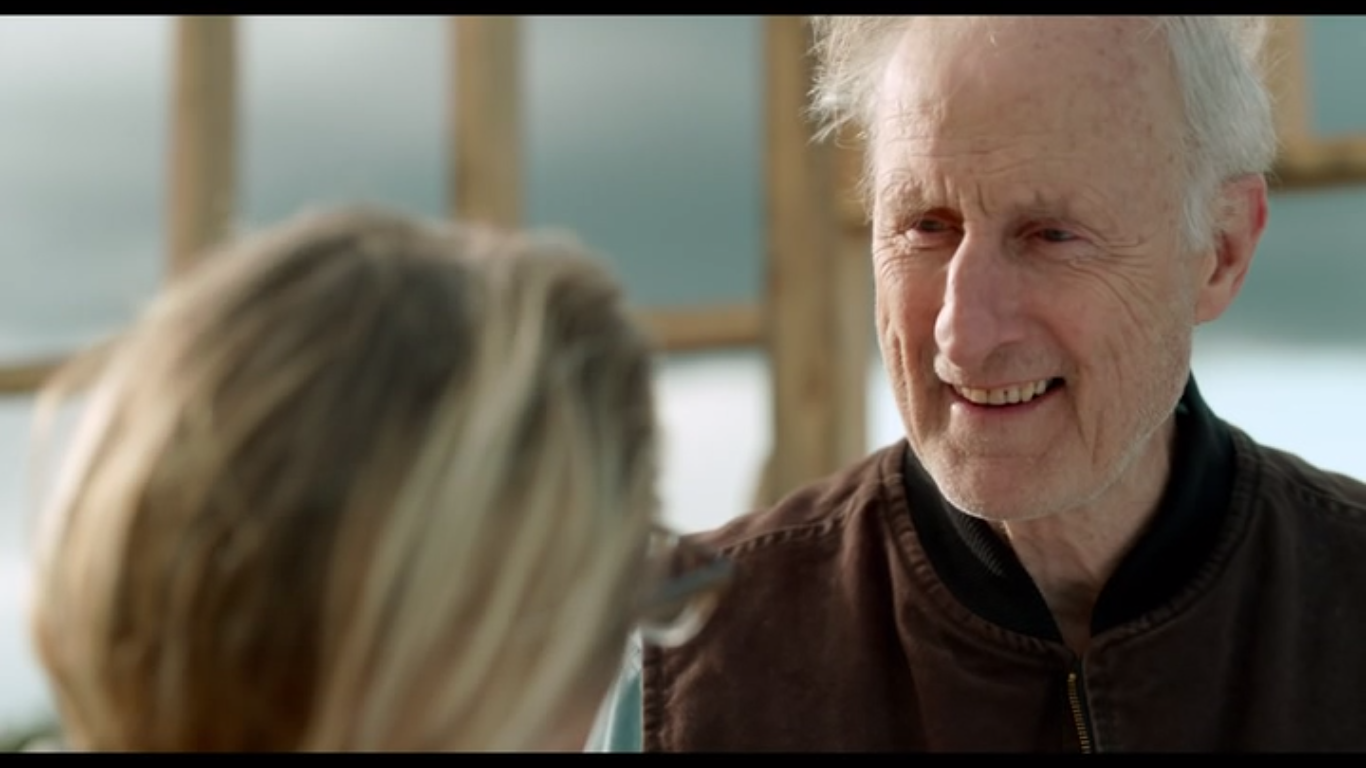
stillmine1This is not a powerhouse film, but it’s bolstered by a powerhouse performance from James Cromwell. His career has always been one worth watching. He’s been prolific for many years now in films like Babe, L.A. Confidential, The Queen, The Artist, and so on. And yet he’s never been a star, simply a wonderful character actor making each film he appears in all the more interesting. He has an imposing frame, often a quiet persona, and a relatable quality.

Still Mine is certainly a romance film, but it’s about one man almost as much as it’s about a couple. Craig Morrison (Cromwell) is well into his 80s now and he is still living in a farmhouse with his wife of 60s years. Her health and memory are quickly deteriorating and he, along with all his children, knows it. He resolves to build her a newer, smaller farmhouse that will be easier to manage.

We like him as an individual because he still has ties to the old world and the way it used to be. He doesn’t beat around the bush, and he gets fed up with the impracticality of modern-day bureaucracy. He’s proud and independent. His idol was Babe Ruth, and he has a great passion for lumber because he father was a shipbuilder long ago.

That’s why when his new project hits roadblock after roadblock in the form of building code violations, he’s peeved and annoyed. But he tries to push through, going past them, because that’s his way. His main opposition is building inspector Mr. Daigle, who although he might be a sour apple and a stickler for rules, is by no means a villain.

stillmine2So in a sense, this story is twofold. We get to see the ties that bind two people together even after so many years of marriage. They are so closely knit. They can have their tiffs, they can get frustrated, but ultimately there is an almost insurmountable amount of faith and affection that holds them together. It makes the mundane beautiful and yet at times, it becomes difficult to watch because Craig knows that his other half is slowly losing her edge, and yet he still loves her so deeply. He gets angry with her, but he has an extraordinary capacity to love her still.

But also this film is interesting because we get to watch the resolve of a man on another front. He wants to keep busy. Despite his advanced years, he wants to do this on his own. It’s the principle of the thing, and he sticks with his convictions no matter what children, neighbors, or members of the bureaucracy say. Although Cromwell still feels fairly young and spry, I didn’t mind him playing a man quite a bit older than himself. Also, the ending including Mumford’s “After the Storm,” was a rather surprising inclusion, but not a bad thing. It adds a contemplative tone to this film’s resolution.

3.5/5 Stars

Ordet (1955)

Ordet1955screenshotCarol Theodor Dreyer’s Ordet is a deeply thought-provoking, spiritual foray into the realms of faith and love. However, it is as much about doubt as it is faith, as much about discord as it is about love. It shows a spectrum that, while irrevocably Danish with its actors and setting (a bit reminiscent of Bergman), still has a universality that correlates to the contemporary world we live in. This later work by Dreyer is deliberate in pace, simple in its misce-en-scene, but the life is breathed into it by the characterizations and a beautifully subtle approach to depicting them.

The story is based off a play by Lutheran Pastor Kaj Munk, which was first performed in 1932. The majority of the tale takes place on a rural farm belonging to aged and bearded widower Morten Borgen. Aside from being a farmer, he is a prominent member of his community and a devout Christian. Now he contents himself smoking his pipe as he has three grown sons and a couple grandchildren.

His first son is happily married to a wonderful woman and mother of two, but he himself is struggling with belief in a God, and he acknowledges lacking faith in such things. His wife continues to encourage him, but he knows that such news will deeply trouble his father.

Johannes, the middle son, began believing he himself was the incarnation of Jesus Christ after deluging himself with the works of the famed Christian existentialist Soren Kierkegaard. So now he goes around spouting off scripture and calling out those around him for their lack of faith. What makes it so mesmerizing is the dazed sincerity behind each word. He truly believes what he is saying.

Finally Borgen’s third boy, Anders, is deeply taken with a girl named Anne from the nearby town, but of course her father Peter is from a different sect, and so everyone knows that neither father would willingly agree to a marriage.

These are the problems that plague the Borgen family, so they are undoubtedly commonplace in any spiritual community. Dreyer depicts it all in very mundane terms but not as unimportant, not without a deft hand and sensitive touch.

There is one scene in particular that comes to mind. The young girl Inger, a namesake for her mother, comes up behind her uncle Johannes and with all sincerity, in her eyes and voice, she begins to ask him to raise her mother from the dead. They talk about it for a time and while they talk pensively the camera slowly makes a spiral around them. Now if this was Tarantino (in Django for instance), he would need to bring attention to his camera and the scene loses all of its impact, because he’s a director who is often about as subdued as a toothache. But with Dreyer there is a sensitivity to his movement that’s gracefully smooth, accentuated by his long takes, with a simple backdrop, and pinpoint lighting.

Between the bickering over Ander’s betrothal and the sudden decline in the condition of the pregnant Inger,  there is a lot of soul searching to be done and problems to be parsed through. In a sense, it looks like any life full of conflict, pain, and unforeseeable suffering. It’s all there and it hurts the Borgen family and turns neighbor against neighbor. This film has so many different worldviews and philosophy colliding at once. There are those who are devout in their faith, but their faiths differ. There are those who doubt it all or want cold hard facts. Some have blind faith and others are off-putting with their message. Then there those who seem content in their spiritual lives even though they are not perfect people. So essentially we have almost every iteration or cross-section of society, at least to some degree. It makes for an interesting battleground, but within that, it’s interesting how these characters start to find common ground and build rapport instead of breeding bitterness.

Furthermore, the final moments of the film are so surprising in their sincerity as they are for what actually happens. It’s in a sense wholly unbelievable, but we don’t disbelieve it — in fact, we want it — because we have followed this film thus far. What happened felt so close to home and so the ending, although somewhat unusual, feels right. It’s a strikingly beautiful conclusion to a film that speaks to our doubts, questions about faith, and ultimately our capacity to love and be loved.

This is the sort of film that would probably never see the light of day in Hollywood. It’s either you make God’s Not Dead or something that has no spirituality in it whatsoever. Ordet goes far beyond the depth of such films and it is better for it. I will not say I agree with everything that each character says, but that’s the point, because they all come from different perspectives. The best we can do is come and try to understand what others think so we can move forward from there. But spiritual conversations matter.

4.5/5 Stars

Review: The Godfather (1972)

godfather1That moment when the undertaker is first seen pleading for justice and the camera slowly pulls closer, it’s so slight we hardly even notice it, but we hear his bitter monologue about America and his disfigured daughter. A head appears in the frame and we get our first vision of the now iconic Don Vito Corleone (Marlon Brando as masterful as ever). It’s a brilliant little scene that introduces us to the character this whole narrative revolves around, and it really is an important point to enter his story, on the wedding day of his daughter.

But it’s not just this opening scene that’s of note. In the sprawling expanse of this film that goes from New York, to Hollywood, to Las Vegas, and even back to the old country in Sicily, there is so much to be taken in. A gruff studio head faces the wrath of Corleone when he gets a present in bed, and he learns never to cross the Godfather again. There’s the moment where Vito first utters the words, “Make him an offer he can’t refuse” and then it is mirrored by his son Michael later on.

godfather2You have the quip from the tubby Clemenza after they pull one of the many hits and then very business-like they leave the gun, but take the ever-important cannoli. There’s the turning point where Michael the war hero faces off against crooked cop McCluskey  (Sterling Hayden) and the opportunistic heroin dealer Solozzo because he wants revenge for the shot they took at his father. There’s the striking juxtaposition when Michael takes part in the dedication of his god-child knowing full well what is happening to the bosses all across town. Finally, we once more peer into the inner office now with Michael at the helm, and the door closes as a concerned Kay looks on at what her husband has become.

But not many people need to be told what their favorite scenes from The Godfather are, and they could probably rattle them off while giving color commentary. Aside from just being great scenes, however, these moments tie together a major theme that pervades this entire epic narrative. Because really, when you break it all down, with all the bloodshed, all the business, and everything else this film encompasses, it’s really about family. It becomes such an interesting paradigm, how Family can be sacred, held in such high regard, and yet violence is at times necessary and it’s also seen as a part of life. The two things are so interconnected and yet somehow they still can occupy two different spheres. Wives, children, etc. are left out of the fray. But when it comes down to business, men like Don Corleone will do what they have to do. After all, they are the men of the family and with that comes responsibility and a need to be stoic and strong. Never lose your temper, never show weakness, never say what you’re thinking, and always make them an offer they can’t refuse.

Vito Corleone played so famously by Marlon Brando is the epitome of The Godfather. A 40-year-old man was made to look decades older, he was given a distinctive mouth guard, and the rest is a giant simply delivering his lines with the nuanced — almost gasping delivery — that he was so well known for. He is in many ways the center point as the patriarch of this great family and the head of their business. Although his role does change as the circumstances change, he is a man of incredible influence with a great many friends, allies, as well as a few enemies. In other words, he’s the man with judges and politicians in his pocket, but it doesn’t come without a cost.

Sonny (James Caan) is the eldest son who is first in line to take over the role as head of the family. But although Sonny is a tough guy, his fiery temper is his downfall. He doesn’t know when to keep his mouth shut, and he lets his anger get the best of him. It doesn’t bode well in a business like his.

Tom Hagen (Robert Duvall) is another interesting addition to the family, because he’s not really one of them at all, but Vito took him off the street and he’s rather like a son, becoming a trusted member of Corleone’s inner circle. He helps carry out business and represents the Don when it comes to legal issues. He’s a good man to have around, but it also makes for an interesting dynamic with Sonny and even Michael.

Fredo (John Cazale) is the one brother who is lost in the shuffle, and he’s most certainly the weakest. All he’s good for is living it up and getting drunk so the family sends him to Las Vegas to stay out of trouble. He is unfit to be head of the family, because he simply has no guts and although his father cares about him, he would never trust him with the business.

godfather3

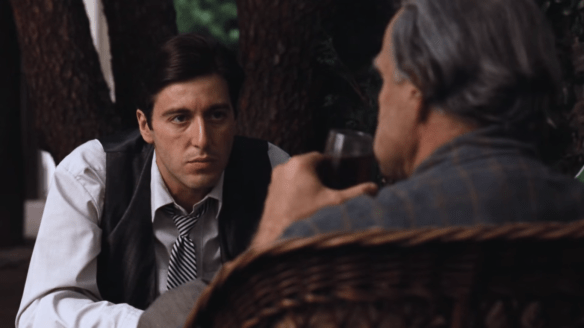
Michael (Al Pacino) comes back a war-hero and with a girlfriend in Kay (Dianne Keaton) who has no understanding of his culture or his people. In fact, the family wants to keep Michael as far from the fray of the family business as possible to protect him. The only possible role he might play is something unimportant so there’s no chance of him getting hurt. But while Don Vito is the focal point at first, The Godfather really evolves into the evolution of Michael from beginning to end. He starts out as an idealistic veteran so far removed from corruption. But the turn of events that deeply affect his family cause him to step into a different role, and he changes as a result. He is a far cry from the man we met during the wedding because now his almost subservient nature has been replaced by a cold-blooded dominance that is personified through his eyes. They’re like to icy black holes that can stare right through you, and they do.


The cinematography of Gordon Willis is obviously superb and generally popularized the golden tinge of The Godfather that gives it a classy and generally nostalgic touch of the 1940s. It makes locales like the open air wedding, Don Vito’s inner office, or even a cathedral all that more atmospheric. On his part, the score of Nino Rota manages to be hauntingly beautiful at one moment and even upbeat when necessary.

What more is there to say but that The Godfather is cinema at its purest and transcendent in its scope. There are few films that carry such magnitude in the vast annals of film history.

5/5 Stars

Intolerance (1916)

800px-Intolerance_(film)His ambitious follow-up to The Birth of the Nation a year before, D.W. Griffith’s Intolerance boasts four narrative threads meant to intertwine in a story of grand design. Transcending time, eras, and cultures, this monumental undertaking grabs hold of some of the cataclysmic markers of world history. They include the fall of Babylon, the life, ministry, and crucifixion of Christ, along with the persecution of the Huguenots in France circa the 16th century.
The stories are stitched together and become only a few touchstones in a contemporary tale of a young man and woman battling against the bleak world around them. The Dear One must try and recover her child from the clutches of a society crippled by corruption, while her husband must battle against a criminal past that looks to ruin his life forever. Each setting has its lulls and crescendos that fluctuate between the mundane and the overtly bleak.

Although some of the religious undertones are somewhat simplistic they still have some resounding power in their successive notes. A Christ subjected to the crucifixion sent there by hypocritical Pharisees. A mother crying to God that she might recover her child because the corrupt and evil seem to be having their way with her. These are the low points of despair. But just as Babylon fell at the hand of Cyrus the Great, our hero The Boy escapes the business end of the hangman’s noose literally by a matter of seconds. It’s perhaps the most intense and ultimately gratifying moment in a film that runs the gamut emotionally.

The film’s four arcs are certainly not in equal parts or equal in impact, but nevertheless, they suggest the complex plotting that Griffith was attempting to experiment with and it’s still quite impressive even by today’s standards. He takes such a broad, universal theme like intolerance and gives it legs in the form of a story that crosses time and space, cultures and languages to really meet all people where they are at. I will stop short of calling it overlong, because Intolerance is one of the truly epic films out there, and while it’s possible to lose a bit of the film’s cohesion, it nevertheless is an impressive endeavor.

So perhaps it’s true that he made the film due to people’s criticism of The Birth of the Nation — though it seems rightly justified. Still, even to this day, the film stands as an emblem of something more and perhaps the best “sequel” to a film of such a dubious nature. It cannot cover up for the sins of the former film, but it can certainly overshadow them. History has looked kindly on Intolerance and if it is not more widely known than its predecessor than it certainly deserves to be.

You could argue that D.W. Griffith was the first person to really explore the language that is film, as a mode of artistic expression. Because, although it may have cleaned Griffith out and ended up an unfulfilled commercial flop, there is no doubt that this colossal silent left an indelible mark on the industry. Perhaps Hollywood took note and began to turn away from the single-minded vision of auteurs in favor of a regimented machine that churned out a commercial product. That ‘s the Classic Hollywood period for you. However, Griffith perhaps unwittingly created many of the rules and dimensions that Hollywood would take to heart and systematically put to work in its future works. Furthermore, a case can be made that Griffith also set the groundwork for European cinema that often gave birth to loftier, more artistically inspired works altogether. Thus, the influence of Griffith cannot be understated. He was vastly important to the medium of film as we now know it.

4.5/5 Stars

Spotlight (2015)

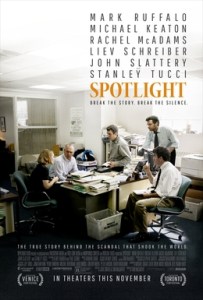
Spotlight_(film)_poster“They say it’s just physical abuse but it’s more than that, this was spiritual abuse.”
I wrote a piece tracing the obvious parallels between All the President’s Men and Spotlight, two films that I could easily see both shaking the very framework of American society through their very candid portrayal of journalism. When actually getting to see Spotlight the connections became even more prominent. Our narrative begins, not in Washington D.C., but in Boston Mass, 1976. It even goes so far as having a Ben Bradlee connection. Bradlee Sr. worked with Woodward and Bernstein while the Big Throat story was breaking. Of course, numerous years later Bradlee Jr., continuing the family profession, was working at the Boston Globe and becoming an integral part of what was going on there.

But enough with similarities, this film, written and directed by Tom McCarthy, deserves its own personal set of commentary. Spotlight is the investigative unit of the Globe and as such their work is not for the quick news flash, but grinding out long, detailed stories, although at times it takes a while to latch onto a juicy tidbit.

However, a new, rather stiff editor named Marty Baron points the team towards a story where a lawyer is accusing a local Cardinal about doing nothing after he found out a local priest was sexually abusing children. It’s a problematic scenario that deserves a little more time, but at this point, it’s an isolated event. It’s one man’s evil. One man doing nothing to remedy an outlier in the Catholic Church.

What follows is as troubling as it is imperative storytelling. The members behind the Spotlight team are not arrogant, self-righteous people, or figure pointers, only truth seekers. That’s their job, after all. The cast is well rounded and credible while no one figure steals the spotlight, literally. Michael Keaton is their leader “Robby” who has close ties with the community even going to high school across the street. Mark Ruffalo is the integral member Michael Rezendes who not only writes the story but has the important task of trying to needle a local attorney for information and documents that can blow the story wide open. Meanwhile, Sascha Pfeiffer (Rachael McAdams) carries out numerous interviews of her own in this multiple-pronged assault for the truth.

Their investigation looks to victim organizations, lawyers, priests, and a psychotherapy specialist. If it’s not obvious already, Spotlight makes it painfully clear that this is not a story of a few isolated incidents but an entire epidemic. This is the whole country — the whole world. It makes you positively squeamish and it’s perturbing in its brutal honesty. There’s no way for it to be sanitized and that’s indubitably frightening. We should be angry, we should be grieved, it should be abrasive to our senses.

It’s bringing to light an entire conspiracy of corruption. There are no paper trails, evidence is swept under the rug, and person upon person remain tight-lipped either due to guilt or shame. Humanity is drawn to darkness, but we want things to be brought to light. It’s the dissonance of what it is to be a person — the constant battle going on in our own human hearts. This isn’t meant to be about individual finger pointing, but an indictment of a system. An indictment of what we all are capable of. If it’s not being able to maintain the celibacy requirement, then it’s a pastor addicted to pornography, or a man sleeping with someone else’s wife. They’re different scenarios, but the people behind them are all similarly broken.

With the narrative of Spotlight cataclysmic events such as 9/11 shift focus, but they cannot fully distract from the bleeding that is still going on behind the scenes. There’s still a need to get to the root of the problem and they do. Mark Ruffalo’s character talks about having some deep down inclination that he will one day go back to the church and then came the day that all that came crashing down as they prepared to break the story. All his hopes went unrealized. It has to be an abysmal feeling. These are folks living in a secular world and a Church that falters so greatly is of little comfort. God is a distant deity, not a personal one, so it seems.

When the story hits the pavements you know that all hell is going to break loose, but what really happens is that all the pain, suffering, and shame has finally received the spotlight it deserves. The major realization is not that one person is the problem or even that another person is the problem. But the most frightening revelation Spotlight offers up is that we’re part of that problem. That’s tough news to swallow and this is a film that does it with immense credence and poise. Perhaps the toughest moments of the film come when the lights have died down and we see the staggering numbers of just how many cities were rocked by similar scandals. If you’re like me you see cities that are all too familiar. A film of this magnitude begs for some kind of response from its audience. It’s up to the viewer to decide what that will be — whether social, spiritual or something else entirely.

This is a potent film of the highest nature that lifts up journalism as a noble profession, while simultaneously rocking its audience with a real-life narrative of substantial magnitude. I’m not one prone to bloated statements, but this just might be the best picture of the year. Its impact has been duly noted.

4.5/5 Stars

La Strada (1954)

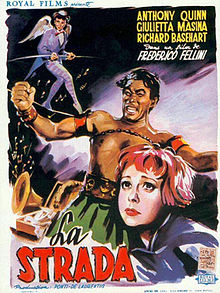
220px-La_Strada_PosterFederico Fellini’s La Strada is in the tradition of other films like Chaplin’s The Circus (1928) and even Nightmare Alley (1947). He even goes so far as to feature two regular Hollywood performers in Anthony Quinn and Richard Basehart. This film is prominent for helping the Italian master achieve mainstream success, and it functions as a sort of crossroads. It still has one foot planted in a neorealist world with the other slowly entering a world of whimsy. It also suffered a production schedule that was as plagued with problems as the characters depicted therein.

The plot itself is relatively straightforward following a volatile strongman (Quinn) who buys a shy young woman off her mother to travel from town to town with him. He’s a real entertainer, and he teaches her most of what he knows so she can assist in the act. However, when they’re not working together, and the show is done, he goes right back to treating her badly and making life quite miserable for her. Zampano’s not the understanding sort.

Giulietta Masina has a starry-eyed quizzical face that elicits not so much a negative response, but one of perplexment. It’s the perfect visage for say a clown (which she masquerades as) since it can be so jovial and in the same instant sad and somehow distant. As her life on the road progresses she finally forgets loyalty and goes on her own to get away from Zampano’s abuse. While being alone she comes across the performance of a skilled acrobat (Richard Basehart) and what follows is a rocky partnership in a rat tag act that once again includes the strongman. But the constant heckling and joking of “The Fool” gets on Zampano’s nerves until things start to get violent. Once he gets out of prison for his behavior, he and Gelsomina get back together, but a run-in once more with his old nemesis turns out badly.

This time all the wind is taken out of her sails after what happens. She is a mime without any emotion, hardly any life left in her. One night Zampano leaves her behind in the night never to see or hear from her again. His existence from then on is as dismal as Gelsomina’s outcome.

Fellini himself suggested that La Strada was a very personal film, and it brings into question if he had a bit of Zampano and Gelsomina inside himself. La Strada also lacks the excess of his later films, instead contenting itself with simple roads and humble people — a stream of beautifully austere images without much extravagance. Also, with the character of Gelsomina comes a wistfulness that drives the tone of the film. As she contemplates with “The Fool,” everything must have a purpose, because if even a pebble has no purpose then everything is pointless. It’s in many ways a dismally bleak film, but still enduringly interesting.

4/5 Stars

Viridiana (1961)

220px-Viridiana_coverLuis Bunuel like another cinematic auteur, Ingmar Bergman, seems to often fill his films with religious imagery and themes, but whereas Bergman appears to have genuine questions about his own spirituality, Bunuel is all but content to subvert all such depictions for his own purposes. He has a wicked sense of humor with the opening crescendos of Handel’s “Messiah” playing over the credits only to come back later when his film is at its most tumultuous.

The story opens, of all places, in a convent with a pretty young novice (Silvia Pinal) preparing to take her vows. But she is ordered by her superior to visit her long-estranged uncle. She is reluctant but goes anyways to his mansion in the country as a courtesy.

There she meets the lonely old man (Fernando Rey), isolated in his great home with only a few servants surrounding him. In young, vibrant Viridiana he finds joy and dare we say, love because in her face he sees the likeness of his now long deceased wife. She embodies the objects of all his passions and desires that he forgot so long ago when he was widowed. However, Viridiana is aloof and will show no affection towards him, ready to stay only as long as she has to. But he wants her to stay, needs her to be by his side forever, obsessing about her, and using all means necessary to keep her in his midst. It’s disconcerting how far he takes things, even lying to his niece that he took advantage of her in her slumber. Now if she leaves the house, she can never be the same woman she entered as, even if what Don Jaime is false. In the end, she does pack her bags in a tizzy and her hopeless uncle takes his life.

Now the life of a nun seems impossible, her life all of a sudden becoming tainted by these events. So she resigns to do the next best thing by taking her Uncle’s home and opening up its doors to the less fortunate — the beggars and the sickly. It’s a nice sentiment, but it doesn’t turn out especially well. She also becomes connected once more with her Uncle’s illegitimate son (Francisco Rabal), who has a more cynical view of the world. He sees her piety with an air of contempt.

In the chaotic interludes that follow, the house is torn to shreds by all the benefactors of Virdiana’s charity. While she is away, they make for themselves a rich feast, “A Last Supper,” pulling out all the stops like table clothes, fine china, and wine. What ensues is utter debauchery that Bunuel plays for laughs all the while Handel reverberates over the din.When Viridiana returns and sees the degeneracy around her she slowly dissolves into a shell of who she used to be. She’s been broken and much to her cousin’s delight, she’s lost her ardor, now jaded by all that is around her.

It’s a depressing conclusion suggesting that charity is all in vain because there is a degree depravity that courses through all people. In some sense, I find a Bunuel film more uncomfortable and disconcerting than most any, because he displays the most surreal, idiosyncratic, and even perverse things as comical. He lacks reverence and reveals the darker side of humanity all with a smile on his face. His style of filmmaking is abrasive because it rubs up against social mores and has fun with the baseness of mankind. If we note that before going forward, it still seems possible to learn from him and be a tad mystified by his work.

4/5 Stars