Enter the Dragon (1973)

Starring Bruce Lee in his last major film before his death, Enter the Dragon has Lee going to a martial arts tournament on the isolated island of a former nemesis in order to infiltrate the proceedings and uncover what is really going on there. Along with Lee two other men are invited and we learn early on that they are chums and both very skilled in martial arts. 

Following the first set of bouts, the evening is extremely extravagant and each guest is treated like a king. While the other two revel in this grandeur, Lee tries to make contact with someone who was planted on the island. That same night Lee sneaks out to try and see what he can uncover with some luck. However, the next morning Han gives a stern warning to his visitors before the competition begins again. Later one man is accused of leaving his room and then Han tries to entice the other to join his operation. Lee again sneaks out and this time to messages for help but not before the alarm is sounded. 

What ensues is an epic display of martial arts mastery but Lee is finally quelled. The next morning things are looking bleak but Lee and his fellow competitor join forces against Han’s men and they eventually gain some help. This is the final showdown and while the all out fight continues Lee must chase down a fleeing Han. In a secret room of mirrors their conflict concludes but not without a great deal of devastation. 

This film is an unorthodox combination of a martial arts film and a Hollywood production. Bruce Lee is the undisputed star in an era where Asians were usually only supporting characters. For this reason as well as the action, this is a pretty good one to watch.

4/5 Stars

Lost In Translation (2003)

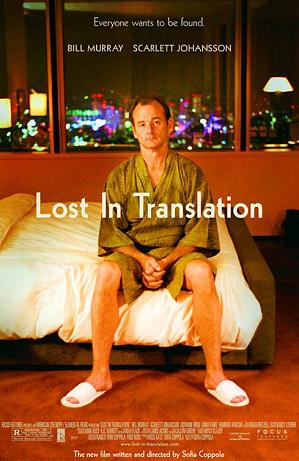
Lost_in_Translation_posterStarring Bill Murray and Scarlett Johannson with direction by Sofia Coppola, this film is set in the fast-paced, technological, and modern world of Tokyo, Japan. That is where Bob and Charlotte find themselves and they both are lost, simply going through the motions of life. He is a middle-aged, former movie star filming a whiskey commercial. She is a newly-married wife of a fashion photographer. Despite their age differences, they find out that they have a lot in common. Over the week they spend time together in Tokyo and become friends. When the time comes for Bob to leave neither one wants their time to end. They say goodbye but do not forget each other. This film was enjoyable because it portrayed two people who could be good friends without getting romantically attached, at least in the conventional sense.

I must say that this type of friendship intrigues me. It is understandable that if you go to a foreign country alone it would be nice to have someone you could at least converse with, without any barrier getting in the way. It might be at Narita airport for a moment, at a Hotel, or walking the streets of Shinjuku.  It would act as a comfort in a world like Tokyo that is so fast paced and high stress. These unusual circumstances could throw together two very different people, with little in common except the language they speak. That is something that does not happen every day.

Needless to say, after gaining the opportunity to visit Tokyo two years in a row it has given me some new insight. I can now wholly empathize with Bob and Charlotte because although I knew a few people, Tokyo is such a highly populated, fast-paced world that seems so easy to get lost and overwhelmed in. There is so much to see, so many lights, so many hurrying folks, so many subway lines, so many surgical masks, so much etiquette, and so much technology. True, some of my ancestors were Japanese but the language still baffles me, making it very easy to get “Lost in Translation.” Being in Tokyo it also helped me realize that it is not only tourists who get lost. It has been over 10 years since this film came out and a lot can happen in that time like more Starbucks and McDonalds on every corner.

Despite the westernization and technological advancement, Tokyo also has a time-worn aspect, and its people are often worn as well. They might not be lost because of a literal language barrier. However, they, like Bob and Charlotte, are often lost because they have difficulty getting close to their peers. Often they, like the two protagonists, seem to be searching for someone to talk to, but in their case manners keep others at arm’s length. Coppola’s film gained an even more personal note now that I have walked in these places and interacted with or at least walked alongside the Japanese people. They like anyone else can be “Lost in Translation,” it just might be a different type of “language” than what we struggle with. They too are humans who have their share of struggles, worries, joys, hopes, and dreams. Hopefully, this type of understanding will help us transcend any barriers so we no longer find ourselves “Lost in Translation.”

4.5/5 Stars

Before Midnight (2013)

Before_MidnightWell, I was expecting great things from this film as the third installment in an intriguing romantic trilogy. I will admit that at first I thought it was decent but I was not blown away.

My favorite moment had to be near the middle when Jesse and Celine took a walk through the ancient streets of Greece. Their conversation was reminiscent of the previous two films and I appreciated that.

However, the beginning of the film was filled with family moments, discussions with friends and little time of Jesse and Celine alone like the years before.

When they finally were alone they were quick to argue and lose their tempers over familial issues and seemingly petty problems. Even to the end of the film, their relationship seemed perhaps more creaky than it had ever been.

However, over time I realized that these things that I did not like made the relationship of Jesse and Celine all the more realistic. They are not the starry-eyed kids or the young lovers meeting up for romance. They have children, strained relationships with former spouses, more wrinkles, full time jobs, and 40 years under their belts, and that is the way that real life often is. So I’ve been told.

I’m not sure if Celine and Jesse will ever be brought back to screen, but I know that I was ultimately satisfied with the place we left them at. As Ethan Hawke said it all began as a story about what might be, then it was a film about what should be, and Before Midnight was the film about what actually is. Linklater did us a favor by not giving into the conventions that we are so often used to, because he was never one to do that before, sunrise or sunset. His lovingly crafted romance would not sink to that level and should not sink to that level. It remained true to itself and even if it was not what I wanted, it was what was called for.

Who knows, 9 years down the road we might get another installment, until then I will be content with the love story Linklater, Hawke and Delphy so graciously gifted us. It’s not perfect by any means, but it’s genuine and that is far better.

4.5/5 Stars

A Letter to Three Wives (1949)

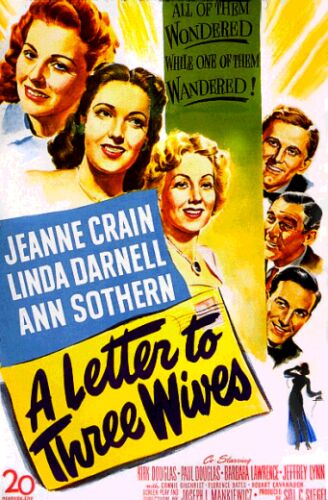
A_letter_to_three_wives_movie_posterHere is a story about three wives, the three husbands that go with them, and the one woman who got in the middle of them all. The main plot device is simply this: This woman named Addie Grace, who we never see but who is always being referred to, has left town and she also left a letter addressed to the three wives. The women get it as they board a boat for an afternoon out at sea with some underprivileged children. When they read what it says their afternoon takes a major turn. The one and only Addie Ross has run off with one of their husbands and yet she does not say who it is.

The rest of their time is spent thinking back on their marriages and each recollection is framed as a long flashback. First, comes Deborah Bishop (Jeanne Crain), a farm girl who met her husband during the war. Now with his friends back home she wishes to make a good impression, but she feels like she can never measure up with such elite society. To make matters worse, she learns that before the war it was thought that Brad would marry Addie Grace because they grew up together.

Next, comes Rita Phipps (Ann Sothern), who puts on an extra special dinner for her bosses from the radio station she writes for. The night includes a forgotten birthday, sappy radio programs, and all the while Rita is constantly trying to please and appease her bosses. They enjoy the evening but her husband George is upset that she constantly caves to them. To make matters worse, as a school teacher, it is difficult for him, as the man of the house, to have her bring in a great deal of their income.

Last but not least is Lora Mae Hollingsway (Linda Darnell) who grew up in a poor household near the train tracks with her mother and younger sister. She focuses her attention on Porter Hollingsway (her future husband), an older divorced man who also happens to own a chain of department stores. After a great deal of back and forth, they get married but underlying their marriage is this assumption that she only went after him for his money. Their relationship hardly seems to involve true love.

All three women return to their lives. Rita is grateful to find George sitting in the living room. Porter, who Lora Mae half expected to be gone, has come into the house exhausted after a long day of work. Deborah is seemingly not so lucky. All of them get ready for the dance that evening with their spirits all at different levels. However, after Porter shares a revelation the evening gets a whole lot better.

This Joseph L. Mankiewicz precursor to All About Eve is a remarkable drama in its own right thanks to its primary narrative device and fine performances from the cast. Thelma Ritter was as entertaining as ever and Celeste Holme was tantalizing as the unseen voice of Addie. It is interesting how all the stories of the film interconnect characters, making us come to understand each and every one of them a little better. The ending was slightly abrupt but still clever. All in all, A Letter to Three Wives was an interesting concept that paid off beautifully.

4.5/5 Stars

Alfie (1966)

alfie“I’ve been doing things my whole life I’m not suppose to” ~ Alfie

Alfie is a real character, with his cockney accent and personal insight about the world he resides in and the people he crosses paths with. Before Ferris Bueller, there was originally Alfie constantly breaking the fourth wall. Although that’s where any comparison ends because Ferris may be a schemer but he is good at heart. Safe to say Alfie is no Ferris Bueller. Not by a long shot. He is a self-indulgent, hedonistic, womanizer, constantly playing the field without looking for anything real.

True he has a kid, a few affairs and casual trysts, but he never sees “Birds” as anything more than objects. Every girl is an “It” not a “Her.” They fulfill his desires and their main purpose is to be used for his pleasure and his needs. He is a man who lives for himself and no one else. He is a real cynic and a deplorable sort of person at that.

Initially I had nothing complimentary to say about the character because the reality is there really was nothing good to say about him. But in a single moment Alfie proved that he might be selfish but not heartless. He finally attempts to “settle down” only for it to backfire on him. That’s the way it works and so Alfie is about right back where he started. I would like to think his heart is a little softer though.

Michael Caine is likable enough to make me not completely hate Alfie and that is to his credit because it was difficult not to. His various conquests and companions were played by, among others, Julia Foster, Jane Asher and Shelley Winters. The film’s jazzy score may not be rock and roll but it seems to personify Swinging London as much as Double-Deckers and Tower Bridge.

3.5/5 Stars

Cry Danger (1951)

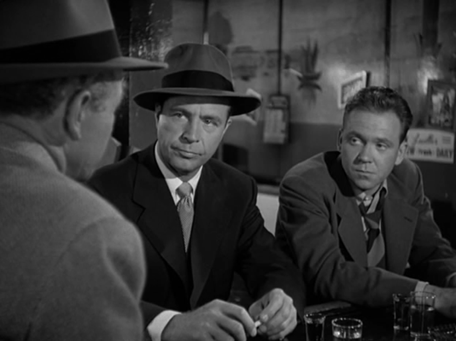
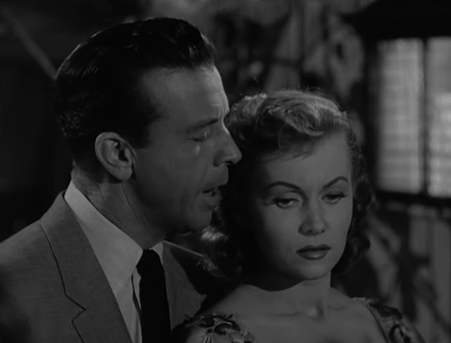
589aa-crydanger2Here is yet another noir gem which would never get made today, much less in a mere 22 days! This directorial debut of Robert Parrish is boosted by an often witty script from William Bowers.

Rocky Mulloy (Dick Powell) is fresh out of prison after a former marine (Richard Erdman) testifies on his behalf though Mulloy already spent five years rotting away in prison. He went in right around the end of the war because of a robbery that he was assumed to be a part of.

Regis Toomey (The Big Sleep, Raw Deal) is Lt. Cobb and he is still skeptical when he is assigned to monitor the newly released man. Richard Erdman is the peg-legged, alcoholic marine who has a penchant for booze and dames. Also, he never actually knew Mulloy before. He just wants some of the loot.

So the two new found chums set up camp in a beat down trailer park of all places, with a music playing proprietor (Jay Adler). It’s not exactly the Ritz, but Delong finds some female company, and it just so happens that Mulloy’s former flame lives there too. Nancy (Rhonda Fleming) is married to Rocky’s pal Danny who is still in the clink. His mission is to prove his innocence, but could it be more harm than good?

Rocky goes to a local mobster named Castro (William Conrad) who left him holding the bag five years ago, and he wants reimbursement for his time. He gets some of it in the form of a horse race which leads to a big payoff.

But as it turns out, the money is hot and Lt. Cobb wants to know where it came from. Rocky obliges but it becomes all too obvious he’s being set up. There was one slip up though, proving Rocky is telling the truth for once, amidst all the lies swirling around. That does not help Delong much and his girl Darlene gets blown sky high. The bullets were obviously meant for Rocky and  Nancy.

Rocky confronts Castro and they play a little game he likes to call Russian Roulette, although it’s very one-sided favoring Rocky. The fearful mobster spills the truth, revealing Danny was actually a part of the plan 5 years ago all the time. Since he took a lighter rap, someone else is holding his share of the payoff. The missing $50,000. Who is keeping it warm for him? You guessed it.

Rocky goes back to the trailer park where Nancy spills all her beautiful guts to him. What she gives is a tempting offer and Mulloy lets her believe it will happen. Off he walks with Lt. Cobb ready to swoop in. Rocky may have gone straight, but it doesn’t mean it makes it any easier. He had to turn on one of the most beautiful girls in the world, courtesy of Rhonda Fleming.

Dick Powell has another laconic performance which nearly matches his turn as Philip Marlowe in Murder, My Sweet. I always love seeing Richard Erdman as a young jokester, because he has gained a following more recently for his work in the television show Community as Leonard. William Conrad will always be the narrator in Rocky and Bullwinkle as well as Cannon. However, his big frame and mustache make for a good criminal type. What can I say about Rhonda Fleming except that she looks stunning in black and white, much less technicolor?

Lt. Gus Cobb: Now, just get it through your heads that the pressure’s on. 
(To Nancy)
Lt. Gus Cobb: I wouldn’t give a nickel for your husband’s chances before that parole board with all this going on.
(To Rocky)
Lt. Gus Cobb: And I wouldn’t give a nickel for your chances with those two apes running around looking for you.
(To Castro)
Lt. Gus Cobb: For you, I just wouldn’t give a nickel.

4/5 Stars

Pitfall (1948)

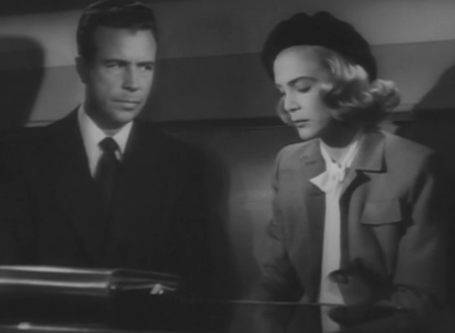
4ac39-pitfall2In Italy Pitfall‘s title was translated to Tragedy in Santa Monica. And that it is, but it plays out as a typical, everyday tragedy. It is far from Shakespearian. John Forbes (Dick Powell) is sorely tired of the monotony of his life: A wheel within a wheel within a wheel so to speak. And he is tired of being the so-called “backbone of the country” employed at Olympic Mutual Insurance Company.

He has a steady job and all, a beautiful, loving wife (Jane Wyatt), and a cute little son Tommy. He’s your prototypical middle-class man from your typical middle-class family. That’s what’s wrong with his life. To put it plainly he’s in a rut and desperately wants to get out.

Pitfall is a  bit of a riff off of Double Indemnity. There is some of the same framework but very different variables and outcomes, so that’s enough comparison.

Things get interesting when Mona Stevens (Lizabeth Scott) comes into the picture. She is a model with a boyfriend who was just recently put into prison for embezzlement. Now Forbes’ company is charged with getting back some valuables from Stevens and she gives them up willingly. Along the way, a hired private investigator named Mac (Raymond Burr) takes a liking for her, but the feelings are not reciprocated. That’s before she meets Forbes.

When they meet, Forbes is immediately struck by her and she takes a liking to his goodwill. Everything would be great in another world. Except in the real world, Forbes is married and Mac is jealous. After he gets accosted by Mac, Mona finds out about her fling’s home life. Surprisingly she lets him off the hook, but Mac won’t let her off.

Forbes’ overall demeanor changes and he feels reinvigorated, even back at home and in the office. But it’s never that simple, and things begin to get messy as Smiley finally gets his ticket out of the clink. Mac has been his constant visitor, filling the paranoid brute with ideas. He thinks Mona has been unfaithful, and he wants to get the guy she was with.

The ending of Pitfall is far more painful than a multitude of meaningless deaths in a monster movie. The reason being, these characters actually have some importance. There is a sense that human life is sacred and if anyone dies it is a big deal, whether they were “good” or “bad.”

Furthermore, there are hardly words enough to describe the look on Jane Wyatt’s face when she finds out the truth. This is one instance when the father did not know best, and their marriage was shaken to the core. It feels all too real. However, this film’s denouement is not quite as fatalistic as Double Indemnity. There still is a tinge of hope that these two individuals can salvage something out of a very difficult situation.

This is yet another feather in the cap of film-noir. So simple and yet so potently effective. I cannot wait for more with Dick Powell.

3.5/5 Stars

The Crimson Kimono (1959)

crimson kimono 1 shigeta and corbettFrom director Samuel Fuller comes another welcomed addition to his canon. It features the same type of seedy urban landscapes and back alleys of Pick up on South Street (1953) and there are some equally interesting characters like Mac (Anna Lee). It all is underlined by some sleazy jazz music in the vein of Sweet Smell of Success except this one is set in L.A.

The plot line is basic enough following two policemen as they investigate the homicide of a local stripper with a heart of gold and wasted plans for a new show involving kimonos and karate. Their only real lead is a painting and the name that goes with it. That’s where the more interesting part of the story begins.

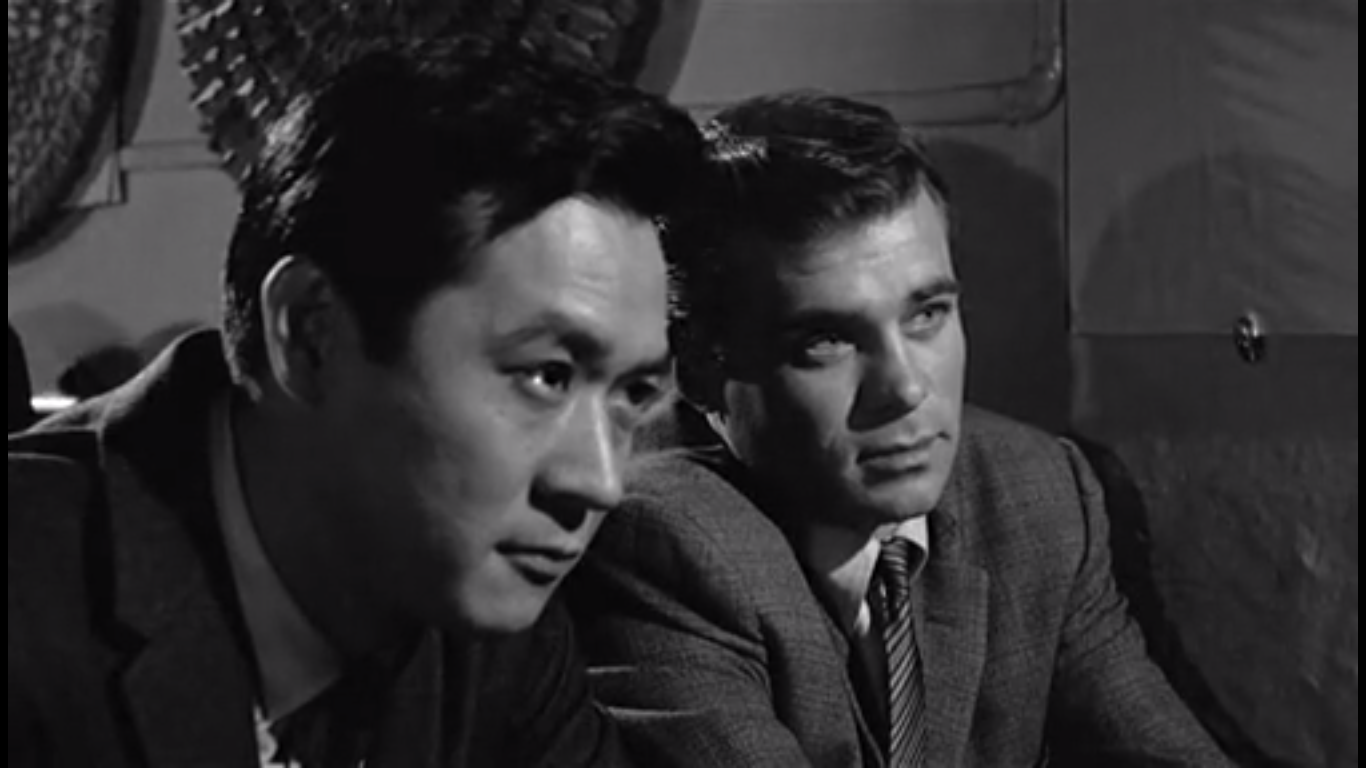
I failed to mention that one of the cops is Caucasian. His name is Detective Sergeant Charlie Bancroft (Glenn Corbett). His partner is Japanese-American or “Nisei,” meaning the second generation. Detective Joe Kojaku (James Shigeta) is his name. The beauty of their relationship, which is one of Fuller’s focuses, is that they are equals who are inseparable ever since landing in a fox hole together in Korea.  Charlie was saved by a pint of Joe’s blood, Charlie practices kendo with Joe in their off hours, and they live together on the side. You cannot get much closer than that.

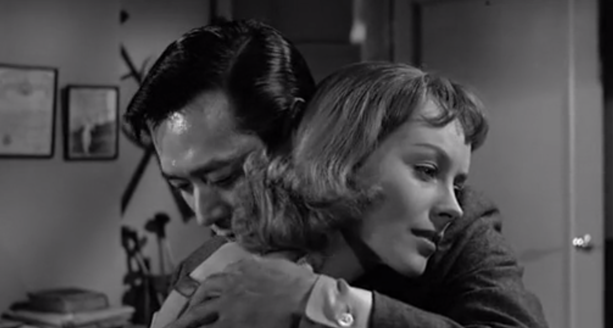
The movement of the plot leads them to Ms. Chris Downes (Victoria Shaw), a pretty young painter who is the only witness who potentially saw the man who shot Sugar Torch. In between looking at journals full of mug shots, she gets to know both Charlie and Joe. Charlie sees himself falling in love with her and like anyone he tells his best friend. Joe is happy for him until the fateful moment when he is alone with Chris. She makes her affection for him quite plain because he’s a pretty great guy, but as a good friend, he doesn’t do anything. It tears him apart and it only hurts them as they plod on with the homicide.

What follows is a painful love triangle embroiled with issues of race, friendship, and misguided notions. It’s jarring because these three are all likable and you want only the best for them, but it cannot be remedied like the murder which ultimately gets wrapped up neatly.

crimson kimono 4 shigeta shawSamuel Fuller always tackles issues of race head on like no other. In fact, he was ahead of his time when no one else would show such relationships, romantic or otherwise, on the silver screen. Beyond whether or not an Asian man and a Caucasian woman romantically involved was accepted back in the 1950s or not, it probably was not what audience cared to see at the movies. To me, now, it’s really interesting, especially to see such non-stereotypical roles all across the board. It’s a breath of fresh air from the Charlie Chans and Mr. Motos.

On another level, Fuller’s camera makes solitary L.A. street corners and the bustling Nisei festival amazingly dynamic. It brings Little Tokyo alive, filling it with genuine people, sights, and sounds. Thank you, Sam Fuller.

It’s like mixing two dabs of paint together. You could never separate them.” ~ Mac on Charlie and Joe

It’s what you think is behind every word and every look.” ~ Chris Downes

4/5 Stars

The Long Goodbye (1973)

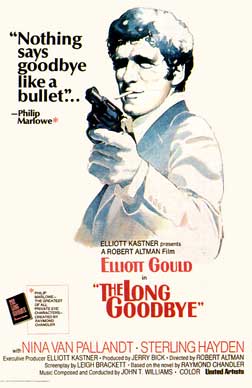
LongposterIn the storied tradition of film-noir comes another film in the canon and yet another depiction of Raymond Chandler’s Phillip Marlowe. However, the world with which Robert Altman places his private eye is far different than any place the character has ever inhabited before. Whereas another neo-noir such as Chinatown followed the storied tradition of noir in many ways, The Long Goodbye is often more of a satire than a new addition to the genre.

Elliott Gould as Phillip Marlowe has the smoking down like Bogart or Dick Powell, the garb, and even the car, but his environment is the 1970s, making him quite anachronistic, and that seems to be just fine with Altman. He subverts the genre by placing Marlowe in a world he does not seem to fit in and yet he himself does not seem to question it.

The girls next door are hardly your typical girls-next-door. The police station looks like it could be out of The Rockford Files. John Williams and Johnny Mercer’s title song pops up in all places from the elevator to the car radio. His tail Harry is an incompetent joke. Passing cars give the security guard time to practice his best movie star impressions. Marlowe as well proves he is not much of an animal guy with a cat that he loses and a dog that hates him.

The drama is not much better in that regard. Two murders take place (including the death of a friend), which are later followed by a man’s suicide and his beautiful wife fleeing the country. All the while, on the case Marlowe is scrounging around and coming up mostly empty. The cops bring him in, an unhappy thug roughs him up over some money, and he can get very little out of the drunken writer Roger Wade (Sterling Hayden) or his wife (Nina van Pallandt) before she disappears.

By now we know better than to compare this Marlowe to any predecessor. He gets smashed about by the waves trying to stop a suicide and ends up in the hospital after getting bowled over by a car. He seemingly does his best detective work in a stupor, and he somehow escapes a chilling confrontation where everyone is removing their clothes. All these scenarios make little sense and even with the twisted conclusion to the mystery, there still is no explanation for the way things are. Altman gives us a surprising end but no answers as we watch Gould dance off into the distance playing a mini harmonica. Marlowe can often be heard saying, “It’s okay with me.” It’s the story of his life and if he is fine with it, I suppose his audience will just have to accept it too, even if they do not quite like it.

4/5 Stars

Marriage Italian Style (1964)

Marriage_Italian_StyleI had never seen any of De Sica’s later work and with the quintessential pairing of Sophia Loren and Marcello Mastroianni this seemed like a perfect place to start the journey. The character Domenico is easy to dislike from the beginning because he constantly floats in and out of the life of the former prostitute Filumena who is ironically devoted to him.

The film relates the struggles of matrimony and family in Italy as Filumena tries to support her family while struggling with Demenico who is never truly ready to commit to her. In fact he becomes absolute fed up with her after a trick marriage, but that is just the beginning.

I can only imagine what Divorce Italian Style will be like (which also features Mastroianni). Without question Sophia Loren is certainly the driving force in this film.

4/5 Stars