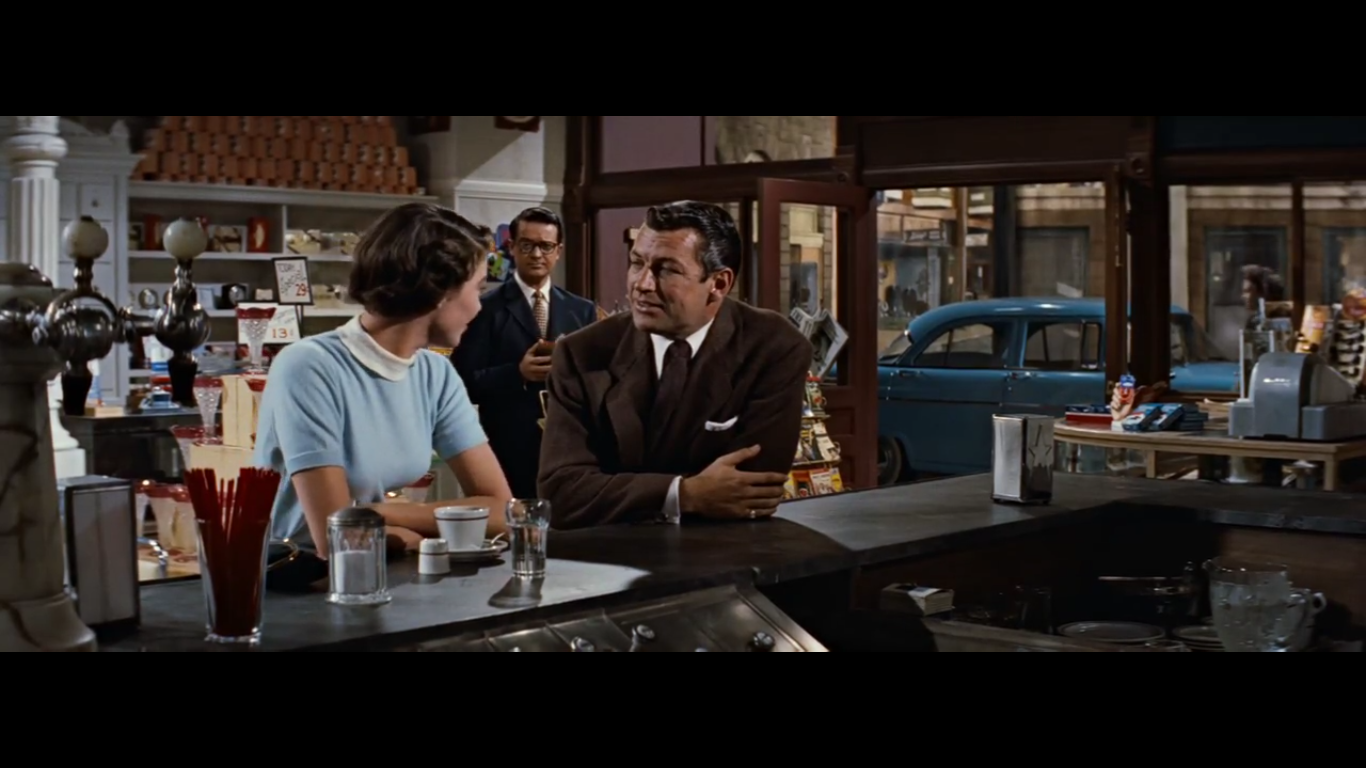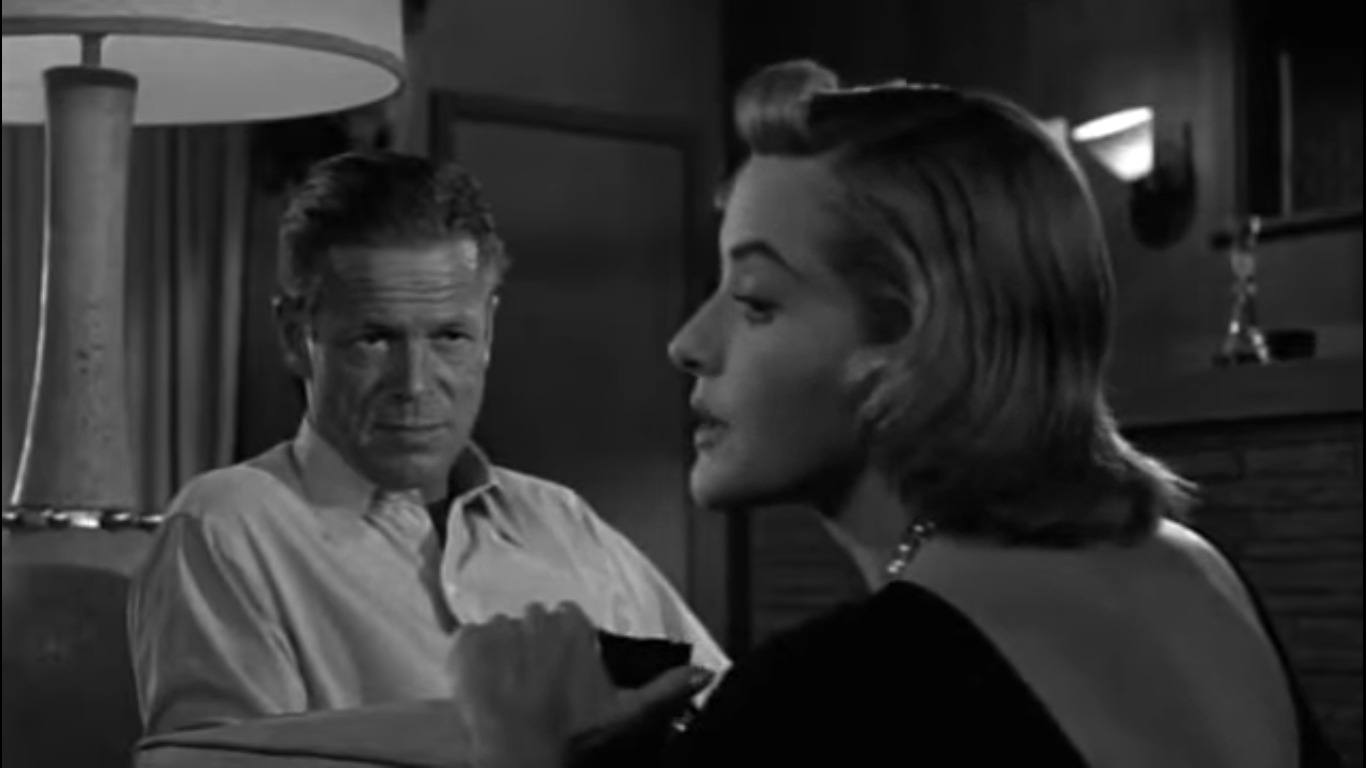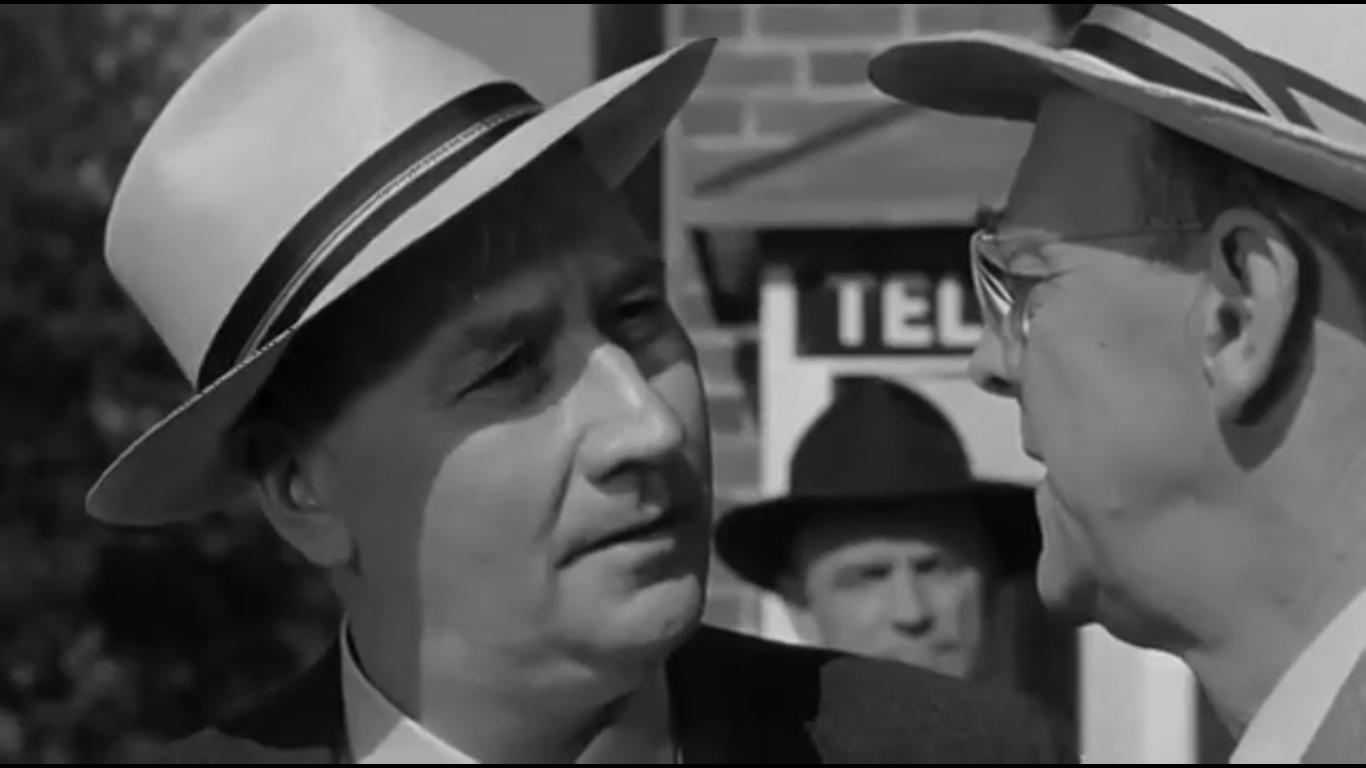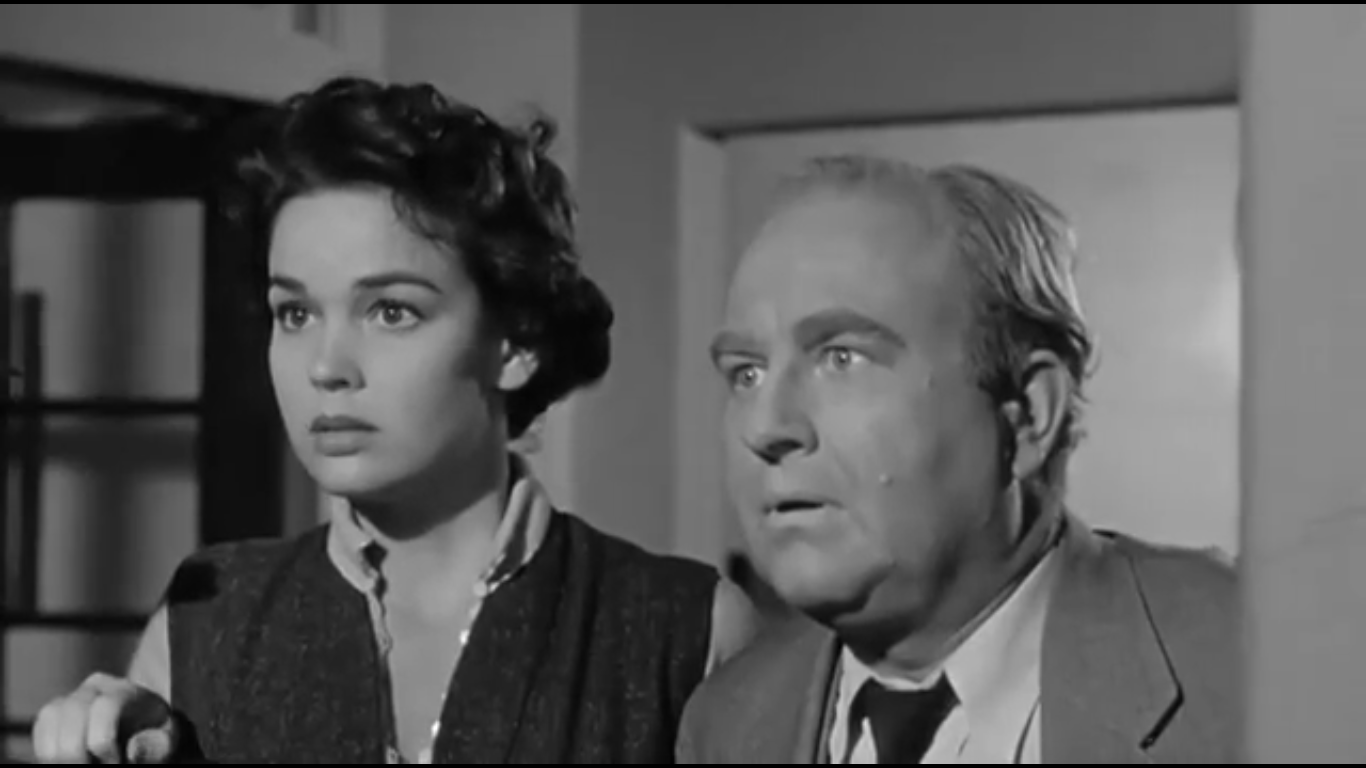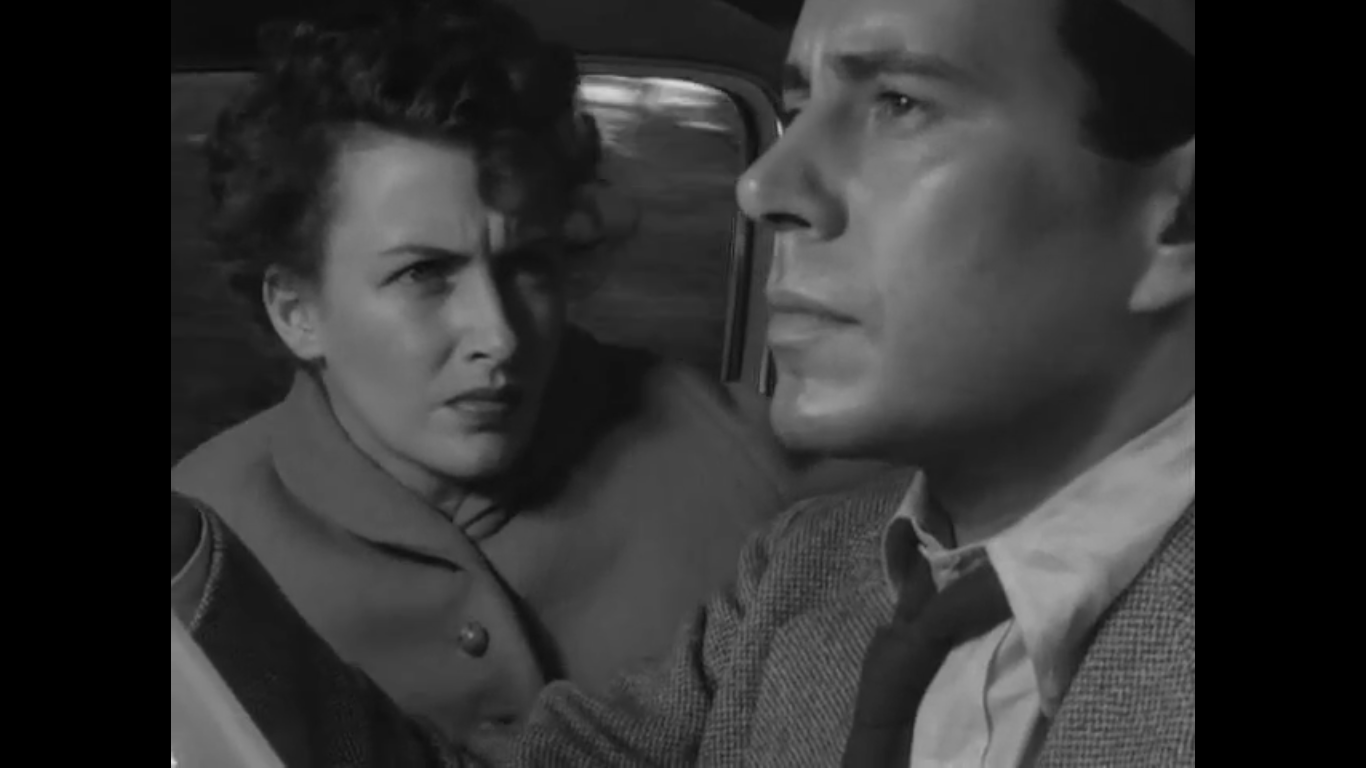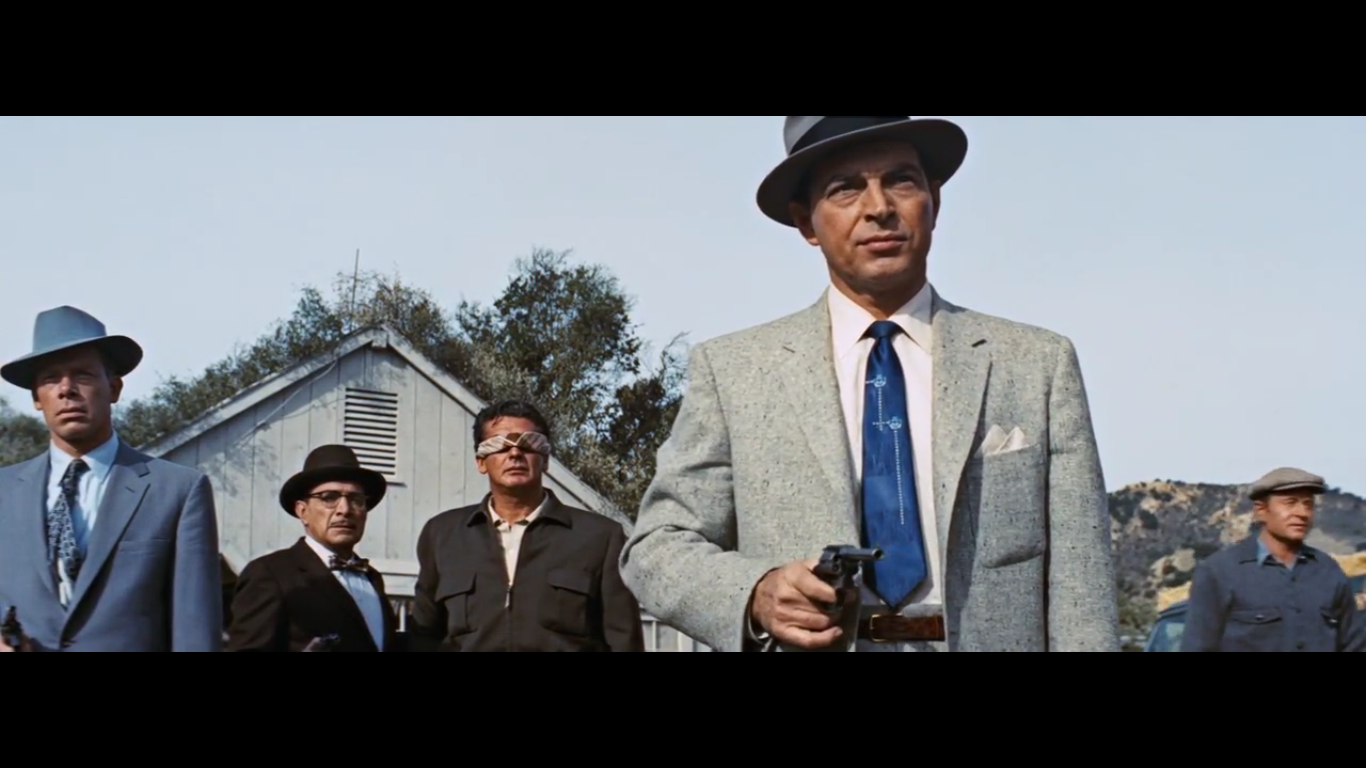
Yield to The Night (1957): J. Lee Thompson and Diana Dors

“For the night is already at hand and it is well to yield to the night.”

There’s immediate traction to Yield to The Night’s opening visuals. We look on at pigeons scuttling about, outdoor waterfalls, and Diana Dors’s heels clicking across an open plaza. Of course, we don’t know it’s her.

J. Lee Thompson’s introduction is almost Hitchcockian in how he utilizes the feet as a kind of synecdoche for the whole body distilling the action down to its most basic form. Because soon enough those feet make their way to an apartment belonging to a fashionable woman about to go inside.

In the chaotic sequence that follows, she gets shot in the back as Dors makes plenty sure her victim is dead in her tracks. Her first closeup almost crushes her face or closer still her face overwhelms the screen and she stares down at her handiwork. She’s just murdered a lady in the street. Riddling her in the back with bullets. There’s no doubt that she’s dead as the frenzied onlookers rush to the scene.

What makes the moment so effective is how purposeful it is from the outset, punctuated by this terrifying act of violence. However, what makes it even more startling is the fact we have no context. Is Dors good or evil? Is she on the side of justice or lawlessness?

Surely she has a reason for what she did. We half expect a flashback right about now — this seems like an opportune place if not the most original. Instead, we get the credits and the story keeps on moving forward.

Hilton’s in prison, but whether it’s a sign of the British civility in the prison system or only a result of the movie mills, there’s something rather congenial about the whole set-up. It’s not exactly Buckingham Palace or Balmoral for that matter, and there are bars like any prison, but the wardens, lawyers, and priests who all cycle through seem like generally decent people.

Hollywood alternatives like Caged or even I Want to Live! in one form or another feel like harsher, less forgiving films. The tone of Yield to the Night functions out of its own dissonance. As a fitting development, Mary’s story materializes in fragments, and it actually becomes a fairly absorbing way in which to take in the narrative.

The presumptive flashback actually comes a few minutes later than expected. Mary Hilton formerly worked in a beauty shop. One evening she encounters a particularly jovial client at a club. He’s at the piano when she sees him. His name is Jim, and he gives her the pet name “Christmas Rose.” She became madly devoted to him even as his own demons and self-destructive habits find him dallying with other women.

His primary romantic partner is a rich socialite named Lucy, who remains faceless and nearly unseen throughout the entire movie. For not having an overt showcase, she certainly holds a major sway over the picture as she effectively dominates and cripples Mary and Jim’s relationship. Mary loves him madly, but he can never be tied down to her, preferring the benefits the other woman affords him.

The ensuing bout of voiceover is a bit much, but there’s a pleasant gossamer quality in Dors’s readings — the lightness in her voice — somehow it juxtaposes with her place as a murderess, and in some small way, it humanizes her.

Back in the present, she receives a number of visitors. Her kid brother, a genial lad who is looking to lift her spirits joins their quibbling mother for the visitation. She’s trying to come to terms with how the girl she strove to raise the right way could end up like this.

Mary also gets called on by her husband Fred. He comes faithfully, leaving work to come check on her.  Suddenly it becomes plainly evident the reason they are separated is on account of Mary. He seems like another decent sort of chap, too decent in a way. He bores her and so there is a defined distance between them. It’s depressing to witness.

Finally, there is Mrs. Bligh, who feels like yet another embodiment of all the benevolent souls.  She’s a kindly old lady, a lover of flowers, and a prison reformer. What she also provides is a social conscience. Strangely, all this goodwill from both the attendants and visitors only emphasizes the disconnect between the warmth of all these people and the punishment at the other end of the hallway.

But the final stroke has to be how the movie foregoes any form of serpentine plotting and focuses in on an individual life in torment. It becomes a far more intimate meditation. Mary is caught in a debilitating cycle of unrequited love, watching her man destroy himself for another woman, and it tears her apart. She’s powerless to save him. The only flaw in the picture might be the suspension of disbelief, that is, how likely would someone rebuff Dors for someone else, albeit someone with higher social standing?

Otherwise, as we bide our time alongside of her in the confines of her cell, constant light streaming in, and guards playing chess, we are introduced to her every monotony. It builds a level of sympathy you can attain no other way. Dors is known as a great glamour girl — Britain’s answer to Marilyn Monroe — and yet when we see her stripped of all pretense, it’s a startling and impressive showcase of vulnerability.

In her own words, the actress acknowledged it was “the first time I ever had a chance to play such a part. I was very thankful to Lee J. Thompson for having faith in me. Until then everybody thought I was just a joke, and certainly not an actress to be taken seriously, even though I knew within myself I was capable of playing other roles.”

She exhibited emphatically she was far more than a pretty face by delivering some emotional resonance as well. One is reminded of the telling exchange with the Preacher.

“This day I shall be with thee in paradise. I think those are the most beautiful words in the Bible.”

“If you believe them.”

It sums up her entire experience. He is a man of faith and he burgeons with hope — hope for her, even in death — in spite of her shortcomings in this life. But her conception of the world doesn’t allow her to believe this. All she has is the melancholy and the pain stockpiled from her romantic heartache. Her outlook more than fits the shabby interiors of the film. It’s a dreary world to be privy to, and it’s just as depressing leaving it behind. Yielding is not in her nature. It doesn’t come easy to many of us.

4/5 Stars

The Burglar (1957): Dan Duryea and Jayne Mansfield

The Burglar is instantly established with a pleasing visual geography. In fact, this kind of pervasively engaging visual landscape is constantly being reinforced, and in his first feature, director Paul Wendkos shows off his perceptive eye. Though he was a workhorse in television, it does lead one to wonder how an industry can so easily canonize certain names and so easily forget others.

But let me take a moment to laud the talents of Dan Duryea. He is such a fantastic bulwark to build a film around. He’s never one to garner prestigious fare, but all the pictures he was allowed to anchor have a certain predetermined grittiness to them that makes them feel inherently watchable. By now he’s older and not as sturdy as he used to be. But that face and his demeanor are still very much the same.

Jayne Mansfield had yet to reach meteoric stardom when the film was first made, although it was re-released a couple years later to make a profit off her newfound celebrity. What a stark and thrilling contrast it is to her usual bombshell image in the likes of A Girl Can’t Help It and Rock Hunter. It feels reminiscent of Marilyn Monroe in Don’t Bother to Knock or maybe Niagara.

When glam girls are allowed to be something more than just a pretty face, it can be remarkable because we see them less and less as objects and more like human beings. Their emotions touch us, and they feel real with problems and issues in drab black and white as opposed to luscious shades of Technicolor.

The Burglar is conceived in such a depressing world. It opens with a Newsreel about Sister Sarah a pseudo-religious figure who lives lavishly thanks to the goodwill of some of her faithful benefactors. This subject in itself feels worthy of more dissection, but it’s really only an opener.

We realize of course this is all pertinent exposition. Nat Harbin (Duryea) and his cronies plan to get within the iron gates of her mansion and run off with as much as they can. However, they know they only have 15 minutes to pull the job while Sister Sarah watches her favorite news broadcast. That’s not much time barring any further complications…

It’s such a sweltering opening full of tension and real dramatic heat. Surely, the movie cannot maintain this kind of fervid criminal activity for the rest of the movie. Of course, it can’t and part of this is the function of the story.

They get the loot but now they must wait it out — we watch their nerves and relationships unravel around them — as the authorities begin their search. Except it feels less and less like your typical police procedural. It has more going for it — partially thanks to David Goodis’s script.

The pieces don’t all fit together seamlessly. They sort of bump up against one another and slide into place. It’s not always taut, cogent, or particularly pithy, but there’s an inbred existentialism and weariness dancing around the corners; it’s difficult to shake.

This melds quite well with the grungy, sweaty cinematography that feels suitable for the burgeoning TV market. At one time it can be both claustrophobic and artful in its construction of mise en scene. It’s the antithesis of decadence, but that doesn’t mean the frame isn’t packed with intriguing visual landscapes.

Martha Vickers also gets her second noteworthy femme fatale role a decade after The Big Sleep — too bad she couldn’t be bequeathed more of them. She had a knack, and it’s no different in The Burglar, although she doesn’t show up until well into the movie.

Simultaneously, the manhunt continues and Nat finds himself being tailed by a shadowy stalker who seems to have a far more private interest in what they are doing. If neither one of these threats comes to fruition, then the gang will probably end up imploding out of mutual distaste. Though they work together out of necessity, they also come to loathe each other’s guts, especially in such close proximity under constant duress.

Duryea is protective of Mansfield, but it’s more of an obligation than affection. He’s made a vow now buried in their past somewhere. He sends her off to Atlantic City for her own safety, but as the movie bowls over, he has no recourse to follow her there, regardless of the danger he brings in his wake.

Coney Island-like atmosphere provides a wonderful visual contradiction to play off the criminal elements that hold the impending tinge of noir-filled doom. It uses the shrieks and ghoulish attractions of a carnival show like many of its great noir predecessors — Brighton Rock, Lady from Shanghai, Woman on the Run, and Strangers on The Train all spring to mind. It certainly deserves at least a mention in this company.

Duryea and Mansfield make full use of the place going from the boardwalk to a house of horrors to a water show, and as the benches clear out and they’re left alone in the cavernous space, it signs the end of the story with one fatalistic final act. Of course, it feels like a foregone conclusion. These pictures rarely end another way. The inevitable catches up with them.

But what I will remember indelibly are some of the individual shots. The Burglar has some of the most epic perspective shots I can recall in recent memory. They punctuate the film like many of the close-ups, and we are left with something so resolutely impactful. It feels like a flawed diamond in the rough. It’s the kind of unwonted gem you won’t soon forget even as the blemishes slowly fade away.

3.5/5 Stars

The Sound of Fury – Try and Get Me (1950)

The Sound of Fury opens with a kind of portent. A demonstrative street preacher yells out at the pedestrians walking by to “Prepare to meet thy God and Repent of their sins.” He pretty much gets trampled with all his pamphlets ending up on the ground in a sea of humanity. It’s really not all that important why it happens, but it does show the indifference and the frenzy that so easily overtakes the masses.

Howard Tyler (Frank Lovejoy) is a man down on his luck with a wife and son to provide for and no job. Life has hit the skids. At home, his demure wife (Kathleen Ryan) pleads with him to find work because every day she’s begging for groceries, and trying to make ends meet. With her pregnancy and a little boy always asking his Pop for stuff, it’s enough to make a guy despondent. He feels totally useless.

It’s in moments like these where honest living seems to give you zilch, only heartbreak, and it’s easy enough for decent men to get enticed by evil. It starts innocently enough, and it’s all for the sake of a buck as Tyler gets seduced by the sirens of noir.

I use this metaphorically because what really does it is a meeting in a bowling alley. He goes there to drown his sorrows. Instead, he meets a confident man finishing up a frame named Jerry Slocum. Slocum’s swimming in dough with fine threads and not a care in the world. Howard looks at his life with envy.

Years before Michael Jackson, Lloyd Bridges proves himself to be a smooth criminal. You probably already can see where this is going without it being spelled out. However, in order to make it explicit, Howard signs on as a getaway driver. He keeps the motor running as Jerry cleans out the cashboxes of local gas stations.

Suddenly, they’re both implicated in a life of crime. At this point, there is no salvaging their lives, as they submerge deeper and deeper. They go so far as to kidnap the son of an influential man. This is far bigger than Howard ever dared to imagine, but he cannot get out — not now.

The Sound of Fury looks to integrate a few more characters. Initially, we don’t know how they fit exactly. It’s a dinner party. A man and his wife. They have a house guest and then his editor (Art Smith) from the newspaper drops by. He’s trying to get his top columnist to look into some local robberies. They hold a discourse on the destruction of public health, sensationalism, and social responsibility of the press. It all feels a bit didactic if altogether well-meaning. It also has no power to save Howard.

The kidnappers send out a ransom note and wait. For Jerry, he plays it cool. It comes naturally as he reunites with his best girl (Adele Jergens), an opportunistic blonde who has dreams of leaving her crummy life behind for the exoticism of Havana. She doesn’t care how Jerry bankrolls it; she’s just impressed that he can. They’re like fire and ice constantly scorching each other and making up just as ferociously.

Lovejoy is coupled up with the other girl (Katherine Locke) in the back seat. If not for the fact that he’s already married, they might be a decent match because they both have a similar propriety and quiet humility. Alas, it can never be. Not only because of his family life but they’re also embroiled in a crime that cannot be easily brushed off. There’s no turning back.

When they pull up to a club with the girls it’s almost like watching a film through funhouse mirrors or something with contorted angles distorting the floorshow and all the gaiety on the floor. It’s totally unnerving. This is just the beginning as Lovejoy’s character falls to pieces. He’s not made for this life of duplicity. It unhinges him as he implicates himself and the film begins to run on this wild energy that will see it through to the end.

It’s the final moments of the film where it stakes its entire reputation as we face an onslaught on so many fronts: visual, emotional, and psychological. We watch the masses descend on the courthouse to gawk, condemn and belittle the criminals after they are brought in. There is no quelling the tide of the momentum and from thenceforward the movie gets carried away by the mob.

Evoking the same ardent energy of Fritz Lang’s Fury (adapted from the same source material), it’s a bit like a modern storming of the bastille. The culprits fly through the jail like apes and howling banshees, and the feeble attempts by the police to maintain any semblance of law and order are quickly snuffed out.

Many generations later, The Sound of Fury feels like one of the most obvious pleas against the swells of McCarthyism in the company of more notable indictments like High Noon or even Invasion of the Body-Snatchers. It’s not merely about the narrative speaking volumes, but the resulting effect on many of its cast members. Cy Endfield was soon forced to flee to England, and he would finish the rest of his career abroad.

The great character actor Art Smith — memorable in everything from Ride the Pink Horse to In a Lonely Place would watch a reliable career go down the tubes. Lloyd Bridges was also affected although he was able to find some relief by cooperating with HUAC. So while they weren’t lynched, it was men like these who were given a damning choice.

They could name names or hold fast and commit career suicide, receiving all the ignominy that came with such a choice. Neither could they stop the tide of fury leading to blacklisting and self-exile, and worst still, they probably more than saw the writing on the wall. There’s nothing more terrifying. You see the malevolent forces at work, and you’re powerless to do anything about them.

The parallels between the movie and real life hardly point-for-point between two killers and accused communist sympathizers. What’s relevant is the wide-ranging reaction top-to-bottom, be it fear or this kind of embittered, hate-filled retribution. Suddenly there is no place for civil discourse. Emotions, which are not inherently bad, begin to boil over and dominate the social spheres.

I’m not an authority on the Red Scare or McCarthyism, nor did I ever experience the full brunt of the Cold War, but even as the issues change and the times with them, at our core, human nature always seems to adhere to the same patterns. True, we are predisposed toward avarice and turpitude, but even our battle cries for justice fall far short.

The fact that the movie was released under two titles and never truly caught on or that Endfield is not more of a household name feels like a cruel sign of the times. Watching it now, from its opening images of a fire and brimstone street preacher to the devastating final acts of violence, it’s sure to rattle the cage. Hopefully, now, we’re better able to appreciate it, and heed its warnings on the state of humanity.

3.5/5 Stars

The Underworld Story (1950): Cy Endfield and Dan Duryea

“You know what’s inside of ivy Mike? Little crawling things. You should feel right at home there.”

The Underworld Story is full of these wild narrative beats forming the foundation of a new normal. It’s like playing an unwieldy game of connect the dots. Take the opening scene. It’s straightforward enough. The district attorney and a gangster informer named Turk are injured on the steps of the hall of justice. They didn’t fall down. There’s a deliberate hit put out on them.

But this particular story has no special investment in apprehending these perpetrators with shotguns and a high-powered car. It plays like more of a misdirect than a primary plot point. Instead, the story slingshots to The Times Gazette‘s hard-bitten reporter Mike Rees who is on the chopping block for not withholding a story.

It’s this breaking news flash that got those same men killed. It’s all his fault, and he finds himself blackballed throughout the industry for breaking their unspoken code of conduct. He’s finished — a leper in the industry.

Dan Duryea is nothing if not a journeyman actor. He went through a number of phases even for the uninitiated. I can think of seeing him in things as diverse as The Little Foxes and The Pride of the Yankees (also as a journalist). Then, came the days of ill repute in everything from Scarlet Street to Too Late for Tears. These were his bread and butter, and he fit the mechanics and the malaise of the material like few others.

What’s marvelous in a picture like The Underworld Story is how he gets leading man status — he was an actor of that caliber surely — but he still plays a starring role as slick and unprincipled as ever.

It goes to show he can play either side of the spectrum — good or bad — and it still comes off mostly the same. There’s something in his delivery that makes it always sound like he’s sneering, disgusted with every human being he has the displeasure of running across. The feelings are mutual.

With nowhere else to go, he sets up shop in Lakeville. In an apt bit of exposition, we learn it is home not only to a church lane but also to a church street…and a graveyard. This is the world he’s walking into. He does his best to play the part of an honest-to-goodness, salt-of-the-earth American. He’ll do anything to survive.

In fact, he gets out of the big ocean so he can poison the water somewhere else. In a small pond where the water’s stagnant, all his rancid practices can fester and congeal into pond scum. The humble paper itself is run by Catherine Harris (Gail Storm) wet behind the ears and her faithful colleague Parky who is a veteran, but he’s used to a leisurely, benevolent sort of reporting. Harris wants none of Mike’s local news with a slant.

When the daughter of the local newspaper magnate (Herbert Marshall) is found murdered in the woods, they have no recourse to run the story. Reese is way ahead of it, prepared to nuke the news flash and blow up circulation all around town. It’s the kind of tactics that might easily get him back into the big leagues.

It also occurred to me right when we see the hustling, bustling frenzy around the murder scene, it plays a bit like a B-side to Billy Wilder’s Ace in the Hole (though it does sit on the right side of history having premiered a year earlier). We have some of that media circus going on here albeit in an alternate small-town setting.

The waves of swirling melodrama are the movie at its most overwrought and tiresome. None of this is original or attention-grabbing in the way a good news story might be. It also pushes the envelope on plausibility with these wonky near-nonsequiturs cropping up every which way.

As such, The Underworld Story proves to be a wildly uneven picture. At times there’s so much to latch on to and ruminate over. Other passages of the film feel downright tacky, whether it’s the dialogue or the rather fervent scoring providing a rampant array of dramatic underpinnings.

When it’s grounded in ideas of the press of what it stands for and how it can be used to manipulate and capitulate situations, that’s when the movie sings with something wielding a definite voice.

We watch Reese continually taking advantage of the situation. First, he’s rather comically running up the bargaining price for their exclusive to his liking by juggling two phone calls at once. He’s also prepared to use Molly Rankin. She’s the girl wanted as a suspect in the young woman’s murder.

The Sentinel vows to prop her up, but far from championing her as a symbol of prevailing justice in the town, it feels dangerously close to a trial, with free publicity attached for the paper. Of course, that’s because that’s exactly what it is. The Defense Fund becomes his latest scheme, which actually proves itself to be very successful in earning public support.

Alas, the public is fickle. The local paper starts sinking in quicksand as they meet a media juggernaut and watch Molly lose all credibility. The last thing to be done is to concede and plead guilty. However, Molly comes from a place of integrity — all she has are her personal convictions that she’s innocent and she won’t give it up — even if pleading guilty to manslaughter might actually allow her to keep living. To pragmatic, unscrupulous sorts, throwing in the towel makes logical sense. She, however, must abide by the truth.

Ultimately, Mike pleads with a newspaperman in his ivory tower — there’s actually some genuine concern there for once — but he also gets fingered by the jovial gangster who lays out threats with a smile. Howard da Silva makes an early appearance only to show up later and practically steal the show. It’s not simply about malice; it’s how he’s able to mask it with this kind of menacing conviviality. There’s a dissonance between the threat in each of his measured words and his outwardly cordial manner.

In the end, true to form, Duryea gets the crud beaten out of him, enough that he earns a date with an ambulance at the end of the picture. Even then when his girl steps in to ride off by his side, it’s hard not to consider their chemistry in the moment. They never felt like a couple, at least not to the degree such an action implied. Gail Storm, no fault of her own, is written to flit back and forth between indignation and admiration. She isn’t allowed to really stand on her own two feet.

It’s a final dagger in a movie that’s a bumpy excursion and still a calculated risk for Dan Duryea aficionados. The movie certainly isn’t averse to risks, taking on the theme of a black woman accused of murder and theft. It has a lot of potential, although the incisive edge is neutered by whitewashing the part and casting Mary Anderson in the role, no doubt to placate southern audiences. It’s a shame.

There’s only one last point that I feel compelled to bring up given the historical moment. The Underworld Story oozes Blacklist from the moment Duryea gets forced out of town and can’t win a favor, even from his friends. This is indicative of the story, but we can also consider all the personnel involved. Cy Endfield and Howard da Silva among them would wind up victims of HUAC destined for ex-communication from the Hollywood majority.

Mind you, these weren’t coincidences. People on both sides knew what they were doing. It proves that art really does have an impact on life. I would use the term art loosely with Endfield’s picture, though it does have a certain trashy allure around the corners — flaws and all.

3/5 Stars

Brothers Rico (1957): Richard Conte and Dianne Foster

I’ll say it again, but Richard Conte is one of the unsung heroes of film noir. He could play ominous villains (Big Combo) or charismatic everymen caught in the pincers of fate (Call Northside 777). But the most important piece is that we buy him in either, whether he’s earnest or simply hard to take our eyes off of.

Digging around in his backstory, it’s telling that he was actually discovered by two fairly auspicious figures in the film and stage community: Elia Kazan and John Garfield. I wouldn’t have immediately drawn the line between them. To my knowledge, they rarely collaborated, and yet Conte does offer something robust and genuine in the majority of his roles. Like a Richard Widmark or a Robert Ryan, he doesn’t get enough acknowledgment, and the dark genre would feel slighter without him.

In The Brothers Rico, he and Dianne Foster are surprisingly frank, and they have a playful rapport between kisses, shaving kits, and showers. It’s all telling character work to set up a more rudimentary story.

It’s difficult to imagine any business more innocuous than running a laundry, but then again, that’s the point because Rico’s somehow connected with a different kind of business: something hot. Although he gave it up long ago with a past that is never fully disclosed, his two brothers are still knee-deep in it.

The film conjures up what can best be described as the fatalistic throes of doom coming back into his life. This growing pull somehow signals the undeniable undercurrents of noir. He gets a clandestine visit from a frightened Gino and learns his other brother Johnny is wanted in the underworld. He’s married a principled woman, and the mobsters are afraid she’ll make him talk. We see the worlds colliding, one engulfing the other, and eating it up.

Eddie’s own marriage is strained as is their dream of adopting a child. Because an old family friend, the kingpin Kublik (Larry Gates), calls on Eddie to search for his missing brother. He needs to straighten the boy out for his own protection. He’s sincere and they have a history. They’re like family. Thusly, Eddie is pulled back into the world.

It deals in terms of family, business, rivals, and all the codes we’ve become familiar with in movies forming the traditions of The Godfather and even an earlier Conte picture like House of Strangers. The family comes first and religion maintains such a crucial moral grip on people and how they make sense of guilt and retribution.

Eddie quickly becomes the seeker hero questioning folks, looking for leads, and going across country to track down Johnny. It’s a bit too convenient how the old world comes out of the woodwork to meet him bearing pretty girls in New York or boasting about gambling in Phoenix, but the point is made.

Finally, he finds his brother (James Daren) in an isolated town, far away from the prying eyes of the urban jungle and salacious gambling parlors. He’s contented himself with a simpler, purer life. Their meeting is inevitable, but it also comes to represent the divergent paths young Johnny wants to take.

It’s curious how Conte who is forever cast as the hero in another’s eyes becomes almost like a specter and executioner himself, representing everything he’s trying to negate. Kathryn Grant has even less to do than in Phenix City Story, but the way she tears across the set beside herself with anguish serves a tangible purpose.

In all his good faith, Eddie has signaled the end for his brother. And even as he finally shows up at his destination, things suddenly seem more tenuous. Although we know what Kubik is capable of, Conte almost makes us believe that some semblance of honor and integrity still exists in the world. And yet it grows more and more suspect.

When he finally reaches Johnny, it’s like the motor of the movie is gone. The story drags until it finds a new focal point. It recognizes the renewed tension in the moment: Eddie is made to talk with Johnny over the phone knowing full well what is going to happen. His little brother is forced to reckon with the welcoming committee that’s waiting for him. And then the picture can only go one place, with Conte on the run like his brothers before him.

The climax is the film at its most mediocre, overblown, and disposable. In a matter of seconds, it brushes off all of the strenuous work of the picture, settling on histrionics over a clear-cut actionable ending. It doesn’t even give us the pleasure of one of Phil Karlson’s patented fistfights.

The resulting denouement is one of those overly twee numbers no doubt forced upon the production by the censors. Because as Mr. and Mrs. Rico, that couple we came to appreciate in the opening moments, finally show up at the orphanage to claim their child, there’s something uneasy about the whole scenario. It feels false and disingenuous given what we have experienced already.

Noir sentiments like these can never be so easily smoothed over. It’s almost sickening to think something so saccharine even deserves to be in the same picture. Particularly because it doesn’t seem to be earned. In the end, there are so many shortcuts and liberties taken and while the groundwork is in place, including character dynamics, and the like, Brothers Rico fails to have a viable payoff.

Regardless, there is much to recommend. I’m fond of both Richard Conte and Dianne Baker. They had varying degrees of career success, but have much to offer the movie. For Phil Karlson aficionados, it’s worth consideration.

3.5/5 Stars.

Phenix City Story (1955) and The Voice of The American People.

“From the ashes of Phenix City has risen the symbol of democracy at work. The power of the ballot will always be the voice of the American People.”

The cut of the film I watched had a rather unique opening prologue complete with interviews by esteemed reporter Clete Roberts (You might remember him from MASH’s Interview episode), and he supplies an instant ethos and credibility to the proceedings.

Faux-newsreel segments have actually been dropped in lieu of actual documentary as he stands on the steps of one of the city’s civic buildings. He takes a moment to talk with a couple notable players including the journalist who broke the story — Ed Strickland — as well as a lifelong resident, Hugh Bentley, who had his home dynamited.

Of course, if we didn’t know any better and we didn’t know these men or see their faces, we might guess this was all for the cause of civil rights. That’s not actually the case. The Phenix City Story is a tale of the criminal syndicate that controlled the city, providing much of its commerce, but also employing rampant coercion tactics.

It’s evident from the first images of Phil Karlson’s actual film, there is an instant dichotomy being created and the two layers of the society. There is the world belonging to the simple, hard-working, God-fearing folks and then the swindlers, gamblers, and generally corrupt subset of society.

Karlson introduces the latter with a knowing visual panache backed by a bluesy dance number. The saucy come-hither floorshow is the epitome of 14th street, and it beckons all men like a greedy seductress looking to bury them. It’s Sin City U.S.A.

What becomes plainly apparent is how evil can come in all shapes and sizes. Rhett Tanner has a gift for southern hospitality. He knows how to schmooze with the locals, chat about the preacher’s Sunday sermons, and keep up appearances. He’s also a shrewd customer behind closed doors as he is the go-to man maintaining the city’s thriving undercurrent of vice. In fact, he’s set himself to be an impregnable despot. No one can topple him because he’s so integrated into society.

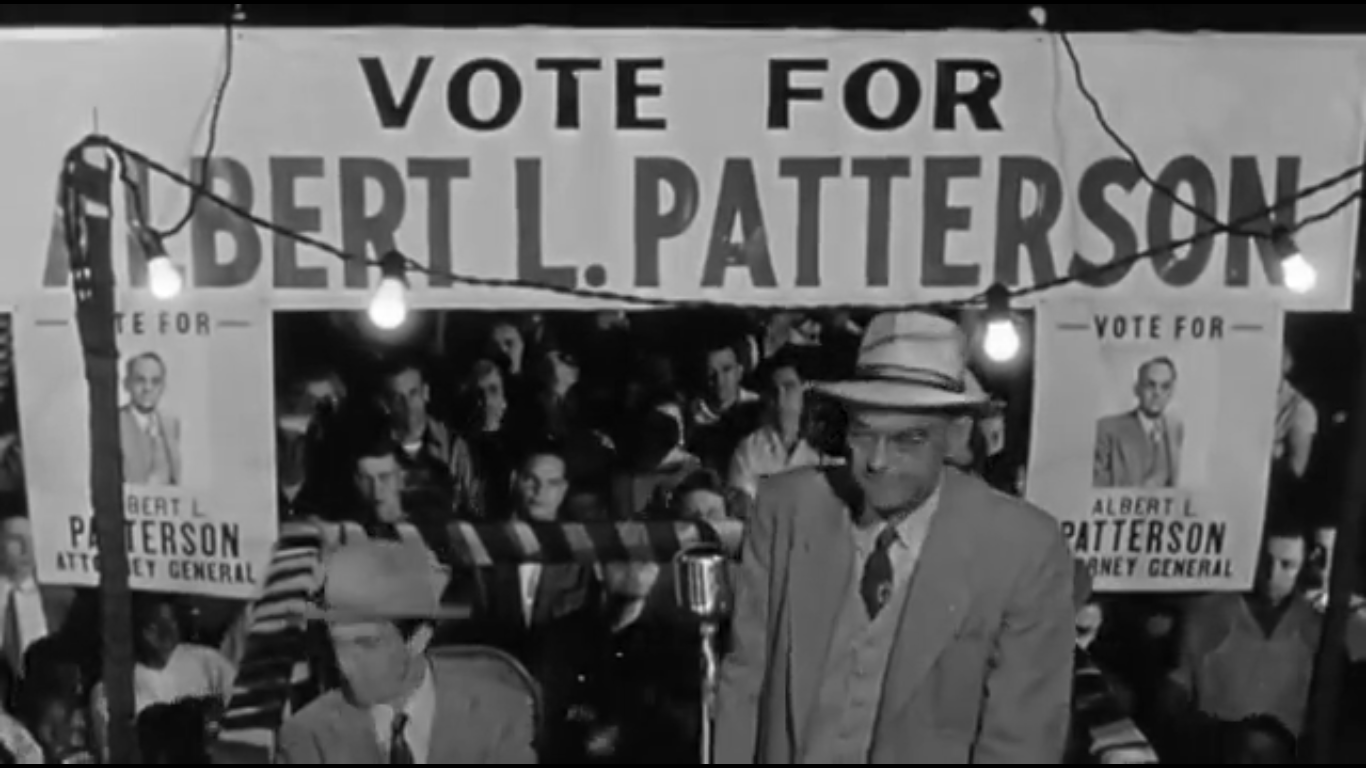
Albert Patterson (John McIntire), as portrayed in this storyline, is one of the men who is reluctant to get involved. He’s a lawyer and a good one — he’s one of the town’s best — but he’s also old and feels the fight is not his. He can live on his side of town in relative peace.

It’s his boy, John (Richard Kiley) who really shakes up the status quo. He is a war vet returning to Phenix with his young family after time away, and he’s disillusioned by what he found. He’s faced with the bitter irony of fighting fascism overseas only to see it have such a deathly grip on his childhood home. He’s prepared to fight to give the town back to the good folks around him.

Kiley’s part is actually conveniently whitewashed to make him a more sympathetic hero. In real life, John Patterson ran on a segregationist ticket — although it might have been more pragmatic than anything — he also didn’t have the best track record as a family man.

But in an effort to probe this topic more, James Edwards is one of the characters we must gravitate towards. Edwards certainly never reached star status, and he’s rarely remembered outside of the classic film circles, but through a series of war films, it’s as if he was given an opportunity to exert himself and represent black characters with dignity.

Phenix City Story is one of the few films where he’s not in uniform, and Zeke is not a revolutionary part; he’s only a humble janitorial type, but he has a strong moral conscience. The fact that he, his wife, and his daughter (who becomes a tragic victim) are the only black characters, is also a salient reality of the film’s world.

The movie feels like a microcosm of the whole society, both what is shown and what is not. My historical geography leaves something to be desired, but I think of 1957 and Orville Faubus, or the 16th Street Baptist Church Bombing in Birmingham in 1963, and the brutality of Selma after that. My mind starts going places. If this is how they treat other whites in a movie, imagine how it is with blacks. To its credit, the movie resolves to show some of this.

Pound for pound, it doesn’t feel like the Sunday school truth it’s trying to project itself to be, but in the world and qualities of life — especially the exteriors — we do get a real eye into society circa 1955. This is the aspect of many classic films that’s the most enlightening even if the actually perceived mimesis of the film itself is still beholden to the tenets of Hollywood drama. Thankfully, for all its forays into docudrama, it still holds onto Karlson’s always reliable sense of bruised and bloodied physicality.  It wouldn’t be one of his pictures without it. But of course, even this has real import.

The ensuing climax feels like a foregone conclusion. People feel a tug or a pull to do something and take a stand. Bystanders can no longer watch. They must act to turn the pervasive tides of oppression. One of them is the young woman Ellie Rhodes (Kathryn Grant before she met Bing Crosby), who saw her boyfriend ruthlessly disposed of. Finally, Albert Patterson resolves to fight as well, and he takes it to the top, running as attorney general. Both of them stick their necks out and pay the consequence. However, these weren’t rash decisions. They knew full well what they were getting into. They counted the costs and pushed forward anyway.

If we are to scan the contemporary movie landscape, something like The Captive City is a comparable movie. Whereas the actual visual plane is more pronounced in individual shots of the earlier movie, Phenix City has the advantage of its world, and if it’s not entirely more expansive, then it certainly feels more evocative. In the dark shrouds of night, we feel the sinister threat hanging over the city’s population.

The Captive City also calls on gangsters who feel like callbacks to the 1930s. The tone verges on social horror. Karlson’s picture is probably even more perturbing because it alights on something that feels fresh and honest in how it pertains to current events in 1955. There’s no escaping reality in this case. We’re still struggling against them over 65 years later. Suddenly, that corny rhetoric at the movie’s opening remains prescient. “The power of the ballot will always be the voice of the American people.”

3.5/5 Stars

The Captive City (1952): John Forsythe and Joan Camden

The movie opens briskly with a man and a woman racing through Middle America in their car. The shots provide a lovely, claustrophobic framing and closeups of our characters making the moment especially palpable. From what I can glean, this was actually attributed to a man named Hoge, a former grip for Gregg Toland who made this noticeable advancement with deep focus. This Robert Wise project was purportedly the first movie to use this new technology, and it pays great dividends over the course of the rest of the movie.

The couple continues to fly down the highway until they pull up outside of a police station in a small town to find some support. They don’t fit the surroundings, but journalist Jim Austin (John Forsythe) asks to record his testimony just in case anything should happen to them…

This kicks off the film’s all-encompassing flashback covering most of the movie. James T. Austin (Forsythe) was the local newspaperman in Kennington, which might as well be Everywhere America. There’s nothing too exciting there, but they find ways to keep busy, and life is generally calm and anodyne.

As such Austin has a generally chipper attitude and very little can sour his mood on the beat. He likes what he does and being a member of the local press avails him certain privileges. However, an inauspicious encounter with a P.I. named Nelson in the local library, leaves him feeling queer. The man is positively paranoid. He says he was working on a run-of-the-mill divorce case, but then sounds the alarm suggesting underworld syndicates and other entities are taking over the town. It’s utterly ridiculous. But he won’t stop looking over his shoulder.

That same day an accident takes place in town late at night. Although it’s actually a hit and run, and the man killed is none other than the same P.I. Austin starts to get queasy feelings. At the very least his interests are piqued, and he does what he does best: investigate. His character was built for such a film as this.

It leads him to a divorced couple, Mr. and Mrs. Murray Surak, who are somehow implicated but don’t want to talk. They’re scared of something. This goes far deeper than one or two people. The Police Chief, a genial enough fellow named Gilette encourages the journalist he might as well back off. In truth, he’s running interference for the bookies in town, and some of Austin’s pals even call gambling harmless fun. At any rate, it’s pervasive throughout town — everyone’s complicit — and it all goes back to one man named Dominick Fabretti.

With a conviction to seek out the truth for the sake of his readers and the community, Austin enlists the help of the paper’s budding photographer (a young Martin Milner before his Route 66 and Adam-12 days). They stake out Fabretti’s home base outside of town and grab a drive-by shot of the elusive kingpin. However, the victory is short-lived after Phil is pounded for the negatives. It’s another warning.

The film soon passes the point of no return as the journalist spies a car watching his house from across the street and his greatest allies at the paper start to turn on him. They can’t understand why he’s willfully stirring up the populous. In some ways, it plays like an early prototype of Invasion of the Body Snatchers without the Sci-Fi element as the world closes in on him and no one believes his story aside from his faithful wife (Joan Camden).

Here’s an unrelated observation but watching the movie you begin to understand the plague that beset people like Dr. King who had their lines tapped and were constantly hustled, harried, and intimated by forces in power. Even then this is only a very small representation of this kind of conflict between the powers that be and the righteous rabble-rousers.

Ultimately, Austin feels compelled to go to the local ministers. Surely they can speak truth into the current mendacity they find themselves enveloped in. And yet even in spite of this blatant hypocrisy, the religious leaders do not feel they are able to take on their own communities in this way. They too feel powerless to reach their audiences in the pews on Sundays. In essence, that’s the extent of their powers because for the rest of the week people go and live their own lives as they see fit.

Eventually, we circle back around, and in another sequence predating Body Snatchers, Forsythe, much like Kevin McCarthy’s character, tries to seek help in the present as the story comes back around. All due respect to Senator Estes Kefauver and his civic pursuits, but the last 2 or 3 minutes kill the movie.

It becomes yet another heavy-handed Hollywood public service announcement in the guise of entertainment. Up until that point, it’s a tense newspaper noir brimming with deadly, full-bodied conspiracy. We truly empathize with John Forsythe as the world begins to cave in around him. He makes it take.

3.5/5 Stars

House on Telegraph Hill (1951): Valentina Cortese and Richard Basehart

Like many of the directors of his day and age, Robert Wise cut his teeth on noirish material on his way up the industry totem pole toward more prestigious projects. House on Telegraph Hill supplants a Belsen Concentration Camp survivor named Karin Dernakova (Valentina Cortese) who emigrates to San Francisco on the prospect of a better life.

This might have felt like a very prevalent narrative in a post-war world, but what makes her story unique is her secret: She’s not actually Karin Dernakova. Her real name is Victoria Kowalska but her feeble friend Karin shares the hope of her distant relatives in America. Although Karin doesn’t live to see it, in a moment of decision, Victoria decides to don the life of her friend. It’s a risk but one she is willing to take as it promises more than she would ever have otherwise.

The Allied liberators are decent, enlightened people who handle her with a human touch. They aren’t looking to find her out, instead intent on helping her assimilate back into society. Her first stop is a displaced person’s camp and then her relatives who live in San Francisco.

Richard Basehart is one of the men watching over the assets of her late “aunt.” In fact, he’s a little more closely involved as guardian of a child and his estate. The lady she was meant to stay with is dead, and her young son doesn’t remember his mother very well; Alan does what he can to make her feel welcome. The attraction between them is also of convenience to her as she’s driven by fear and a desire to realize her American dreams. Ultimately, they get wed.

As House of Telegraph Hill settles and finds itself as it were, what becomes apparent are these varied strands coming together. Because it shares elements we see in innumerable films of the same period. The first is the gothic home and the woman in danger noir. At first, it’s not altogether explicit, but there’s an eery sense about the place.

An imperious portrait of a deceased relative sits prominently in the middle of the parlor. There’s something slightly unnerving about it like it might somehow catch her in the lie. Likewise, their governess Margaret (Fay Baker) is built out of the Ms. Danvers prototype, making Karin feel thoroughly unwelcome in her own home. Though this is the undercurrent of the entire movie, isn’t it? It actually isn’t hers to have.

There is this general sense of unease bubbling up from the surface from any number of nooks and crannies. Although Rebecca is a better mood piece and its actors are probably more prominent in their evocations, House on Telegraph Hill not only has an illusory housekeeper and a specter of a proprietress but also a man of the house with dubious intentions.

In order to offset the perceived menace, there must be an escape valve and Marc Bennet (William Lundigan) is just the man. Although Alan is reproachful of his old school chum, he has the kind of good-hearted, easy charm to provide Karin with a much-needed ally — someone to let her know she is not crazy. For that matter, there’s her son, and Gordon Gebert is just about one of the best child actors of the era if we’re basing our criteria solely on spunky adorableness. Playing baseball with his mother is one of the most humanizing activities you might imagine for a young boy.

This general malaise displaces the hope and prosperity brought on by the end of the war and happiness is extinguished by this unnerving sense of unease. It seems the horrors of the Holocaust are given a very real form and expression. We have a paranoia-filled framework perfect for a noirish tale of distress brimming with psychological torment and underlining duress.

There’s a mysterious drop-off in the rickety old playhouse caused by a sudden explosion, and later faulty breaks causing her car to careen violently through the hills. Somehow she survives, and it feels like it could all be an illusion — not just back projections of a studio lot — but also a manifestation of the pervasive mania she finds herself stricken by.

Basehart doesn’t necessarily have a cushy headliner role. Still, he’s good at playing bad with his charming manner and dashing good looks. And yet this becomes a glorious noir portrayal because it provides such a contradictory projection of truth and falsehoods that we must reconcile as an audience alongside Cortese. In other words, the ominous scoring says one thing, while his demeanor says another. We’re always kept in this state of uncertainty. It doesn’t help since we have the contradiction of the budding love affair between Basheart and Cortese in real life.

In Suspicion, Hitchcock was forced to pull Cary Grant away from the brink and if there is one thing in this picture’s favor, it’s that we can still have our villain. True, it resorts to wildly histrionic melodrama in its final moments, stewing in all its gothic glory. There are strings and drums pounding away, as orange juice, not milk, is ingested. If it’s not altogether satisfying, at least it delivers on the kind of cinematic delirium we expect from a movie like this, wearing all its many facets right on its sleeve.

3.5/5 Stars

The Incredible Shrinking Man (1957)

These old Jack Arnold films are a perfect example of how expectations don’t always meet reality. Because if you’re like me, you have a certain preconception about how these movies will go — how they will look — and thus you may have written them off. Part of this might be the fault of the movie posters and the sensationalized advertising, and it also might be chalked up to our cliche-filled cache of old sci-fi and monster movie imagery.

The Incredible Shrinking Man fits comfortably as a twee ’50s-era television rom-com. “Scott” Carey (Grant Williams) is on a vacation with his wife playfully arguing about who will get the beers from the galley of the boat. It’s a bit of levity even as they jockey around the roles of man and wife in a marriage.

Minutes later Scott’s engulfed by a curious mist that comes out over the sea, and it leaves him confounded. For the moment, there’s nothing more to say. Months later, they are back in their suburban life. The milkman stops by in the morning, Louise busies herself in the kitchen, and Scott gets ready for work. Except, this morning his pants are too big — the dry cleaners must have made a mistake — but then his shirt is too big also. It throws him off.

His wife doesn’t have any clue either and so he goes to his doctor for a physical. The genial doctor (William Schallert) tries to explain away the changes with the routine explanations. Because, to put it plainly, people don’t get shorter…unless they do. It’s true there is no medical precedent for what’s going on with Scott.

He’s put through all sorts of tests to make some sense of the change in his body. Finally, the researchers settle on something. The molecular cells in his body have gone through a rearrangement — no, not cancer — but an anti-cancer. In a eureka moment, they realize a cocktail of insecticide and radioactive mist, led to the adverse effects.

But the Incredible Shrinking Man is hardly a story obsessed with the nuclear age. Instead, the premise turns into a far more intriguing conceit about everything from emasculation to Scott becoming a sideshow attraction in the media with national notoriety. The phone rings off the hook and people hang around to gawk at the new pariah.

Going out to clear his head only makes matters worse. Normal, everyday scenarios like walking down a street corner or grabbing a cup of coffee only emphasize his size even as the carnival freak show makes him queasy. He’s one of them. It’s true that one of their members, Clarice, is the same size as him. Being with her is some small comfort to him. Still, even that doesn’t last. He continues to shrink.

Rapidly his loving marriage begins to dissolve around him correlated with his continually diminishing size. Louise hasn’t changed, but Scott is bitter now, understandably discontent, and prone to lash out at his wife regardless of what she tries to do. On a side note, it’s wonderful to simply sit back and appreciate the scale of everything and this is years before similar trickery would be pulled in a film like the Hobbit for instance.

Marvel at the perspectives. There’s the harrowing moment where the cat gets back into the house, and it becomes a fight for survival as the feline terrorizes the dollhouse Scott now inhabits. In the wake of the incident, he is pronounced dead though he’s really only trapped in the cellar with no possible way of climbing up the massive stairs.

The pervading sense of helplessness sets in as Louise leaves the house one last time prepared to sell their home at the behest of her brother. They drive off, and that’s the end of it. What a dismal arc it is when we consider the initial joy of the marriage. We almost forget all of this if only because of the immediacy of the journey Scott still has ahead of him.

This demarcation point sets up the latter stage of the film as it devolves into a Robinson Crusoesque adventure set in the basement. He wouldn’t have given a thought about only a year prior. Now it’s a moment-by-moment struggle.

Realizing he’s trapped, Scott seeks shelter in a forgotten matchbox. Then, he finds himself water and sustenance and even creates some tools — including a spear. The emergence of a tarantula makes it all too evident he is no longer on the top of the food chain. If he is to live another day, he must vanquish the other creature or die trying. When they face off, dread sets in like I haven’t felt in some time. It’s palpable and strangely compelling in some primordial way. It plays better than many of the glossier battles we are served up today courtesy of CGI.

This is not his only trial. There are great chasms to cross, then torrential floods of water; we take on his powerlessness and are privy to his weakness. The perspective is surprisingly weighty and although Grant Williams is hardly a famed actor, there’s something totally spent about his performance. Behind the scenes, he was sent to the hospital several times due to blisters and other ailments. And he goes through the final act of the movie barefoot and scraggly like a real trouper.

As the narrative continually builds on Scott’s story, it increasingly becomes a movie full of soliloquies and at times the verbosity may be ill-fitting, but what they do provide is something running in the face of all those preconceived notions we have about these exploitative-type movies. They actually do mean something. There is an import to what it is trying to express and get across (at least sometimes).

One evening he peeks out and looks up into the heavens. He has an epiphany. In this vast majesty of creation, he realizes it has to mean something, and therefore he must mean something too.  Suddenly the existential crisis of man is given center stage and in another stunning turn, the incredible shrinking man’s struggle is precisely our struggle, coming to terms with our place in the world — the vast infinite spaces of the galaxies as we ourselves are insignificant in comparison. It’s all relative but in a single moment, we are made to feel a lot like him. But if we make peace with our station in life perhaps it is more of a blessing than a curse.

4/5 Stars

Le Petit Soldat (1963)

“Photography is truth, and cinema is truth 24 times a second.”

Although Le Petit Soldat was released in 1963 — no thanks to the censors — it was actually filmed in 1960. This context is all-important because Jean-Luc Godard is still fresh off the sensibilities of Breathless, and they pervade this film as well.

Its plot follows the aftermath of a professor killed in a terrorist attack and a young journalist in Geneva, who is enlisted by French intelligence to assassinate a man named Palivoda. This is in the age of the Algerian War; the young man, Bruno Forestier (Michel Subor), has avoided the draft, and the man he’s assigned to kill is a National Liberation Front sympathizer.

If it’s not apparent already, the groundwork has been set for a political spy thriller. While balking at murdering the man in a drive by, Bruno simultaneously falls in love with Veronica (Anna Karina), a dark-haired beauty in a trench coat. His friends bet him he’ll fall in love the first time he sees her on the street. He sheepishly shells over the money after only a brief introduction. He’s instantly smitten.

Le Petit Soldat is such a literary film thanks in part to its voiceover. Bruno, as Godard’s stand-in and cinematic conduit, references a myriad of things. He asks rhetorically about Veronica, “Were her eyes Velasquez gray or Renoir gray?”

It’s as if Godard is contemplating the muse in his own art. Still, he continues with a steady stream of namedrops including painters, authors, and composers. Van Gogh and Gauguin. Then, Beethoven and Mozart. Anna Karina prancing around to Joseph Haydn is definitely its own mood.

It occurs to me this is a distillation of Godard as a filmmaker. It’s a visual style wedded with these deeply mined traditions of literature and art.  Both cutting edge and steeped in the culture of the past before thenceforward going off and creating its own unique vocabulary.

Godard gleefully inserts himself all over the movie on multiple occasions where we see him in the flesh. It’s a spy movie as only he can conceive it totally deconstructed and aware of itself while simultaneously taking most of the thrills out of the genre.

Soldat remains a precursor to Alphaville by effectively turning the contemporary world around him into the environment for his latest genre picture. Whereas Breathless‘s jazz-infused contemporary aesthetic is accentuated by the black and white streets of France, here they are repurposed. Though it’s as much a film about driving around the city philosophizing as it is about any specific dramatic action.

Because Francois Truffaut, while not always disciplined, could spin stories with a narrative arc and genuine emotion. Godard is at his best as a philosopher and cinema iconoclast where his style doesn’t totally get bogged down by ideas, and he uses the medium in ways that would become the new standard. Or at least his own standard, before he decided to upend them again.

But in order to make the case for Anna Karina as more than Godard’s Pygmalion, it’s necessary to consider her screen image in depth. Whatever Godard gave to Anna Karina in terms of iconography or legacy, Karina gave that much back, and they will be inextricably linked for all times. Because if there was ever a reason to fall in love with her, it’s right there in Le Petit Soldat.

His alter ego riffs about God and politics, political left and right, quotes Lenin, and unravels his entire worldview (ie. about a man who loves ideas, not territories). When he asks his girl why she loves him, she shrugs her shoulders and says I don’t know. I don’t think she’s dumb, but whereas here we have one character who is in their head, she seems to be a creature who is real and present in the moment. She has a heart.

Whatever the digressions and despite the perplexing way Bruno interrogates her during their impromptu photoshoot, she is undeniable. If cinema is truth 24 frames a second, she somehow makes Godard’s cinema more accessible and real — she takes his theorizing on truth and gives it a pulse.

The movie is still a thriller, and it follows its own version of narrative beats. Bruno is framed, he continually has second thoughts about his assignment; he gets the gun, but things always get in his way. His heart is not in it — killing a man mercilessly — because this is not who he is.

Instead, he wishes to run away to Brazil with his girl. He’s locked away and tortured as a double agent for his troubles. These sequences are simplistic — contained in a hotel bathroom — and yet as they light matches near his fingertips and dunk him for minutes on end in the water, there’s a definite heartless menace about it.

We have the political bent of Godard’s cinema detected early on before his other overt efforts later in the 60s. It comes in the guise of his story as it unpacks current events, ideologies, and even controversy around torture.

True to form, he has the audacity to cram the final act of an entire movie into one minute of celluloid. He shows us some things and just as easily explains away the rest with voiceover.

It feels like he leaves just as he emerged. He’s totally singular. At times, maddening and bombastic, and yet always prepared with his own take and alternative approaches to convention. Godard will always challenge the viewer and make you reconsider how much you appreciate cinema even as he continually helps to redefine how we conceive things.

1960 or 63. It makes no difference. Le Petit Soldat has a young man’s malaise acting as a film for the coagulating disillusionment of the ’60s. This isn’t your father’s war nor one of his films — not the “cinema du papa” as Truffaut put it. If Godard’s style was coming into its own, with Karina cast front and center, then the propagation of his ideas is equally evident. Cinema would not be the same without his distinct point of view.

3.5/5 Stars

Note: This review was written before the passing of Jean-Luc Godard on September 13, 2022.