C’mon C’mon (2021)

I was thinking about how although Joaquin Phoenix has steadily become one of the most admired actors at work in film today, I don’t necessarily enjoy him or closer still I’ve never felt a kinship for him when he’s onscreen. Ethan Hawke, Andrew Garfield, Adam Driver, even Leonardo DiCaprio have offered performances where I sense their humanity and empathize with them.

I forget Phoenix’s capable of the kind of mundane naturalism that also defines a certain mode of acting. C’mon, C’mon is a reminder he can be a rudimentary person, a normal human being, and when he’s playing Joker or Napoleon, it’s not better just different (Why does everyone have to be eccentric? It’s okay to be normal too).

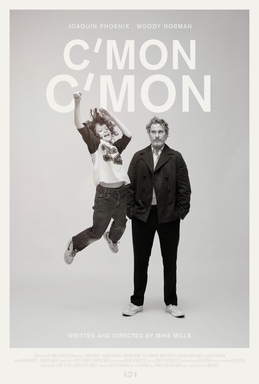
Mike Mills’ stylized black and white movie follows a radio journalist named Johnny (Phoenix) who is enlisted by his sister (Gaby Hoffman) to watch over her 9-year-old son Jesse (Woody Norman) as she attends to a family emergency. He’s an unattached working professional who’s hardly equipped to be a caregiver, but who is?

It’s a learning experience for both uncle and nephew as they get used to each other in Los Angeles. The movie takes them all across the country as Johnny conducts interview with youth across the country. Jesse becomes his boom man learning what it is to do sound.

Those of a certain generation will know about Art Linkletter and “Kids Say the Darndest Things.” Johnny and his team seem to give us an update on this; sometimes adolescents have a wisdom we would all do well to tap into for simple, clear-sighted lucidity about the future. From time to time, sans the coarser language from the adults, it’s a Mr. Rogers movie. There’s a mild sense of wonderment and an appreciation of what the younger generations can teach us.

They have ways of asking the most searching and honest questions. Jesse questions why his mom is away. Johnny explains she had to check in on his father (he’s a composer going through a nervous breakdown). Why does his dad need help? It’s not an easy answer that’s cut and dry. And suddenly you appreciate the tightrope walk it is to be a parent and also the unprepossessing honesty kids maintain.

Adults are fractured and imperfect often hurting the ones we love. Divorce, the problem of evil, why bad things happen to good people, adults struggle with these issues for most of their lives. Kids are not immune to any of this and are affected by it all.

C’mon C’mon is not so much a road movie as it is about impressions and impressions in particular about familial relationships. Brother and sister hold a two-way conversation for most of the picture from different states keeping a dialogue going. It provides a very loose framework.

With The Velvet Underground acting as an auditory transition the story shifts to New York. It’s more Noah Baumbach than Woody Allen but the West Coast, East Coast juxtaposition is real, and it plays well in the movies. Meanwhile, New Orleans offers up its own unprecedented aesthetic to the patchwork.

Otherwise, the film takes an observational approach as uncle and nephew experience life together. It’s not a raw-raw, grab-life-by-the-horns pump-up piece; it’s smaller, from the ground up about moments and the kind of trifles you catch if you stop long enough to appreciate them.

I’m still trying to decipher if there is enough here for a conventional movie, but of course, I answered my own question because this is not a movie you get every day. It just needs to find the right audience and Mike Mills no doubt has a tribe of followers ready and waiting.

In a particular interview, a young man is asked what happens to us when we die. He offers up that he and his mother are Baptist so he believes in heaven. Pressed further he says he imagines it as a meadow with one big tree where you lay on the grass with the flowers and stare up at the sun relaxing; it wouldn’t be too hot.

The interviewer marvels that it sounds beautiful. Yes, it does. There’s no agenda or politics or vanity. The response feels so genuine. Does anyone remember what Keanu Reeves said in response to the question of what happens when we die? After a pause, he answered, The people who love us will miss us very much…I feel like we’re all searching for those shards of wisdom.

One of my favorite bands actually has a deep cut that’s called “C’mon, C’mon” and the lyrics go like this:

So c’mon, c’mon, c’monLets not be our parentsOh, c’mon, c’mon, c’monLets follow this throughOh, c’mon, c’mon, c’monEverything’s waitingWe will rise with the wings of the dawnWhen everything’s new

These words don’t speak to Mike Mills’ movie precisely, but in an impressionistic way, I can tie them together in my mind. There’s something generational about it — this youthful sense of wonder and optimism — and the desire to spur others on.

When I hear the phrase C’mon, C’mon, there’s a playfulness welcoming someone else in, whether it be into a kind of life or an uncertain future, even a game of tag or a bit of make-believe. C’mon, C’mon is an open hand. I want this kind of posture.

Because there is a not-so-subtle difference between childish and childlike. I want the latter for my life. Actors, directors, writers, creatives, I feel like they never quite lose this spirit at their very best, and it’s something worth fighting to hold onto. Sometimes our youngest members can give us so much if we have the humility to learn from their example.

3.5/5 Stars
The Little Fugitive (1953)

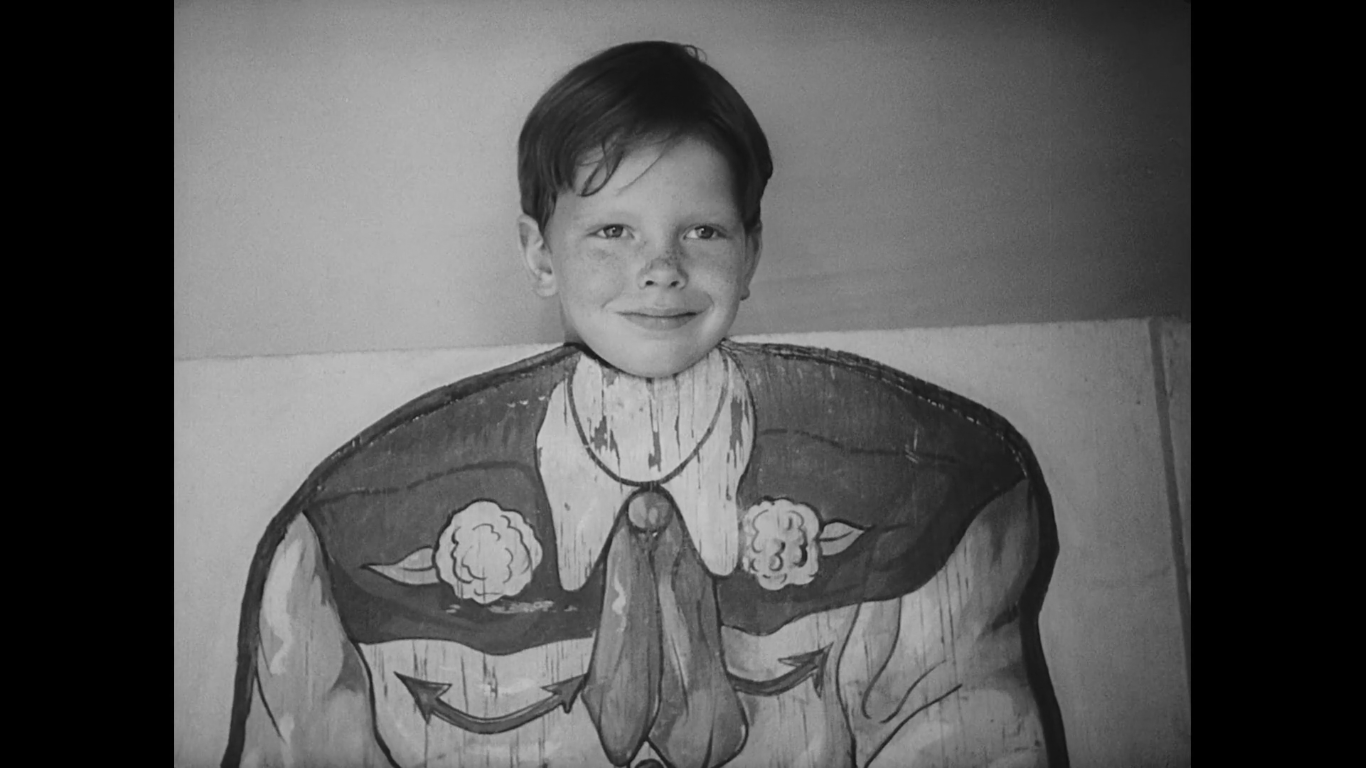
The aesthetic of The Little Fugitive is made plain thanks to chalk drawing credits playing over “Home on The Range.” We are about to enter a little boy’s world with all the joys and menial problems an adolescent life engenders. The key is giving these problems credence. Because in a young life, they feel ginormous.

Joey Norton always has his trusty pistol and holster and his big brother Lennie can always be found with his harmonica. They have your typical sibling dynamic. The little brother nagging, the big brother both put-upon and protective.

There’s an initial impression from the clunky dialogue causing the illusion of the film to falter. However, everything else around it feels real and sincere in a way we are unaccustomed to seeing in 1950s American films. Then you realize the whole picture had its dialogues done after the fact and it falls into place.

Coincidentally, it does give it a European sensibility with the dubbed dialogue. I can see how a film like this might have come to Cahiers du Cinema, Francois Truffaut in particular, and lit a fire under them. This is what movies could be, and not only something they could be, but also something attainable to others as long as they had a personal story to tell.

The 400 Blows but also Breathless and Le Beau Serge, developed narratives out of spaces the directors knew intimately. It wasn’t outside the purview of their experience, and it made a stunning entry point into their respective cinematic visions as they continually evolved over time. Still, one cannot discount their origins.

In the era of The Little Fugitive, a boy’s world was occupied by very specific things: baseball, guns, cowboys and Indians, television serials, comic books. The premise itself feels like an episode of Leave It to Beaver albeit outside of the watchful eye of middle-class suburbia.

Mother has to go away to pay a visit to a sick grandparent. Lennie has to watch over his little brother, and it’s going to derail his birthday outing to Coney Island with his friends. We have a simple dramatic situation and although he’s not a bad guy, he needs to use his boyish ingenuity to find a way out of his responsibilities. A dagger made out of ice is too impractical so they get the idea of using ketchup to fake a grisly death like they do in the movies.

The trick works wonders on getting rid of a pesky brother, and the film really comes into its own as they take it to the streets, and he’s out on the lam. It seems prudent to mention Ray Ashley, Morris Engel, and Ruth Orkin, the trifecta behind the film’s conception.

Their greatest asset was a cutting-edge 35 mm camera both portable and unobtrusive making The Little Fugitive landmark for another reason. It really feels like one of the obvious birthplaces of independent cinema because we have this idea of film emerging from the studio lots out onto the streets. And these aren’t just exotic foreign locales but the humble spaces you and I frequent in our daily lives. Even these spaces can have their share of fascination for a willing audience.

It’s a cornucopia of leisure, a boy’s delight having a day on Coney Island. We get a steady stream of vignettes: photo cutouts, batting cages, hot dogs, watermelon, the beach, ball toss, and whirling carousel rides providing full immersion of a different era.

Not since Harold Lloyd can I recall such a great showcase for Coney Island. We’re even reminded recycling was a problem at the beach back in the 1950s too. Joey quickly learns he can make some loose change culling the seashore for glass bottles and simultaneously proving himself to be inquisitive and quite entrepreneurial.

I’m not sure how our little fugitive had so much money to begin with; the film doesn’t find need to explain itself, but then he figures out how he can get more and uses them on a very sound investment: pony rides. He’s positively infatuated with ponies, and it shows him returning time and time again just to get another chance to live out his dreams on the range.

Although the film is mostly kid-centric, it’s a pleasure to observe several of the adults who seem to be genuinely nurturing souls. Whether it’s the photographer (Will Lee) or Jay the ponyman (Jay Williams), they seem to encourage kids in their interests and imagination. It would be so easy for a film like this to feel severe and somehow oppressive, yet what comes off is the lightness and the joy of each of these very specific moments as experienced by a little boy.

If I’m honest, I’ve recognized a growing bias in my own film appreciation. I’m partial to films that use modest means, modest runtimes even, and still manage to transport us with stories and worlds we can relate to. I can think of no finer compliment for The Little Fugitive because it captures a moment plucked out of my parent’s generation, honed in on a very particular Brooklyn milieu, and through its images we are able to imbibe all these tactile sensations pulling us into the moment.

Although the boys at Cahiers can feel a bit arrogant and combative, even in how they dismissed much of the past and canonized the auteur-director as king, I do like the idea that they placed no undue importance on bigger, larger productions tossed out as awards bait. There’s something almost more satisfying happening in a movie like this because not so many folks will be joining the bandwagon — the fad of the cultural moment. That is the road lined with glitz, accolades, and transience.

Only with a bit of diligence and an open mind, do we get the opportunity to unearth it, and what a glorious joy it is. Unassuming gems like this make the moviegoing experience such a spectacular journey of human revelation. Because this little boy’s day speaks to so much and since I was a boy once, it resonates deeply. I won’t forget it until the next time I return to this story caught in time, where it will be waiting for me again even as I continue to change. This is the magic of the movies.

4.5/5 Stars

Mask (1985): Eric Stoltz and Cher

Peter Bogdanovich lost his girlfriend Dorothy Stratten to tragedy in 1981 and after the release of their picture together, They All Laughed, it was anyone’s guess if he’d ever be able to return to directing.

I’ve heard an often-repeated anecdote that he ultimately decided to take Mask as his next project as a way to honor Dorothy. The reason isn’t immediately obvious. However, he explains that Dorothy was fascinated by the Elephant Man, who shared the same condition as Rocky in Mask. But she was a highly sought after beautiful woman. How could she relate?

It seems that extreme ugliness and extreme beauty by the world’s standards puts you outside of the normal purview of society. It’s not something individuals asked for. They are born with it or given it by circumstance, and as a result you have the world’s prying eyes looking at you. So both of these films are about this kind of social “others,” who must make an existence for themselves in a world where they’ll never quite fit in.

The greatest epiphany of Mask is how Rocky (Eric Stoltz) does exactly that. We’ve seen movies about people lashing out because of the hand they’ve been dealt. This is a reasonable reaction, but this movie is never about that.

It’s my own human inadequacies making it so I look at him and feel discomfort. But it’s a classic example of not judging a book by its cover. Outward appearance doesn’t define the mark of an individual.

The brilliance of this teenager is how he rewrites the script and subverts the expectations around him. He’s the personification of all our outcast inclinations when we’re in middle school and high school. None of us would have envied him during those formative years. And yet he rarely gets rattled by any of it, even when he might have the most excuse to do so.

Rocky has a level of supreme confidence so in a manner of weeks teachers know he can succeed and look after himself and his fellow students come to appreciate his wit and his near-Encyclopedic knowledge. He has a high view of himself and this allows him to be self-deprecating. I like the idea that we don’t think less of ourselves, but we think of ourselves less often. It makes our lives centered around others.

Part of this is the family unity around him. They support him and love him for who he is even as he does yeoman’s work to look after his mother. It’s almost as if he’s her guardian sometimes with the lifestyle she leads, a holdover from the ’60s with drugs and a conveyor belt of male suitors.

Cher is a powerful force and she always has a natural charisma in front of the camera that suggests so much about her. Although their relationship is the backbone of the whole movie, they have an entire motorcycle gang to watch out for them including the old family friend and Cher’s past lover Sam Elliot.

He’s a quiet enigma of cool, but with his laidback demeanor and a “Moustache Rides” tee, a character who could easily be a vehicle for outside conflict becomes more of a stabilizing force.

Rocky is even granted one of the loveliest adolescent romances of the 80s as he begrudgingly decides to spend his summer volunteering at a camp for the blind meeting Diana Adams (Laura Dern).

It’s reminiscent of City Lights with a love story based on personality and kindness as opposed to superficial appearance. In other words, it is a deeper bond and even as she’s an equestrian girl with an affluent background and he’s been raised on the road with a motorcycle gang, they relate on what’s most important.

I couldn’t help myself and seek out the writing on the wall. Rocky can’t last forever. In real life Roy L. “Rocky” Dennis passed away at 16 years old. If you didn’t know him you might think this was merciful and yet having watched his life play out on screen, we see the tragedy of it. He was such a loving, vibrant, jovial force to behold. He could have accomplished so much. And one can only imagine his mother was devastated. Because her boy was special and the bond they held was incomparable.

Bogdanovich augments the story with his trademark use of dietetic sound to fill out the world on top of some of Bruce Springsteen’s finest tracks. I watched the director’s cut which included a few extra scenes and all I can say is that I’m thankful to Bogdanovich’s conviction to get his version out there without compromise. This included working with Springsteen himself to get the original recordings licensed for the rerelease. It pays heavy dividends.

Regardless of the director’s shortcomings, I will dearly miss his classical sensibilities as a filmmaker. He made films imbued with joy and melancholy. Both speak to me and surely I’m not the only one because life becomes a subtle dance between a panoply of emotions.

Like the masters of old, he was able to take a story and personalize it so the core themes are somehow made manifest and evident in his own life. It’s a lovely brand of storytelling, and it allows Mask to constantly ambush us with some winsome surprises. This is how movies should be.

4/5 Stars

Running on Empty (1988): River Phoenix, Fire and Rain.

I know only very little about River Phoenix’s upbringing but somehow it’s easy for me to make the leap from his real-life existence to his family in this movie. Running on Empty has to do with an unconventional upbringing.

Danny Pope (that’s his real name) has grown up with his little brother and two parents Annie (Christine Lahti) and Arthur (Judd Hirsch), who have lived on the run from the feds since the early 70s. They were implicated in an anti-war protest at a napalm plant that left a janitor dead.

The Popes are a tight-night clan in spite of their unusual circumstances or because of them. Somehow in this environment of constant flux and fresh identities, they’ve managed to raise two boys who are loving and smart.

Danny enrolls in a new school and immediately distinguishes himself on the piano. He seems like an obscure prodigy because no one knows anything about him and his benevolent music instructor (Ed Crowley) gets little information on him. Still, he’s talented and generally considerate. He doesn’t play into the expected stereotypes of a malcontent.

He also makes the acquaintance of the teacher’s daughter (Martha Plimpton) who has a much more jaundiced view of education and musical appreciation. She’s used to a more typical lifestyle and yet she’s drawn to the new boy, not out of an act of rebellion against an overbearing father or anything like that. Danny is genuinely decent and kind. She immediately likes him, and they spend time together. She wants to get to know his family too and so she does.

I was a bit disappointed Jackson Browne’s tune “Running on Empty” has no place in the movie, but they may have done themselves one better with James Taylor’s “Fire and Rain.” Their celebration of Anne’s birthday turns into a dance party in the dining room; there’s something spontaneous and joyous about it.

It encapsulates the best aspects of the movie where we’re suspended in these moments of relational goodness. To be a part of the scene feels organic and the characters become all the more real in front of our eyes. We enjoy their company.

Martha Plimpton has a James Dean Rebel Without a Cause poster in her bedroom and somehow Phoenix carries some of the same ethos. There’s the morbid similarity in that they both died young and yet more than that, it has to do with a palpable emotional investment in their roles. It’s more like music than it is blue-collar craftsmanship and their brand of sensitive masculinity feels off the charts.

Phoenix has an emotional maturity and precociousness that feels wise beyond his years and still wracked with inner demons. Here he must carry the burden of his parents’ life. It also fuels the budding romance that Phoenix and Plimpton were an item in real life.

Christine Lathi still feels mostly underappreciated as an actress. She’s a loving mother, a strong wife, and the scene where she has a teary reunion with her father after many years is lachrymose but never totally saccharine. They supply just the right amount of heartbreak and tenderness.

Judd Hirsch deserves his plaudits as well though if you’re like me you appreciate him for being the stabilizing force on Taxi. He plays the part so well that sometimes you forget he’s an actor’s actor.

I’m reminded of his rapport with Timothy Hutton in Ordinary People and his scenes with Lahti and Phoenix here. He always gives off this aura of street smarts. He’s tough and able to spar, but it’s never totally untethered from his unerring heart. He cares and somehow he’s able to make his audience feel his concern.

What I appreciated most is that Running on Empty never feels over-reliant on its political elements which are often relegated to the background in favor of far more sensitive developments of character. It would be so easy to succumb to drama. Instead, it chooses a more nuanced road as Danny starts to put down roots and gets encouraged to apply to Julliard. Suddenly, his lifelong anonymity is bumping up against his youthful dreams of a normal future.

Director Sidney Lumet was always a fine filmmaker and one of the most enduring because he was a workman and he knew how to rehearse, he was smart, and made compelling movies. Running on Empty is never one of the most high profile mentioned, but it leaves space and feels attuned to the family at its center and their relationships. This is why I go to the movies to be shown people’s humanity up on the screen and then be uplifted by it.

The movie hardly dwells on its ending. Perhaps we could have done with a bit more resolution, but it does itself proud with a refrain of James Taylor’s “Fire and Rain” pulled from an earlier scene. It’s as if the chorus of singing voices — the family all joyful and gay — is a concrete reminder that that bond will never be broken even as they move on.

There’s something satisfying about discretely reaching back and referring to the movie’s most poignant moment. Because it means so much and these are the kind of memories we carry with us wherever we go. Family is forever.

4/5 Stars

The Children Are Watching Us (1944)

What begins as a day out at the cinema turns into an excursion out to the local park watching a Punch and Judy show with all the kiddies. A mother (Isa Pola) is out in public with her boy (Luciano De Ambrosis) and his scooter — sharing is hard whatever generation — though her mind is on other things aside from parenting.

Because we also have the core dramatic situation playing out only meters away unbeknownst to the little boy. His mother comes across a man — a lover — and he vows to take her away for good. They can have a life together, and the boy catches the end of it, though he probably cannot fully comprehend that more is going on than a few pleasantries. Why should he? Because children are not normally predisposed to distrust people’s intentions. Especially their parents. That only comes with time.

This sense of a child’s perspective framing adult situations is very much a precursor to Fallen Idol and its own dilemma involving a kind of heartbreaking, illicit romance. In this iteration, she seems to make her choice once and for all.

You can see it in her face and through her actions; she loves the boy dearly and then the door closes and her face is gone. So too is her presence in the household. We are conditioned and still hardly believe this could be happening.

They are a middle-class family nevertheless packed into a building with nosy neighbors and landlords — it’s the kind of environment where gossip spreads like wildfire. We have a father (Emilio Cigoli) holding down a job while trying to figure out what to do with his son. First, he’s looked after by the housekeeper, and then a sister-in-law who works as a tailor with a host of other women.

They become Prico’s surrogate babysitters. But the division of responsibility end there as the boy is sent out to the country to live under his imperious grandmother, cared for by his older cousin Paolina. Though few of these people are callous, it’s evident how quickly abandonment issues arise with everyone passing the buck. Still, there is a certain amount of care depicting all involved.

Because what sets its impressions apart from Brief Encounter or even Fallen Idol is how the “other spouse” in this case is not asinine or tyrannical but a person of dignity who wants the best for his boy and does not want his wife to be spoken poorly of.

De Sica is considered one of the formative figures in Italian Neorealismb and yet the movie has several sequences that are cut to the emotion. Aboard a rumbling train, the passing dreams flow through the boy’s feverish, listless mind culminating with his mother departing into the recesses of his memories. It’s a near-premonition while simultaneously speaking to his longings. I mean this sincerely; sometimes a boy’s best friend is his mother.

Sure enough, she comes to pay a visit when her little darling is in bed and his father is away. But she doesn’t take off her hat. Prico begs her to take it off — to stay with them — and it’s a prolonged moment of agony. Because she is not a heartless woman. She cannot bear to break from her family completely. Thus, she came back and makes the reparations of these relationships all the more difficult. Where can they go from here?

I never feel like I am being played like melodrama because the situations ring with a very core and incisive truth flowing out of the characters. In these adult situations between husbands and wives, children are very real and present collateral damage caught up in the middle.

They might be innocent bystanders but they are crucially affected. It’s irreparable and there’s no denying it feels like an uphill climb to repair the relationships. How helpless the little boy is and how oblivious he remains about the situation. There can be two levels of understanding going on in one scene and De Sica allows us to be privy to both.

Part two of the film offers a change of location and with it a change of tone. It’s an understandable decision because what it does is provide a reprieve. The family seems nominally happy again frolicking at the beach on their vacation. They are making a valiant effort to pick up the pieces and come together again.

Alas, we already know it cannot last. The flirtatious beachcomber Dada seems like another portent as she holds court with her amorous friends. Eventually, Andrea leaves and his wife and son stay behind. They’re both vulnerable. She to a visit from her former lover, and Prico because his mother is not around; he tries to run away. It’s the habitual cycle of infidelity and resulting fear and abandonment that cannot be broken.

Later in the film, the little boy shares a POV similar to that found in Fallen Idol peering down at the world below him although in this case, it’s watching his tearful father leave him behind at his new boy’s school. Again, it’s a scene injected with the most sincere of emotions, and they only build from there. Because for one final moment Prico must reunite with his mother. He’s already beside himself, and he feels so totally betrayed.

He goes toward the reliable arms of his housekeeper, then, looks up at his mother’s solemn face and tentatively backs away. She’s done so much to hurt him and his response is valid, and yet regardless of what words you put to the moment, it still sears the heart.

Obviously, the movie takes place in a specific era, but there is an air of timelessness about it. Because one cannot help but consider the war years and what impact they might have had on the production. In truth, the picture was shot in 1942 and not released in 1944. During that time De Sica was offered a position by the fascist film industry, which he purportedly refused.

Hardly a pro-Fascist diadem, it would become a stunning prototype for a new kind of cinema that would take the international world by storm in the post-war years. It still astounds me I had never heard of this early De Sica work. Part of the reason is due to how it moves me like some of his finest works do. It’s hard to leave a movie like this and not feel changed.

4.5/5 Stars

A Raisin in the Sun (1961)

It seems that some of the greatest strides in diverse representation have found their roots on the stage. One of the cornerstone examples would have to be Lorraine Hansberry’s A Raisin in the Sun (1961). I saw the film adaptation quite a few years ago, but now, with a renewed sense of context, it’s ripe with so much more discovery.

While it might feel like a trivial observation, I was reminded how the movie is laden with nagging, moaning, and groaning as you would find in any family living in close quarters. For this very reason, the stage conventions feel less of a limitation and more of an expression of this family’s tangible struggle.  But it also feels like a safe space for the black cast where they are able to express themselves in all manner of ways. One moment they’re wild — gesticulating all over the place — and the next minute is the height of silliness. It feels almost unprecedented for the era.

Sidney Poitier is often shafted for playing an “Uncle Tom” because detractors have some kind of preconceived straw man of him they’re prepared to tear down. Whatever your thoughts on this, Walter Lee Younger is just the character to rip those presumptions down to their foundation. His main credo is built around the idea that money is life and despite everything Poitier became known for over his illustrious career, in A Rasin in the Sun, nobility goes straight out the window.

But it’s not simply a story about a man, because we must consider the entire family as they wait impatiently for the $10,000 insurance check set to be bequeathed to their matriarch Lena Younger. Walter Lee can’t wait to siphon off some of the funds for one of his shady business deals.

His sister, Beneatha, is a young free-minded woman of the modern world with aspirations of becoming a doctor. She’s hoping for some financial support to make her dreams come true. Marriage is considered an afterthought.

However, whatever she might say, there are two worthy suitors played by a pair of familiar faces. Ivan Dixon is the benevolent Nigerian suitor: Mr. Asagai, tickled pink by her iron will and prepared to take her back to his homeland. The other is Lou Gossett Jr’s George. He’s hoodwinked by Beneatha’s recent behavior and when he comes a calling, he’s left on the couch to crawl out of his skin. Walter’s ready with the rich black college boy wisecracks or else prepared to proposition the boy’s daddy with one of his business ideas.

Beneatha and Walter have plenty of sibling animosity to go around (I dissected something that looked just like you yesterday). And she also receives the ire of her mother because God has no place in her personal destiny. She tells the scandalized old lady point blank, “I get so tired of Him getting all the credit for everything the human race achieves through its own stubborn effort. There’s only man and it’s he who makes miracles.” Needless to say, it doesn’t go well.

Because the movie is borne out of this generational difference. Lena Younger (Claudia McNeil) was raised up a certain way, and God will always be present in her house just as family and charity are of great importance to her. She’s not a woman trained in book learning, but she is a picture of stalwart character. Keeping her family together means everything to her, but she will never become a slave to money.

Ruby Dee is the only one who seems unencumbered by the thought of worldly wealth and what it will do to them, both good and bad. Instead, she works diligently at her laundry and becomes a kind of calming force in a house that feels constantly in a state of familial tumult.

This is what makes their final introduction to their new home that Lena plans to purchase so cathartic. When they drive up, walk up the steps, and then rush around the house, it’s a slice of suburban heaven, albeit situated in an all-white neighborhood. As a housewarming gift, her kids pitch in for some gardening tools, and it speaks to her character — always wanting to till the soil and cultivate all that is around her with love.

However, we must also take a moment to mention John Fiedler and Clybourne Park Improvement Association. He’s a favorite of mine from 12 Angry Men, The Odd Couple, Bob Newhart, and of course, he’s the voice of Piglet. What an inspired piece of casting it is to have this diffident, genteel little man be the face of de facto racism in the world we live in. He’s perfectly civil; he will gladly trade pleasantries, and yet his people want no part of blacks in their neighborhood. At any rate, it doesn’t fit the agenda or the name of their little two-bit association.

It all comes down to his fabled line: “race prejudice simply doesn’t enter into it.” These are like trigger words signaling a gunshot going off. When he’s out of the room, the more satirical members of the Younger family rephrase his words: “he can’t understand why people can’t learn to sit down and hate someone with good Christian fellowship.”

If you’re anything like me, these words sting a little. But that’s nothing compared to what hits Walter. The hammer drops when a no-good shyster runs off with some of his money. Ever the principled moral compass, Lena gladly loves others at their lowest, when they’ve made a mess of things and the world has whipped them. Because despite all of her unyielding values, she’s a creature of love and integrity.

Poitier makes his final stand — his first prominent act as head of the household with the blessing of his mother — like his father would have done before him. So perhaps I wasn’t quite right. Even in this picture, Poitier makes a stab at nobility. The greatest part is how he’s given license to fail.

Although their hope might be deferred, they still have hope nonetheless. What a lovely reminder it is about the human spirit. We are thoroughly irrepressible creatures and strengthened in the arms of our loved ones. Let that hope reap heavy dividends. My prayer is this comes sooner rather than later.

4/5 Stars

What happens to a dream deferred?
      Does it dry up
      like a raisin in the sun?
      Or fester like a sore—
      And then run?
      Does it stink like rotten meat?
      Or crust and sugar over—
      like a syrupy sweet?
      Maybe it just sags
      like a heavy load.
      Or does it explode?
      – Langston Hughes

Rocco and His Brothers (1960): An Epic Family Drama

Screenshot 2020-07-12 at 8.02.52 PM

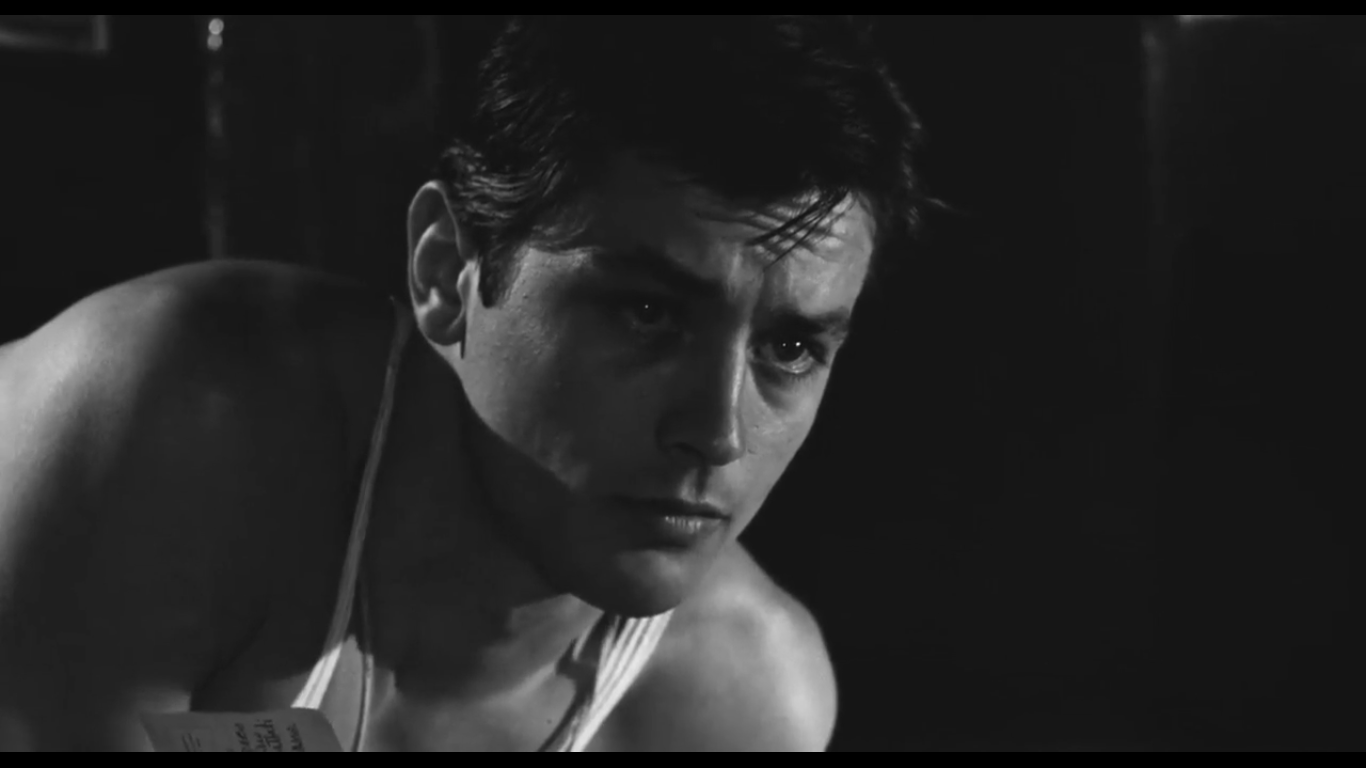
One immediate takeaway from Luchino Visconti’s Italian epic Rocco and His Brothers is its gorgeous, swoon-worthy black & white that’s absolutely magnificent. It shares hallowed ground with films such as The Grapes of Wrath or The Godfather where the palette does yeoman’s work when it comes to informing the drama.

At its most essential level, the movie is about a poor rural family from the South journeying to Milan to make a new life for themselves. Their patriarch is dead and now his wife (Katina Paxinou) heads up north with her four boys to reconnect with the oldest brother.

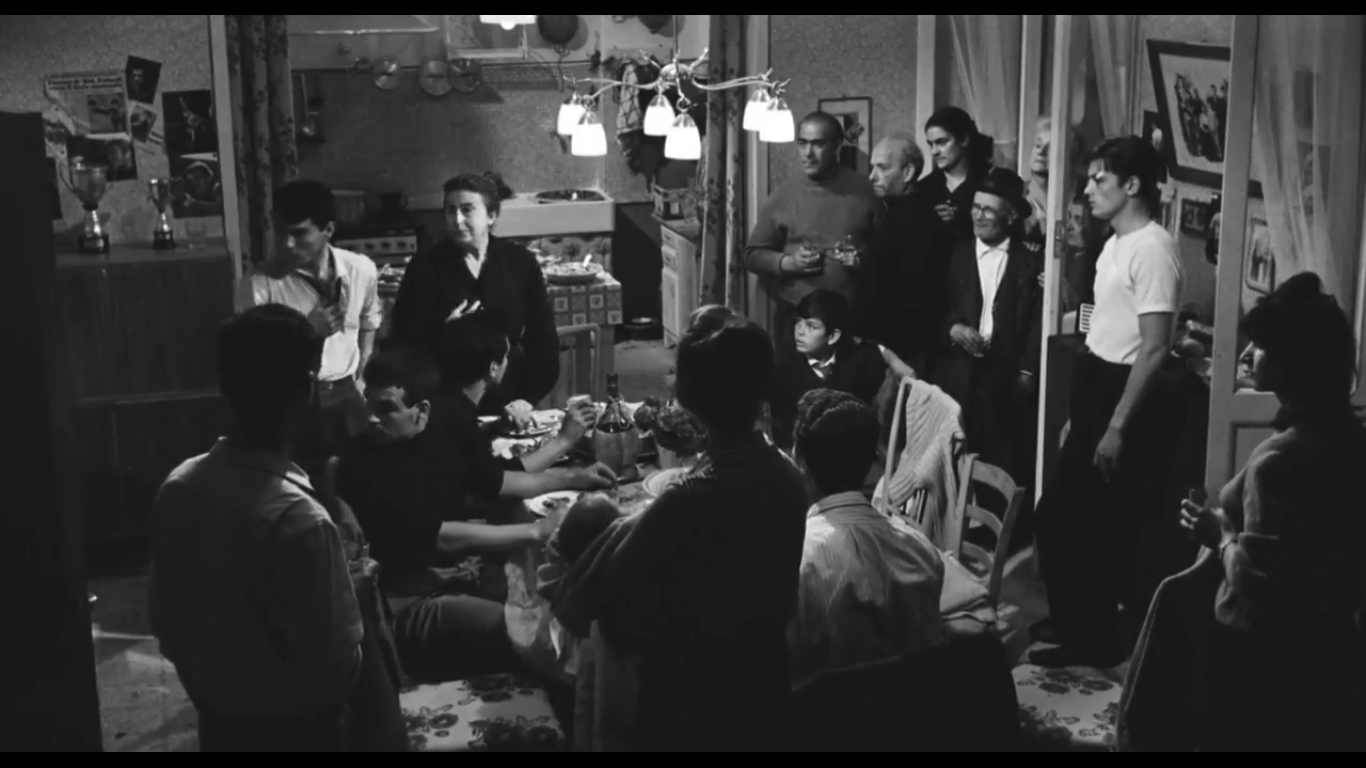
Vincenzo (Spiros Focás) is courting a dark-haired beauty (Claudia Cardinale) with thoughts of marriage once he gets steady work. Their home feels gay and bright with the roving camera capturing the full expanse of their household. It’s positively overflowing with family, and we expect nothing less.

I think some contemporary critics were disappointed by its sheen which is very un-neorealist. But it does boast its own brand of truth about family and life and love and all the constellations of emotions that we grapple with every day whilst living with other people. In this way, it shares a brand of authenticity with those earlier generations of films.

Francis Ford Coppola was certainly influenced by the picture, not only based on his hiring of composer Nina Rota but also in a more general sense in courting themes about family. It makes for a compelling ensemble telling their stories in a manner that feels totally immersive and honest to who they are as human beings. And yet it’s destined for heightened tragedy akin to Rebel Without a Cause or West Side Story.

Screenshot 2020-07-12 at 9.21.48 PM

What a raucous opening it is; it’s spectacular with the families pitted against one another and by families, I mean the mothers butting heads, while their children are left to pick up the pieces and play peacemakers. It feels all too real. Vincenzo quickly finds himself with an angry mother and a whole pack of brothers he has to find lodging for, no wife, and still no job. Everything goes to hell in a matter of moments.

Despite its sheer expanse, Rocco and his Brothers feels simultaneously well-organized and still free to follow the whims of life. Each brother gets a chapter of sorts and yet each one bleeds into the next. They’re never obvious sections and so it feels more like poetry woven throughout a story than hard and fast rules that must be adhered to.

For the time, Vincenzo lands them a temporary place to live, somewhere they can stay on until they get evicted. It’s not a promising life, but the family does receive a couple propitious bits of luck. Newly fallen snow means work shoveling snow, and the boys wake up early, downing their mom’s piping hot coffee, as they scramble out into the early dawn to bring home some bacon as it were.

Because it becomes a story of each brother exercising their worth. They are valued by the manner in which they are able to provide bread money to the family unit. Rocco (Alain Delon) bumbles his way around a dry cleaner weathering all the young ladies teasing with a good-natured stoicism. Ciro goes the sensible route, conducting his schooling so he can land a suitable job at the local Alfa Romeo factory.

Simone (Renato Salvatori) fancies the idea of joining the local boxing gym as a chance at some easy dough, and he gets the biggest break out of all of them. A trainer takes a chance on him, and he wins his first fight, despite a belligerent temper.

If these scenes are only preliminary, they provide the framework to understand our characters going forward. Simone presumably lacks the moral prerequisites for a lengthy boxing career: a rejection of drinking, smoking, and women. Rocco is called upon to be his sparring partner and his guardian.

After his glorious showing for the home crowd, the brothers proceed to get embroiled in a street fight only to wander off with the pretty streetwalker Nadia (Annie Girardot). Simone’s behavior doesn’t bode well. Life roles onward and with few prospects, Rocco pursues his military service. It’s far from a digression. Instead, it reflects the passage of time

Screenshot 2020-07-12 at 8.06.38 PM

Rocco is one of those enigmatic figures who watches the world and seems to see everything. Those who think he’s quiet or unfriendly, over time, come to realize he’s perceptive, carrying deep reservoirs to make the most of life and have faith in everything around him. There’s a dashing nobility to him. This becomes even more true when he returns home.

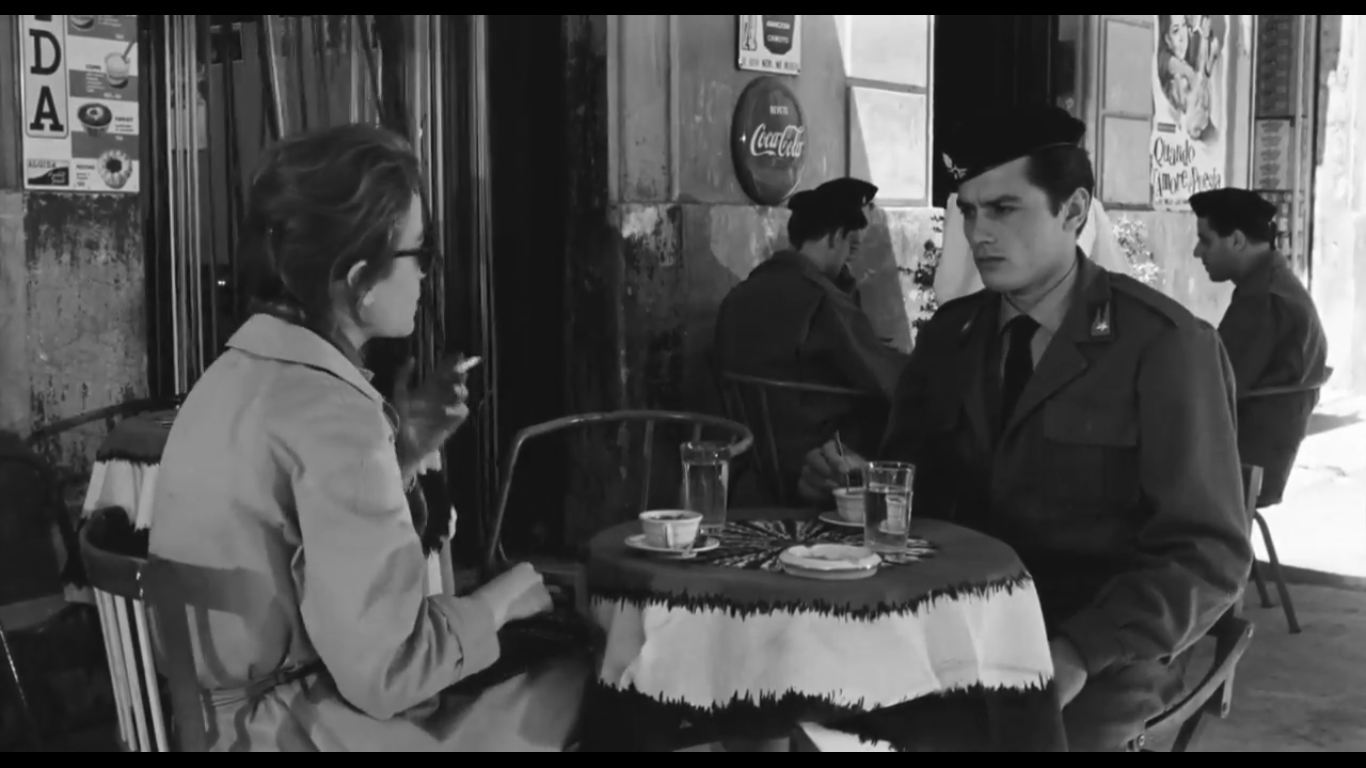
The first person he meets at a sidewalk cafe is a face from his past: Nadia. He, smartly dressed in his uniform. Conservative. She, in her sunglasses looking him over. She’s no longer with Simone — at least they drifted apart — because she was serving a prison term. In Rocco, she finds someone understanding and kind who never demeans her. She feels understood in his company. Pretty soon a subtle romance blooms between them, warm and tender.

What we haven’t taken into account is Simone. The time has changed him as well. Now he’s hardened, disgruntled, and disillusioned with his boxing career. He dedicated himself to smokes, drinks, and pool with the boys. But he’s also intent on ripping Rocco and Nadia apart. Jealousy takes hold, and it’s the stuff of melodrama. To detail it all now would be rote and a disservice.

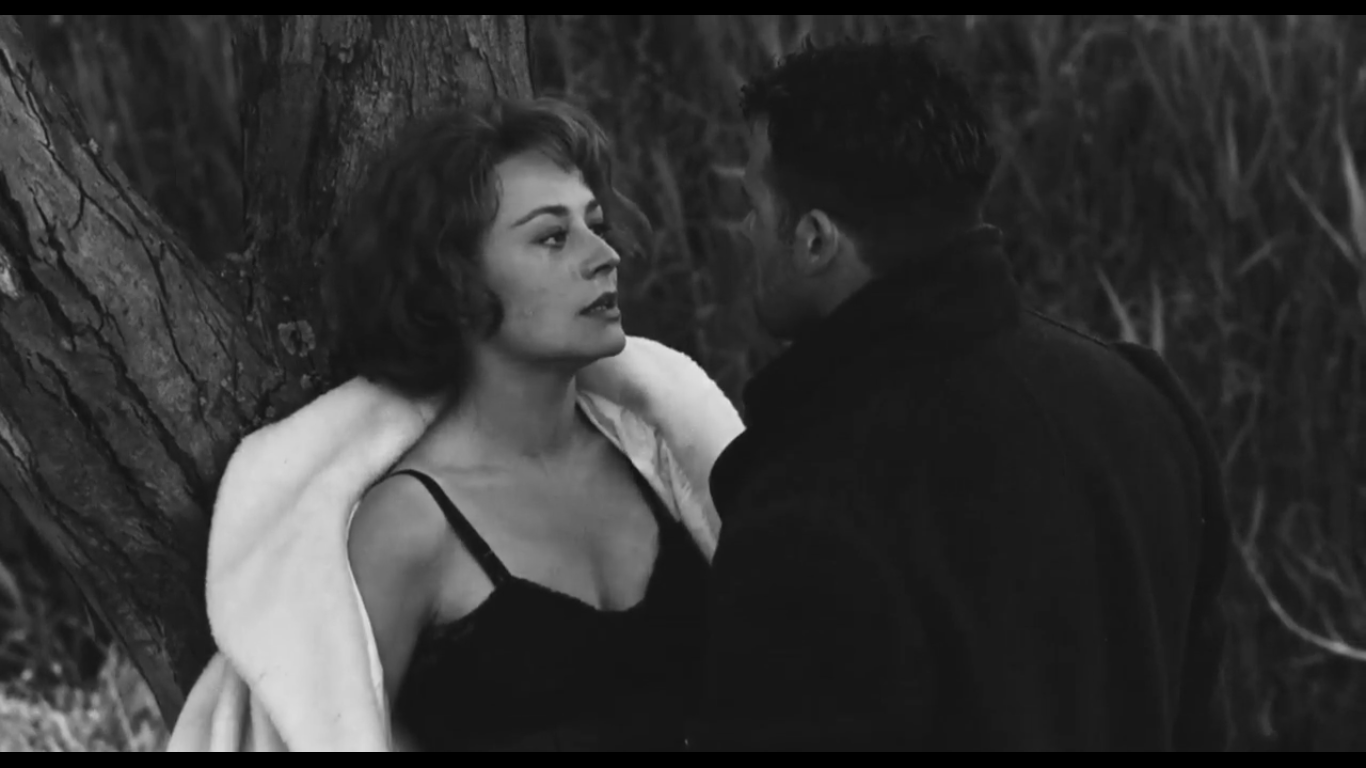
You need to see it as he brings them down to his level with a wounded tenacity nearly as electric as anything Dean or Brando managed in East of Eden or Streetcar. Suddenly, everything that was so blissfully and right between the two lovers is besmirched. And they cannot get it back. The way the camera clings to them violently as Simone tries to advance on Nadjia feels convulsive. It’s the film’s cataclysmic event.

Screenshot 2020-07-12 at 9.14.36 PM

In its wake, Rocco ascends in his own boxing career channeling his hatred into his rounds in the ring and shedding tears for how the harshness of the world has changed him. 

As Vincenzo settles into his own familial life, it is Ciro’s turn to respond to the fracture between his other brothers. He confronts both on his mother’s behalf, entreating Rocco, “A seed gone bad must be weeded out. After all, trees are meant to bear fruit.” However, the well-meaning boy doesn’t quite know how to apply this teaching into practice.

Rocco continues on the rise in his singular objective. Simone’s sunk into the gutter as not only a malcontent but the laughing stock of the community — his debts piling up and Nadia staying with him, partially out of malice and a promise to Rocco. It is here where the film’s editing comes front and center as the two brothers go their separate ways.

My mind is drawn to a curious interchange between mother and son as they dialogue on the self-destructive nature of the black sheep of the family:

“It’s not for us to judge him but to save him.” – Rocco

“Christ will regret the suffering he visited upon us.” – Mother

“We’re no longer under God’s grace. We’re our own enemies.”

Rocco proves himself again to be this near-otherworldly figure. He has an almost unfathomable amount of grace for others, and yet he’s prepared for penance and to take the burden and sorrow on his back. He is Christ-like and yet unable to be their savior.

It makes for a dismal denouement drained of all hope. Still, the family must pick themselves up out of the muck and the mire and make a way in life — each brother on his own path. Rocco finds his face plastered all over the news kiosks for his latest exploits. Simone has fallen into disarray. Ciro represents a certain hopefulness — what his brothers used to be, and Vincenzo is what they could have been — both settling down with families. Little Luca’s fate is yet to be decided. He’s indicative of the fight still left to be forged.

But I am left to return to my opening metaphor. Whether it’s Tom Joad or Michael Corleone, and in this case, Rocco, these are young men who made irrevocable choices in their lives from which there is no turning back.

The chasm between who they were and who they become couldn’t be more disparate and in all accounts, it has heady implications on their family unit. What they do, they do for their loved ones, and they still see everything they love crumble around them. It’s not a new concept — it’s not novel — but there’s something distinctly profound in this. Because we all experience something of the same.

My final thought is only this. It occurs to me that the Parondi brothers might all represent the seeds in the parable, falling all along the road. I’ll leave it up to you which ones will make their way through the straight and narrow and which ones will bear fruit. Because human beings are often resilient, and they are often granted second chances in life if they accept them. Perhaps they can remain under God’s grace after all or maybe it’s not for us to know.

4.5/5 Stars

Whisper of The Heart (1995): Take Me Home Concrete Road

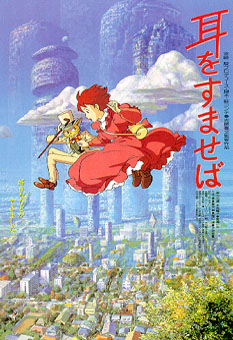
Whisper_of_the_Heart_(Movie_Poster).jpgWhisper of The Heart is wholeheartedly a Japanese anime and yet learning John Denver’s “Country Roads” holds a relatively substantial place in the plotline might catch some off guard. After all, as the metropolitan imagery establishes our setting, we hear a version of the song playing against the bevy of passersby, cars, and convenience stores.
Director Yoshifumi Kondō boasts animation both simple and clean yet ever so attractive for those very same reasons. It positively glows with nostalgic yellow hues and employs anime’s preoccupations with the most intricate details — moths drawn to a light being just one prime example.

When I lived in Japan, I became fascinated by foreign music and how it gained a foothold in the country. You only have to look to jazz, The Ventures, The Carpenters, or Mariah Carey to see how deep their imprint is on the collective culture. The same goes for John Denver who made tours of Japan on several occasions.

But whereas musicians often become icons, sometimes Japan cultivates an environment where nuggets of culture can take on a life of their own. This theme serves as a perfect breeding ground for Ghibli’s classic coming of age story.

Shizuku is, at her heart, a spunky and feisty heroine with the kinds of hope and aspirations that often seem buried in a very restrained culture like Japan. In her middle school existence, an unknown person named Amasawa becomes an almost mythic figure in her life as they have checked out all the books she’s so voraciously eaten up in her nascent but ambitious literary odyssey.

They look to be a kindred spirit. It takes a fortuitous meeting with a commuting cat on the JR line to sustain her adventure. The disaffected animal leads her to a Secret Garden of sorts. This one is not found in nature but in the home of a delightful old man.

Because Whisper of The Heart is full of the blushing love of adolescence in its many tangles found throughout the student body. It’s no different in Japan, at least on the emotional level, or for that matter, the utter denseness of the male sex.

But it’s also a very particular world where dwarves and fairies can coexist with the mundane elements of everyday life. Shizuku comes to realize this when she reaches the end of her adventure — the peculiar second-hand shop cluttered with clocks, violins, and shiny doodads of all shapes and sizes. It’s run by a genteel proprietor who also happens to relate to her not so fictitious phantom: Amasawa.

This looks to be the working of Hayao Miyazaki behind the scenes because no matter how mundane we might perceive the world to be, he’s always allowing for bits of magic to seep in and liven up our existences. Implicitly, he always seems to be suggesting we need the richness of our imagination girded around us to make the most out of life.

He also employs the most amicable cultural appropriation, turning Denver’s down-home “Country Roads” into a lively, bright-eyed violin jam session in a Tokyo back parlor. It’s the strangest incarnation of the song I could have ever imagined and yet somehow it manages to be apropos. I only need to remember pop instrumentals of “Daydream Believer” during my former days frequenting 7-Eleven’s in Tokyo. It fits the aesthetic.

But back to Shizuku. Her newfound companion dreams of being a Violin maker and going off to apprentice in Italy. Not to be outdone, she wants to write stories. She’s charged with empowerment and then the subsequent doubts ambushing anyone who’s ever endeavored for such a thing. I am reminded of the artistic encouragement churned up by C.S. Lewis and J.R.R. Tolkien that blessed the world over with two of the most formidable fantasy worlds: Middle Earth and Narnia.

Because we need people who will gladly court our ideas, gives us encouragement, and supply even the brief inkling that our passing daydreams are not complete balderdash. If they provide enjoyment or engage with beauty or goodness for just one person, perhaps even this makes them entirely worthwhile.

The sagely old man charges Shizuku that craftsmanship of any kind is never perfect. But we must begin. We need to start somewhere. To pilfer the film’s own metaphor, we are all unburnished stones waiting to be polished to the point of perfection. There’s the necessity of time and effort to make it work. The diamond must be pulverized. The brass burnished. The grain sent through the thresher. 

Again, Miyazaki’s imprint is all over the picture because he is always and forever the spinner of benevolent fairy tales paired with creative inspiration. His avid imagination never ceases to mesmerize. Surely there are lots of magical beings, soaring through the air, lands full of castles and kings, and yet the seat of it all is found in the revelation these very things can exist in our everyday reality. They need not be distant. Far off lands can come to meet us, be it through books or writing, music, or people with memories that extend far beyond what we see and know.

It’s easy for me to laud Whisper of The Heart for being timeless. Yes, we see word processors, a dearth of cell phones, more antiquated train services, and yet so much of the interactions, the yearnings, and the derivations are universal.

I must turn my attention only to the sound of cicadas, the warning bell near the train tracks, or the clink of a mailbox at the front door. They are so basic, so unextraordinary, and yet they sound so familiar. To my ears, they remain almost comforting. Because this movie is comfort food, whether you fancy udon or steak and potatoes.

Full of warmth. Love. Longing. Passion. Miyazaki and Ghibli have captivated the world over with such sensations. Yoshifumi Kondō more than proved himself capable of eliciting this same type of wonder. It’s only a shame he was not able to give us more films. But there only needs to be one solitary act of creation to leave an impression. Whisper of The Heart is an unassuming monument to his career.

4/5 Stars

The Yearling (1946): A Boy and His Deer

the yearling 1.png

“When I was a child I spake like a child…” ~ 1 Corinthians 13

Like the previous year’s Valley of Decision, The Yearling opens with an establishing shot paired with Gregory Peck’s voice, this time in a folksier register. Aside from being unoriginal, one can hardly condemn director Clarence Brown for an act of plagiarism.

However, what it does go to exemplify is a certain amount of unspoken structure supplied to Old Hollywood films. This shorthand, along with needlessly informational title cards, feel very much like the bane of the era’s filmmaking. It’s as if with the age of the talking picture, film’s forgot about the primacy of the image and as such, they dumbed down movies for their audiences. After all, it’s so easy for dialogue to become a constant crutch to fill in any ambiguities.

Even despite this aspect, The Yearling still has innumerable elements going for it. Gregory Peck is a fine actor, even making ho-hum voiceover moderately palatable, and the gorgeous Technicolor tones of nature within the film are breathtakingly resplendent. In fact, the movie proves a well-situated follow-up to Brown’s earlier success, National Velvet. It is a portrait of pioneering before the days of Old Yeller, joining together such lucrative elements as adolescence and animals.

The adolescent in this tale, adapted from Marjorie Kinnan Rawling’s eponymous novel, is Jody (Claude Jarman Jr.), and the fauna deserves mentioning later on (although you probably already know what it is).

For now, the amiable Penny Baxter (Peck) and his boy form a bit of a good-natured partnership, sticking together as the men of the house. Their chemistry is undeniable making their onscreen pairing as father and son ripe with all kinds of affection. None of it feels like a fake veneer plastered on for the benefit of the audience.

The third member of the Baxter household is Ora (Jane Wyman), the no-nonsense wife and mother who’s both homely and severe, completely different than her kinfolk. Still, there’s something within her that Wyman does so well to intimate through her characterization. Thus, despite all she says and does that under normal circumstances might make us dislike her, most will find it within themselves to give her the benefit of the doubt. So much of it is understated and unspoken even as she never gives an inch. Her maternal heartbeat is undeniable although it maybe periodically obscured.

The Yearling really is fable-like by providing an impression of a way of life focused on a frontier family and more directly, the young boy who grows up right before our very eyes. While there is a narrative of sorts — all the events can be strung together as subsequent rungs in the journey — it’s mostly a vignette-driven piece meant to reflect the vicissitude of life.

One moment father and son are streaking through the forest with the family dogs to subdue ol’ Slewfoot, the ornery bear who mercilessly slaughtered one of their livestock. It becomes a lively jaunt and the first lesson in the boy’s nascent repertoire.

Due to the utter uselessness of his firearm in the tense encounter with the bear, Penny takes it upon himself to acquire a new weapon, and he manages quite ably through a bit of horse-trading with the nearest neighbors. One of the bunch is an ornery fellow also easily duped. By the end of the confrontation, he’s given up a beautiful rifle for an underperforming pooch.

Then there are the momentous trips into town to pick up materials at the general store. Mama is still dreaming of a well someday, and the obliging shopkeeper (Henry Travers) offers the boy a mouth organ as he comes face to face with a girl his own age. It’s hardly young love.

Instead, father and son get involved in a right neighborly brawl in the center of town, which is yet another of the film’s more jocular moments. It’s not afraid of the humor to punctuate the drama of life.

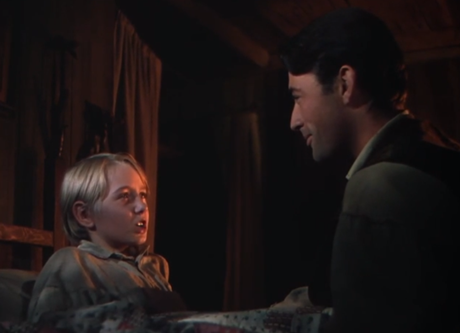
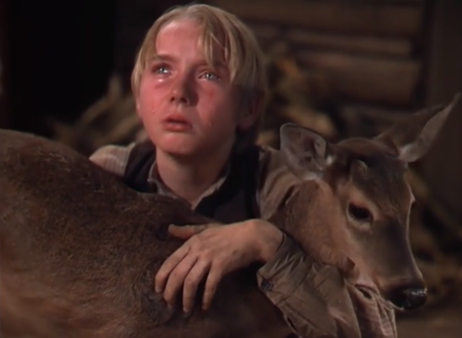
Because the next scene of note is really the turning point. Out in the forest, Penny is bitten by a rattler and fortuitously he’s able to shoot a nearby doe using the bodily organs to draw out the poison. It’s a scary incident leaving the man of the house weak and his son aims to take the orphaned doe as the pet he’s always been begging for.

The rapturous crescendo of angelic audio grandeur introducing our true main character is laid on a bit thick. However, if your heart is ready to be melted and you have held onto a shard of childhood innocence, The Yearling can remain a powerful tale of youth. No scene is more emblematic than this one.

the yearling 2

The film’s title comes front and center once again as we watch the parallel characters of a growing boy and his growing companion. He dotes over the little deer taking him to bed and imploring his mother not to take his pride and join away from him. Though the animal ruins them on multiple occasions trampling their crops.

If it’s not the fault of a creature, then nature whips up its own retribution. Their next tribulation is carried out by a torrential downpour decimating their hard-earned crops and sending emotions to a fever pitch. Evoking the sufferings of Job hardly seems a welcomed antidote to their plight.

But then, something begins to happen. A boy is becoming a man as he begins bearing the load of toil normally carried by his obliging father. He builds a fence to keep his deer out while fixing up their camp.

Then, they must say goodbye to a newlywed bride and groom. We don’t know them well but the family is deeply affected. Their exit by sea is a bittersweet departure, and as they ride back home Jody glumly notes, “I don’t like people going away it’s like they were dying.” His father only condolence is an honest observation, “That’s life boy. Getting and losing.” He must come to accept it. Death, goodbyes, trials; they never exactly get easier, but we must do our best to push through them with the support of our loved ones.

The Yearling might seem lightweight compared to some similar stories, but one must try and recall our own childhoods, where any number of thoughts and feelings experienced for the first time became monumental markers of life. That first pet you had. The death of a friend. The first girl you ever had a crush on. Each takes on varying degrees of importance in The Yearling and even for a story rich in sentimentality, these really are moral parables at their core.

Because it strikes some balance between maintaining a child-like wonder and zest for life while also understanding sometimes we must literally put to death our former ways. Finding that balance just might be one of the keys to a meaningful existence.

3.5/5 Stars

The Nutty Professor (1963): Jerry Lewis is Jekyll and Hyde

the nutty professor.png

I can bemusedly remember more than a few trips out to the high school football fields as our designated evacuation point for fire drills. The other times we ended up out there was more likely than not due to the chemistry department setting them off with some supernal explosion of their own devising. You can only imagine it being a giddy badge of honor among these grown-up nerds.

In full disclosure, I must admit being indebted to Disney’s Absent-Minded Professor for creating my paradigm for the mad scientist. Jerry Lewis takes this readily available archetype to set up an analogous comic cocktail — albeit to the utmost extremes — marrying it with one of his own creations: Julius Kelp.

The Nutty Professor‘s gloriously campy color schemes are all the better for this wonky Jekyll and Hyde riff. Rooms look like they’re all but made out of cardboard and as such, every interior and visible prop feels expendable. School officials (Del Moore) and secretaries (Kathleen Freeman) are either high-strung or chatty cartoon characters.

In one exemplary moment, Lewis all but railroads the usually fastidious chancellor into doing an impromptu rendition of Hamlet on his office table. A modicum amount of ego-schmoozing effectively makes a complete mockery of the man with typical Lewis lampoonery.

Likewise, the interminable supply of handsomely-clothed, virile male co-eds all look like they either play quarterback or shooting guard for their respective sports teams. And all the pert young women are a similar picture of All-American, bright-eyed ideals.

Considering these elements, The Nutty Professor is derived mostly from performances more than being gag-driven; the jokes come organically out of character. I’ll fall back on my normal diagnosis of Lewis comedies, namely, the plot too often gets in the way.

Kelp is a walking stereotype, but he’s also an endearing Jerry Lewis creation, complete with outrageous buck-teeth, googly glasses, a lexical vault full of spoonerisms, and probably the worst excuse for a haircut in the history of the movies. If we can risk being facetious momentarily, these are all very calculated decisions. It’s a visual statement made all too obvious; this man is a loser.

The childishly simple premise digs into these same themes. Although there might only be one or two isolated occurrences we can think of, Kelp attempts to combat a bully in his class who pushes him around. Since it’s not altogether overwhelming conflict, we must consider this to be partially his own inferiority complex speaking.

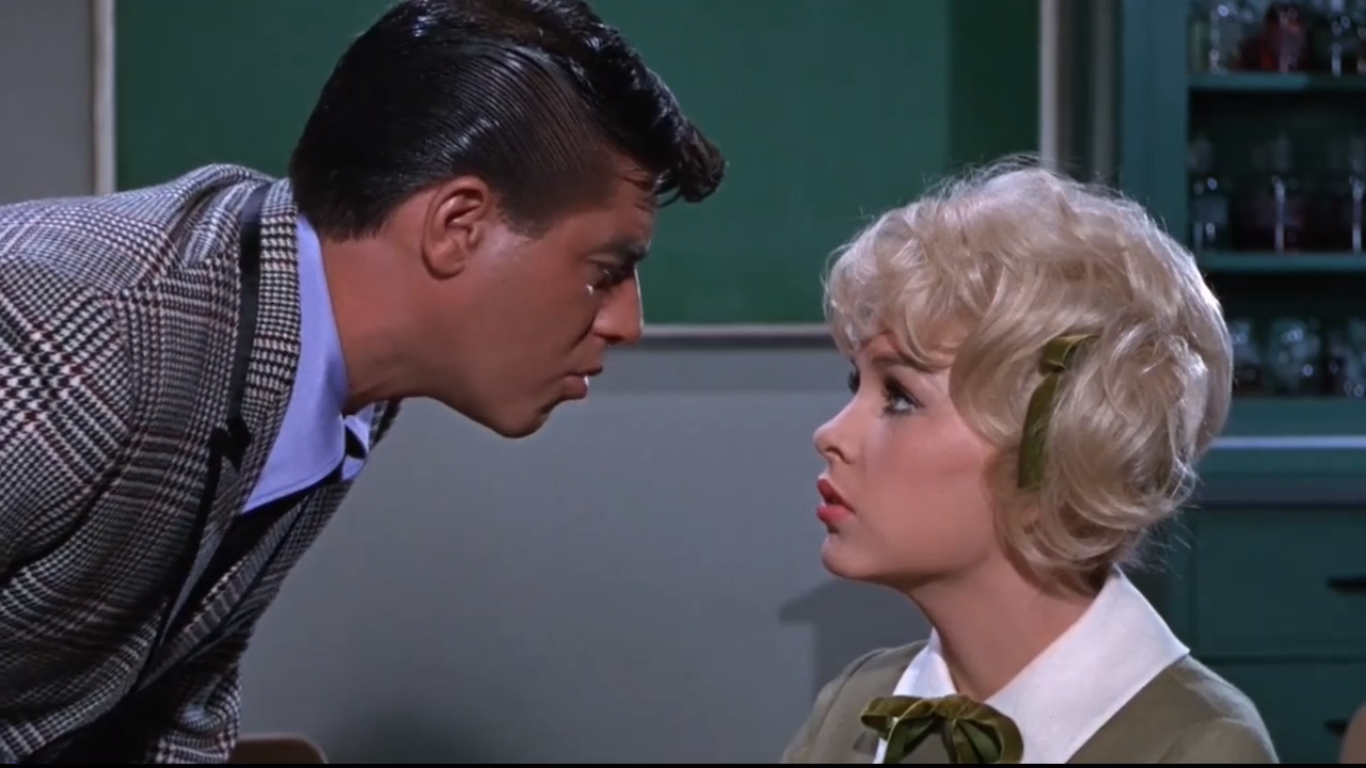
It doesn’t help a pretty student like Stella Purdy (Stella Stevens) simply reinforces all of his inadequacies. Because she is yet another paradigm with her hairbows and schoolgirl charms.  She is caught between the dorky loser and the vain, devilishly handsome lady killer. The question remains: Where do her values lie?

the nutty professor 2.png

If I haven’t spoiled the punchline already, there is an obvious road the zany tale must traverse. Around his new fitness regimen, Julius acquires a carload of books from the library; his results spawn a most curious potion. One would think he’s transforming into a werewolf or something. Actually, it’s far worse: Enter Buddy Love (also played by Lewis).

If you don’t hear the imaginary notes of “Love Potion No. 9” performed by The Coasters or The Searchers (depending on your preference), then your brain isn’t as formulaic as mine.

Regardless, Kelp’s alter ego soon finds himself waltzing into the local collegiate watering hole, the aptly christened Purple Pit. There Buddy Love makes his self-assured debut, hair plastered down, smoking a cigarette, and owning his outrageous duds. He catches everyone gawking on the street, and it’s much the same on the inside — showcasing a Lewis POV shot allowing us inside his conceited head.

It’s easy to consider The Nutty Professor a vanity project on a cursory level. Because Jerry Lewis is always at the center of this universe. Take the moment he’s supposed to be the devilishly handsome Love and literally, the whole club comes to the standstill. It’s absolute absurdity.

But in some ways, this perspective just doesn’t take because although Lewis is at the center of everything, he’s willing to look like a dorky, bumbling, idiot just as much if not more so. Someone who can do that has to be at least somewhat comfortable in their skin or at least content with putting on the charade of an utter doofus.

It relies completely on his dual role and Lewis’s own capacity — having the world constantly revolve around him — self-promoting himself and simultaneously tearing himself down. The tightrope walk is a compelling one.

Some have posited Buddy Love is a not-too-subtle shot at Dean Martin as the former compadres were still broken up after a fairly acrimonious split. Lewis instead denied these assertions by suggesting it was a knock on all the vainglorious phonies he had met on his long stint in show business. It seems just as likely The Nutty Professor could even function as a dialectic to examine Lewis’s own persona.

One can only imagine, in some outrageous universe, where the fulcrum between Lewis’s own worst and best selves would fall along the spectrum of his two cinematic creations. On one side, he has this image as a klutzy uncouth man-child and yet we must reconcile this with his authoritative vision as a director and a subsequent product of the same show business machine.

He was the one who could brazenly claim so much fame, success, and accomplishment at such an early age. It’s difficult to envision a world where circumstances didn’t go to his head even a little bit. And if there is not already a piece of Love in him, then at least we can acknowledge there is a risk of such a persona cropping up.

If The Bellboy had a family-friendly moral tacked on at the end, then The Nutty Professor is much the same with a few more lines devoted to a theme. Because the inevitable happens and the worlds collide — Jerry or Love or Kelp is ousted as his true self, after masquerading in front of all these people. What a horrible ordeal to slog through.

However, he finds some words. They go like this: “You might as well like yourself. Just think about all the time you’re gonna have to spend with you. If you don’t think too much of yourself, how do you expect others to?”

It’s a compelling message even if the preceding content is all over the spectrum. Along with the science-fiction, we have the audience-appointed fairy tale ending with the guy getting the girl. There need not be more explanation. The Nutty Professor rumbles through all our expectations.

I do find it strangely compelling having all the main players bow in the end credits. It’s like the curtain call in a play where everything is far more intimate. Of course, Jerry Lewis puts his lasting mark on this one by falling into the camera and shattering it. We would expect nothing less.

3/5 Stars