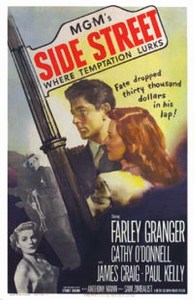
Side Street (1950)


SideStreetposterThough director Anthony Mann later made a name for himself with a string of Westerns pairing him with James Stewart, it’s just as easy to enjoy him for some of the diverting crime pictures he helped craft. Everything from Raw Deal (1948) to T-Men (1947), He Walked by Night (1948), and of course this little number.

Another simple pleasure gleaned from Side Street is the second teaming of the two young starlets Farley Granger and Cathy O’Donnell who made such an impression together in Nicholas Ray’s sensitive drama They Drive By Night (1948)

We begin this particular picture with a flyover of New York City and the “Voice of God” narration comes off as another installment of The Naked City (1947) because it too takes to the streets, shot on location in the city of a thousand stories with thousands more waiting to happen.

There’s something engrossing in this style of storytelling which takes interest in several seemingly unextraordinary, unconnected individuals and then over the course of less than an hour and a half slowly ties together all the threads of their lives into one cohesive narrative.

There are some calling cards of crime pictures including sleazy extortion, a body fished out of the East River, and the police who are working the beats of the case and trying to keep the frenzy of journalists at bay. Paul Kelly and Charles McGraw head up the police procedural angle.

But the man we come to know the best is unassuming postman Joe Norson (Granger), who becomes extra jumpy after unwittingly stealing thousands of dollars when he thought he only swiped a few bucks to buy his wife a mink coat. He’s just a poor, small, unimportant little man in the scheme of things. An “Average Joe” if you pardon the expression. He’s not supposed to be embroiled in such a story. It’s a bigger can of worms than he could ever imagine and there are consequences.

Other people of interest are wealthy businessmen, crooked lawyers, cabbies, bar owners, bank tellers,  journalists, cops on the verge of retirement, nightclub singers, and at least a few ex-cons, all the usual standard bearers.

Joe’s wife is in the latest stages of her pregnancy and shortly her baby is on the way but her husband has made up a fanciful story about a new out-of-town job that’s loaded him with cash. Of course, she has no idea what’s going on and nor does he. He asks a near stranger, the man who runs the local bar to hold the cash for him. He says it’s a nightgown for his wife.

But Joe’s not a criminal. His guilty conscience is too much for him so he goes back to the office to plead with them to let him return the money. Of course, they have as much right to it as he does. What follows is a cat and mouse chase across the city. First, some thugs tail Joe looking for the $30,000. Then, Joe and ex-convict George Garsell look for the bar owner who has all but disappeared and conveniently the money’s gone too.

As the police are also involved, they want both men, believing they are complicit in different murders that have been committed. Joe has just enough time with his wife to explain his predicament. Still, he got himself into this mess and he holds the belief that he is the only one who can make it right.

What follows is a culmination of all the events thus far as all the character arcs begin to bump up against each other. Namely, Joe, a local nightclub singer (Jean Hagen), and the last man that Joe wanted to see, Garsell himself.

Side Street closes out with a lively car chase near The Third Avenue El that predates many of the revered classics from Bullitt (1968) to The French Connection (1971) years later. The full weight of the title’s meaning, subsequently makes itself increasingly clear as squads of police cars look to close in on the criminal’s getaway taxi. Of course, what makes it compelling is the fact that Joe is right in the thick of it all to the very last avenue…with a loaded gun pointed at his head. Thankfully there are no speed bumps in this one.

3.5/5 Stars


Too Late for Tears (1949)

Too_Late_for_Tears_DVDA couple is driving along a desert highway when a bag loaded full of cash is tossed into the back of their convertible by a passing motorist. They’re a pair of everyday nobodies and yet this single act of fate throws their entire existence into chaos. Of course, it gets a little leg up thanks to Jane Palmer (Lizabeth Scott) as she takes the wheel to get away with the cash, convincing her husband Alan (Arthur Kennedy) that they hold onto the payload for awhile. Finally, he relents and leaves the briefcase in a Union Station locker.
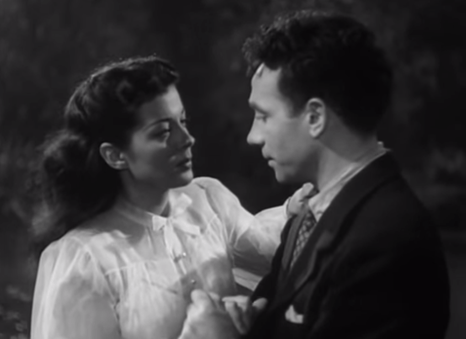
It’s a tad of an unbelievable scenario but that’s what makes it so exhilarating as Lizabeth Scott plays all parties involved using her doe eyes and feminine wiles to great effect like the foremost of femme fatatles that she is. And the fact that she does it both unwittingly and with willful intent is crucial to her turn for the very fact that it creates the seesaw of emotions.

There’s a certain sense of ambiguity because we begin to invest in her story and like her in one sense, while simultaneously distrusting her motives that seem mostly driven by avarice more than anything else. There’s also this extraordinary quality about her where she somehow manages to look young and feel old all at the same time thanks to her memorable baritone. It’s a bit unsettling.

The next important figure is Danny Fuller, Dan Duryea donning one of his sleazeball roles as a drunk who nevertheless has a bit of a sympathetic side at least put up against the acerbic poison of Lizabeth Scott. She’s the epitome of that long-held expression that greed is the root of all evil. If she didn’t write the book on it, she at least tore through its pages voraciously. Initially badgered by Danny for swiping the payoff he believes is rightfully his, she soon has him roped into her plan. It’s almost too much for the cad to bear. He calls her “Tiger” sardonically at first but he doesn’t realize how right he is.

But the most interesting setup in the narrative are the contrasting couples and they might not pair up the way you first expect with Arthur Kennedy getting the short end of the stick. He starts out happily married and winds up out of the picture.

There’s the rapacious Jane matched with Danny boy as they both feed into each other with their distrust and vices. Then you have the ever-present “Good Girl” or guardian angel,  Alan’s sister, Kathy (Kristine Miller), a sensible,  prepossessing young woman who only begins to distrust Jane as circumstances become more and more strained.

Meanwhile, Alan’s old war buddy (Don DeFore) comes a calling on his old pal and finds himself spending time with the man’s sister instead. But they become our necessary counterpoints to balance out the film’s more corrupt characters.

The final reveal that we’ve been waiting for arrives and it spells the end of Jane’s charade as she’s brought tumbling down. But as noir has a habit of doing, it manages to paint a bit of a happy ending against this dark backdrop with Kathy and Don winding up with each other and a shoulder to lean on. Still, that final image cannot quite downplay all the deceit and murder that has gone down up until now.

Too Late for Tears resonates thanks to a pair of incomparable sordid performances by Scott and Duryea. Miller and DeFore make a lovely couple but it’s the moneygrubbing ones who make this a true noir delight because they represent the incorrigible vices often found in humanity. That’s a lot more fun in the movies.

3.5/5 Stars

Review: Moonrise (1948)

moonrise 1.png

It’s like being in a long dark tunnel…the way you look and act and talk. ~ Gail Russel as Gilly

From its very foreboding outset, there’s no question that Frank Borzage’s Moonrise could be characterized as film-noir. Everything suggests as much from the scoring to the stylized imagery and even the subject matter. We have hangings, brawls, fistfights, and murder all under 5 minutes of celluloid. But equally important, the film delves into the psychological depths of despair and more than any of Borzage’s films it seems invested in the mental well-being of its characters.

Dan’s personal narrative is brought to us early on. His father was hung for some inexplicable reason. The kids in school brutally tease him about the ignominious shame of his family which he has no control over and all throughout his life thereafter he carries a chip on his shoulder. We don’t quite understand him but at least we begin to empathize. We meet Dan (Dane Clark) again as an adult at a local dance.

That’s where the next chapter in his story begins as he tries to bridle his anger and keep the reins firmly in check. It doesn’t always work so well for him. After all, he is the man with a constant death wish driving cars on wet roads like it’s the Indy 500. He is the man who is prone to strong-arm tactics. He is the man who trusts no one to be his friend and expects very little from others. But he does have one thing going for him.

Her name is Gilly (Gail Russell), she’s the local schoolteacher, and if nothing else her very presence humanizes him. She formerly ran with the local hotshot (Lloyd Bridges) but she has found some quiet decency in Dan and if she sees it, maybe we can see more in him as well. In some ways, he’s still a little boy and she reads him like one of her students with thinly veiled observations. His frumpy Aunt Jessie pins him as a good boy but that doesn’t make up for the absence of his parents or the anger that he still harbors from boyhood.

But a small town setting and a purported crime prove to be an ever-intriguing synthesis of Americana and the ugly underbelly which if it doesn’t rear its head through gossip alone, then murder certainly fits the bill in a pinch. It’s summed up by dances, carnivals, and coon hunts with an undeniable undercurrent of darkness.

As far as I can tell Charles F. Haas had few other feature scripts to his name but his work in Moonrise offers up some interesting figures full of witticism and unique voices that help to differentiate each from the diverse pack.

The bullied mute Henry Morgan is at one time befriended and also berated by Dan. Rex Ingram proves to be a landmark African-American actor for the era, full of a quiet strength and wisdom. As local keeper of the bloodhounds, he addresses his canines as Mr. Dog surmising that everyone is entitled to a certain amount of dignity. Just as importantly, he rightfully asserts that man is a communal being (Man oughta have a woman. Man oughta live with other folks).

The Local Soda Jerk has the jive talk down pat and Lloyd Bridges and Harry Carey Jr. fill in for a couple relatively minor spots. Of course, Ethel Barrymore is in the coveted keynote cameo as Daniel’s  sagely Grandma. But aside from Ingram’s significant turn, Alyn Joslyn is one of the more entertaining characters as the sheriff who waxes philosophical. One of townsfolk even notes as much that he should have been a preacher man instead of a lawman.

Cinematically speaking, Moonrise proves that the finest places to meet your best gal seem to be darkened interiors and if nothing else it’s a feast for the eyes and a treat for the audience. And it’s true that with its quaint country backwoods and swamps, Borzage’s picture shares some of its world with Joseph L. Lewis’s Gun Crazy (1950). But for Borzage, in particular, this feels very much like a departure which is by no means a bad thing. Here the love story is still present but it seems to ultimately have a different functionality altogether from many of the director’s most remembered entries.

3.5/5 Stars

Review: Gilda (1946)

Gilda_trailer_hayworth1If you’re worried about Johnny Farrell, don’t be. I hate him~Gilda

And he hates you. That’s very apparent. But hate can be a very exciting emotion. Very exciting. Haven’t you noticed that?…There’s a heat in it that one can feel. Didn’t you feel it tonight? ~Ballin

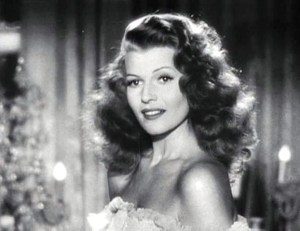
Gilda became synonymous with Rita Hayworth and for good reason. She was the embodiment of so many of the things found desirable by many men from a certain age. Frisky. Sultry. Beguiling. Teasing men, leading them on, and leaving them. Hating them as much as she loves them. That’s where the passion derives from — very volatile beginnings.

It’s true that Hayworth’s playfully ravishing seductress was forever immortalized in Shawshank Redemption and really in the mind’s eye of anyone who ever has seen her singing “Put the Blame on Mame” even once. She’s also, consequently, the epitome of the deadly lineage of femme fatales at times both tragic and destructive, alluring and lively. It’s difficult not to get drawn in like a moth to the flame.

But underlying such a performance is something a little more disheartening as this is only a cinematic depiction. It is not reality and yet it brings to mind a paraphrased quote that I will attribute to Hayworth, perhaps recalling her turbulent union with Orson Welles or maybe all the men who found their way into her life. “They go to bed with Gilda and wake up with me.”

The implications, of course, are far-reaching suggesting just how much this fawned over female ideal was a pure fabrication. It’s not real. Rita Hayworth could never measure up to that fantasy nor should she have to. Because while Gilda’s tantalizing as a cinematic siren, in real life she could never exist. Her passions impinge on her entire existence where she sees hatred, lust, and love all in synonymous terms. She hates Johnny and she loves him. She doesn’t want him and she does for those very reasons.

While not to downplay the negative impact the role may have had for Hayworth’s personal life, there’s no doubt of its cultural clout even today and it helps make this film-noir directed by Charles Vidor a high water mark of the dark genre for the very reasons mentioned before. Jo Eisinger’s script is also a strikingly perverse number as it begins to draw up the relationships between Gilda and her men.

Because it doesn’t end with her. Gilda needs others to play with and she’s given the perfect counterparts in Johnny Farrell (Glenn Ford) a man who willfully counters anything she offers up in the areas of sexual tension, embittered ridicule, or psychological warfare. It’s like they enjoy to torture each other — they enjoy to be able to make each other reel and fume. It’s all part of the twisted game they play of love and hate. He seethes with a vindictive coiled anger just waiting to be unleashed and he lets it go time after time. Sometimes upon provocation and other times out of sheer malice.

It all finds roots in a past we can only presume about and it’s true that all three of our leads are shrouded in some mystery when we’re introduced to them. First, Johnny Farrell a smart aleck gambler who gets himself a job as the right-hand crony for Ballin Mundson (George Macready) a man who is far more than a simple casino magnate. His business dealings run a little broader and more clandestine than he initially lets on.

Farrell’s a quick learner and ambitious so he moves up the ranks and soon he’s got the most prized position by Ballin’s side as his closest confidante and most importantly of all he’s there to watch over the other man’s wife — his favorite treasure to flaunt — the one and only Gilda.

It’s in that unspoken past that Gilda and Johnny learned to disdain each other and it stokes the flames of their relationship. It’s brutality mixed with sensuality which is at one time disconcerting but at the same time hard to pull away from. Again, moths to the flame.  It’s so wickedly twisted with rage and passion and all those human emotions that make us despise one another one moment only to make us no be able to live without each other in the next.

At a certain point, there’s no longer any sense in trying to draw up sides whether it’s feeling sorry for Gilda or empathetic toward Farrell and the thoroughly uncomfortable position he has been placed in as keeper of the bosses wife. Both of them have the makeup of true noir protagonists.

Otherwise, Rudolph Mate’s gorgeous imagery is absolutely fantastic and is certainly worthy of simply being marveled at on multiple occasions for its delicious compositions and use of shadow. Hayworth is rendered even more beguiling and Macready becomes an even more perplexing figure masked in darkness. Meanwhile, the Carnival celebrations are cast as stunning spectacle and over the top extravagance that’s also rudely disrupted by murder.

One could take it as a metaphor suggesting that the post-war era had commenced with a flourish but that cannot completely get rid of the sour taste left over from the war. A veil of darkness still remains.  Along similar lines, there’s a bit of Casablanca’s tension running through this film, and its atmosphere, while not quite on par with its predecessor, still rings with a lot of character.

The roulette wheels are in fine form and the establishment is full of its own rogue gallery of humorous and foreboding figures alike. The always lovable Uncle Pio provides a dose of good humor but there are also treacherous Germans, numerous rich boy toys, and a surprisingly civil government agent who all make a habit of frequenting the most popular casino in Buenos Aires.

It might be true what Johnny says about gambling and women not mixing but then again with the lens of film-noir they prove to be a high octane combination, representing vice and sensuality, two of its most readily available commodities.

4.5/5 Stars

Plunder Road (1957)

220px-Plunder_Road_posterThe rain is pouring down. A group of men sits in silence in truck cabs their heads full of all sorts of thoughts. Two more sit in the rear hoping the explosives sitting in their stead don’t decide to go Kablooie over the next bump. Nary a word is spoken, the entire sequence playing out in silence except for the inner monologues of each man.
But surprisingly enough all goes as clockwork with this heist as they gear up for a train carrying a U.S. Mint gold shipment. They divert the track. Get their men in place and board the vehicle to subdue all aboard. That’s done quick and efficiently and they continue doing their work that same way. They use one of the truck’s crane to hoist their plunder into the waiting beds of their getaway vehicles. No one sees it go down and no one will know anything about their job until they’re well on their way.

Of course, that’s only the first leg as the five accomplices break off. Now the spoil is split between the three trucks one loaded with furniture, another with “chemicals” and so on. So even though the events have all been done before, the execution of Plunder Road makes its version interesting in its own right.

The one lone driver steadies himself by chewing gum like there’s no tomorrow but that doesn’t help him to get past a police checkpoint after some radio static gives him away. He’s one casualty.

The only name of repute in the film that I knew was Elisha Cook Jr. now quite along in years and he’s playing a con man with the gift of nervous gab in the second vehicle. He tries to get buddy-buddy with his mate and we actually do learn some small trifles about them. It’s not much but it’s the kind of stuff that begins to make them into human beings.  They both have sons. One had his wife die while he was in the clink. The other never married. Their journey takes them to a rural gas station out of necessity and there we have the second casualty a neighborly old gas station clerk.

By this time the story has progressed to the third vehicle and they’re really sweating it now no thanks to special correspondent John Oliver from Salt Lake City who practically lives on the radio airwaves to provide the latest up to date news flashes. They weather routine police questioning and bide their time at the usual rest stops on their way to their final destination — a foundry near LA.

It’s an odd place to go but they do their best to conceal their prize in order to make their final getaway way far away from any nosy policemen. Though there plan doesn’t work completely. Still they manage. They pick up a girl who has their passports waiting for them and it looks like smooth sailing. But film-noir was born in an era that was hard-pressed to allow crime to pay and it’s a single moment of cruel fate that leads the heist off the tracks for good. Like Detour or The Killing and other such classics when fate rears its ugly head, things are never allowed to work out. That’s the accepted convention.

Plunder Road is so close to letting at least a few of its perpetrators get away but then it snatches their gold away from them. Compact heist films don’t come much better than this and this one benefits from a heightened sense of unsentimental realism.

3.5/5 Stars

Woman on the Run (1950)

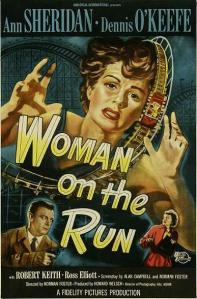
Woman_on_the_RunB-films have little time to waste and this one jumps right into the action. In a matter of moments, a man is shot, another man has killed him and a third witness gets away into the night. Although Frank Johnson (Ross Elliot) is rounded up by the police to be a witness he gives them the slip for an undisclosed reason and they must spend every waking hour trying to track him down.
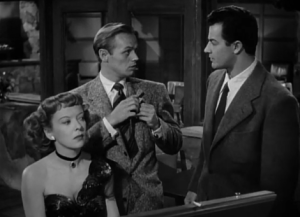
What’s important to this particular story is that he left behind his wife Eleanor (Ann Sheridan) to be questioned by the police and they are hurting for a break. They need answers so they slam her with all sorts of inquiries.

She’s not all that cooperative though and the reasons are rather hard to discern. Is it belligerence, fear, or sheer apathy to the entire ordeal? Because you see, Ms. Johnson for some time had been drifting apart from her husband an accomplished painter who nevertheless put little stock in his own skill.

And that’s where the film’s two themes begin to intertwine.  The police surmise that the runaway man is fleeing a killer, but for his wife the implications are twofold. In her eyes, he’s just as likely running away from a marriage he couldn’t cope with. That is her dilemma which she masks both pointedly and inadvertently with various diversions to keep the police reeling.  After all, she’s not particularly keen on helping them or sticking around for that matter.

Whereas in earlier roles Ann Sheridan was always slightly overshadowed by other performers, most notable of those being the always electrifying James Cagney, here she gives perhaps her finest performance and she’s at the center of it all. That’s not to say she isn’t surrounded by a stellar supporting gallery.

Dennis O’Keefe, remembered as a gritty leading man in pictures such as T-Men and Raw Deal, showcases a new playful side as a journalist trying to nab a scoop on the runaway witness and at the same time making eyes at the man’s bride. But he manages to give the part some life that goes far beyond a one-dimensional characterization. There’s more to him as we soon find out.

The other important player turns out to be Inspector Ferris (Robert Keith) who as the long arm of the law is looking to find his man before his adversary does. But he’s not about to take flack from anyone and if ever there was a cop who was no-nonsense he fits the bill. His croaking voice always interrogating his subjects in a continuous effort to get his job done. Too bad he wasn’t quite counting on Ann Sheridan.

A relentless climax aboard a roller coaster at a local amusement park precedes Hitchcock’s Strangers on the Train when it comes to making carnival games such a deadly ordeal. And there are hints along the way ratcheting up the tension whether it’s a familiar cigarette lighter, a striking coincidence, or a passing remark that initially goes unnoticed.

The script strikes a strange path at times given to clunky expositional dialogue that feels as trite as can be and then in the very next sequence there’s a bit of patter or a dry quip that makes things all the more interesting. Also, a pair of small supporting roles for Victor Sen Yung and Reiko Sato add another layer of authenticity to the characterization only surpassed by the on location shooting that catches the essence of mid-century San Francisco.

In the end, Woman on the Run turns out to be one of those wonderful treasures that has rather unfairly gotten buried in the dusty attic of film noir. But far from being an antique, it plays fairly well today with an underlying tension running through Sheridan’s performance as she not only reflects on her own dwindling marriage but stresses to discover her husband’s whereabouts in fear of his very well-being.

It’s surprisingly entertaining and you get the sense that if Norman Forster (a fairly prolific actor, director, and screenwriter) were someone other than Norman Forster, this picture might have been scrutinized more closely. As it is, it’s just waiting for more people to dredge it up. How did I get here? If you’re a sucker for film noir and Ann Sheridan there’s no better place to go than Woman on the Run.

3.5/5 Stars

Road House (1948)

Road House 1“Doesn’t it ever enter a man’s head that a woman can do without him?” ~ Ida Lupino as Lily Stevens
Jefty’s is quite the joint. Bowling, drinks, floorshows. In a one-horse town, it’s the place to go especially when the establishment’s proprietor (Richard Widmark) brings in the alluring nightclub singer Lily Stevens (Ida Lupino) to liven up the bar. Although he hired her without much forethought following a trip to Chicago, Jefty’s convinced this girl is really something although his faithful right-hand man Pete Morgan (Cornel Wilde) has her pegged from the start.  Smoking and playing solitaire. It sums up her life. It’s true.

They don’t exactly hit it off because he thinks he already knows what type of girl she is and she’s not too happy about getting pushed out of this gig. But ultimately she stays, the general public starts coming in droves, Jefty’s happy, and Pete does his best to keep away from her. But she does exactly the opposite. She appreciates Jefty but really has eyes for Pete and she pursues him.

What the film hinges on is really a love diamond with Ida Lupino and Cornel Wilde at the points. She is the object of desire for Jefty who thinks he could finally tie the knot with a girl. He’s in love no question. But Pete warms to Lily as well and is the one looking to go away with her. There also must be some necessary credit given to Celeste Holm for her performance although she has the most thankless role as Susie, the cashier at the Road House who also has obvious feelings for Pete.

But everything is thrown for a loop when Jefty comes back from a week long hunting trip with big news to spring on Pete. He’s gotten a marriage license. He’s going to ask Lily to marry him. However, over that same week, Pete and Lily have gotten closer than ever. Obviously, when the truth comes out the old friends have it out and the two lovers look to leave town.

The whole film thus far, Jefty has been a bit of a loose cannon but a generally nice guy. Except on a dime, things turn. Soon Pete is being detained for some cash missing from the company’s safe that his old friend claims is missing. It’s Pete’s words (with Lily’s) against Jefty’s with the police in the middle. It seems like a small deal but in a whirlwind sequence of events, Pete is brought to court and convicted of grand larceny. However, in a diabolical turn of events, Jefty becomes Pete’s savior as well as his master following a talk with the judge who agrees to put the convicted man on probation at the Road House. It’s just like old times, the gang all back together again except this time Jefty has Pete in a bind. One false move, one thing that he doesn’t like and Pete goes back to fulfilling his prison sentence. Jefty’s got him on a string and everyone knows it.

It’s in these moments where the remnants of the maniacal cackle of Tommy Udo from Kiss of Death begin to rear their ugly mug. And the next hunting trip Jefty plans with everyone included fills liked forced fun. No one’s having it and Lily and her love look to take one final chance to run away because any life is better than a life under Jefty’s thumb. What follows is a race for the woods and the Canadian border with Susie fleeing after them pursued by the crazed man packing a gun a bit like A Dangerous Game. It’s bound to be a deadly finale. Someone has to lose.

Cornel Wilde always feels too much like cardboard or plastic, whichever you prefer especially when put up against Ida Lupino and Richard Widmark. The latter pair is more at home in the worlds of film noir, Lupino being both alluring and assertive, boasting a gravelly voice perfect for rasping out “One for my Baby (and One More for the Road)” that is enhanced by her smoking habits.

Meanwhile, Widmark always had a handle on the sleazy and embittered characters who were in one moment grinning and in another seething with a cunning anger. There’s a volatile polarity that he taps into that makes most every character he plays enjoyable as we slowly watch their evil tendencies overwhelm any good that is in them (or vice versa). He also likes hitting the sauce. Cigarettes and booze have always been a hallmark with noir and so it is with this film. So if you’re looking for a good time and a bit of uncompromising filmmaking, look no further than the Road House.

3.5/5 Stars

Suddenly (1954)

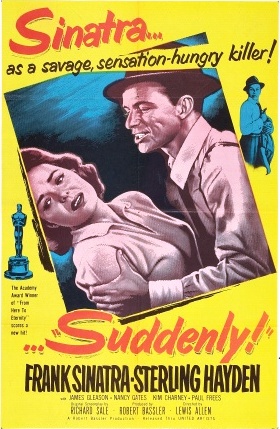
Suddenly_(1954_movie_poster)In some ways, the sleepy town of Suddenly feels like it could have easily been the prototype for Mayberry (Willis Bouchey’s appearance acting as the one actual tie-in to The Andy Griffith Show). The sheriff wanders around lazily. He knows everyone by name and they probably haven’t had anything exciting actually happen for 20 or 30 years at least. But then they go and have something bigger than Mayberry ever dreamed. No filling station robberies, or shipments of gold, or even a group of out of towners trying to case the bank. This is big. It involves the President of the United States and Frank Sinatra or rather Johnny Baron, the man who`s looking for a big payday from assassinating the commander in chief. But people generally liked Ike and so the Secret Service roll in to take the necessary precautions including cueing in the local sheriff on the particulars and shutting down the town.
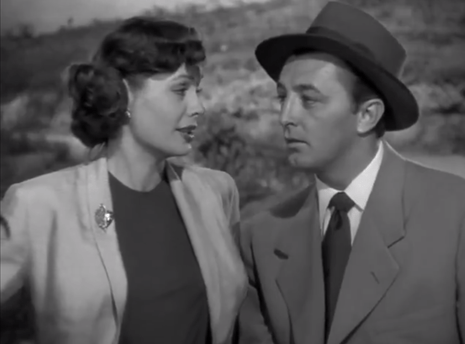
But the one family that doesn’t happen to get the memo are the Bensons who just happen to have the property overlooking the town — the perfect point to knock off an unsuspecting president from but, of course, a thought like that would never cross their minds, not in a quaint town like Suddenly. Still, Baron has thought about it quite a lot and he and his cronies make a house call on the Bensons and subsequently take over their humble abode, except the family doesn’t realize yet that this is a home invasion.

It just so happens that one of the Veteran servicemen Agent Carney (Willis Bouchey) goes way back with Pop Benson (James Gleason) and so he and Sheriff Shaw pay a visit to the family but the welcoming committee is far from obliging. After the initial setup, the film evolves into a tense drama involving not only the imminent attack on the President but the very real hostage situation that we are now privy to. The majority of the ensuing drama is crammed inside the tight quarters of the home as all the hostages tensely wait for events to unfold. Sheriff Shaw looks to keep Baron talking as they bide their time.

But even his background in law enforcement cannot fully prepare him for who he is dealing with and that’s a great deal of the enjoyment that comes out of Suddenly. The characters are ripe with possibilities and Sinatra, in particular, gives an electrifying performance off of Hayden’s somewhat uncharacteristic stalwart turn.

Paul Frees as one of the thugs wasn’t quite bad-enough (sorry for the Rocky & Bullwinkle pun) and the other hired gun is constantly clutching his ulcer.

Richard Sale’s script is surprisingly vibrant and it does a lot in a limited amount of time building up connections and backstories of characters that help make each life valuable while simultaneously increasing the stakes, packing a punch on multiple occasions. And although there were more guns than I was expecting it’s far more than a simple shoot ’em up.

Sinatra’s character is tormented by demons, constantly referring to his own war record and the silver star he won, and in the same breath writing off the hit on the President as just another job for him. It’s true that the specters of World War II seem to affect everyone. Likewise, Ellen Benson (Nancy Gates) must grapple with her own hatred of violence and guns as a result of her husband’s death in the war that keeps her from allowing her spunky son Pidge from seeing war movies or playing with firearms. She’s also hesitant to indulge the calling of Tod because she’s not ready to move on. Each of these aspects underlines the film’s main conflict.

There’s also some striking connections that can be made to the Manchurian Candidate (also featuring Sinatra) as well as the realization that this was the pre-Kennedy era, meaning no one knew what was possible. In some ways, the film’s premise seems rather incredible but then again maybe it was more credible than even the makers of the film realized. Just a few years down the road our President would be killed, the man Frank Sinatra would sing a campaign slogan for.  So, Suddenly comes off as a B-picture but it rises above those meager expectations and turns into a fairly impressive thriller with some stalwart talent and moral issues anchored in its plot.

3.5/5 Stars


The Big Steal (1949)

the big steal 1.png

Granted you have star power but it’s easy to assume that The Big Steal will be a no name picture. A minor triumph at best. Not so! This film fares far better than countless of its bigger competitors.

It proves to be a winking romp full of bedroom brawls, car chases, and twists and turns every which way that send us whipping through Mexico. Equally important to the pace of the action is the levity of the script from Daniel Mainwaring (under a pseudonym) that gives our stars something to do and they do it effortlessly.

Robert Mitchum and Jane Greer (partnered again after the undisputed classic Out of the Past) meet as the two obvious foreigners in a sea of locals as Mitchum is getting accosted by a street vendor to buy a parrot. He’s one of those foreigners coming off as a buffoon navigating other cultures and the languages that go with them. Though I can’t ride him too hard as one of those blundering Americans myself. Still, his Spanish is mediocre at best and she is aghast at his cultural insensitivity. So right there you have the needed romantic tension and things only get better going forward.

Because their association doesn’t end there. Of course, it doesn’t. Duke Halladay is out to nab the man named Fiske (Patric Knowles) who absconded with some of his hard earned cash and Joan had a similar job pulled on her — the man of questionable integrity also just happened to be her boyfriend.

The unlikely partnership is formed after Mitchum leaps for the running board of the other man’s fleeing vehicle and winds up dragging Greer in front of the Inspector General to explain the public disturbance.

The Inspector General (Ramon Novarro) happens to be a budding pupil in English as his second in command (Don Alvarado) attended the University of California which while being convenient for the story also manages to make our Mexican characters into actual individuals who are endowed with an animated quality all their own.

If the main chase is our leading couple trying to track down Fiske, who gives them the slip on multiple occasions then the scenario simply gets more convoluted as Duke’s superior (William Bendix) is tailing him. They have some unfinished business to attend to because Blake believes the other man took part in a theft of his own. Thus, The Big Steal is just that. Even the soft-spoken John Qualen (probably best remembered for Casablanca) gets in on the party and flaunts a bit of a villainous side.

Some of the finer moments are the lighter ones. There’s the ongoing patter of the dialogue firing off between Mitchum and Greer which couldn’t be better and it comes from the days where a guy could call a dame “Chaquita” and it’d stick. But the beauty of their relationship is Greer with that quizzical look of hers can dish it right back in Mitchum’s direction.

Likewise, during a winding car chase, the same character can quite seriously exclaim “Watch out for the cow” only to turn right around and create a livestock blockade of his own. Or because we are in rural Mexico cars can get stuck behind a caravan of hay wagons ambling along leisurely. They have no respect for the drama at stake. On another note, I’m flabbergasted that the cars involved survived at all with the dubious amount of off-roading they managed. I guess in the 1940s they built things to last.

There’s one hilarious roadblock in particular where Jane Greer uses her Spanish and Mitchum’s obliviousness to tell a local road worker (Pascual Garcia Pena) that they are madly in love and running away from her disapproving father. They must get through at all costs and it just so happens that Captain Blake is right behind him and receives a fine welcoming committee.

But the key is that the film ends not on the downward plunge but on the upswing as our two lovebirds observe the local mating rituals and give it their own twist. What a great picture and sure, it’s no Out of the Past but no one needs it to be. We already have one of those and The Big Steal is a leisure ride of its own making.

Set this against a backdrop beyond the Mexico border, a spliced together version of on location atmospherics and studio shots, and you are blessed with the wonderful patchwork of authenticity and artificiality that old Hollywood was known for in the 40s and 50s.

What’s more fascinating is that The Big Steal at least in this form might never have been. Robert Mitchum was hot off his notorious jailtime term because of marijuana possession, an event that undoubtedly solidified his reputation as an antihero. Meanwhile, not too happy with Jane Greer, RKO studio head and temperamental mogul Howard Hughes gave her this role out of spite.

How could a picture this small be any good with a leading man saddled with bad publicity? I cannot speak to contemporary audiences but today The Big Steal plays quite well. We have our stars and screenwriter to thank as well as a young up and coming director named Don Siegel who started out as a montage man and transitioned into B-pictures.

What makes him a wonderful worksmith is how he always seems to have a pulse on the action and he turns situations into truly dynamic entertainment even when it’s on a small scale. He didn’t need a big budget to still make a rip-roaring good time. The Big Steal is a stellar testament to what the Classic Hollywood studios were capable of with meager means. It’s an absorbing effort.

4/5 Stars

Reign of Terror/The Black Book (1949)

reign terror 1.png

Depending on where you look Anthony Mann’s 1949 film comes under two different titles that are both equally apt. Reign of Terror denotes its roots in the French Revolution of the 1790s that saw the ousting of King Louis XVI and Marie Antoinette while putting Maximilien Robespierre at the helm of one of the most ghastly mobs known to man.

Any lover of history can call most everything in this picture into question but that’s almost beyond the point. This is not a tale that claims historical accuracy but a story of claustrophobic intensity that takes an era and builds an intriguing and gritty little drama out of all the sordid, twisted details. Perhaps more importantly than that it begins to draw parallels to the contemporary moment and that’s where the second title comes in.

The black book is the object that causes men to kill and lie and deceive one another because within its pages dwells great power to dictate the outcome of this kingdom on the precipice of something new. Whether or not that proves to be an optimistic direction very much depends on who gains access to said book. Robespierre (Richard Basehart) has lost it, the chief of the secret police Fouche (Arnold Moss) is intent on acquiring it for his own, as is a ring of staunch patriots looking to pilot their beloved nation back toward stability. That is only the main narrative thread. It seems like little coincidence that a black book shares great similarity to a blacklist.

In the 1950s, whether a concrete document existed hardly mattered because having your name added to this industry list was enough. Though not the same as being sent to the guillotine, for an actor or director it was tantamount to the death of a career as many found themselves out of work for years afterward.

While High Noon is often noted as one of the most high-profile blacklist allegories, The Black Book might be one of the most striking since it dares to find a point of reference between volatile and bloody history many years prior and the current reality. There’s nothing subtle about it.

Thus, whatever you want to label it, Reign of Terror or The Black Book, it proves to be a fascinating amalgamation of historical drama, film noir, and political allegory. Somehow it manages to be a low budget epic combining some wonderful talents that go beyond just Anthony Mann but to producer Walter Wanger, legendary cinematographer John Alton, and set designer William Cameron Menzies.

On the whole, it’s an unsentimental portrait comprised of severe low angle close-ups and shadows that spell film noir forwards and backward. It’s deliciously atmospheric, brooding with darkness and matched by ferocious stylized violence that sizzles in every moment of conflict. The sequences in front of the guillotine against the backdrop of the masses even conjure up the frames of Dreyer’s Passion of Joan of Arc and it’s true that this picture ironically recycled sets from Joan of Arc from the year prior.

Looking at film from the perspective of a historian, one of the greatest enjoyments comes when I am able to view content that has a similar theme running through it whether a specific director, actor, genre, or subject. In a flurry of activity, I’ve been able to derive a greater appreciation for the talents of Robert Cummings in particular.

Though this might sound reductive, much in the way that Joel McCrea is called the poor man’s Gary Cooper, Cummings just might be the poor man’s Jimmy Stewart and I say that because he has the same type of everyman quality that’s easy to latch onto.

Although I could never see Stewart pulling off a period role like this and though not entirely authentic, Cummings is a fine protagonist navigating the back alleyways and roads of deception and treachery that dictate the life of a citizen of the New Republic. Even when he does something that might be suspect there’s inherent trust the audience attributes to him.

Meanwhile, stunning Arlene Dahl looks ravishing in period costume but she also becomes a multifaceted companion of Charles D’Aubigny (Cummings) and one of his only points of contact who proves reliable and resourceful. Otherwise, the picture is crammed full of all sorts of characters with varying allegiances and intentions, not to mention cameos from such figures as the Marquis de Lafayette and Napoleon.

If it’s not quite like the blacklist then you figure out how very easily it could be. The film takes so many about faces and turns by the denouement it’s hard to know who is in the right or wrong or more important yet who ended up on the right side of history — the ones who wrote the victor’s narrative — because oftentimes they are the ones who go down as the heroes. Whether that is true or not is up for considerable debate.

4/5 Stars