The Lost Patrol (1934): A Tale of Survival

Screenshot 2020-07-03 at 11.12.23 PM

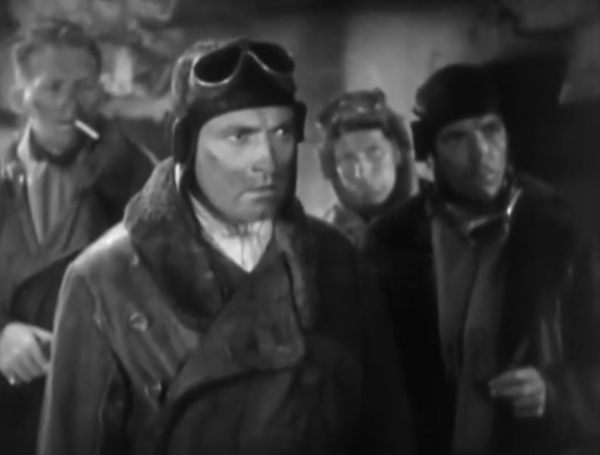
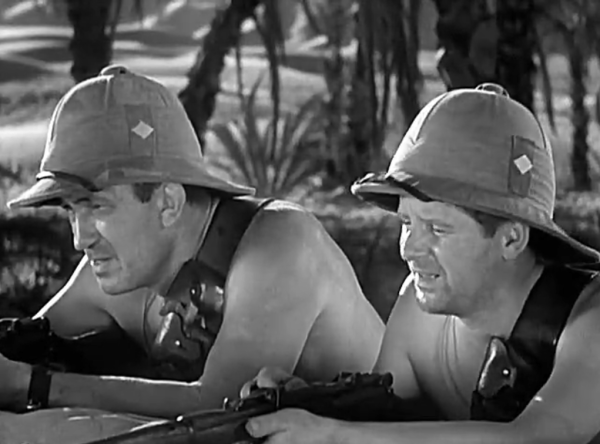
The Lost Patrol comes out of the colonialist traditions of the era with the white soldiers in Mesopotamia doing battle with an Arab enemy who strike like ghosts. They are phantoms and rarely seen in the flesh. It’s an unwitting bit of commentary but it also simultaneously becomes one of the story’s most unnerving assets. There’s a tension born in an adversary who is all but invisible and still has a deadly sway on the story.

The film’s opening images are telling in establishing setting and the man behind the camera. Because this is a John Ford movie. It’s a fairly early offering, but there are elements that feel unmistakably relevant to his oeuvre. There’s the shadow of horses trotting across the sand, and then a line of riders snaking their way across the wide-open vistas of the dunes. It’s a variance on the western form or at the very least a transplant.

During this journey, their thick-skulled commanding officer is knocked off unceremoniously. He also never thought it prudent to tell his second-in-command what their orders were. With him gone, the remaining contingent is left wandering through the desert wasteland without any kind of direction.

The Lost Patrol is an expeditious drama with little time to waste and so survival becomes its primary focus. It’s not searching out a destination or looking to vanquish the foe as much as it’s about these men living to fight another day. It’s a windswept character piece more than anything.

We see Victor McLagen at his most restrained and sensible. His wealth of experience has taught him to keep his head, and he makes darn sure that all his men stay on high alert. Take, for instance, the euphoric scene where the mirage is real, and they finally settle on a spring of water. The men are satiated by a cool drink — a lifeline in the midst of such an arid and desolate terrain — and they fall into it with joyous elation. Their Sergeant is the one man who holds back, chiding them to take care of their steeds.

If McLagen is one of the stalwarts, Boris Karloff is uncharacteristic as Sanders, a jittery and spiritually inclined fellow clinging to his belief although he seems ever ready to spout off jeremiads. For him, their latest discovery is tantamount to The Garden of Eden.

It is an oasis, but they’re also stuck there. Instead of being excommunicated, they might as well die where they stand if they can’t get support. Much of the film at this juncture comes from digging in and waiting it out. We get to know the band of men and at the time same are brought into the tension of their prolonged campaign of survival.

A young lad, wet behind the ears, is crazy about Kipling and the glories of war. Whereas he’s woefully ignorant of the tough side of the life he’s chosen. Morelli (Wallace Ford) is a bit more jocular blowing off some steam with his harmonica even as he brushes off his own bad luck, calling himself the Jonah of their expedition. Still, their leader doesn’t see fit in tossing him overboard. They’re only going to prevail if they stick together.

Because this is a Ford picture, there also have to be a couple token Irish old boys to round out the company. They’ve seen much of the world thus far, and they have more or less willed themselves to fight another day. It’s baked into their stock.

By far the most intriguing has to be Boris Karloff as he’s taken over by his religious fanaticism. And he’s not the only one to totter toward the precipice of insanity or unrest. There are others. In fact, how does one not lose their mind under such dire circumstances?

Their situation is laden with the kind of dread of a who-done-it murder mystery. Men get knocked off or become lost to the elements, one by one, until their mighty group is dwindling with the unseen enemies still lurking just beyond the sand dunes.
Though the parameters of the drama come out of a bygone era that we have left far behind, somehow Ford’s film maintains some amount of its mystique. He’s already well-versed in capturing the panoramas around him in striking relief. He’s actually aided even more by hardly showing his villain at all. Time honors this decision because it falls away, and we forget the stereotypes as much as we feel the specters hanging over the patrol.

To the very end, McLaglen is a stalwart and you can see how Ford is able to fashion him into a reputable even idealized champion. He’s not unlike a John Wayne or other figureheads Ford found ways to fashion into his personal visions of inimitable manhood. There’s something admirable about them — found in their mettle and loyalty — even as they exude a persistently evident humanity.

3.5/5 Stars
Dawn Patrol (1930) and The Numbing Cycle of War


dawn patrol

Taken in the context of his entire career, Dawn Patrol becomes a prototype for a plethora of later Howard Hawks pictures involving aviation and male bonding, including the likes of Ceiling Zero, Test Pilot, and certainly, Only Angels Have Wings. As a WWI pilot, Hawks has more than a passing interest in flying. He seems totally invested in its depiction. But despite its inadequacies, Dawn Patrol has more to offer than a mere technical exhibition.

This one opens with a telling note about WWI and the nations “entrusting salvation to youth.” It’s a sobering thought, but the phrase makes more and more sense as the film progresses.

We meet Major Brand (Neil Hamilton) as he’s forced to pass hours at his desk. He goes out on the limb for his men with superiors having the gall to suggest over the phone that they’re not doing enough. It’s a thankless job that only gets worse when he listens to the planes touching down. He knows by the sound of the engines how many boys have come back unscathed (and how many have perished).

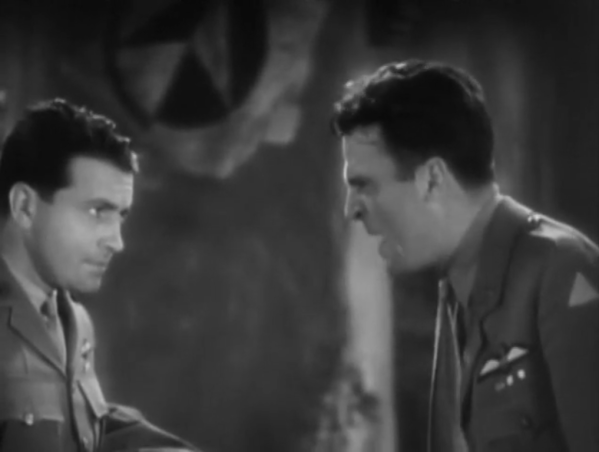
It’s a fine representation of how Hawks is able to indicate exposition through what is off-screen. Soon, the head of the flyers, Captain Courtney (Richard Barthelemess), checks in to give his report. He and Brand have a contentious relationship and every one of their conversations devolves into a yelling match.

The men standing outside, by the bar, give some suggestion it might be over a girl they both knew in France. All we have is the here and now, and that seems heated enough. We don’t envy either of their posts: The one giving the orders and the one obediently carrying them out.

Barthelemess never had much range, but this blandness does serve the picture well. He doesn’t need life. He needs to evoke the emptiness, the tiredness, the deadly monotony of his station. With every new mission, bright-eyed inexperienced kids arrive like lambs being readied for slaughter. It’s utter insanity, and we are there to witness it.

The chalkboard in their headquarters becomes one of the most sobering markers of the film. Because as the names come off and get replaced by a fresh batch, there’s something inevitable and terrifying about it. This suggests the impermanence of life with each name so easily wiped away from that board as each life is snuffed out.

His best friend, the affable Scott (Douglas Fairbanks Jr.), is one of the few pilots with enough skills, tenacity, and good fortune to survive their regimen of harrowing missions. He’s someone you can count on through thick and thin.

Similar to John Ford’s movies, songs become such an integral part of their community, banding together and joining their voices in an act of unity during their off-hours. It also settles their nerves.

dawn patrol

However, Dawn Patrol simultaneously considers the absurdity of war where you can share a drink, a laugh, and a hug with the man who shot you down out of the sky and was trying to kill you. How can it be? It only works if you can compartmentalize the experience and keep your feelings contained.

But this is only a temporary salve. Soon there’s a new villain on the rise — he’s a German ace named Von Richter — and more kids are called in to counter the havoc he’s wreaking on the allies. Although the chain of command changes with Courtney being promoted, the flaws and unyielding shackles of leadership become even more apparent. Soon friends are pitted against one another, fighting over the life of a hapless younger brother: one of the latest recruits. He knows not what he’s signed up for. They know only too well.

It causes a rift between the two men. In fact, it’s uncanny how much it’s like the row between Court and his Major before them. He’s become the distraught leader made callous and mercurial with daily stress and drink. But this is his best friend on the other side of the desk and the life of Scott’s kid brother is in the balance. Surely this should be different. What a horrible institution war is and what a terrible position to be in.

You survive long enough, and they stash you behind a desk so you get the unsavory job of sending men off to their deaths. What makes it worse is the sheer eagerness that all these fresh-faced lads take to their assignments. They brim with enthusiasm ready to do their part on behalf of the war effort and their country.

What a horrible cycle it is, and it seems ceaseless. The only way Court sees a way out of it means taking matters into his own hands — breaking the chain — and making the ultimate sacrifice on behalf of his best friend.

Because there is a suicide mission to be done. A volunteer is needed. Scott jumps at the opportunity, wanting to get out of that vile place and knowing full-well Court will be happy to see him go. Of course, this isn’t the case. There’s still a beating heart in there somewhere, and he takes on the bombing assignment himself.

In one of the last scenes, in the dark of night, they wait nervously ready to light fires on the runaway for Court’s return. Surely, he will come back! He always has before…They never see him. There’s only the faint motor of the plane and what a brilliant piece of exposition because the full import of the significance only hits us moments later.

If this scene is one of the most affecting, the last one is equally telling. No, the war is not over. That would be too clean, too easy. Instead, the chain of command has continued. The faces ready to take to the skies have changed just as new names get wiped off the chalkboard. What an abhorrent thing this is. What’s more terrifying is how numb we become to it.

3.5/5 Stars

Swing Shift (1984): Underrated Classic with Caveats

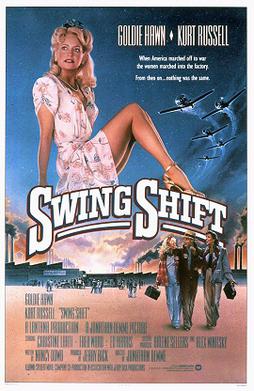
Swing_shiftAside from films actually produced during the war years, I’m not sure if I can think of a film that highlights the homefront to the degree of Swing Shift. The soundtrack is also perfectly antiquated (sans Carly Simon) fitting the era and mood to add another definite dimension. It effectively takes us back with the auditory cues of Glenn Miller, Hoagy Carmichael, and the rest.
We read in our history books about Rosie the Riveter and women gaining a newfound freedom as they fell into work formerly held only by men. But here this reality is put into practice in a manner that makes tangible sense.

The events of the war happen to them as they walk along the pier, sit in their living rooms, or do their work. Instantly they become current events.

We understand the certain amount of independence women would have been allowed in this time, where they were given a part to play in the struggle against the Axis powers. War can simultaneously cause deep wells of tragedy and bring us the greatest joys.

Our relationships become entrenched with a profound camaraderie and yet we can hurt the ones we love. We change and they change. Things very rarely remain the same after something so cataclysmic.

There are several intentional and formative relational dynamics in Swing Shift. It is about two working women: Goldie Hawn and Christine Lathi. They are by each other’s side through the thick and thin of friendship. Putting in a solid day’s work and then getting dolled up to go out on the town. They’re inseparable. However, sometimes it’s relationships like these that can suffer the most.

It is about a husband (Ed Harris) and a wife (Hawn): one going off to war and the other staying behind — prepared to walk alone. This isn’t what they were planning, but it’s happened and they move forward through the paces of it the best they can. And yet life gets in the way — where time and space separates them — and makes the waiting and the worry all the more difficult.

It’s about a woman and a man who cannot contain the genuine feelings they foster for one another (In real life Kirk Russell and Goldie Hawn fell in love and never looked back). Because he is present, in the flesh, good-natured and available in a way her husband never was — even when he was around. And yet Lucky (Russell), when he’s not riding his motorbike or playing the trumpet, is a wounded soul in his own right. War only works to exacerbate the clouded emotions of the day and that goes for all these relationships. They are interconnected issues.

But I think this is the best compliment that can be paid to the story. Because sometimes it looks a bit like a TV soap, and the story doesn’t always fall together, and yet there is a broader sense of what this movie is and what the focal points must be. This I believe we can attribute to Jonathan Demme. It’s meant to be more than conventional romance and we get tastes of that.

I say tastes because Swing Shift also has to be one of the most notorious cases of artistic tampering, right up there with The Magnificent Ambersons or Terminal Station. Warner Bros., at the behest of Goldie Hawn, edited the movie and reconstructed the story after Demme had finished principal photography.

Aside from story or continuity questions causing a few head scratches, the issues seem to go deeper still. I am by no means an insider, but from what I can gather, Hawn’s version tried to center the story around her and Russell. There’s an obvious reason for this. They have more than chemistry. They have romance. However, it also attempted to simplify her image and rectify any conflict we might have with her character. In essence, the goal was to make her more likable.

It causes her to maintain some sense of moral dignity and still the movie ends on an unfulfilling, empty note. It’s as if some kind of greater catharsis was possible, and we are robbed of it all with a final tear and a whimper. The resolution is not quite a cop-out as it is an exercise in indecision. The picture dissolves when something more complex, something more evocative, was probably called for and just waiting to be excavated.

Someday I hope the Demme version might go back into circulation, not just so we can see the movie as it was meant to be seen, from the untarnished vantage point of its creator. That’s part of it. But there’s also a sense Demme attempted to develop something more full-bodied and well-contoured.

Hollywood is always obsessed with primary action — the characters at the center of the story — but so often what is most interesting is what remains on the periphery. The supporting characters or the elements of the world that make it come off the screen and feel real.

One is reminded of the moment a smartly dressed soldier boy comes up to one of the swing shift members (Holly Hunter). He’s there to give her the horrible news, and she knows it before the words leave his lips. She falls onto him and he apologizes — he’s never done this before. How horrible and pitiful and lovely it is because it feels so innocent and honest.

Moments like these are a testament to a movie with so much to offer, bubbling up under the surface. It’s a shame it was so badly mangled. We must be thankful for what we have and hold out that someday we might get to see the cut that kept to Demme’s vision. Here’s to hoping. For what, it’s worth, Swing Shift might well be an underrated classic with a couple substantial caveats to include.

3.5/5 Stars

The Young Lions (1958): Humanity in Epic Scale

the young lions 7 (1)

The opening of Edward Dmytryk’s The Young Lions, based on Irvin Shaw’s titular novel, could be plucked out of an earlier picture like The Mortal Storm. It’s New Year’s Eve 1938 in Bavaria, Germany. Young lovers ski and frolic in the snow as locals make merry indoors.

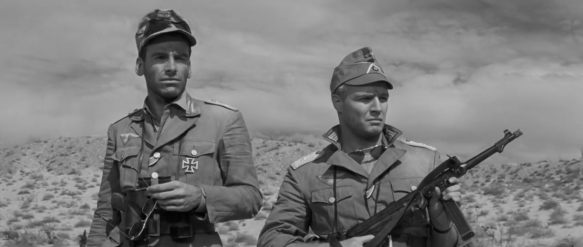
Marlon Brando is a sympathetic German or closer still a principled man named Christian, currently sharing the company of a beautiful American — one Margaret Freemantle (Barbara Rush). For her, the evening is quashed with the word of Hitler. However misguided it might be, he has a genuine optimism about what Hitler can and will do for his country. Christian is not a monster. Likewise, he believes if lives have to be sacrificed for the sake of peace, he will gladly go to war.

Although these two people will never share the screen again, this is the beginning of everything. Because of course, we know what happened next in the history books. War did come. First in Europe, making its way to France, then Britain, and finally, the U.S. got involved. Christian gets his start policing the streets of France, upending their derogatory view of the enemy, even as he struggles with the perils of radical ideology.

It occurs to me, part of Brando’s success comes with how his social consciousness paired with his acting prowess. Because when he still seemed thoroughly engaged with his career, he sought out parts of such diversity, bringing humanity to all sorts of disparate people. They didn’t always hit the mark (I think of Viva Zapata and Tea House of The August Moon), and yet during this same period, he played an informant, a southern ace who falls for a Japanese girl, and here a sympathetic German during WWII.

There’s a calculated empathy to the adaptation, casting a German and a Jewish man as two of our most prominent protagonists. It’s difficult to begrudge The Young Lions its inclinations because they seem genuine and earnest, especially in the capable hands of Brando and Montgomery Clift. Yes, we must take a moment to mention Clift now.

The older actor is sometimes clumped with Brando, but even in the context of this movie, it’s fascinating to begin comparing them. Brando burst onto the scene and ultimately let himself go — becoming disinterested and disaffected by his screen career. Clift, likewise, was an incandescent talent transplanted from the stage, but he was totally engaged in his craft.

His own setbacks were initially out of his control: a car accident that left him dependent on drink and pain killers. He considered Brando a squandered talent for all of his abilities, but if anything, it shows how devoted Clift was to his art, doubling his efforts even after his injury.

the young lions 2

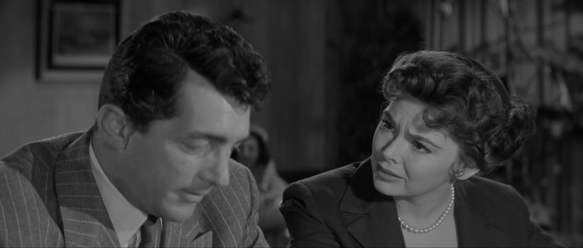
While they’re not exactly “young” lions, Dean Martin and Clift are a pair of compelling ones as they are drafted to be sent out overseas. You would never think of putting them together. Their personalities seem so adverse to one another, and yet there is a component of loyalty found in their performances bleeding out into real life. They were there for each other, forged by fire as they were.

Dean Martin was two years removed from his split with Jerry Lewis, and The Young Lions was his first big chance to redefine his image as an actor. He gives it a valiant go in a performance that maintains shades of his persona. In this case, Michael is a stage entertainer hesitant about going off to war and looking to dodge culpability any way he possibly can. He jousts with his girlfriend Margaret (Rush), who simultaneously doesn’t want him to die even as she disapproves of his dereliction of duty. When the time comes, he proves his mettle and his steadfastness.

Maximillian Schell was a revelation to me quite a number of years ago when I first saw Judgement at Nuremberg. Because in a picture with such contentious stakes and with so many prominent acting powerhouses, for me, he is the film’s standout with the most spectacular stand. In The Young Lions, he plays Brando’s superior espousing the typical rhetoric: The German army is invincible because it obeys orders and it harbors no sentimentality, moralists, or individualists.

In one sense, he constantly castigates Christian for his lapses in judgment, for this softness he has, but for all his perniciousness, Captain Hardenberg still comes off as a human being.  He has a flirtatious wife (May Britt) waiting back home and a life ultimately crippled by injury. If Martin holds his own up against Clift, then Schell — learning his lines phonetically no less — certainly proves himself a compelling presence opposite Brando.

They get reassigned to Rommel’s Afrika Corps in North Africa working behind enemy lines. It’s in these moments, in particular, as they bomb and mow down their unsuspecting enemy, we get a gutting portrait of how merciless the world can be, but that lets people off the hook too easily.

Human beings — myself included — can be petty, mean-spirited, and cruel to one another, and The Young Lions is not only about this global scale of war between nations. It’s about the conflicts and schisms formed in what’s supposed to be a united front — a shared cultural identity. Whether it’s a German with a heart and soul or a Jewish man who is ridiculed and discriminated against in his own country for something that is out of his control.

the young lions 7

The onslaught of Allied forces sweeping across North Africa — the Brits with their bagpipes and Patton with his tanks — is a force to be reckoned with even as the homefront is ripe with the division. Even as Noah (Clift) finds himself a lovely small-town girl (Hope Lange) to wed, the systematic bigotry of his barracks-mates and his superior officer is crippling. He faces it with a lion-hearted resolve as Michael does his best to back him up.

The tide of the war finds Brando and Schell fleeing on a motorcycle to escape the steadily advancing enemy forces. Christian eventually loses his commander and must face the man’s wife with a renewed disillusionment. Even a return to Paris and greetings from old friends (Parley Baer and Liliane Montevecchi), show him the world has changed dramatically. He has as well.

On the Allied front, Michael finally asks to be sent to Normandy, and there reunites with Ackerman to liberate a concentration camp. It is the same camp that has opened Christian’s eyes about what the Germans have been perpetrating for the past 5 years under the guise of Nazism. While not a totally graphic scene, it’s no less of a gut punch as each character is forced to meditate on what is before them.

There’s this driving sense of fate as The Young Lions mounts to highlight one of the monumental absurdities of war. Here we have spent an entire film — through all its peaks and valleys, heartbreaks and reveries — and we finally bring together our three primary leads.

They are on opposites sides of the conflict though they are all men of a certain stock and decency. And yet because of war and how factions are aligned, they are meant to kill one another. They will never have a chance to sit down at a table together and know how similar they really were. This is the great tragedy The Young Lions underlines.

Not only does it exhume the hidden evils of the human heart, but it also annihilates all sense of common humanity, forcing us to only see a demonized enemy opposed to men and women who are not unlike ourselves.

In a better world or even in a world before the war, these three men could have been friends or compatriots. Alas, it was never to be and what’s crueler still, they will never know what they have missed out on. They already have so many traumas; it’s difficult to discern if these thoughts will plague them. But that is not the purpose. The film is constructed in such a way, it’s meant to commend us to cast off war altogether and this is far more telling.

The impression I am left with has magnitude. It’s a minor miracle how the grandiose scale of a cinemascope epic, backed by performances from such renowned talents, somehow still manages an immediacy and intimacy. The Young Lions might be lengthy, but it never loses its protagonists in a mass of humanity. Instead, it highlights the humanity of a few to illuminate a whole society.

4/5 Stars

“The young lions lack and suffer hunger; but those who seek the LORD shall not lack any good thing.”

Sayonara (1957): Marlon Brando and Miiko Taka

sayonara 9

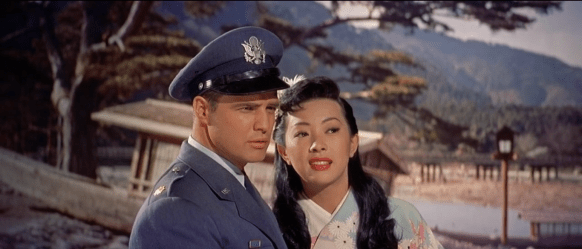
Major Lloyd “Ace” Gruver (Marlon Brando) lands on the airbase in Korea and almost immediately gets assigned leave in Kobe. However, this leave has ulterior motives, signed by General Webster (Kent Smith), a friend of his father’s and the father of the pilot’s sometime girlfriend. It’s meant to be a contrived reunion no doubt so they can consider their wedding plans.

One of Gruver’s men, Joe Kelly (Red Buttons) is set to get married himself. Soon they’re showing off cheesecake photos of their girls until it evolves into something far more complicated with more uncomfortable implications. Because Joe is intent on marrying a Japanese gal named Katsumi (Miyoshi Umeki). If nothing else, you admire the man because he’s totally committed; there’s a complete integrity and personal conviction behind his intentions.

As the film points out later, he wasn’t alone. Lots of servicemen looked to marry Japanese girls after the war, and yet there certainly is something countercultural about him. What becomes immediately evident is this sense of casual (or not so casual) racism. Though hardly a spiteful person, Gruver has some preconceived notions about “slant-eyed runts.”

He has his misgivings about the wedding and yet, as a favor to his subordinate, he agrees to serve as his best man. The pervasive strains of discrimination continue as Gruver makes it to Japan and rendezvous with the Websters and Eileen (Patricia Owen). They attend a club for American personnel only to witness a soldier getting turned away with his Asian girlfriend. The coded language of “fraternization” is really just de facto segregation. For the time being, Gruver has no stake in the matter and so leaves it be.

His first true immersion into Japanese culture, at the behest of his girlfriend, comes from a Japanese kabuki performance put on by a revered actor. Although it’s a bit unfortunate having Ricardo Montalban playing Nakamura, he gives it his best showing, which actually comes off rather sensitive as far as yellowface goes.

While I’m not sure Joshua Logan exactly comprehends Japanese culture aside from its exquisite exoticism, he does take his stage pedigree and proceeds to translate the Japanese arts into flat two-dimensional showings mirroring their inherent performance elements. At the very least he understands their use of space and augments them within the framework of the broader film.

Owen is intriguing because she has all the attributes of a beautiful American girl: well-groomed and fit to be a 1950s housewife, but she has enough wherewithal to think for herself and not to be a “type” for her man to return home to. It forces Brando to make some kind of commitment. Currently, he’s not in a place where he feels that he can. If the movie were to continue down this commonplace path it would be dull going.

Instead, the camaraderie between Brando and a marine, Mike Baile (James Garner), is born. The other actor doesn’t have much to do except act as a cultural guide; still, Garner takes to his role genially and with his unadulterated charms no one could ever fault him. He’s another agreeable face, and he also knows a good deal more about Japanese culture…

Miiko Taka literally stops Brando cold (and the movie with it). The film turns on a new axis as Gruver becomes infatuated with the preeminent dancer, Hana-ogi-san, who can be found crossing the bridge to the theater every day before and after her daily performances. The outmatched pilot finally plucks up enough acumen to find himself a pocket Japanese dictionary only to toss it away.

It’s like a new pastime as he waits to catch a glimpse of her and get a chance to interact. He finally gets his chance — a meeting with her in person — though this is normally totally forbidden for someone in her position. The added grievance is the death of her father who perished at the hands of an American bomb.

sayonara 12

Even though the preamble has some rumblings of discord, there’s something about Brando’s introduction to the Japanese household that’s warm and affecting because in it some cultural understanding is made — appreciation of customs and how our differences somehow lead us to a place of mutual respect.

Amid gags of him continually bumping his on on doorways, there are far more tender moments that never feel like they’re reaching toward didacticism. Joe has him remove his shoes before entering the home, and he learns about sake (fermented rice wine) and how to pour for others.

If this scene tickles the heart, it doesn’t last long. The accompanying moment with Brando and Taka’s first time reclining at table alone together is imbued with a sinking feeling of discomfort. He’s so lax and culturally unfamiliar, making a go of it the best way he knows how. There’s a sense he is sunk even before he’s begun. What words will come out of her mouth in response?

Far from being dismissive, she’s gracious and tender speaking of her life and her desires for love and some far-off dream amounting to something more than her extravagant life of a dancer on the stage. She craves something deep-seated, a longing inside of her.

Although they come from two distinctly different worlds, their lives are similarly planned. Either by the strict confines of her theatrical tradition or the regimens of the military. And yet against this backdrop, they find happiness together watching fireworks, being in each other’s company, and generally filling up their days with romantic contentment. What’s refreshing is how none of this feels self-serving or staged. We willingly believe there is something tangible between them.

The seeds of bigotry have already been planted early and so they eventually germinate. The military cracks down calling for all military personnel to stop seeing Japanese women and those who are married, like, Joe are given especially harsh treatment. They’re effectively forced into subordination on the threat of court-martial and deportation.

Sayonara has successfully put its flag in the ground when you know what’s happening and yet the events unfold and you cannot look away. Because the mantle of the story has been passed onto the characters whom we now care for. What follows has legitimate consequences for us.

sayonara 2

Thus, their friend’s fate is swiftly decided and yet Ace and Hana-ogi’s roads look to be diverging. There is no other way through unless one of them intercedes and gives up everything they have already built. It’s a point of no return.

To Brando’s credit, he sells the transformation from blundering ignorance to genuine care for this woman who has so enchanted him. Mikko Taki, who is still with us, far from simply being gorgeous, brings a quiet understanding and gentility that stays the course of the movie. In no way does it feel like she’s totally overwhelmed or upstaged by Brando. They make the romance a union between two people bridging two cultures in the face of adversity.

The final delight comes with Brando sticking it to all the naysayers and wishing a “Sayonara” to everyone who would stand in their way. It leads to warm feelings not least of all because the picture is finally done.

All said, the Technicolor scenery and scenario are noteworthy, even cutting edge for the time period, but with the loose threads and lumbering running time, the movie could spare to lose a few scenes. Although admittedly obligatory, it’s the scenes of mechanized conflict and dialogue between Brando and the military that feel rote and uninteresting.

The main players are the ones making waiting through the dross worth it thanks to their candor and agreeable charisma. What a lovely screen couple Red Buttons and Miyoshi Umeki make. Above all, it gladdens me, in all her humility, Audrey Hepburn turned down the role foisted on her at the behest of Joshua Logan. She graciously declined and instead, we were blessed by a performance by Miiko Taka.

Although she, like Shirley Yamaguchi in House of Bamboo or even Umeki Miyoshi, is cast as the delicate Japanese beauty, this only becomes a stereotype if it is never replaced with other roles. For what it is, the part balances several traits, including a degree of independence and familial duty. Thus, any lasting criticisms for Sayonara in this area feel more indicative of the industry now 60 years on than a single performance decades ago.

If Sayonara is rife with stereotypes in its honest attempts, then not enough has been done to build on its legacy to bring us even further in the present. Because, amid the flaws, there were some exquisite touches, from the gorgeous imagery to little accents like the neighborhood cherry shop on the corner or the Japanese conversations shared between a husband and wife. They elicit something genuine and emotionally sincere.

3.5/5 Stars

Seven Days in May (1964): A Twilight Zone America Strikes Close to Home

Sevendays_moviepThe opening images of Seven Days in May could have easily been pulled out of the headlines. A silent protest continues outside the White House gates with hosts of signs decrying the incumbent president or at the very least the state of his America.  We don’t quite know his egregious act although it’s made evident soon enough.
The scene at hand rapidly escalates to violence. There’s an immersive cinema-verite quality to the mob that breaks out between rival protesters. It instigates the film’s overt sense of technical style even if it’s not always straight to the point.

What becomes imperative to John Frankenheimer’s movie is how this showmanship frames the performances at its core because the movie is driven by its robust melange of characters. Fredric March is president Jordan Lyman. He’s getting middling reviews for headlining a nuclear disarmament deal with the Soviets. This includes backlash from his highest-ranking military officials, and they’re not going to sit around while he lets America get annihilated.

It might seem like a slightly peculiar (if not entirely unfounded) reaction, seeing as in real life so many people would soon call for peace. Except in this world, the Cold War is literally reversed; now they have peace, and the outcome still remains the same. Everyone’s suspicious of what might really be going on behind the Iron Curtain.  If it’s not evident already, Seven Days in May effectively becomes an off-shoot of your typical Cold War doomsday drama.

Somehow it seems fitting Rod Serling adapted the script from the titular novel because this is a story planted in an inconspicuous and generally subtle near-future. It is its own Twilight Zone in that the logic feels slightly tweaked from what contemporary America was familiar with. At any rate, it’s concerned with an entirely different outcome than President Kennedy was currently faced with. What makes it truly startling is how much of a hop, skip, and a jump it feels from reality.

While it’s unfeasible to totally encapsulate public discourse during the early 1960s of the Kennedy administration, it’s often true movies act as an echo chamber of the times, reverberating the current issues in fundamentally different ways. I cannot speak to the anxieties Seven Days in May explicitly illustrates. But there are tinges of very real conditions, be it public protests and national marches (with the civil rights movement) and certainly the ongoing frozen-over politics of The Cold War.

Foremost among the detractors is General Scott (Burt Lancaster), who adamantly believes nuclear disarmament is a dubious peace — a sign of America’s weakness as they roll over and cave to Soviet interests — leaving the nation vulnerable. And it’s not an isolated opinion with close associates including Colonel “Jiggs” Casey (Kirk Douglas) sharing his line of thinking.

However, even their own private allegiances dictate drastically different courses of action. There would not be a movie if “Jiggs” did not uncover General Scott’s covert operations. Namely, a garrison of men training at an undisclosed facility in El Paso. It’s the first of several red flags.

The Colonel immediately brings a line of communication straight to the top triggering mistrust and paranoia as the inner circle of the president is overtaken with consternation. Although he seems admittedly quick to sound the alarm, it is indicative of the times. Especially because their fears of a military plot to take over the government seem overwhelmingly well-founded. Such a coup d’etat on the oval office almost feels unthinkable in the modern age of America; maybe this fits a more Twilight Zone sense of our government structures.

Regardless, Lyman heeds the warning and sends one of his closest allies, old southern boy, Ray Clark (Edmond O’Brien), to check out El Paso. Another oval office insider (Martin Basalm) ends up tracking down the one standout from the conspiracy — an admiral currently based out of Spain — who gives a signed statement of foreknowledge. Meanwhile, The Colonel is asked to continue in the uncomfortable position of an informer. The President must bide his time until he can back up the claims, lest he be seen as a raving madman by the general public.

While Lancaster might have the more high-profile post, it is Douglas who feels like the sinews holding the movie together, and rightfully so, because he was one of the major forces behind the film’s production. To his credit, it shows his ability to play a more restrained part — close to the vest — which still remains deeply impactful.

His scenes with Ava Gardner feel like a minor side note to this covert conspiracy of international importance, and yet it’s a tribute to both of them; it feels real and devastating in its own right. Their shared context means something.

Given the era, it’s hard not to consider the likes of Advise & Consent and then the more nuclear-oriented dramas like Fail Safe and Dr. Strangelove. And of course, John Frankenheimer had a well-documented pedigree with the political thriller from one of the most high-profile contenders, The Manchurian Candidate, and the criminally overlooked Seconds a few years down the road.

If we were to take his loose trilogy and compare it with Alan J. Pakula’s trifecta of thrillers from the 1970s, we can somewhat trace the evolution of the genre from one decade to the next.

As Lyman notes, the electorate is looking to elect a personal God for the duration, whether a McCarthy or a General Walker. They clamor for such a person to assuage their fears. The enemy is not other men but the nuclear age. We suspect infiltration and that the enemy is trying to blow us off this rock. Not until later would our own government be implicated, and then big business and our own systems be seen as a source of the problems.

Some of the best scenes take place in the privacy of the oval office because we sense the tension provided by the stakes. However, the whole drama is brought down to a manageable scale that can be quantified and understood through human relationships.

The intimate confrontation between March and Lancaster is probably a pinnacle of the storytelling, far more impactful in fact, than watching a full-scale conflict play out. Instead, it’s the whole movie hinging on one showdown between two incomparable forces, and what a showcase it is.

What makes the film smoke with legitimacy is how both men suggest, in their heart of hearts, that they are right and justified in what they are doing. And that’s what the great actors can do. Lancaster, in particular, is easy enough to cast as the power-hungry, possibly sleazy villain with a Napoleonic complex. But Lancaster’s ferocity is only matched by his steely delivery. There’s never a suggestion he is phoning in those lines of dialogue. They come off real and true and unflinching.

In the eleventh hour, there’s a sigh of relief and an equally perturbing sense of unease. We conveniently never find out if the peace treaties were a ploy by the Soviets. All we’ve done is live to fight another day. Tomorrow could signal oblivion. For this early in the decade, it feels surprisingly downbeat signifying the times certainly were a-changin’. The shift was inexorable.

4/5 Stars

*I wrote this review well before events at the Capitol on January 6th, 2021. 

The Eagle and The Hawk (1933): March The WWI Flying Ace

Screenshot 2020-03-20 at 80407 PM

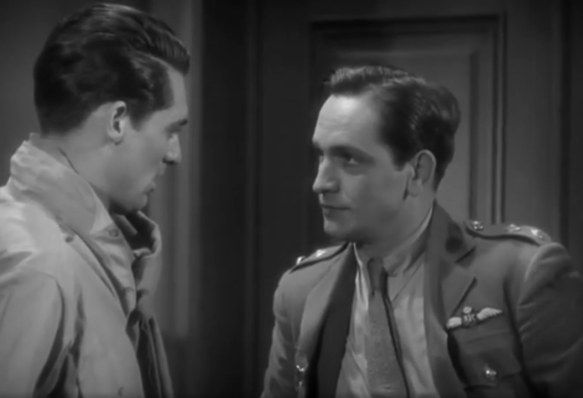
There are two elements in the opening of The Eagle and The Hawk that might catch some viewers off guard. First, is the matter of a plane landing upside down. Second, being the fact the pilot is an uncharacteristically abrasive Cary Grant. He’s still playing support to our true lead Fredric March.

It’s alright to admit the shoe never quite fits and, thankfully, Grant was not forever relegated to such unseemingly roles again (well, there is Suspicion or Notorious). Regardless, in this WWI picture, a group of American aviators ship out from London to give their British allies a lift in France.

New forms of technology like aeroplanes still feel a bit rudimentary, yet to be time-tested, and therefore they carry with them a bit more danger. They must take recon photos flying close to the ground and often engage the enemy in aerial combat. The footage of the dogfights is lively if equally rudimentary.

It’s Grant’s Lt. Crocker who has aspirations to be a pilot, not an observer — the less glamorous posts going to those who take pictures and gun. Cary’s got a chip on his shoulder, and it’s turned him sour. Jack Oakie is the complete opposite — chipper, well-liked by all, and conveniently supplying comic relief.

However, it is the final star, the leading man, Fredric March who stands head and shoulders above the rest, at least on this occasion. He goes through a startling transformation over time. He soon learns the hard lesson. For every two kills of a jubilant Jerry Young (March), there’s the searing reality of a comrade dead.

We are instantly reminded war never allows a man to rest on his laurels before inundating them with the sheer callousness of such a conflict. It shows no favoritism. Officers or enlisted men alike. Doughboys or flyboys. It makes no difference. Everyone is susceptible.

In a matter of minutes, the weight of war is made obvious. It happens between a letter written to a dead man’s spouse and a blackboard with names constantly being erased and added.  Beyond being indiscriminate, war also waits for no man.

As time progresses, the dogfight sequences maintain quite the impressive pace for their day and age. The sequences use the resources at their disposable and varied shots to develop something fairly immersive beyond mere back-projection fillers.

Finally getting his first go, Grant shoots down an unarmed parachuter with great relish, his first day on the job, only to kill the mood after hours. They say he’s a “dirty deuce,” but perhaps he’s the only realist around. He treats it like war. They treat it like an exhibition in some contrived form of chivalry.

There are rules to war and gentleman’s agreements to be abided by on one side and then the “killed or be killed” mentality of Grant. And yet even as March remains one of the righteous ones, he starts medicating with alcohol to get over what he’s been privy to.

Soon he can’t get over the insanity or reconcile with the consequences set before them. They are bestowed medals by the French military with the rain pouring down — it’s a wet affair — and he’s still soused. 

A new batch of fresh-faced youngsters come to replace those who have already expired. He’s enlisted to speak to the new recruits, sharing a message for the sake of moral, though it’s evident he barely believes what he’s spewing. Because some of them will die before even getting to the front. What’s the purpose of it all? So the folks back home might cling to some misguided patriotic fervor?

The night terrors begin — Jerry’s mind now filled with burning, blood, and snipers at night. A change of scenery is suggested and so he’s given leave.  But in the households, the conversations are boorish and needlessly taken with the romanticism of war and glory.

Here are people drunk on the same wine. Men laugh about the enemy going down in flames. Curious young boys ask questions about what it’s like to meet the enemy with hopes to be up there one day. No one seems to understand, and how can they. They haven’t been there.

Watching from a distance, there is at last one pair of perceptive eyes. They belong, of course, to Carole Lombard. She slides her way into Jerry’s cab as he tries to leave the idle chatter behind. Instead, they find a quiet park, out of the way, to share some champagne and engage in genuine conversation.

She has only a momentary part — it really is a glorified cameo if we should call it that — and this is a movie that’s already so succinct. Still, it’s a memorable spot, and she offers a sympathetic countenance in a world all but lacking such consideration. It makes her all the more attractive.

Still, Jerry must go back to the lines and maintain the burden of being a shining example for others. After all, he is the fitting emblem of what a military hero should be. Fearless in the face of the enemy. All but indestructible with a stirling flying record.

However, we become jaded with the same persistent cynicism of Jerry pulling him from the airs above back into the parties and routines down below at the base. He can’t even manage to muster any kind of good-natured sentiment in such a jocund company.

All he sees are the chunks of flesh and bone on his chest in the form of medals. And all he can think about are the boys who have died either by his hands or at the hands of others. He’s gotten his medals, gained hero status and adulation from his peers, for killing kids. What’s worse, few seem to acknowledge him, going on their merry way. Surely he’s merely drunk. He’ll get over it in the morning. Except he doesn’t.

The film’s ending is a brutal shock to the system, but it settles into an honorable arc. If anyone was worried, Cary Grant is redeemed in the final moments preparing to soar off toward bigger and better successes.

What I’m most impressed with is how The Eagle and The Hawk does such a phenomenal job distilling some of the most pressing themes of war in its harshest and most bitter realities in such a meager allotment of time. It’s like All Quiet on the Western Front lite, and I mean this as the most sincere of compliments. It adeptly hones in on the essential elements of the prior film as another stark, unfaltering statement exploring human conflict on this seismic scale.

It comes not through heedless idealism but a sobering, unblinking examination of what war really is. Any pretense is stripped away in a matter of minutes while March gives one of the most piercing performances, arguably, of his entire career. If you haven’t already, go seek it out. My hope is that you’ll be glad you did.

4/5 Stars

The Aimless Bullet (1961) in Post-War Korea

Screenshot 2020-03-01 at 44139 PM

The film sets a precedent when a group of men is tossed out of a bar. They lack the funds to pay their tab and they’re wasted, singing the old war songs they used to know in the military. One refrain goes like this, “We march over the bodies of dead soldiers.”

One of their company is a crippled former commander who bemoans the fact he’s a has-been — a broken bowl of a human being — resigned to a life on crutches. It’s a telling annunciation of the South Korean experience after the war.

It positions itself as an important film on par with The Best Years of Our Lives, The Bicycle Thief, The Third Man, or Floating Clouds. Because it shows a Korea wracked with post-war degradation, depression, and economic disparity comparable to the manner these other films provided a lens to their respective cultures.

This is vitally important. Especially for those of us from the western world. It’s difficult to understand the Korean War’s total effects because we were not altogether present to see them out. The U.S. often has the privilege of leaving the battlefields of other countries behind. Even with monetary aid, it’s usually others who are forced to pick up the pieces.

Let’s face it. You can only glean so much about the wartime circumstances from MASH episodes shot in Malibu Creek State Park 20 years after the fact. Rigid historical accuracy was never the crux of those stories anyway.

Once we’ve sorted out our setting, the story is really about two brothers. The older one is Cheolho, and he’s ended up as an accountant of all things. It doesn’t seem like a bad job, but it’s also not terribly lucrative working away on an abacus all day.

After the daily grind, he lives in a glorified shack with his wife, who’s nearly catatonic, a babbling mother with PTSD, a sister struggling to get work, and a little girl always coveting pretty things she can never have. His own private pain is the toothache he’s been living with because he doesn’t have the money to get it checked. It plagues him ceaselessly.

But there’s also his little brother. Yeongho is the handsome one drifting along, trying to find himself a living so he can come through on all the grand promises he makes to his niece. It never seems to pan out.

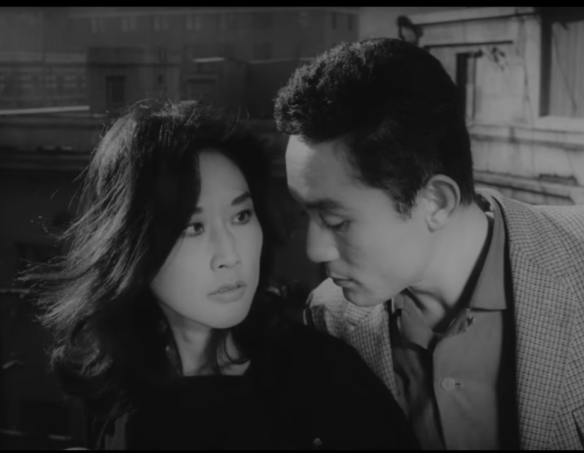
However, there are a couple of high points in an otherwise dreary and oppressive reality. For one, he rekindles an old flame with a nurse (Hye-ran Mun) he knew during the war. It’s nothing too passionate at first, but sweet and affectionate — the kind of romance that people go to the movies to watch. And it feels like a much-appreciated digression from the rest of the film as Yeongho gets back with the alluring Seolhui, who has a smile to light up the screen.

But even her life is far from idyllic. She manages to get by living in a humble apartment way up high and spends her nights unnerved by her next-door neighbor — an unsettled teen boy smitten with unrequited love — who bursts into her room after hours. Peace is nowhere to be found.

Even in one distinctly self-reflexive moment showcasing the nature of movies, our protagonist makes a go at being a movie actor for a brief stint. He finds himself called upon to play a soldier, not unlike his reality in real life. However, the mention of his real wounds — a pair of bullet scars in his side — literally cut to his core wound as a character.

It absolutely scalds him to be forced to dwell on them in any manner. He’s not about to take part in a film trying to capitalize on his hurt, and he stomps out in a rage. Thus, he still has no job, and he’s still disaffected.

What’s so compelling about Aimless Bullet comes with its brand of Korean neorealism because within my own limited grasp of world cinema, it’s something I’ve never been fortunate enough to witness outside of documentary. But the images, matched with the story, tell us so much about the society — what it was still going through — and honestly, how these types of issues feel universal wherever they take place.

While the metaphors are different, the implications are very much the same between Floating Clouds and Aimless Bullets, and they draw on a similar dynamic. Ironically, whether they’re considered enemies or allies, on the ground level, the world feels very much the same.

People are poor, and they can’t get work. Women scrounge for anything they can get and that means picking up American servicemen who are looking for a one-night stand and a good time. There’s nothing more to it than a business transaction.

Meanwhile, the individual and also their related communities are impacted in the most adverse ways possible. One of the characters bemoans the fact people have become burdens for one another these days.

There’s yet another heartwrenching scene on the streetcar. Two strangers are looking down below, grinning at a Korean woman who is romancing an American G.I. Cheolho cuts between them having experienced something much the same with his sister.

Whether or not he heard them entirely, he’s experienced his share of familial shame, and the moments are instantly linked in our minds. In the very same moment, there’s this conflicting duel going on between some bouncy American tune and a more somber Korean song providing another piece of complementary audio commentary. It’s a devastating reminder of what we have observed with this cultural clash.

Ultimately, the brothers have it out because they are prone to two different philosophies — two different ways of life — and yet neither one seems satisfied. Cheolho questions why they have to forget about their conscience and morality to be rich. Because that’s how the contemporary world around them seems to function.

However, Yeongho decides to take matters into his own hands. He gets one of his old war buddies to keep the engine running for him, an acquaintance Miri can vouch for his alibi, and then he proceeds to slip under the shutters of the local bank as it closes. His intentions are made clear enough even as a procession of Christian passerby sing “Nearer My God to Thee” in a highly ironic touch.

How we get from here to our other protagonist eventually bleeding out is anybody’s guess. I won’t pretend to understand everything. However, it underlines the bitter, persistent adversity that proves the bedrock of this story. One brother on the outside wandering like a zombie and the other wounded to his core.

When the film purportedly got banned in some form because of its finale, this feels like a slight misnomer; it got banned because the entire third act is weighed down by tragedy upon tragedy in relentless, pulverizing succession. Don’t expect any relief.

4/5 Stars

Till We Meet Again (1944): Directed by Frank Borzage

Till_We_Meet_Again_poster

This is my entry in the CMBA’s Hidden Classics Blogathon!

The movie is built out of the opening juxtaposition. A youthful nun with an angelic countenance (Barbara Britton) lifts up supplications to her triune God asking for prayers on their behalf — herself and the host of children and other sisters around them.

Their daily discipline is disrupted by a commotion down the road — Nazi soldiers firing after fleeing prisoners. It’s a signifier of tense times, but very real and pertinent ones in a French village plunged deep into Nazi occupation.

One of the girls asks Sister Clothhilde, “What happened outside?” All she can manage in response is that she doesn’t know, nor does she want to know. It suggests the core tenets of her character, maintaining all levels of religious piety, even her own serenity, above all else. She’s cloistered from the outside world.

Because it’s true the convent walls provide a buffer — a peaceful asylum — and for someone like the young sister it’s all she’s ever known and all she’s ever loved. Sister Clothilde is generally content with the amiable life of a nun, taking care of the young children in her dormitory with warmth and diligence. That could be the end of it right there, but as this is a movie, of course, there must be more.

The Reverend Mother has a rather pointed distaste for the Germans (enduring three wars will do that to even the most generous of spirits), but she and the local Major Krupp maintain their etiquette amid obdurate conflict. He has orders to make a search for runaway prisoners, and she is adamant about not opening her doors. For a time they can play the game easily enough, and Sister Clothilde can remain equally ignorant of the world outside.

However, all of this changes with the appearance of a wanted American pilot carrying vital information for the local underground. He all but appears out of nowhere, happening upon the sister quite by accident. In the darkness and the solitude, there is something strange outlined around them. It’s not menace nor romantic melodrama exactly but a yet to be discovered facet in their relationship.

Milland, terse and paranoid, wants to get to his contact and the sister wants nothing of his world. Ultimately, she has no choice but to become a part of it. There is no one else and so she instantly finds herself giving up her small comforts for a mission of immense peril that, coincidentally, takes her outside the walls she’s grown so accustomed to. She goes from a woman of faith to a full-fledged civilian on the outside, given a new name — that of Louise Dupree — and betrothed in marriage.

If there are all the nuts and bolts of a cloak and dagger thriller, these are never a part of Frank Borzage’s primary agenda. After all, he is a far cry from a Friz Lang or an Alfred Hitchcock. I’m thinking of Ministry of Fear or even Foreign Correspondent in particular. Also, although it’s not as robust as The Mortal Storm, Till We Meet Again becomes both an extension of that world and its themes courtesy of screenwriter Lenore Coffee.

What’s evident is Borzage’s forever visible sense of this kind of high-minded naturalism. Where they can momentarily forget the task at hand, that is getting to a distant airbase and freedom, so they can help return a wayward baby bird back to its mother. Is there a need for such a scene? In a word, no, but in Borzage’s conception, this is the more crucial matter because it denotes something elemental.

Man’s duty is not only to his fellow man but to the creatures on God’s green earth. The director gravitates toward acts of care and goodness as opposed to the needless destruction as represented by the Nazis in their brutish, insensitive clumsiness.

Even as they travel together and “Louise” comes to know John as a most intimate friend, she learns a great deal from his assertions. That God is everywhere: reflected in acts of beauty, nature, the vows of marriage, and the goodness that crops up in any person who lives in this world.

It comes through thanks to Milland gushing affection about the marvelous intricacies of marriage between two human beings in intimate union, babies, jam in the morning newspapers, and tripping over the slippers. To her own astonishment, he speaks the words with a kind of devoted reverence. “You say it like a litany — a kind of prayer.”

But to those who think of Borzage as merely a starry-eyed dreamer, the movie is still compelling when they are forced to evade the Nazis, now trailing them with ill-intent and more precise intel. The sense of dread is immediate, and there are stakes.

In another key scene, after she’s done so much on this treacherous journey, the sister makes one false step. Smoke billows out from a dimly lit room, and she rushes toward it to sound the alarm for John to make his getaway. Instead, out steps an old adversary showing himself from under the shroud of darkness.

She is from thenceforward intimidated and threatened in a way that feels so real you can just imagine have it was used against so many victims before her. She has committed an act of treason, put herself beyond the protection of her church, and acted as an enemy of the German Reich. Under such duress, she has every right to feel hopeless.

Instead, she makes a personal judgment, a double sacrifice out of this transcendental love of hers. It’s not simply romantic love but love wrapped up with ideals and goodness that must be shielded from the Nazis at all cost.

They escape to England with Milland, and she lets him go gladly. But the second sacrifice is the Christ-like one. If I have to spell it out for you then the allusion means nothing nor the cross she holds in her grasp. You have to see it for yourself.

Although it’s sublimely sentimental and swelling with angel’s song, this simply means Till We Meet Again is yet another definitive Borzage picture. It’s somehow fitting he would trace the line of religious iconography all throughout the picture even as a woman learns what her faith means in all walks of life.

Far from trivializing it, her vocation feels richer, bolder, and freer than it ever was before. And yet with Borzage, he’s not so much a champion of religious ardor as he is a believer in the grandeur available in life for those who readily embrace it.

These large, esoteric, unsearchable concepts whether they be spiritual, transcendent, or in other ways ethereal are there for the taking. For a humble movie, Till We Meet Again gets swept up with the same scope. Importantly, it’s kept accessible by the candor of Milland and the vestal warmth of Barbara Britton. Because it is once and for all a litany — a kind of layman’s prayer.

4/5 Stars

Operation Petticoat (1959): Blake Edward’s Cheeky Service Sit-Com

operation petticoat 1.png

“On a sub you have to operate in close quarters.”

Operation Petticoat positions itself as an easy film to enjoy and a difficult one to love. It’s true Blake Edwards was capable of stirring up breezy even wacky entertainment, from Breakfast at Tiffany’s to The Pink Panther to The Great Race. Even this is only acknowledging a very small subset of his filmography without consideration of the several exemplary dramas he directed.

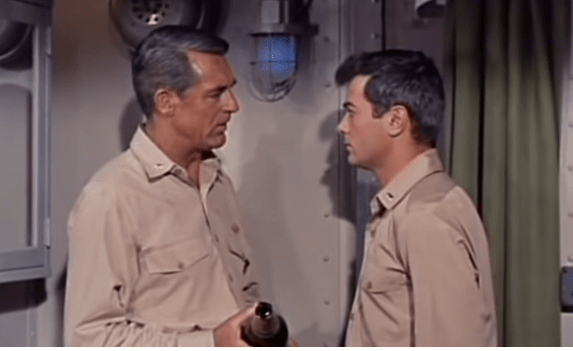
He was usually aided by fine casts, who could carry the material smartly, and it’s little different here. Cary Grant was hardly ever ruffled nor stretched in his later career, and Operation Petticoat could hardly be considered more than a lark for him. He plays his quietly bemused self — this time a submarine Lt. Commander, who must make the most of a wonky situation following the attack on Pearl Harbor. 

For his part, Tony Curtis is all but at ease as the wheeler-dealer with a touch of sleazy class. Let’s just say he’s got an affinity for the finer things in life and the ladies who can give it to him. It’s generally a delight to see Cary Grant return to a sub after Destination Tokyo, this time joined by Curtis, who looks to be relishing going toe-to-toe and rustling the feathers of his boyhood idol.

Forgiving the shameless pun, without its two stars, the movie would be sunk by mediocrity. If we want to give a slightly backhanded compliment, Operation Petticoat is a fitting precursor to some of the popular sitcoms of the ’60s.

Helping the argument are the presence of Gavin MacLeod, Marian Ross, and Dick Sargent representing, of all things, McHale’s Navy, Happy Days, and Bewitched. And of course, although it transposed the action of a submarine crew to a rural locale, one cannot forget Petticoat Junction.

Like McHale’s Navy, it would be all but impossible to pull off the wartime comedy set in the aftermath of Pearl Harbor if we hadn’t at least won the war. This gives freedom for some creative license and a bit of zaniness sprinkled in with the typical military fare. One must only remember one gag recycled in the TV show, namely, sinking a truck with a torpedo.

Before they can even get afloat, they have to put their belching sub back into working order. The man up for the task is their latest addition Lt. Holden. Though the commander doesn’t relish the idea, he turns the other way and lets his junkman get to work pilfering everything he can get his grubby hands on. He’s able to do what no one else could, securing all the parts (by dubious means) to get them back in commission.

If we want to point out the film’s flaws, it takes about an hour to really churn up some steam by entering the waters of a 50s era rom-com afloat in awkward waters. Because once they get past the fear that the Sea Tiger will fall apart around them, they find their newest conundrum. They are being tasked with accommodating a batch of stranded nurses. It just isn’t done. It isn’t decent. And yet somehow in this film it happens and, subsequently, becomes the source for most of the comedy.

Quite mysteriously, all the shipmen aboard fall ill and need medical attention from the nursing staff. Their commanding officer all but scares them back to perfect health. Holden is all but smitten by bodacious blonde, Dina Merrill, who has the ill-fortune for always falling in love with Mr. Wrong. He’s not exactly the prototypical image of the upstanding, clean-cut boy next door.

Major Heywood (Virginia Gregg) strikes up a boiler room romance with the local fix-it man (Arthur O’Connell) because she proves just as resourceful as he is. He’s forced to mince every small-minded word he ever said about women and washing in his workspace. Commander Sherman is hardly on the lookout for such flings, simply trying to navigate their highly irregular and awkward situation and the perpetual clumsiness of Nurse Crandall (Joan O’Brien).

Between designated shower times for the ladies, the sharing of pajamas between co-eds, and allowing for Lt. Crandall’s curvaceous figure in the tight quarters of the submarine, he gets more than he bargained for, all played for wry comic effect, of course. It’s these later interludes milking the sheer awkwardness that exhibit touches of redolence on par with Pillow Talk or any such brethren. It’s a reason to miss the films of old. Cheeky and more brazen than expected, but mostly good-natured, especially compared to the hypersexualized culture we now live in.

operation petticoat 2.pngVarious scenarios spring to mind of farcical hijinks worthy of McHale’s band of Eight Balls. Prime examples are Holden setting up a supply depot casino to wrangle parts and even resorting to pig-napping to augment their New Year’s festivities. Seaman Hornsby causes quite the stir and in order to hold onto the plump porker, Commander Sherman generously opens up his subordinate’s quarters so a disgruntled native can raid them in recompense. He comes away with a golf bag, tennis rackets, and all the doodads you can imagine.

In another stroke of brilliance, some Einstein has the foresight to mix white paint with the red so they have enough for a new coat. For any of those who passed preschool, that makes — not gray — but pink. When they’re not picking up more passengers and wayward goats, babies are being born in the makeshift ward.

 The most cringe-worthy moment comes when they get caught in the crosshairs of a friendly battleship looking to sink the unidentified, highly irregular submarine. As one last resort, they signal their allies with a trail of women’s undergarments. Surely the Japanese would not resort to the same tactics. 

The resolution to the story is fit for the crowd-pleasing, sunshiny rom-com we’ve been offered. Cary and Tony say a cheering goodbye to their old friend The Sea Tiger, and we get some novel if unsurprising exposition about their love lives. In case you didn’t guess as much, a movie about a pink co-ed submarine is not going to push your brain or the envelope. For the generous viewer, it’s intermittently mirthful and relatively harmless amusement not to be taken too seriously.

3/5 Stars