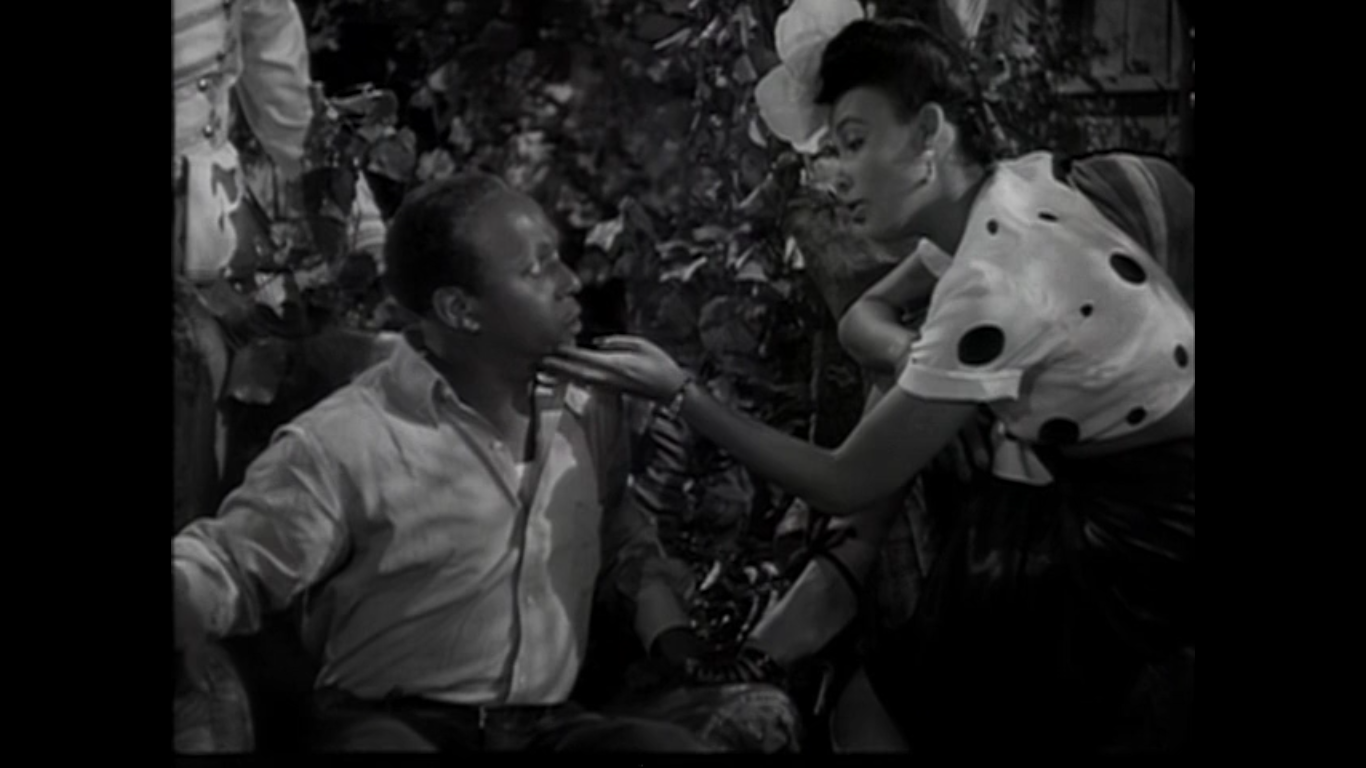
Hallelujah (1929): Daniel L. Haynes and Nina Mae McKinney

Hallelujah (1929) is one of those films that takes some leg work in order to grapple with what it fully represents. But like some of King Vidor’s broadest, most humane portraits, it has moments pregnant with all sorts of residual meaning.

We begin with iconography that feels troublesome even as it feigns authenticity. Happy-go-lucky Blacks sing a joyful chorus of “Swanee River” as they labor in the cotton fields. We are still on the cusp of the sharecropping generation — Blacks who lived resolutely poor — where Jim Crow regulations prolonged the Antebellum-era oppression.

Zeke (Daniel L. Haynes) is a stout-hearted man with broad shoulders, who exudes a jovial spirit. Life is hard, but his family is close-knit, and they find ways to glean contentment out of every day. This is Vidor’s glorified nostalgia for the cotton fields and spirituals from his childhood.

It brings to mind an excerpt from Frederick Douglass’s autobiography that frames these images quite differently. He says the following:

“I have often been utterly astonished since coming to the north, to find persons who could speak of the singing among slaves as evidence of their contentment and happiness. It is impossible to conceive of a greater mistake. Slaves sing most when they are unhappy. The songs of the slaves represent the sorrows of his heart, and he is relieved by them only as an aching heart is relieved by its tears.”

Later, Zeke is confronted with human urges; in one solitary moment, he’s overtaken by the devil, kissing a young Black woman as she plays the wedding march for the ceremony right outside. Far from simply being a warning peal of drama, it suggests an inherent predilection toward lust in the man’s heart. It has nothing to do with race, but the insinuations are clear.

Now it’s easy to cast King Vidor as another southern boy in the mold of D.W. Griffith and though Hallelujah feels a fair bit more palatable and life-giving than Birth of a Nation (that’s not too difficult), there’s no doubt it still caters to an archaic and paternalistic view of Black culture.

There is a Mammy character, and she sings the children to sleep, rocking away, after a long, hard day in the fields. Then, she gives her oldest grandchild a playful smack on the rear. He’s too big to be cradled in her arms.

The world is saturated, even inculcated by prayer and song because these are the sinews that keep families together in a harsh life of daily toil and systemic oppression. And yet the movie remains as an almost one-of-a-kind relic chock full of the kind of recorded history we can imbibe no other way. At the very least, Vidor’s intentions seem sincere.

However, we must also acknowledge Nina Mae McKinney, who became one of the pioneering Black film stars of the 1920s no matter how brief her time in the spotlight was. Her Chick is frisky and full of joy in the dance hall, but she’s also in cahoots with a gangster, duping drunks out of their hard-earned cash.

McKinney, a mere teenager during filming, lights up the screen in a way that feels incandescent, acting as a precursor to other musical talents like Lena Horne and Dorothy Dandridge — women who were only allowed a small amount of cultural currency in Hollywood’s landscape.

As she seduces Zeke, we come to realize, that it is from her role we get other saucy street tramps like Georgia Brown and Carmen Jones. Again, we must reckon with archetypes being propagated in front of us that were simultaneously groundbreaking and injurious.

With Zeke caught in a war over his soul and the casting off of his lusts, he gravitates back toward the church, devoting his life to becoming a preacher, and we are reminded of what a seminal force the Black Church and gospel music was and still remain.

When Zeke rides a donkey into a town for a religious revival, only to be accosted by two very familiar figures, the biblical imagery is not lost. No matter how besmirched he was in the past, his zealous transformation sculpts him into a Christ-like figure mocked by the sinners in his stead.

The latter half of the picture is enveloped by these scenes of euphoric, clamoring, overwhelming spiritual revival. What’s striking about them is how they don’t feel done up in a Hollywood fashion. They feel raw and real, where the music is organic and not merely a musical aside to spruce up a broader narrative. Otherwise, Hallelujah finds itself wallowing in morally inflected melodrama punctuated with quite the surprising chase scene through the muck and mire of a swamp.

Of course, it must settle back into its contented status quo brought about through the continued power of song and the lasting stability of the family. It is a happy ending, although for Blacks living and working in 1929, on the eve of the depression, you wonder if such a thing was even possible.

It’s not meant to be a judgment on anyone, but I do find it intriguing that for all the lasting stereotypes and any of the elements that might ruffle modern sensibilities, there’s something stirring about seeing these performers burgeoning with joy and emotion.

Mind you, it’s not something found in the construction of the plot. These are the made-up faux realities that stink with the stereotypes of the time. But when we’re able to get away from that, even momentarily, it feels like there’s still something lasting about Hallelujah because suddenly it becomes about irrepressible humanity — people, resolute and proud — and it’s not something foisted upon them for the sake of an audience.

There are moments in Vidor’s picture where his performers get to be vessels of dignity before sinking back into the dated rhythms of the narrative. For better and for worse, this film would beget many progeny and be one of the foremost purveyors of Black representation moving forward.

For that, it is a landmark and that’s not an entirely auspicious distinction. Movies like Green Pastures (1936) and Cabin in the Sky (1943) are built right out of this tradition making Black culture a sometimes overly simplistic amalgamation of religiosity and fervent song.

There seems no better place to end than with the words of the film’s mostly-forgotten star Daniel L. Haynes: “I cannot say what our race owes King Vidor and Metro-Goldwyn-Mayer — there are not words forceful enough for that. Hallelujah will, as Moses led his people from the wilderness, lead ours from the wilderness of misunderstanding and apathy.”

These words feel simultaneously deeply optimistic and effusive in their praise while underlining some of the lasting issues endemic to the film and the historical moment. We must deal with it all in kind.

3.5/5 Stars

Afire (2023): A German Summer Movie a la Rohmer

Christian Petzold is a filmmaker I was introduced to over a decade ago, and I would consider myself a passionate fan. I’ve seen every one of his films since then, and I would gladly share him with anyone who might listen. There’s some pleasure in championing a director who’s not as much of a household name as one might hope. 

The other wonderful thing about Petzold is what an ardent cinephile he is, but he’s also quite loquacious and charismatic. Obviously, English is not his first language, but he always does wonderfully candid and thoughtful interviews all across the festival circuit. I can imagine he would be quite the person to grab a coffee with. He’s shared on multiple occasions how he crossed paths with Abbas Kiarostami in New York City under such circumstances. 

Forgive me for burying the lede, but I appreciated Afire because, like many of the director’s earlier films, it does feel like it’s deep in conversation with the vast annals of cinema. 

This one in particular feels like a paler, pudgier version of an Eric Rohmer movie. Something in the vein of La Collectionneuse, Pauline at the Beach, or even A Summer’s Tale. I felt vindicated hearing that Petzold was in fact consuming some Rohmer films during the pandemic, but that was only part of his inspiration. 

Reading an interview he cited a significant reference point for his latest effort in People on Sunday. It’s not a film I would have considered in a million years because it’s well, almost 100 years old. But in regard to this allusion, he makes a fascinating observation. 

Unlike Hollywood, Germany doesn’t have a lineage of summer movies about the last day of school or hanging out at the beach with no adult supervision. There’s also no Summer with Monica or Eric Rohmer. 

With men like Billy Wilder, Edgar G. Ulmer, Fred Zinnemann, and Robert Siodmak — all creative collaborators in People on Sunday, they were forced to leave Germany. And when they moved to Hollywood in the wake of the Nazi scourge, their work got harsher with the likes of Detour, Lost Weekend, and more film noir.

The summer had vanished not only from their filmographies but from Germany as a whole. The nation rarely got this opportunity with the ascension of the Nazis and this historical backdrop gave rise to many of the specters which have haunted most of Petzold’s oeuvre.

If you wanted to make a case, Afire is actually Petzold’s most comedic film to date and his closest to romantic comedy. Leon (Thomas Schubert) is staying at his friend Felix’s idyllic summer home out in the forest near the Baltic Sea. They think it’ll be a great place to get away: Leon needs to finish a manuscript and Felix (Langston Uibel) has an art portfolio to complete though he seems far more at ease and prepared to make the most of the tranquil surroundings. 

It starts out as the vacation from hell we might all be familiar with to different degrees. First, their car breaks down, they get lost taking a shortcut, and it looks like Leon might be stranded out at night in the forest with no cell signal. Felix goes off to make his way to the family cabin. 

Eventually, they get there. Except it turns out they won’t be alone. A co-worker’s daughter has set up shop; we don’t know for how long or why. We just know Leon’s plan for an uninterrupted getaway is catastrophically ruined. Strike two. 

The walls are thin and you can hear everything…It makes sleeping very hard and Leon’s even grouchier than he was before. The incessant bugs and the impending fires don’t do much to lighten the mood. 

Leon also seems genetically predisposed to be a moody, pretentious misanthrope of the first degree. Felix is good-natured and thoughtful. He would never think to impose himself on others or make a stink. It comes naturally to Leon. 

The camera takes on his surreptitious gaze which makes me uncomfortable as he spies on their housemate out in the yard before ever officially meeting her. Still, nothing he does can negate Paula Beer. In her work with Petzold, she always comes off as such a charming and intelligent performer who gives so much to the camera. 

Between her last film Undine where she played a modern-day mermaid, and Afire with its landscape ablaze, there’s this pervasive sense of the classical elements permeating the collaboration. It’s this lovely amalgamation of the deeply modern with the primordial. It makes one wonder where Petzold and Beer might go next. 

In the previous film, she was a docent focused on Berlin’s history of urban planning. Here Nadja works at an ice cream stand doling out flavors of “Smurf” sherbet. She’s disarmingly straightforward, cutting through any pretense. It makes her immediately attractive as a personality.

Whereas Leon’s a perpetual excuse machine. He never swims or takes anyone up on anything. He’s the kind of person you try to be nice to by inviting them to stuff even if you don’t want to, and then they decline so many times, you feel exasperated. They’re too blind to recognize you’re trying to do them a favor.  

Leon should be a lost cause, and yet even if we don’t particularly like him, we can empathize with him, and I think all his acquaintances in the movie make us appreciate him a little more. 

Later, at an open-air dinner, he lashes out at the rescue swimmer Devod. He feels like a stereotypical beefcake, and yet belies the image making Leon all the more uncomfortable. Because their new acquaintance was sleeping with Nadja, but he seems like a genuinely nice guy. These don’t have to be mutually exclusive. 

At first, Leon’s defensive about sharing his work; I recognize what a private and vulnerable thing it can be, and still, I wouldn’t give him that much credit. After Nadja asks to read Club Sandwich, he eventually relents. One suspects it becomes a mechanism to try and get closer to her and into her good graces — a way of covering his growing insecurities.

Leon’s also made a big deal of setting up time with his bespectacled editor (Matthias Brandt) to review his new work. He’s an older veteran, not unkind, but extremely busy. It turns out the full weekend they were meant to have together has been whittled down to one full day and some change. After Nadja invites Helmut to dinner, Leon grows jealous when it seems like everyone else gets a piece of him too. 

He takes great interest in Felix’s art portfolio – the one that Leon either didn’t get or totally disregarded. Then, Helmut trades poetry with Nadja; she recites her favorite poem, “The Asra.” It comes out she is working on a Ph.D. in Literature on Heinrich von Kleist’s The Earthquake in Chile (What she terms the “quake of representation”). 

Leon’s pettiness feels like a symptom of his own making. He knows Club Sandwich is crap. Nadja was honest enough to tell him as much. But he tried to dismiss her criticism; she’s only an ice cream seller. 

He never thought to ask her about what she might be studying. And now with the recognition that not only is this girl better looking than him but also perhaps smarter as well, it’s more than his fragile ego can take. 

Everyone else seems casual and comfortable, enjoying the throes of what summer has to offer. He’s the only one in obvious crisis, slowly imploding until the world around him joins in. 

The fire which was always hinted at continues to rage ever closer. Ash falls over their world like a ruinous dusting of snow. The boys go to tow their car with a tractor. Helmut starts to convulse on the lawn and Nadja takes charge to rush him to the hospital.

I noticed one particular jump cut in the editing involving Leon. He realizes he’s made a huge mistake; he’s been selfish and incapable of doing almost anything. What’s more, what will Nadja think of him? 

The raging conflagration brings with it human tragedy that strips away any remnant of sun-soaked vibes and focuses our story on its purest elements. As we should expect, it goes darker, but there’s another turn in the story. Our perspective changes subtly.

Nadja and Leon are called into the hospital again. There’s pensive voiceover narration to go with the images, and we realize intuitively even as the actions happen in front of us, somewhere in the present or future Leon is writing a new novel. 

I’m led to question if it’s still callous that he seems to be writing the story as the events seem to be happening or is it the most authentic thing he’s ever done? I’m not sure.

Later, he sees Nadja again from a distance. Some time has passed. We’d like to think he’s changed, and we know he’s wracked with guilt. Their eyes lock in recognition. Petzold cuts before there’s anything else, and it feels like the quintessential ending. We can fill in the rest with whatever we want.  

I’m still trying to get my feelings in order, but it delivered like Petzold always seems to. It’s deeply observed and engaging with its perceptive vision of humanity and interpersonal relationships. But what makes it richer comes with how the writer-director takes a simple premise and simultaneously imbues it with all this intertextual meaning. 

His references are not always overt, but couched within his stories are the echoes of his nation’s films as well as literature and mythologies – many of his projects over the years have been adaptations of much older work. In our current age of cursory knowledge and vapid fads, he’s a refreshingly thoughtful filmmaker. I’m still holding out for that coffee someday, preferably at Berlinale. 

4/5 Stars

Past Lives (2023)

A version of this review was published on Film Inquiry.

I’ll admit that in our modern world and hyperactive lifestyles full of constant distractions and competing spectacles, I’m thankful I was able to watch Past Lives the old-fashioned way. I sat there in the dark with other strangers uninterrupted by the chaos of the day. It was an uneventful weekday after work with no baggage or preconceptions. And I sat there prepared to imbibe what it had to offer.

The movie is the epitome of contemplative, meditative cinema. In a different context, under different circumstances, I can see the spell of the movie being neutralized and the surrounding chaos. As is, I was met head-on by what it had to offer.

The opening scene almost feels like a mini Godfather moment a la Gordon Willis. The golden hue of the lighting, the camera slowly moving toward a subject in the foreground as voices offscreen speak so we can hear them. It’s a brilliant device to set up the scenario. A male and a female voice chat back and forth. They’re people watching from the opposite side of a bar as a Korean man, a Korean woman, and another white man sit together in quiet conversation. What a strange trio they make.

It’s true that in such moments there are so many stories you could draw up to try and justify the scenario. Celine Song takes an entire movie to explain it to us. The heart of her story opens with two young kids in South Korea. They’re competitive when it comes to their grades, always dueling between being 1st and 2nd in their class. Hae Sung makes Na Young cry by beating her out one day, but regardless, they always walk from school together. They haven’t quite figured out what romance is, but there’s a closeness between them. They’re fast friends.

However, when her dad decides to immigrate overseas, “Nora” must relinquish this friendship for whatever the future holds. In camera, we watch their diverging paths as they trudge their separate ways. She will go first to Canada, and then America to seek out her dream of winning the Nobel Prize. He will stay behind in Korea.

Song’s use of time is self-assured and brazen. She’s loose and elastic with it bravely allowing her story to cut 24 years into the past before fast-forwarding 12 years and then 12 years again. But these jumps in time feel subtle and right with the perfectly applied sense of space and context. We never feel like we’re being rushed. The elliptical nature of a single cut is imbued with so much power.

They reconnect by chance 12 years later, thanks to Facebook, and rekindle a friendship over Skype. This specific moment in time feels intentional. Long-distance friendships or even relationships are hampered by the shoddy technology. What we have now cannot totally replace in-person interaction — we all know that — but it’s lightyears ahead of what we had even 10 years ago.

Nora’s life is taking her into the literature circles of New York including a writer’s retreat for up-and-coming talent. He is attending a good school in Korea. They’re amazed to see each other: they’re changed and yet nothing has changed. If you’ve ever had a similar experience you know this paradox to be true.

Song conjures up this idea of In-Yun or destiny which infuses Korean culture and implies something between people in their past lives together. In modernity, it might only be utilized as a pickup line, but for sincere, starry-eyed lovers it might just carry some weight and lend a sense of comfort. Any interpersonal connection may apply.

There is a sense that Hae Sung and Nora are in their very specific orbits and they are not prepared to fight the inertia around them. Nora takes the first step and asks to stop their online rendezvous. It’s too painful to live in the uncertainty with little hope of change. She takes a leap of faith in her career meeting fellow writers with similar ambitions. One of them is named Arthur (John Magaro). Their orbits are leading them in the same direction and so eventually they get married.

Lying in bed together having one of those late-night conversations on the edge of consciousness Arthur asks her one of those what-if questions about where she ended up. She responds matter-of-factly, “This is my life.” She seems satisfied with that. Her husband admits something else to her. Sometimes he hears her talk in Korean while she’s sleeping. It’s heartbreaking to hear him admit that she dreams in a language he can’t understand…It’s not wrong nor does it mean they can’t make their way together, but it matters to him. Because he wants to know her intimately. It’s important to him.

I have issues with Lost in Translation, but there is something about that film that sticks with me — the loneliness and malaise — as much as the Tokyo streets I dearly love. As best as I can describe it Past Lives, is born out of this same tradition. There’s a delicacy and dignity to these people. It could bend so many directions — choose so many roads — and in the end, somehow it chooses the bravest one.

In another film, in another world, maybe in a past life, there could be a passionate love affair between two people who seemed to be destined to be together. These are the stories our culture seems to eat up because they make us feel good and vindicate our desires to live out our best lives — the lives that make us feel the most validated regardless of others. Or it could be a sordid melodrama where the Korean couple cross time and space and the white spouse is cast off like the cultural patriarchy readily pulling them apart. The movie wryly acknowledges this narrative trope. Of course, none of this is true.

Past Lives foregoes all of these ideas while simultaneously tapping into the longings many of us have deep in our hearts and still allowing them to play out in meaningful reality. It feels true and right, like things are meant to be. We can see this story occurring naturally with genuine people. And the emotions engendered feel beautiful.

Of course, 12 years after they broke off their internet relationship Hae Sung finally comes to the U.S. — to New York. Ostensibly it’s for some rest and relaxation, but everyone knows his only reason for being there is to see Na Young again. Their reunion is pregnant with all sorts of import, and they visit the Statue of Liberty together surrounded by a sea of couples. Just imagine how it is when he finally meets the man Greta ended up marrying. Uncomfortable doesn’t even begin to describe it. There’s so much more here.

I could write a whole exploration of code-switching and cross-cultural communication, international dialogue, and subtitles in film. However, I will only say Past Lives replicates the joys and genuine struggles of existing in this world in-between cultures and languages.

Greta Lee is such a phenomenal conduit of this drama, and she takes every scene with a self-assured composure full of warmth and feeling. Teo Yoo has a forthright candor morphing from a boyish heartthrob to a man still grappling with unresolved feelings.

John Magaro could easily be a whiny-voiced annoyance — the white evil of the movie — and yet it’s a credit to his humanity that we like him and even empathize with him (especially if we don’t speak Korean like this viewer). It’s almost like we’re there sitting at the bar in what feels like a private conversation that we don’t understand. It feels a bit awkward, but there can also be a connection there. If you will, it’s in-yun.

Nora cries at the end of the movie. Her husband takes her in his arms as they walk back up the steps to their apartment. The perceptiveness of this moment cannot be simply attributed or articulated. I don’t have the capacity to totally explain what emotions have come to the fore. All I know is that they are there. It’s perplexing, but in the way I like my movies to be.

In Lost in Translation, I’ll never know what Bill Murray whispered to Scarlett Johannson. Here we’ll never know what could have happened or why she’s crying exactly. Maybe she doesn’t even know herself. But living out that ambiguity feels key and ultimately true to the human experience.

We’re always looking to discern what our future will be. Religious people question God’s plan for their lives. And often we have the nagging thoughts of what-ifs and how things could have been. Perhaps I’m the only one who thinks like this. But Past Lives seems to suggest this is not the case. I’m still mulling over the movie, but I’m glad I saw it. Hopefully, you will be too.

4.5/5 Stars

Hiroshima, Mon Amour (1959), Nevers, and Casablanca

“Like you I know what it is to forget.”

Recently I’ve been meditating a lot on the impact of the atomic bombs in part because of the resurgence of the life and work of Robert Oppenheimer; he will be inextricably tied to Hiroshima and Nagasaki for posterity’s sake. Thanks to Alain Resnais’s film, Hiroshima and Nevers will always have a connection in the minds of cinephiles everywhere. 

Although I have walked the streets of Nagasaki and been to the memorial museum there, most of what I know of Hiroshima is gleaned from John Hersey’s journalistic account. The documentary footage from this film never ceases to scald my senses. I have to avert my gaze when the images grow harsher than any horror film imaginable. 

Hiroshima, Mon Amour gets much of its thematic resonance out of filming in Hiroshima itself because it comes with an abundance of inbred meaning; it will be ground zero of devastation and a beacon of peace for perpetuity now, ever since that day on August 6, 1945. 

This lays the groundwork for the film’s first half as we consider Hiroshima – the images primarily being juxtaposed with two bear bodies of a couple intertwined. 

It slaloms so effortlessly through time and space like few films before or after. Although as it progresses, the way the film and its characters are set adrift by the editing is increasingly unnerving. This in itself feels honest to where our characters find themselves. 

There’s something rhythmic, repetitive, and still poetic about their questions and responses conjured up by the voiceover penned by Marguerite Duras. It builds this contrast between the French actress filming an international movie in Hiroshima and the Japanese Architect that she’s having an affair with on-location. They only have one day together before time and space will pull them apart, potentially forever. 

In truth, once you know a little bit more about Resnais, it gets harder and harder to separate his film from this kind of relativism of the age where truth seems to be subjective and everything we seemed to take for granted before, from absolute truths to morals, seem to have totally eroded around us. 

Even with this perplexing development denoted by Resnais’s fairly oblique style, brought to even greater fruition in Last Year at Marienbad, it’s hard to discount the swaths of beauty in his film. And if it is mostly an agnostic film, one cannot totally dismiss this point of view in a world coming to terms with carnage and the brutality of the atomic bomb. Because this disillusionment does have an amount of warrant, arguably more than any other time in modern history. 

The movie becomes this roving portrait involving a want of intimacy and closeness in a world ravaged by so much pain and suffering. Is it any wonder that in the post-war years plagued with the atomic threat, the world hit its baby boom. Couples coming together to start their nuclear families as a balm to the hysteria in the world at home and abroad. 

They both say they are a happily married man and a happily married woman, but even this I read almost ironically seeing the connection they form. If they are culturally worlds apart, somehow they share in the same traumas of a post-war, post-atomic generation coming to terms with all that entails. 

He has the specter of Hiroshima to contend with and she was castigated for loving the enemy during wartime: imprisoned, her head shaved, while also seeing her lover die in her arms. They’re different experiences and still share something endemic to both their realities. Thus, they gladly share a real-world romance on the edge of the apocalypse as time is slipping away from them. For now, they have tangible passion and meaning that they can caress in their arms. 

There is a passage in the movie that felt reminiscent of the jaded pessimism of the ancient wisdom literature of Ecclesiastes: 

He: Maybe it’s possible for you to stay.
She: You know it’s not. Still more impossible than to leave.
He: A week
She: No.
He: Three days.
She: Time enough for what? To live from it? To die from it?
He: Time enough to know which.
She: That doesn’t exist. Neither time enough to live from it. Nor time enough to die from it. So I don’t give a damn.

There’s a fluidity to the night and their relationship as the clock ticks and they know they will be pulled apart. Eventually, they make their way to a late-night cafe called Casablanca. The name carries with it all these connotations: Rick & Illsa, “As Times Goes By,” “La Marseillaise,” and even bits of your favorite dialogue.

Of course, one of the finest remembrances is “We’ll always have Paris.” Nothing can strip these memories away from the Casablanca couple regardless of sacrifice. Somehow there’s something honest about Hiroshima, Mon Amour in that it recognizes all these things are transient – these memories of love will pass away. They are already dissipating, and not as eternal as we would like to believe. 

More and more I see the shared vision of Agnes Varda’s La Pointe Courte and Hiroshima, Mon Amour – finding their form as part documentary, part romantic treatise. It’s the blending of the two giving them body and making them sublime. 

Here the performers also work wonders. Emmanuelle Riva has the most vibrant eyes in the cinema. They are a delight to look at in the light of the camera both glassy and at times equally melancholy. It’s her film debut and you would never know it. She’s youthful and lithe, yes, but there is so much depth to her. Call it self-confidence with the prerequisite vulnerability. 

Eiji Okada seems ruggedly handsome, but not without the capacity for gentleness. It feels as if he’s experienced an entire lifetime during the war years which in part was true. The only reason he foregoes the horrors of Hiroshima is that he was off fighting in the war with the Imperial Army. 

I read that all his French dialogue was memorized phonetically and if that is the case, although I don’t always have an ear, it came together splendidly, never pulling me out of the story. It felt real and believable to have these two people relate in such a way. 

What’s more, as someone who grew up in a culturally mixed environment, Hiroshima, Mon Amour stands as a groundbreaking depiction of a couple who plow through the societal conventions of the times.

When I watch this film it’s about so much more than the bomb. On the surface, it’s about an illicit affair that cannot be, it’s about two people coping with the fallout of war, and one woman’s struggle to hold onto her memories and cling to the love that’s still there in her life before it evaporates before her. How she cannot forget this man in Hiroshima or that man in Nevers because they are tied to emotions and specific moments in time – times when she felt something.  

Somehow it parallels what the film itself represents. Because it is a document as much as a piece of art. It came out about 14 years after the bombs were dropped. Somehow still fresh and a minor lifetime away from the fallout. These people have living memories to contend with. 

Someone like me does not and so the film is as much about these character’s memories as it is the visual representation of the film itself so we might never forget what those places represent in the cry for universal peace. 

Watching it in a theater I could sense a level of perplexity in the air. It’s not an easy film. Not everything makes sense, and there’s some troubling conclusions that you can come to. Also, one earth-shattering slap in a cafe is hard to deal with. Still, in the wake of all of this, it’s hard to reject the moments of beauty present here. I don’t think this is a mere justification. 

Rather I watch a movie like Hiroshima, Mon Amour where not everything is summed up or painted in full. We must leave with the impressions, the maddening anti-literalism of the piece that has no point-for-point attributions we can easily plug in. Nothing comes out in a nice bow nor do we get a true emotional resolution. It just kind of hangs in the air for us to consider in full.

But sometimes this hard work when something is perplexing feels all the more worthwhile because it provides something worth going back to so we might cull for something new. I’m never going to understand every grain of this film, and that’s okay. 

The distinction is having something to fall back on. When memories fade and we forget and the world seems to be fragmenting around us, it helps to have some standard or reference point outside ourselves to mediate the chaos. 

Otherwise, what’s the point if there’s no time to live and no time to die? What hope is left in such a debilitating landscape? On top of that, there’s a bomb that might just easily blow us all to smithereens. We require something more. 

4.5/5 Stars

Oppenheimer (2023)

Being a history aficionado I pored over American Prometheus by Kai Bird and Martin Sherwin, which provided the inspiration for Christopher Nolan’s latest film on J. Robert Oppenheimer.

So many ideas were swirling around my brain when I entered the theater, but the first is obvious and it’s where Nolan begins: In Greek mythology, Prometheus took fire from Zeus, gifted it to humanity, and then was castigated for it.

Obviously, it’s easy to cast Oppenheimer as one of the most important figures of the 20th century since he was the “Father of the Atomic Bomb,” but he was also one of its greatest tragedies. There’s a scale and scope to this narrative woven right into the very fabric of history.

My other thought is a far more intimate detail but equally telling. Although he spent much of his time teaching at Berkeley and Cal Tech, Robert had a deep abiding love for the wide-open New Mexico territory where he kept a ranch and often went horseback riding. It was the first time I realized that Los Alamos and the outpost for the Manhattan Project was not some arbitrary place chosen by the government. It held such deep ties to who he was as a human being and what he held dear.

American Prometheus is a vivid and fascinating historical tome, but one can imagine the difficulties in adapting such a massive work. Nolan comes at it ferociously turning the historical details laid out before him, into something unequivocally cinematic.

A whole movie could be borne on Cillian Murphy’s face and it is. Between his vivid eyes, gaunt contour, the porkpie hat, and pipe, there’s something instantly iconic about him. He’s haunted and profound even before he says or does much of anything.

It’s dizzying watching Nolan develop the rich world around Oppenheimer packed with substance — a real world of real people and events we get to experience firsthand. This immediacy is key and although I’ve read the book, I don’t think you’re required to keep it in your back pocket.

The movie creates a complex constellation of relationships. These include important people in his life personally like Jean Tatlock (Florence Pugh) and his future wife Kitty (Emily Blunt) or his intellectual heroes such as Niels Bohr (Kenneth Branagh) living before us. I appreciated how we are thrown into his existence without true introductions or pretense.

He also punctuates the drama with mid to minor cameo parts taken on by notable actors like Josh Hartnett, Casey Affleck, Gary Oldman, and Rami Malek. This punch of celebrity does yeoman’s work in creating recognition in his audience regardless of historical knowledge.

Oppenheimer’s early life comes whizzing by us with so many stimuli and swirling jumps in location and setting that it feels like the cross between a globetrotting action movie and the roaming panoramas of late-period Terrence Malick. Nolan trusts the audience and expects them to pick up the pieces.

What differentiates Nolan’s work from his source material partially comes down to the visual flourishes at his disposal but also the ingrained structure he uses to mold it to his own vision. He effectively creates a narrative tension between fusion and fission as denoted by the alternating scenes of color and black & white framed by the two contrasting hearings.

The director has noted Amadeus (1984) among his reference points for his latest project because it is a character study functioning in a kind of duality. Mozart’s exasperating genius is framed by the point of view of his rival Salieri. Albeit our “Mozart” feels far more sympathetic, and our “Salieri,” well, you must make up your own mind.

Nolan does something narratively brilliant by providing us Strauss’s perspective juxtaposed with our protagonist. Lewis Strauss was a member of the U.S. Atomic Energy Commission and played a crucial role in Oppenheimer’s government clearance being stripped in 1954.

I read the book and despised Strauss as well as the prosecutor Robb (Jason Clarke) because of what they had done to Oppenheimer. But Nolan for a time strings me along even with this pre-existing knowledge so I begin to empathize and even get inside the interior life of this man. The doubts set in. Perhaps I misconstrued the facts as I remember them. He’s not all bad.

And yet when the vindictive pettiness that was there the whole time comes out again, it was somehow a shock and also an affirmation of everything I thought this man to be. Still, Nolan was able to encapsulate and still obfuscate this strange dynamic between these two men.

Robert Downey Jr. also must be given credit in a role that relies on his acting chops more than his wry charisma. I’m not always a fan of actors aging into roles like this, but I’m sure he’s going to surprise more than a few folks in the audience.

As the movie hurtles toward the apex of the Trinity test with the race against the Nazis at full tilt and Oppenheimer shouldering this massive project alongside General Leslie Groves (Matt Damon), we all know innately where we are going. These moments speak for themselves. I wouldn’t dream of trying to distill this suspended moment in time with a few inadequate lines. You must contend with it yourself.

However, with all that happens in Oppenheimer, I’m still trying to figure out if the structure works exactly because we spike with the Trinity test and still must witness the hearings and Oppenheimer’s gradual martyrdom.

It certainly maintains a breakneck pace that kind of overwhelms you in a way that’s never boring. The lengths of scenes, the cross-cutting, and the non-linear jumps through time and space are probably the writer-directors greatest attributes.

Ultimately the meeting between Einstein and Oppenheimer that Strauss only caught the tail-end of becomes a kind of lynchpin moment plucked out of time. In some ways, it does feel like a continuation of Dunkirk and Nolan’s deep commitment to the manipulation of time. Chronologically this is relatively early in the story and yet he somehow builds it to be the beginning of the end exploding into our current modernity.

There they stand on Princeton’s campus together meeting again. Oppenheimer reminds his elder of his biggest fear: That the construction of the bomb would conceivably set off a chain reaction destroying the world.

“What of it?” Einstein asks.

Oppenheimer responds, “I believe we did.”

It’s a sobering ending as nuclear imagery engulfs the screen once more. Because as an audience in the 21st century, we must reckon with a changed future imparted to us by Oppenheimer and his colleagues. Although the atomic bomb didn’t actually blow up the world as some feared, it birthed a reality in the wake of The Cold War and McCarthyism hysteria we are still coming to terms with today.

The film feels more grotesque and shocking than I’m accustomed to in Nolan’s oeuvre or perhaps I just blocked out the grimmer corners of his work. He’s certainly not squeamish about the darkness.

When “Oppie” is beset by a gymnasium full of cheering people and the horrors building up around him or he faces interrogation and his intimate trysts with Jean Tatlock merge and all but play out for everyone to see, I was perplexed, even disturbed. I didn’t want this and I go so far as to say I didn’t need the explicit nature, though Nolan probably has his reasons.

I’m not sure if it can be hailed as his magnum opus, but in some ways, Nolan has done the unthinkable by making a potentially stodgy historical piece into a gripping blockbuster. In the age of superhero movies, studios have mostly assumed historical genres are dead. Likewise, by shaking up a prosaic biopic form, the director alights on something that’s narratively audacious even when it falters.

That’s why he’s remained one of our most beloved filmmakers over the last decades. He makes big movies for thinking people, and if nothing else, I hope Oppenheimer acts as a clarion call for more thoughtful tentpoles in the industry. The audience seems to be more than rewarding his efforts.

4/5 Stars

Personal Shopper (2016)

It’s not a groundbreaking observation, but the French seem predisposed to have a less dismissive posture toward genre fare. I’ve written ad nauseam about how Jerry Lewis has lasting appeal overseas (befuddingly I know).

In the ’50s and ’60s, The Cahiers du Cinema gang did their best to champion Howard Hawks, Nicholas Ray, and Hitchcock among others — all capably genre-orientated — “smugglers” as Martin Scorsese called them. Because these were filmmakers who worked within the tropes and constraints of genre to share their personal vision with an audience through popular entertainment.

Here, jumping forward into the 21st century, we have a director in Oliver Assayas intent on casting the girl of werewolf acclaim — Kristen Stewart — in his movies. Many of us have a myopic view and would never consider this, but again, something about our colleagues across the sea, they can see inspiration where we cannot.

First, Stewart showed up in Clouds of Sils Maria with Juliette Binoche and then as Personal Shopper becoming a focal point unto herself. Personal Shopper is a modern-day ghost story.

I’m not particularly fond of the genre of apparitions and haunted houses so I’m predisposed not to appreciate the movie. However, it’s self-evident Assayas is not content in making a conventional ghost story. He wants to use it for alternative purposes — to consider human themes — and his ready muse is Kristen Stewart.

If you take a cursory survey of Personal Shopper, it feels like disparate worlds melding ideas of 19th century spiritualists and theosophy with the modern landscapes of high-end fashion and personal assistant-driven celebrity.

Because Maureen (Stewart) is a personal shopper and general grunt for a narcissistic fashion model even as she spends her off hours looking to make contact with a presence she feels. She lost her twin brother Lewis; he left behind a wife in Paris, and Maureen is driven to search for signs from the deceased. In a deserted home, she meets a mercurial spirit later recounting the event matter-of-factly to her sister-in-law (She vomited this ectoplasm and left…).

It’s only subsequently that we realize how the personality she slaves for and the spirit of her brother she searches for feel eerily similar. They exist on the outskirts and hinterlands of her life mostly disembodied from their physical selves by technology or the great beyond. And practically this has deep implications.

There are minor special effects throughout the film, but it relies on the performative aspect of Stewart and her bearing herself in front of the camera. She mostly does a single as she drifts through the film, rides her motorbike through the city, and frequents spaces with a moody despondency we can all appreciate.

She begins getting mysterious text messages; it feels like she’s being catfished by a ghost — or is the correct term ghosted? I don’t have the vocabulary to describe it, but it happens and never shatters what we deem to be reality. Assayas seems fine even pleased to have his film come off as a blend of horror and psychological thriller with the aforementioned specters and a stalker playing mind games with Stewart.

Later, there’s a conversation Maureen has with her sister-in-law’s new boyfriend (the trusty Anders Danielsen Lie), setting up arguably the most crucial scene in the movie. Because eventually he leaves and we see a glimmer of something — a figure, there’s a glass — and then a smash! This triggers her attention and she goes to investigate and clean up the debris. It’s the most overt sign in the movie thus far. Only we see it for what it is. The veil is pulled back for us momentarily, and then it’s gone.

Eventually, she decides to leave Paris behind and visit her boyfriend in Oman — another disembodied presence we never see again. Instead, she arrives at their mountain getaway and has a different encounter…It’s like a tantalizing breadcrumb, but any of us who live in a mortal world predicated on faith knows there are few easy answers. Any tap might be the supernatural speaking to us or the rustle of the wind blowing wherever it pleases.

While I appreciate the yeoman’s work Stewart does with her listlessness and also the distinctive take on the contemporary ghost story, Personal Shopper does not satiate me. I appreciate the ambiguity and the open-mindedness. Still, it’s unclear if Assayas’s means for all the pieces to fit together or if he’s only giving vague shades and strands of impressions and allowing us to fit them together as we so desire — hoping we will attribute it to some deeper meaning.

It’s possible he’s compelling us to make a judgment of faith or otherwise suggesting there is no definitive truth in the story a la Antonioni. We’ll never know. It’s a film that deserves further consideration. This time around my gut wasn’t entirely convinced. Because it doesn’t quite pass the litmus test of genre entertainment even if it does pass the intellectual grade.

3/5 Stars

Summer Hours (2008)

A few years ago my mother helped sell my grandparents’ home, and it was a home they had resided in for well nigh 50 years. They were not affluent French folk with a fine arts collection; what they did have was a connection to that space.

And it wasn’t just my grandparents but my mother and her siblings, and then all the grandchildren and great-grandchildren, who had varying attachments. It’s a strange sensation when a space that has been an element of your life for many years, or in my case, as long as I can remember, is boarded up or renovated and the cycle of life continues there. It’s these kinds of ideas Oliver Assayas’ Summer Hours bring to the fore, and I’m sure many can easily relate.

The movie opens with the 75th birthday of the family’s matriarch (Edith Scob). It has remained her lifelong mission to the maintain the legacy of the famed artist, and her uncle, Paul Berthier. But she’s also pragmatic and realizes the reality, resigned to the facts. “A lot of things will be leaving with me. Memories, secrets, stories that interest no one anymore,” she says. The same might be said of the Corot paintings and a broken plaster that belonged to Degas. They are impressive relics but relics nonetheless.

They are an imperfect family — what one isn’t — but even if you compare this film to something like A Christmas Tale, the story is not so much borne out of dysfunction, but what the passing of generations and time means to us all. Things cannot mean the same or remain the same for all of us. We are bound to see them in a different light.

The seeds are sown early on: one son (Jérémie Renier ) is based abroad in China and a daughter (Juliette Binoche) lives in New York for work in the design industry. It’s quite a long trek for them to get back to France and see their mother. Only the eldest, Frederick (Charles Berling), lives nearby with his family. This doesn’t feel altogether unusual, in fact, many of the people I know in the fast pace world I live in, are not close to relatives. This is a luxury. Eventually, the presents are opened, small talk is had, kisses are shared, and the family must leave.

Once again, the mother is left alone. It’s not callous; it’s reality. I’ve noticed Assayas employs long fade-outs in his films. It could have several uses, but it also suggests the passage of time. Their mother Helene is gone quite abruptly, and they must contend with her affairs.

If you wanted to be crass, you could pattern the movie after Citizen Kane, instead focusing on a French lady who left behind a lot of artifacts for her family to quibble over. It’s all very tasteful and orderly but still, there’s something so unnatural about going through the possessions of the departed.

The one son who still lives in France has a romanticism about him, assuring his mother all her work will not be dissolved, and they will hold onto her country home for the grandchildren. He doesn’t want to believe what she’s already accepted. Sure enough, things begin to progress just as she foresaw. And although I didn’t want to believe it, I also realized I was blinded because life gets in the way.

It doesn’t really make sense to hold onto the place. It’s not practical and with most of the family out of the country anyway and the money needing to be split three ways, how do you do that without causing rancor to build up? No, it makes the most sense to sell, donate, and auction off as much as possible. And so they do just that.

They work through the arrangements and make sure their mother’s faithful housekeeper is well taken care of or at least as best as they can manage. It still feels like an unceremonious end.

Pretty soon beloved family heirlooms are in a museum where they can benefit more people. It’s history for them to appreciate. But it also feels austere and unenchanted. There’s a distance between it and the people who are meant to enjoy it. Now they are quite literally museum pieces.

I had a friend I met overseas. She was not French but she loved Nice dearly. It was the home of Auguste Renoir, one of the country’s most beloved painters. I bring it up only because she is from a different generation and somehow it feels like they have a greater appreciation for the natural arts. It’s not that they have a monopoly or that none of us care, but we’ve come of age in a different time of modern art, technology, and globalization.

Summer Hours made me grapple with these emerging realities all the more pervasive in an era well after the film’s release in 2008. The past can never quite hold the same sort of import for us because they are not our personal experience and never can be. My parents have memories I will never know or just as easily forget if they tell me. Grandparents lived in generations I will never fully comprehend nor appreciate.

But it’s not like we can sit around taking stock of everything they ever did. It’s not a game we can ever hope to win against the inevitable march of time or unexpected human tragedy. It would be totally futile and hopeless otherwise.

It’s what makes the organic moments we get, a stray memory or a long-hidden away anecdote, all the more special. And yet it seems we would do well to know their stories and their history as best as we can.

I’m still not sold on the importance of leading a lasting legacy. That’s perhaps something only affluent French people and film critics dither about. I’m not sure. But there is something to respecting history and where we’ve come from while still continuing to navigate our everyday lives. We must strike a balance.

In Summer Hours we see the dissolution of years of work right in front of us, not out of malevolence but due to life and necessity  — choosing the path of least resistance. It’s hard to admit, but these are the things we all strive for and so it’s hard to blame these characters for any of their actions. Even if it doesn’t seem entirely right, it’s also a part of life.

One of my primary qualms with the picture is how it seemed to pick up ancillary characters only to drop them. We meet Binoche’s boyfriend in one scene, Eloise’s nephew is a kindly cab driver, and we meet Frederic’s kids.

His daughter was a character I was skeptical of and yet she becomes one of the most crucial as a kind of bridge between generations. The mother’s home is about to be sold at the end of the summer, and so they have a short amount of time to enjoy it. Rather than being prudish about it, they let their kids hold a party. I was half wondering if they expected the kids to trash the place and turn it into a kind of funeral pyre. With all the youth flooding in it feels like the place is about to be met with desecration.

Instead, something else happens. They hold their party. The grounds are full of exuberant young teens and adolescents hanging out and having a good time. It’s somehow a recontextualization and a new life for the space. We almost forget all the old antiquities and works of art and now only see it with all this youthfulness dancing around and enjoying one another’s company.

The daughter sneaks off with her young beau no doubt like her grandmother before her, and we feel a certain amount of catharsis in a situation that is left relatively open-ended. We didn’t have a party in my grandparent’s backyard to send it out — I kind of wish we had — but I’d like to think that like Summer Hours a young family or some kids are enjoying that space like we did a couple of decades before.

4/5 Stars

Irma Vep (1996)

Our entry point into Irma Vep as an English-speaking audience is Maggie Leung, and although this is a French production from Olivier Assayas, it’s almost as if he’s provided us an avatar. The cinematic Maggie in the film becomes our window into the world created around her.

Although the film is from a bygone generation, it’s modern in the way of filmmakers like Jim Jarmusch who seem curious, open-minded, and intent on fleshing out stories that spill out across different cultures.

Cheung is congenial throughout, and it’s no wonder she has become a luminary figure in world cinema. In The Mood for Love will immortalize her and Tony Leung for posterity’s sake. But in Irma Vep she feels so much like a contemporary person we can comprehend and understand intuitively. She’s an actress yes, but there’s something down-to-earth and so personable about her.

In a film of  continual strife, she seems to be this enduring ray of optimism and warmth for everyone around her. Although her being an outsider carries with it a certain naivete, she’s also excited to work and do something she finds to be enjoyable.

Even as the local crew gripe with one another, most everyone is amenable to her, speaking English and doing their best to make her feel at home regardless of what they think about her casting. One of her primary acquaintances is Zoe (Nathalie Richard), a fiery costumer who helps her navigate the chaos by transporting her around the city and welcoming Maggie into their nighttime commune of technicians. She also harbors a little crush on the film star.

It’s a wonderful confluence of worlds being smashed together and even with its humble handheld camera sensibilities, we recognize the international scope of the production. This is what French cinema, what European cinema, can afford us if we burst through our myopic Hollywood blockbuster lens.

It has a brash energy to it that fits in with the up-and-coming directors of the ’80s and ’90s. Some had been to film school, others knew about the French New Wave, and out of it was birthed a generation of films full of grit, life, and personal expression. Assayas might be a few years older, but he looks intent to say something very particular.

Part of me wonders if this period of film is dead as our technology gets more advanced, and it becomes cheaper to shoot better quality footage that more easily hides budgetary restraints. Obviously low budgets are still a part and parcel of making it in the industry, but with filmmakers like Richard Linklater or even Assayas here, there’s a certain simplicity to their work where their personal vision in some ways outpaces or totally transcends the limited resources at their disposal.

I was thinking how much ’90s energy the film embodies when it harnesses Sonic Youth’s “Tunic” doing a survey of Maggie’s hotel room when she returns home late at night. We are constantly bumping up against the self-reflexive nature of the movie with Cheung playing a film version of herself. She is the Hong Kong action star who Rene Vidal (Jean-Pierre Leaud) believes is the only enigmatic beauty in the world who can play the modern incarnation of his heroine: Irma Vep.

When she’s not slinking around her scenes or getting fitted in a latex catsuit, she’s being interviewed by a French journalist about John Woo action cinema and French stars like Alain Delon and Catherine Deneuve — real constellations of film history.

It’s almost second nature to trace the lineage from Day for Night to Irma Vep even as it’s indebted to the silents: Les Vampires in particular. Jean-Pierre Leaud’s eccentric mad scientist behind the camera spouts off his director-speak between sips of his 2-liter Coca-Cola. It’s his mercurial nature guiding the whole production and thus sending it toward a tailspin of discombobulation.

Day for Night is often about this illusion of cinema where you don’t know where the movie ends and reality begins. Irma Vep has some of that — Cheung becoming a nighttime cat burglar quickly comes to mind — but its greatest debt to the earliest project is portraying the behind-the-scenes mayhem of a film production.

So much goes wrong; there’s chaos and personal troubles. Watching films such as these, it’s a wonder movies get made at all. If I’m sometimes uncompassionate toward Hollywood, then Irma Vep gives Assayas license to bash the French film industry whether it be navel-gazing directors or unprofessional crews. However, for all the criticisms he lobs its way, he’s still a part of it, and revels in its traditions because it still manages to be deep and rich. One must appreciate how both can be true at the same time. So it is with Irma Vep.

Leaud is the first of the main players to evaporate into the silence. Then Maggie drives off in a taxi, and we never see her again in the flesh. The film itself descends into a hypnotic montage of shapes and images and rhythms, with eyes scraped out and a kind of gutted soundscape.

What it is exactly? You tell me. All I know is I felt something. Irma Vep is a reminder that the moving image has unadulterated power, and it’s what’s made the movies such a mesmerizing opiate for over a century. We’re still finding new layers and new forms of self-expression in them all these years later. I hope this does not die out any time soon.

4/5 Stars

James Whale: The Old Dark House (1932) and The Invisible Man (1933)

The Old Dark House (1932)

The Old Dark House has a disarming levity that broadsided me at first. James Whale, the man who famously gave us Frankenstein, has all of his notable features with the tinges of horror on hand for another ghastly delight, and then he goes and pokes fun at the whole setup. Raymond Massey is instantly pegged as a slightly stuffy husband. His wife, dazzling Gloria Stuart, a young ingenue has signed up for more than she bargained for with the outrageous downpour dousing them in the dead of night.

Then, there’s old reliable Melvyn Douglas playing his quintessential character type, always good for a wisecrack, with his feet kicked up, and his pipe tucked in his mouth as they proceed to get hopelessly lost. And of course, he can’t help but whistle a few fractured bars of “Singing in the Rain” when their waterlogged buggy has no recourse but become semi-amphibious.

Oftentimes bathos is used as a kind of criticism — this idea of anticlimax or a break of the mood — because it’s too jokey and therefore undermines all the groundwork put down before it. However, Whale seems to be doing something different.

At any rate, it’s not an out-and-out drama and so while somehow deconstructing his tropes and suggesting to his audience he knows precisely what he’s doing, we reap the benefit of the humor and the chills in ample measure. This is the underlying success of the film in a nutshell. It carries off both and becomes invariably more intriguing in the process.

Because The Old Dark House fits seamlessly into the tradition of Cat and the Canary, Hold That Ghost, House on Haunted Hill et al. A dark and stormy night is a genre given, but the abode itself must bring with it the unnerving idiosyncrasies to make the audience ill at ease. Rest assured. It does.

The proprietors include a white-haired gentleman trembling with timidity and his eternally deaf and priggish sister who condemns all blasphemers en masse. Their valet (Boris Karloff) might as well be a grunting prototype for the wolf man. All of this doesn’t quite suggest a warm and amicable atmosphere. It screams something else. But that’s just the beginning of the festivities…

If I’m to be terribly honest, it seems like an utter waste of Karloff’s talents, especially because I was barely aware he was playing the part. He gets partially overshadowed by the more verbal characters. Charles Laughton, for one, comes tottering through the front door soaked through as gregarious Sir William accompanied by his playful and rather giddy companion (Lilian Bond). Her lithe spirit mirrors Douglas, and they gel nicely. The night quickly turns them into an item. In fact, all the guests hang together.

One could wager it comes out of necessity. It’s a ghoulish space filled with funhouse angles and other parlor tricks. Locked upstairs is a decrepit patriarch and behind another closed door is crazy Saul, who makes a cameo appearance spouting the story of King Saul and David. You know the one, where malevolence came over Saul and he proceeded to spear the other man to death.

He finds a knife and brandishes it with a kind of giddy insanity we don’t know how to respond to. He could do anything. Douglas, the picture of casual confidence and charm for most of the picture, finds his own veneer unseated filling in for David. It’s these kinds of digressions that we never expected, and somehow they make the picture by leaving the audience totally nonplussed.

By the time The Old Dark House is wrapped up, it feels like the gold standard of this brand of haunted house movie because it’s just as much about being a mood piece — finding humor in these outlandish scenarios — and Whale does all of the above with assured aplomb.

4/5 Stars

The Invisible Man (1933)

I always thought about The Invisible Man as a scientific marvel, but now I understand how he’s firmly planted in the realm of horror with added superhuman abilities. There’s something that feels somehow modern about Claude Rains’ portrayal of the eponymous character. It’s almost as if he’s the precursor to some enigmatic alien creature from Star Wars.

He’s unique and out of step with this more traditional setting of a bar and lowly establishment as local folks chew the fat and the incomparable Una O’Connor runs the place. One feels quintessentially British, albeit through the prism of the Hollywood dream factory. Rains is totally a movie machination born of smoke, mirrors, and special effects.

But it’s also as if this camouflage provided Rains the means to give one of his most ballistic and volatile performances. It’s not that he couldn’t play, wry, sly, or even bad-tempered, but his typical onscreen disposition was one of regality. He commands the room but in a very different way.

He’s seething one moment and then hysterical the next. The local constable rightly asserts, “He’s invisible. He gets those clothes off and we’ll never catch him for a thousand years!” It makes the stakes obvious. Soon thereafter the maniacal doctor commences a reign of terror making good on his threats by committing murders and diverting trains off their rails. He makes it clear he has the power to make the world grovel at his feet.

If it’s not obvious already, he’s taken on the mantle of a violent “Superman” cut out of the cloth of Dostoevsky’s Raskolnikov. What’s worse, there seems to be no one capable of stopping him.

What’s most fascinating is how the film builds the legitimacy of the Invisible Man. It’s not merely a sitcom-like trope where the invisible are given the freedom to pull practical jokes or take on a Groundhog Day-type disregard of worldly conventions. This is part of it, yes, until it becomes something more.

It turns into a story of fear and broader social implications broadcasted over the news and through every small town by word of mouth. He’s continually left unchecked and the drug he’s taking pumps him full of delusions of grandeur. It’s a drug and addiction of a different sort. Not even the affection of his former girlfriend (Gloria Stuart) can change his mind. He’s too far gone.

The special effects and the choreography get better and better as a crowd of bobbies forms a human dragnet to converge on him in the dead of night. He skips away with a policeman’s trousers sowing chaos and discord wherever he goes. But before anyone gets the idea The Invisible Man is a mere lark, we’re quickly shocked back to reality.

It has a jagged edge of vindictiveness which the production codes would make sure soon enough would never see the light of day (at least for a good many years). For now, it feels like a chilling, compact drama chock full of ideas, invention, and not a wasted minute of running time. It’s also without a doubt Rains’ finest entrance in a movie: It happens in the final frame.

4.5/5 Stars

Reviews: The Mummy, Island of Lost Souls, The Black Cat

The Mummy (1932)

There’s something deeply prescient about The Mummy beginning with an archeological expedition for The British Museum. If it’s not evident from the outset, the film is firmly planted in the reality of 1922 when Howard Carter famously discovered the tomb of Tutankhamun. This is only one historical example, but even I remember hearing about the exploits of this modern discovery.

Now we live in a world in dialogue with the history of colonialism from the cultural tension over the Elgin Marbles to the very idea of ancient antiquities being housed in museums themselves. Even if it’s mostly to capitalize on something the contemporary audience might be aware of, The Mummy makes it plain, this kind of potential cultural desecration is not a totally new idea from our “enlightened” age. It has deeply entrenched traditions.

The British expeditioners come from two different camps, and they must mediate the pull between doing their methodical work of cataloging and then following the finds that will gain the most press. Those who are fully committed know they are working for the cause of science and not for loot.

It begins with a young man who will not heed the terrible curse on a casket, and he awakens a creature from eons before. It is Imhotep (Boris Karloff), who enters back into the world fully prepared to take back what is rightfully his and reunite himself with his long-lost love by any means at his disposal.

The Mummy starts out promising, but it never quite nails down the extent of its mythology and everything feels far too convenient with the re-animated mummy capable of doing anything he pleases to serve his purposes (and the plot). He’s well-versed in mind control, he has what looks like a shortwave television, and he’s all but indestructible to human hands.

The flashback sequences of Egypt hearken back to the expressionistic imagery of silent cinema and here is where our director, Karl Freund, seems to show his origins as the fantastic cinematographer for revered works like Fritz Lang’s Metropolis.

The film’s other compelling theme involves a woman of Egyptian blood (Zita Johann), who almost functions as a doppelganger through time. One man falls in love with her in the present (David Manners) and another man loved her in the past. She’s effectively trapped between two worlds — one distantly remembered — and yet now dwelling in the body of a young woman, breathing and alive.

She is not prepared to make the kind of sacrifice asked of her and only the supernatural can save her. Karloff is expectedly chilling, but the pieces around him aren’t quite as enjoyable as his greatest monster movies.

3.5/5 Stars

Island of Lost Souls (1932)

“Mr. Parker, do you know what it means to feel like god?” – Dr. Moreau

Island of Lost Souls is the kind of movie that all but disappeared with the more stringent implementation of the production codes in 1934. It begins with an uneasy mood as a castaway is rescued by a not-too-genial sea captain, who’s anxious about dumping him at the first sign of land.

This is how our protagonist Richard Parker (Edward Arlen) catches a ride to shore on the Island of Dr. Moreau. There’s something rather uneasy about the whole setup and the movie frequents a landscape and a world not so foreign from The Most Dangerous Game. It’s as if an island conveniently eschews all traditional rules of law and order.

While the earlier film is harrowing, subjecting Joel McCrea and Fay Wray to a grueling game of high-stakes cat and mouse, this one is more thematically rich. This might be entirely thanks to H.G. Wells. He is the man who originally conceived of Dr. Moreau. However, something else must be attributed to Charles Laughton.

There’s a level of devilish forethought to Laughton’s performance. Although he’s not an entirely imposing figure, there’s something mischievous about him. Sometimes he comes off gleefully boyish even as he takes on these calculated and totally premeditated social experiments on his self-made ecosystem.

Parker knows nothing about the world he’s wandered into, but he is our stand-in representing everything inherently decent about humanity. And there is something deeper to this since he is white in the age of colonialism. While he might not necessarily bear the “white man’s burden,” certainly he’s aware of his place in the social hierarchy. He’s a benevolent figure. Dr. Moreau is this privileged mentality gone astray.

Judeo-Christian society would look back to Genesis, and the parallel imagery is made plain fairly quickly. There’s a specific order to the world, a created dichotomy between humans and beasts. Because Moreau has installed himself as god on his own private world. However, he has somehow perverted what is good in strange and troubling ways.

These themes get murkier when you start considering ideas of eugenics and even how the aforementioned production codes forbade the outright depiction of miscegenation or the mixing of races in romance. These are not synonymous terms when it comes to humans and beasts living on the island, but it’s hard not to see how predominantly white audiences at the time might conflate the two.

Because Moreau’s rudimentary imitation of creation has elements to mirror what we already know intuitively. His creatures live by basic laws shouted out by their de facto leader (Bela Lugosi), and they realize through roundabout means certain tenets. He has taught them what pain is, and he’s molded some like his prized creation Lota (Kathleen Burke) into his own human image.

If the Christian origin story hinges on a Fall from grace where Adam and Eve were deceived by the serpent and ate from the forbidden tree of knowledge of good and evil, then Island of Lost Souls has its own paradigm. Suddenly, these indigenous monstrosities of his realize their creator is mortal or at the very least they can rebel against him. The law is no more and it’s been disproven. There is no longer anyone willing to uphold or live by it. Namely, because they realize it’s fallacious.

Parker is mostly uninteresting as we watch his repugnance grow, and he looks to be reunited with his innocent love (Gloria Stuart). Meanwhile, the doctor toys with him and tries to set him up with Lota. Lota fits crucially into this deeply human narrative because there’s a suggestion of her “evolution” within the arc of the film even if it’s not in purely Darwinian terms. Because she has come to understand what sacrificial love is: laying one’s life down for one’s friends.

If nothing else, surely this shows her not to be a creature without reason or logic but predetermined with something deeper and more primal inside of her. I find it impressive how something that feels deeply exploitive could still come down on some deeply philosophical ideas without ever forfeiting its obligation to a paying audience. It’s the kind of genre film capable of triggering all sorts of ancillary conversations, and I’m all the more curious to return to Wells’s source work.

4/5 Stars

The Black Cat (1934)

Each lineage of horror movies must have its own in-house aesthetic and stable of performers matched with specific technicians who come to exemplify a studio and their body of work. The Black Cat brings together much of what made Universal Pictures horror so lucrative from the studio, and it gathers together two of their most iconic stars: Bela Lugosi and Boris Karloff.

Although we’re not in Transylvania, the story picks up aboard a train traveling through Hungary, a typically foreign locale for a hometown audience. We meet a newlywed couple (David Manners and Julie Bishop) on their honeymoon only to have their compartment’s marital bliss disrupted by Lugosi’s Dr. Vitus Werdegast. He looks nice enough, but there’s always something menacing behind his eyes (even when he’s playing pleasant).

Inclement weather leads to a devasting crash and the couple and their newest acquaintance show up on the doorstep of one of his old friends, although I use the word friend loosely. Hjalmar Poe is a famed Austrian architect, and his abode lives up to his reputation. We must expect nothing less as we are welcomed into the home of the always foreboding Karloff.

For the rest of the picture, The Black Cat feels like an oblique tour throughout the art deco space with a subtle game of death going on between Karloff and Lugosi. Because instead of bringing two unsuspecting victims into their lair, this is much more a grudge match with two unsuspecting parties caught in the middle.

It becomes a world modulating between the polls of the supernatural and baloney. With a rogue gallery of Lugosi and Karloff, we know better, and as the good doctor demures, “There are many things under the sun.” His evocation of Ecliasstes has very ominous underpinnings.

But that’s not the only source of disquiet. The way the two actors lurk around the corridors, the very way they interact around the woman is unnerving. Karloff always seems to be leering and ogling even if that’s how his face is predisposed. Then, moments later, he’s caressing a chess piece in a disturbing manner. Or is it only our imaginations playing tricks on us?

There were lulls that I wouldn’t mistake for tension, and yet there is so much to be said about the architecture of that house even when the architecture of the film seems to fail. Because this aspect of the mise en scene embodies something that fits so perfectly with the personas of Karloff and Lugosi. Somehow always incongruous and ill at ease.

And the film never feels pulse-pounding; it’s outrageous, yes, but it also builds to these harrowing moments. They’re sinister and escalate into a final descent into the pit of Hades further accentuated by the lines of the architecture.

The ending nearly balks on the entire movie. It’s a wink and a joke that dares us to tell others about what we just saw. They’d never believe it because this is the apex of outlandish storytelling. The Black Cat‘s not great, nor is it mediocre; instead, it feels deeply alive with something probably more indebted to Edgar G. Ulmer than Allan Poe.

3.5/5 Stars