
 Films Noir often find their hooks in lurid titles but also in metaphor. Ride the Pink Horse fits into the latter category as pulled from the pages of Dorothy B Hughes and adapted by Ben Hecht & Charles Lederer. The horse can be taken in the literal sense as one of the wooden animals that go round and round on the local carousel but there’s some symbolism in this opulent creature. In some distant way, it’s the fantasy of a different life that every man seems to crave when he doesn’t have it. But still, he strives and grinds to get closer and closer to it. More often than not he does not succeed in finding so-called contentment.
Whether you get that sense from actually watching Ride the Pink Horse is up for debate, but it’s a film that deserves more limelight for its numerous assets. Robert Montgomery is not necessarily the most agreeable lead at first as Lucky Gagin, a war vet who travels to the New Mexico tourist trap of San Pablo to end some unfinished business for a friend.
But the camera gives the sense of constantly tailing Montgomery as he makes his way through the surprisingly atmospheric streets of New Mexico. The on-location shooting is a credit to the film, in particular, the work inside La Fonda Hotel in Santa Fe that gives a certain Spanish sensibility to the film through its very architecture. It has the type of color that you expect to find in a place like Rick’s Cafe or The Mos Eisley Cantina.
 And it’s from these opening moments that we try to get a line on Gagin by watching his every move and word. He’s brusque and abrasive with almost crazed features — constantly suspicious, demanding, and sour. He had a little too much cyanide for breakfast (although he does like fruit cocktail). Just as we watch him with interest, his probing eyes case every joint and every person he comes in contact with. Because, if it’s not obvious already, he’s not come to San Pablo for R & R. He’s come to town to avenge his dead army buddy, who was double-crossed and put out of a commission by a very big man (Fred Clark).
Gagin’s looking to get Shorty’s due: $15,000. But he hasn’t thought it out a whole lot; he doesn’t quite understand what he’s up against as is often the case with rough and tumble noir heroes. It can be their undoing. Uncle Sam (Art Smith) is in one sense grandfatherly but there’s also a sly sparkle in his eyes that leads to some question to his motives. Does he really have Gagin’s well-being in mind or is there something sinister going on here? It’s too early to tell.
However, in a dive bar, Gagin meets the jovial local Pancho (Thomas Gomez in a particularly spirited performance) who quickly befriends the out of towner over drinks and simultaneously makes the audience like Gagin a little more by simple transference. We like Pancho right off and if Pancho likes this character then we might as well give him a chance. He makes him into an actual human being and that’s what he’s searching for too. Because, in truth, Gagin is wary of anyone and everyone. The people who are out to get him. The “dames” you touch only to get stung in return.
 Just as there is a cultured femme fatale (Andrea King), her counterpoint is the tentative Pila (played sympathetically but rather unfortunately by Wanda Hendrix), who floats in to watch over Gagin even when he doesn’t want her around. She stays anyways.
A merry go round was utilized by Hitchcock a few years later in Strangers on a Train but in a different way. He used the frenetic energy to his advantage. In Ride the Pink Horse it’s the blatant juxtaposition that is telling. Something so pleasant and joyous as a merry go around takes a whole new meaning in the presence of violence.
A grand fiesta makes its way through town that culminates in the traditional burning of the effigy of Sasobra, The God of Bad Luck. A dozen years later Sam Fuller would use a similarly lively cultural celebration as the climatic backdrop for The Crimson Kimono.
However, what stands out about Ride the Pink Horse is the idiosyncratic roads it traverses. It’s difficult to put a finger on it exactly, as it has glimpses of other films but there’s also nothing quite like it. The way the story progresses, what the characters find time to talk about, even the title, it’s all fascinating for its very uniqueness.
4/5 Stars
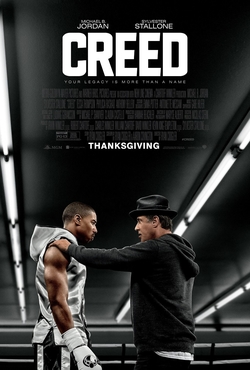 There’s a very special place in my heart for Rocky (1976) and I choose those words very carefully. The reason being, subsequent films lost the appeal of the original and I simultaneously lost interest in the franchise. Perhaps it’s because, after Sylvester Stallone’s breakthrough film, the series lost much of its unassuming charm. It was no longer an underdog story. It no longer felt as personal and intimate.
 Sophie Scholl: The Final Days is a film that people need to see or at the very least people need to know the story being told. For those who don’t know, Sophie Scholl was a twenty-something college student. That’s not altogether extraordinary. But her circumstances and what she did in the midst of them were remarkable.
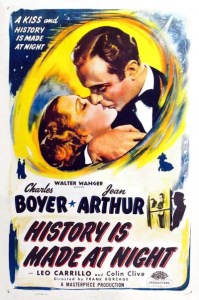 History is Made at Night molds love into the grandest of pursuits and it wouldn’t be altogether wrong in that assertion because for humanity it is one of the most euphoric, confounding, beautiful entities known to mankind. I have no qualms with saying that whatsoever.
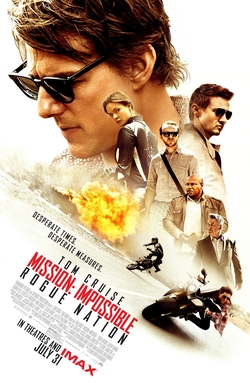 n the last decade or so arguably the greatest action/spy/thriller franchises have been Jason Bourne, James Bond, and Mission Impossible. To their credit, each series has crafted several passable films fortified by a few real stalwarts of the spy thriller genre. Although many of these series thrive on gadgetry, set pieces, and a cynical tone more at home in the modern millennium, one thing that set some of the better films apart were interesting female characters.
 Early on, when she is growing up, it seems very easy to read Stella (Barbara Stanwyck). She is a young woman born into a humble background with a family that could at best be called earthy. Still, Stella wants to know what it feels like to live in the lap of luxury. She wants a more refined life and it’s easy for all the cynics to assume she’s making eyes at the handsome mill executive Stephen Dallas (John Boles) for what he can give her.
 You could say that Fritz Lang was fascinated, even preoccupied with issues of justice. M, Fury, and You Only Live Once all take a particular interest in crime in relation to systems of justice while still functioning as tense thrillers. Although Fury was his first film across the pond in Hollywood, Lang maintained his fine form in a potent debut.
 Our introduction to The Mortal Storm feels rather flat. Bright and bland in more ways than one as we become accustomed to our main storyline. Professor Viktor Roth (Frank Morgan) is held in high regard all throughout the community as a prominent lecturer at the local university and beloved by his colleagues and family. The year is 1933 and the Bavarian Alps are still a merry and gay place to live. That’s our understanding early on as the Professor celebrates his 60th birthday with much fanfare and receives a commemorative memento from his class.
 Its title suggests that this film might be something like Lubitsch’s Heaven can Wait but The Devil and Miss Jones could easily hold the title as the original version of Undercover Boss. Although its main function is on the romantic and comic planes, it also has a bit of a social message behind it that signals for change.
 They Drive by Night is a surprisingly engrossing picture and I only mention it for its obvious relation to High Sierra. It came out a year earlier, helmed by Raoul Walsh starring George Raft, Ann Sheridan, Ida Lupino and, of course, Humphrey Bogart. The important fact is that if Walsh had gotten his way, he would have cast Raft again as Hollywood’s perennial tough-guy leading man.
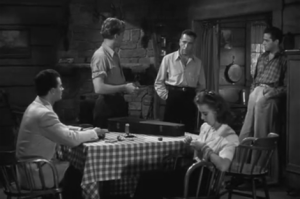 He’s not about to lose his nerves or take his eyes off the objective but the two young bucks he’s thrown in with (Alan Curtis and Arthur Kennedy) carry the tough guy bravado well but there hardly as experienced as him. He’s not too happy about the girl (Ida Lupino) they have hanging around either because she’s an obvious liability. In his experience, women squawk too much. The man on the inside (Cornel Wilde) is even worse, a spineless hotel clerk with even less nerve.
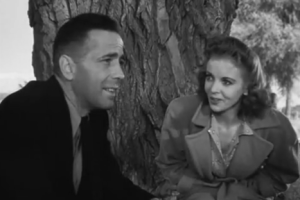 In an unassuming act of charity, Roy has a doctor friend take a look at Velma and ultimately pays for the surgery that heals her ailment completely. Still, if the story ended there it would be a happy ending but with the heist in the works, Roy is not so lucky. He pulls off the job and makes his getaway but with most any cinematic criminal activity in Hollywood’s Golden Age there must be repercussions. After all, that’s what keeps things interesting and it’s true that Roy and Marie are able to lay low for a time but soon the word is out and the gangster is a wanted man.
