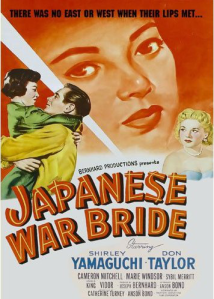
 Much like Sam Fuller’s Crimson Kimono (1959), Japanese War Bride’s title carries certain negative stereotypes, however, its central romance similarly feels groundbreaking, allowing it to exceed expectations.
The film opens during the waning days of the Korean War. A man lies incapacitated in a hospital bed, but he couldn’t be happier because he’s met the love of his life. Maybe it’s war fatigue or something else, but he simply cannot take his eyes off the pretty young nurse Ms. Shimuzu (Shirley Yamaguchi).
And although prospects don’t necessarily look that promising, since duty calls, Jim leaves that hospital bent on getting that girl for his wife. He’s serious. So serious in fact that he goes straight away to convene with Tae’s grandfather (Philip Ahn) that he might persuade him for Tae’s hand in marriage. Although warning that the road ahead will be a difficult one, the sagacious man, relents, reluctant to stand in the way of this blossoming love.
It’s after the happy couple is picked up at the train station by family and settle into the old family home, that it becomes obvious that things aren’t quite the same. They’ll be more difficult than they first appeared.
Jim’s parents and brother are welcoming enough, but there is still a necessary period of gelling as they get used to their new family member. Even Jim encourages his petite young wife to be more assertive and embrace American culture fully. She does her best.
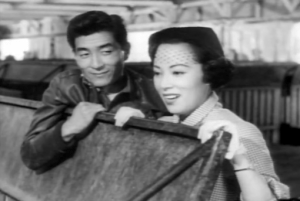 Jim looks to build up a happy life with her as he looks to take some of his father’s land to keep a home of his own and raise crops. Tae begins to acclimate to her new life and gains the respect of the Taylor family while making a few friends including the kindly Hasagawa siblings (Lane Nakano and May Takasugi) who work at a factory nearby. The icing on the cake is when Tae announces she’s pregnant and Jim could not be more ecstatic.
Still, what crops up are the subtleties of racism through slight snubs and bits of insensitivity. First, the skeptical sister-in-law (Marie Windsor) drops pointed remarks towards Tae. At first, they are so veiled, they seem only a passing wisp of a word, hardly worth acknowledging. But following one of the neighbors confessing how much she hates all the Japanese, it becomes evident that all is not right in Monterrey.
One moment Tae is getting accosted by a drunken merrymaker at a party who jokingly calls her a geisha girl. Then the family is scared, rightfully so, when Mr. Taylor receives a threatening letter. It voices the opinion of an unnamed “friend” about the fact that there are rumors floating around that Tae’s baby looks fully Japanese and she has been spending time with Shiro Hasagawa. A scandal of this kind will ruin Mr. Taylor’s reputation among his fellow growers. It will ruin him period.
But most important to this story, it infuriates Jim with a fiery rage. He’s angry at all the narrow-minded folks he used to call friends. He’s mad at his family and most of all Fran for her part in Tae’s distress. It’s in these most tenuous moments that Tae decides to take her baby and seek asylum somewhere else to get away from the cultural chasm that has formed. Of course, they are reunited and there is a version of a happy ending, but it does not take away from the bottom line. They’ll still have to struggle against societal pressures and flat-out bigotry. However, if you’re in love, there are many rivers you are willing to ford and the same goes for Jim and Tae.
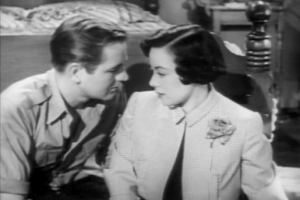 Japanese War Bride is continuously fascinating for the presence of Japanese within its frames. First, we have a rather groundbreaking and relatively unheard of interracial romance between the always personable average everyman Don Taylor and stunning newcomer Shirley Yamaguchi. Their scenes are tender and hold a great deal of emotional impact. It’s the kind of drama that has the power to make us mentally distraught but also imbue us with joy.
The film carries even more sobering underlying tension given the relative freshness of World War II. Mothers are still bitter about the deaths of their sons and that righteous anger is not discriminating between people. It only sees race. Meanwhile, Shiro and his sister reflect the times as Nisei, who were affected by internment and increased amounts of prejudice. While Shiro was imprisoned in Japan during the war, his family was interned at Tulare near Sacramento and his resentful father nearly had all of his land taken. Many other Japanese farmers were not so lucky.
For her part Marie Windsor plays her prime role as the antagonistic woman to the tee, effectively embodying all the small-minded, underhanded folks out there that live life without a genuine kindness for their fellow man. Poisoning other people’s mind just as they are poisoned, and it’s this type of rancor that leads to fear and bigotry. A breeding ground for hatred. In some shape and form, it still rears its ugly head to this day. What makes this film special is how it reflects the realities as it pertains to Japanese and Japanese-Americans. Veteran director King Vidor’s effort is a generally authentic and nuanced tale that pays his subjects the ultimate respect even in its more melodramatic moments.
3.5/5 Stars
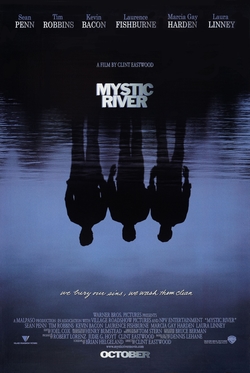 When you enter into the world of a film you often expect it to be perfect in your own minds-eye, following your own rationale to a logical conclusion. In that sense, Mystic River is invariably imperfect in how it ties up all its loose ends, but then again, what film really can bear that weight — and it’s all subjective anyhow. Instead, Clint Eastwood’s Boston-set drama builds off a story about three young boys and evolves into an engaging police procedural intertwining the lives and events of these three individuals. But it all starts with a game of street hockey.
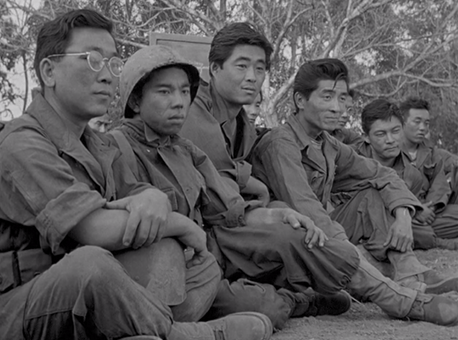 WWII is always a fascinating touchstone of history because it has some many intricate facets extending from the Pacific to the European Theater to the American Home Front and so on, each bringing with it unique stories of everyday individuals doing extraordinary things. One of the best-kept secrets is the 442nd Infantry Division later joined with the 100th and effectively making the first all Japanese-American fighting unit which served over in Italy and France.
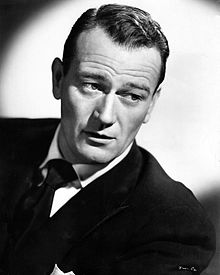 Contrary to popular belief, I wasn’t always a classic movie aficionado or a western lover but you do not have to be either of those to know and love the Duke because he is more of an American icon than a simple movie star in the conventional sense. He’s so integral to the very cultural fabric of our country. For instance, by watching I Love Lucy or M*A*S*H (and Radar’s impressions) or having one of your dad’s favorite film being True Grit, you can get to know him by simple osmosis. It’s just a fact. Even words like “Pilgrim” and “Baby Sister” begin to sneak into your everyday lexicon. You cannot help but hear them and by association use them (I’m not speaking from experience at all).
 But it’s from these roots that he ultimately moved out to sunny California, a noted member of the USC football team before a career-ending injury. This is a part of his life that I will mostly gloss over. Because it was the next part of his life that always resonated with me on a personal level. His very persona seems imprinted on the world that I grew up with from an early age. His name and likeness could seemingly be found everywhere. I grew up seeing his statue and even passing by his personal boat The Wild Goose and seafront home on family excursions (also featured in a Columbo episode).
 Citizen Kane is so often lauded for the simple fact that never before had a director had so much creative control on a project and exercised it in such an unprecedented fashion, especially given the state of affairs in the Hollywood studio system. It’s an enigma, a stunning debut and really an astounding miracle where all things aligned for an instant of so-called perfection.
 At first glance The Trial is a bare-boned parable, feeling gaunt and cavernous with empty sets and even emptier words. Everyone Josef meets talks him in circles, tirelessly — never leading to any significant conclusion, only the next diversion in his journey.
 If The Trial is a hodgepodge of talent, with the presence of Americans Orson Welles and Anthony Perkins, international sirens Jeanne Moreau, Elsa Martinelli and Romy Schneider, with European backing and source material from Kafka, then it is a thoroughly intriguing marriage all the same. This film is perhaps the greatest adaptation of the work of Kafka and not due necessarily to its faithfulness to its source material, but because it displays an unmistakably Wellesian vision. The cyclical nature of the legal system pales in comparison with the fascination that comes with watching the continual creativity that is projected up on the screen — this is a hollow dream of a film.
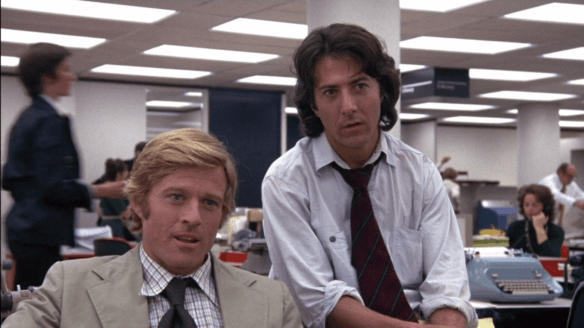 You couldn’t hope to come up with a better story than this. Pure movie fodder if there ever was and the most astounding thing is that it was essentially fact — spawned from a William Goldman script tirelessly culled from testimonials and the eponymous source material. All the President’s Men opens at the Watergate Hotel, where the most cataclysmic scandal of all time begins to split at the seams.
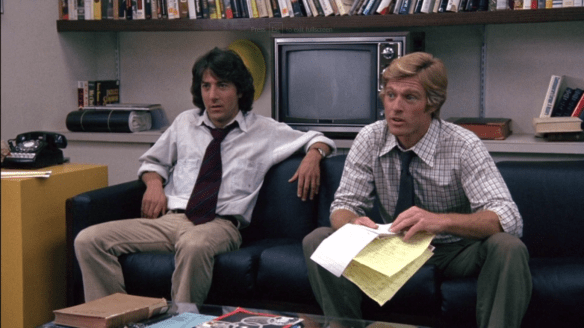 But it only takes a few breakthroughs to make the story stick. The first comes from a reticent bookkeeper (Jane Alexander) and like so many others she’s conflicted, but she’s finally willing to divulge a few valuable pieces of information. And as cryptic as everything is, Woodward and Bernstein use their investigative chops to pick up the pieces.
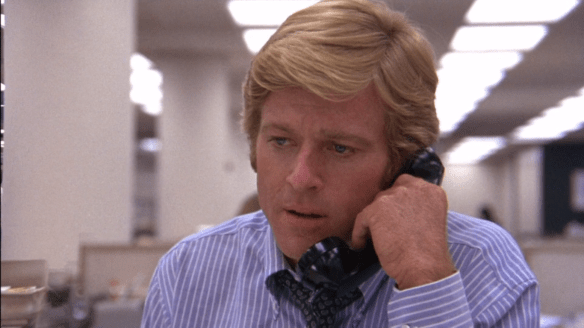 Gordon Willis’s work behind the camera adds a great amount of depth to crucial scenes most notably when Woodward enters his fateful phone conversation with Kenneth H. Dahlberg. All he’s doing is talking on the telephone, but in a shot rather like an inverse of his famed Godfather opening, Willis uses one long zoom shot — slow and methodical — to highlight the build-up of the sequence. It’s hardly noticeable, but it only helps to heighten the impact.
 The opening notes of Joan Jett hollering “Bad Reputation” made me grow wistfully nostalgic for Freaks & Geeks reruns. The hope budded that maybe 10 Things I Hate About You would be the same tour de force narrative brimming with the same type of candor. It is not. Not at all. But that’s okay. It has its own amount of charms that forgive the obvious chinks in the armor of this very loose adaptation.
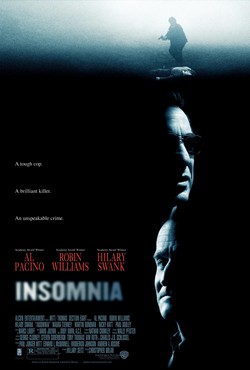 “You and I share a secret. We know how easy it is to kill somebody.” – Robin Williams as Walter Finch
 This was not the film I expected from the outset, and oftentimes that’s a far more gratifying experience. Nostalgia was expected and this film certainly has it, even to the point of casting the legendary funny man and cultural icon Don Knotts in the integral role as the television repairman.
 One of Jean-Luc Godard’s strengths is his capability of feigning pretentiousness, while still simultaneously articulating humor. His film opens with its first of many inter-titles, “A film adrift in the cosmos,” followed by the equally poignant “A film found in a dump.”
 Conflagrations engulf cars and human bodies while above the din comes the piercing screams of a woman bemoaning the loss of her Hermes handbag. We cannot take this anyway but humorous because it once again is yet another moment of utter insanity.
 4 Star Films