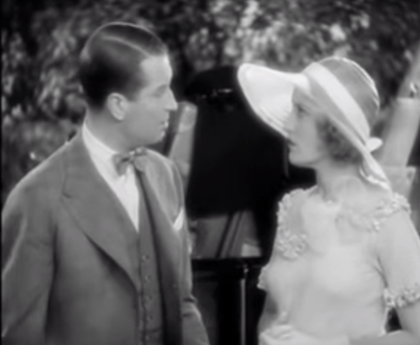
 This is unequivocally the age of sound! That’s what this film proclaims from the rooftops with its symphony of syncopation as the world of Paris awakens from its slumber. Its opening rhythms are pure ingenuity and the glorious unfoldings never cease for the rest of the cheery production.
In its efforts to tip a hat to Lubitsch, Rouben Mamoulian’s film manages to eclipse him or rather make a name for itself completely removed from the previous Maurice Chevalier musicals. In fact, Love Me Tonight feels like the obvious precursor to later classics like An American in Paris and the works of Jacques Demy. Whereas Lubitsch’s films almost always function as a comedy and social commentary, Love Me Tonight is first and foremost a musical and it rides on its melodies even while simultaneously driving forward its plot line.
When our humble but nevertheless jovial tailor winds up chasing after one of his notorious spendthrift customers to his relative’s aristocratic residence, things are in motion. Maurice is certainly out of his element, but his charm wins him many an admirer in the household including the Duke (C. Aubrey Smith) and his man-hungry niece (Myrna Loy). In fact, there are only two people who seem wary of this new arrival, the Duke’s skeptical daughter, Princess Jeanette (Jeanette MacDonald) and her feeble suitor.
Everybody else persuades The Baron — as he is called — to stay because his is such a magnetic and disarming personality. Of course, when the real news about him gets out following an incriminating wager for his honor, it dooms his romance. But every story needs a final epiphany of realization and, in this case, Princess Jeanette comes to her senses. She throws the utter absurdity of family rank and status out the window.
True, this is a love story, but while that could be the focal point there are wonderful sequences that fill all the nooks and crannies. Fine gentlemen walking around a tailor’s shop without their pants on or a trio of aunts who come right out of the pages of Hamlet. As a Pre-Code film, it certainly has a few risque moments including a Doctor’s visit and one or two mentions of a nymphomaniac — all played for comedic effect of course.
Meanwhile, tunes like “How are you?” and “Isn’t it Romantic” literally takes the country by storm manifesting themselves in all forms imaginable. “Mimi” is a particularly saucy number that pays homage to our main female heroine and it’s opening refrains boast some wonderful point of view shots of our fated lovers. Love Me Tonight winds up being an operetta of repeatedly and ingeniously inventive rhyme and melody all the way through. It also has brilliant sound design from head to toe.
Maurice Chevalier is as charming as ever, still melding his song with a magnetism that flows right into his role, ironically enough, as a character named Maurice. Although Myrna Loy might have become a bigger name arguably, this is Jeanette MacDonald’s film and she plays her part with the necessary aloofness that nevertheless gives way to amorousness. By the end, we like them both and we can’t help but be won over by their songs. For being lesser known on the generally accepted spectrum of classic musicals, this one is a gem.
4.5/5 Stars
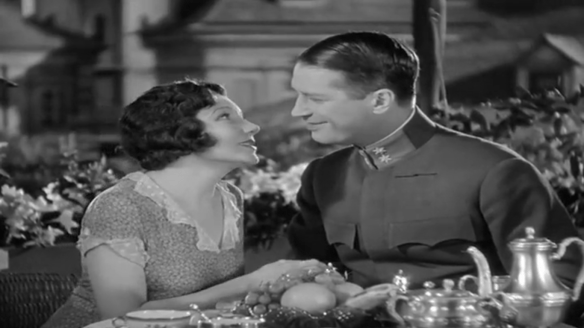 One would never think that one well-placed wink would change the course of an entire life or be the basis for an entire film, but on both accounts it is true. Ernst Lubitsch’s The Smiling Lieutenant represents all that is good and right about one of his films. It’s light and airy with a dash of charm and a tune in its heart. It’s light on its feet with humor and somehow maintains its self-respect, much like the man at the center of this one (Maurice Chevalier).
 But Lubitsch’s final twist is completely out of left field and a completely comic inversion of what’s supposed to happen — capping off his oeuvre of song, suavity, and sensuality in high fashion.
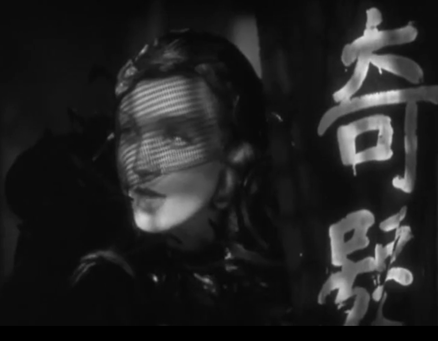 The same year as Grand Hotel there came another film, that while still boasting an ensemble cast felt far more intimate. In its day it was christened “Grand Hotel on wheels” and its narrative does unravel aboard a train. However, Josef von Sternberg’s film opens with a faceless atmosphere spilling over with the bustling commotion of a railway station. It takes a few moments to lock onto the characters we will be making the journey with, but we won’t soon forget them.
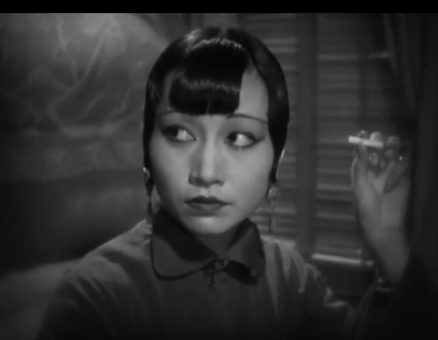 It is in these moments that are two female heroines must act. Hui Fei (Anna May Wong) so that she might defend the honor of herself and her country. Lilly so that she might express the great, expansive depths of the love she still holds for “Doc.”
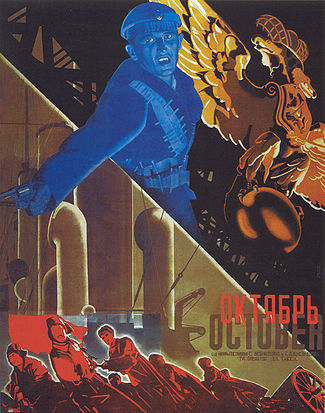 It’s curious that the first image October conjures up is a biblical nightmare from the book of Daniel. In that instance, the Babylonian king is frightened in his dream by a giant statue that comes tumbling to the ground. Of course, in that context, it had a lot of the same connotations, that his kingdom would come crashing to the ground with a resounding thud.
 “I always did like a man in a uniform. That one fits you grand. Why don’t you come up sometime and see me? I’m home every evening.” ~ Mae West
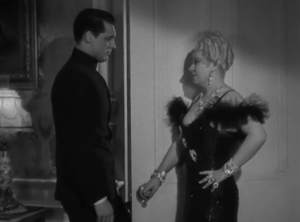 This is her film — her personal vehicle. She rules it that twinkle in her eye and a rapier wit coming from her mouth. Sometimes it’s not even what she says but how she says it (Why don’t you come up sometime and see me?). No one quite has a delivery like her. Whatever she says seems to carry implications and double meanings. In a modern culture that’s overwrought with sexual innuendo and bad taste, West led the trend when it was still in vogue. Back then, it was certainly controversial, but the box office doesn’t usually lie, and West did pretty well for herself, especially during the Depression era. There’s a reason that soldiers named their life vests after her. She was the queen of double entendres in the post-Shakespearian age, and she was ripe in the public consciousness. There was no one quite like her.
 My father has always maintained that two of his favorite films are The Magnificent Seven and True Grit. The first one makes sense with its stellar cast, resplendent score, and some top rate gunslinging. The second film, well, it makes sense too, but for completely different reasons.
 “Nobody throws me my own guns and says ride on. Nobody” ~ James Coburn as Britt
 Into the valley road the seven rather like the light brigade, at first simply preparing to train up and prepare their little village of farmers to fight back against the brutal outlaw Calvera (Eli Wallach). But there’s something that happens over time. When you spend time in close proximity with people, eating their food and sharing their shelter, it’s hard not to build a bond — a connection that holds you there. At first, it seems of little consequence when the enemy gets beaten back, but everyone knows they will return with a vengeance.
 And we get the final skirmish with guns blazing, bullets flying, and lives being put on the line. Here is a film where the final body count deeply matters. Not so much of the enemy, but of our heroes, because each one chisels out a little niche for themselves. Everyone has worth and importance even as they jockey for screen time and it pays off in the end. They fight with honor just as they die with honor. Perhaps it might seem futile, but not without significance. The little village is left in peace to live out their days in tranquility. Calvera’s final words echo in their ears: “You came back – for a place like this. Why? A man like you. Why?”
 I still remember driving through the hills and dales of the English countryside listening to Hard Day’s Night in the family rental car. Back then I had a haircut that could best be described as a mop top. And then during my one visit to Liverpool, I was beyond ecstatic. I’m a fairly reserved person and yet standing in Paul McCartney’s kitchen at 20 Forthlin Road (his childhood residence) what else could I do but bend down and kiss the floor?
 What it manages to bring together within the frame of a meager B-film plot is quite astounding, balancing the brutality and atmospheric visuals with the direction of Robert Wise to develop something quite memorable. Boxing movies have been bigger and better, but film-noir has a way of dredging up the grittiest pulp and the Set-Up is that kind of film.
 You can take Animal House one of two ways. Either it glorifies fraternity life to chaotic proportions or it’s a satirical mockery of the collegiate institutions. Either way, the film works, because the bottom line is that it has laughs. Sure, some of them take hold of nostalgia while simultaneous instigating the trend towards crude, gross-out humor, but Animal House has some generally uproarious moments of mayhem to match some quality pieces of irony. When you actually think about it a lot of these characters are great fun too.
 4 Star Films