Hot Fuzz (2007)

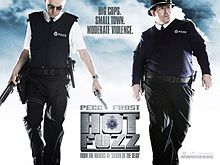
220px-HotFuzzUKposterWhen we go to see the latest action movie are we consciously thinking about what we are ingesting, what the motives of the characters are, or even the film’s title? More often than not the answer is no, because we want to be entertained, like Romans attending gladiator battles. We want thrills above content, without considering what we are being fed. In the line of these types of films are Lethal Weapon, Point Break, and now Britain’s addition Hot Fuzz.

It’s the story of probably, the most industrious, skilled, highly-trained policeman you could imagine. His name is Nick Angel (Simon Pegg) and he’s a butt-kicking, paperwork-completing sergeant, who is making the rest of the force look bad. He has the potential to be a great action hero. Enter in Martin Freeman, Steve Coogan, and Bill Nighy, and they agree to reassign him to the sleepy of village of Sanford, and all his dreams are kaput. Ambition will lead him nowhere in such a town, and it feels more like Mayberry than the locale for a great action flick.

But being as diligent as he is, Angel makes strides even before he starts his first day. Among one of his arrests at the local pub is fellow police officer Danny Butterman (Nick Frost), who also happens to be the son of the police inspector. It’s rather a strange introduction, but of course, the two of them are partners. Nick simply tries to tolerate all those around him, but it proves difficult, and he’s a little taken aback by the geniality of the locals. They all seem to know his name.

However, when a string of grisly murders takes place successively around town, Angel has what he wants, something to investigate. Again, everyone around him says it’s all been a line of unpleasant accidents. They aren’t willing to face the reality that their sleepy little town might have a murderer on the loose.

As you might expect Angel and Buttermann actually begin to build some rapport despite how different they are. However, Hot Fuzz also has a major twist that frames this entire story in a different light. And although the film does exhibit its share of violence, it also has a wickedly funny streak running through it. At times that means laugh-out-loud antics, courtesy of Nick Frost, or maybe uneasy giggles when someone bites the dust in an outrageous manner.

Edgar Wright’s film is also noticeable for its rapid editing, involving quick cuts, flying transitions, and slicing and dicing. It keeps the story at breakneck speed and yet there is a great pathos built around its characters. We actually begin to care for Nick and Danny, which is often not the case in superficial action flicks. But that’s just it. Hot Fuzz is a satirical homage to all the cop/buddy movies out there and it has its share of action, and yet there’s more to it. In other words, action films are not just skin deep. Hot Fuzz proves that resoundingly. It’s a throwaway title maybe, but not a throwaway film.

4/5 Stars

The Cabinet of Dr. Caligari (1920)

Das-Cabinet-des-Dr-Caligari-posterI’ve never seen anything like it, and I mean that in all truthfulness. The Cabinet of Dr. Caligari has the esteem of being called the original horror film, and that’s not something to be taken lightly. Perhaps I’m more partial to Murnau’s Nosferatu that came out two years later, but this film directed by Robert Wiene is really the epoch of German Expressionism. The German Expressionism Movement, after all, was not simply about painting, or architecture, or theater. It bled into the Weimar film industry as well, drifting as far away from realism as was possible at the time. Some say D.W. Griffith wrote the rules of moving pictures as we know them today, and if that’s so, then it was this film that tried to push the boundaries to the limit.

In an effort to be transparent, I will acknowledge that The Cabinet of Dr. Caligari does not engage me, narratively speaking, like some other silent films. It follows a Dr. Caligari as he presents his spectacular somnambulist Cesare (Conrad Veidt) at a local carnival. But all is not as it seems as a string of murders terrorize the town by night. Also, I was not a big on the score that accompanied this version. It was rather a discordant cacophony and it did not seem to go well with the action, but that is often a problem with silent films if they do not already have a score to go with them.

CABINET_DES_DR_CALIGARI_01Nevertheless, the images alone are striking, and it is still fascinating for the very reasons I mentioned above. It boasts the craziest sets, highly stylized, and made up of every type of angle and shape imaginable. We know resolutely that this is not reality, these are simply facades being put up to engage our eyes. It features a mise-en-scene for the ages, with no attempt to try and be the least bit objective. There’s no effort to aim for realism; none whatsoever, and that level of audacity is impressive. Furthermore, it’s mind-boggling to think that so many people and so many films were influenced by this movement. Especially in Hollywood.

Without it, we would not have 1930s horror films like Frankenstein and Dracula. There would be no Film-Noir or at least not the same moody, atmospheric creature that we know today. In truth, it was many European directors like Fritz Lang, Billy Wilder, Otto Preminger, and even Alfred Hitchcock, who channeled this movement in their own work. It proved to be so important to the medium of film and thus, it’s important to remember these roots. So maybe The Cabinet of Dr. Caligari is not as engaging today, but there is much to be admired and extracted from it still.

4.5/5 Stars

The Earrings of Madame De… (1953)

MadamedeposterThe Earrings of Madame De…, in essence, feels like the perfect incarnation of an Ophuls’ film. In fact, sometimes I forget that Ophuls is actually German because his films are full of French sentiment. I mean that not because of their cast, although we do have Charles Boyer and Danielle Darieux, but more so due to the fact that his films are about elegant, melodramatic romances that fit the decadence of Parisian high society. For instance, in Madame De… Danielle Darrieux is positively swimming in luxury, whether it means dresses, furnishings, or especially jewelry. Materially her husband Andre (Boyer), a French general, has lavished all the worldly possessions upon her. Except that’s not what she wants. At least that’s not what will make her happy. She may be obsessed with the material, but even the material which she so desires is ultimately poisoned over time. Over time Andre cannot even win her over with trinkets and gifts. She cares little for the eponymous earrings until they come from her true love Baron Donati (Vittorio De Sica).

These are the same earrings that she sold to pay off a debt. The same earrings that Andre reacquired from the jeweler and then made the rounds once more. Ophuls said himself that he was drawn to this narrative because “there is always the same axis around which the action continually turns like a carousel. A tiny, scarcely visible axis: a pair of earrings.” And really it is a fascinating plot device that ties the entire narrative together, while also seeming to reflect the utter frivolity and triviality of it all. How can these earrings hold so much weight to one person? And yet that’s only the face value, because, to begin with, they are only an object to be coveted and maybe cherished. Over time they become a token, a symbol of true love and Louise gives them away to the parish because she no longer needs them. She has some notion now of what true love actually feels like.

For the majority of the film, Andre is forever civil with her. He knows that she does not really love him, and he even has time for a mistress on the side. He handles her opportune fainting spells and little charades with grace and at times amusement. But when he gets a hint at Donati’s relationship with his wife, he does what any honorable gentlemen would do. He’s indignant of his rival and builds a huge feud out of nothing. What follows is a duel and the rest is history.

Madame De… probably does not get as much acknowledgment as it should, because Ophuls was a champion of so-called “Women Pictures,” which actually take on the point of view of women, in an industry that’s so male-dominant even to this day. Thus, Madame De… is a little different in perspective, and it tries to hide all of its tragedy behind superficiality. It makes for an interesting lesson in romance and the female psyche. Yet again the director shows his immense affinity for staircases turning them into the personal playground for his camera. He loves to twirl, pirouette, and glide just as much as Louise and Donati do as they dance the night away at the ball. De Sica is a champion director in his own right, but it was especially fun to see him in front of the camera and he seemed an apt player opposite his costars. The worthy equal of Boyer and a suave love interest on top of that. There’s nothing more romantic than Danielle Darreux dreamily repeating to him, “I don’t love you, I don’t love you, I don’t love you.” The sad irony is that those words ring true with her actual husband as reflected by a pair of earrings.

4.5/5 Stars

Mad Max (1979)

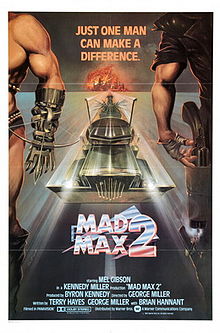
MadMazAusThis is where it all began and honestly, I knew so little about it. You have Mel Gibson and about everyone else is unknown to me. But that’s fun because they are a population that’s made up of clean slates. I have no expectations for them so they’re constantly engaging me and altering my expectations. Australia’s Outback is not quite apocalyptic yet, but we’re on the road there soon enough, with bleak roads and gasoline shortages. Likewise, Max Rackatansky has not quite taken his name to heart. He needs to go through hell first, and that’s where this film leads.

Max and his best bud Goose are Main Force Patrol officers who work for the highway patrol. They soon are chasing after the crazed gang member “Nightrider,” who is looking to outrun his pursuers in a stolen vehicle. But Max waits patiently for his prey and then strikes after his colleagues are knocked out. But despite the demise of “Nightrider,” his motorcycle gang lead by Toecutter continue to ravage the roads. They commit rape, partake in all kinds of destruction, and raise fear in anyone who gets in their way, because of their sheer unpredictability.

The fiery Goose becomes an easy target for their mayhem, and he’s left a sitting duck. Not even his good friend Max can save him and with his friend gone our hero seems content to get away with his family. He doesn’t want to deal with the madness so he picks up and leaves on a vacation. Max takes his beautiful wife Jesse and their little baby, but of course, the gang crosses path with him once more, and yet again there’s nothing he can do. He’s too late. Max has a choice now: either do nothing or go on a mad rampage of vengeance. He chooses the latter.

George Miller shows his audience these events without holding our hands, simply placing them in front of us and allowing us to observe as if this is in fact cold hard reality. Despite what we might think, there is nothing strange or out of the ordinary about it. This is the way society works and once you buy into the adventure, it’s easy to get enraptured in the action. Although there are jumps in narrative most definitely, it is made engaging by a dystopian world and characters who have so many odd ticks and mannerisms. Perhaps more importantly, stunts, car chases, and crashes never feel like pointless eye candy, but they are executed with precision and impact that is impressive. There’s nothing cheesy about it. This is all grit and a lot of road rage.

3.5/5 Stars

Three Colors: White (1994)

threecolorswhite1The Three Colors Trilogy is made up of the three colors of the French flag. Thus, the second installment, between Blue and Red is of course White. It is considered by some to be the weakest of the three films, but that is rather unfair because it is still wonderful in its own right.

The other films are pensive, thoughtful pieces of drama, but White is actually quite funny in a dismal sort of way. You see, Karol Karol (Zbigniew Zamachowski) is a Polish hairdresser, who is going through divorce proceedings because his beautiful French wife says she doesn’t love him anymore. He has to sit through the court hearing being delivered in a foreign tongue, and he has to go through public embarrassment in front of everyone. It’s a humiliating situation and the worst of it is that he still loves Dominique (Julie Delpy). He loses all his money, his credit is invalidated, and she takes about everything else. At least Karol has his giant suitcase, but that’s about it.

threecolorswhite2That’s where a fellow named Pole Mikolaj finds him slumped up against a wall in the subway station. He’s pitiful, but they strike up a conversation in their native language, and he agrees to help Karol stowaway to get back to Poland. There’s nothing left for him in France after all, so he hides in his suitcase and his new friend takes it through customs. It’s utterly ridiculous, but they play it straight. Then picture this. You’re stowing away inside a suitcase and then some thieves steal it to get the payoff inside. Imagine their surprise when they find not valuables, but a human being. And the jokes on them because that human has absolutely nothing to steal. All that’s left to do is give him a firm kick in the rear and leave him for dead. If it wasn’t so depressing, this would be absolutely hilarious, and it still is pretty funny.

Next Karol tries to make some quick money, because hairdressing may be in demand, but it’s not a great moneymaking proposition. He ends up being hired as a bodyguard, and he’s a very awkward sort to be packing a firearm. His next scheme is to double-cross his boss by buying up plots of land before his bosses can. They looked to sell if for profit to big corporations, but Karol beats them and they cannot touch him. They’ve no way to get the money from him, and all of the sudden, it seems like he’s doing very well.

threecolorswhite3The time has come for one last vengeful trick and the joke’s on Dominque this time. He still loves her, but Karol enlists the help of Mikolaj and a few others, to help him get back at his wife. It works better than he was expecting, in fact, maybe too well. Dominque still has feelings for him, but now he may never be able to see her again.

Krzysztof Kieslowski’s films usually have a sensuous and mysterious woman in the lead, whether it’s Irene Jacob or Juliette Binoche. Julie Delpy is a similar type of beauty, and yet she is less the focal point compared to Karol Karol. In a sense, you give up some of that enigmatic aura of the aloof goddess, but Karol is an extremely funny character, even visually. Thus, White is not quite like Blue or Red, but they are interconnected and it’s still thoroughly worthwhile. Different is often a strength, not a weakness, and in this case, it is a good thing.

4/5 Stars

The Wind (1928)

190px-The_Wind_(1928)The makers of The Wind took their content seriously. Filming commenced near Bakersfield in the Mojave Desert where temperatures fluctuated around 100 degrees. Eight airplanes where used to churn up enough force for the effect of swirling sand and much of the crew was forced to wear protective clothing while facing the elements. It sounds like a hardly pleasant experience and yet Swedish director Victor Sjostrom’s project with silent film goddess Lillian Gish proves transcendent to this day.

An early inter-title explains the film’s story of a “woman who came into the domain of wind,” and essentially that sets up this archetypal woman vs. nature story. Gish is our heroine Letty, who has come all the way from Virginia to live with her cousin. Why she would want to live in such nasty conditions is not clear, but she must have had good reasons. Every sequence you are reminded of this film’s title, because hats, hair, scarfs, are always blowing in the wind, no exceptions. Tranquility does not have a place in this film. Vast expanses of desolate terrain reign supreme and the men match the land. The first acquaintance Letty makes on her way out is the forward cattle buyer Wirt Roddy. He warns her of the treacherous country she is about to enter, but she is, after all, Lillian Gish. Nothing will stop her.

When she finally arrives at the ranch of her cousin Beverly, he is delighted to see her, but his callous wife and bratty kids are not so warm with their welcome. Letty also catches the eyes of two ranchers: The rugged Lige Hightower and the aging Sourdough. Both have a hankering to ask for her hand in marriage, and the dance in town seems like the perfect place for popping the question.

But a giant cyclone strikes leaving destruction in its wake, and the general public seeks shelter below ground as the men try and brace for impact. In the mayhem, Roddy declares his intentions and now there are three suitors vying for Letty’s affections. It’s good fun for Letty until the jealous Cora forces her out of the house. She doesn’t want Ms. Sly Boots wrecking her home as she surmises.

Letty needs someone to turn to and her first choice is Roddy, but he always was a grinning conniver, and he finally confesses he’s already married. That won’t do and she reluctantly chooses Lige. Although, since he is so rough around the edges, she doesn’t know how to relate to him. She certainly doesn’t love him, and he catches on pretty quickly when trying to kiss his new bride. Despite, a violent side, Lige proves he does have a grain of decency buried in the sand somewhere. He resolves to get enough money to send Letty back to where she came from and, he soon loses his scruffy beard.

Lige goes out in the elements out of necessity in taking part in a roundup. His wife initially pleads with him to take her along, but the conditions are too adverse and she is left behind, all alone between four flimsy walls which are supposed to defend her from the forces that be. A deadly Northern is coming, personified by a prancing stallion, but that’s not all. Roddy sneaks back to Letty intent on taking her away with him, and between the never-ending onslaught of wind and sand, along with her former suitor, Letty is beside herself. It’s a frantic struggle against the wild forces of nature, not to mention a craven man. However, being the heroine that she is, Lillian Gish find her gun and does what she has to do. As they say, absence makes the heart grow fonder, and thus when a jaded Lige gets home, he is surprised to be met by Letty with open arms. They share the original Titanic embrace, with the wind billowing around them, eyes closed, enjoying this moment of pure adrenaline. Even for the 1920s, Gish is a universal beauty, and there’s a pristine magnetism to her. I would never wish any type of harm or misfortune upon her. She has such a sincere face. Or maybe it’s a fragile frame backed up by courageous nature. Her struggles remind me somewhat of The Gold Rush or Steamboat Bill Jr. because in each of these films a character we truly care about is pitted against nature’s wind. These films have different effects, but each is powerful in its own right.

4.5/5 Stars

Lee Marvin as Liberty Valance (1962)

libertyvalance.png

I can enter into a discussion of The Man Who Shot Liberty Valance from two different avenues. Most obvious is the film itself. As far as star power, Lee Marvin is playing third fiddle to John Wayne and James Stewart, the undisputed stars of this film.

However, Liberty Valance is a wonderful role, because certainly this is about Wayne and Stewart, but on the other hand its Marvin who has his name in the title, and that’s not something to be taken too lightly. He’s at the core of this film, because it is his villainy and criminal activities that create the conflict in this story line and elicit a response from both of our leading men. He forces their hand and it becomes the call to action for a final showdown.

The fact that the film’s narrative is told, rather like a film noir, with a flashback creates this type of aura not only around Wayne’s Tom Doniphin but the notorious Liberty Valance himself. Because although we see Ransom Stoddard (Stewart) in the present along with his faithful wife (Vera Miles), the  two other men are only made available to us through eyewitness account. Around them is built a type of legend and that ultimately makes Liberty Valance a fascinating figure. Dressed in black, swinging his whip menacingly and boisterous as all get out, Lee Marvin is the perfect man to portray Valance.

In a sense, it feels like he’s at the crossroads of his career, in transition from his heavy roles to being a top billed tough guy. The Big Heat and Liberty Valance represent his earlier turns before he progressed to The Dirty Dozen and Point Blank as a silver-haired tough-as-nails leading man. Marvin was arguably never more larger-than-life than his time as Liberty Valance. Perhaps it was because he was forced to hold his own against Stewart and Wayne. As the famous quotation goes, “When legend becomes fact, print the legend..” Well in this case, Lee Marvin did make Liberty Valance in a legendary villain deserving to be among the pantheon of baddies.

However, there’s also Gene Pitney’s billboard charting tune also called “The Man Shot Liberty Valance,” which although it was not featured in the film, sums up its story quite impeccably.

The lyrics read like so:

When Liberty Valance rode to town, the womenfolk would hide, they’d hide
When Liberty Valance walked around, the men would step aside
‘Cause the point of a gun was the only law that Liberty understood
When it came to shootin’ straight and fast, he was mighty good

From out of the east a stranger came, a law book in his hand, a man
The kind of a man the West would need to tame a troubled land
‘Cause the point of a gun was the only law that Liberty understood
When it came to shootin’ straight and fast, he was mighty good

Many a man would face his gun, and many a man would fall
The man who shot Liberty Valance
He shot Liberty Valance
He was the bravest of them all

The love of a girl can make a man stay on when he should go, stay on
Just tryin’ to build a peaceful life where love is free to grow
But the point of a gun was the only law that Liberty understood
When the final showdown came at last, a law book was no good

Alone and afraid, she prayed that he’d return that fateful night, aw, that night
When nothin’ she said could keep her man from goin’ out to fight
From the moment a girl gets to be full-grown, the very first thing she learns
When two men go out to face each other, only one returns

Everyone heard two shots ring out, one shot made Liberty fall
The man who shot Liberty Valance
He shot Liberty Valance
He was the bravest of them all

The man who shot Liberty Valance
He shot Liberty Valance
He was the bravest of them all

So if Marvin’s portrayal doesn’t already make Liberty Valance into a mythical villain, then this number certainly does. We can read it a bit like a western folktale, emotive and surprisingly true to the film’s narrative arc. But what it leaves us with are the result of that showdown that happened so many years ago…

The point of a gun was the only law that Liberty Valance understood, and he was forced to pay penitence for his misdeeds under the barrel of that same law — at the hands of the hero christened only by the name “The Man Who Shot Liberty Valance.”

Written as part of The Great Villain Blogathon featured HERE


The Crowd (1928)

220px-Crowd-1928-PosterThe Crowd is a true piece of urban Americana, setting the standard when it comes to your average everyday American. King Vidor’s film lacks big-name star power and plays on a universal story similar to Murnau’s Sunrise. Our protagonist is Johnny Sims, who was fittingly born on the 4th of July. He’s the quintessential stand-in for anyone who has ever pursued the American Dream. He faces the death of his father at an early age and grows up getting lost in the masses of New York. With wall to wall skyscrapers towering above and a hopping city life, it’s easy to disappear.

This film is not Metropolis, but it is about a metropolis with the same behemoth sets swimming over the top with extras. In fact, at his job, Johnny looks like the original C.C. Baxter from The Apartment. He’s a cog in the giant mass of humanity, a little stop in the ever-churning conveyor belt.  Like Baxter, Sims becomes smitten with Mary, a lovely girl he meets on a double date with his joking colleague Bert. A lively night at a carnival and going through the tunnel of love cements their relationship. Soon they are married and heading off to the perfect honeymoon destination: Niagara Falls. This is where the love story is at its peak, riding on a wave of euphoria since these two are loved and in love. They feel indestructible, and there’s no one in the world that they would rather be with.

But as per usual, life happens to get in the way of love. Johnny isn’t too fond of Mary’s brothers and her mother, and the feelings are mutual. They just don’t see eye to eye, and they are skeptical of his prospects as a breadwinner. Matters are made worse during a tiff where Mary threatens to leave, and Sims does little to object. Their house is slowly falling apart, although they keep it together momentarily since she announces her pregnancy. That is the thin thread that binds them together.

Following their baby boy, comes a little girl, and finally, the raise that Johnny has been hoping for, but it’s not much. Things continue to be difficult as Johnny still waits for his ship to come in. His wife is annoyed with him and the meager prospects ahead. We are reminded that it’s not the big things but often the little ones that cause the most damage. Like little biting remarks that cut to the quick. And yet somehow, Johnny and Mary hang onto their romance.

In one scene she gazes down from the windowsill at him on the street below and they make up after a row. It’s rather reminiscent of Romeo and Juliet, reflecting that they still care about each other. But matters are not helped by the fact that Johnny seems pretty useless. On a beach holiday Mary struggles to get everything right, and despite her best efforts, it all turns out wrong.

Only a few years before Johnny laughed out loud at a man forced to humiliate himself carrying signs masquerading as a clown. How embarrassing! And yet a desperate Johnny winds up with a similar lot. It doesn’t help that personal tragedy strikes his family where they are most vulnerable. In its day it was actually considered obscene (for featuring a toilet), and it was far from a success due to a downbeat ending. This is a Pre-Depression world, and yet life is still far from easy.  And that allows The Crowd to stand the test of time fairly resiliently because it’s still possible to relate with its patriotism, its tragedy, and its resolute optimism.

4.5/5 Stars

Stage Door Canteen (1943)

stagedoorcan2

Director Frank Borzage’s Stage Door Canteen is a gentle-handed piece of propaganda. It plays out rather like a scripted 1940s wartime reality. It’s less a film and more of a historical relic commemorating the eponymous Stage Door Canteen in New York City. Thus, any effort to give it some sort of rating almost seems beside the point, because it was meant to be a rallying cry of comfort, entertainment, and escape from the war right outside. It met the general public right where they were and inundated them with mega star power. This wasn’t the only nightclub or film to do this either. The Stage Door’s west coast counterpart was the Hollywood Canteen, and it received a film treatment of its own in 1944.

In truth, the real nightclub was still in full use every day so the next best alternative was the RKO Lot in Culver City. That’s where it all happens like a day in the life. We follow three soldiers: the perfect cross-section of white red-blooded American G.I.s. Each one gets to dance and talk their last days away with a pretty girl serving as a hostess at the canteen. Each one of them will never forget it.

The entertainment is full of partial cameos, pop-ups, and performances from a plethora of stars. For even the most well-acquainted modern viewer, it’s hard to recognize all the faces and names that show up. Katherine Cornell, Count Basie, and Yehudi Menuhin are a few such figures who come to mind.

stagedoorcan1There are also strategic vignettes sprinkled throughout to boost morale and the camaraderie between allies. A few Brits can be heard taking part in the gaiety and making friends with our protagonists. A table of Hispanic soldiers takes in a floor show. One of our hostesses gets a moving letter from her older brother in the marines who is bent on returning to his family and proving that his training can outlast any “Jap” out there. There’s a last-minute marriage ceremony that we are privy to. Sam Jaffe introduces the audience to a few Russian allies, an Australian soldier has just returned from the front, and several Chinese air cadets get a rousing appreciation. Merle Oberon (the only actress close to being Asian in the film) gives them a stirring sendoff. Finally, Katharine Hepburn drops in for the premier cameo, to tie together all the loose ends and rally her fellow men and women to keep on keeping on for the sake of the country, so that the Allies might win the war.

From our modern day perspective, this might all come off like saccharine hogwash, but that’s not giving the material its due sensitivity. For that point in history, it was exactly what the American public was looking for. Today it’s a fascinating piece of remembrance. Then, it was still a story with a “to be continued” ending.

3.5/5 Stars

Ali: Fear Eats the Soul (1974)

alifear4Werner Rainer Fassbinder is one of those artists known for his tumultuous personal and political life, and yet with all the dialogue swirling around his backstory and untimely death, there is no doubt that he sent a charge through the film community that is still being acknowledged today. The New German Cinema of the 1970s breathed new life into an industry and created a massive impact. Part of the fact is that Fassbinder’s work hearkens back to his forefathers while constructing a space within the medium that was all his own. That’s what the great filmmakers do. They take what has already been done, grab hold of some inspiration, and run with it into some new uncharted territory.

In the case of Ali: Fear Eats the Soul, he takes the work of 1950s melodrama master Douglas Sirk and transposes it to his contemporary Germany. His particular inspiration is All That Heaven Allows, which revolves around the shocking romance between a respectable woman and her younger suitor. That in itself makes for a juicy piece of drama, but Fassbinder expands on that by adding a racial component. Always fascinated by topics of race, Fassbinder looks at an elderly German lady (Brigitte Mire), who begins to form a bond with a much younger Moroccan laborer named Ali (El Hedi ben Salem).

alifear3What begins as a small gesture, soon enough actually develops into something more, because once they sit down to coffee, they realize they actually appreciate each other’s company. Although I don’t understand German, the subtitles make it clear that Ali’s German is rather rudimentary, and yet that matters little to Emmi. She just enjoys having someone to talk to.

Emmi works as a maid and her husband is deceased and her children are grown up. She’s lonely. Ali has a group of friends from his homeland, but he feels like he’s treated less than human in Germany. Emmi’s different than your average German, but then again, her first husband was a Pole during the Nazi regime, so she’s no stranger to going against the grain. To her, it’s not a big deal. It’s just gets blown up by family and the tenants around her. Her nosy neighbors are quick to gossip and they all have a heavy case of discrimination. In fact, the unlikely couple is surrounded by narrow-minds sitting atop old bodies. A prime example is the local grocer, who ignores Ali, before changing his tune since he wants Emmi’s business.  But even Emmi’s children are not pleased. You can understand being surprised and a bit dismayed, but once a television set is kicked in, there’s automatically more to it. It’s not simply anger in it being such a rash decision, but the fact that Ali is a foreigner (and much younger). And yet all these separate issues are so closely intertwined it becomes an interesting situation. More often than not it’s the pervading bigotry that is the most noticeable.

alifear5Although the issue of age plays a role too, because at times Emmi looks out of place with Ali’s friends, and the same goes for Ali among her friends. It even leads him to a one night stand with the sultry bar owner (Barbara Valentin).  But Emmi is a very forgiving soul and in her, Ali finds grace. I’m not sure if I concur with all the conclusions that Fassbinder draws, but I can respect his stands on race. In fact, when Ali alludes to the catastrophe in Munich during the Olympics in ’72, such a current events make this prejudice toward Arabs all too real. It was a real pertinent issue and it still is to this day.

As for Fassbinder, he certainly knows how to work around his sets. The composition of his scenes is simple, but vibrant in mise-en-scene. He certainly has a touch of Sirk, being a little less luxurious, but still as bright. The closest modern example I think of is Wes Anderson as far as utilizing interesting color schemes and symmetry to frame shots. Also, there are quite a few times where Fassbinder maintains a shot for seconds on end. In such moments, it feels like we’re looking at a painting in a Fassbinder gallery. And it is exactly that. Art with an emotional depth from one of the foremost German masters.

4.5/5 Stars