The Pink Panther (1963)

Pink_panther63I came into the Pink Panther with a bit of prior knowledge about the franchise and Henry Mancini’s legendary theme music. In all honesty, the first film I ever saw in the series was A Shot in the Dark (1964). Peter Sellers‘ Inspector Clouseau is the undisputed star of that film which came out only a year later.

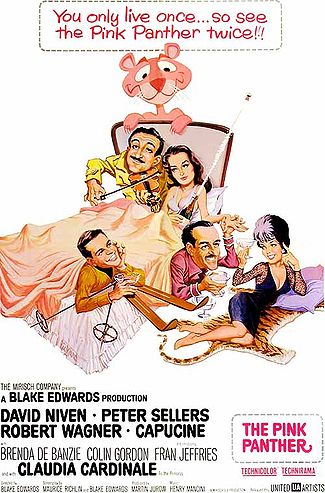
That’s why this initial installment from Blake Edwards was rather surprising, to begin with. This is a David Niven vehicle with him playing a modern Don Juan of sorts who also is a world renown thief known as “The Phantom.” He and his female accomplice have their eye on the equally well-known diamond christened the Pink Panther. It now is in the possession of a beautiful young princess (Claudia Cardinale), but the people of the country believes the diamond belongs to them. Into this seemingly serious story of theft and international relations waltzes in the ever-bumbling but good-natured Inspector Clouseau.

Sir Charles Lytton (David Niven) has his eyes on Princess Dala, surveying her every movement. What he doesn’t know is that his young nephew (Robert Wagner) is up to some tricks of his own, and he flees the United States in search of his uncle. Clouseau leaves France with his lovely wife Simone (Capucine) and follows the princess to a ski resort to see if he can sniff out the culprit. They turn out to be a lot closer than he realized.

It’s during a chaotic masquerade ball when the diamond is in jeopardy, with several costumed apes having their eyes on it. The bumbling Clouseau clumsily tries to set a trap, and yet he unwittingly stumbles upon the culprits leading to a chaotic car chase. In fact, The Pink Panther has a rather odd ending with the culprits getting away and Inspector Clouseau getting the blame. Don’t be too worried, however, because Sellers brought the character back numerous other times.

Despite being initially relegated to a supporting role, there is no doubt that Sellers steals his scenes with his ad-libbing and numerous brilliant pieces of slapstick. He might be stepping on his Stradivarius in the dark or getting his hand jammed in a beer stein.  It’s all the funnier when everyone else is playing the scenes relatively straight. There were some other humorous sequences of deception as the culprits try and pull the wool over the Inspector’s eyes. It’s not all that difficult because he’s an utter buffoon. But lovable. Did I mention that?

3.5/5 Stars

Monkey Business (1952)

monkeyb5I always was under the assumption that the screwball comedy died off in the 1940s with homages coming out years later. Is there such a thing as neo-screwball comedies? Anyways, after watching Monkey Business I feel it is necessary to reevaluate that general conclusion. Here is a film from Howard Hawks that channels a great deal of the madcap craziness that you see in his earlier works like Bringing up Baby (1938). For lack of a better term, it is very screwy indeed. Right from the opening credits, you have the voice of God (Hawks himself) breaking the fourth wall and calling Cary Grant by his real name.

Then the film actually opens, and we meet the quintessential absent-minded genius Barnaby (Grant) and his loving wife Edwina (Ginger Rogers). They are meant to go to a social gathering and yet he is so caught up in his work that they stay behind. You see he is trying to develop an elixir of youth. His experiments are of interest to the business-minded and much older Oliver Oxly (Charles Coburn), who only sees the positives of such a discovery. Barnaby tries to explain to him that it’s not so cut and dry. In fact, his work could have dire effects if careful precautions are not taken.

Little does Dr. Fulton know that one of his lab chimps got loose in his lab and tampered with some chemicals, dumping them in a water cooler. After this absurd moment, Barnaby unknowingly consumes the rejuvenating concoction and his whole demeanor takes a turn.

Soon he’s out buying flashy clothes, getting a flamboyant car, ice skating, and driving like a speed demon down the thoroughfares with an astonished secretary Ms. Laurel (Marilyn Monroe). Cary Grant even shows off his impressive acrobatic skills, performing a cartwheel and a few other tricks.monkeyb3Only when the concoction wears off does he figure out what happened, and he resolves to be more careful next time. Except next time turns out to come sooner than he was expecting when Edwina willingly drinks some of the substance so Barnaby can observe her. Just like that, she is a prank-pulling schoolgirl with insatiable energy.

Once more Barnaby takes the elixir while Edwina is sleeping off the effect. However, when she wakes up a misunderstanding leads to more mayhem as she tries to get help from Mr. Oxly. What develops is a spiral into more hilarity. Barnaby and Edwina are reunited, Edwina’s old flame is incensed, Ms. Laurel is petrified, and chimps and man alike are taking part in some Monkey Business. If none of this makes much sense then I did my job!

3.5/5 Stars

They Were Expendable (1945)

They_Were_Expendable_posterThere’s nothing very intriguing about a film entitled They Were Expendable. In essence, we already know what the conclusion of the film is, however it is important to understand the context of when this John Ford World War II docudrama was coming out. In 1945 the Nazis and Japanese had finally been quelled, and the Allies could look back at the sacrifices that had been made.

One such example was in the Philippines after Pearl Harbor. Despite being undermanned and without much support, the brave men in the navy wreaked havoc against the enemy trying to hold onto their strongholds as long as possible before being forced to evacuate. It is far from a glamorous moment in the war because the war seemed to favor Japan and our forces were made to flee. However, in those moments of distress and tragedy, bravery seemed to flourish and our resolve only greatened. General Douglas MacArthur summed up the sentiments of every man when he promised, “I shall return.”

That being said, John Ford’s They Were Expendable is not always easy to follow; it can feel slow and deliberate, however, it exudes a gritty realism that is hard not to appreciate. It certainly is patriotic, but it does not often over sentimentalize war with high drama. We see it for what it often is. It means smoke, explosions, shipwrecks, death. It means breaking apart friends, crews, and men and women who care about each other.

Part of that realism is probably helped by Ford’s work filming a documentary of the Battle of Midway and lead Robert Montgomery (who plays Lt. Brickley) also fought on a P.T. boat during the war. Although he was not ever in the military, John Wayne always has a knack for reflecting American ideals of grit and determination. That’s why he was made for westerns as well as war films. This time around playing the fiery but loyal Lt. Rusty Ryan. Donna Reed on her part has a rather small role, and yet it is an integral part because she represents the brave nurses who support the military. She is the lifter of morale, the girl next door, all these ideals that fit this pretty young lady from Iowa. It’s hard to know if she’s just playing herself or not.

At times it’s a hard film to follow because it often seems to jump or skip events. Maybe it happens in an attempt to cover more story or maybe Ford did not want to hold his viewer’s hand, I’m not sure. I do know that I am far less of an informed viewer about this time period or this moment in World War II history. It often seems like most of the limelight is given to mainland Europe and not the Pacific.

As much as I was drawing connections and finding similarities, this film is far from McHale’s Navy. The story is far more somber, more realistic, and at times depressing to watch. It’s the kind of film that could only be made after we had won. It affirms our American resolve and honors those who paid the ultimate sacrifice. That and the film’s beautiful low lit images make it worth watching. The cinematography makes numerous scenes far more interesting by layering characters in darkness and accentuating the shadows in a hospital corridor for instance. Rather than making everything feel stylized, it only helps to augment the realism that makes They Were Expendable a worthy testament of WWII.

3.5/5 Stars

Review: Breathless (1960)

breathless2Breathless is such a fresh, smooth piece of cinema that feels as cool now as it was back then. The transcontinental French vibe paired with the revolutionary production is strangely still appealing. It does so many things with such style that is always unique but never quite off-putting. Not to mention the score which is playful in an elegant sort of way. The film has an array of quick cuts, it’s discontinuous, abrupt, and it literally jumps between images. Actions, like shooting a cop or sitting in a room with a girl, become more interesting than we could ever give them credit for.

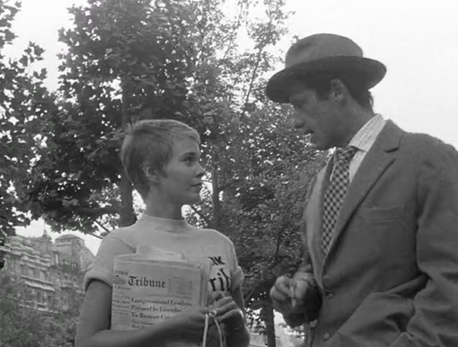
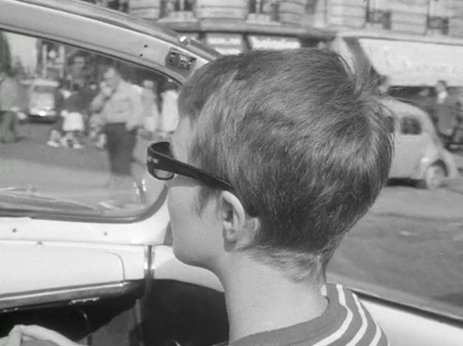
Godard is known for saying that all you need for a film is a girl and a gun and that’s basically all Breathless is. Michel (Jean-Pierre Belmondo) is a low down, no good hood who also happens to be quite funny at times. He shoots a cop for no good reason and after that, the police are after him on the streets of Paris.breathless5He’s also broke and all his buddies are either unavailable or in some trouble of their own. He swipes money from one girl and rendezvous with his latest fling, the aspiring American journalist Patricia (Jean Seberg). They do very little except drive around the city or lounge around her room. In one memorable shot, jump cuts piece together scenes of the back of Patricia’s head as she sits in the passenger seat observing the world around her pass by.

Michel, on his part, seems only to want sex and yet he says he’s never loved a girl before. He’s continually drawn to Patricia, and he never can quite pull himself away.

She, meanwhile, has another man with an eye on her, and she hopes to propel her fledgling journalism career. Her one assignment happens to be interviewing the highly philosophical and somewhat pompous Mr. Parvulesco (Jean-Pierre Melville).breathless10The billboards around town even foreshadow the impending doom of Michel. Patricia later learns from the police that her lover is wanted for murder, and she must decide what to do about it. In a memorable scene, Patricia is shown pacing around the room in a wide circle. In the end, she does turn in the hood to prove to herself that she doesn’t truly love him.

Michel looks utterly pitiful, like a wounded deer after he gets winged by the police and collapses in the middle of a quiet avenue. Patricia stares straight at the camera giving the queerest of looks as Michel breathes his last. If you wanted narrative clarity you’re definitely looking in the wrong place.

breathless9In some ways, Jean Seberg’s iconic look reminds me a young Audrey Hepburn another gamine glamour girl. The photography of Seberg is iconic from the reflection in her sunglasses to her donning Michel’s hat. Breathless proves film is not just entertainment, but it can also be lastingly stylish. There’s nothing wrong with that, and it still seems to work after over 50 years. Honestly, when I was starting out, Breathless helped open up all of European cinema to me and for that, I am indebted to Godard and The French New Wave.

4.5/5 Stars

The Sure Thing (1985)

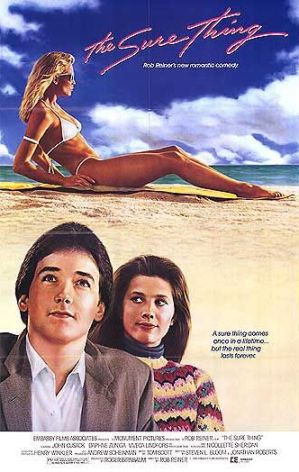
Sure_thingposterThe Sure Thing is one of the early works of both director Rob Reiner and young teen star John Cusack, and it proved to be a success for both parties. In the film, Walter Gibson and his friend Lance are heading off to college. Gib is heading to a stuffy school on the East Coast, while Lance is venturing off to the sun-soaked southern California shores with the female prospects at an all-time high. It doesn’t help Gib who has recently been striking out with the opposite sex, because, to put it bluntly, they don’t buy his astronomy inspired pick-up lines. He’s just too much of a jerk.

And so the two friends go off to their separate spheres and for Gib things do not end up too bad. His school’s not a bore, but he’s not getting the kind of action Lance has, not yet. That is until his friend tells him about a “sure thing.” The girl who is one out of a million and who is available, just waiting for Gib in California. So as any red-blooded American college student would do, Gib begins the cross-country trek over his Christmas Break.

The catch is this. He’s forced to travel with an overly enthusiastic couple obsessed with singing show tunes and that’s not the worst of it. His backseat companion is fellow classmate Alison Bradbury (Daphne Zuniga) who happens to be very attractive, but she also hates his guts.

She and Gib happen to be polar opposites, and they did not get off to a good start at school. She already has a boyfriend. She is always on top of her academics, and she never does anything outrageous. Gib is a showboat, prone to wildness that includes shotgunning beers and trying to pick up girls.

Their constant bickering and nagging find them sitting on the roadside in the middle of nowhere trying to thumb their way to California. And so it looks like they will go their separate ways, but they end up traveling together, broke, wet, and starving. Somehow they get there and along the way they begin to genuinely appreciate each other. There does not have to be anything between them. Of course, right before they get to their final destination a disagreement leaves them at odds. However, after spending so much time with someone like Alison, a sure thing just does not have the appeal it once did for Gib. He proves to himself that’s he’s not quite as shallow as he thought he was. If only Alison could know that.

The enjoyment of this film is not so much in discovering the result because any Joe Schmoe who has seen at least a handful of romantic comedies knows how the story is supposed to end. The true joy of the experience is how we arrive there with these two characters. In the back of our minds, there is a kind of peace of mind, because although they seem so far apart and at odds, we know where they will end up. We can take a little bit of enjoyment out of every single moment they spend together mundane or not. In many ways, the road movie feel of The Sure Thing brought to mind other similar storylines like Train, Plains, and Automobiles as well as It Happened One Night. I have to say I was pleasantly surprised by this film. Cusack pulls off the lovable jerk well and despite her initial stuffiness Daphne Zuniga is a lot of fun too.

4/5 Stars

Young Mr. Lincoln (1939)

youngmr1Hailing from a year laden with numerous American classics, Young Mr. Lincoln is undoubtedly overlooked in deference to other titles like Gone with the Wind and The Wizard of Oz. Even John Ford’s own Stagecoach, starring John Wayne, overshadowed this autobiographical work headed by Henry Fonda. Then the next year they came out with The Grapes of Wrath and that title garnered praise for both men. But again, it seems like most have forgotten about Young Mr. Lincoln.

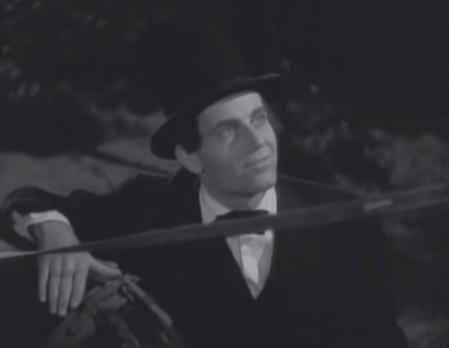
It really is a shame, because this is a quintessential Ford film, and Henry Fonda gives an iconic turn as one of the great historical giants of all time. Except instead of focusing on his major accomplishments, trials, or fatal death, this story contents itself with a simpler story. The focus is the fledgling law career of Abraham Lincoln, who back in 1857 is only a lanky country boy with a hankering for learning. He sees tragedy at a young age when people pass away around him and yet out of those formative years rises a man who is wise beyond his years, because he understands his fellow man and cares deeply about justice.

Lincoln is hardly a lawyer of any repute, and he seems hardly a political figure compared to the likes of the great Stephen Douglas. But the people respect him because he wins them over with his common sense and homespun witticisms. Aside from his ubiquitous top hat, he willingly judges pie eating contests, and play the Jew’s harp with feet reclined at his desk.  One of his dear admirers is the young socialite Mary Todd who takes an immense liking to him. He’s the kind of figure that the elite and common folk alike can truly respect.

So when two brothers are accused of murdering another man after a fight one night, it is Mr. Lincoln who avoids a lynching and appeals to the morals of the locals. He, in turn, promises the mother of the boys that he will do his very best to win their freedom and he does all he can to gain her trust.

When the trial begins he carefully picks the jury and faces off against a venerable prosecutor with much greater experience than himself. The mother of the accused saw the squabble, but she cannot bear to implicate her sons. Lincoln pleads on her behalf.  It also looks like the key witness and friend of the deceased man will put a seal on the case, but young Mr. Lincoln is not done yet.

Thus, the film ends and Lincoln is most certainly on the rise, but we get to imagine his future knowingly, on our own, because none of that length of the story is told. In that way, it’s rather interesting to juxtapose Ford’s film with Spielberg’s more recent biography Lincoln, starring Daniel Day-Lewis. They represent different generations of filmmaking, because the latter film takes a monumental moment in history, the passing of the 13th amendment, and places a magnifying glass to it. Focusing on all the individuals involved, and it is certainly going for an amount of period realism, starting with the impressive performance by Day-Lewis as our 16th president.

Young Mr. Lincoln is a lot simpler because it does not need to focus on the highlights. It takes as great of an interest in Abe’s origin story so to speak. On his part, Henry Fonda plays the role wonderfully using his mannerisms and plain speaking delivery to give a homey quality to Lincoln. He’s believable, but in a different way than Day-Lewis. It’s not better or worse necessarily, just different. That being said, Young Mr. Lincoln deserves a place among the exulted classics of that legendary year of 1939. Hopefully, it will continue to receive the respect that it deserves, because it is a moving and surprisingly very witty film. Probably in the way Abraham Lincoln was.

4.5/5 Stars

Love & Mercy (2015)

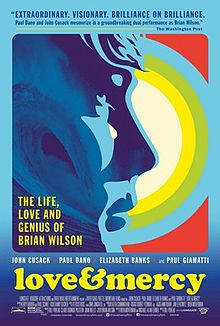
Love_&_Mercy_(poster)It’s a tough one. How do you do justice and even begin to scratch the surface of a living legend like Brian Wilson? His songs have brought joy to countless millions and numerous generations of music lovers. And yet out of all the joy he gave people, his life was steeped in so much pain and suffering. If anything became all too clear, it was the harsh reality of his life back then, but thankfully not now. At first, I didn’t understand the significance of the title (It’s the lead track of one of his albums back in 1988), but the words it hoists up are so perfect in describing his character.

I must say that I was a little skeptical of two actors playing Wilson. For those who don’t know, Paul Dano plays a young Wilson in the ’60s during his creative peak and familial turmoil. Then John Cusack picks his portrayal up in the ’80s when a messed up Wilson is being controlled by his quack psychiatrist Eugene Landi. They seem like two starkly different touch points, displaying two very different actors. Again, how could a director, in this case, Bill Pohlad, find cohesion out of this narrative chaos? But it works and ironically, that’s exactly what Brian Wilson did in his lifetime. That’s why he was such a mastermind.

As a young man his father abused him — hounded him to death. He suffered panic attacks, stopped touring, and embarked on some of the greatest musical odysseys anyone could ever hope to imagine.  We are thrown headlong into his genius during the Pet Sounds and Smile sessions. It might be a reenactment, but it feels like I am watching an artist at work. He’s on a different level, and it makes me appreciate each one of his songs even more. On a side note, I recently saw the documentary The Wrecking Crew, about the famed group of session musicians. And while they brought the skill in their craft, Wilson did truly bring artistic genius that was unique to him. That’s what, in many ways, caused a rift between him and his bandmate cousin Mike Love.

We are tossed back and forth from earlier past to later past as Wilson meets cars saleswoman Melinda Ledbetter (Elizabeth Banks) and embarks on a new journey as the manipulative Landi continues to drag him deeper and deeper into hell. In fact, sometimes it’s hard to imagine that this is the same Wilson and that is helped by Cusack’s performance. He is jumpy, helpless, muted, almost in a haze. But in him, you can see there is an immense vulnerability and capacity for love. That’s what Melinda sees as the layers get peeled back and that’s why it tears her apart seeing Brian suffer so.

As it turns out, Brian Wilson’s mind is not only a place of musical creation, but of fear, pain, and confusion. He was stuck between an antagonistic father and Landi’s manipulating presence. Whether it was the abuse, the drugs, the hallucinations, or a little bit of each, his story is one with a happy ending, and the film plays out that way. Isn’t it fitting that his immortal tune “Wouldn’t It Be Nice” closes the gates on this chapter of his story? It certainly is not over, still going, forever hopeful, and continuing to soar ever higher on a wave of positivity.

His genius astounds and now his resilience amazes me. He finally has found the Love & Mercy he deserved. Thank you Brian Wilson for gifting us such immortal tunes.

4/5 Stars

An Affair to Remember (1956)

anaffairto2An Affair to Remember (1956) has always been noted as a great American romance as far as I can ever remember, and I figured out that part of that was because it gets a mention in Sleepless in Seattle (1993). Whatever the reason, I finally got around to watching it and it is certainly an enjoyable weepy. Any film with Cary Grant as a romantic lead is usually, at the very least, charming and this one is too. He is a famed man on an ocean liner who has finally gone and gotten himself hitched. It’s big news and as soon as the ship touches down he is going to meet his love.

Quite by chance, he meets Deborah Kerr’s character and they are immediately taken with each other. Soon their friendship grows into an affectionate romance, and yet they feel uncomfortable in front of the other passengers who seem to be watching their every move with interest. They both know that once the boat reaches New York things will not be the same between them for some time.anaffairto4And so it is, but they had made one last plan to meet each other at the top of the Empire State Building. Grant makes it, but Kerr is detained for a very good reason. After seeing her in an awkward situation at the theater, Grant resolves to go see her and get to the bottom of what happened. It’s a tearful, albeit happy, reunion as they come back together.

If any of this feels familiar, like a rerun, that’s because it is. Leo McCarey actually made An Affair to Remember (1956) as a scene for scene remake of his earlier film Love Affair (1939). I never thought I’d say that I like a film with Charles Boyer more than a comparable one with Cary Grant, but it’s the truth. I’m not sure if it’s because I saw it first or that the film feels more intimate, but I really enjoyed Love Affair. An Affair to Remember is certainly elegant in color and Deborah Kerr gives a fine performance, but I was personally blown away by Irene Dunne as an actress. In fact, back in the day, Dunne worked quite a bit with Cary Grant (The Awful Truth, My Favorite Wife, and Penny Serenade).

So my advice is, go back and give Love Affair a watch. It’s still by McCarey with much of the same story so it’s really a personal preference what film you like more.

3.5/5 Stars

Terminator 2: Judgment Day (1991)

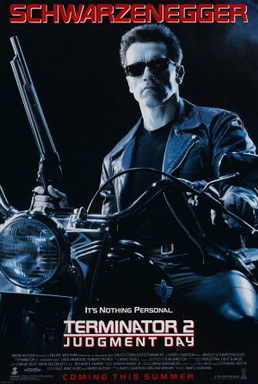
Terminator2posterBack in 1984 a strange life form came to earth in search of Sarah Connor and ultimately left a trail of destruction. It’s the same terminator (Arnold Schwarzenegger) who now shows up in the year 1991 intent on getting the right clothes, transport, weaponry, and cool shades to aid in the completion of his new mission. It’s the same terminator, except not really because he has been reprogrammed to protect young John Connor who will be the future savior of civilization as we know it. Right now he is a 10-year-old juvenile delinquent living with foster parents. His mother, the aforementioned Sarah Connor, is locked up tight in a mental institution after the events in the previous film.

But there also is a second more highly advanced terminator that Skynet has sent to assassinate Connor, and it becomes obvious that he is in grave danger. Both cyborgs converge on his location, and he flees with the help of his new found guardian. The terminator is programmed to listen to him and over time they form a bond with John teaching him slang (ie. the famed “hasta la vista baby”) and perhaps more importantly that he cannot kill everyone he sees.

They go to rescue Sarah from captivity on John’s bidding, but the other terminator has the same idea. The resourceful mother has plans of her own that are disrupted by witnessing her former executioner with her son close in toe. It’s all very confusing as they must alert her to the real danger and escape the present dangers.

Sarah leads them out of the city to the home base of a loyal friend who can give them resources and, above all, weapons. She sets her sights on Miles Dyson, the man who unwittingly developed the technology that would end in “Judgment Day.” In a fit of vigilantism, she mercilessly goes after the innocent man, for his work which would cause millions of future deaths. It takes the arrival of John and the Terminator to get her to calm down.

With Dyson’s help, they head to his office to destroy the prototypes for good, but they get a little company and it turns into a firework show complete with pyrotechnics and blockbuster explosions.

Yet again the shift-shaping, poly-alloy terminator pursues the trio and this time they are trapped inside of a steelworks. It’s a fitting locale for a desperate showdown with a wounded Sarah, a battered Terminator, and a thoroughly frightened John. Some last-ditch heroics finish off the futuristic assassin, but that is hardly the end of the story. John must say goodbye to his friend and probably the best male role model he’s ever had. He was a faithful companion to John, and he, in turn, came to understand why humans cry. There are just some things that cannot be expressed through words, protocol, or any type of rationale. The future is still to come, but at least for the present is safe.

I am unabashed to call Terminator 2 thoroughly enjoyable, because it embraces the fundamentals of a great sci-fi blockbuster, while never quite losing its human component. Perhaps we could have used more character development and less action, but the characters played by Linda Hamilton, Edward Furlong, and Arnold Schwarzenegger have enough depth to make them work proficiently. In fact, they are icons by now and I can understand why. James Cameron certainly knows how to develop thematic spectacle to the nth degree and this installment is no different. This sequel is bigger and better than the original 1984 film, which is a testament to not only the special effects but the story and characterizations. Hasta la vista Baby. Until next time anyway.

“If a machine, can learn the value of human life, maybe we can too” ~ Sarah Connor

4.5/5 Stars

Purple Noon (1960)

purplenoon4Right off the bat, there are two things that stick out about Purple Noon. First, you cannot help to notice the colors because the blues and reds pop like some vibrant 1960s painting. Then there’s Alain Delon who at the age of 23 made his rise to stardom, thanks to this film and Rocco and his Brothers (1960). As Tom Ripley, he finds a role that is fascinating in more ways than one.

During the first interludes of Rene Clement’s thriller, based on the Patricia Highsmith novel, I didn’t really know what I was watching or what to think. Tom was sent to Italy to bring the wealthy Phillipe Greenleaf back to San Francisco at the wishes of the man’s father who is paying Ripley. Their story begins as an entertaining jaunt through the city. They lounge at cafes, take carriage rides, and generally have fun living it up at night.

Tom is nothing like Greenleaf. He’s far poorer coming from a humbler background, but he is also much more resourceful and clever. When he takes a trip with the wealthy young man aboard his yacht, he finally hatches a plan to get what he wants. He abruptly stabs Greenleaf during a game of cards and the whole trajectory of the film changes in an instant. It began playfully absurd and quickly switches gears as a thriller involving murder, stolen identity, and deception.

purplenoon5

He plays up the tiff between Greenleaf and his girlfriend Marge, telling her that he is still angry and so he went off somewhere else without her. Thus, begins Ripley’s transformation into Greenleaf, forging a passport and signatures until he can pass off as the man himself. He starts dressing differently, spending more money, and continually acting as if he actually is Greenleaf. But things get difficult when he nearly runs into folks he knows, and Marge is desperate to know where her love is. These all prove problematic and yet Ripley skirts most of these entanglements with relative ease. It’s when a friend of Greenleaf’s named Freddie Miles figures out his charade that things begin to escalate because Tom’s only option seems to be murder. He commits the act coolly and plans his next move with calculated ease.

The police are after a murder, but it looks as if Tom has tied up all the loose ends and we find him relaxing reclined on the beach. He doesn’t know that the game is up, because of what the police found at sea.

The visuals of this film definitely do justice to the young Delon who is strikingly handsome with piercing eyes, but his turn is interesting in its own right because he was always so adept at playing the coolest of characters. He’s no different here and Purple Noon proved to be the initial boost to his storied career.

4/5 Stars