DON’T BE SURPRISED IF THE SITE LOOKS DIFFERENT IN THE UPCOMING DAYS AS I TRY TO UPDATE THE LAYOUT AND DESIGN.
THANKS FOR YOUR PATIENCE AND UNDERSTANDING!
-Tynan at 4 Star Films
DON’T BE SURPRISED IF THE SITE LOOKS DIFFERENT IN THE UPCOMING DAYS AS I TRY TO UPDATE THE LAYOUT AND DESIGN.
THANKS FOR YOUR PATIENCE AND UNDERSTANDING!
-Tynan at 4 Star Films
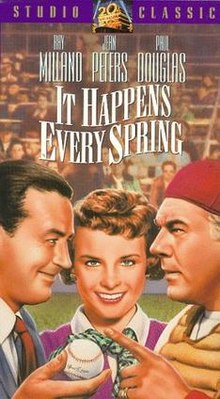
Does this film glorify those who cheat and deceive taking advantage of others through the advances of modern science? Certainly not! Well, maybe a little but this is one of those ludicrous stories that never makes a pretense of being real life or a moral tale for that matter. It’s just a zany story that’s actually quite rewarding to be a part of.
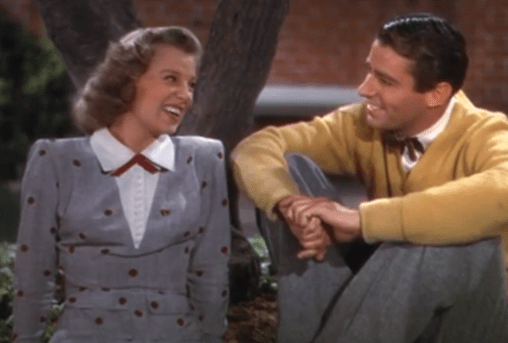
At its core is a middling college researcher. He’s in love with a girl but not rich enough to offer her much of anything. What’s more intimidating is that her father is the dean of the school and Vernon’s tireless amount of research is getting him nowhere fast. Another seemingly trivial detail remains that every spring he gets obsessed with baseball and becomes distracted in his lectures, in his lab, and in life in general.
If you want to think about one of Disneys live-action classics, it’s easy to draw some similarities between this film and The Absent-Minded Professor (1961). In the latter film, flubber is used for an advantage on the basketball court. Here it’s all about baseball.
Vernon Simpson (Ray Milland) discovers the extraordinary characteristics of his new substance methylethylpropylbutyl quite by accident when he rolls a dampened baseball by a block of wood only to have the two repel. His eyes almost pop out of their sockets when it works time after time. The implications are simple. He can harness this discovery to make it in the MLB and S.T. Louis has aspirations for a pennant but needs pitching. This is his chance to realize his dreams.
The film admittedly doesn’t explain much about why Vernon is infatuated with baseball. Perhaps it was enough that most Americans still were taken with it since it was “The National Pastime.” Regardless, he hurriedly gets a leave of absence from work and provides a cryptic message to his girl not to worry about him.
His baseball career as chronicled by the film is a meteoric rise that totally revels in its completely ludicrous nature. He walks into the clubhouse talks with the manager (Ted De Corsia) and the teams head executive (Ed Begley) who doubt this adamant thick-headed nobody who brags he can win 30 games. Boy, does he shut them up and they’re glad he did.
Most everything is textbook as far as a film about a science researcher playing major league baseball and using a miracle substance to win ballgames can be. His girlfriend thinks he’s involved with the mob. He tries to keep his true identity a secret under the pseudonym King Kelly, and he begins to form a bond with his veteran bunkmate and backstop Monk Lanigan (Paul Douglas). I’ve always been a fan of Paul Douglas as an actor because he plays his characters straight with a gruff yet palpable sincerity. It’s little different here. Milland though hardly an American bred on stickball nevertheless is a charmingly scatterbrained lead.
I didn’t realize it until now but I’m rather fond of science fiction baseball comedies. It breaks every rule of baseball. It’s absurd. There’s so much to call into question and yet I don’t want to. But just for the fun of it all, let’s look at a few obvious inaccuracies from It Happens Every Spring.
King Kelly would never get a win if he came into a game that his team was already winning and yet he asks for $1,000 in compensation for such an appearance. Furthermore, it looks like he’s committing a balk about everytime he winds up. And if he’s not then baserunners would be stealing on him all day because he never pitches from the stretch. He’d be an easy target.
Believe it or not, Kelly actually doctoring the baseball, secret formula aside, definitely is not all that ludicrous. Pitches such as the spitball and scuffball were famously used in the games early days. Pitchers like Burleigh Grimes, a personal favorite of mine, made a living off the pitch and though the spitball, in particular, was outlawed in 1920, pitchers like Grimes were grandfathered in. He continued throwing it until 1934.
Still, that didn’t completely deter later pitchers from using it like another Dodger great Preacher Roe and then Gaylord Perry in the modern era. As long as you didn’t get caught there was no recompense and the same can be said of Kelly. Again, we’re not glorifying cheating. Don’t get any ideas.
3.5/5 Stars

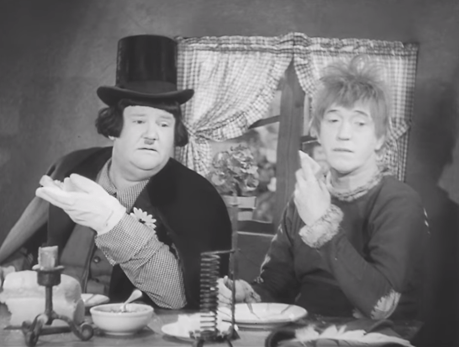
Laurel and Hardy had better films with better gags and more iconic moments but Babes in Toyland, or The March of The Wooden Soldiers as it was also known as develops the most immersive fantastical world that they ever had the privilege of gallivanting through. It’s almost fitting that we find them in an almost childlike world because they brought laughter to not only adults but a plethora of children as well and this picture does them both justice.
It’s true that out of the imagination of babes (which was consequently Oliver Hardy’s lifelong nickname) comes a film steeped in nursery rhythms and kiddie stories. Above all, it proves to be the perfect playground for two of comedy’s greatest treasures as they play Make-Believe in a world of Mother Goose, the Three Little Pigs, Old King Coal, and a host of others. Except it’s not made up at all. By 1930s standards everything is very much alive and it very easily could be a child’s delight. Also, rather unwittingly a minor Christmas classic was born.
Ollie Dee and Stannie Dumm, as they are affectionately called, work at the local toy factory in Toyland and reside in a Shoe with a certain Old Woman as well as Little Bo Peep.
But she is being accosted by the resident villain and shoe forecloser Silas Barnaby. He’s a hyperbolic, conniving, cackling antagonist who undoubtedly finds origins in the invariably black and white worlds of a child’s fantasy (It’s no coincidence that Disney’s canon has boasted some of the most iconic villains). He’s played by none other than 21-year-old Henry Brandon and though he’s draped in a beard there’s no doubt that his stunts in the final scenes evoke the physique of a young man.
Anyways, our heroes promise to raise the necessary money to keep the shoe so Little Bo Beep doesn’t have to marry such a horrible fellow. But of course they go and make a shamble of things messing up Santa’s wooden soldier order and they get fired. Even a trojan Christmas present in July sent to Barnaby fails because of Stan’s typical good-natured idiocy.
He’s up to his usual tricks as the lovable pal who begins his trademark sniveling while his friend is getting tortured with a dunk tank only to offer Ollie a glass of water once he’s made it back to dry land with his usual vacuous deadpan. Furthermore, still plagued by malapropisms, he turns “heartbroken” into “housebroken” and similarly misconstrues other words.
The villainous Barnaby is not to be outdone. First trying to arrest Ollie and then framing Bo Peep’s true love with the kidnapping of one of the three pigs. Banishment to the dreaded Bogeyland looks all too imminent. Still, Babes in Toyland stages one of the most delightful battles of good versus evil that evokes everything from The Nutcracker to The Wizard of Oz. Toys become ammunition and buildings are to be sieged as everything comes alive.
Like Our Relations two years later, this film employs one of the oldest sitcom tricks but here it’s all but forgivable. Because, again, television tropes hadn’t been invented yet much less television. It’s true that the kids will probably enjoy this the most or perhaps the young at heart. Still, Hal Roach delivers another Laurel and Hardy comedy with its share of child-like charm and some dashes of Disney magic (namely a Mickey Mouse lookalike and the Three Little Pigs theme song). Yes, it’s puerile entertainment but what’s wrong with that?
3.5/5 Stars

In the Hebrew Pentateuch, the Levitical law lays out a framework of precepts quite clearly that the people were meant to follow. One iteration can be paraphrased like so: If a man marries both a woman and her mother it is perversion. There must be no wickedness among you.
Doing a once over of the Spanish elite Don Lope (Fernando Rey), we see in him a man who came out of nobility and nevertheless lives a fairly humble life for the very fact that he’s never held a day job. He’s upper class by title and pretense only. Subsequently, his moral makeup is very much the same as he nobly provides a home for an orphaned ingenue (Catherine Deneuve).
Like his status, it is nearly all for show. It’s under the pretense of charity and the guise of a gentleman that he takes in the young Tristana, still in mourning following her dear mother’s death. Don Lope touts himself as a gallant defender of the weak and undoubtedly sees himself as a dying breed of man. Still, as his devoted housekeeper, Saturna remarks, when it comes to women he’s got horns and a tail. It’s hardly a secret.
We note the times in Spain during the 1920s or 30s. It is an irreligious generation as reflected in the deterioration and lack of importance placed in the church bell tower which used to be crucial to the daily rhythms of people’s lives. Now they’re too distracted by other pleasures.
Don Lope for one, does not concern himself with issues of money. Haggling is of great distaste to him. Instead in the quiet corridors of some great cathedral, he asks Tristana for a clandestine kiss. It’s the root of his perverse desires. Afterward, he makes troubling statements like, I’m your father and your husband and he seems to wholeheartedly believe them.
So despite the presence of Deneuve, in some respect, the narrative is more akin to Viridiana (1961) than Belle de Jour (1967) with Rey once more involved in a romantic tryst where he seems to be the main proponent of the relationship.
His spiritual beliefs come down to a few basic points including the assertion that Jesus was the first socialist and that the real priests are the men who look after the weak, fighting against hypocrisy and the powerful. He’s not altogether wrong but the words prove ironic coming from his lips. Because we know full well his own seemingly incongruent behaviors.
Still, it’s too true that we can equally criticize the advice of the local priest. However benevolent he might be, his words to Tristana stands in the face of what seems to be inherently right. He knows full well what Don Lope has done and yet he does next to nothing to protect the girl. All he can entreat her is to stay with him because he seems to have changed and treats her well enough. That is all.
Fernando Rey’s character is obviously problematic to grapple with even if the performance itself is of merit. Because he’s this baffling mixture of old-fashioned values which give the pretense of respectability and honor. He’s not outrightly despicable, masking his indiscretions well. Perhaps because in his own mind’s eye these are hardly sins at all.
In realizing this we’ve come to what’s most problematic about him. Because he’s created his own code, in a sense, since there is no universal moral code that he falls back on. He is a strict adherent to moral relativism. You see, usually religious people, people who grew up in faith have something to check themselves with — Levitical law for instance.
Far from being legalistic, grace was in theory supposed to accord adherents the ability to forgive others but also be forgiven and live in complete freedom if they were penitent. But Don Lope can’t be troubled with religiosity, the commandments, and dos and don’ts of the church are all he sees. They seem so restrictive. Undoubtedly because most of the people living by them misinterpret their intentions and as a result carry on repressed even harshly ascetic existences. And yet in disregarding the same, Don Lope’s own “morals” cause him to step over accepted boundaries.
Thus, his relationship with Tristana from the day he betrays her innocence is forever tainted. And there is no grace there and no sense of repentance as if he actually did nothing wrong, and so he doesn’t really change. It only serves in making his victim more bitter by the hour.
Rey’s performance might be the most crucial but being partial to Catherine Deneuve there’s no question that her transformation from a young grieving woman of such pure naivete is striking. Because she’s so innocent only to become tarnished by Don Lope’s behavior. She’s a far cry from the woman she arrived in his home as — both physically and mentally. It’s taken its toll.
She is plagued by morbid dreams but Bunuel has gotten a great deal more subtle with his surrealist diversions skillfully weaving them into the framework of reality with seamless aptitude. There are individual moments that you don’t realize are actually dream-like until the bubble has burst and you’re out of them.
So the film utilizes a fairly straightforward narrative for Bunuel but that must be taken with a grain of salt. Because it’s contorted along the same lines of subversion and social norms that the Spanish director is usually fond of lambasting with his typical iconoclastic verve. It’s not always blatant in this picture but still evident.
Ultimately it becomes a story of revenge as Tristana finds love with another man (Franco Nero) and yet still feels trapped by Lope. As a result, her heart grows hard and full of resentment toward the old man who ruined her. To return the favor, she is all but ready to ruin him. It’s a lovely sentiment.
In reading some over the career of Luis Bunuel I’ve realized the correlation between him and Alfred Hitchcock in a couple areas. First, they were very much visual filmmakers who knew what they were shooting before they ever got on set. The movie was already inside their heads and made. They simply needed to use the actors and equipment at their disposal to get it done.
Furthermore, thematically since they both had a Catholic background and a slightly sardonic wit, you often see touches of those sensibilities throughout their pictures. Hitchcock in the likes of Rear Window (1954) and Vertigo (1958), also considered themes of sexual obsession and deep-seated vices which Bunuel held a similar preoccupation with. I’ve always held a preference for “The Master of Suspense” but I must still pay my deference to the latter as a tirelessly inventive filmmaker who proved to have remarkable longevity.
4/5 Stars

Luis Bunuel made a name for himself ever since his early work on Un Chien Andalou (1929) as king of the surrealist filmmakers. That and bashing the bourgeoisie. Some might be surprised in finding that Diary of a Chambermaid, adapted from the eponymous 1900 novel of Octave Mirbeau, is a fairly straightforward narrative for him.
From what I gather, that’s not to say its fully faithful to its source but more so it does not send the narrative hurtling into surrealistic visions like many of his other prominent works. What’s not missing is his typical acerbic wit that belittles the lifestyle of the upper class partially through the eyes of a Chambermaid named Celestine (Jeanne Moreau).
Before it’s begun we already know it’s charted out a diverging course from that which Jean Renoir’s Hollywood effort tread. That goes without question because not simply the directors but the systems that they were working under prove drastically different. Thus, there’s little reason to label this a remake. It’s an entirely different beast.
Furthermore, their leading ladies, the vivacious Paulette Goddard, and the aloof Jeanne Moreau could not be more different muses. The latter dame of France projects even a mild indifference to the hoops she’s put through.
Moreau actually received the part over Silvia Pinal who was intent on being in the picture (even learning French for the role). Bunuel was no doubt happy to have Pinal aboard as well but ultimately the French backing won out.
While he did not get his initially chosen leading lady, Bunuel nevertheless was blessed with one of his other most prolific collaborators the young French screenwriter Jean-Claude Carriere who would go on to work with the director on many of his most prestigious later works.
Celestine, as portrayed here, is not an altogether awful human being — she does show some amount of heart even — but that does not mean she fails to realize the degree of power she has over people.
Yes, she’s only a chambermaid. There’s an elder gentleman who resides in the manor. His adult daughter who oversees much of their affairs. And we have the upstairs-downstairs drama at hand most certainly with gossip being traded. Especially about the Madame’s husband (Michel Piccoli) whose raging libido means he is just about to pronounce his love for anything that moves.
However, in this particular picture, the Monsieur Monteil also has an ongoing feud with the retired army officer next door who is constantly ridiculing him and tossing refuse onto his property. In fact, there are numerous other exemplary moments of wry humor like when a pronounced animal lover annihilates a butterfly at point-blank range his first time using a shotgun. Or the fact that the same man who turns out to be Lord of the manor finds Celestine far too long a name and christens her Marie; that’s what all his past maids went by.
But as Bunuel pictures are accustomed to doing, this one slowly begins to roll out the carpet of perversity masked under refined sophistication. The master has Celestine read to him in the evenings and quite nonchalantly asks to touch her calf. He says she has nothing to fear and otherwise he might be the most charming individual in the home. He’s simply exercising a few whims, after all, he’s advanced in years. He should be given leeway… That’s how the rationalization goes anyway. However, the moment is as cringe-worthy as it is despicable especially in an age where such acts of sexual harassment are finally being brought to the fore and into the light.
Except in a Bunuel picture these proclivities were never really hidden. He tantalizes and nearly taunts you with them. Because this elderly “gentleman” is not the only one. The perpetually vexed husband keeps inquiring if Celestine has settled in because he wants to have a love affair with her. He promises that he’s not a brute though his past history seems to suggest otherwise.
Then, there’s brusque chauffeur Joseph who initially picked her up at the station. He relishes the opportunity of making the goose for dinner suffer because they taste better that way. And he also brandishes callous statements about killing jews after scanning the newspaper headlines. His anti-semitic sentiments are never in question.
The crass behavior doesn’t end there either. The father dies and on the very same day, a darling little girl that Celestine had taken care of is prematurely pulled from the picture as well. Both have dubious shrouds lingering over them. Amid it all, Celestine nearly leaves her post but comes back and the marriage proposals keep on coming from every man. She finally ends up with probably the nicest of the lot. It turns out hurling insults and garbage is almost docile.
Even the priest while not necessarily a wayward figure provides no type of spiritual guidance. He has no wisdom to impart. Instead entreating his parishioners to give to his church. There is no one righteous, not even one.
One of the few moments Bunuel does stray from normal classical filmmaking comes in the final frames. The first time you see it the immediate assumption is your eyes must be playing a trick on you.
But then we see a mass of protesters jump once, then again, and one final time so that they have all disappeared from the screen with each subsequent cut. One final lightning bolt for good measure and the books close on Bunuel’s rueful indictment of the bourgeoisie. It was very much his favorite pastime.
And yet any neat explanation of the film — even if it is more conventional as a narrative — is soon eviscerated by any number of complications. The contradiction in character, political undertones, and even a finale that indubitably has ties to Bunuel’s early career all spring to mind. His picture L`Age d’Or (1930) was decried with a similar protest. There’s no doubt that with each subsequent picture, the director pushed the cinematic boundaries with schemes of visionary ingenuity. Love him or hate him, there is no denying the skill in his craft.
4/5 Stars

The opening narration of Los Olvidados asserts that the great modern cities of the world including New York, Paris, and London all mask issues of poverty and delinquency amid their magnificent structures. This is a universal problem that plagues Mexico as well.
In Los Olvidados a test case is being proposed and the solution left open-ended because change is still necessary. There’s still need for some kind of resolution. Whether it’s completely true word for word is nearly beyond the point because it feels authentic. There’s little need to make up a world as dire and ugly as this one unless there’s at least a grain of reality in every frame.
Where boys break out of reform school, stone blind beggars in retaliation, and form gangs as a kind of social safety net to lash out at their environment. Beating up the poor and the helpless. They too are poor but this band of theirs allows them to be less helpless and prey on others instead. That’s their main tactic of survival in their life of impoverished vagrancy.
It proves to be a harrowing exhibition in social realism and though defamed in its day, its candid and at times brutal depiction of juvenile delinquency has gained it a spot as one of Mexico’s most prestigious pictures. There’s no doubt that it’s a violent picture seething with adolescent rage. The only question is how much is environmental and how much is a product of the individuals?
As much as this film is disquieting and repulses me to the core of my being, I cannot deny its place as an important commentary and cinematic landmark from Luis Bunuel. The Spaniard is a master who always makes my skin crawl and challenges my very convictions. Los Olvidados succeeds in doing the very same thing again by forcing us to acknowledge the loathsomeness in the world that we so often want to brush under the rug. It’s there. There’s no denying it. Man left to his own devices will send the world hurtling towards malicious chaos.
There’s an intent to every moment with action streamlined but never feeling rushed or forced in its everyday rhythms that provide a seamless illusion of real life. Luis Bunuel still finds space to imprint Los Olvidados with his own surrealist vision as a young boy, Pedro, is haunted by a grinning corpse to mirror the dead body now laying in a ditch where he served as an accomplice. However, his disquieting nightmares are compounded by a mother complex. He wants her love and yet seems to do everything to receive her ire.
In a world such as this where we see the brokenness and the sheer depths of poverty, it seems like it would be easy to empathize and yet this film makes it rather difficult. Because some of these boys are so boorish. So violent and dirty-minded. There’s no sense of decency even if they wanted it and their leader Jaibo is the worst of the lot.
But there are two boys that I do have some lingering sympathy for. Pedro is not unlike the others. Out on the street getting into trouble and the like. And yet there’s something in him that is trying to reform. He looks to find work and he wants the love and affection of his mother once more. The problem is she’s already given up on him. There is no love in her heart. And his pals are constantly impeding his road to reform. That’s as much as an indictment as the city that has no effective system to give these boys a better life or the boys themselves who live wayward existences.
The second sympathetic figure simply goes by “Eyes” and he’s been waiting patiently for his father to return. He hasn’t. Instead, he becomes the guide to the ornery street musician who makes a living in the town square when he’s not accosted by young gangsters. “Eyes” gets pulled into the drama too but there’s an innate integrity that’s lacking in most of his contemporaries. He generally treats the old man well and respects the pretty young ingenue Meche. That cannot save any of them from an awful existence.
The final image is grotesque. Not for the graphic nature of the imagery but the metaphoric juxtaposition. A body thrown into a trash ditch like a bag of flour. There’s no value to it and the people who do it while not the perpetrators are further implicated in this societal problem. They trade pleasantries with the mother as she searches for her son — a son she never seemed to love — until he’s in trouble. The issues run so deep it hurts to watch. The finger can be pointed in any direction.
The problems must fall on the parents, adults, and peers who do not find it within themselves to speak up or to continue loving or fighting for change. Complacency and hard hearts are just as bad a problem as juvenile delinquency. Put them together and you sow nothing but generations upon generations of human beings damned before they even have a chance at a decent life. It’s over 60 years on and we’re probably still searching for many of the answers to these very same issues. As much as I would like to admit that this film is outdated, to make such a statement would be heedlessly ignorant.
Because of course Los Olvidados in English is literally translated to “The Forgotten.” There’s part of your problem right there. As humans we so easily forget. We brush problems under the rug, pass the buck, and so on. Before you know it years have gone by and a new generation of youths are all but forgotten. The deadly cycle begins again and never ends until someone champions radical change. Until that day they will continue as the unnamed, unwanted, forgotten foes of society. Los Olividados.
4.5/5 Stars

It’s easy to infer there is an innate kinship between famed director Jean Renoir and the folks within this picture. Certainly, he was no peasant, by any means related to those found in Millet’s The Gleaners. However, like his painterly father Auguste Renoir (a figure I always find myself reverting back to) he had a penchant for people and nature underlined by a genteel eye for beauty.
That is not to say, Jean was exactly the same. His films can often be socially-minded, capable of both satire and commentary. But underlying such themes is always this same sense of natural and artistic pulchritude.
Though his output in the states is generally forgotten, upon closer analysis, efforts like The Diary of a Chambermaid (1946) and The Woman on The Beach (1947) have glimmers of his brilliance as an auteur. We can even see how the content often fit Renoir, though the system and in some cases, the performers might not have. However, in its day, most everyone seemed to agree that of all his efforts as an expatriate, The Southerner was his finest achievement stateside. I don’t disagree.
At its core, Zachary Scott gives an understated performance full of grit and common decency as the head of the Tucker clan. Right beside him, his wife, Nona (Betty Field) exhibits a stalwart character exuding both affection and maternal grace, a constant rock to steady her man. In an inciting event that feels strikingly similar to The Grapes of Wrath (1940), Gramps dies and the family sets out on a pilgrimage in search of a new life. This will eventually lead them to a strip of land to call their own.
While Scott’s no Henry Fonda, I’m pretty sure even John Ford would consider Jean Renoir his equal if not a superior director. Regardless, both are visual filmmakers of the most visceral kind. In fact, Poetic Realism was an attempt to put a label on Renoir’s exquisite naturalism, placing the human form in environments like modern day evocations of the Garden of Eden in an otherwise sullied world. A Day in The Country (1936) or even Toni (1938) stand as stunning earlier examples from his native France.
Compared to his other American efforts, The Southerner has the most straightforward and even conventional narrative. Because the story is simplistic and the dialogue unadorned; at it’s worst it’s throwaway. However, it effectively provides a bulwark for Renoir to capture strains of humanity with a truth that gleams with his usual sensibilities. Again, like Ford, such a minimal plot frees him up for digressions that are more lyrical and character based so by the end of the picture as short as it is, we feel like we have witnessed something full-bodied and singular.
The Tuckers have the most darling little kids. Beulah Bondi subverts her angelic image as the cackling, particularly ornery granny. Their new life is hard, their resources scant, and yet the Tuckers are cisterns full to the brim with indefatigable spirit. Sam is driven by the humble desire of Man to cultivate his own land. He never says it implicitly but God was a Creator and so it’s almost innate for him to want to do some of the same.
But Tucker, like Job, is born to trouble with backbreaking labor and constant devastation. His boy is stricken with sickness needing nutrition from vegetables, lemons, and milk that they either don’t have or can’t afford. The Tuckers live by a creed of family and neighborliness but they receive no such charity from those nearest to them. It’s like the gruff farmer next door is seeking to see them fail. Nature too is all but looking to sink them. There’s no amount of clemency
In one pleading moment, Tucker even walks out to his decimated crop he’s toiled over for so long and talks to God in the most candid of ways. It’s like a modern-day psalmist asking the honest questions. His resolution is to keep going and hold his family together thanks to the unremitting determination shared by his wife.
However, overlaid on this is also the struggle between the new urban centers and all the natural wonders of God’s green earth. We saw it in Renoir films such as The Human Beast (1938). In Sam’s case, his friend all but guarantees him a steady factory job and yet he continually balks at the chance. His calling is to be in the fields no matter how inexorable his opposition might prove to be.
The beauty is that we get a bit of a reprieve from the constant barrage of misfortune. It comes in the form of a wedding when two jolly old folks get hitched and it births the most joyous occasion. Partying ensues full of good-old-fashioned gaiety and square dancing brimming over with laughter and hilarious antics made 10 times more humorous in the company of others. Each and every one of them is a part of this grand joke. The Job-like assaults keep on coming and yet in the company of others they hardly seem as catastrophic. There you have a secret to life.
I rather like the conclusion Renoir’s film makes tacitly. It’s quite evident in the following aphorism voiced by one of the characters, “It takes all kinds to make up this world.” So this is not the Romanticist where everything mechanical and technological is inherently bad. Nor is farming or the land being tilled and cultivated any less important. They share equal footing and they need each other.
Again, it’s the humanism of Renoir fully realized. This is an American story, the most American narrative undertaken by the French director. However, in the waning days of WWII, you cannot help but see this as a universal rallying cry. Out of the ashes of destruction and international animosity, ill-will, and hatred, we need each other. Come to think of it, the credo is a timeless one at that. We could use these words now as much as we ever did. There you have a secret to the relevance of Jean Renoir.
4/5 Stars

If Bunuel’s well-remembered adaptation of this material is considerably darker and biting as his pictures always seem to be, then Jean Renoir’s version is fittingly consistent with his own sentiments and oeuvre.
Celestine, as played by the ever precocious Paulette Goddard, looks to be one to tear asunder the stately tranquility of the estate she has been hired to serve at. But in fact what we are met with over time is quite the opposite and that’s one of the great ironies of this film.
Another is the fact that Renoir was called upon to make such a satire under the Hollywood production codes. He is no Bunuel and still, there is a certain anarchy and irreverence that can be taken from many of his native works.
You have only to look at Boudu Saved from Drowning (1932) or is acclaimed masterpiece Rules of the Game (1939) to see the social commentary at work. There is the same upstairs, downstairs dynamic and the pronounced divide between those with means and those who serve those with means.
Paulette Goddard gives a fine showing in the title role that puts her plucky and radiant chambermaid front and center. Whereas she often played opposite a romantic lead like a Chaplin or even Bob Hope, this is her picture and that’s a refreshing change of pace.
What she provides is her usual brand of bodacious energy that carries along her cohort Rose (Irene Ryan) and stands up to the severe and misogynistic valet Joseph (Francis Lederer) who has been in faithful service to the Lanlaire family for 10 years. It sets the tone for the entire picture but it also subsequently reveals that everyone in her vicinity has their own agenda.
There’s Joseph who much like her would love to leave behind his current life for a life of privilege and good fortune. Meanwhile, the controlling Madame Lanlaire (Judith Anderson) wants to use Celestine’s services and certain attributes to help keep her grown son (Hurd Hatfield) at home. She’s suffocated him for an entire lifetime.
The demure, bearded Mr. Lanlaire feels more at ease with Celestine than with his own wife and his feuding next door neighbor the idiosyncratic Captain Mauger (Goddard’s husband and the film’s screenwriter Burgess Meredith) wants to steal Celestine away and hire her on to work at his own estate. He’s even ready to propose marriage and give her nice things if only she’d accept.
So in a sense, if you want to look at the film in very basic terms, Celestine has numerous suitors. One who shares her personal aspirations. One who shares her romantic love. One who makes life a great deal more fun for her and so on. Though only one can end up with her in the end.
It is an admittedly strange circumstance to have a French director of such repute as Renoir directing an English language film from French source material no less. How we ended up with such a project is befuddling. But rather than get caught up in the incongruities it’s suitable to enjoy them for what they are. It could have been a shambles.
I am reminded of Vittorio De Sica’s Terminal Station (1953) that fell under Selznick’s control and was recut and reissued as Indiscretions of An American Wife. The conflicting visions proved to be a disaster.
Here it works to a satisfactory degree. It’s shot and feels like a Renoir film even if the actors themselves or the system they are working in does not. But a Hollywood exterior does not make this film impervious to improprieties. While in some respects it relieves the picture of its claws, there’s nevertheless yet another irony found therein, though the facade must be first pulled away.
It’s so eccentric and giddy with all the flourishes of classical Hollywood and quality supporting actors that it makes us almost forget the strange even indecent behavior that comes to pass. That’s because it’s a Hollywood picture and not a French one.
Furthermore, just because the action is set in France and orchestrated by a French director does not instantly mean that this is a satire of that society alone. Are we so blind as to see the conflicts and relational quibbles that dissect this film as being so far removed from our own?
Surely we don’t have any stratospheres like this or any people with these kinds of behavior in the United States? Charming and unrepressed chambermaids. Brooding men who are bent on vengeance. Mothers willing to use the allure of other women to manipulate their children into still loving them. I can’t speak to any of these things directly but only know we’re often more alike than we would care to admit.
So enjoy Renoir’s Chambermaid on the perfunctory level if you wish. It’s a quirky backroom comedy-drama bolstered by winsome Paulette Goddard. But if you want to see it for something more you may — a satire, a veiled look at risque themes, and anything else you can discern within its frames.
3.5/5 Stars

The Woman on the Beach is ripe with subject matter that feels akin to Jean Renoir as much as any Hollywood picture possibly could be. Since the beach, in his specific case, initially evokes not the California coasts but the shores that might have so easily cropped up in the paintings of his renowned father Auguste Renoir. Marrying that preconception with the domain of beguiling femme fatales makes it all the more disconcerting.
But this is also a story of what it is to be an artist and you can see Renoir using the materials at his disposal to grapple with such themes which were no doubt ruminating in his own mind.
Like any director of irrefutable substance, Renoir was probably aspiring to do far more with the medium than his American backers would have preferred and that could explain why his movie was cut down from an unspecified length into the version we now have.
It’s true that the film is yet another collision of worlds with a tortured American tough guy like Robert Ryan paired with a French master of composition and commentary like Renoir. But far from being a mere incomprehensible jumble, the results are still revelatory if not quite flawless.
The opening underwater dreamscape proves to be an entrancing interlude as it plays out in Robert Ryan’s subconscious, brought to us by a self-imposed exile like Renoir no doubt with obstacles of his own to do battle with.
If we want to try and be standard in our appraisal of the picture by providing the cadence of the plot, it’s about a Coast Guard officer (Robert Ryan) stationed on the West Coast who is taken with a woman (Joan Bennett) he comes across when she is picking up firewood on the beach.
There’s an almost uncanny lucidity to how she pinpoints his deepest fears in their initial encounter and they come to the conclusion that they’re pretty much alike. How Peggy Butler can be so sure is slightly beyond the point. Certainly, it doesn’t make sense in rational terms.
Here again, we are met with the bewitching gaze of Joan Bennett that first came to my attention in a portrait found within a dream of a film called Woman in the Window (1944). She’s undoubtedly one of the underrated noir sirens out there because she was one of the preeminent talents in casting a spell of enchantment to entangle her male companions. Ryan falters much like Edward G. Robinson did previously, twice over.
Charles Bickford gives a performance of equal import as the blind artist Tod Butler, a man who is as attached to his work — a passion that he can no longer realize — as much as he is to his wife. They want to get rid of him in one moment and they think he’s faking his frailty in another but all these preoccupations fall by the wayside.
Thus, The Woman on the Beach cannot be branded as a pure film-noir but instead a vein of those crime pictures grafted with Renoir’s own sensibilities. Even if the studio knew in part what they were getting, it still makes sense that they were not completely satisfied.
It looks to be one of those sordid love triangles that were always a mainstay of film noir but, again even in its short running time with footage lopped off, it works beyond that and despite Hollywood’s best efforts (whether intentionally or not), Renoir’s going to have a voice.
To a degree, it’s possible to see some sort of progression from Le Bete Humaine (1938) in its stylized atmospherics highlighted by billowing smoke, psychological duress, and oh yes, an alluring gal playing opposite Jean Gabin in Simone Simon.
Aside from the luminescent Bennett, a few other ideas leave a lasting impression whether it’s the turmoil of an artist caught in the throes of obsession or the dreams that overtake a man plagued by post-traumatic stress. This picture has more to offer than you might expect.
It brings to mind John Huston’s Red Badge of Courage (1951) another cannibalized picture that in its present form is about two-thirds of a minor masterpiece. There’s still an exceptional spirit and resonance to what was leftover. It can only lead us to imagine what might have been on both accounts.
This would prove to be Renoir’s last film in the States before he washed his hands of the whole industry and returned to his native land to continue the creation of high-regarded works like he had never left. True, this is a picture that is often neglected but that’s simply because there are other works of great repute. That does not speak entirely to the detriment of The Woman on the Beach.
3.5/5 Stars

May 25th, 1945. That’s when The Clock was originally released. To save you doing all the mental calculations V-E Day was on Tuesday, May 8th and the folks at home were ready for the war to be over. So in such an environment, this is hardly a war film and it can’t even claim to be a post-war picture like The Best Years of Our Lives (1946). It’s floating in limbo.
This is the story of a fresh-faced soldier boy in the big city (Robert Walker) constantly craning his neck in awe of skyscrapers and cowering a little bit under the weight of them all. As such he’s constantly being bumped into, like a tourist perpetually lost. From such a moment springs an almost unforgivable meet-cute we can spy from a mile away. She trips over him and loses a heel.
But our stars are winsome and their persons genuine in nature in the days when that was unequivocally so. Corporal Joe Allen (Walker) proves to be to New York City what Mr. Smith was to Washington D.C. He even rides the very same sightseeing bus. He’s also a bit of an idealistic builder not unlike George Bailey.
The soldier and the gal he asks to follow a piece, end up taking a Central Park stroll together followed by a tour of the local art museum, taking a load off, butt up against an Egyptian sphinx. There’s something inherently refreshing about its meandering wanderings through New York City. It gives this illusion of circumstance where there is no clear-cut agenda. In a moment of decision, he goes pell-mell chasing after her bus because he knows something special is onboard and he sets up a date just like that.
Vincente Minnelli is looking out for his heroine as Judy Garland was his own new romantic interest but his camera setups also reflect a stewardship over the contents of the film with his usual array of fluid shots. Far from just taking care of Garland you always get a sense Minnelli is watching out for all his actors with his camera often walking alongside them. She proves to be a fine performer sans singing and although long remembered for Strangers on a Train (1951) and his tumultuous personal life, Robert Walker undoubtedly exudes a naive candor of his own.
It’s always striking how Hollywood was able to cast a certain vision of the every day while reality was oftentimes so different. One aspect of that was the wartime shortages which made shooting on location highly impractical so everything from train stations to exteriors were created on the MGM lot to closely mirror their real-life counterparts and it, for the most part, takes very well. We feel like we are traveling through the big city with a soldier and a gal. At any rate, the city crowds feel realistically suffocating.
But beyond the simple (or not so simple) realm of sound stages and set design it also extends to the actors themselves. Robert Walker who played opposite his wife in the epic home front drama Since You Went Away (1944), had a horrid time getting through the picture as their marriage was on the rocks.
By the time he got to The Clock he had been overtaken by alcohol addiction and Jennifer Jones was all but on the way to marrying executive David O. Selznick. Judy Garland on her part, that shining beacon of traditional Americana was struggling with an addiction of her own and after some creative differences with Fred Zinnemann, she had her soon-to-be husband Vincente Minnelli brought on to revitalize the production.
In these ways, it becomes obvious how there’s almost a conflicting double life going on in front of and behind the camera and yet there’s no doubting that this picture is brimming with sincerity whether partially made up or perfectly simulated. It still works.
You can undoubtedly see the same fascination with the very conversations and interactions that make up a relationship in everyday environments. The walking and talking we do when we share time together. The silly things we get caught up on or pop into our heads on a whim. And yes, there is a bit of Before Sunrise (1995) and Before Sunset (2004) in Minnelli’s picture for those who wish to draw the parallels but the beauty of it is The Clock is obviously not trying to be anything else. It takes simple joy in its story and the characters it holds in its stead.
It’s a film that dares have a scene where our two leads sit in a park, silent for a solitary moment as they listen to the street noise emanating from the city center and breaking into their tranquility. Take another extended sequence where the two lovebirds catch a ride on a midnight milk wagon driven by that perennial favorite James Gleason.
He’s the local milkman waiting impatiently for his request on the late night radio station and intent on some company along the route. But a flat tire puts him out of commission only to bring about another inspired piece of casting. Keenan Wynn as a drunk appears for mere minutes and earns high billing in the picture. It’s worth it. When our stars are allowed to sink into the periphery, the accents of the real world come into focus.
It’s equally true that those are the exact moments where you see the extent of another person’s character. Because it’s not simply the two of you but you get the opportunity to see them in a context with other people and that’s often very telling about who they are. Depending on the perceptions it can make you fall even more in love with someone and seeing as these two individuals help their new friend with his milk run, you can just imagine what it does for their relationship.
As for James Gleason and Lucille Gleason, they make the quintessential cute old couple and that’s because they truly are spinning their wisdom and bickering like only the most steadfast wedded folks do. The last leg of the film is when it goes for drama turning into a literal race against the clock bookended by one of the most distinct courthouse weddings ever captured. But even this picture doesn’t end there. Further still, it sinks back into this odd shadowland between the drama and the happy ending.
We could venture a guess it settles in on a realistic denouement where life isn’t always as we would like it but we can still love people deeply and do not regret the decisions we have made. As we walk off into the crowd with Judy Garland there is little to no regret only a faint hope for a future and assurance in the institution of marriage as something worth pursuing.
They are traditional values and yet, in this context, there’s something comforting about them. Minnelli has spun his magic on us even as the cinematic in its so-called reality slowly drifts away from the Hollywood marital standards of its stars. It’s both an idealized vision and a genuine one.
4/5 Stars