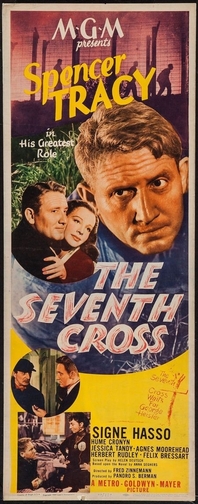
The Seventh Cross (1944)

Fred Zinnemann had one of his first Hollywood successes with the daring Seventh Cross. Since he was Austrian and lost family to the concentration camps, the personal nature of the material is unquestionable. He takes the novel by fellow Austrian emigre Anna Seghers and packs the story full with a wealth of European emigre actors and a few choice Americans as well. What it delivers is a stirring testament to humanity and the joining together of grit and determination in the face of oppressive evil.

I actually don’t mind Spencer Tracy playing the lead in the picture because it has the Hollywood bent of the studio system. Like casting James Stewart as a Hungarian in The Shop Around The Corner, there’s a collective understanding that Tracy’s attributes, as a kind of grounded everyman, are what matter most. It helps make this very specific and personal story a universal story for all men to see themselves in.

He is one of seven prisoners who make a nighttime escape from a Nazi concentration camp. As they all break off from one another and go their separate ways, we know the goal is the active pursuit of survival in a malevolent world. There’s nothing more fundamental, and we walk alongside George Heisler as he searches out any old friends and his former flame, who might be able to help him in his dire need.

Meanwhile, all the other prisoners are mercilessly rounded up and hung up on the crosses erected by the camp commandant; they are meant to be a warning sign to anyone else, but everyone knows the inherent metaphor. They are martyrs to the cause like the thief hung next to Christ. There is hope that they will one day see paradise.

The story utilizes a dead man’s voiceover before Billy Wilder took the device for Sunset Blvd. Here it feels a bit more like a crutch to distill Anna Seghers novel down; he lives as a ghostly subconscious entreating Heisler to remember the address 46 Morganstrasse…

At its best, the movie becomes a lyrical pilgrimage for this character as he’s privy to the kindness, passivity, and utter heartlessness of common people, each in turn. Because at your lowest, when you have nowhere to go and you rely solely on the good graces of others, this is where their true nature becomes evident.

I can see Classic Hollywood films, taking on Nazism, being derided in a modern context for going too soft, especially if you have a preconceived notion of what they might be. Certainly, these artists didn’t know every atrocity that had been perpetrated, but they were not stuck with their heads in the ground. In many cases, they knew far better than the general American public.

There’s immense consequence to everything within the frame, and Zinnemmann brings many searing evils to the screen, both seen and unseen. The aforementioned cross imagery is bleak iconography borrowed from Seghers. There are little boys with Nazi armbands rumbling around town to try and tattle and find fugitives.

One of the runaways, a formerly famed trapeze artist, must flee across the rooftops as locals gawk at the show and the Nazis hunt him down like cornered game. He takes one final curtain call after being mortally wounded and leaps forward in total serenity. It’s his final performance with his last breath. Heisler watches the scene, and before catching the ending, he disappears around the corner grimly.

His former flame Leni (Kaaren Verne) vowed to wait for him, but now she’s married and terrified to see him. The fear in her eyes manifests itself in brusque accusations. He has nothing but fondness for her; he’s requesting food and accommodation, and she will give him nothing. He stuffs a few crusts of bread in his pocket and disappears, feeling totally betrayed.

There’s another particularly unnerving scene. As the dragnet closes around George, he gets a tip about a doctor who might be sympathetic and can bandage him up for a wound. He pays a call on the man. Dr. Lowenstein (Steven Geray) states in accordance with the law that he must tell his patients before working on them that he is Jewish.

There might be other contemporary cinematic depictions of the Nuremberg laws or other anti-Jewish legislation like this, but the mundanity of this institutionalized prejudice is like ice in the veins. It’s right there in the open and in the face of this, the doctor still chooses to do an act of good.

Our hero is graced by another generous soul when he’s put up in a Hofbrau on his perilous road to freedom. By now, his name and likeness are all over the papers; Toni (Signe Hasso) the barmaid, could turn him, and yet she doesn’t. They share the kind of solitary love story that exists suspended in movies or those real-life moments where there is no time to stop and think before two ships pass on in the night.

George Macready even gets one of his first opportunities to play a conflicted, if ultimately sympathetic man caught in the crosshairs of the war and his own personal comforts. It takes all kinds for the sake of the cause.

Hume Cronyn shows up over halfway into the movie, and he is our respite. Paul Roeder might have the first genuine smile in the entire film with his domestic life alongside his wife, Liesel (Jessica Tandy), being a refuge from the hopeless world at large. He treats George well, symbolizing the growing tide toward human decency.

What he also represents is another viewpoint. The movie has the right to paint the Nazis as villains, and yet it does present a German character like Paul, who has been mostly shielded from the horrors.

What he sees is the economic prosperity and the help he’s received as he goes about providing for his wife and caring for his kids. The government has done good by him, and this is what he holds onto. George must help him see the other side and bet on the human proclivity toward good, even if we must forgive how easily Paul gets away from SS interrogation.

For being a film with so much grief and oppression — even if it’s fashioned on a Hollywood backlot — the movie does ring even more resolutely with this affirmation of human dignity. Instead of labeling it mere naivety, I prefer to see the optimism as represented by Paul and the little people.

Felix Bressart has the briefest cameo as the local delicatessen owner who brings George sustenance for the long journey ahead. Like his Shylock speech in To Be or Not To Be, he comes to signify the entire picture with his resolute encouragement. He doesn’t know the man, and yet he extends this generous hand; he’s just one of the faithful worker ants who will not let goodness die. Together, they can overcome.

What the film does well is distill these sentiments into individual human interactions we get to observe and imbibe as an audience. So although we are not completely inured to the state of the world, we are not blinded to it either, like Paul.

In 1944, there was still much of the war to be fought and won. Thus, The Seventh Cross does feel like a daring picture and one with immeasurable worth. I’m not sure if it was appreciated in its day, but looking back on it, there is much to admire in its incisive self-awareness.

3.5/5 Stars

Classic Movie Beginner’s Guide: Montgomery Clift

In our ongoing series, we continue shining a light on classic actors we think more people should get to know. This week our focus is none other than Montgomery Clift!

Monty Clift was one of the unsung champions of a new brand of acting that bridged the gap between the New York stage and the soundstages of Hollywood. Before Marlon Brando, James Dean, and others, Montgomery Clift introduced moviegoing audiences to a new form of intense masculinity paired with a striking vulnerability.

His life was marred by tragedy but instead of dwelling on that let’s celebrate the extraordinary career he forged for himself with some of the great directors of his generation. Here are 4 of his greatest movies with performances to match. 

Red River (1948)

Image result for red river 1948

What’s immediately apparent about Monty Clift is how particular he was about his roles. Because his film debut was nothing short of an instant classic. In this iconic sagebrusher from Howard Hawks, Clift went toe-to-toe with a vengeful John Wayne, playing an adopted son and his father who vie for control of the family herd with startling outcomes. 

The Search (1948)

Image result for the search 1948

Once more Clift aligned himself with an esteemed director — this time Fred Zinnemann — and invested himself in a story with real-world urgency. He plays an American soldier who takes in a young boy orphaned by the war. They strike up a relationship while racing against the clock to reunite him with his kin. The chemistry between the two is beautiful to watch.

A Place in The Sun (1951)

Image result for a place in the sun

This is the film that will forever define Clift’s career slotting him opposite a dazzling Elizabeth Taylor in one of her first adult roles. The adaptation of Theodore Dreiser’s An American Tragedy, directed by George Stevens, captures the emotional weight Clift was able to channel into many of his greatest roles. It’s one of the most devastating romances of American film thanks in part to Clift and Taylor.

From Here to Eternity (1953)

Image result for from here to eternity montgomery clift

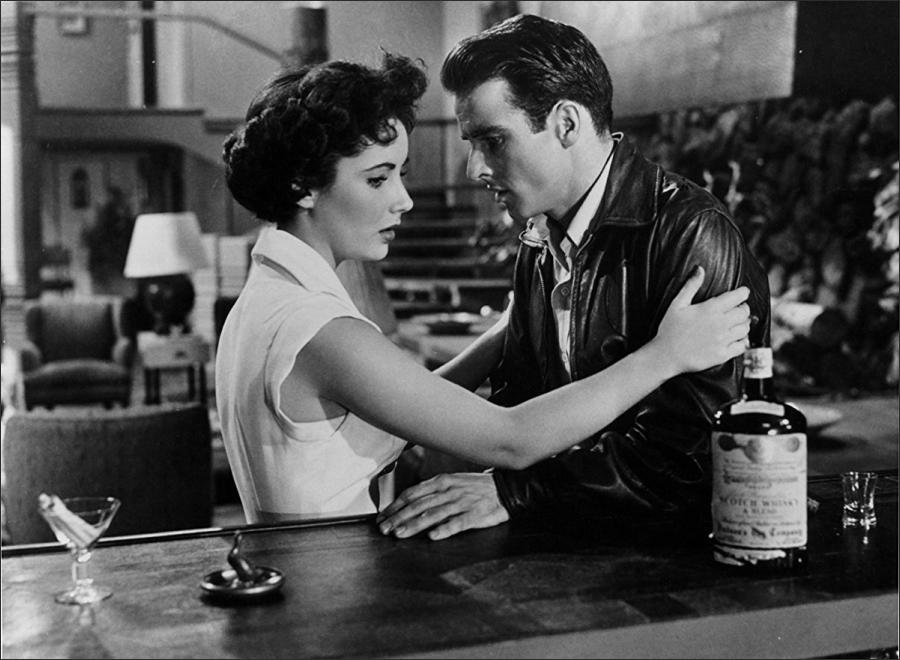
Although I’m led to believe the film is slightly overrated, there’s nothing wrong with Monty who brings his continual range as a troubled soldier on the eve of Pearl Harbor. Though it’s easy for him to get overshadowed by kisses in the waves between Burt Lancaster and Deborah Kerr or the gutsy performance of Frank Sinatra, there’s no question Clift is front and center playing opposite Donna Reed.

Worth Watching

The Heiress, I Confess, The Young Lions, Wild River, Judgement at Nuremberg, The Misfits, Freud: The Secret Passion.

The Search (1948)

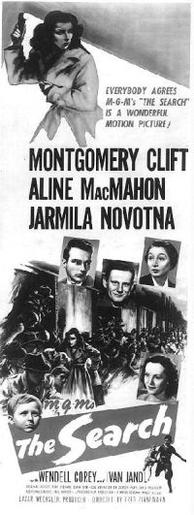
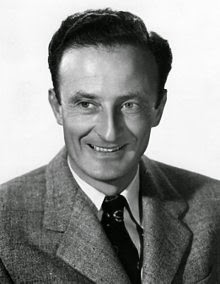
The_Search_posterAny knowledge of director Fred Zinnemann only aids in informing The Search. Formerly living in a Jewish family in Austria, he would immigrate to the bright lights of Hollywood in the 1930s only to have both his parents killed in the Holocaust. So if you think he had no stake in this picture you would be gravely mistaken.
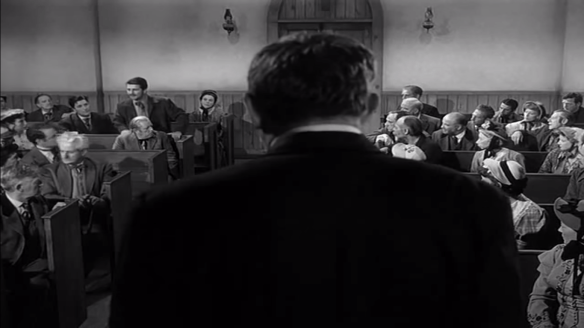
Like Carol Reed’s Third Man of the following year, Fred Zinnemann’s film does an impeccable job in its opening moments placing us in a landscape that feels all but tangible. Improved by true post-war locales, The Search gives audiences a fairly frank depiction of the trauma and destruction left in the wake of such an all-encompassing wave of carnage like WWII.

At least in this area alone, there is no sense that this is a facade or something fake and done up to look real. There’s little of that. Not least among the casualties are children displaced from all different nations and backgrounds. Subsisting without families through much of the war.

Now, with the clouds dissipating there is work to be done. It’s the task of understaffed personnel to begin sorting through all the pieces to try and get everyone back where they need to be. It seems an insurmountable job but they get on as best as they can.

Mrs. Murray is one of the workers we get to know, a woman with both a sense of pragmatic industry but also an underlying warmth. She knows if her job is done well, there will be many children given far better lives. She does everything in her power toward those ends.

Carrying a few points of reference from Aline MacMahon’s early career, it truly is a joy to watch her fall into this role which is a stark departure from the likes of One Way Passage (1932) or Gold Diggers of 1933 (1933). Certainly, it’s less flashy but no less meaningful. She makes it count.

The pure ambiguities created by language barriers is made palpable and for American viewers, there is a narrator but little in the way of interpretation. So much of what goes on is either left unsaid or must be taken with a grain of salt. That’s compounded by the fact the reticent children are afraid men in uniforms might be SS troopers or any word they let slip will be subsequently used to send them away to a concentration camp.

While it’s near impossible to take on two viewpoints at once, at any rate, we begin to understand not only Mrs. Murray’s predicament but also the well-founded fears of these displaced youths. That’s what leads one group of children, crammed into an ambulance marked with an ominous red cross, to scatter at the first opportunity. One includes a pale-faced boy named Karel who has remained all but silent during his initial questioning and yet his will to survive is insurmountable. Still, one needs food to survive and he doesn’t have any.

This problem is what prompts the initial meeting of the two figures who we might consider our heroes. It actually happens 40 minutes in and it nearly doesn’t amount to anything at all. Sitting in his jeep, lazily kicked back, eating a sandwich, is an army engineer named Steve (Montgomery Clift) who is soon being shipped back home.

He sees a small body pop up behind some rubble obviously eyeing his lunch. The boy’s afraid to take a handout and so the soldier puts his jeep in gear to drive off but thinking better of it, he turns around and tosses the boy his sandwich. Here we have the genesis of their curious relationship, at first tenuous, because Karel has learned to fear other people and their lack of formal communication lines makes mutual understanding even more difficult.

Though not as intense as his most revered parts, Monty Clift provides a genuine charm to the role, an all but effortless job at character building. Young Ivan Jandl knew no English going into the shoot but this same undoctored quality makes the opening sequences all the more imperative. He and Clift build a rapport that’s right there in front of us.

Initially, Karel lashes out thinking he is being held prisoner again. Steve tries to get him to understand his newfound freedom and when that is established, next comes the acquisition of language which the bright boy picks up quickly. One could say that The Search is at its finest when the pair is stuck in a space together. I’m not sure about others but I resonate with these scenes. The moments where a language barrier necessitates some form of universal understanding. Words have no meaning. Like in Film itself, actions can be far more universal than any amount of exquisite dialogue. For example, chocolate tastes “good.” Alcohol smells “bad.”

Together the soldier and the boy form a bond to the point Karel follows him around like a lost puppy. He doesn’t want to be abandoned. Not again. Of course, we know Steve must ship out soon… Meanwhile, Mrs. Murray enlists the help of a concentration camp survivor (Jarmila Novotná) who is looking determinedly for her son — the dramatic irony all but apparent, if it wasn’t already.

As Steve begins to teach “Jim” English lessons, he and his buddy Jerry (Wendell Corey) try and get some news on the boy’s origins. And all they have to go on is the telling tattoo on his forearm. It’s the arrival of family from stateside that sets something off. A switch goes on inside of Jim’s brain and he realizes he needs to find his “mother” because he comes to understand what that word means and that his is missing.

The Search endangers itself with a melodramatic turn of events and to a degree, they do come. Speaking for myself, I was a most agreeable recipient if that’s what it was. With the trills of angelic voices and a final maternal embrace — the conclusion the entire film has been charted for — some emotional manipulation might be on hand. However, in a period of rebuilding, though the past must not be forgotten, nevertheless, there is a deep abiding need for hope.  I would like to think that The Search is a film acknowledging precisely that and offering some solace.

Out of all the bombed out buildings, emaciated children racked with trauma, and horrors upon horrors, there is still something that can and must be clung to. When we are lost and alone, we can be found and returned to the place where we belong. There is no need to wander aimlessly because we have a home. Whether or not you believe this picture to be a purveyor of authenticity, Zinnemann has provided a revelatory parable of genuine sensitivity. I for one admire its aspirations greatly even if they might be imperfect. Such a time calls for this kind of hope.

4.5/5 Stars

Review: High Noon (1952)

highnoon1Drums softly beating. A voice mournfully bellowing,”Do not forsake me, oh, my darlin‘.” It can only mean one thing, the beginning of High Noon, a western that has grown near and dear to my heart in the recent years. And yet how can a western of under 90 minutes mesmerize and cause goose bumps to form time after time? That opening ballad sung so wonderfully and folksy by Tex Ritter is one great reason. It’s a mournful dirge of a song which nevertheless draws us into this film, and personally, I cannot help but belt out a few lines now and then (I’m unashamed to say I know the whole song). After all, it’s this song that reflects the story of our main character Marshall Will Kane (Gary Cooper) and reiterations of the tune can be heard throughout for the following hour as we all wait for the noon train.

The song makes it clear that Ben Miller is coming after Kane for sending him to prison. He’s got revenge on the mind and three of his buddies, including his brother, are waiting for his arrival, along with everybody else in town. Meanwhile, the Marshall is about to hang up his badge as it were, because he’s gotten hitched to a pretty young quaker (the estimable Grace Kelly), and they look to settle down with a store in some sleepy town. He’s well-deserving of it after all he’s done and the town stands behind him.

But the news of Miller’s return is no way to start the honeymoon. Still, the couple sets off, but Kane turns around realizing he cannot run (I do not know what fate awaits me. I only know I must be brave. For I must face a man who hates me, Or lie a coward, a craven coward; Or lie a coward in my grave).

highnoon4

This is the backdrop that he’s trying to scrounge up a posse with. Others getting out of town, some telling him he should get out of town too, and a general commotion about what they should do about the whole mess. There are numerous cross-sections and enclaves all with different motives and most importantly excuses. They all turn down a chance to help Kane for one reason or another (even his closest friends). It seems so easy to pass judgment, but then again what would we do in such a situation? In fact, it brings to mind the Hollywood Blacklist which this story was supposed to be an allegory for. This is not just some fictionalized parable, it was mirroring real life to some extent.

What really resonates about this film is the resolve of one man, because when it comes down to it, Kane did not need to stay, he did not need to do what he did, but he stood by his guns, literally, when no one else would stand with him. It’s easy to conform, easy to go with the crowd. It takes real courage to walk out on your own — although the Marshall did have a little help. So whether or not John Wayne thought this film was wholly “Un-American” or not, I think I would have to disagree with him on this one. Maybe what Kane has is reluctant courage, and I could see how the Duke would be disgusted by such a “spineless” individual. But for me, he’s all the more relatable played so aptly by Gary Cooper.

highnoon7It continues to amaze me that a film of this length can have so many wonderful characters who leave an indelible mark on the story. Certainly, you have the hero and the villains, but then we have character actors such as Thomas Mitchell, Harry Morgan, and Lon Chaney Jr. playing some of Kane’s buddies. There’s the gang at the bar and the hotel clerk, who are no friends of the Marshall. There’s his former flame Helen Ramirez (Katy Jurado) and his hot-headed deputy (Beau Bridges). The rest are filled out by men, woman, children, town drunks, and churchgoers. Zinnemann does a wonderful thing aside from just using the clock as a plot device and tension builder. He also calls back all these many characters as the noon train comes in with smoke billowing black. The audience and all these people know what that shrill whistle means. Things are going down, and Kane is going to face it all alone.highnoon2The isolation is so wonderfully conveyed by an aerial shot where the camera moves up to show the stoic Marshall standing in the middle of a ghost town. No people around and no one showing their faces. Then of course, when it’s all over, the floodgates open and all the folks rush into the center of town. Fittingly,  Kane drops his tin star in the dirt in disgust as the refrains of Tex Ritter’s ballad continue.

Put High Noon up against other films and it could be criticized as nothing more than a western, but perhaps that’s why I like it. I cannot help but gravitate towards it. In some ways, it reminds me of growing up and it allows me to forget about any sort of deeper meaning for an instant so I can be fully enraptured with this story, this song, and these characters. It’s a worthy incarnation of the mythic west, that also leaves a little space for some humanity.

People gotta talk themselves into law and order before they do anything about it. Maybe because down deep they don’t care. They just don’t care.” – Martin Howe (Lon Chaney Jr.)

5/5 Stars

People on Sunday (1930)

peopleonsunday1One of the last German silent films was People on Sunday, a modest project from a group of young men. Our stars are young professionals in real life and only amateur actors who did not quit their day jobs. They only could film on the weekends and that’s how we end up with People on Sunday! It takes on a faux-documentary style, and it follows the lives of four individuals as they meet one another and then spend a pleasant Sunday afternoon together.

There is certainly a breezy playfulness to the film as the two men and two women spend time frolicking at the beach and reclining in the sun. They share laughs while eating and listening to records. It quality fun and there seems to be a general innocence to their behavior that while sometimes rude is all in good fun.

This is, in fact, a film of the late Weimar Republic, without the cloud of Hitler’s Nazi regime hanging over the country (not until 1933). It stands in sharp contrast to later works or documentaries because People on Sunday is seemingly free and wholly unrestrained by ideology or prejudice.

We should undoubtedly be grateful for this historical piece of New Objectivity cinema and the reasons are twofold. First, since the film essentially works as a documentary, it gives us a wonderfully clear picture of what life was like in the world of Berlin. There are continuous shots of the city streets, passing vehicles, and people making their daily rounds.

One especially memorable moment occurs when the story takes a short aside to afford time for a montage of faces. The camera slowly captures face after face providing a sample of all the individuals who walk these streets. They transcend time and space because of their humanity, their mundane quality, and they have the same lightness of our main characters.

When we look at the names behind People on Sunday, it is almost staggering to acknowledge these men who were formerly unknowns.

As directors, you have Robert and Curt Siodmak. Your main writer is the great Billy Wilder. As cinematographer, you have another great in Fred Zinnemann, and finally, production was helped by the B-picture master Edgar Ulmer. Due to the rise of the Nazis, all of these figures would end up emigrating to Hollywood and the rest was history.

In many ways, we are indebted to them, because they helped form some of the great American classics and you can already see them honing their craft. The images are visually arresting and there is even a sense of humor that we could seemingly attribute to Wilder. It would only get better from then on.

If I’m not mistaken there are several scores that have been used to accompany the film, but I did really enjoy the Czech film orchestra because it added a lot to this otherwise silent picture. Hope you enjoy this unassuming jaunt as much as I did.

4/5 Stars

Act of Violence (1948)

ActofViolenceAct of Violence is an interesting post-war moral tale from director Fred Zinnemann. Frank (Van Heflin) returned home from war a hero. He now has a small child with his pretty young wife Edith (Janet Leigh) in the vibrant California town of Santa Lisa.

Little is known about his P.O.W. past and all his comrades were killed. Except one. His friend Joe (Robert Ryan) is still alive but he is plagued by a crippled leg now. He finds out about Frank’s whereabouts and it become his personal vendetta to straighten him out. The innocent Edith is in the dark about the whole ordeal and with the shadow of Joe constantly haunting him, Frank must family face the specter of his past.

He goes off on a business trip to escape and there out of desperation he winds up hiring a hit man to get Joe off his back. The two former buddies set up a meeting (which is really a trap), But as would be expected it does not work out as planned. Justice is dealt but there is still a strange sense of moral ambiguity. This is  certainly not Zinnemann’s best work, but it brings up some interesting questions about moral scruples and personal conflict.

3.5/5 Stars

A Man For All Seasons (1966)

a4d49-a_man_for_all_seasonsSir Thomas More had the misfortune of getting in the way of perhaps one of the most notorious kings in history, and it proved costly. It is the early 1500s in England, and the Reformation has shaken the world but Henry VIII (Robert Shaw) has his own plans for the church in his country. He is bent on getting his marriage annulled by the pop,e because young Anne Boleyn will be much more likely to give a healthy heir to the throne.

A Man For All Seasons focuses on the position of More who at the time was Lord Chancellor of England. First, in talking with Cardinal Wolsey, More resolves not to sign the letter to the pope on the king’s behalf, because it goes against his conscience. Later, in his dealings with Thomas Cromwell, More resigns rather than to sign an oath making Henry VIII the supreme leader of the church in England.

Except there is more to it than that. More certainly was not a dissident or a rebellious political figure. Far from it. At least in the film, he is portrayed by Paul Scofield as a constantly even-keeled and gracious man in all circumstances. When a young man named Rich (John Hurt) sold More out for a high title, in a Christ-like response More has only pity for the fellow. Selling his soul for the world is worse enough, but Rich did it for Wales.

Not even the pleading of his newly-wedded daughter (Susannah York), or his strong-willed wife (Wendy Hiller) can change More’s conviction as he wastes away in the Tower of London. Sir Thomas went calmly to his death confident that his faith in his Lord would give him eternal peace. He died there for a seemingly trivial reason at the hands of men who used to be his friends. But he died with his conscience intact.

As I acknowledged, Paul Scofield is such a serene force during the storm of this film. The portly Orson Welles and Leo McKern seem to fit their roles well, and Robert Shaw has enough bluster to pull off Henry VIII. A young John Hurt turns in a fine performance as the Judas of the film and Nigel Davenport is commendable as More’s exasperated friend the Duke.

Adapted from a stage play, here is another highly acclaimed film from director Fred Zinnemann. Perhaps it is the period drama, but this film strikes me as very English and it did very well for itself. I suppose because it’s a tale that is universal and audiences love to identify with men such as Sir Thomas More. Zinnemann was always superb at capturing the inner struggles that humanity is often forced to confront, and he did it once again here.

4/5 Stars

The Nun’s Story (1959)

b2aa8-nun_storyFrom director Fred Zinnemann and starring Audrey Hepburn, here comes a very unique film indeed. Hepburn is Gaby also known as Sister Luke, who makes it her life mission to become a Nun. She leaves behind her loving father (Dean Jagger), young love, and siblings to lead a life of solitude and sacrifice.

She learns and is disciplined at the convent, finding out what it means to “die to self.” However, it is by no means easy, because as with any human being pride and other struggles impede her progress.

Quickly she shows her skill as a nurse, and yet she is challenged to act with more humility. Sister Luke winds up not in her desired location of the Congo, but in Europe to continue to grow spiritually.

Finally, she is rewarded for her patience and goes to the Congo only to fall into her element. There she is beloved by the natives and nuns alike, while also gaining the respect of the local practicing doctor (Peter Finch) who is not a believer.

He however rightly concludes that Sister Luke is not your typical nun, because she has too much self-determination and individuality. As a good sister she tries to block out his words, but after she is sent back to the convent she must face this reality head on. World War II has erupted and the Sisters are called not to intercede on either side, but after personal tragedy Sister Luke realizes she must give up the life of the nun.

After so much loving service to her fellow man while wearing the robes, she is forced to shed them on her own accord. It is a solemn moment as Gaby once again removes her ring of commitment and walks off into the unknown world plagued by war. It is an unsatisfying conclusion but a moving ending nonetheless.

Zinnemann is often interested in the inner struggles of his protagonists and that is on display again in this film. Furthermore, his on location shooting in the Congo adds a sense of authenticity to the story. I am convinced that no actress other than Audrey Hepburn could possibly have done justice to this role, or at least no one else could have played it so wonderfully. She exudes such a sweetness and innocence it is difficult to see how anyone could every get annoyed with her. Her Sister Luke is seemingly spot on, and the lengthy film would have certainly faltered without her.

4/5 Stars

The Best Films of Fred Zinnemann

1. High Noon
2. From Here to Eternity
3. The Search
4. A Man For All Seasons
5. A Nun’s Story
6. Oklahoma
7. The Men
8. Act of Violence
9. The Day of the Jackal
10. The Seventh Cross
11. Julia
12. People on Sunday

The Men (1950)

2c6ea-the_menI was really drawn into this film and I appreciated Zinnemann’s realistic style in capturing Marlon Brando’s powerful screen debut. I would have rated this film higher because the topic was interesting, the performances were good, the supporting cast was respectable, and so on. The only thing is although Brando is a good actor and I really love Teresa Wright, they just seem wrong opposite each other. Wright was made for a Best Years of Our Lives and Brando for Streetcar or On the Waterfront. I will say I was surprised to see a young Richard Erdman, who is known to modern audiences as Leonard in Community.

3.5/5 Stars